Health Care Economics: Screening Analysis

Verified

Added on  2019/09/16

|3
|447
|227
Case Study
AI Summary
This case study delves into the economic aspects of health screenings, specifically focusing on breast and prostate cancer. It analyzes the trade-offs involved in screening decisions, highlighting the potential benefits of early detection against the risks of false positives and over-diagnosis. The study emphasizes that the decision to undergo screening is a personal one, influenced by individual values and perceptions of the potential harms and benefits. It also touches upon the economic concept of opportunity cost and cost-benefit analysis in the context of medical screening, concluding that screening can be viewed as a gamble with varying outcomes for different individuals.
Document Page
health care economics
tabler-icon-diamond-filled.svg

Paraphrase This Document

Need a fresh take? Get an instant paraphrase of this document with our AI Paraphraser
Document Page
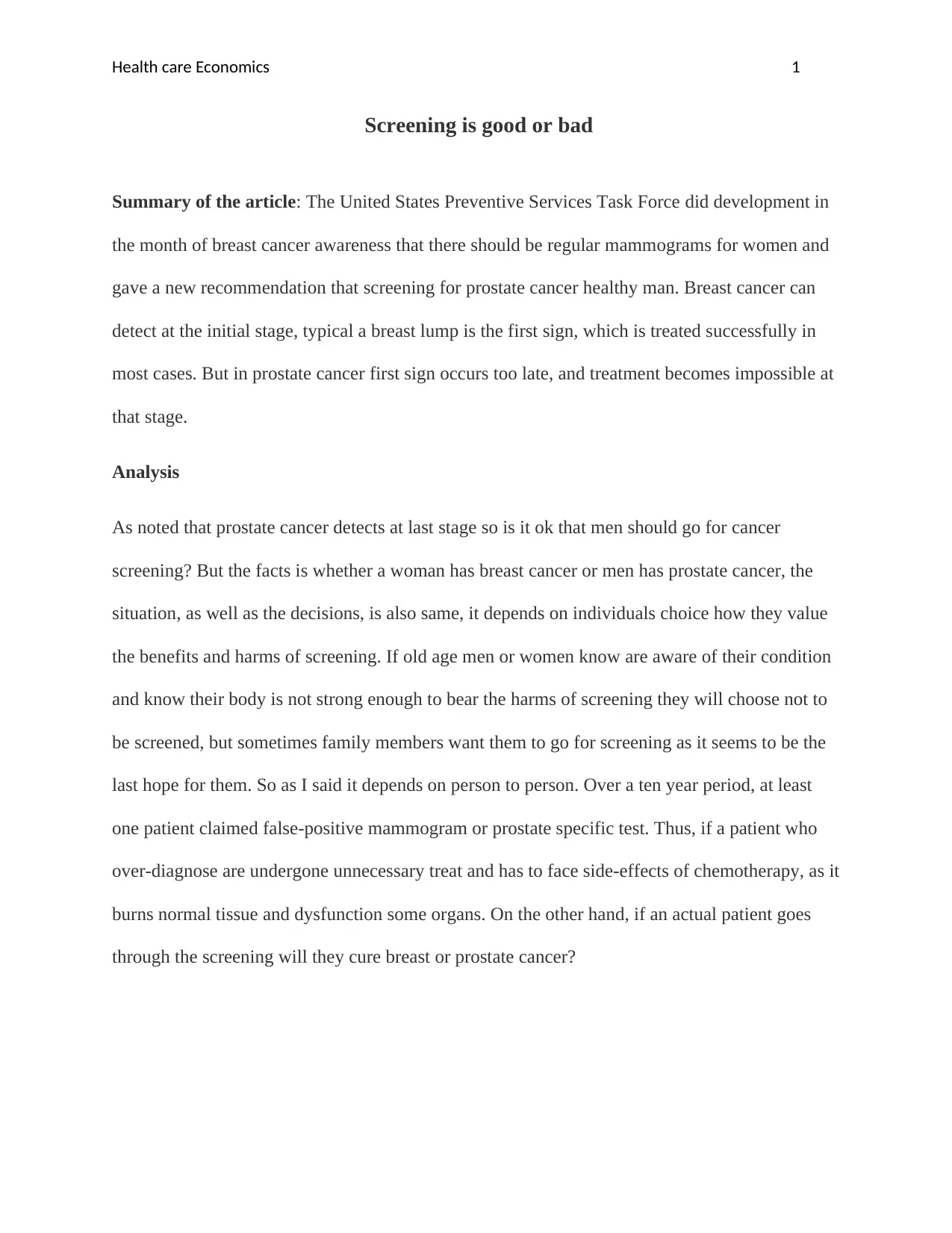
Health care Economics 1
Screening is good or bad
Summary of the article: The United States Preventive Services Task Force did development in
the month of breast cancer awareness that there should be regular mammograms for women and
gave a new recommendation that screening for prostate cancer healthy man. Breast cancer can
detect at the initial stage, typical a breast lump is the first sign, which is treated successfully in
most cases. But in prostate cancer first sign occurs too late, and treatment becomes impossible at
that stage.
Analysis
As noted that prostate cancer detects at last stage so is it ok that men should go for cancer
screening? But the facts is whether a woman has breast cancer or men has prostate cancer, the
situation, as well as the decisions, is also same, it depends on individuals choice how they value
the benefits and harms of screening. If old age men or women know are aware of their condition
and know their body is not strong enough to bear the harms of screening they will choose not to
be screened, but sometimes family members want them to go for screening as it seems to be the
last hope for them. So as I said it depends on person to person. Over a ten year period, at least
one patient claimed false-positive mammogram or prostate specific test. Thus, if a patient who
over-diagnose are undergone unnecessary treat and has to face side-effects of chemotherapy, as it
burns normal tissue and dysfunction some organs. On the other hand, if an actual patient goes
through the screening will they cure breast or prostate cancer?
Document Page
Health care Economics 2
Economic concept
In economics, the trade-off is analyzing the opportunity cost of taking a decision. Here patient
has to decide whether he should go for a screening or not.
Cost-benefit analysis of the decision, a screening will be helpful if the test is positive for a
patient and it has losses if a patient is a false-positive test.
Summary
One can say screening is like gambling; some patients are lucky enough to cure their cancer
while others lose a lot more. Sometimes doctor just overreacts to even tiniest variation, which
ends up in over-diagnoses and false-positive test. Whether a woman has breast cancer or men has
prostate cancer, the situation, as well as the decisions, is also same, taking decisions of screening
depends on individuals choice how they value the benefits and harms of screening.
chevron_up_icon
1 out of 3
circle_padding
hide_on_mobile
zoom_out_icon
[object Object]