University Nursing Essay: Promoting Health in Extended Care Settings
VerifiedAdded on 2020/04/07
|9
|2615
|47
Essay
AI Summary
This essay delves into the critical aspects of promoting health in extended care settings, focusing on the application of nursing theories and best practices. It begins with an introduction to the significance of treating older adults with dignity and respect, highlighting the importance of the Miller functional theory and Levett-Jones clinical reasoning cycle in nursing practice. The essay then presents a detailed case scenario of Mr. Ratin Bhai, a patient with Parkinson's disease and hypothyroidism, to illustrate the practical application of these theories. Through the analysis of Mr. Bhai's case, the essay demonstrates how nurses can effectively assess, manage, and provide culturally sensitive care while maintaining the patient's dignity. The discussion includes the symptoms of Parkinson’s disease and hypothyroidism, and suggests solutions for Mr. Bhai's mobility issues, emotional well-being, and medication management. The essay concludes by emphasizing the value of these theories in forming effective treatment plans and the importance of documenting lessons learned to improve care in future cases.
Running head: PROMOTING HEALTH IN EXTENDED CARE 1
Promoting Health in Extended Care
Institution’s Name
Date
Promoting Health in Extended Care
Institution’s Name
Date

Paraphrase This Document
Need a fresh take? Get an instant paraphrase of this document with our AI Paraphraser
PROMOTING HEALTH IN EXTENDED CARE
2
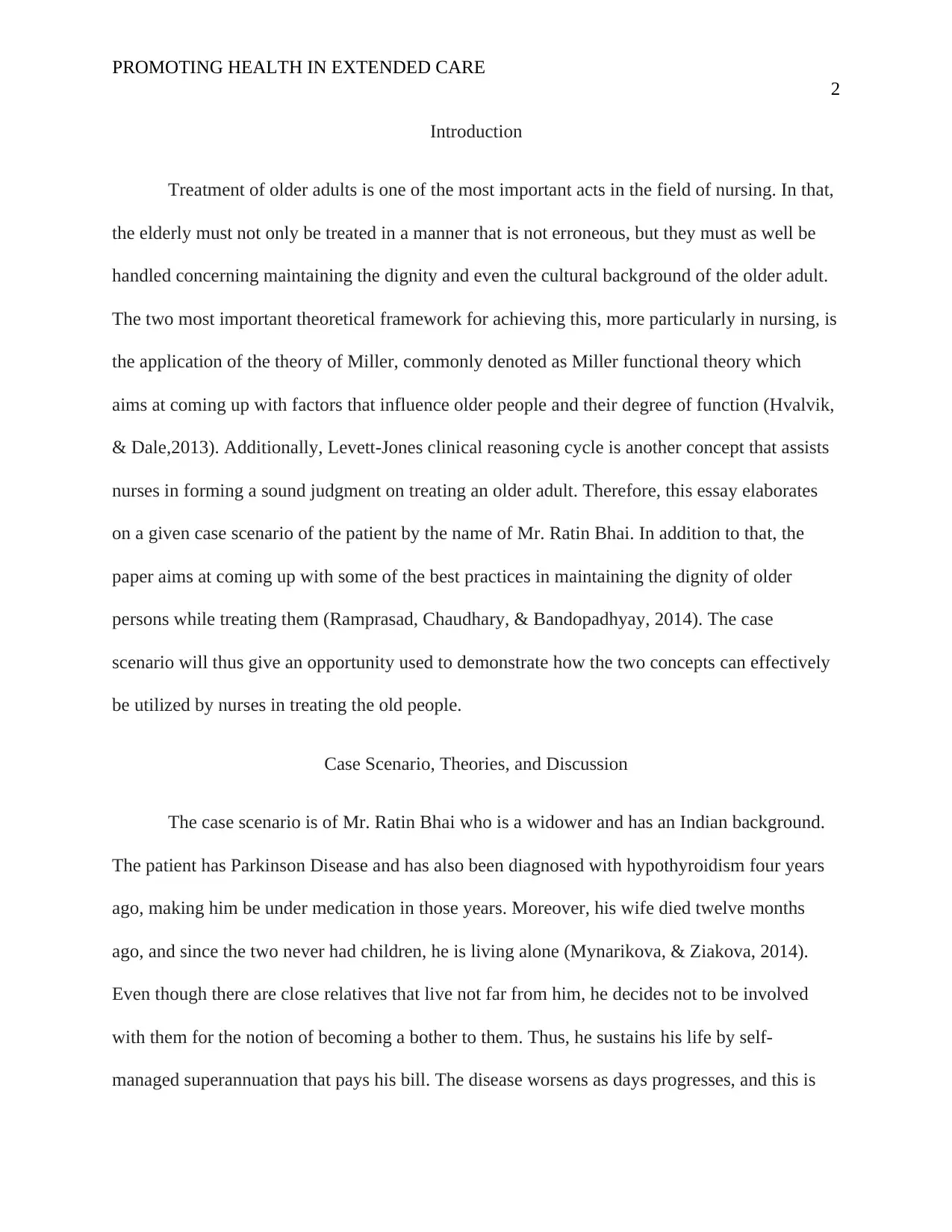
Introduction
Treatment of older adults is one of the most important acts in the field of nursing. In that,
the elderly must not only be treated in a manner that is not erroneous, but they must as well be
handled concerning maintaining the dignity and even the cultural background of the older adult.
The two most important theoretical framework for achieving this, more particularly in nursing, is
the application of the theory of Miller, commonly denoted as Miller functional theory which
aims at coming up with factors that influence older people and their degree of function (Hvalvik,
& Dale,2013). Additionally, Levett-Jones clinical reasoning cycle is another concept that assists
nurses in forming a sound judgment on treating an older adult. Therefore, this essay elaborates
on a given case scenario of the patient by the name of Mr. Ratin Bhai. In addition to that, the
paper aims at coming up with some of the best practices in maintaining the dignity of older
persons while treating them (Ramprasad, Chaudhary, & Bandopadhyay, 2014). The case
scenario will thus give an opportunity used to demonstrate how the two concepts can effectively
be utilized by nurses in treating the old people.
Case Scenario, Theories, and Discussion
The case scenario is of Mr. Ratin Bhai who is a widower and has an Indian background.
The patient has Parkinson Disease and has also been diagnosed with hypothyroidism four years
ago, making him be under medication in those years. Moreover, his wife died twelve months
ago, and since the two never had children, he is living alone (Mynarikova, & Ziakova, 2014).
Even though there are close relatives that live not far from him, he decides not to be involved
with them for the notion of becoming a bother to them. Thus, he sustains his life by self-
managed superannuation that pays his bill. The disease worsens as days progresses, and this is
2
Introduction
Treatment of older adults is one of the most important acts in the field of nursing. In that,
the elderly must not only be treated in a manner that is not erroneous, but they must as well be
handled concerning maintaining the dignity and even the cultural background of the older adult.
The two most important theoretical framework for achieving this, more particularly in nursing, is
the application of the theory of Miller, commonly denoted as Miller functional theory which
aims at coming up with factors that influence older people and their degree of function (Hvalvik,
& Dale,2013). Additionally, Levett-Jones clinical reasoning cycle is another concept that assists
nurses in forming a sound judgment on treating an older adult. Therefore, this essay elaborates
on a given case scenario of the patient by the name of Mr. Ratin Bhai. In addition to that, the
paper aims at coming up with some of the best practices in maintaining the dignity of older
persons while treating them (Ramprasad, Chaudhary, & Bandopadhyay, 2014). The case
scenario will thus give an opportunity used to demonstrate how the two concepts can effectively
be utilized by nurses in treating the old people.
Case Scenario, Theories, and Discussion
The case scenario is of Mr. Ratin Bhai who is a widower and has an Indian background.
The patient has Parkinson Disease and has also been diagnosed with hypothyroidism four years
ago, making him be under medication in those years. Moreover, his wife died twelve months
ago, and since the two never had children, he is living alone (Mynarikova, & Ziakova, 2014).
Even though there are close relatives that live not far from him, he decides not to be involved
with them for the notion of becoming a bother to them. Thus, he sustains his life by self-
managed superannuation that pays his bill. The disease worsens as days progresses, and this is
PROMOTING HEALTH IN EXTENDED CARE
3
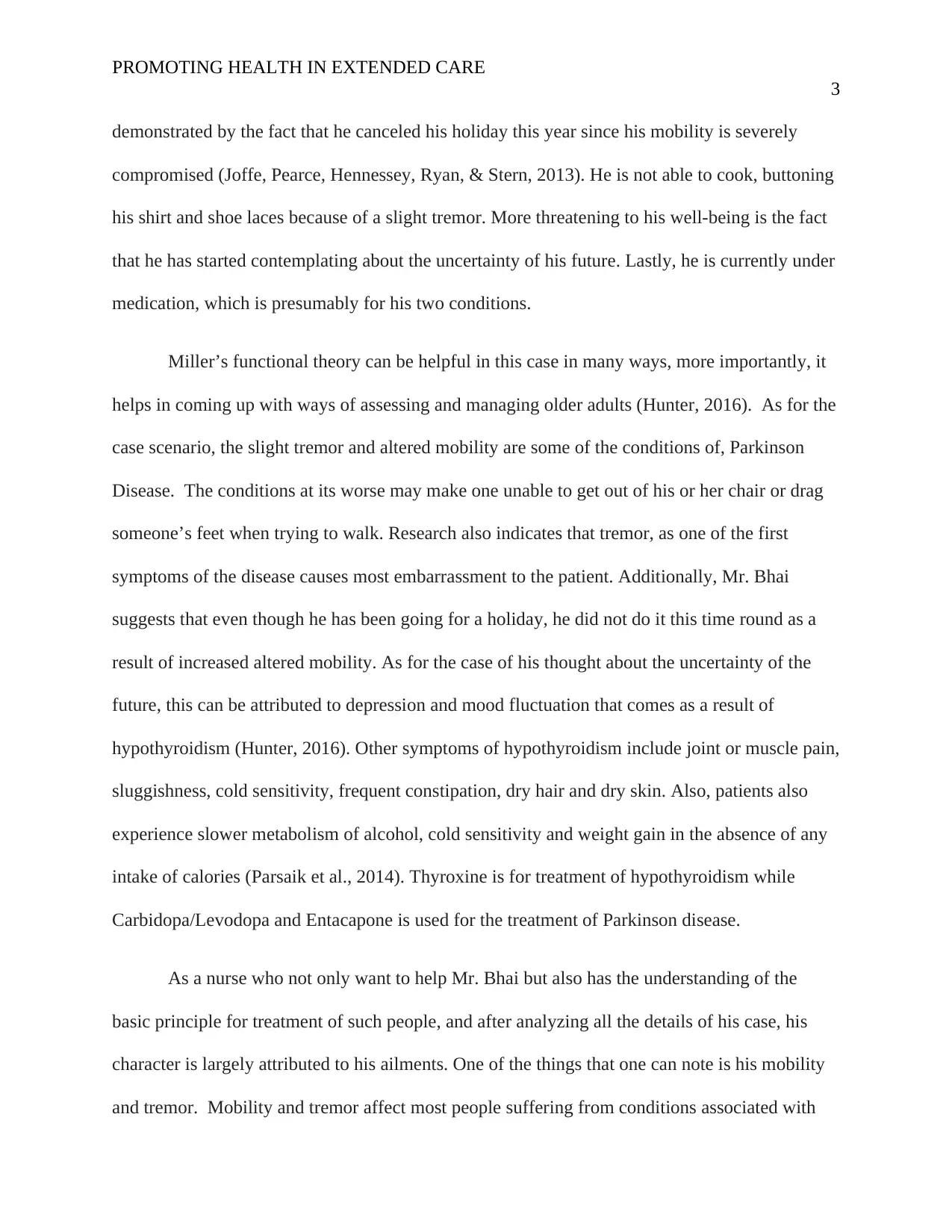
demonstrated by the fact that he canceled his holiday this year since his mobility is severely
compromised (Joffe, Pearce, Hennessey, Ryan, & Stern, 2013). He is not able to cook, buttoning
his shirt and shoe laces because of a slight tremor. More threatening to his well-being is the fact
that he has started contemplating about the uncertainty of his future. Lastly, he is currently under
medication, which is presumably for his two conditions.
Miller’s functional theory can be helpful in this case in many ways, more importantly, it
helps in coming up with ways of assessing and managing older adults (Hunter, 2016). As for the
case scenario, the slight tremor and altered mobility are some of the conditions of, Parkinson
Disease. The conditions at its worse may make one unable to get out of his or her chair or drag
someone’s feet when trying to walk. Research also indicates that tremor, as one of the first
symptoms of the disease causes most embarrassment to the patient. Additionally, Mr. Bhai
suggests that even though he has been going for a holiday, he did not do it this time round as a
result of increased altered mobility. As for the case of his thought about the uncertainty of the
future, this can be attributed to depression and mood fluctuation that comes as a result of
hypothyroidism (Hunter, 2016). Other symptoms of hypothyroidism include joint or muscle pain,
sluggishness, cold sensitivity, frequent constipation, dry hair and dry skin. Also, patients also
experience slower metabolism of alcohol, cold sensitivity and weight gain in the absence of any
intake of calories (Parsaik et al., 2014). Thyroxine is for treatment of hypothyroidism while
Carbidopa/Levodopa and Entacapone is used for the treatment of Parkinson disease.
As a nurse who not only want to help Mr. Bhai but also has the understanding of the
basic principle for treatment of such people, and after analyzing all the details of his case, his
character is largely attributed to his ailments. One of the things that one can note is his mobility
and tremor. Mobility and tremor affect most people suffering from conditions associated with
3
demonstrated by the fact that he canceled his holiday this year since his mobility is severely
compromised (Joffe, Pearce, Hennessey, Ryan, & Stern, 2013). He is not able to cook, buttoning
his shirt and shoe laces because of a slight tremor. More threatening to his well-being is the fact
that he has started contemplating about the uncertainty of his future. Lastly, he is currently under
medication, which is presumably for his two conditions.
Miller’s functional theory can be helpful in this case in many ways, more importantly, it
helps in coming up with ways of assessing and managing older adults (Hunter, 2016). As for the
case scenario, the slight tremor and altered mobility are some of the conditions of, Parkinson
Disease. The conditions at its worse may make one unable to get out of his or her chair or drag
someone’s feet when trying to walk. Research also indicates that tremor, as one of the first
symptoms of the disease causes most embarrassment to the patient. Additionally, Mr. Bhai
suggests that even though he has been going for a holiday, he did not do it this time round as a
result of increased altered mobility. As for the case of his thought about the uncertainty of the
future, this can be attributed to depression and mood fluctuation that comes as a result of
hypothyroidism (Hunter, 2016). Other symptoms of hypothyroidism include joint or muscle pain,
sluggishness, cold sensitivity, frequent constipation, dry hair and dry skin. Also, patients also
experience slower metabolism of alcohol, cold sensitivity and weight gain in the absence of any
intake of calories (Parsaik et al., 2014). Thyroxine is for treatment of hypothyroidism while
Carbidopa/Levodopa and Entacapone is used for the treatment of Parkinson disease.
As a nurse who not only want to help Mr. Bhai but also has the understanding of the
basic principle for treatment of such people, and after analyzing all the details of his case, his
character is largely attributed to his ailments. One of the things that one can note is his mobility
and tremor. Mobility and tremor affect most people suffering from conditions associated with
⊘ This is a preview!⊘
Do you want full access?
Subscribe today to unlock all pages.

Trusted by 1+ million students worldwide
PROMOTING HEALTH IN EXTENDED CARE
4
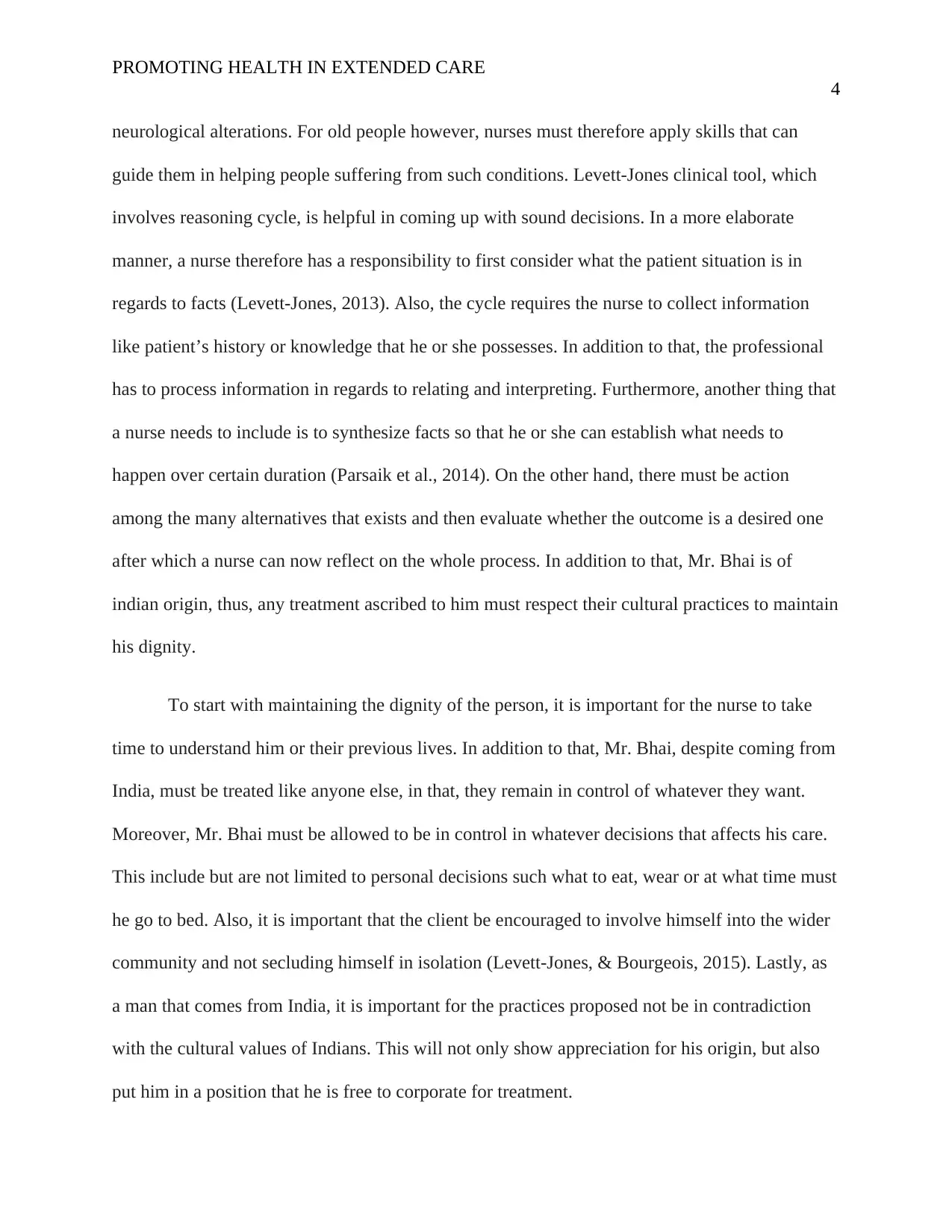
neurological alterations. For old people however, nurses must therefore apply skills that can
guide them in helping people suffering from such conditions. Levett-Jones clinical tool, which
involves reasoning cycle, is helpful in coming up with sound decisions. In a more elaborate
manner, a nurse therefore has a responsibility to first consider what the patient situation is in
regards to facts (Levett-Jones, 2013). Also, the cycle requires the nurse to collect information
like patient’s history or knowledge that he or she possesses. In addition to that, the professional
has to process information in regards to relating and interpreting. Furthermore, another thing that
a nurse needs to include is to synthesize facts so that he or she can establish what needs to
happen over certain duration (Parsaik et al., 2014). On the other hand, there must be action
among the many alternatives that exists and then evaluate whether the outcome is a desired one
after which a nurse can now reflect on the whole process. In addition to that, Mr. Bhai is of
indian origin, thus, any treatment ascribed to him must respect their cultural practices to maintain
his dignity.
To start with maintaining the dignity of the person, it is important for the nurse to take
time to understand him or their previous lives. In addition to that, Mr. Bhai, despite coming from
India, must be treated like anyone else, in that, they remain in control of whatever they want.
Moreover, Mr. Bhai must be allowed to be in control in whatever decisions that affects his care.
This include but are not limited to personal decisions such what to eat, wear or at what time must
he go to bed. Also, it is important that the client be encouraged to involve himself into the wider
community and not secluding himself in isolation (Levett-Jones, & Bourgeois, 2015). Lastly, as
a man that comes from India, it is important for the practices proposed not be in contradiction
with the cultural values of Indians. This will not only show appreciation for his origin, but also
put him in a position that he is free to corporate for treatment.
4
neurological alterations. For old people however, nurses must therefore apply skills that can
guide them in helping people suffering from such conditions. Levett-Jones clinical tool, which
involves reasoning cycle, is helpful in coming up with sound decisions. In a more elaborate
manner, a nurse therefore has a responsibility to first consider what the patient situation is in
regards to facts (Levett-Jones, 2013). Also, the cycle requires the nurse to collect information
like patient’s history or knowledge that he or she possesses. In addition to that, the professional
has to process information in regards to relating and interpreting. Furthermore, another thing that
a nurse needs to include is to synthesize facts so that he or she can establish what needs to
happen over certain duration (Parsaik et al., 2014). On the other hand, there must be action
among the many alternatives that exists and then evaluate whether the outcome is a desired one
after which a nurse can now reflect on the whole process. In addition to that, Mr. Bhai is of
indian origin, thus, any treatment ascribed to him must respect their cultural practices to maintain
his dignity.
To start with maintaining the dignity of the person, it is important for the nurse to take
time to understand him or their previous lives. In addition to that, Mr. Bhai, despite coming from
India, must be treated like anyone else, in that, they remain in control of whatever they want.
Moreover, Mr. Bhai must be allowed to be in control in whatever decisions that affects his care.
This include but are not limited to personal decisions such what to eat, wear or at what time must
he go to bed. Also, it is important that the client be encouraged to involve himself into the wider
community and not secluding himself in isolation (Levett-Jones, & Bourgeois, 2015). Lastly, as
a man that comes from India, it is important for the practices proposed not be in contradiction
with the cultural values of Indians. This will not only show appreciation for his origin, but also
put him in a position that he is free to corporate for treatment.
Paraphrase This Document
Need a fresh take? Get an instant paraphrase of this document with our AI Paraphraser
PROMOTING HEALTH IN EXTENDED CARE
5
In analyzing Mr. Bhai case and to start with altered mobility, it is making him difficult to
associate with people or interact. In effect, he lives in isolation which is not a good thing
especially for an old person like him. In addition to that, Parkinson disease is altering his
thinking and making him perceives to bother his brother better not but instead live alone. This is
not a good decision at all. For the tremor that makes him uncomfortable to perform a small task,
this condition will even worsen the disease advances, and therefore, it is important that he makes
a proper adjustment now before it is too late (Holmberg, Valmari, & Lundgren, 2012). Lastly, his
thought on uncertainty in the future can be attributed to the depression that he is currently facing
as a result of the two conditions
As a matter of solutions, Mr. Bhai must be allowed to interact not only with his brother
but also with the community at large. In addition to that, if possible, he ought not to live alone
but either with a helper or with his brother. This will have various advantages which include
ensuring that he does not forget to take his medications. However, all this must be carried in the
right way and with a clear procedure for achieving them (Ebrahimi., Torabizadeh, Mohammadi,
& Valizadeh, 2012). Therefore, the first one would be to set goals for Mr. Bhai, which he may be
allowed to visit and form relations with people once in a while, this can also serve as an
alternative approach for him should he decline to live with his brother.
Assessing his conditions, the most appropriate action for him however, will be one that
makes him an active person in society (McMahon, & Fleury, 2012). This can be either taking up
roles that will make it possible for him to associate with people or neighbors. In addition to that,
it would be important for him to be referred to a psychological counselor. This is important for
advice and keeping check of his depression (Holland, 2017). Additionally, forming a bond and a
relation with the councilor will be important for him in living a healthy and active life. Another
5
In analyzing Mr. Bhai case and to start with altered mobility, it is making him difficult to
associate with people or interact. In effect, he lives in isolation which is not a good thing
especially for an old person like him. In addition to that, Parkinson disease is altering his
thinking and making him perceives to bother his brother better not but instead live alone. This is
not a good decision at all. For the tremor that makes him uncomfortable to perform a small task,
this condition will even worsen the disease advances, and therefore, it is important that he makes
a proper adjustment now before it is too late (Holmberg, Valmari, & Lundgren, 2012). Lastly, his
thought on uncertainty in the future can be attributed to the depression that he is currently facing
as a result of the two conditions
As a matter of solutions, Mr. Bhai must be allowed to interact not only with his brother
but also with the community at large. In addition to that, if possible, he ought not to live alone
but either with a helper or with his brother. This will have various advantages which include
ensuring that he does not forget to take his medications. However, all this must be carried in the
right way and with a clear procedure for achieving them (Ebrahimi., Torabizadeh, Mohammadi,
& Valizadeh, 2012). Therefore, the first one would be to set goals for Mr. Bhai, which he may be
allowed to visit and form relations with people once in a while, this can also serve as an
alternative approach for him should he decline to live with his brother.
Assessing his conditions, the most appropriate action for him however, will be one that
makes him an active person in society (McMahon, & Fleury, 2012). This can be either taking up
roles that will make it possible for him to associate with people or neighbors. In addition to that,
it would be important for him to be referred to a psychological counselor. This is important for
advice and keeping check of his depression (Holland, 2017). Additionally, forming a bond and a
relation with the councilor will be important for him in living a healthy and active life. Another
PROMOTING HEALTH IN EXTENDED CARE
6
thing that must be put in consideration is whether he possesses or even watches television or be
active in any social media groups. If not, it is important that Mr. Bhai tries out these activities as
they are helpful in relieving stress and any undesirable worries that he may have (Huey, &
Manoochehri, 2015). Additionally, Mr. Bhai needs to be educated on the need of taking his
medication. It will serve an important purpose for him in ensuring that he is fully aware that
avoiding taking them has an adverse effect on his well-being.
In regards to considering whether there has been any change to his condition, it is
important to ask him how he is doing or whether there has been any significant changes in his
condition. This will make it possible to document all the changes that are happening in him, both
positive and negative in relation to treatment and medication (Walker, & Colledge, 2013).
Lastly, the crucial aspect is to determine the lessons that one learns from the evidence recorded,
all the positive and negative things recorded, the processes carried out and the changes that are
brought about in each and every step. Using Mr. Bhai as a case scenario, a nurse must therefore
include what needs to be improved should the same case appear in future, either in regards to
medications, advice, and the advice or the manner of handling the client.
Conclusion
Thus, the two theories are useful in forming in the treatment of elderly people because
they not only identify the factors that affect an older person for the sake of Miller theory, but also
form a base for forming decisions for the case of Levett-Jones’ tool. Also, in nursing as a career
and in treating the elderly, there are various things that must be observed so that the dignity the
elderly patient is maintained, even if he comes from a different cultural background. Some of
these things include but are not limited to making sure that he makes his own decisions, that he is
6
thing that must be put in consideration is whether he possesses or even watches television or be
active in any social media groups. If not, it is important that Mr. Bhai tries out these activities as
they are helpful in relieving stress and any undesirable worries that he may have (Huey, &
Manoochehri, 2015). Additionally, Mr. Bhai needs to be educated on the need of taking his
medication. It will serve an important purpose for him in ensuring that he is fully aware that
avoiding taking them has an adverse effect on his well-being.
In regards to considering whether there has been any change to his condition, it is
important to ask him how he is doing or whether there has been any significant changes in his
condition. This will make it possible to document all the changes that are happening in him, both
positive and negative in relation to treatment and medication (Walker, & Colledge, 2013).
Lastly, the crucial aspect is to determine the lessons that one learns from the evidence recorded,
all the positive and negative things recorded, the processes carried out and the changes that are
brought about in each and every step. Using Mr. Bhai as a case scenario, a nurse must therefore
include what needs to be improved should the same case appear in future, either in regards to
medications, advice, and the advice or the manner of handling the client.
Conclusion
Thus, the two theories are useful in forming in the treatment of elderly people because
they not only identify the factors that affect an older person for the sake of Miller theory, but also
form a base for forming decisions for the case of Levett-Jones’ tool. Also, in nursing as a career
and in treating the elderly, there are various things that must be observed so that the dignity the
elderly patient is maintained, even if he comes from a different cultural background. Some of
these things include but are not limited to making sure that he makes his own decisions, that he is
⊘ This is a preview!⊘
Do you want full access?
Subscribe today to unlock all pages.
Trusted by 1+ million students worldwide
PROMOTING HEALTH IN EXTENDED CARE
7
treated like all other patients and that he is allowed to make personal decisions. Lastly, in regards
to the reasoning cycle, there is need to document and note the reasons that must be learnt which
will establish or clearly guide a nurse in reviewing and making changes in whatever result of the
treatment of Mr. Bhai reveals and any mistakes or decisions that does not properly works out
should there be any.
7
treated like all other patients and that he is allowed to make personal decisions. Lastly, in regards
to the reasoning cycle, there is need to document and note the reasons that must be learnt which
will establish or clearly guide a nurse in reviewing and making changes in whatever result of the
treatment of Mr. Bhai reveals and any mistakes or decisions that does not properly works out
should there be any.
Paraphrase This Document
Need a fresh take? Get an instant paraphrase of this document with our AI Paraphraser
PROMOTING HEALTH IN EXTENDED CARE
8
References
Ebrahimi, H., Torabizadeh, C., Mohammadi, E., & Valizadeh, S. (2012). Patients9 perception of
dignity in Iranian healthcare settings: a qualitative content analysis. Journal of medical
ethics, medethics-2011.
Holland, K. (2017). Cultural awareness in nursing and health care: an introductory text. CRC
Press.
Holmberg, M., Valmari, G., & Lundgren, S. M. (2012). Patients′ experiences of homecare
nursing: balancing the duality between obtaining care and to maintain dignity and self‐
determination. Scandinavian journal of caring sciences, 26(4), 705-712.
Huey, E. D., & Manoochehri, M. (2015). Practical management of frontotemporal. Hodges'
Frontotemporal Dementia, 229.
Hunter, S. (Ed). (2016). Miller’s nursing for wellness in older adults (2 nd Australia and New
Zealand ed.) North Ryde, NSW: Lippincott, Williams and Wilkins.
Hvalvik, S., & Dale, B. (2013). Nurse experiences of caring for older persons in Transition to
receive Homecare: being somewhere in between competing Values. Nursing research and
practice, 181670, 9. doi:10.1155/2013/181670
Joffe, R. T., Pearce, E. N., Hennessey, J. V., Ryan, J. J., & Stern, R. A. (2013). Subclinical
hypothyroidism, mood, and cognition in older adults: a review. International journal of
geriatric psychiatry, 28(2), 111-118.
8
References
Ebrahimi, H., Torabizadeh, C., Mohammadi, E., & Valizadeh, S. (2012). Patients9 perception of
dignity in Iranian healthcare settings: a qualitative content analysis. Journal of medical
ethics, medethics-2011.
Holland, K. (2017). Cultural awareness in nursing and health care: an introductory text. CRC
Press.
Holmberg, M., Valmari, G., & Lundgren, S. M. (2012). Patients′ experiences of homecare
nursing: balancing the duality between obtaining care and to maintain dignity and self‐
determination. Scandinavian journal of caring sciences, 26(4), 705-712.
Huey, E. D., & Manoochehri, M. (2015). Practical management of frontotemporal. Hodges'
Frontotemporal Dementia, 229.
Hunter, S. (Ed). (2016). Miller’s nursing for wellness in older adults (2 nd Australia and New
Zealand ed.) North Ryde, NSW: Lippincott, Williams and Wilkins.
Hvalvik, S., & Dale, B. (2013). Nurse experiences of caring for older persons in Transition to
receive Homecare: being somewhere in between competing Values. Nursing research and
practice, 181670, 9. doi:10.1155/2013/181670
Joffe, R. T., Pearce, E. N., Hennessey, J. V., Ryan, J. J., & Stern, R. A. (2013). Subclinical
hypothyroidism, mood, and cognition in older adults: a review. International journal of
geriatric psychiatry, 28(2), 111-118.
PROMOTING HEALTH IN EXTENDED CARE
9
Levett-Jones, T. (Ed.). (2013). Clinical reasoning: Learning to think like a nurse. Pearson
Australia.
Levett-Jones, T., & Bourgeois, S. (2015). The Clinical Placement-E-Book: An Essential Guide
for Nursing Students. Elsevier Health Sciences.
McMahon, S., & Fleury, J. (2012, January). Wellness in older adults: A concept analysis. In
Nursing forum (Vol. 47, No. 1, pp. 39-51). Blackwell Publishing Inc.
Mynarikova, E., & Ziakova, K. (2014). The use of Nursing Diagnosis in clinical practice. Central
European Journal of Nursing and Midwifery, 5(3), 117-126.doi:
10.15452/CEJNm.2014.05.0006
Parsaik, A. K., Singh, B., Roberts, R. O., Pankratz, S., Edwards, K. K., Geda, Y. E., ... &
Petersen, R. C. (2014). Hypothyroidism and risk of mild cognitive impairment in elderly
persons: a population-based study. JAMA neurology, 71(2), 201-207.
Ramprasad, R., Chaudhary, B., & Bandopadhyay, R. (2014). Induced Pluripotent Stem Cells—A
Milestone in Regenerative Medicine: 2012 Nobel Prize for Physiology or Medicine.
National Academy Science Letters, 37(2), 203-206.
Walker, B. R., & Colledge, N. R. (2013). Davidson's Principles and Practice of Medicine E-
Book. Elsevier Health Sciences.
9
Levett-Jones, T. (Ed.). (2013). Clinical reasoning: Learning to think like a nurse. Pearson
Australia.
Levett-Jones, T., & Bourgeois, S. (2015). The Clinical Placement-E-Book: An Essential Guide
for Nursing Students. Elsevier Health Sciences.
McMahon, S., & Fleury, J. (2012, January). Wellness in older adults: A concept analysis. In
Nursing forum (Vol. 47, No. 1, pp. 39-51). Blackwell Publishing Inc.
Mynarikova, E., & Ziakova, K. (2014). The use of Nursing Diagnosis in clinical practice. Central
European Journal of Nursing and Midwifery, 5(3), 117-126.doi:
10.15452/CEJNm.2014.05.0006
Parsaik, A. K., Singh, B., Roberts, R. O., Pankratz, S., Edwards, K. K., Geda, Y. E., ... &
Petersen, R. C. (2014). Hypothyroidism and risk of mild cognitive impairment in elderly
persons: a population-based study. JAMA neurology, 71(2), 201-207.
Ramprasad, R., Chaudhary, B., & Bandopadhyay, R. (2014). Induced Pluripotent Stem Cells—A
Milestone in Regenerative Medicine: 2012 Nobel Prize for Physiology or Medicine.
National Academy Science Letters, 37(2), 203-206.
Walker, B. R., & Colledge, N. R. (2013). Davidson's Principles and Practice of Medicine E-
Book. Elsevier Health Sciences.
⊘ This is a preview!⊘
Do you want full access?
Subscribe today to unlock all pages.
Trusted by 1+ million students worldwide

1 out of 9


Related Documents


Your All-in-One AI-Powered Toolkit for Academic Success.
+13062052269
info@desklib.com
Available 24*7 on WhatsApp / Email
![[object Object]](/_next/static/media/star-bottom.7253800d.svg)
Unlock your academic potential
Copyright © 2020–2026 A2Z Services. All Rights Reserved. Developed and managed by ZUCOL.