Health Promotion Project Proposal: Chronic Disease Management Report
VerifiedAdded on 2020/05/04
|11
|2753
|80
Report
AI Summary
This report presents a comprehensive project proposal focused on chronic disease prevention and management among patients and their relatives in Australia. It begins with background information on chronic diseases, their causes, and the need for effective management strategies. The report outlines project objectives, emphasizing the identification of prevention methods and evaluation of common chronic disease causes. A detailed literature review explores the causes of chronic diseases, including lack of exercise, poor lifestyle choices, alcohol overuse, and poor dieting, alongside prevention and management strategies such as healthy lifestyle choices and regular medical checkups. The methodology involves a team of health students and specialists collecting data from health institutions and patient interviews, supported by a detailed budget and identified limitations. The evaluation plan focuses on achieving project objectives and educating the community. A time plan, Gantt chart, and recommendations are included, concluding with a call to action for community cooperation to improve health outcomes. The project aims to enhance community development through improved health practices and disease management, contributing to a healthier and more productive population in Australia.

NAME
STUDENT ID
SUBJECT
TOPIC
DATE
1
STUDENT ID
SUBJECT
TOPIC
DATE
1

Paraphrase This Document
Need a fresh take? Get an instant paraphrase of this document with our AI Paraphraser
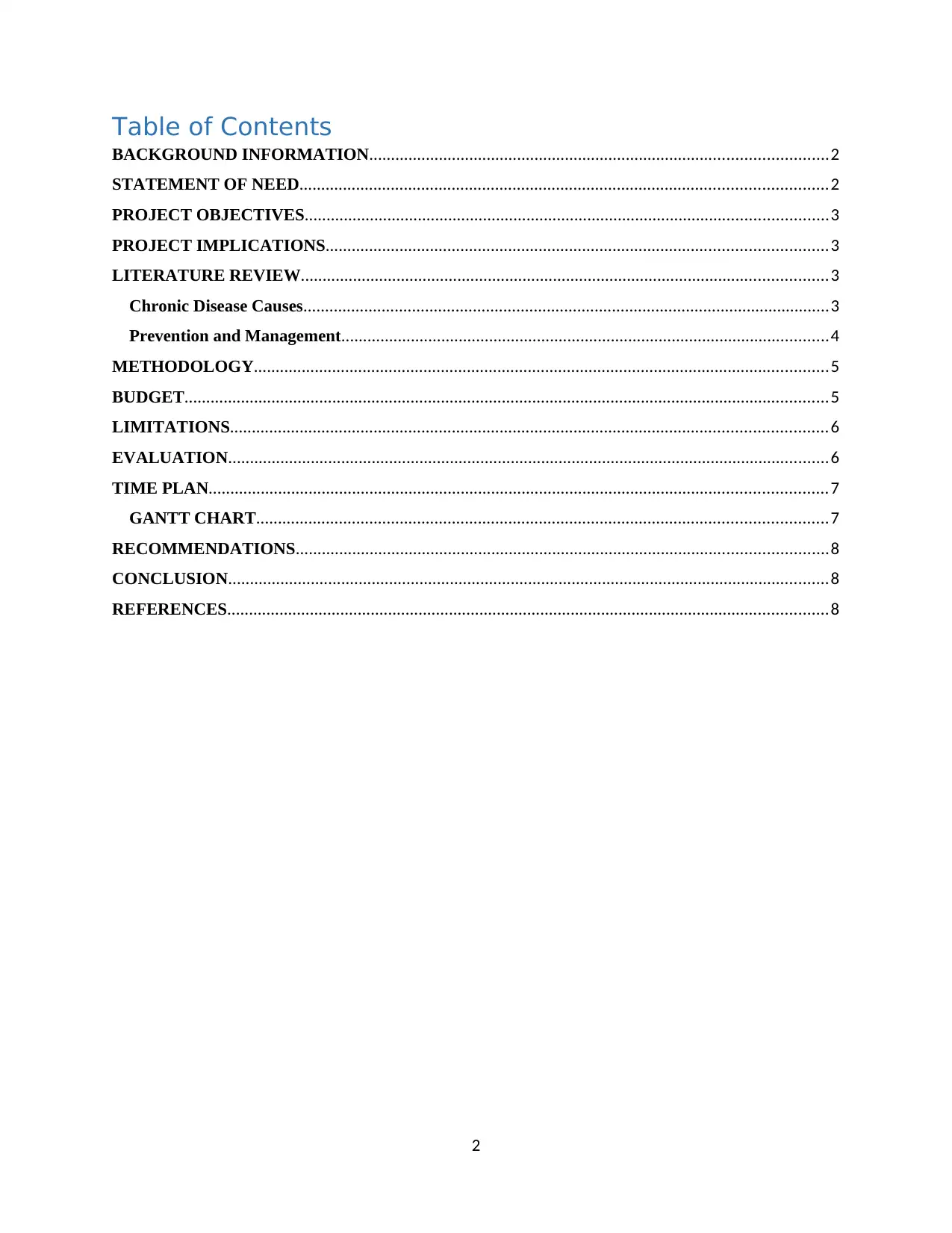
Table of Contents
BACKGROUND INFORMATION.........................................................................................................2
STATEMENT OF NEED.........................................................................................................................2
PROJECT OBJECTIVES........................................................................................................................3
PROJECT IMPLICATIONS...................................................................................................................3
LITERATURE REVIEW.........................................................................................................................3
Chronic Disease Causes.........................................................................................................................3
Prevention and Management................................................................................................................4
METHODOLOGY....................................................................................................................................5
BUDGET....................................................................................................................................................5
LIMITATIONS.........................................................................................................................................6
EVALUATION..........................................................................................................................................6
TIME PLAN..............................................................................................................................................7
GANTT CHART...................................................................................................................................7
RECOMMENDATIONS..........................................................................................................................8
CONCLUSION..........................................................................................................................................8
REFERENCES..........................................................................................................................................8
2
BACKGROUND INFORMATION.........................................................................................................2
STATEMENT OF NEED.........................................................................................................................2
PROJECT OBJECTIVES........................................................................................................................3
PROJECT IMPLICATIONS...................................................................................................................3
LITERATURE REVIEW.........................................................................................................................3
Chronic Disease Causes.........................................................................................................................3
Prevention and Management................................................................................................................4
METHODOLOGY....................................................................................................................................5
BUDGET....................................................................................................................................................5
LIMITATIONS.........................................................................................................................................6
EVALUATION..........................................................................................................................................6
TIME PLAN..............................................................................................................................................7
GANTT CHART...................................................................................................................................7
RECOMMENDATIONS..........................................................................................................................8
CONCLUSION..........................................................................................................................................8
REFERENCES..........................................................................................................................................8
2
HEALTH PROMOTION PROJECT PROPOSAL
CHRONIC DISEASE PREVENTION AND MANAGEMENT AMONG THE CHRONIC
DISEASE PATIENTS AND PATIENTS’ RELATIVES IN AUSTRALIA
BACKGROUND INFORMATION
A chronic disease is one that lasts for more than three months. It is basically a health condition
that is meant to last for a long period of time or a disease whose effects appear periodically
(Bynum, 2015). A chronic disease cannot be cured with the use of vaccines or other related
medications. In addition to that, a chronic disease does not appear anyhow but caused by various
aspects in a person’s lifestyle. For instance, lack of body exercise, poor eating choices and
unhealthy lifestyles among others (Pedersen and Saltin, 2015). Examples of chronic disease
include diseases like arthritis, stroke, diabetes, obesity, cancer, asthma, heart disease to name a
few. The fact that these diseases cannot be cured with the use of any vaccine or any other
medication means that the diseases must be managed to increase the lifespan of the people
suffering from these kinds of diseases. By managing the disease itself as well as their conditions,
will increase the probabilities of curing the disease (Greenberg et al, 2011). Research has shown
that these disease are can be found in any age group, i.e. whether young or old or aged people of
the community. This group of community member are said to have poor or low immunity
system, poor eating habits and low body strength hence giving a chance for the uprising of such
disease and health conditions.
STATEMENT OF NEED
Chronic disease management refers to the application of knowledge, skills, expertise and
experience towards the support and care for the people suffering from chronic disease conditions.
Through the management of these chronic disease conditions, these patients are able to earn new
ways to care for themselves with the aim of improving their health itself and generally (Martin,
2007). The support and care needed for such kind of patients involve conducting activities like
regular visits, regular body and health checkups as well as observations. It is important to note
that, chronic disease management is supposed to be a process to be conducted by specialists or
professionals who have experience and expertise on these kind of fields, e.g. registered nurses
and specialist doctors (Landon et al, 2007). In addition to that, the patients can be helped by the
family physicians and other primary care givers to manage these kinds of diseases. Just as
3
CHRONIC DISEASE PREVENTION AND MANAGEMENT AMONG THE CHRONIC
DISEASE PATIENTS AND PATIENTS’ RELATIVES IN AUSTRALIA
BACKGROUND INFORMATION
A chronic disease is one that lasts for more than three months. It is basically a health condition
that is meant to last for a long period of time or a disease whose effects appear periodically
(Bynum, 2015). A chronic disease cannot be cured with the use of vaccines or other related
medications. In addition to that, a chronic disease does not appear anyhow but caused by various
aspects in a person’s lifestyle. For instance, lack of body exercise, poor eating choices and
unhealthy lifestyles among others (Pedersen and Saltin, 2015). Examples of chronic disease
include diseases like arthritis, stroke, diabetes, obesity, cancer, asthma, heart disease to name a
few. The fact that these diseases cannot be cured with the use of any vaccine or any other
medication means that the diseases must be managed to increase the lifespan of the people
suffering from these kinds of diseases. By managing the disease itself as well as their conditions,
will increase the probabilities of curing the disease (Greenberg et al, 2011). Research has shown
that these disease are can be found in any age group, i.e. whether young or old or aged people of
the community. This group of community member are said to have poor or low immunity
system, poor eating habits and low body strength hence giving a chance for the uprising of such
disease and health conditions.
STATEMENT OF NEED
Chronic disease management refers to the application of knowledge, skills, expertise and
experience towards the support and care for the people suffering from chronic disease conditions.
Through the management of these chronic disease conditions, these patients are able to earn new
ways to care for themselves with the aim of improving their health itself and generally (Martin,
2007). The support and care needed for such kind of patients involve conducting activities like
regular visits, regular body and health checkups as well as observations. It is important to note
that, chronic disease management is supposed to be a process to be conducted by specialists or
professionals who have experience and expertise on these kind of fields, e.g. registered nurses
and specialist doctors (Landon et al, 2007). In addition to that, the patients can be helped by the
family physicians and other primary care givers to manage these kinds of diseases. Just as
3
⊘ This is a preview!⊘
Do you want full access?
Subscribe today to unlock all pages.

Trusted by 1+ million students worldwide
mentioned earlier, management of these diseases increases the life span of the patient besides
improving their entire health condition. This project will focus on discussing chronic disease
management among the old or aged in the Australia community.
PROJECT OBJECTIVES
To identify various ways to prevent and manage chronic diseases in the community
To identify and evaluate different causes of the most common chronic diseases
PROJECT IMPLICATIONS
The project will focus on the different techniques and methods to implement when it comes to
prevention and management of chronic diseases common in Australia or rather the
Australiancitizens. Through this project, the team members will be able to identify the most
common types of chronic disease affecting and being experienced by the Australiancitizens as
well as identify various ways of preventing and managing each one of them. Additionally, once
the project is complete, the Australian citizens will have gained immense knowledge on the best
and most effective ways to prevent and manage certain specific common chronic diseases which
is a basic way to develop and improve community development in terms of health.
LITERATURE REVIEW
Chronic diseases have recently become one of the largest contributor and cause of death among
the generation of today. Besides being long term health conditions, they cause other health
problems or rather conditions. However, these disease have causes and prevention methods or
techniques that are used to help manage these diseases (Sturmberg and Martin, 2007)
Additionally, it is important to note that these methods and techniques are more effective when
they are carried out or rather implemented by a professional or specialist e.g. registered nurses or
doctors. This is simply because these parties are the ones trained, skilled and with the required
knowledge to handle such kinds of disease management issues.
Chronic Disease Causes
Lack of body exercise
This is the major cause for most chronic diseases in the modern world. Body exercise involves
activities like running, lifting weights, playing physical games to name a few. In other words, it
is called physical body activity whereby the human gets the chance to move around vigorously
4
improving their entire health condition. This project will focus on discussing chronic disease
management among the old or aged in the Australia community.
PROJECT OBJECTIVES
To identify various ways to prevent and manage chronic diseases in the community
To identify and evaluate different causes of the most common chronic diseases
PROJECT IMPLICATIONS
The project will focus on the different techniques and methods to implement when it comes to
prevention and management of chronic diseases common in Australia or rather the
Australiancitizens. Through this project, the team members will be able to identify the most
common types of chronic disease affecting and being experienced by the Australiancitizens as
well as identify various ways of preventing and managing each one of them. Additionally, once
the project is complete, the Australian citizens will have gained immense knowledge on the best
and most effective ways to prevent and manage certain specific common chronic diseases which
is a basic way to develop and improve community development in terms of health.
LITERATURE REVIEW
Chronic diseases have recently become one of the largest contributor and cause of death among
the generation of today. Besides being long term health conditions, they cause other health
problems or rather conditions. However, these disease have causes and prevention methods or
techniques that are used to help manage these diseases (Sturmberg and Martin, 2007)
Additionally, it is important to note that these methods and techniques are more effective when
they are carried out or rather implemented by a professional or specialist e.g. registered nurses or
doctors. This is simply because these parties are the ones trained, skilled and with the required
knowledge to handle such kinds of disease management issues.
Chronic Disease Causes
Lack of body exercise
This is the major cause for most chronic diseases in the modern world. Body exercise involves
activities like running, lifting weights, playing physical games to name a few. In other words, it
is called physical body activity whereby the human gets the chance to move around vigorously
4
Paraphrase This Document
Need a fresh take? Get an instant paraphrase of this document with our AI Paraphraser
and actively (Pittet et al, 2009). Physical activity is a major contributor when it comes to
improving organ functionality and performance. For instance the human heart can be function
more effectively when its function is challenged e.g. when exercising hence improving its
performance in general (Booth et al, 2012). Additionally, body exercise can be used as a methods
to lose weight especially for the people who need to keep fit. With body exercise, a person can
prevent disease like obesity, heart disease, stroke to name a few.
Poor lifestyles
Poor lifestyle choices such as smoking can also be a cause for chronic disease. Smoking involved
the inhalation of harmful substances into the human body which are likely to damage the lungs,
throat and liver (Durstine et al, 2013). Apparently, any kind of smoking can cause disease like
lung cancer, throat cancer, asthma etc.
Alcohol overuse
This is also another type of poor lifestyle choice. Alcohol overuse can cause disease like liver
cancer, liver cirrhosis and other disease related to the liver. Alcohol abuse involves the ingestion
of harmful substances into the human body frequently and for a long period of time hence
causing such kinds of diseases.
Poor dieting
In the modern era, the choice of foods and eating habits for the current generation has proved to
be very poor and unhealthy. Many people are often feeding on junk foods which means that they
actually do not take balanced diet foods. The capability for such kinds of foods to increase body
weight and cause other related health problems are very high (Egger and Dixon, 2014). Some
examples of chronic disease caused by poor dieting habits include, stroke, cancer, obesity, heart
disease, hypertension to name a few.
Prevention and Management
Healthy lifestyle choices
In most cases, doctors encourage on healthy lifestyle choices to help prevent and manage chronic
diseases. However, many people or rather patients do not understand the meaning for such
recommendations and therefore may not implement the recommendations into their lives (Fortin
5
improving organ functionality and performance. For instance the human heart can be function
more effectively when its function is challenged e.g. when exercising hence improving its
performance in general (Booth et al, 2012). Additionally, body exercise can be used as a methods
to lose weight especially for the people who need to keep fit. With body exercise, a person can
prevent disease like obesity, heart disease, stroke to name a few.
Poor lifestyles
Poor lifestyle choices such as smoking can also be a cause for chronic disease. Smoking involved
the inhalation of harmful substances into the human body which are likely to damage the lungs,
throat and liver (Durstine et al, 2013). Apparently, any kind of smoking can cause disease like
lung cancer, throat cancer, asthma etc.
Alcohol overuse
This is also another type of poor lifestyle choice. Alcohol overuse can cause disease like liver
cancer, liver cirrhosis and other disease related to the liver. Alcohol abuse involves the ingestion
of harmful substances into the human body frequently and for a long period of time hence
causing such kinds of diseases.
Poor dieting
In the modern era, the choice of foods and eating habits for the current generation has proved to
be very poor and unhealthy. Many people are often feeding on junk foods which means that they
actually do not take balanced diet foods. The capability for such kinds of foods to increase body
weight and cause other related health problems are very high (Egger and Dixon, 2014). Some
examples of chronic disease caused by poor dieting habits include, stroke, cancer, obesity, heart
disease, hypertension to name a few.
Prevention and Management
Healthy lifestyle choices
In most cases, doctors encourage on healthy lifestyle choices to help prevent and manage chronic
diseases. However, many people or rather patients do not understand the meaning for such
recommendations and therefore may not implement the recommendations into their lives (Fortin
5
et al, 2013). A healthy lifestyle includes carrying out practices like healthy eating habits, body
exercising, manageable or reduced alcohol use (if possible) to name a few. In other words, with
healthy lifestyle practices, a person is capable of reducing, preventing and eradicating almost all
the causes of chronic diseases. Therefore, to prevent and manage some of these chronic disease
conditions, patients are advised to exercise and choose healthy lifestyle behaviors on a daily
basis (Hart and Millard, 2010). In addition to that, healthy lifestyle practices may also involve
stress management techniques, nutritional counseling sessions, exercise trainings etc.
Regular medical checkups
This is whereby a person visit the doctor to be checked on a regular basis about their entire
health status. This is however applicable for diseases like the chronic health conditions which
have recently become the cause for death among people of all ages. People with such chances
can be screened for diseases like cancer of all types, body weight measurement to determine
obesity occurrences, heart disease condition occurrences, stroke to name a few.
METHODOLOGY
The project will be carried out by a team of health students with the help of other health
specialists and experts like registered nurses and doctors working in the community. The group
will focus on identifying the most common chronic diseases and conditions by referring to the
public and private health institution records. However, this will be done after permission is
granted from the institution’s management team and most of the patients. The team will then
question the patients in records received as well other patients who may not be in the records.
Furthermore, the team will also be helped by the patient’s relative and other people who are
responsible for taking care of them. Through this, the team will be able to get the required data to
carry out and complete the project successfully.
BUDGET
Project team members’ compensation- $300,000
Consultation fees- $10,000
Travel fees- $100,000
Telephone expenses- $3,000
6
exercising, manageable or reduced alcohol use (if possible) to name a few. In other words, with
healthy lifestyle practices, a person is capable of reducing, preventing and eradicating almost all
the causes of chronic diseases. Therefore, to prevent and manage some of these chronic disease
conditions, patients are advised to exercise and choose healthy lifestyle behaviors on a daily
basis (Hart and Millard, 2010). In addition to that, healthy lifestyle practices may also involve
stress management techniques, nutritional counseling sessions, exercise trainings etc.
Regular medical checkups
This is whereby a person visit the doctor to be checked on a regular basis about their entire
health status. This is however applicable for diseases like the chronic health conditions which
have recently become the cause for death among people of all ages. People with such chances
can be screened for diseases like cancer of all types, body weight measurement to determine
obesity occurrences, heart disease condition occurrences, stroke to name a few.
METHODOLOGY
The project will be carried out by a team of health students with the help of other health
specialists and experts like registered nurses and doctors working in the community. The group
will focus on identifying the most common chronic diseases and conditions by referring to the
public and private health institution records. However, this will be done after permission is
granted from the institution’s management team and most of the patients. The team will then
question the patients in records received as well other patients who may not be in the records.
Furthermore, the team will also be helped by the patient’s relative and other people who are
responsible for taking care of them. Through this, the team will be able to get the required data to
carry out and complete the project successfully.
BUDGET
Project team members’ compensation- $300,000
Consultation fees- $10,000
Travel fees- $100,000
Telephone expenses- $3,000
6
⊘ This is a preview!⊘
Do you want full access?
Subscribe today to unlock all pages.
Trusted by 1+ million students worldwide
Project advertising expenses- $5,000
Community seminars and training costs- $200,000
Resource purchasing expenses- $200,000
Miscellaneous expenses- $300,000
TOTAL BUDGET- $1,118,000
LIMITATIONS
Every project and project team has some problems or limitations that hinder them from
completing the project successfully and achieving the project objectives. In this project, some of
the expected limitations include the following:
Lack of cooperation from the community members. Some people may refuse to give the project
the permission to study and reference their health conditions. The main reason for this is the fear
and worry of being known by the whole community. This means that most of them may need to
keep their health conditions a secret from the public which is the most probability for most
chronic disease patients.
Lack of enough funds to conduct the project
Lack of clear and current health records from the health institutions
EVALUATION
As for the project, the process will be focusing specifically on achieving the two main objectives.
The project team members will therefore concentrate on ensuring that all the problems
mentioned above are identified and solutions sort prior to project commencement period. In
addition to that, the project manager will ensure that the projects scope, budget, time frame and
resources to be used are followed and implemented to the letter. The team will not study or
conduct the project but will also educate the community members (especially the patient already
suffering from these diseases as well as their relatives and care givers) with the aim of increasing
their knowledge on healthy living and lifestyles, disease prevention and management. Through
this, the project will be able to increase and improve community development by helping the
country’s citizens live a healthy productive life.
7
Community seminars and training costs- $200,000
Resource purchasing expenses- $200,000
Miscellaneous expenses- $300,000
TOTAL BUDGET- $1,118,000
LIMITATIONS
Every project and project team has some problems or limitations that hinder them from
completing the project successfully and achieving the project objectives. In this project, some of
the expected limitations include the following:
Lack of cooperation from the community members. Some people may refuse to give the project
the permission to study and reference their health conditions. The main reason for this is the fear
and worry of being known by the whole community. This means that most of them may need to
keep their health conditions a secret from the public which is the most probability for most
chronic disease patients.
Lack of enough funds to conduct the project
Lack of clear and current health records from the health institutions
EVALUATION
As for the project, the process will be focusing specifically on achieving the two main objectives.
The project team members will therefore concentrate on ensuring that all the problems
mentioned above are identified and solutions sort prior to project commencement period. In
addition to that, the project manager will ensure that the projects scope, budget, time frame and
resources to be used are followed and implemented to the letter. The team will not study or
conduct the project but will also educate the community members (especially the patient already
suffering from these diseases as well as their relatives and care givers) with the aim of increasing
their knowledge on healthy living and lifestyles, disease prevention and management. Through
this, the project will be able to increase and improve community development by helping the
country’s citizens live a healthy productive life.
7
Paraphrase This Document
Need a fresh take? Get an instant paraphrase of this document with our AI Paraphraser
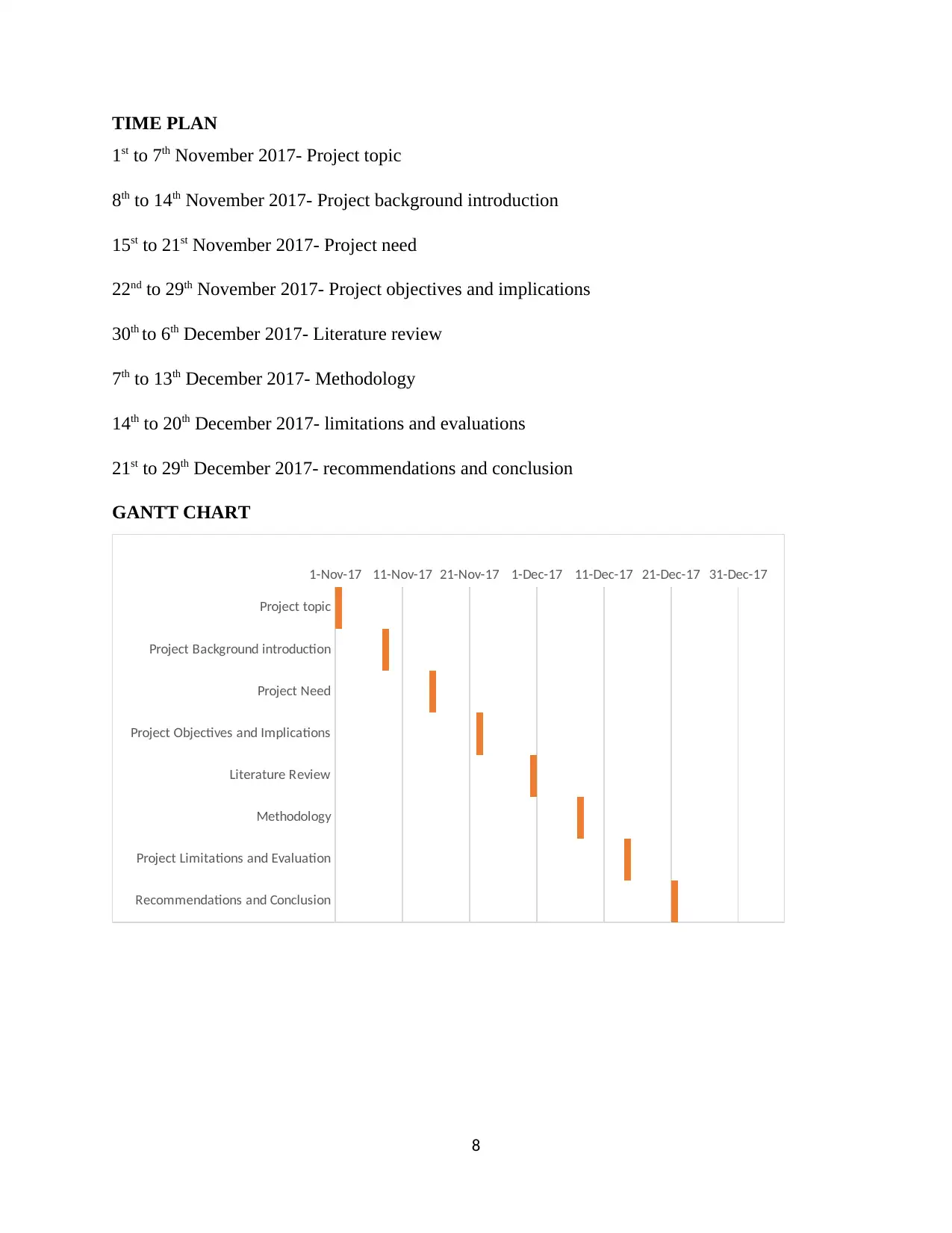
TIME PLAN
1st to 7th November 2017- Project topic
8th to 14th November 2017- Project background introduction
15st to 21st November 2017- Project need
22nd to 29th November 2017- Project objectives and implications
30th to 6th December 2017- Literature review
7th to 13th December 2017- Methodology
14th to 20th December 2017- limitations and evaluations
21st to 29th December 2017- recommendations and conclusion
GANTT CHART
Project topic
Project Background introduction
Project Need
Project Objectives and Implications
Literature Review
Methodology
Project Limitations and Evaluation
Recommendations and Conclusion
1-Nov-17 11-Nov-17 21-Nov-17 1-Dec-17 11-Dec-17 21-Dec-17 31-Dec-17
8
1st to 7th November 2017- Project topic
8th to 14th November 2017- Project background introduction
15st to 21st November 2017- Project need
22nd to 29th November 2017- Project objectives and implications
30th to 6th December 2017- Literature review
7th to 13th December 2017- Methodology
14th to 20th December 2017- limitations and evaluations
21st to 29th December 2017- recommendations and conclusion
GANTT CHART
Project topic
Project Background introduction
Project Need
Project Objectives and Implications
Literature Review
Methodology
Project Limitations and Evaluation
Recommendations and Conclusion
1-Nov-17 11-Nov-17 21-Nov-17 1-Dec-17 11-Dec-17 21-Dec-17 31-Dec-17
8
RECOMMENDATIONS
I can recommend the project team members to first and foremost identify and find solutions to
the possible project limitations before the project is officially commenced.
I can recommend the project team members to not only focus on educating the patients with
chronic diseases and their relatives but also consider developing and improving health institution
follow-ups and operations that relate to chronic disease prevention and management
I can also recommend the community member to offer as much cooperation as possible to the
project team members simply because they are the ones to actually realize the most benefits from
the project once it is completed and successful
CONCLUSION
Nowadays, chronic diseases like heart disease, stroke, cancer, diabetes and arthritis are the most
common. These disease are currently some of the main causes of death among the population of
the current generation. These diseases have proven to be costly to prevent and manage besides
taking many years to get rid of them. These diseases may not be cured by use of any vaccine but
can be prevented and managed. This basically means that every patient or any person on the
verge of being diagnosed with a chronic disease to focus on getting involved with some practices
that can help prevent and manage them. For instance, stress management procedures, healthy
living choices like good eating habits, engaging in physical body exercising to name a few.
Therefore, with the help of this project and by adhering to the recommendations mentioned
above, the Australian citizens will be in a position to prevent and manage most of the common
chronic diseases affecting the population.
9
I can recommend the project team members to first and foremost identify and find solutions to
the possible project limitations before the project is officially commenced.
I can recommend the project team members to not only focus on educating the patients with
chronic diseases and their relatives but also consider developing and improving health institution
follow-ups and operations that relate to chronic disease prevention and management
I can also recommend the community member to offer as much cooperation as possible to the
project team members simply because they are the ones to actually realize the most benefits from
the project once it is completed and successful
CONCLUSION
Nowadays, chronic diseases like heart disease, stroke, cancer, diabetes and arthritis are the most
common. These disease are currently some of the main causes of death among the population of
the current generation. These diseases have proven to be costly to prevent and manage besides
taking many years to get rid of them. These diseases may not be cured by use of any vaccine but
can be prevented and managed. This basically means that every patient or any person on the
verge of being diagnosed with a chronic disease to focus on getting involved with some practices
that can help prevent and manage them. For instance, stress management procedures, healthy
living choices like good eating habits, engaging in physical body exercising to name a few.
Therefore, with the help of this project and by adhering to the recommendations mentioned
above, the Australian citizens will be in a position to prevent and manage most of the common
chronic diseases affecting the population.
9
⊘ This is a preview!⊘
Do you want full access?
Subscribe today to unlock all pages.
Trusted by 1+ million students worldwide
REFERENCES
Booth, F.W., Roberts, C.K. and Laye, M.J., 2012. Lack of exercise is a major cause of chronic
diseases. Comprehensive Physiology.
Bynum, B., 2015. A history of chronic diseases. The Lancet, 385(9963), pp.105-106.
Durstine, J.L., Gordon, B., Wang, Z. and Luo, X., 2013. Chronic disease and the link to physical
activity. Journal of Sport and Health Science, 2(1), pp.3-11.
Egger, G. and Dixon, J., 2014. Beyond obesity and lifestyle: a review of 21st century chronic
disease determinants. BioMed research international, 2014.
Fortin, M., Chouinard, M.C., Bouhali, T., Dubois, M.F., Gagnon, C. and Bélanger, M., 2013.
Evaluating the integration of chronic disease prevention and management services into primary
health care. BMC health services research, 13(1), p.132.
Greenberg, H., Raymond, S.U. and Leeder, S.R., 2011. The prevention of global chronic disease:
academic public health's new frontier. American journal of public health, 101(8), pp.1386-1390.
Hart, M.K. and Millard, M.W., 2010. Approaches to chronic disease management for asthma and
chronic obstructive pulmonary disease: strategies through the continuum of care. Proceedings
(Baylor University. Medical Center), 23(3), p.223.
Landon, B.E., Hicks, L.S., O'malley, A.J., Lieu, T.A., Keegan, T., McNeil, B.J. and Guadagnoli,
E., 2007. Improving the management of chronic disease at community health centers. New
England Journal of Medicine, 356(9), pp.921-934.
Martin, C.M., 2007. Chronic disease and illness care. Canadian Family Physician, 53(12),
pp.2086-2091.
Pedersen, B.K. and Saltin, B., 2015. Exercise as medicine–evidence for prescribing exercise as
therapy in 26 different chronic diseases. Scandinavian journal of medicine & science in
sports, 25(S3), pp.1-72.
Pittet, I., Berchtold, A., Akré, C., Michaud, P.A. and Surís, J.C., 2009. Sports practice among
adolescents with chronic health conditions. Archives of pediatrics & adolescent
medicine, 163(6), pp.565-571.
10
Booth, F.W., Roberts, C.K. and Laye, M.J., 2012. Lack of exercise is a major cause of chronic
diseases. Comprehensive Physiology.
Bynum, B., 2015. A history of chronic diseases. The Lancet, 385(9963), pp.105-106.
Durstine, J.L., Gordon, B., Wang, Z. and Luo, X., 2013. Chronic disease and the link to physical
activity. Journal of Sport and Health Science, 2(1), pp.3-11.
Egger, G. and Dixon, J., 2014. Beyond obesity and lifestyle: a review of 21st century chronic
disease determinants. BioMed research international, 2014.
Fortin, M., Chouinard, M.C., Bouhali, T., Dubois, M.F., Gagnon, C. and Bélanger, M., 2013.
Evaluating the integration of chronic disease prevention and management services into primary
health care. BMC health services research, 13(1), p.132.
Greenberg, H., Raymond, S.U. and Leeder, S.R., 2011. The prevention of global chronic disease:
academic public health's new frontier. American journal of public health, 101(8), pp.1386-1390.
Hart, M.K. and Millard, M.W., 2010. Approaches to chronic disease management for asthma and
chronic obstructive pulmonary disease: strategies through the continuum of care. Proceedings
(Baylor University. Medical Center), 23(3), p.223.
Landon, B.E., Hicks, L.S., O'malley, A.J., Lieu, T.A., Keegan, T., McNeil, B.J. and Guadagnoli,
E., 2007. Improving the management of chronic disease at community health centers. New
England Journal of Medicine, 356(9), pp.921-934.
Martin, C.M., 2007. Chronic disease and illness care. Canadian Family Physician, 53(12),
pp.2086-2091.
Pedersen, B.K. and Saltin, B., 2015. Exercise as medicine–evidence for prescribing exercise as
therapy in 26 different chronic diseases. Scandinavian journal of medicine & science in
sports, 25(S3), pp.1-72.
Pittet, I., Berchtold, A., Akré, C., Michaud, P.A. and Surís, J.C., 2009. Sports practice among
adolescents with chronic health conditions. Archives of pediatrics & adolescent
medicine, 163(6), pp.565-571.
10
Paraphrase This Document
Need a fresh take? Get an instant paraphrase of this document with our AI Paraphraser

Sturmberg, J.P. and Martin, C.M., 2007. The foundations of primary care: daring to be different.
Radcliffe Publishing.
11
Radcliffe Publishing.
11

1 out of 11


Related Documents


Your All-in-One AI-Powered Toolkit for Academic Success.
+13062052269
info@desklib.com
Available 24*7 on WhatsApp / Email
![[object Object]](/_next/static/media/star-bottom.7253800d.svg)
Unlock your academic potential
Copyright © 2020–2026 A2Z Services. All Rights Reserved. Developed and managed by ZUCOL.