Effectiveness of Health Education in Preventing Adolescent Smoking
VerifiedAdded on 2023/01/07
|42
|13935
|2
Essay
AI Summary
This dissertation investigates the effectiveness of health education interventions in preventing smoking among adolescents. It explores the multifaceted nature of the issue, emphasizing the global public health concern of adolescent smoking and its associated mortality rates. The research delves into the background of the problem, including the various factors that contribute to smoking initiation among youth, such as peer pressure, behavioral issues, and exposure to tobacco-related content. The study examines the role of health education in providing adolescents with the knowledge and skills to adopt and maintain healthy behaviors, considering various intervention models, theories, and strategies, including the Theory of Reasoned Action and the Theory of Planned Behavior. The essay critically appraises different articles, discusses recommendations, and highlights the importance of comprehensive programs that integrate age-based education, community-based approaches, and digital media to effectively engage adolescents in smoking prevention. The essay also discusses the significance of peer-led approaches and the application of innovation diffusion theory in promoting positive health behaviors, emphasizing the need for tailored interventions and effective training for health professionals to deliver smoking cessation-related support. The research also emphasizes the importance of addressing the broader determinants of health and the need for continuous evaluation of the programs.
REVIEW QUESTION: ARE HEALTH EDUCATION INTERVENTION EFFECTIVE IN PREVENTING SMOKING IN
ADOLESCENTS?
WORD COUNTS: 8000 WORDS EXCLUDING TITLE PAGE, APPENDICES AND REFERENCES
ACKNOWLEDGEMENTS
1 | P a g e
ADOLESCENTS?
WORD COUNTS: 8000 WORDS EXCLUDING TITLE PAGE, APPENDICES AND REFERENCES
ACKNOWLEDGEMENTS
1 | P a g e

Paraphrase This Document
Need a fresh take? Get an instant paraphrase of this document with our AI Paraphraser

I give thanks and glory to the Almighty God who made this dream come true.
I would like to express my utmost thankfulness to my husband and children in supporting my vision.
2 | P a g e
I would like to express my utmost thankfulness to my husband and children in supporting my vision.
2 | P a g e
ABSTRACT
The dissertation is mainly focused on consider the concept regarding health intervention as well as
education that always support for identifying prevention of smoking among Adolescents . This
dissertation draws on different interventions using various means of health education from various
journal articles on the prevention of smoking among adolescents. This is because Health education
entail long-term, well reasoned, carefully organized and evaluated programme (Whitehead, 2019). For
health education to result in positive outcomes, Whitehead and Russell, (2004), The research is mainly
focused on the pinpoint various strategies in term of goal and objective. It help for specific negotiating
goals and always tried to take follow-up on regular process through multiple evaluation event or
program. These plans may consider the effective health educational event or programme are
structurally prepared and evaluates. Furthermore, it will be organised the various model as well as
theories, which providing the guidance towards specific aim, objective and generated result or outcome.
Apart from that it can be restricted the single process regarding behaviour changes and information
gathering or providing activities.
The intervention that could prevent smoking in adolescents has to be multiple because of the
multifactorial nature of the health issue and health education has been shown to be effective to a
certain extent.
3 | P a g e
The dissertation is mainly focused on consider the concept regarding health intervention as well as
education that always support for identifying prevention of smoking among Adolescents . This
dissertation draws on different interventions using various means of health education from various
journal articles on the prevention of smoking among adolescents. This is because Health education
entail long-term, well reasoned, carefully organized and evaluated programme (Whitehead, 2019). For
health education to result in positive outcomes, Whitehead and Russell, (2004), The research is mainly
focused on the pinpoint various strategies in term of goal and objective. It help for specific negotiating
goals and always tried to take follow-up on regular process through multiple evaluation event or
program. These plans may consider the effective health educational event or programme are
structurally prepared and evaluates. Furthermore, it will be organised the various model as well as
theories, which providing the guidance towards specific aim, objective and generated result or outcome.
Apart from that it can be restricted the single process regarding behaviour changes and information
gathering or providing activities.
The intervention that could prevent smoking in adolescents has to be multiple because of the
multifactorial nature of the health issue and health education has been shown to be effective to a
certain extent.
3 | P a g e
⊘ This is a preview!⊘
Do you want full access?
Subscribe today to unlock all pages.

Trusted by 1+ million students worldwide
TABLE OF CONTENTS
Acknowledgement.............................................................................................................................2
Abstract.............................................................................................................................................3
Introduction.......................................................................................................................................5
Chapter One:
Background........................................................................................................................................6
Chapter Two:
Methodology ...................................................................................................................................11
Chapter Three:
Critical Appraisal................................................................................................................................16
Chapter Four:
Discussions and Recommendation......................................................................................................21
Chapter Five:
Conclusion........................................................................................................................................27
Appendices
CASP.................................................................................................................................................29
References..........................................................................................................................................39
4 | P a g e
Acknowledgement.............................................................................................................................2
Abstract.............................................................................................................................................3
Introduction.......................................................................................................................................5
Chapter One:
Background........................................................................................................................................6
Chapter Two:
Methodology ...................................................................................................................................11
Chapter Three:
Critical Appraisal................................................................................................................................16
Chapter Four:
Discussions and Recommendation......................................................................................................21
Chapter Five:
Conclusion........................................................................................................................................27
Appendices
CASP.................................................................................................................................................29
References..........................................................................................................................................39
4 | P a g e
Paraphrase This Document
Need a fresh take? Get an instant paraphrase of this document with our AI Paraphraser
INTRODUCTION
This research is mainly exploring the concept of health intervention and education that are providing
prevention activities towards the smoking among multiple adolescents. Health education intends to
provide individuals with the expertise require to live and maintain positive healthy behaviours. It mixes
self and combined intervention plans to acquire more knowledge and skills according to the
requirements. Sometimes, it also appropriate for decision making and also linked with the health
condition of adolescent. However, these involvements are complex and combine different complex
elements. The consequences of these interventions arise from both the interventions themselves and
the circumstances they evolved (Cambon et al., 2012).
Tobacco smoking is based on the causes of reduce the death rate and also linked with 7 million deaths
yearly. This is approximated to mount to more than 8 million death yearly in 2030, with 80%.
Furthermore, it also happened to determine the income of low- as well as middle- income nations.
(Semwal et al., 2019). Most people commence smoking in youths: two thirds before they attain 18years.
There are various reason for started the smoking, which are becoming more complex, ranging
from peer pressure to behavioural issue or problem. (Public Health England (PHE) 2015). The multiple
children are likely to start the smoking The best method of reducing smoking among youths is t. o
reduce it in the world around them (PHE 2015).
In this Chapter-1, it explore the background and the rationale behind whether health education
interventions are effective in preventing smoking in adolescents.
In this Chapter-2, it also discussed about the research methodology that can be used in the research
project. Also consists of different research questions.
In this chapter-3, it is critically appraise the six different articles.
5 | P a g e
This research is mainly exploring the concept of health intervention and education that are providing
prevention activities towards the smoking among multiple adolescents. Health education intends to
provide individuals with the expertise require to live and maintain positive healthy behaviours. It mixes
self and combined intervention plans to acquire more knowledge and skills according to the
requirements. Sometimes, it also appropriate for decision making and also linked with the health
condition of adolescent. However, these involvements are complex and combine different complex
elements. The consequences of these interventions arise from both the interventions themselves and
the circumstances they evolved (Cambon et al., 2012).
Tobacco smoking is based on the causes of reduce the death rate and also linked with 7 million deaths
yearly. This is approximated to mount to more than 8 million death yearly in 2030, with 80%.
Furthermore, it also happened to determine the income of low- as well as middle- income nations.
(Semwal et al., 2019). Most people commence smoking in youths: two thirds before they attain 18years.
There are various reason for started the smoking, which are becoming more complex, ranging
from peer pressure to behavioural issue or problem. (Public Health England (PHE) 2015). The multiple
children are likely to start the smoking The best method of reducing smoking among youths is t. o
reduce it in the world around them (PHE 2015).
In this Chapter-1, it explore the background and the rationale behind whether health education
interventions are effective in preventing smoking in adolescents.
In this Chapter-2, it also discussed about the research methodology that can be used in the research
project. Also consists of different research questions.
In this chapter-3, it is critically appraise the six different articles.
5 | P a g e
In this chapter-4, it also discussed and recommendations of the literature in the research.
In this chapter-5, it is conducting the specific part of the research.
CHAPTER ONE
BACKGROUND
The following are the list of important concepts in Health education intervention in prevention of
tobacco use among youths: Adolescent, Cessation, Stopping, Health education, Prevention, Intervention,
Youth. These are different activities that help for providing guidance and counselling to stop smoking.
The rational of research is to understand the concept of health education and their specific intervention
in context of preventions.
Smoking in adolescents is a problem of worldwide public health concern (Starkey et al., 2009). Tobacco
is based on the most causes of death, which are linked with the 7 Million deaths every year (Semwal et
al., 2019). As per evidence, it has found that increases death approximately 8 Million deaths yearly basis
in 2030, with 80% happening within low as well as middle-income nations. (Semwal et al., 2019).
In England, it has happened one in five adults smokes cigarette and 90000 regular smokers between
ages 11-15 (PHE 2015). 17% of all death in individuals aged 35 and above are cause by tobacco use. The
risk it poses will not be spreading because people in more deprived area are more likely to smoke and
are less possible to stop (PHE, 2015). Smoking is one of the consider as underprivileged individual and
forecast to contribution within health balance imbalances in England (PHE 2015).
In United State of America (USA), tobacco is the main cause of avoidable deaths and diseases, killing
443,000 people yearly (Primack et al., 2014). The large majority of people that always die from tobacco
6 | P a g e
In this chapter-5, it is conducting the specific part of the research.
CHAPTER ONE
BACKGROUND
The following are the list of important concepts in Health education intervention in prevention of
tobacco use among youths: Adolescent, Cessation, Stopping, Health education, Prevention, Intervention,
Youth. These are different activities that help for providing guidance and counselling to stop smoking.
The rational of research is to understand the concept of health education and their specific intervention
in context of preventions.
Smoking in adolescents is a problem of worldwide public health concern (Starkey et al., 2009). Tobacco
is based on the most causes of death, which are linked with the 7 Million deaths every year (Semwal et
al., 2019). As per evidence, it has found that increases death approximately 8 Million deaths yearly basis
in 2030, with 80% happening within low as well as middle-income nations. (Semwal et al., 2019).
In England, it has happened one in five adults smokes cigarette and 90000 regular smokers between
ages 11-15 (PHE 2015). 17% of all death in individuals aged 35 and above are cause by tobacco use. The
risk it poses will not be spreading because people in more deprived area are more likely to smoke and
are less possible to stop (PHE, 2015). Smoking is one of the consider as underprivileged individual and
forecast to contribution within health balance imbalances in England (PHE 2015).
In United State of America (USA), tobacco is the main cause of avoidable deaths and diseases, killing
443,000 people yearly (Primack et al., 2014). The large majority of people that always die from tobacco
6 | P a g e
⊘ This is a preview!⊘
Do you want full access?
Subscribe today to unlock all pages.
Trusted by 1+ million students worldwide
use start at age 18 or younger, that is why many counter-tobacco interventions suitably concentrate on
adolescents (Primack et al., 2014).
In addition, China is considered as biggest way to produce tobacco consumers and, there are only one of
14 nations that increases the burden of tobacco useable. (Hsia et al., 2010). Initially, This research has
investigation the adolescent which report between 28% to 43% of males and 1% to 11% of females
acknowledged themselves as smokers (Chen et al., 2006). Further information suggested that smoking
incidents in youths have been on the increase, and the commencement age of tobacco use is reducing.
(Zhangi et al., 2003). Lessening the predominance of smoking among youths remains a crucial public
health preference for China (Hasting and Angus, 2008). It has always increased the death rate in china
because people are smoking very quickly manner.
In Greece, no less than one-third of students have used tobacco, with the country recorded to have one
of the highest per capita tobacco uses in the European Union, evidencing the necessity for smoking
restraint intervention in the country (Kousoulis et al., 2016).
Adolescence is the time of passing into adulthood and youth may inherit risky behaviour while making
effort to reach adulthood (Levia et al., 2018). Earlier research has acknowledged different socio-
demographic, intrinsic and environmental hazard and protective elements like vulnerability to mass
media which link with tobacco use in youth because it make them vulnerable to tobacco related content
that is connected with unfavourable smoking outcomes. Also, the use of social media exposes youth to
tobacco use which is associated with smoking in youth (Shensa et al., 2016).
The flaming, amiably and insightful changes throughout youth make adolescence a time when
adolescents are more likely to initiate tobacco use. Tobacco use by parents and friends has specific
significance at this period (Gilman et al., 2009, Hill et al., 2005 cited in Levia et al., 2018). Additionally,
other determinants like genetic, pressure, low self-respect, poor locus of control, low school awareness,
susceptibility to peer influence (Levia et al., 2018).
These factors need to contemplate the wider problems people experience in their lives. It ranges from
shortage of opportunity to social isolation, which can elevate the dangers of unhealthy behaviour (PHE
2015).
7 | P a g e
adolescents (Primack et al., 2014).
In addition, China is considered as biggest way to produce tobacco consumers and, there are only one of
14 nations that increases the burden of tobacco useable. (Hsia et al., 2010). Initially, This research has
investigation the adolescent which report between 28% to 43% of males and 1% to 11% of females
acknowledged themselves as smokers (Chen et al., 2006). Further information suggested that smoking
incidents in youths have been on the increase, and the commencement age of tobacco use is reducing.
(Zhangi et al., 2003). Lessening the predominance of smoking among youths remains a crucial public
health preference for China (Hasting and Angus, 2008). It has always increased the death rate in china
because people are smoking very quickly manner.
In Greece, no less than one-third of students have used tobacco, with the country recorded to have one
of the highest per capita tobacco uses in the European Union, evidencing the necessity for smoking
restraint intervention in the country (Kousoulis et al., 2016).
Adolescence is the time of passing into adulthood and youth may inherit risky behaviour while making
effort to reach adulthood (Levia et al., 2018). Earlier research has acknowledged different socio-
demographic, intrinsic and environmental hazard and protective elements like vulnerability to mass
media which link with tobacco use in youth because it make them vulnerable to tobacco related content
that is connected with unfavourable smoking outcomes. Also, the use of social media exposes youth to
tobacco use which is associated with smoking in youth (Shensa et al., 2016).
The flaming, amiably and insightful changes throughout youth make adolescence a time when
adolescents are more likely to initiate tobacco use. Tobacco use by parents and friends has specific
significance at this period (Gilman et al., 2009, Hill et al., 2005 cited in Levia et al., 2018). Additionally,
other determinants like genetic, pressure, low self-respect, poor locus of control, low school awareness,
susceptibility to peer influence (Levia et al., 2018).
These factors need to contemplate the wider problems people experience in their lives. It ranges from
shortage of opportunity to social isolation, which can elevate the dangers of unhealthy behaviour (PHE
2015).
7 | P a g e
Paraphrase This Document
Need a fresh take? Get an instant paraphrase of this document with our AI Paraphraser
The main prevention of smoking among adolescents is hence, specifically significant due to the
enormous attempt needed for people who are smoking since long time to stop smoking because of their
extent of nicotine addiction (Park et al., 2017). there are major evidence which indicates that the major
intervention which are delivered throuh the professional of health are efficacious for the prevention of
the smoking Health professionals’ advice has been demonstrated to elevate efforts to stop smoking and
use medicines intended at stopping smoking (Semwal et al., 2019). The effective intervention that
mainly explained the result or outcome. Furthermore, It also explained the brief overview, which is
mainly identified the cessation level. However, the shortage of relevant knowledge and skills is an
important obstacles. According to report, it has been identified the health condition while preventing by
different health professionals, which mainly giving a better counselling to prevent preventing them from
smoking cessation. However, it will give an effective advice of individual person, who are already
consume the Tobacco and many more patients suffered from it. (Semwal et al., 2019).
proper education and on time and cost effective training are significant to make sure that professional
and experts relating to health have suitable knowledge and expertise to deliver smoking cessation-
connected intervention. For Example- Government should create an effective program or event. In order
to educate the causes of tobacco. E-learning or Digital education will be provided through different
digital technology have the possibility to elevate opportunities relating to education, augment activities
for teaching and minimise the different obstacles in term of health profession event or program.
(Semwal et al., 2019).
Research recommends that efficacious programs on prevention of smoking combine various elements,
include age based educaitonal model, communty based views and many other points and
empowerment of youth (Bottorff et al., 2014). Embracing approaches that integrate these various
elements assists adolescents to be extra actively involved in programs relating to smoking prevention
and education relating to health that are therefore more possible to yield successful results (Peppler and
Kafai, 2007). Digital Media provide various possible advantages as an operative education relating to
health instrument for encouraging adolescent health together with prevention of smoking (Norman and
Yipp, 2012).
Health education is a significant subset of public health. Health education is influenced primarily by
behavioural sciences. It is from behavioural sciences that the practice of health education borrows the
strategic planning of its method (Sharma et al., 2016).
8 | P a g e
enormous attempt needed for people who are smoking since long time to stop smoking because of their
extent of nicotine addiction (Park et al., 2017). there are major evidence which indicates that the major
intervention which are delivered throuh the professional of health are efficacious for the prevention of
the smoking Health professionals’ advice has been demonstrated to elevate efforts to stop smoking and
use medicines intended at stopping smoking (Semwal et al., 2019). The effective intervention that
mainly explained the result or outcome. Furthermore, It also explained the brief overview, which is
mainly identified the cessation level. However, the shortage of relevant knowledge and skills is an
important obstacles. According to report, it has been identified the health condition while preventing by
different health professionals, which mainly giving a better counselling to prevent preventing them from
smoking cessation. However, it will give an effective advice of individual person, who are already
consume the Tobacco and many more patients suffered from it. (Semwal et al., 2019).
proper education and on time and cost effective training are significant to make sure that professional
and experts relating to health have suitable knowledge and expertise to deliver smoking cessation-
connected intervention. For Example- Government should create an effective program or event. In order
to educate the causes of tobacco. E-learning or Digital education will be provided through different
digital technology have the possibility to elevate opportunities relating to education, augment activities
for teaching and minimise the different obstacles in term of health profession event or program.
(Semwal et al., 2019).
Research recommends that efficacious programs on prevention of smoking combine various elements,
include age based educaitonal model, communty based views and many other points and
empowerment of youth (Bottorff et al., 2014). Embracing approaches that integrate these various
elements assists adolescents to be extra actively involved in programs relating to smoking prevention
and education relating to health that are therefore more possible to yield successful results (Peppler and
Kafai, 2007). Digital Media provide various possible advantages as an operative education relating to
health instrument for encouraging adolescent health together with prevention of smoking (Norman and
Yipp, 2012).
Health education is a significant subset of public health. Health education is influenced primarily by
behavioural sciences. It is from behavioural sciences that the practice of health education borrows the
strategic planning of its method (Sharma et al., 2016).
8 | P a g e
The Theory of Reasoned Action (TRA) and Theory of Planned Behaviour (TPB) are relevant to prevention
of smoking in adolescent (Sharma, 2016). The important attributes of both theories is their assertion
that behavioural intention is the most significant factor of behaviour. The TRA and TPB argue and
explained the individuals consider the consequences of their actions before embarking on or abstain
from any specific behaviour (Sharma, 2016). These two theories stresses the role of thoughts in decision
making about involving in behaviour and they states that an individual’s intention is decided by two
antecedents, comprising of personal factors and social influences. The TPB include a third predictor, that
of control over the behaviour (Sharma, 2016).
These two theories have been criticized in that they project behavioural intention and behaviour but do
not necessarily clarify behaviour modification which is the primary responsibility of health education and
health promotion programs (Sharma, 2016). In addition, they failed to view personality-connected
elements, ethnic elements and demographic variables that structure behaviour.
Peer-led approach intervention programs aimed to include or recognized school-based classroom and
training session in both older as well as same age group, which help for prevention of smoking among
adolescents (Starkey et al., 2009). The reason for employing peer-led approached comprises the view
that peer education draw into youths’ natural manner. it has been performed the different activities
regarding the information sharing process, Also utilizing the certain impact of social network on
adolescents' behaviour for favourable ends. Innovation diffusion theory is being used for
comprehending how opinions and practices circulate all over a community. The most important part of
the diffusion activities which help for modelling and applicable for implementing the innovations that
has been already embraced by influential individuals (Starkey et al., 2009). This type of theory, which
mainly practically applied witihn the different areas of public health by Kelly which majorly emphasizes
over the significance of identifying the natural potential of the leaders. It includes the people who are
more popular and most liked and trusted by other people and who promote the behaviours of good
health of the target population. Opinion leaders are only peer but those whose opinions, attitudes and
behaviour can impact others because of their social standing’ (Kelly).
A participatory video production program by adolescents themselves is use as an intervention to slow
down or avert smoking commencement among youths (Park et al., 2017). This intervention is based on
theoretical model, emanated from both Self- determinations Theory (SDT) and the Global Youth Voices
model with smoking (Park et al., 2017). This theory is helping for applicable different principal crucial
9 | P a g e
of smoking in adolescent (Sharma, 2016). The important attributes of both theories is their assertion
that behavioural intention is the most significant factor of behaviour. The TRA and TPB argue and
explained the individuals consider the consequences of their actions before embarking on or abstain
from any specific behaviour (Sharma, 2016). These two theories stresses the role of thoughts in decision
making about involving in behaviour and they states that an individual’s intention is decided by two
antecedents, comprising of personal factors and social influences. The TPB include a third predictor, that
of control over the behaviour (Sharma, 2016).
These two theories have been criticized in that they project behavioural intention and behaviour but do
not necessarily clarify behaviour modification which is the primary responsibility of health education and
health promotion programs (Sharma, 2016). In addition, they failed to view personality-connected
elements, ethnic elements and demographic variables that structure behaviour.
Peer-led approach intervention programs aimed to include or recognized school-based classroom and
training session in both older as well as same age group, which help for prevention of smoking among
adolescents (Starkey et al., 2009). The reason for employing peer-led approached comprises the view
that peer education draw into youths’ natural manner. it has been performed the different activities
regarding the information sharing process, Also utilizing the certain impact of social network on
adolescents' behaviour for favourable ends. Innovation diffusion theory is being used for
comprehending how opinions and practices circulate all over a community. The most important part of
the diffusion activities which help for modelling and applicable for implementing the innovations that
has been already embraced by influential individuals (Starkey et al., 2009). This type of theory, which
mainly practically applied witihn the different areas of public health by Kelly which majorly emphasizes
over the significance of identifying the natural potential of the leaders. It includes the people who are
more popular and most liked and trusted by other people and who promote the behaviours of good
health of the target population. Opinion leaders are only peer but those whose opinions, attitudes and
behaviour can impact others because of their social standing’ (Kelly).
A participatory video production program by adolescents themselves is use as an intervention to slow
down or avert smoking commencement among youths (Park et al., 2017). This intervention is based on
theoretical model, emanated from both Self- determinations Theory (SDT) and the Global Youth Voices
model with smoking (Park et al., 2017). This theory is helping for applicable different principal crucial
9 | P a g e
⊘ This is a preview!⊘
Do you want full access?
Subscribe today to unlock all pages.
Trusted by 1+ million students worldwide
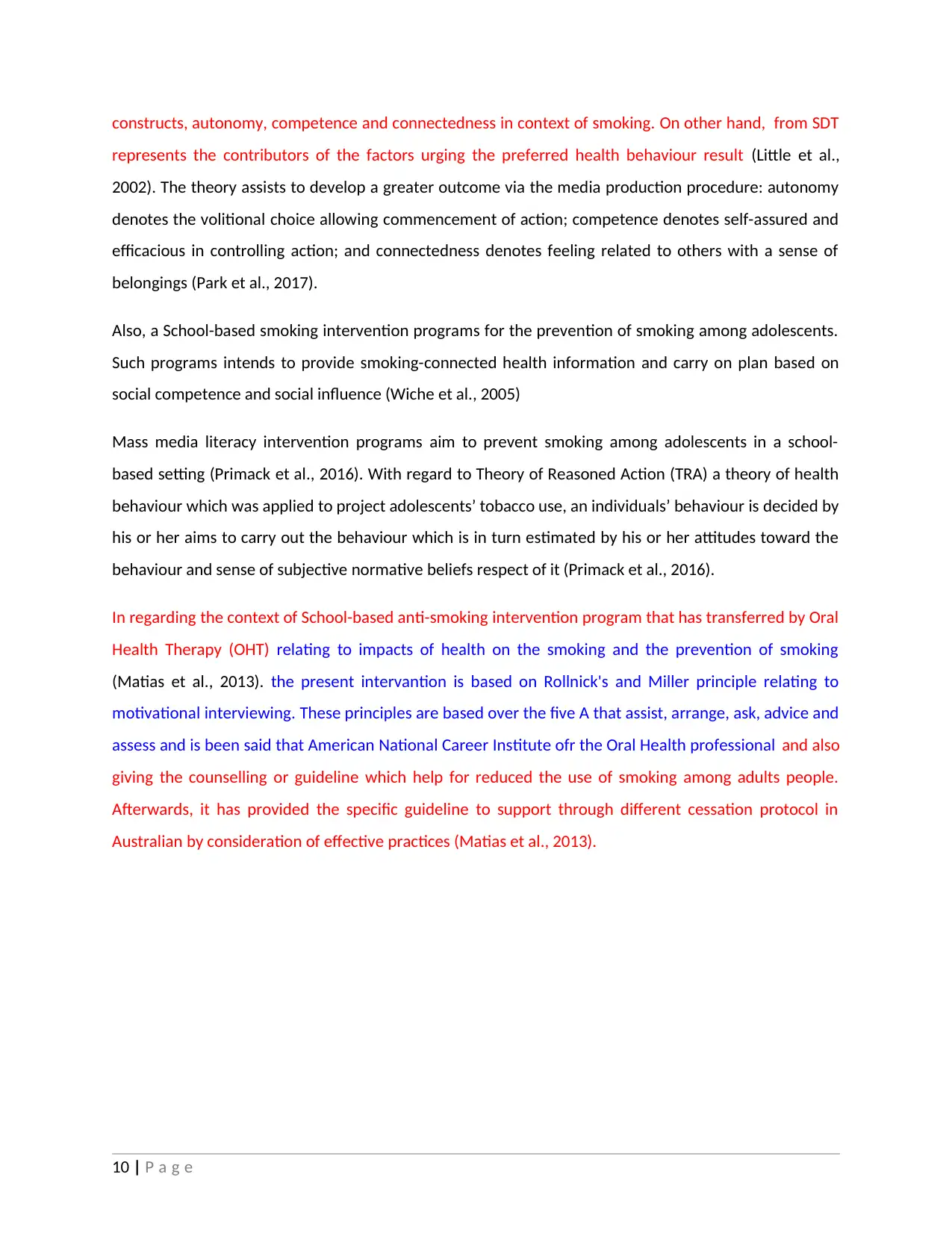
constructs, autonomy, competence and connectedness in context of smoking. On other hand, from SDT
represents the contributors of the factors urging the preferred health behaviour result (Little et al.,
2002). The theory assists to develop a greater outcome via the media production procedure: autonomy
denotes the volitional choice allowing commencement of action; competence denotes self-assured and
efficacious in controlling action; and connectedness denotes feeling related to others with a sense of
belongings (Park et al., 2017).
Also, a School-based smoking intervention programs for the prevention of smoking among adolescents.
Such programs intends to provide smoking-connected health information and carry on plan based on
social competence and social influence (Wiche et al., 2005)
Mass media literacy intervention programs aim to prevent smoking among adolescents in a school-
based setting (Primack et al., 2016). With regard to Theory of Reasoned Action (TRA) a theory of health
behaviour which was applied to project adolescents’ tobacco use, an individuals’ behaviour is decided by
his or her aims to carry out the behaviour which is in turn estimated by his or her attitudes toward the
behaviour and sense of subjective normative beliefs respect of it (Primack et al., 2016).
In regarding the context of School-based anti-smoking intervention program that has transferred by Oral
Health Therapy (OHT) relating to impacts of health on the smoking and the prevention of smoking
(Matias et al., 2013). the present intervantion is based on Rollnick's and Miller principle relating to
motivational interviewing. These principles are based over the five A that assist, arrange, ask, advice and
assess and is been said that American National Career Institute ofr the Oral Health professional and also
giving the counselling or guideline which help for reduced the use of smoking among adults people.
Afterwards, it has provided the specific guideline to support through different cessation protocol in
Australian by consideration of effective practices (Matias et al., 2013).
10 | P a g e
represents the contributors of the factors urging the preferred health behaviour result (Little et al.,
2002). The theory assists to develop a greater outcome via the media production procedure: autonomy
denotes the volitional choice allowing commencement of action; competence denotes self-assured and
efficacious in controlling action; and connectedness denotes feeling related to others with a sense of
belongings (Park et al., 2017).
Also, a School-based smoking intervention programs for the prevention of smoking among adolescents.
Such programs intends to provide smoking-connected health information and carry on plan based on
social competence and social influence (Wiche et al., 2005)
Mass media literacy intervention programs aim to prevent smoking among adolescents in a school-
based setting (Primack et al., 2016). With regard to Theory of Reasoned Action (TRA) a theory of health
behaviour which was applied to project adolescents’ tobacco use, an individuals’ behaviour is decided by
his or her aims to carry out the behaviour which is in turn estimated by his or her attitudes toward the
behaviour and sense of subjective normative beliefs respect of it (Primack et al., 2016).
In regarding the context of School-based anti-smoking intervention program that has transferred by Oral
Health Therapy (OHT) relating to impacts of health on the smoking and the prevention of smoking
(Matias et al., 2013). the present intervantion is based on Rollnick's and Miller principle relating to
motivational interviewing. These principles are based over the five A that assist, arrange, ask, advice and
assess and is been said that American National Career Institute ofr the Oral Health professional and also
giving the counselling or guideline which help for reduced the use of smoking among adults people.
Afterwards, it has provided the specific guideline to support through different cessation protocol in
Australian by consideration of effective practices (Matias et al., 2013).
10 | P a g e
Paraphrase This Document
Need a fresh take? Get an instant paraphrase of this document with our AI Paraphraser
CHAPTER TWO
METHODOLOGY
Literature review is the broad study and explanation of literature that connects to particular question
(Aveyard, 2018). I have used the research question that help for attempting to identify the positive
response of different research questions. Furthermore, it is also assessing and evaluating the pertinent
literature using a structured approach (Aveyard, 2018). In addition, literature review is a piece of
research and has a particular method. The method of carrying out a literature reviews follows the
identified phases of the research procedure (Moule et al., 2016). Thus, a literature review will have a
distinct clarified research question that is answer by searching for pertinent literature and then
assessing and evaluating that literature (Aveyard, 2016). It comprises of the following (Aveyard, 2018).
* Research question: that is provided in the brief introduction about whole research project;
* Method section: It obviously state the way the question will be answered, it can be used qualitative
methodology and other type of search strategy, Through this literature, it can be appraisal and other
type of analysing the literature;
*Result question: It is set of identifying accurate results, it become obvious thing to represent and also
integration of the critical appraisal of the studies.
11 | P a g e
METHODOLOGY
Literature review is the broad study and explanation of literature that connects to particular question
(Aveyard, 2018). I have used the research question that help for attempting to identify the positive
response of different research questions. Furthermore, it is also assessing and evaluating the pertinent
literature using a structured approach (Aveyard, 2018). In addition, literature review is a piece of
research and has a particular method. The method of carrying out a literature reviews follows the
identified phases of the research procedure (Moule et al., 2016). Thus, a literature review will have a
distinct clarified research question that is answer by searching for pertinent literature and then
assessing and evaluating that literature (Aveyard, 2016). It comprises of the following (Aveyard, 2018).
* Research question: that is provided in the brief introduction about whole research project;
* Method section: It obviously state the way the question will be answered, it can be used qualitative
methodology and other type of search strategy, Through this literature, it can be appraisal and other
type of analysing the literature;
*Result question: It is set of identifying accurate results, it become obvious thing to represent and also
integration of the critical appraisal of the studies.
11 | P a g e
*It has discussed and recommended the effective practices in research project.
The PICO framework has been in existence for long and can be used for both redefining questions and
developing strategies. PICO stands for population, intervention, comparison and outcome. The PICO
framework was meant for questions that include intervention and comparisons, which makes it
cumbersome to use in its real form for developing and refining questions that do not include these
components (Hewitt-Taylor, 2017).
In addition, The purpose of PICO framework that help for explaining the concentration on
interventions to prevent the effects of smoking. Afterwards, it also comparisons between health
interventions program Afterwards, it can be evaluating the specific result or outcome. It is one of the
most amenable to questions intended at evaluating the evidence from quantitative instead of
qualitative research (Cooke et al., 2012). The aim of using a framework is to assist in developing a
distinct and focused question, not to create difficulties. At the same manner, whilst some questions have
no comparison, some do have various comparisons (Guyatt et al., 2011). However, even if PICO
framework does not exactly fit your questions, using its principles can assist you to think about what you
want to research, even if you do not end up with a true PICO question (Hewitt-Taylor, 2017).
In this research project, it is basically considered PICO framework to examine the specific review of the
literature that is 'is education for health intervention effective in order to prevent smoking habit among
the adolescent?':
Population: adolescents
Intervention: eduction relating to health
Comparison: education counselling and nursing database.
Outcome: smoking
Intervention
the library chosen for the current study is the Medline (Ovid) and CINAHL.
A study was conducted within the database of CINAHL that is Cumulative Index of Nursing and Allied
Health Literature. Thus this study was an instrument for the nursing professionals wherein the users of
informaiton can have acces to the fast and good essay relating to the data. This data of CINAHL involved
12 | P a g e
The PICO framework has been in existence for long and can be used for both redefining questions and
developing strategies. PICO stands for population, intervention, comparison and outcome. The PICO
framework was meant for questions that include intervention and comparisons, which makes it
cumbersome to use in its real form for developing and refining questions that do not include these
components (Hewitt-Taylor, 2017).
In addition, The purpose of PICO framework that help for explaining the concentration on
interventions to prevent the effects of smoking. Afterwards, it also comparisons between health
interventions program Afterwards, it can be evaluating the specific result or outcome. It is one of the
most amenable to questions intended at evaluating the evidence from quantitative instead of
qualitative research (Cooke et al., 2012). The aim of using a framework is to assist in developing a
distinct and focused question, not to create difficulties. At the same manner, whilst some questions have
no comparison, some do have various comparisons (Guyatt et al., 2011). However, even if PICO
framework does not exactly fit your questions, using its principles can assist you to think about what you
want to research, even if you do not end up with a true PICO question (Hewitt-Taylor, 2017).
In this research project, it is basically considered PICO framework to examine the specific review of the
literature that is 'is education for health intervention effective in order to prevent smoking habit among
the adolescent?':
Population: adolescents
Intervention: eduction relating to health
Comparison: education counselling and nursing database.
Outcome: smoking
Intervention
the library chosen for the current study is the Medline (Ovid) and CINAHL.
A study was conducted within the database of CINAHL that is Cumulative Index of Nursing and Allied
Health Literature. Thus this study was an instrument for the nursing professionals wherein the users of
informaiton can have acces to the fast and good essay relating to the data. This data of CINAHL involved
12 | P a g e
⊘ This is a preview!⊘
Do you want full access?
Subscribe today to unlock all pages.
Trusted by 1+ million students worldwide

1 out of 42


Your All-in-One AI-Powered Toolkit for Academic Success.
+13062052269
info@desklib.com
Available 24*7 on WhatsApp / Email
![[object Object]](/_next/static/media/star-bottom.7253800d.svg)
Unlock your academic potential
Copyright © 2020–2026 A2Z Services. All Rights Reserved. Developed and managed by ZUCOL.