Health Education and Factors Impacting Health Status: An Overview
VerifiedAdded on 2023/06/16
|9
|3235
|246
Essay
AI Summary
This essay delves into the significance of health education and its influence on individual health status, examining factors such as socio-economic status and education. It compares and contrasts these factors, highlighting their similarities and differences in impacting health outcomes. The essay also addresses potential barriers service users may encounter when accessing healthcare services, including financial, psychological, emotional, and cultural obstacles. Furthermore, it explores the relationship between illness and health beliefs, emphasizing how perceptions and attitudes can affect health-related behaviors and decisions. The discussion extends to the range of factors that can affect communication between healthcare practitioners and service users, underscoring the importance of understanding these dynamics for effective healthcare delivery. Desklib provides this essay and other resources for students.
Health education

Paraphrase This Document
Need a fresh take? Get an instant paraphrase of this document with our AI Paraphraser
Table of Contents
INTRODUCTION...........................................................................................................................3
MAIN BODY...................................................................................................................................3
CONCLUSION................................................................................................................................8
REFERENCES................................................................................................................................9
INTRODUCTION...........................................................................................................................3
MAIN BODY...................................................................................................................................3
CONCLUSION................................................................................................................................8
REFERENCES................................................................................................................................9
INTRODUCTION
Health education refers to the type of education which can be designed for individual for
gaining knowledge, value, skills along with attitude which are necessary to maintain, promote,
restore and improving patient health. This is the one which can be effective and allow individual
to gain information that can allow to deliver quality health care services to the large population.
In this essay, there is discussion about the importance of health education and the factor which
can impact the health status that can includes similarities along with differences. There is also
comparison of factors which includes education along with socio-economic group. There is
discussion about the potential barriers for the service user that can be faced during accessing
healthcare services. There is also discussion about relationship between illness and health beliefs.
There is also discussion about the range of factors which can affect the communication between
healthcare practitioner and service user (Bafadhel and et. al., 2018).
MAIN BODY
Health status refers to an individual relative level of illness and wellness which can take
into account and have the presence of physiological, biological dysfunction, functional
impairment, symptoms. In this, there is need to ensure about the good health which can be
achieved through getting health education. There are different range of factor which can impact
individual health. This is the one which is effective and allow to ensure about the impact on
individual health. There are some determinants of health which are important factor for
impacting individual health. This may include economic, personal, social and environmental
factor which are effective and have the ability to influence individual health status. There is also
some another factor which are also effective and plays an important role in impacting individual
health. This may include random events, healthcare, quality of relationship, individual behaviour
and decision which individual make (Dalton and et. al., 2019). Education and socio-economic
group can be the factor which can impact individual health status. There are some seminaries and
some differences which can be effective to for individual health.
Education is important in providing knowledge and skills which are effective and allow to
delivery quality life. Through education individual is able to learn different skills and knowledge
which can be applied to take care of their own health. This can be effective and allow individual
to ensure about their better health. Socio-economic group is also effective and ensure about
Health education refers to the type of education which can be designed for individual for
gaining knowledge, value, skills along with attitude which are necessary to maintain, promote,
restore and improving patient health. This is the one which can be effective and allow individual
to gain information that can allow to deliver quality health care services to the large population.
In this essay, there is discussion about the importance of health education and the factor which
can impact the health status that can includes similarities along with differences. There is also
comparison of factors which includes education along with socio-economic group. There is
discussion about the potential barriers for the service user that can be faced during accessing
healthcare services. There is also discussion about relationship between illness and health beliefs.
There is also discussion about the range of factors which can affect the communication between
healthcare practitioner and service user (Bafadhel and et. al., 2018).
MAIN BODY
Health status refers to an individual relative level of illness and wellness which can take
into account and have the presence of physiological, biological dysfunction, functional
impairment, symptoms. In this, there is need to ensure about the good health which can be
achieved through getting health education. There are different range of factor which can impact
individual health. This is the one which is effective and allow to ensure about the impact on
individual health. There are some determinants of health which are important factor for
impacting individual health. This may include economic, personal, social and environmental
factor which are effective and have the ability to influence individual health status. There is also
some another factor which are also effective and plays an important role in impacting individual
health. This may include random events, healthcare, quality of relationship, individual behaviour
and decision which individual make (Dalton and et. al., 2019). Education and socio-economic
group can be the factor which can impact individual health status. There are some seminaries and
some differences which can be effective to for individual health.
Education is important in providing knowledge and skills which are effective and allow to
delivery quality life. Through education individual is able to learn different skills and knowledge
which can be applied to take care of their own health. This can be effective and allow individual
to ensure about their better health. Socio-economic group is also effective and ensure about
⊘ This is a preview!⊘
Do you want full access?
Subscribe today to unlock all pages.

Trusted by 1+ million students worldwide
providing financial status which can be helpful in attaining better education related with health.
This allow to deliver the quality and improvement in individual health (Dantas, Fleck, Oliveira
and Hamacher, 2018). Education and Socio-economic both factor is effective and allow
individual to gain information either directly or indirectly about the attaining better and
improved health. There is also a similarity that both are effective factor and plays an important
role in deliver quality life and improved individual health. There is also a similarity that both are
having perception of social class and social status which can enforces to attain good health and
provide positive health status.
There is a difference between the education and socio-economic factor that both are
separate identity. Where education can provide knowledge and help in learning different skills
which can be effective and allow to deliver better health. Here, health education can be helpful to
ensure practice positive aspect which can allow to provide better and positive health impact on
individual life (Doris, Cheng and Wang, 2018). Whereas, socio-economic factor can be having
their own importance that can impact individual impact on their health. This is related with
individual income but not onto it. This also encompasses subjective perception, financial
security. In this, it focusses on the society and social health which is also effective and can have
better impact on society health which comprises of many individual. There is also difference
between both factor that education can influence individual regarding implementing best practice
that can help in attaining better health. Whereas, socio-economic factor can ensure about the
facilities that can be attain by society or individual for achieving better and improved health.
While accessing to healthcare services individual or large population may face different
barriers which can be highly effective and force individual in getting access to effective
healthcare services. In this, there are some of the potential barriers like healthcare cost,
psychological, emotional, cultural, attitude and individual perception barrier can face by the
service user while accessing healthcare services (Jan and et. al., 2018). These are some of the
potential barrier which can be faced by the service user while accessing to the healthcare.
Healthcare cost is one of the potential factor which can be effective and play an important
role while service user access to healthcare services. This allow individual to receive healthcare
services according to financial status. Every individual has their own potential to afford cost of
healthcare. Sometime, there is need to get healthcare services which are cost effective and
individual is not able to receive such services. Service user need to pay for the care service cost
This allow to deliver the quality and improvement in individual health (Dantas, Fleck, Oliveira
and Hamacher, 2018). Education and Socio-economic both factor is effective and allow
individual to gain information either directly or indirectly about the attaining better and
improved health. There is also a similarity that both are effective factor and plays an important
role in deliver quality life and improved individual health. There is also a similarity that both are
having perception of social class and social status which can enforces to attain good health and
provide positive health status.
There is a difference between the education and socio-economic factor that both are
separate identity. Where education can provide knowledge and help in learning different skills
which can be effective and allow to deliver better health. Here, health education can be helpful to
ensure practice positive aspect which can allow to provide better and positive health impact on
individual life (Doris, Cheng and Wang, 2018). Whereas, socio-economic factor can be having
their own importance that can impact individual impact on their health. This is related with
individual income but not onto it. This also encompasses subjective perception, financial
security. In this, it focusses on the society and social health which is also effective and can have
better impact on society health which comprises of many individual. There is also difference
between both factor that education can influence individual regarding implementing best practice
that can help in attaining better health. Whereas, socio-economic factor can ensure about the
facilities that can be attain by society or individual for achieving better and improved health.
While accessing to healthcare services individual or large population may face different
barriers which can be highly effective and force individual in getting access to effective
healthcare services. In this, there are some of the potential barriers like healthcare cost,
psychological, emotional, cultural, attitude and individual perception barrier can face by the
service user while accessing healthcare services (Jan and et. al., 2018). These are some of the
potential barrier which can be faced by the service user while accessing to the healthcare.
Healthcare cost is one of the potential factor which can be effective and play an important
role while service user access to healthcare services. This allow individual to receive healthcare
services according to financial status. Every individual has their own potential to afford cost of
healthcare. Sometime, there is need to get healthcare services which are cost effective and
individual is not able to receive such services. Service user need to pay for the care service cost
Paraphrase This Document
Need a fresh take? Get an instant paraphrase of this document with our AI Paraphraser
which is not possible for every social class and can create barrier for the service user to access to
healthcare services (KNOW, 2020). There is need to spend some cost on health care to attain
better healthcare services for getting effective health. Cost have an important role in delivery of
healthcare services where higher cost can create barrier to access the healthcare services. There
are large population who are not financially strong and are not able to afford the higher cost of
healthcare services. This restrict them to receive the particular treatment where healthcare cost
acts as an effective barrier. Due to higher cost many people like to avoid the access to healthcare
services and like to prevent their health condition through management and other substitute.
Example- When patient need to get treatment of cancer then cost for getting proper
treatment is higher. Due to this, there are many patients who get unable to bear the cost of
expenses for the treatment and create barrier to access to healthcare treatment.
Individual perception also plays an important role while accessing to healthcare services.
This is one of the potential barrier which is highly effective and influence individual to restrict
the access to healthcare services. Every individual has their own perception where they have
either positive or negative perception that can have high impact on their behaviour and influence
their decision making. This is the one which can result on the influencing individual regarding
access to health care services (Mirbolouk and et. al., 2018). This can also influence them to take
action and ensure about attain good health. Individual perception can have the role in influencing
individual about either to take the healthcare service or not. This can create barrier to service
user in accessing to healthcare services. Individual perception can be effective that can influence
individual behaviour which can create barrier for service user while accessing to the healthcare
services.
Example- There are many people who have some perception about healthcare services.
During covid, there was perception within large population about the effectives and impact of
vaccine which influence their behaviour regarding getting vaccinated. In this, due to having
perception that they may get sick or die because vaccine is not having 100% effective. This
individual perception act as barrier while accessing to the healthcare services.
There is also other potential barrier like emotional, cultural, attitude that can create
different impact on service user that can create barrier to accessing the healthcare services.
Emotional barrier can create barrier in accessing healthcare services to service user.
healthcare services (KNOW, 2020). There is need to spend some cost on health care to attain
better healthcare services for getting effective health. Cost have an important role in delivery of
healthcare services where higher cost can create barrier to access the healthcare services. There
are large population who are not financially strong and are not able to afford the higher cost of
healthcare services. This restrict them to receive the particular treatment where healthcare cost
acts as an effective barrier. Due to higher cost many people like to avoid the access to healthcare
services and like to prevent their health condition through management and other substitute.
Example- When patient need to get treatment of cancer then cost for getting proper
treatment is higher. Due to this, there are many patients who get unable to bear the cost of
expenses for the treatment and create barrier to access to healthcare treatment.
Individual perception also plays an important role while accessing to healthcare services.
This is one of the potential barrier which is highly effective and influence individual to restrict
the access to healthcare services. Every individual has their own perception where they have
either positive or negative perception that can have high impact on their behaviour and influence
their decision making. This is the one which can result on the influencing individual regarding
access to health care services (Mirbolouk and et. al., 2018). This can also influence them to take
action and ensure about attain good health. Individual perception can have the role in influencing
individual about either to take the healthcare service or not. This can create barrier to service
user in accessing to healthcare services. Individual perception can be effective that can influence
individual behaviour which can create barrier for service user while accessing to the healthcare
services.
Example- There are many people who have some perception about healthcare services.
During covid, there was perception within large population about the effectives and impact of
vaccine which influence their behaviour regarding getting vaccinated. In this, due to having
perception that they may get sick or die because vaccine is not having 100% effective. This
individual perception act as barrier while accessing to the healthcare services.
There is also other potential barrier like emotional, cultural, attitude that can create
different impact on service user that can create barrier to accessing the healthcare services.
Emotional barrier can create barrier in accessing healthcare services to service user.
There are various barriers came across for the service user while assessing the healthcare
such as the psychological, emotional, economic, cultural, attitude, perceptions and many other.
These particular barriers can play an essential role as well as make a negative impact over the
service user while assessing the healthcare (Pearce and et. al., 2018). In context with
psychological barriers, these are particularly due to an emotional character as well as the mental
limitations of an individual. Such barriers can contain an outcome which is about absent
mindedness, the fear of expressing the ideas or thoughts of one person towards the other. It can
also involve the emotional instability, excitement, these all can account for an overwhelming
various communication issues. It is particularly due to the way an individual's mind can works as
well as the way that this can impact over the behaviours. The psychological requirements as well
as the feelings are generally the basic obstacles towards the healthcare communication process
where the service user as well as the service provider's interaction can be affected. In context
with the attitudinal barriers, these are the particular barriers which generally results from the
people's own assumption as well as the attitude which are particularly build up over the past
years and is based on the socio-economic as well as the cultural background. It can particularly
grow in a part due to which the people's unique frame of references that is basically a sum of
their past experiences, fears, their beliefs as well as their expectations (Rajgor and et. al., 2020).
In context with the perception as a barrier, the way people can perceive an event which
specifically can affect the way in which the thoughts of the people about it are converted while
communicating, sending, receiving as well as interpreting or determining a particular message.
In this, the issue while communicating with the others can occurs because the people can
perceive the things more differently particularly based on the unique experiences of an
individual.
In the well-being, making decisions among the people are particularly expected to
navigate the choices which are particularly involved in identifying the risk for the consequences
with the benefits of the action. The behaviours generally contribute towards the initiation of the
illness as well as the progression which are often pleasurable such as overeating and smoking. In
this, the motivation to forgo these such pleasurable behaviours or can engage in the inconvenient
preventive behaviours is generally believed to be driven to some of its extent by the beliefs about
the likelihood that the consequences of well-being will occur (Rodrigues, Brochado, Troilo and
Mohsin, 2017). The co-relational information can encourage an at least the modest link among
such as the psychological, emotional, economic, cultural, attitude, perceptions and many other.
These particular barriers can play an essential role as well as make a negative impact over the
service user while assessing the healthcare (Pearce and et. al., 2018). In context with
psychological barriers, these are particularly due to an emotional character as well as the mental
limitations of an individual. Such barriers can contain an outcome which is about absent
mindedness, the fear of expressing the ideas or thoughts of one person towards the other. It can
also involve the emotional instability, excitement, these all can account for an overwhelming
various communication issues. It is particularly due to the way an individual's mind can works as
well as the way that this can impact over the behaviours. The psychological requirements as well
as the feelings are generally the basic obstacles towards the healthcare communication process
where the service user as well as the service provider's interaction can be affected. In context
with the attitudinal barriers, these are the particular barriers which generally results from the
people's own assumption as well as the attitude which are particularly build up over the past
years and is based on the socio-economic as well as the cultural background. It can particularly
grow in a part due to which the people's unique frame of references that is basically a sum of
their past experiences, fears, their beliefs as well as their expectations (Rajgor and et. al., 2020).
In context with the perception as a barrier, the way people can perceive an event which
specifically can affect the way in which the thoughts of the people about it are converted while
communicating, sending, receiving as well as interpreting or determining a particular message.
In this, the issue while communicating with the others can occurs because the people can
perceive the things more differently particularly based on the unique experiences of an
individual.
In the well-being, making decisions among the people are particularly expected to
navigate the choices which are particularly involved in identifying the risk for the consequences
with the benefits of the action. The behaviours generally contribute towards the initiation of the
illness as well as the progression which are often pleasurable such as overeating and smoking. In
this, the motivation to forgo these such pleasurable behaviours or can engage in the inconvenient
preventive behaviours is generally believed to be driven to some of its extent by the beliefs about
the likelihood that the consequences of well-being will occur (Rodrigues, Brochado, Troilo and
Mohsin, 2017). The co-relational information can encourage an at least the modest link among
⊘ This is a preview!⊘
Do you want full access?
Subscribe today to unlock all pages.
Trusted by 1+ million students worldwide
the risk perception as well as the health behaviours. In this, the risk perception is generally also
reliably impacted by the contextual factors. Such as the looming threats can become more
immediate, the risk perception can tend to become more pessimistic. In this, the perception of the
following risks also tends to be greater when the well-being threats is generally seen dreaded or
uncontrollable. Moreover, an affective contextual factors can play an essential role among people
can experiencing an anger that particularly tends to involves the more optimistic risk perceptions.
In this, those people who generally experiencing the fear generally tends to involve more
pessimistic perceptions of developing risk. The general affects can also impact the synthesis of
perceptions of risk. Such as the distress is generally linked with the elevated perceptions of risk
as well as the people who are depressed are more prone to adjust their perceptions regarding risk
estimates in response to the health data than the non-depressed people (Shiha and et. al., 2021).
These particular tendencies contain an essential implication for the formation of risk perceptions
in context with well-being. In this, it is given that most of the well-being threats as well as the
clinical care concept can particularly evoke the very strong emotions. In this, the health beliefs
involve a model called as health belief model which illustrates that a person's belief in a personal
threat of a particular illness in linked with a person's belief in the effectiveness of the
recommended well-being behaviours or the actions that will predict the possibility about the
person will adopt the particular behaviour. It can construct to predict the well-being behaviours
such as the risk severity, the benefits of action, risk susceptibility, the self -efficacy as well as the
cues of action. It can effectively define the key components which particularly impacts the well-
being behaviours as the people's perceived threats towards a particular sickness, the beliefs of
consequences, the potential benefits of the particular actions as well as the exposure towards the
factors which specifically prompts. In context with the risk perception, it particularly refers
towards the person's judgement about the possibility of the negative happenings like illness,
deaths, injuries and so on. It is specifically essential in the well-being as well as the risk
communication because it analyses the particular hazards for which the people care about. It can
also involve the determination about how the people can effectively deal with such hazards. In
this, the strengths are directly related with the self-perceived competence (Villa-Torres and et.
al., 2017). If the efficacy matches the perception of competence needed, elevated satisfaction as
well as the low fear can results as well as the interactions among them will be a rewarding
reliably impacted by the contextual factors. Such as the looming threats can become more
immediate, the risk perception can tend to become more pessimistic. In this, the perception of the
following risks also tends to be greater when the well-being threats is generally seen dreaded or
uncontrollable. Moreover, an affective contextual factors can play an essential role among people
can experiencing an anger that particularly tends to involves the more optimistic risk perceptions.
In this, those people who generally experiencing the fear generally tends to involve more
pessimistic perceptions of developing risk. The general affects can also impact the synthesis of
perceptions of risk. Such as the distress is generally linked with the elevated perceptions of risk
as well as the people who are depressed are more prone to adjust their perceptions regarding risk
estimates in response to the health data than the non-depressed people (Shiha and et. al., 2021).
These particular tendencies contain an essential implication for the formation of risk perceptions
in context with well-being. In this, it is given that most of the well-being threats as well as the
clinical care concept can particularly evoke the very strong emotions. In this, the health beliefs
involve a model called as health belief model which illustrates that a person's belief in a personal
threat of a particular illness in linked with a person's belief in the effectiveness of the
recommended well-being behaviours or the actions that will predict the possibility about the
person will adopt the particular behaviour. It can construct to predict the well-being behaviours
such as the risk severity, the benefits of action, risk susceptibility, the self -efficacy as well as the
cues of action. It can effectively define the key components which particularly impacts the well-
being behaviours as the people's perceived threats towards a particular sickness, the beliefs of
consequences, the potential benefits of the particular actions as well as the exposure towards the
factors which specifically prompts. In context with the risk perception, it particularly refers
towards the person's judgement about the possibility of the negative happenings like illness,
deaths, injuries and so on. It is specifically essential in the well-being as well as the risk
communication because it analyses the particular hazards for which the people care about. It can
also involve the determination about how the people can effectively deal with such hazards. In
this, the strengths are directly related with the self-perceived competence (Villa-Torres and et.
al., 2017). If the efficacy matches the perception of competence needed, elevated satisfaction as
well as the low fear can results as well as the interactions among them will be a rewarding
Paraphrase This Document
Need a fresh take? Get an instant paraphrase of this document with our AI Paraphraser
experience. In this, the self-efficacy can play an essential part in dealing with the problems
regarding health.
The factors which can affect the care provider and patient’s communication can involve
the differences in languages, variation in perceptions of illness, the variation in perceptions of
social components of the well-being communication and so on. It is necessary to reduce the
language differences as it can negatively influence the well-being outcomes such as by
decreasing the satisfaction level of the patients. Furthermore, it is important in a healthcare
system to have an effective communication among the healthcare professionals or care providers
with the patients as it can lead to the higher understanding of the patient’s health issues.
Effective communication can contribute towards the increased adherence to the treatment plans
and thus, providing the support (Zhang and et. al., 2017).
CONCLUSION
From the above discussion it is concluded that the relationships among the care providers
and the service user is very crucial. The partnership working through the development of the
very positive relationships can ensures an enhanced practice holistic approach towards the care
as well as the support which is needed. In this, the positive relationships are based on the trust,
which is particularly a key to ensuring the people are particularly safeguarded as well as can
receive the care and encouragement which they require. In this, it is concluded from the above
report that there are various factors which can impact over the health status such as education as
well as the socio-economic groups. In this, it is also concluded that it specifically involves the
barriers through which the service user generally faces the issues while assessing the healthcare
services. The barriers which are described in the above report can include such as the language
barriers, psychological, cultural, attitudinal as well as the perception barriers that particularly
makes a negative influence over the service users while assessing the healthcare needs.
regarding health.
The factors which can affect the care provider and patient’s communication can involve
the differences in languages, variation in perceptions of illness, the variation in perceptions of
social components of the well-being communication and so on. It is necessary to reduce the
language differences as it can negatively influence the well-being outcomes such as by
decreasing the satisfaction level of the patients. Furthermore, it is important in a healthcare
system to have an effective communication among the healthcare professionals or care providers
with the patients as it can lead to the higher understanding of the patient’s health issues.
Effective communication can contribute towards the increased adherence to the treatment plans
and thus, providing the support (Zhang and et. al., 2017).
CONCLUSION
From the above discussion it is concluded that the relationships among the care providers
and the service user is very crucial. The partnership working through the development of the
very positive relationships can ensures an enhanced practice holistic approach towards the care
as well as the support which is needed. In this, the positive relationships are based on the trust,
which is particularly a key to ensuring the people are particularly safeguarded as well as can
receive the care and encouragement which they require. In this, it is concluded from the above
report that there are various factors which can impact over the health status such as education as
well as the socio-economic groups. In this, it is also concluded that it specifically involves the
barriers through which the service user generally faces the issues while assessing the healthcare
services. The barriers which are described in the above report can include such as the language
barriers, psychological, cultural, attitudinal as well as the perception barriers that particularly
makes a negative influence over the service users while assessing the healthcare needs.
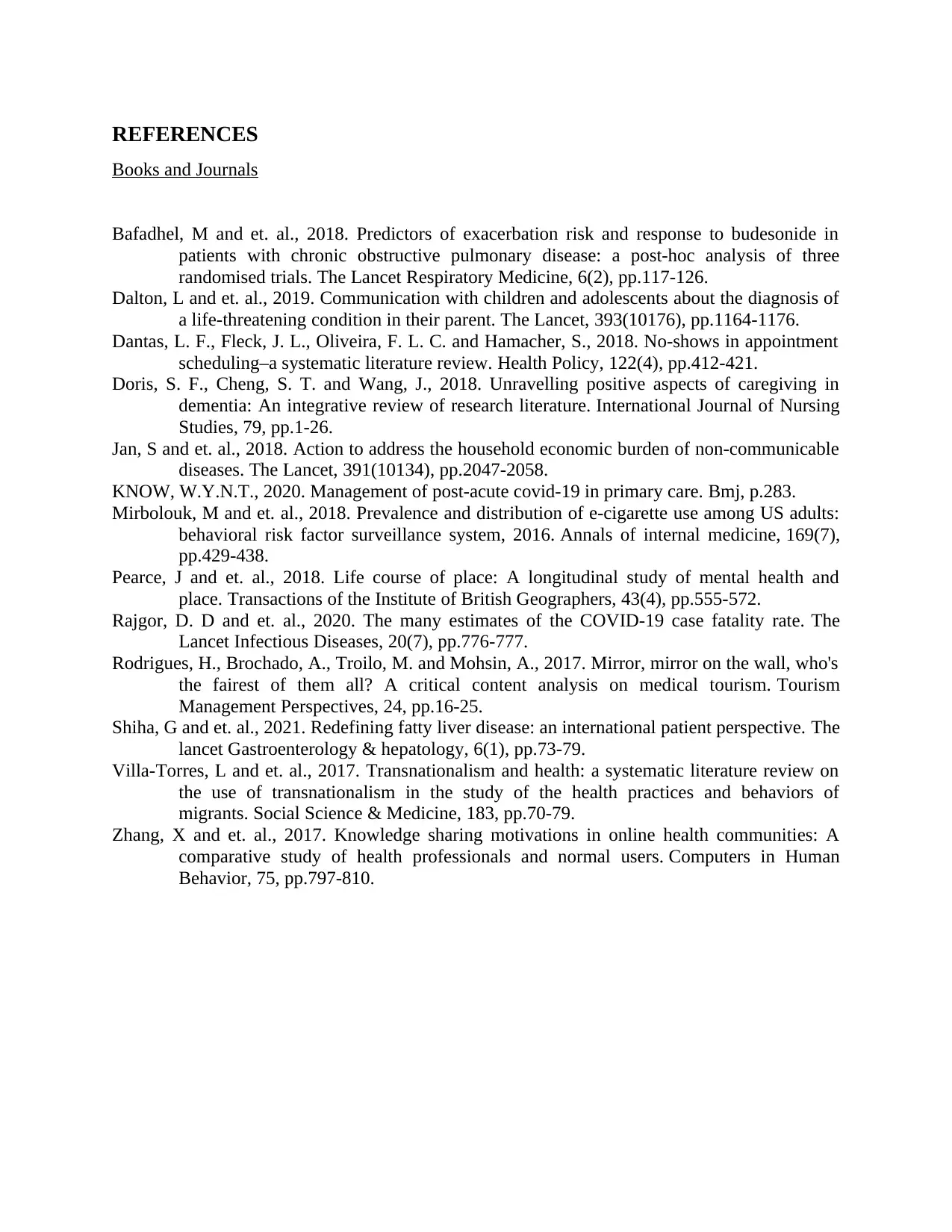
REFERENCES
Books and Journals
Bafadhel, M and et. al., 2018. Predictors of exacerbation risk and response to budesonide in
patients with chronic obstructive pulmonary disease: a post-hoc analysis of three
randomised trials. The Lancet Respiratory Medicine, 6(2), pp.117-126.
Dalton, L and et. al., 2019. Communication with children and adolescents about the diagnosis of
a life-threatening condition in their parent. The Lancet, 393(10176), pp.1164-1176.
Dantas, L. F., Fleck, J. L., Oliveira, F. L. C. and Hamacher, S., 2018. No-shows in appointment
scheduling–a systematic literature review. Health Policy, 122(4), pp.412-421.
Doris, S. F., Cheng, S. T. and Wang, J., 2018. Unravelling positive aspects of caregiving in
dementia: An integrative review of research literature. International Journal of Nursing
Studies, 79, pp.1-26.
Jan, S and et. al., 2018. Action to address the household economic burden of non-communicable
diseases. The Lancet, 391(10134), pp.2047-2058.
KNOW, W.Y.N.T., 2020. Management of post-acute covid-19 in primary care. Bmj, p.283.
Mirbolouk, M and et. al., 2018. Prevalence and distribution of e-cigarette use among US adults:
behavioral risk factor surveillance system, 2016. Annals of internal medicine, 169(7),
pp.429-438.
Pearce, J and et. al., 2018. Life course of place: A longitudinal study of mental health and
place. Transactions of the Institute of British Geographers, 43(4), pp.555-572.
Rajgor, D. D and et. al., 2020. The many estimates of the COVID-19 case fatality rate. The
Lancet Infectious Diseases, 20(7), pp.776-777.
Rodrigues, H., Brochado, A., Troilo, M. and Mohsin, A., 2017. Mirror, mirror on the wall, who's
the fairest of them all? A critical content analysis on medical tourism. Tourism
Management Perspectives, 24, pp.16-25.
Shiha, G and et. al., 2021. Redefining fatty liver disease: an international patient perspective. The
lancet Gastroenterology & hepatology, 6(1), pp.73-79.
Villa-Torres, L and et. al., 2017. Transnationalism and health: a systematic literature review on
the use of transnationalism in the study of the health practices and behaviors of
migrants. Social Science & Medicine, 183, pp.70-79.
Zhang, X and et. al., 2017. Knowledge sharing motivations in online health communities: A
comparative study of health professionals and normal users. Computers in Human
Behavior, 75, pp.797-810.
Books and Journals
Bafadhel, M and et. al., 2018. Predictors of exacerbation risk and response to budesonide in
patients with chronic obstructive pulmonary disease: a post-hoc analysis of three
randomised trials. The Lancet Respiratory Medicine, 6(2), pp.117-126.
Dalton, L and et. al., 2019. Communication with children and adolescents about the diagnosis of
a life-threatening condition in their parent. The Lancet, 393(10176), pp.1164-1176.
Dantas, L. F., Fleck, J. L., Oliveira, F. L. C. and Hamacher, S., 2018. No-shows in appointment
scheduling–a systematic literature review. Health Policy, 122(4), pp.412-421.
Doris, S. F., Cheng, S. T. and Wang, J., 2018. Unravelling positive aspects of caregiving in
dementia: An integrative review of research literature. International Journal of Nursing
Studies, 79, pp.1-26.
Jan, S and et. al., 2018. Action to address the household economic burden of non-communicable
diseases. The Lancet, 391(10134), pp.2047-2058.
KNOW, W.Y.N.T., 2020. Management of post-acute covid-19 in primary care. Bmj, p.283.
Mirbolouk, M and et. al., 2018. Prevalence and distribution of e-cigarette use among US adults:
behavioral risk factor surveillance system, 2016. Annals of internal medicine, 169(7),
pp.429-438.
Pearce, J and et. al., 2018. Life course of place: A longitudinal study of mental health and
place. Transactions of the Institute of British Geographers, 43(4), pp.555-572.
Rajgor, D. D and et. al., 2020. The many estimates of the COVID-19 case fatality rate. The
Lancet Infectious Diseases, 20(7), pp.776-777.
Rodrigues, H., Brochado, A., Troilo, M. and Mohsin, A., 2017. Mirror, mirror on the wall, who's
the fairest of them all? A critical content analysis on medical tourism. Tourism
Management Perspectives, 24, pp.16-25.
Shiha, G and et. al., 2021. Redefining fatty liver disease: an international patient perspective. The
lancet Gastroenterology & hepatology, 6(1), pp.73-79.
Villa-Torres, L and et. al., 2017. Transnationalism and health: a systematic literature review on
the use of transnationalism in the study of the health practices and behaviors of
migrants. Social Science & Medicine, 183, pp.70-79.
Zhang, X and et. al., 2017. Knowledge sharing motivations in online health communities: A
comparative study of health professionals and normal users. Computers in Human
Behavior, 75, pp.797-810.
⊘ This is a preview!⊘
Do you want full access?
Subscribe today to unlock all pages.
Trusted by 1+ million students worldwide

1 out of 9


Related Documents


Your All-in-One AI-Powered Toolkit for Academic Success.
+13062052269
info@desklib.com
Available 24*7 on WhatsApp / Email
![[object Object]](/_next/static/media/star-bottom.7253800d.svg)
Unlock your academic potential
Copyright © 2020–2026 A2Z Services. All Rights Reserved. Developed and managed by ZUCOL.