Analyzing Health Care Ethics: De-registration of Professionals

Verified

Added on  2023/06/14

|5
|1030
|280
Essay
AI Summary
This essay delves into the ethical complexities surrounding the de-registration of healthcare professionals found guilty of misconduct. It examines the pressures and challenges faced by professionals in acute healthcare settings, arguing that while maintaining professional standards is crucial, a nuanced approach is necessary before imposing lifetime de-registration. The essay considers factors such as process gaps, lack of support, cultural and spiritual mismatches, and compassionate fatigue, all of which can contribute to errors or perceived misconduct. By referencing relevant legislation and literature, it advocates for a balanced approach that prioritizes patient safety while acknowledging the humane limits and potential for rehabilitation among healthcare professionals. The essay emphasizes the importance of person-centered care, human rights, and human dignity, suggesting that de-registration should be reserved for cases where all other avenues for improvement and support have been exhausted. Desklib offers this assignment as part of its collection of study resources.
Document Page
Running head: HEALTH CARE ETHICS
Health Care Ethics
Name of the student
University name
Author’s note
tabler-icon-diamond-filled.svg

Paraphrase This Document

Need a fresh take? Get an instant paraphrase of this document with our AI Paraphraser
Document Page
1
HEALTH CARE ETHICS
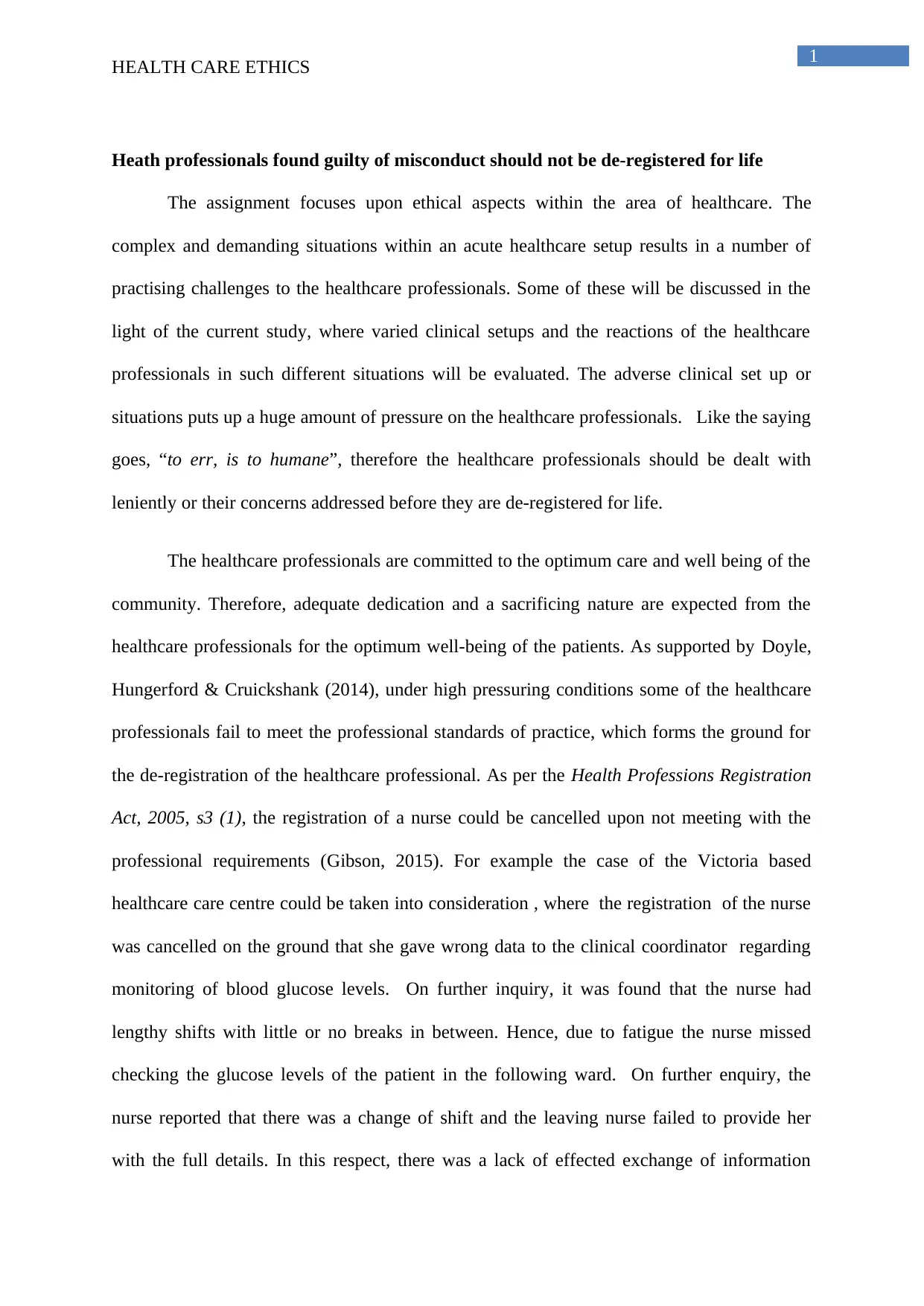
Heath professionals found guilty of misconduct should not be de-registered for life
The assignment focuses upon ethical aspects within the area of healthcare. The
complex and demanding situations within an acute healthcare setup results in a number of
practising challenges to the healthcare professionals. Some of these will be discussed in the
light of the current study, where varied clinical setups and the reactions of the healthcare
professionals in such different situations will be evaluated. The adverse clinical set up or
situations puts up a huge amount of pressure on the healthcare professionals. Like the saying
goes, “to err, is to humane”, therefore the healthcare professionals should be dealt with
leniently or their concerns addressed before they are de-registered for life.
The healthcare professionals are committed to the optimum care and well being of the
community. Therefore, adequate dedication and a sacrificing nature are expected from the
healthcare professionals for the optimum well-being of the patients. As supported by Doyle,
Hungerford & Cruickshank (2014), under high pressuring conditions some of the healthcare
professionals fail to meet the professional standards of practice, which forms the ground for
the de-registration of the healthcare professional. As per the Health Professions Registration
Act, 2005, s3 (1), the registration of a nurse could be cancelled upon not meeting with the
professional requirements (Gibson, 2015). For example the case of the Victoria based
healthcare care centre could be taken into consideration , where the registration of the nurse
was cancelled on the ground that she gave wrong data to the clinical coordinator regarding
monitoring of blood glucose levels. On further inquiry, it was found that the nurse had
lengthy shifts with little or no breaks in between. Hence, due to fatigue the nurse missed
checking the glucose levels of the patient in the following ward. On further enquiry, the
nurse reported that there was a change of shift and the leaving nurse failed to provide her
with the full details. In this respect, there was a lack of effected exchange of information
Document Page
2
HEALTH CARE ETHICS
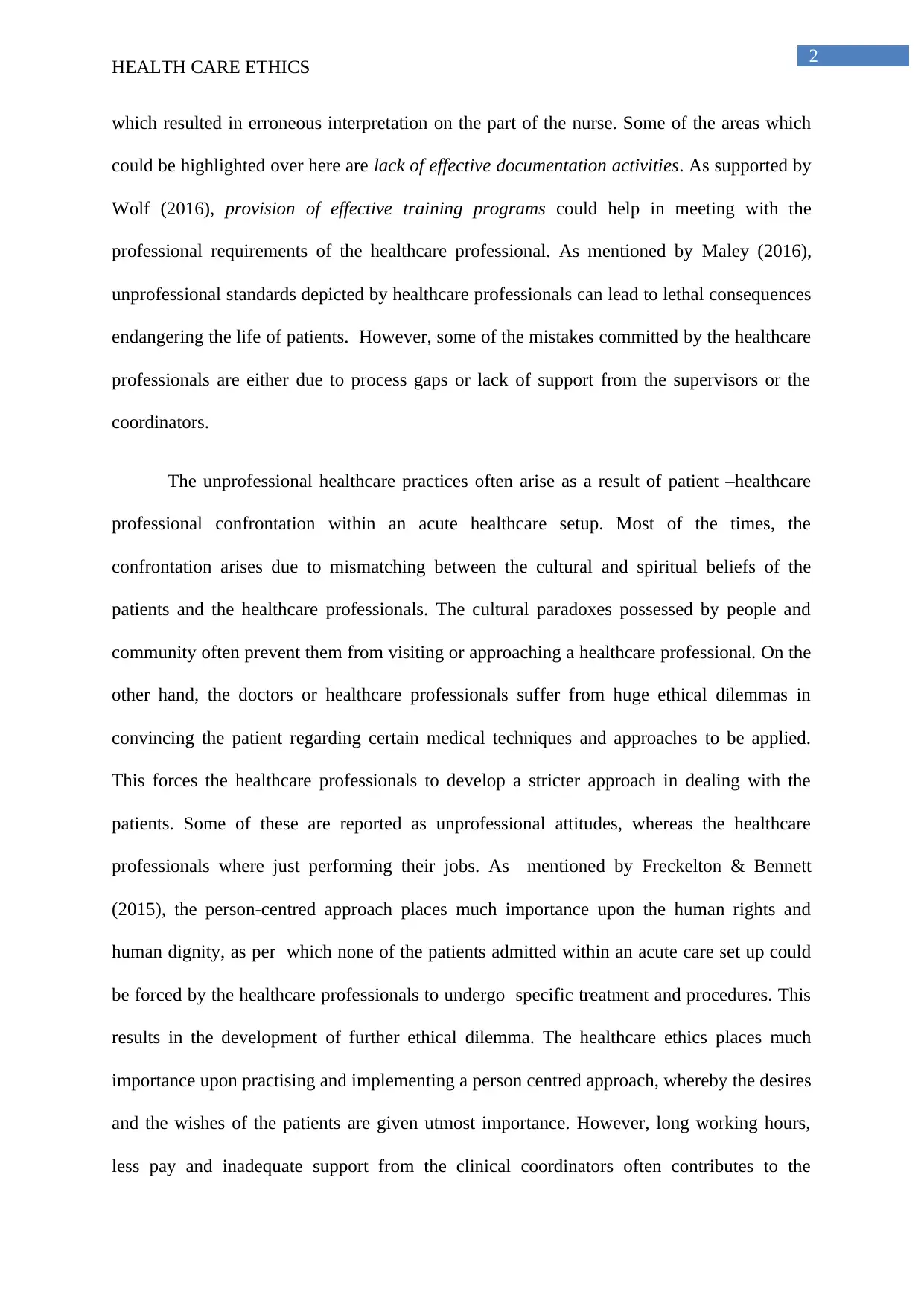
which resulted in erroneous interpretation on the part of the nurse. Some of the areas which
could be highlighted over here are lack of effective documentation activities. As supported by
Wolf (2016), provision of effective training programs could help in meeting with the
professional requirements of the healthcare professional. As mentioned by Maley (2016),
unprofessional standards depicted by healthcare professionals can lead to lethal consequences
endangering the life of patients. However, some of the mistakes committed by the healthcare
professionals are either due to process gaps or lack of support from the supervisors or the
coordinators.
The unprofessional healthcare practices often arise as a result of patient –healthcare
professional confrontation within an acute healthcare setup. Most of the times, the
confrontation arises due to mismatching between the cultural and spiritual beliefs of the
patients and the healthcare professionals. The cultural paradoxes possessed by people and
community often prevent them from visiting or approaching a healthcare professional. On the
other hand, the doctors or healthcare professionals suffer from huge ethical dilemmas in
convincing the patient regarding certain medical techniques and approaches to be applied.
This forces the healthcare professionals to develop a stricter approach in dealing with the
patients. Some of these are reported as unprofessional attitudes, whereas the healthcare
professionals where just performing their jobs. As mentioned by Freckelton & Bennett
(2015), the person-centred approach places much importance upon the human rights and
human dignity, as per which none of the patients admitted within an acute care set up could
be forced by the healthcare professionals to undergo specific treatment and procedures. This
results in the development of further ethical dilemma. The healthcare ethics places much
importance upon practising and implementing a person centred approach, whereby the desires
and the wishes of the patients are given utmost importance. However, long working hours,
less pay and inadequate support from the clinical coordinators often contributes to the
Document Page
3
HEALTH CARE ETHICS
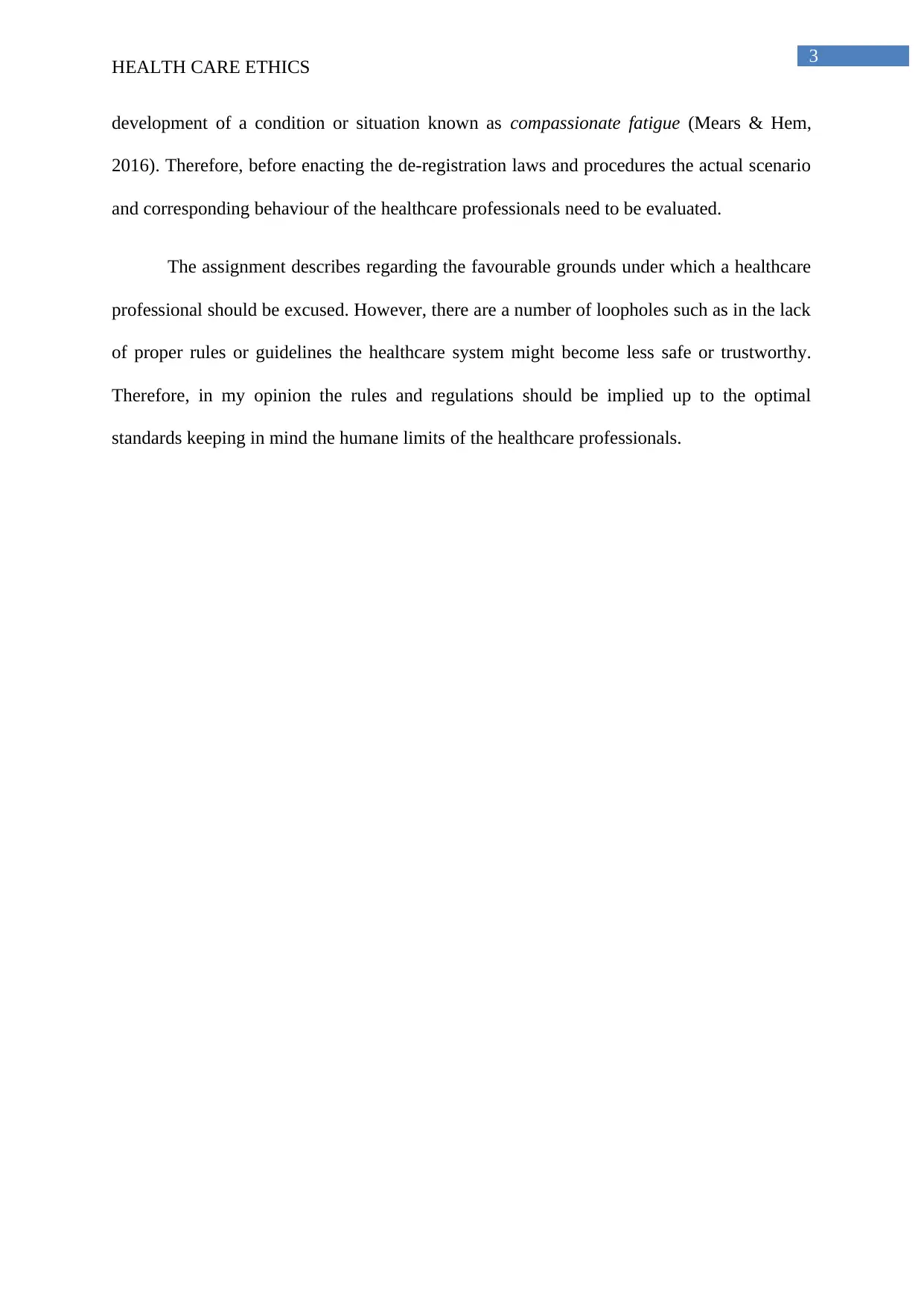
development of a condition or situation known as compassionate fatigue (Mears & Hem,
2016). Therefore, before enacting the de-registration laws and procedures the actual scenario
and corresponding behaviour of the healthcare professionals need to be evaluated.
The assignment describes regarding the favourable grounds under which a healthcare
professional should be excused. However, there are a number of loopholes such as in the lack
of proper rules or guidelines the healthcare system might become less safe or trustworthy.
Therefore, in my opinion the rules and regulations should be implied up to the optimal
standards keeping in mind the humane limits of the healthcare professionals.
tabler-icon-diamond-filled.svg

Paraphrase This Document

Need a fresh take? Get an instant paraphrase of this document with our AI Paraphraser
Document Page
4
HEALTH CARE ETHICS
References
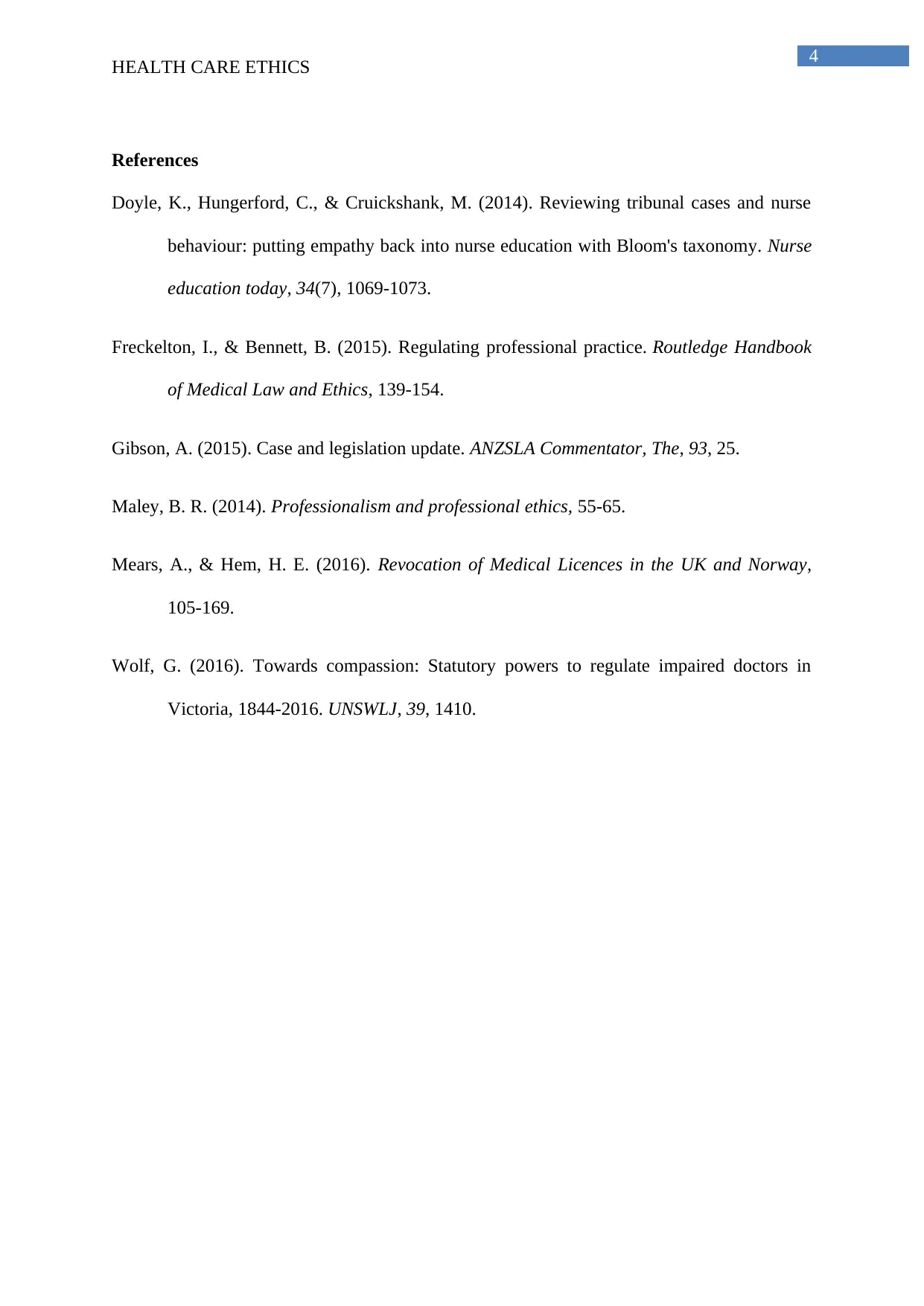
Doyle, K., Hungerford, C., & Cruickshank, M. (2014). Reviewing tribunal cases and nurse
behaviour: putting empathy back into nurse education with Bloom's taxonomy. Nurse
education today, 34(7), 1069-1073.
Freckelton, I., & Bennett, B. (2015). Regulating professional practice. Routledge Handbook
of Medical Law and Ethics, 139-154.
Gibson, A. (2015). Case and legislation update. ANZSLA Commentator, The, 93, 25.
Maley, B. R. (2014). Professionalism and professional ethics, 55-65.
Mears, A., & Hem, H. E. (2016). Revocation of Medical Licences in the UK and Norway,
105-169.
Wolf, G. (2016). Towards compassion: Statutory powers to regulate impaired doctors in
Victoria, 1844-2016. UNSWLJ, 39, 1410.
chevron_up_icon
1 out of 5
circle_padding
hide_on_mobile
zoom_out_icon
[object Object]