Health and Human Service Management: Basketball Injury Treatment

Verified

Added on  2023/05/30

|12
|771
|241
Report
AI Summary
This report introduces the application of Health and Human Service Management (HHRM) in sports, specifically focusing on basketball injury care and treatment. It highlights the relevance of HHRM in addressing healthcare issues, reducing injuries, and motivating players for high performance. Common basketball injuries such as ankle sprains and knee injuries are discussed, emphasizing the importance of effective communication between managers and injured players. The report also touches upon potential legal actions players might pursue in case of injury, including assumption of risk, intentional tort, and product liability lawsuits. Ethical considerations within HHRM, such as unbiased care and treatment, are underscored. Furthermore, the study assesses issues like physical injuries and lack of information, advocating for strategies like non-verbal and verbal communication to improve healthcare outcomes. Trial and error learning theory and expectancy theory are presented as relevant frameworks for continuous healthcare development. The report concludes by affirming the utility of HHRM in fostering constant healthcare development within the context of basketball injuries.

Document Page
Health and Human
Service
tabler-icon-diamond-filled.svg

Paraphrase This Document

Need a fresh take? Get an instant paraphrase of this document with our AI Paraphraser
Document Page
Introduction
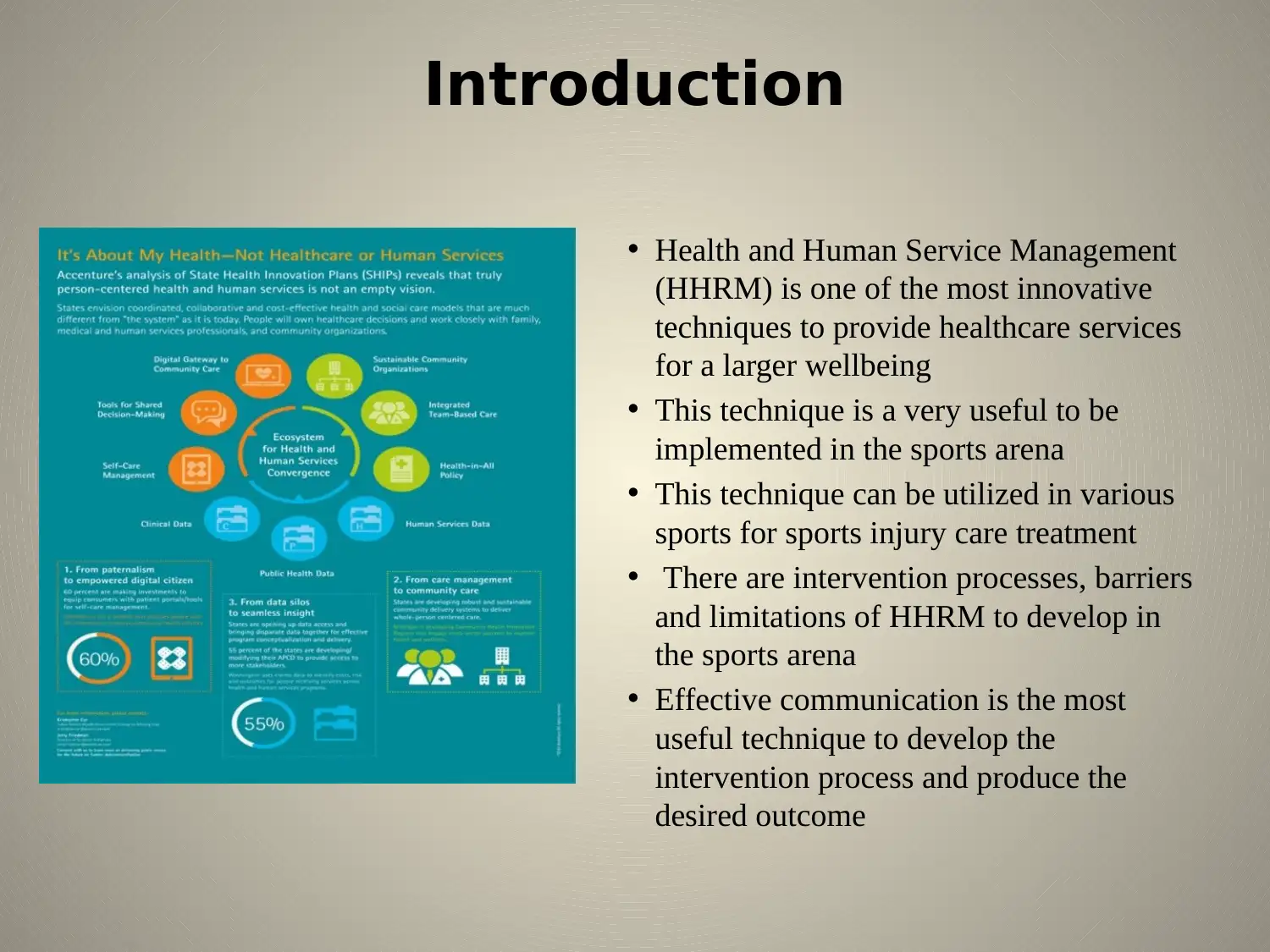
Health and Human Service Management
(HHRM) is one of the most innovative
techniques to provide healthcare services
for a larger wellbeing
This technique is a very useful to be
implemented in the sports arena
This technique can be utilized in various
sports for sports injury care treatment
There are intervention processes, barriers
and limitations of HHRM to develop in
the sports arena
Effective communication is the most
useful technique to develop the
intervention process and produce the
desired outcome
Document Page
Rationale
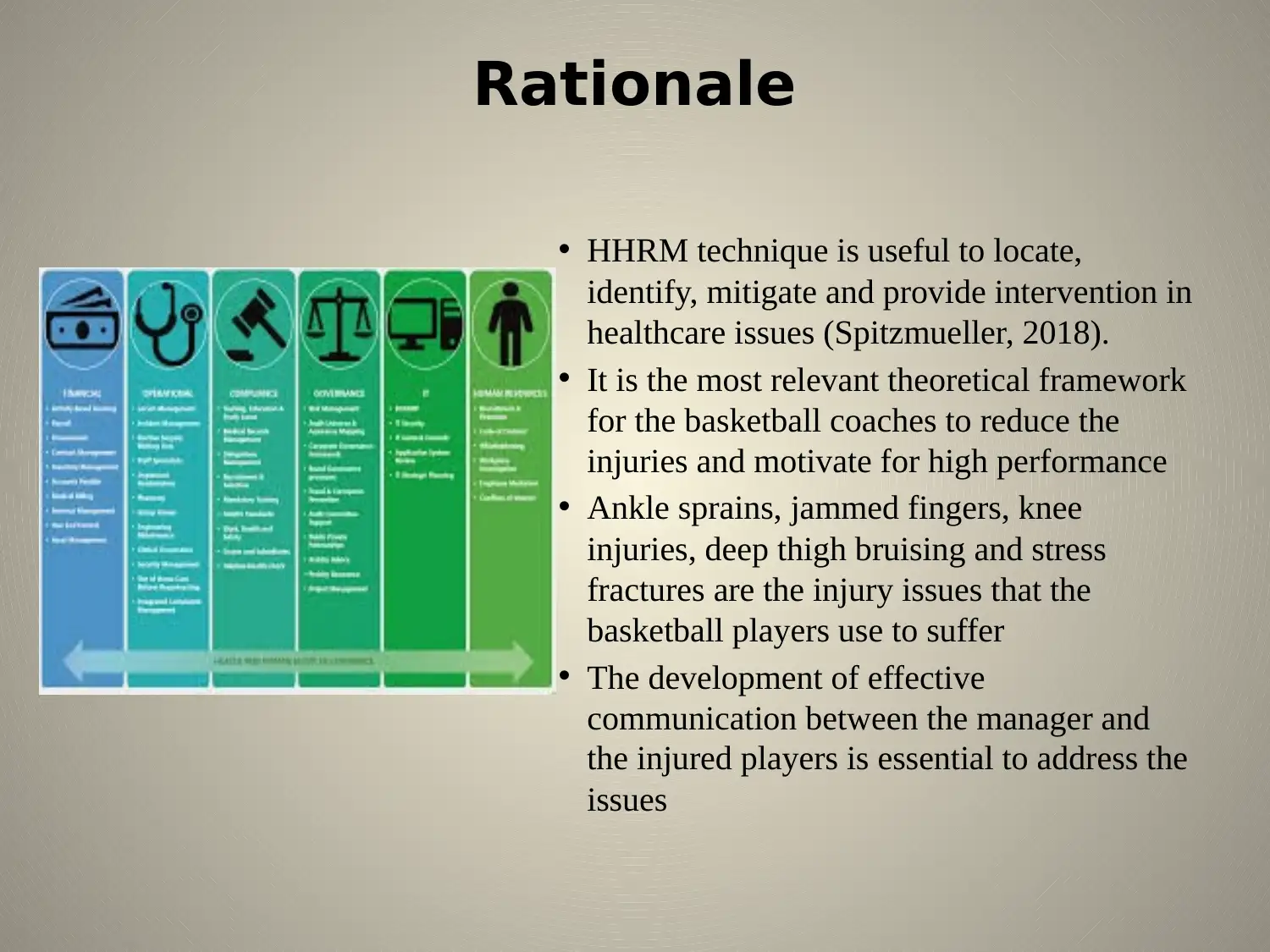
HHRM technique is useful to locate,
identify, mitigate and provide intervention in
healthcare issues (Spitzmueller, 2018).
It is the most relevant theoretical framework
for the basketball coaches to reduce the
injuries and motivate for high performance
Ankle sprains, jammed fingers, knee
injuries, deep thigh bruising and stress
fractures are the injury issues that the
basketball players use to suffer
The development of effective
communication between the manager and
the injured players is essential to address the
issues
Document Page
Legal acts
The players can pursue three main lawsuits
incase of an injury during a match:
Assumption of the risk doctrine (Spitzmueller,
2018).
Intentional tort lawsuit.
Product liability lawsuit.
tabler-icon-diamond-filled.svg

Paraphrase This Document

Need a fresh take? Get an instant paraphrase of this document with our AI Paraphraser
Document Page
Value and beliefs
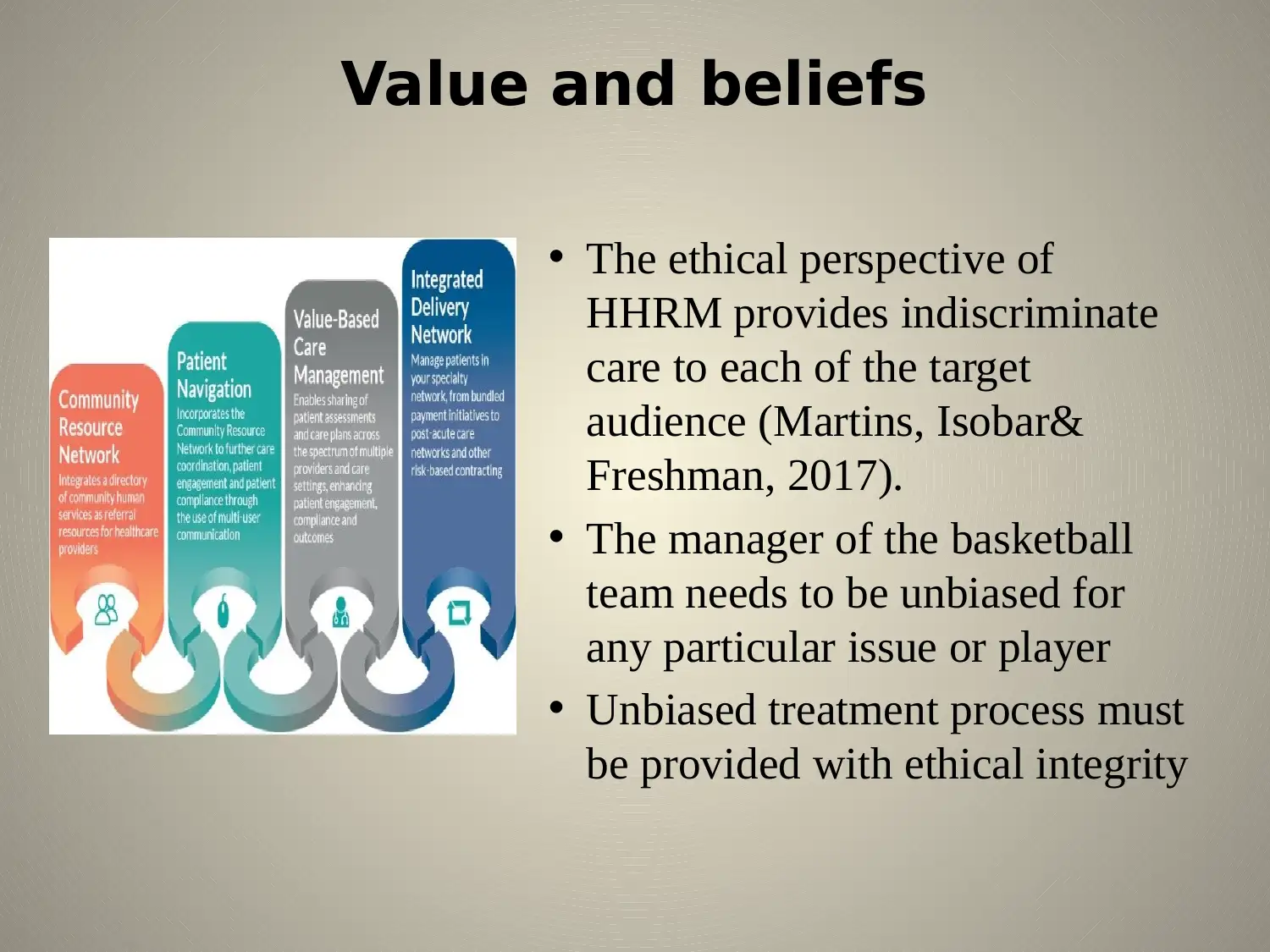
The ethical perspective of
HHRM provides indiscriminate
care to each of the target
audience (Martins, Isobar&
Freshman, 2017).
The manager of the basketball
team needs to be unbiased for
any particular issue or player
Unbiased treatment process must
be provided with ethical integrity
Document Page
Issue assessment
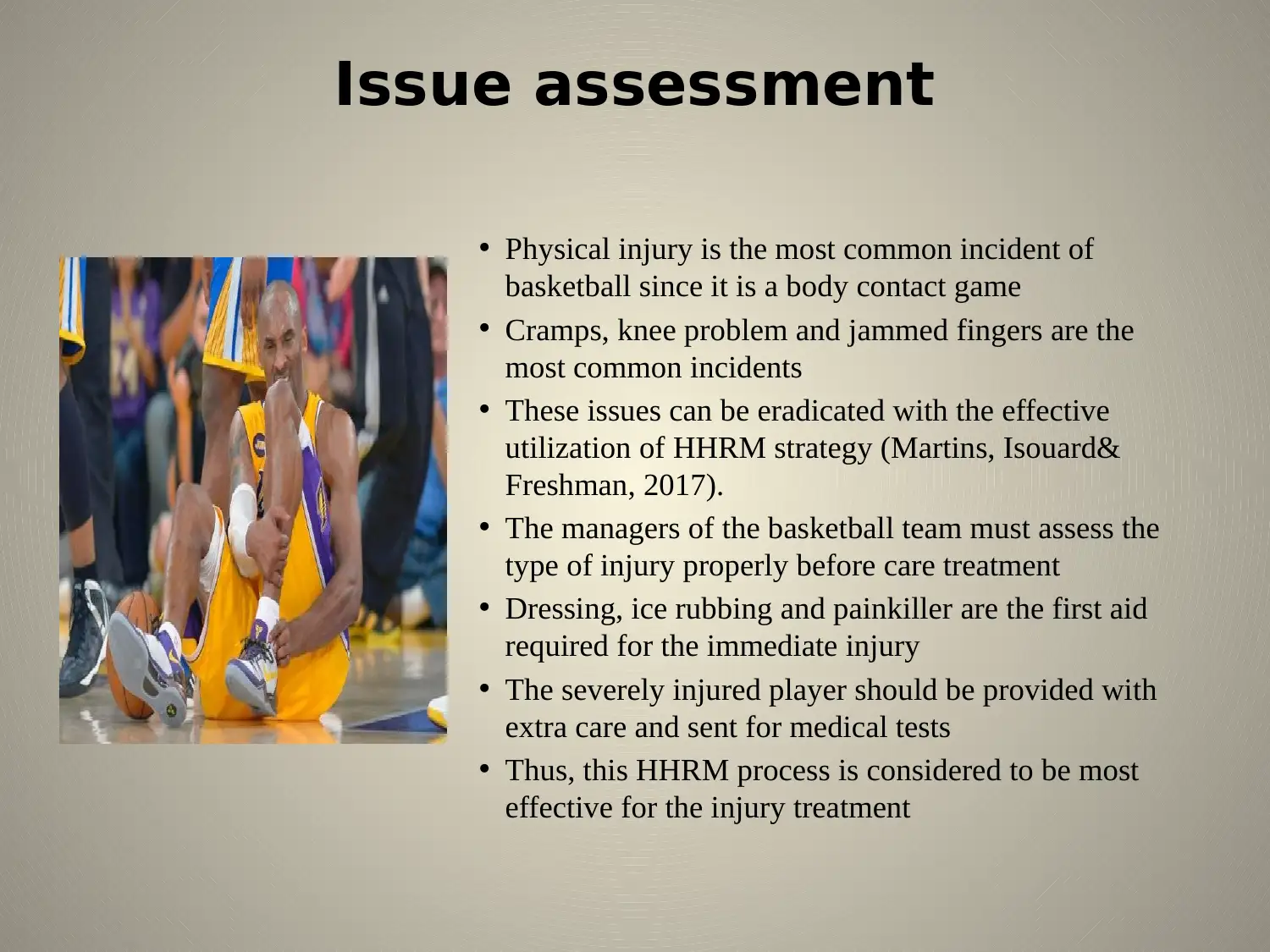
Physical injury is the most common incident of
basketball since it is a body contact game
Cramps, knee problem and jammed fingers are the
most common incidents
These issues can be eradicated with the effective
utilization of HHRM strategy (Martins, Isouard&
Freshman, 2017).
The managers of the basketball team must assess the
type of injury properly before care treatment
Dressing, ice rubbing and painkiller are the first aid
required for the immediate injury
The severely injured player should be provided with
extra care and sent for medical tests
Thus, this HHRM process is considered to be most
effective for the injury treatment
Document Page
Lack of Information
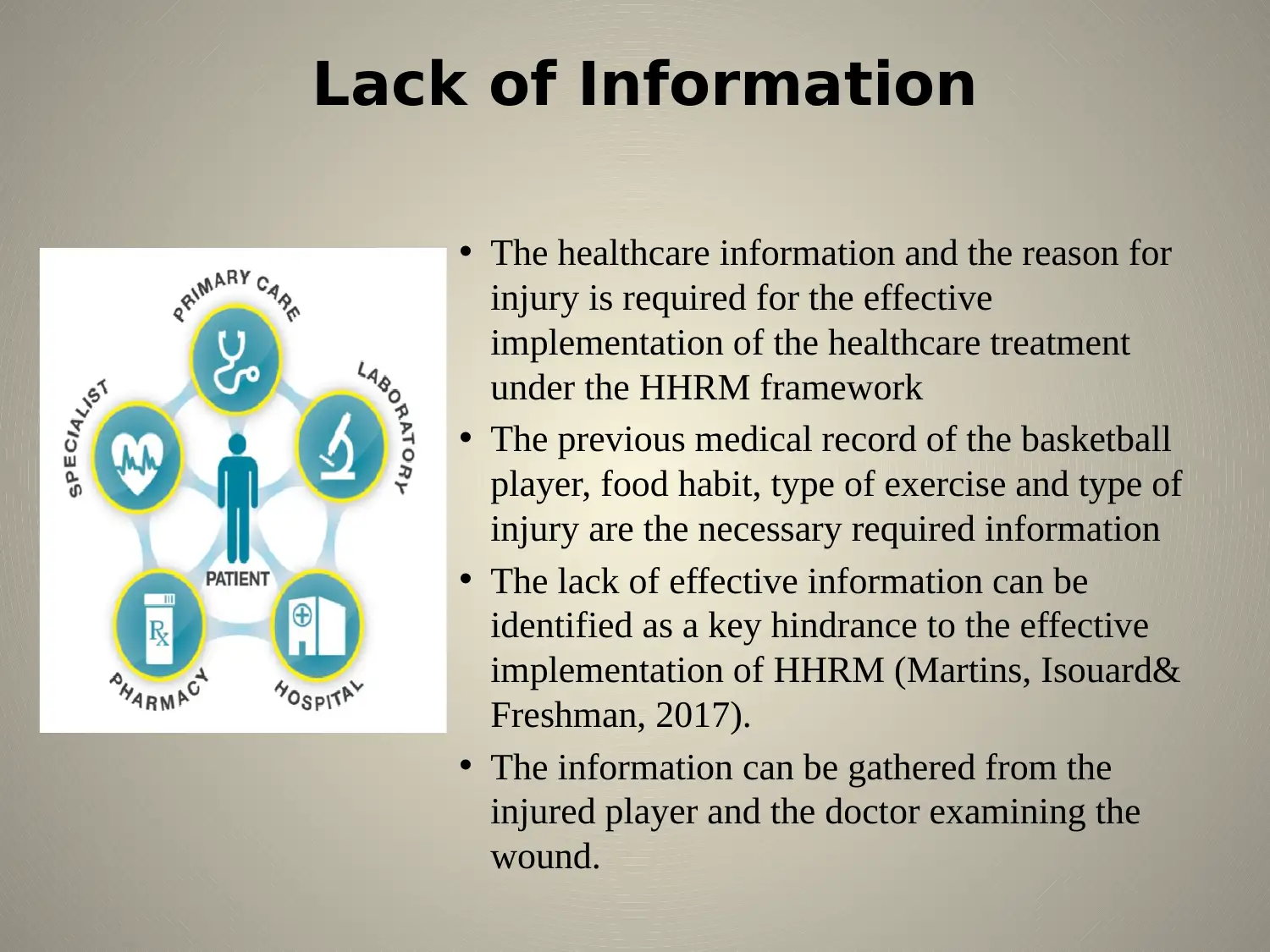
The healthcare information and the reason for
injury is required for the effective
implementation of the healthcare treatment
under the HHRM framework
The previous medical record of the basketball
player, food habit, type of exercise and type of
injury are the necessary required information
The lack of effective information can be
identified as a key hindrance to the effective
implementation of HHRM (Martins, Isouard&
Freshman, 2017).
The information can be gathered from the
injured player and the doctor examining the
wound.
tabler-icon-diamond-filled.svg

Paraphrase This Document

Need a fresh take? Get an instant paraphrase of this document with our AI Paraphraser
Document Page
Trial and Error learning theory
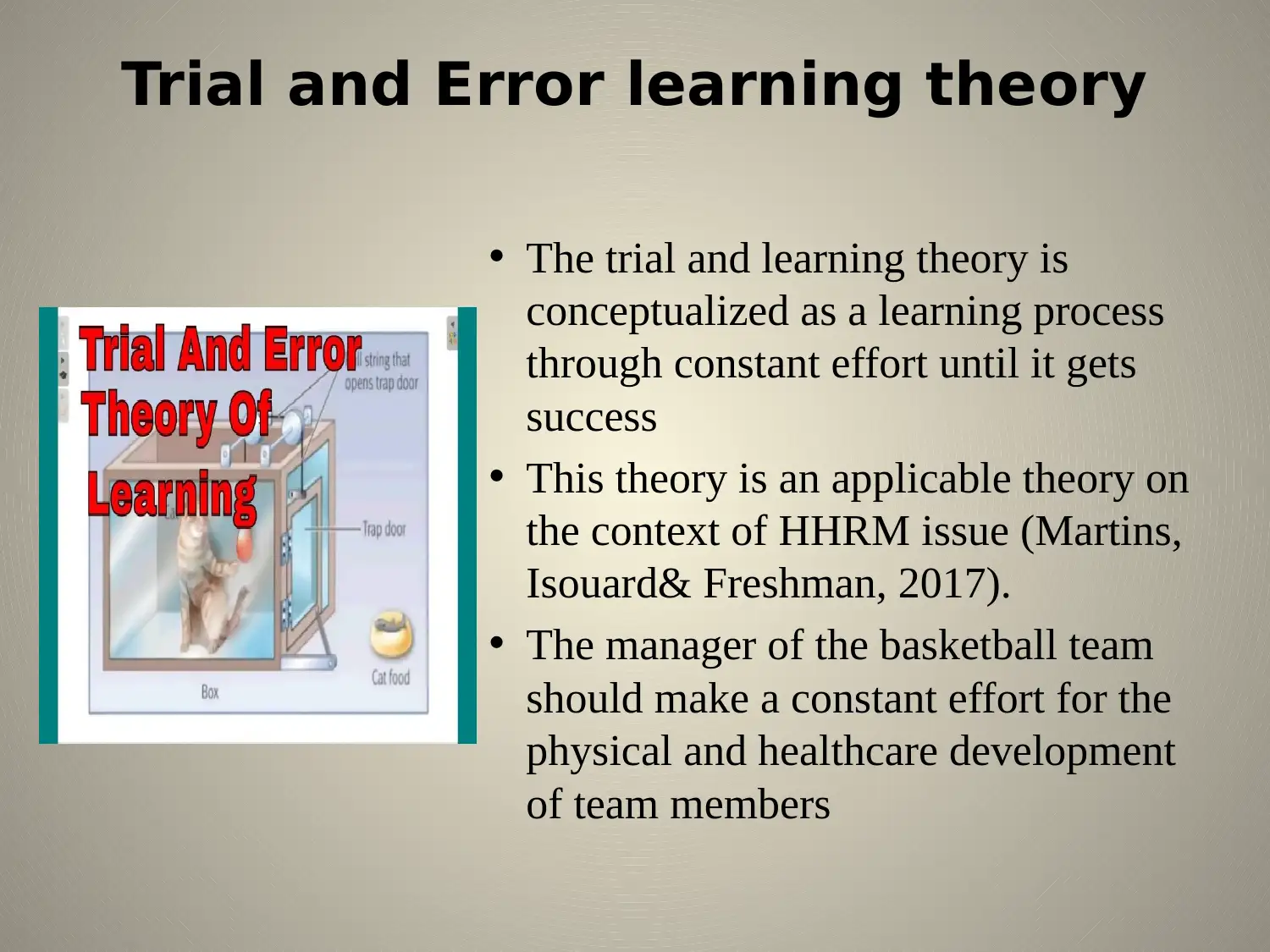
The trial and learning theory is
conceptualized as a learning process
through constant effort until it gets
success
This theory is an applicable theory on
the context of HHRM issue (Martins,
Isouard& Freshman, 2017).
The manager of the basketball team
should make a constant effort for the
physical and healthcare development
of team members
Document Page
Expectancy theory
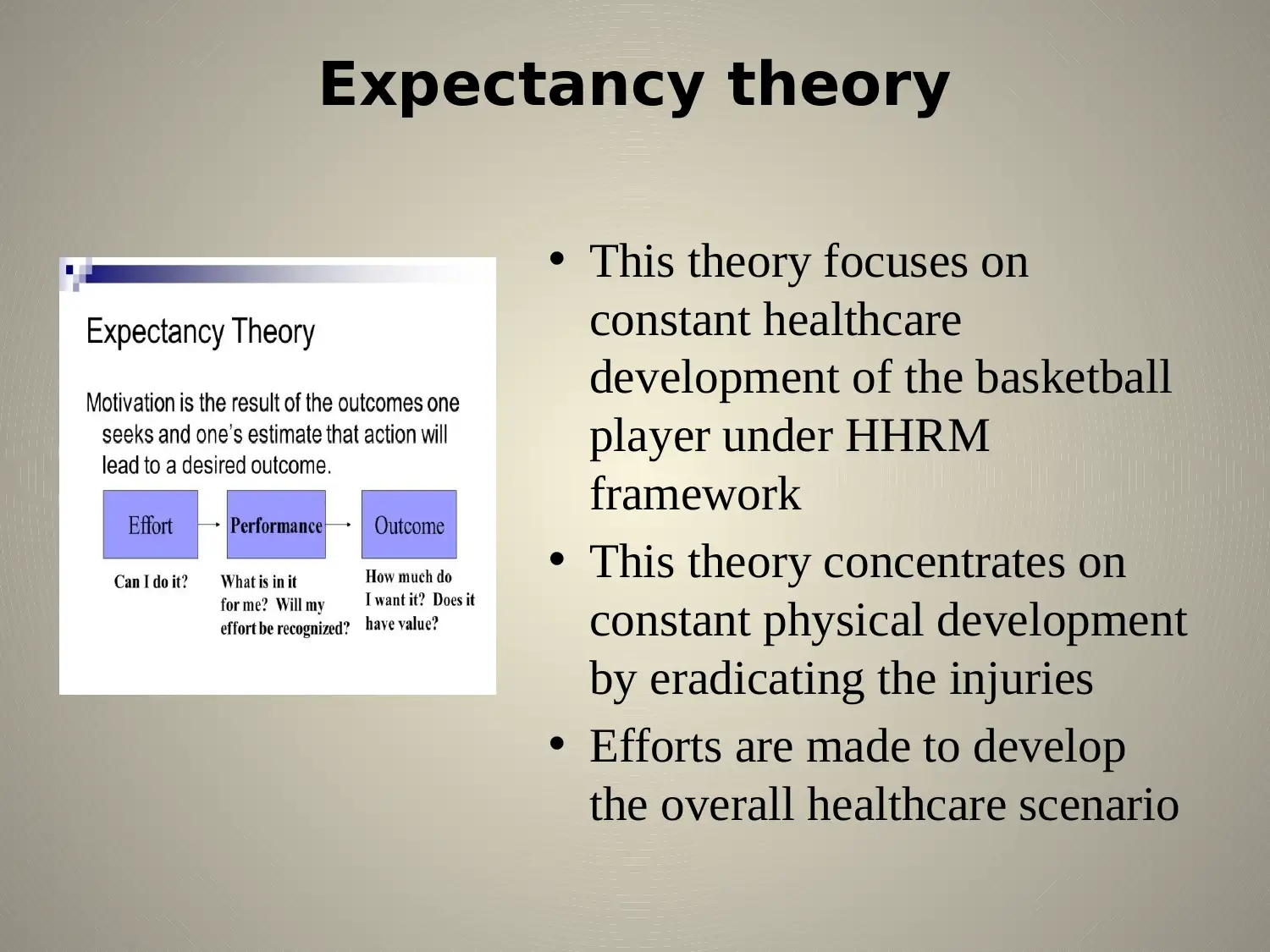
This theory focuses on
constant healthcare
development of the basketball
player under HHRM
framework
This theory concentrates on
constant physical development
by eradicating the injuries
Efforts are made to develop
the overall healthcare scenario
Document Page
Strategies
The two strategies which can be used are:
Non-verbal communication- during a match
non-verbal communication can be very helpful
to avoid any injuries as it helps in maintaining
cooperation within the players.
Verbal communication- verbal communication
can be used by the sports manager to warn the
players on the ground or even motivate them.
tabler-icon-diamond-filled.svg

Paraphrase This Document

Need a fresh take? Get an instant paraphrase of this document with our AI Paraphraser
Document Page
Conclusion
The study has experimented the HHRM health
framework
The experiments are made on the context of
basketball injuries
A constant healthcare development through
HHRM adaptation can be a useful outcome.
Document Page
References
Spitzmueller, M. (2018). Remaking “Community”
Mental Health: Contested Institutional Logics and
Organizational Change. Human Service
Organizations: Management, Leadership &
Governance, 42(2), 123-145. doi:
10.1080/23303131.2017.1422071
Martins, J., Isouard, G., & Freshman, B. (2017). The
human dimension of health service management.
Australian Health Review. doi: 10.1071/ah17063
chevron_up_icon
1 out of 12
circle_padding
hide_on_mobile
zoom_out_icon
[object Object]