Health Literacy: Reflecting on Course Learnings and Implications
VerifiedAdded on  2022/08/23
|4
|837
|38
Essay
AI Summary
This essay reflects on the student's understanding of health literacy, emphasizing its impact on healthcare quality, efficiency, and safety. The paper discusses how health literacy improves patients' ability to make informed decisions and reduces healthcare disparities. The student learned about the relationship between social determinants of health and population health, highlighting the need for multidimensional measures to foster sustainable changes. The essay also covers strategies for improving health literacy at community and interpersonal levels, including the use of WHO blueprints and tailored school curricula. The student emphasizes the importance of information sharing, communication, and collaboration in enhancing health literacy and achieving positive outcomes in terms of population health, literacy, and disparity. The essay references key literature on health literacy and its implications.
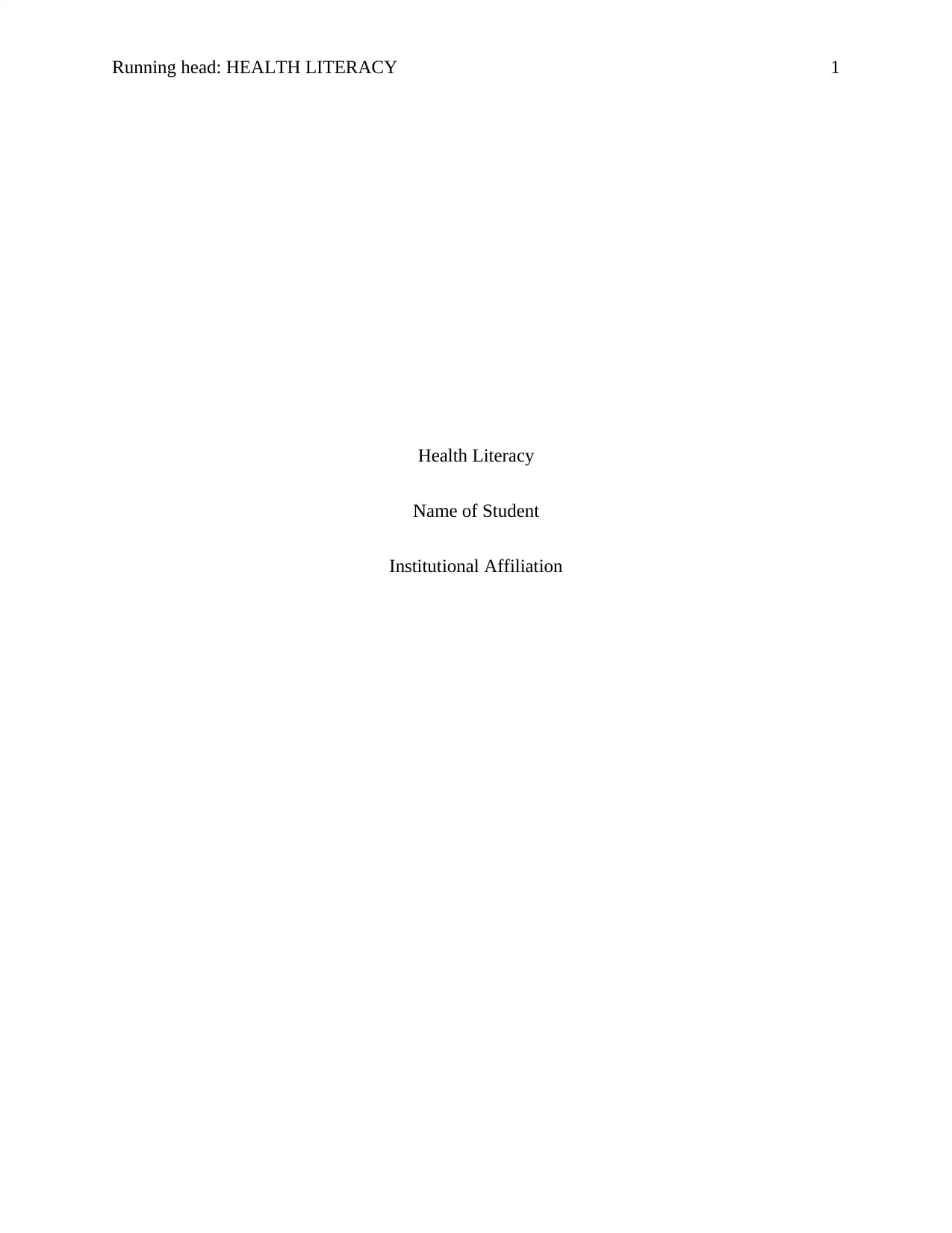
Running head: HEALTH LITERACY 1
Health Literacy
Name of Student
Institutional Affiliation
Health Literacy
Name of Student
Institutional Affiliation
Paraphrase This Document
Need a fresh take? Get an instant paraphrase of this document with our AI Paraphraser

HEALTH LITERACY 2
Health Literacy
Health literacy is associated with the how populations countinusly find, appreciate, use,
and access health information or services that they require when making health-related decisions.
Knowledge of health matters improves the ability of patients to make informed decisions. This
except is a reflection on health literacy.
Based on the areas covered during the course, I learned that health literacy influences
health populations in different ways. Health literacy leads to improved quality, efficiency, and
safety in terms of healthcare services and decisions. It also guarantees a reduction in healthcare
disparity. Through health literacy, it is possible to improve the coordination of healthcare
interventions between practitioners and patients (Easton et al., 2013). A positive change in terms
of health literacy among individuals synergistically improves the population as well as the public
health condition (Jayasinghe et al., 2016). I also learned that when people are aware of health-
related information, they will also understand the ethical and privacy issues of healthcare. In this
case, there will be improved privacy practices and safety considerations, which fosters positive
public health.
Additionally, while learning about different concepts of health literacy, I comprehended
the existing relationship between social determinants of health and population health. Social
determinants defining community and population health revolve around factors that create
disparity across different groups. Education, physical environment, social support and network,
and economic variables affect the health and wellbeing of individuals (Argita & Hinton, 2018).
These factors also describe the existing disparity. I learned that by addressing the social
determinants of health, it guarantees a positive change in terms of population health. Initiatives
within the healthcare system as well as those outside clinical health have been used to mitigate
Health Literacy
Health literacy is associated with the how populations countinusly find, appreciate, use,
and access health information or services that they require when making health-related decisions.
Knowledge of health matters improves the ability of patients to make informed decisions. This
except is a reflection on health literacy.
Based on the areas covered during the course, I learned that health literacy influences
health populations in different ways. Health literacy leads to improved quality, efficiency, and
safety in terms of healthcare services and decisions. It also guarantees a reduction in healthcare
disparity. Through health literacy, it is possible to improve the coordination of healthcare
interventions between practitioners and patients (Easton et al., 2013). A positive change in terms
of health literacy among individuals synergistically improves the population as well as the public
health condition (Jayasinghe et al., 2016). I also learned that when people are aware of health-
related information, they will also understand the ethical and privacy issues of healthcare. In this
case, there will be improved privacy practices and safety considerations, which fosters positive
public health.
Additionally, while learning about different concepts of health literacy, I comprehended
the existing relationship between social determinants of health and population health. Social
determinants defining community and population health revolve around factors that create
disparity across different groups. Education, physical environment, social support and network,
and economic variables affect the health and wellbeing of individuals (Argita & Hinton, 2018).
These factors also describe the existing disparity. I learned that by addressing the social
determinants of health, it guarantees a positive change in terms of population health. Initiatives
within the healthcare system as well as those outside clinical health have been used to mitigate

HEALTH LITERACY 3
disparity and address the social determinants of health. The outcome of such measures has
resulted in improved health and wellbeing as well as enhanced literacy across different
population groups. However, I realized that there is a need for additional multidimensional
measures to foster sustainable changes.
Furthermore, I noticed that it is possible to support communities and initiate health
literacy as part of the measures of improving population health. Several strategies have been
developed through community-based evidence in improving health literacy at the community
and interpersonal levels. I learned that the World Health Organization blueprints on health
literacy have been used across the globe to develop comprehensive national action plans.
Distribution of safety and health information tailored to improve population health fosters
literacy. Health literacy is achieved by sharing of accurate, actionable, timely, and accessible
information (Easton et al., 2013). Changes in healthcare delivery systems have also been used to
enhance healthcare literacy. In this case, the focus is set on information sharing, communication
with the public, training on decision making, and encouraging and supporting continuous access
to professional services. Countries with such actionable interventions have achieved significant
milestones in terms of population health, literacy, and disparity. Additionally, the use of tailored
school curricular has been part of the measures for increasing health literacy across different
population groups. Furthermore, scholarly evidence also ascertains that building partnership
through collaboration also increase health literacy when targeted to the existing health
determinants (U.S. Department of health, 2010).
disparity and address the social determinants of health. The outcome of such measures has
resulted in improved health and wellbeing as well as enhanced literacy across different
population groups. However, I realized that there is a need for additional multidimensional
measures to foster sustainable changes.
Furthermore, I noticed that it is possible to support communities and initiate health
literacy as part of the measures of improving population health. Several strategies have been
developed through community-based evidence in improving health literacy at the community
and interpersonal levels. I learned that the World Health Organization blueprints on health
literacy have been used across the globe to develop comprehensive national action plans.
Distribution of safety and health information tailored to improve population health fosters
literacy. Health literacy is achieved by sharing of accurate, actionable, timely, and accessible
information (Easton et al., 2013). Changes in healthcare delivery systems have also been used to
enhance healthcare literacy. In this case, the focus is set on information sharing, communication
with the public, training on decision making, and encouraging and supporting continuous access
to professional services. Countries with such actionable interventions have achieved significant
milestones in terms of population health, literacy, and disparity. Additionally, the use of tailored
school curricular has been part of the measures for increasing health literacy across different
population groups. Furthermore, scholarly evidence also ascertains that building partnership
through collaboration also increase health literacy when targeted to the existing health
determinants (U.S. Department of health, 2010).
⊘ This is a preview!⊘
Do you want full access?
Subscribe today to unlock all pages.

Trusted by 1+ million students worldwide

HEALTH LITERACY 4
References
Argita, S. & Hinton, E. (2018), Beyond Health Care: The Role of Social Determinants in
Promoting Health and Health Equity. Disparities Policy. Available at:
https://www.kff.org/disparities-policy/issue-brief/beyond-health-care-the-role-of-social-
determinants-in-promoting-health-and-health-equity/
Easton, P., Entwistle, V. A., & Williams, B. (2013). How the stigma of low literacy can impair
patient-professional spoken interactions and affect health: Insights from a qualitative
investigation. BMC Health Serv Res. 2013;13(1):319. DOI: 10.1186/1472-6963-13-319.
Jayasinghe, U. W., Harris, M. F., Parker, S. M., Litt, J., van Driel, M., Mazza, D., Del Mar, C.,
Lloyd, J., Smith, J., Zwar, N., Taylor, R., & Preventive Evidence into Practice (PEP)
Partnership Group (2016). The impact of health literacy and lifestyle risk factors on
health-related quality of life of Australian patients. Health and quality of life
outcomes, 14, 68. DOI: 10.1186/s12955-016-0471-1
U.S. Department of Health. (2010). National Action Plan to Improve Health Literacy. U.S.
Department of Health and Human Services, Office of Disease Prevention and Health
Promotion. Washington, DC: Author.
References
Argita, S. & Hinton, E. (2018), Beyond Health Care: The Role of Social Determinants in
Promoting Health and Health Equity. Disparities Policy. Available at:
https://www.kff.org/disparities-policy/issue-brief/beyond-health-care-the-role-of-social-
determinants-in-promoting-health-and-health-equity/
Easton, P., Entwistle, V. A., & Williams, B. (2013). How the stigma of low literacy can impair
patient-professional spoken interactions and affect health: Insights from a qualitative
investigation. BMC Health Serv Res. 2013;13(1):319. DOI: 10.1186/1472-6963-13-319.
Jayasinghe, U. W., Harris, M. F., Parker, S. M., Litt, J., van Driel, M., Mazza, D., Del Mar, C.,
Lloyd, J., Smith, J., Zwar, N., Taylor, R., & Preventive Evidence into Practice (PEP)
Partnership Group (2016). The impact of health literacy and lifestyle risk factors on
health-related quality of life of Australian patients. Health and quality of life
outcomes, 14, 68. DOI: 10.1186/s12955-016-0471-1
U.S. Department of Health. (2010). National Action Plan to Improve Health Literacy. U.S.
Department of Health and Human Services, Office of Disease Prevention and Health
Promotion. Washington, DC: Author.
1 out of 4
Related Documents
Your All-in-One AI-Powered Toolkit for Academic Success.
 +13062052269
info@desklib.com
Available 24*7 on WhatsApp / Email
Unlock your academic potential
Copyright © 2020–2025 A2Z Services. All Rights Reserved. Developed and managed by ZUCOL.