Analyzing Health and Aging Strategies: A NZ and India Report
VerifiedAdded on 2023/06/11
|11
|3670
|192
Report
AI Summary
This report provides a comparative analysis of life expectancy and healthy aging strategies in New Zealand and India. It examines the factors influencing life expectancy in both countries, including lifestyle, nutrition, education, and healthcare access. The report highlights New Zealand's Healthy Aging Strategy, its background, and its development, comparing its themes with those of Indian health aging initiatives. It notes the significant improvements in life expectancy over time due to government policies and improved living conditions, while also acknowledging the disparities between developed and developing nations. The analysis covers the vision and framework of New Zealand's strategy, emphasizing its alignment with national health strategies and its focus on building mental and physical capacity for older adults. This assignment is available on Desklib, where students can find a wide range of study resources including past papers and solved assignments.
RUNNING HEAD: Health of Older Adults
Health of Older Adults
Health of Older Adults

Paraphrase This Document
Need a fresh take? Get an instant paraphrase of this document with our AI Paraphraser
Health of Older Adults 1
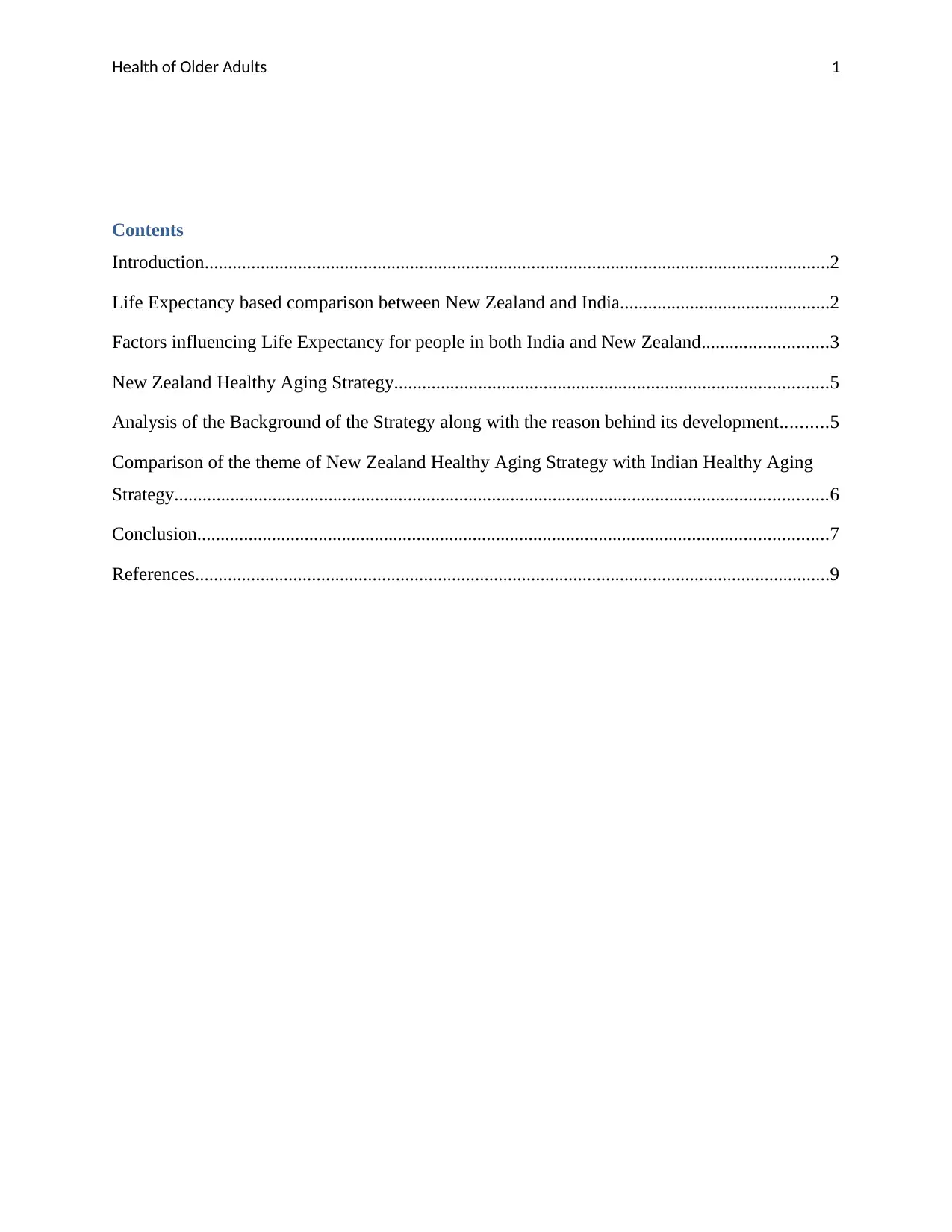
Contents
Introduction......................................................................................................................................2
Life Expectancy based comparison between New Zealand and India.............................................2
Factors influencing Life Expectancy for people in both India and New Zealand...........................3
New Zealand Healthy Aging Strategy.............................................................................................5
Analysis of the Background of the Strategy along with the reason behind its development..........5
Comparison of the theme of New Zealand Healthy Aging Strategy with Indian Healthy Aging
Strategy............................................................................................................................................6
Conclusion.......................................................................................................................................7
References........................................................................................................................................9
Contents
Introduction......................................................................................................................................2
Life Expectancy based comparison between New Zealand and India.............................................2
Factors influencing Life Expectancy for people in both India and New Zealand...........................3
New Zealand Healthy Aging Strategy.............................................................................................5
Analysis of the Background of the Strategy along with the reason behind its development..........5
Comparison of the theme of New Zealand Healthy Aging Strategy with Indian Healthy Aging
Strategy............................................................................................................................................6
Conclusion.......................................................................................................................................7
References........................................................................................................................................9
Health of Older Adults 2
Introduction
There is no universal definition for the age for older adults. However, World Health
Organization (WHO) has defined old age as the non- competence for performing the roles
previously performed by the individual, inability to actively contribute towards the society and
institution of new role in life (World Health Organization, 2014). Different countries have
different considerations for old age. The age of 60 years is considered to be old age in United
Nation and some other countries have specified the age of 65 years as old age (Fox, Baldock,
Freeman & Berry, 2016).
The term life expectancy can be defined as the average period of time that a person may expect
to survive if there are no changes in the mortality pattern found at the time of birth of such an
individual (Koontz, 2012). Over a period of time, there has been a radical variation in the life
expectancy of each and every country. With the help of various government policies, the average
life expectancy has significantly increased by 20 years. However, the poor countries are still not
capable of attaining this figure. The government strategies have proved to be of great help in the
retirement phase of an individual. The difference in the life expectancies in different countries is
the result of diverse social, economic and political environment (Deimling, Brown, Albitz,
Burant & Mallick, 2017).
This report focuses on the comparison of data around life expectancy in New Zealand and India
along with the factors that influence the life expectancy of people in these countries. Moreover,
it highlights the theme of New Zealand Health Aging Strategy along with the reasons of its
development. Furthermore, this report compares the theme of the strategy with Indian health
aging strategy.
Life Expectancy based comparison between New Zealand and India
Different regions have different life expectancies as a result of economic differences and
regional variations. The life expectancy at birth is calculated on the basis of sources such as
Demographic Statistics, Eurostat, U.S Census Bureau, Census Reports and various other sources.
The life expectancy is significantly improving in different parts of the world as a result of
Introduction
There is no universal definition for the age for older adults. However, World Health
Organization (WHO) has defined old age as the non- competence for performing the roles
previously performed by the individual, inability to actively contribute towards the society and
institution of new role in life (World Health Organization, 2014). Different countries have
different considerations for old age. The age of 60 years is considered to be old age in United
Nation and some other countries have specified the age of 65 years as old age (Fox, Baldock,
Freeman & Berry, 2016).
The term life expectancy can be defined as the average period of time that a person may expect
to survive if there are no changes in the mortality pattern found at the time of birth of such an
individual (Koontz, 2012). Over a period of time, there has been a radical variation in the life
expectancy of each and every country. With the help of various government policies, the average
life expectancy has significantly increased by 20 years. However, the poor countries are still not
capable of attaining this figure. The government strategies have proved to be of great help in the
retirement phase of an individual. The difference in the life expectancies in different countries is
the result of diverse social, economic and political environment (Deimling, Brown, Albitz,
Burant & Mallick, 2017).
This report focuses on the comparison of data around life expectancy in New Zealand and India
along with the factors that influence the life expectancy of people in these countries. Moreover,
it highlights the theme of New Zealand Health Aging Strategy along with the reasons of its
development. Furthermore, this report compares the theme of the strategy with Indian health
aging strategy.
Life Expectancy based comparison between New Zealand and India
Different regions have different life expectancies as a result of economic differences and
regional variations. The life expectancy at birth is calculated on the basis of sources such as
Demographic Statistics, Eurostat, U.S Census Bureau, Census Reports and various other sources.
The life expectancy is significantly improving in different parts of the world as a result of
⊘ This is a preview!⊘
Do you want full access?
Subscribe today to unlock all pages.

Trusted by 1+ million students worldwide
Health of Older Adults 3
availability of improved education and health services along with noticeable improvements in the
lifestyle.
The World Bank provides data related to life expectancy from the year 1960 to 2016. In 1960,
the total life expectancy at birth taking into account the figures of males and females in New
Zealand and India was 71.237 years and 41.174 years. The life expectancy of males in both the
countries was 68.7 years and 41.89 years. Similarly, the life expectancy of females in these
countries was 73.9 years and 40.413 years (The World Bank, 2018).
After 40 years, in the year 2000, there was a noticeable change in both the countries. The total
life expectancy at birth in New Zealand and India was 78.637 years and 62.582 years.
Classifying the life expectancy for males and females separately, it was 76.1 years and 61.789
years for males and 81.3 years and 63.438 years for females (The World Bank, 2018).
The latest data related to life expectancy provided by the World Bank is for the year 2016. The
comparison between the life expectancy of males in New Zealand and India provides that in New
Zealand, the average life expectancy is 79.91 years and in India, it is 67.094 years. on the other
hand, the life expectancy of females in New Zealand and India 83.4 years and 70.166 years. This
leads to the total life expectancy at birth of males and females in New Zealand and India to be
81.612 years and 68.56 years (The World Bank, 2018). This means that India is still not able to
match up with the figures of New Zealand.
The comparison further provides that the changes in the life expectancy are the result of changes
in the lifestyle of the people as people have started living an improved life. This improved life is
due to the reason of increase in proper medication, income and nutrition along with a number of
other factors. In India, the major causes of death include road traffic accidents, cancer,
tuberculosis, low birth weight, HIV/AIDS, hypertension, etc. (Mathers, Stevens, Boerma, White
& Tobias, 2015).
Factors influencing Life Expectancy for people in both India and New Zealand
There are a number of factors due to which the life expectancy of people is influenced such as
lifestyle, nutrition, education, housing, income, etc. Moreover, there is also an influence of
gender, heredity and age on the life expectancy. According the World Health Organization
availability of improved education and health services along with noticeable improvements in the
lifestyle.
The World Bank provides data related to life expectancy from the year 1960 to 2016. In 1960,
the total life expectancy at birth taking into account the figures of males and females in New
Zealand and India was 71.237 years and 41.174 years. The life expectancy of males in both the
countries was 68.7 years and 41.89 years. Similarly, the life expectancy of females in these
countries was 73.9 years and 40.413 years (The World Bank, 2018).
After 40 years, in the year 2000, there was a noticeable change in both the countries. The total
life expectancy at birth in New Zealand and India was 78.637 years and 62.582 years.
Classifying the life expectancy for males and females separately, it was 76.1 years and 61.789
years for males and 81.3 years and 63.438 years for females (The World Bank, 2018).
The latest data related to life expectancy provided by the World Bank is for the year 2016. The
comparison between the life expectancy of males in New Zealand and India provides that in New
Zealand, the average life expectancy is 79.91 years and in India, it is 67.094 years. on the other
hand, the life expectancy of females in New Zealand and India 83.4 years and 70.166 years. This
leads to the total life expectancy at birth of males and females in New Zealand and India to be
81.612 years and 68.56 years (The World Bank, 2018). This means that India is still not able to
match up with the figures of New Zealand.
The comparison further provides that the changes in the life expectancy are the result of changes
in the lifestyle of the people as people have started living an improved life. This improved life is
due to the reason of increase in proper medication, income and nutrition along with a number of
other factors. In India, the major causes of death include road traffic accidents, cancer,
tuberculosis, low birth weight, HIV/AIDS, hypertension, etc. (Mathers, Stevens, Boerma, White
& Tobias, 2015).
Factors influencing Life Expectancy for people in both India and New Zealand
There are a number of factors due to which the life expectancy of people is influenced such as
lifestyle, nutrition, education, housing, income, etc. Moreover, there is also an influence of
gender, heredity and age on the life expectancy. According the World Health Organization
Paraphrase This Document
Need a fresh take? Get an instant paraphrase of this document with our AI Paraphraser
Health of Older Adults 4
(WHO), various factors determine the health of an individual such as the social, physical and
economic environment along with the individual characteristics and behaviors of a person. The
improved life expectancy around the world is the result of low number of deaths below the age
of five (Conner, McKinnon, Ward, Reynolds III, & Brown, 2015).
In case of New Zealand, there are some regions where people have access to less number of
economic resources. Such people have shorter life expectancy as compared to the people who
have most of the resources in easy access (Skiadas & Skiadas, 2018). People with lower income
suffer from lower quality of life as they are not able of affording good health and nutrition. The
life expectancy in New Zealand is also influenced by physical activity which when combined
with healthy diet improves the quality of life. The people who are engaged in physical activities
are able to defend diseases like cardiovascular disease and obesity and which in turn leads to
increased life expectancy (Park, Elavsky & Koo, 2014). There is also an influence of alcohol
consumption and smoking on the life expectancy of people. The physical and mental health of a
person is affected due to hazardous drinking which may further lead to violence, road accidents,
etc. the life expectancy of males is shorter than that of females along with higher mortality rates
(Collins, Tutone & Walker, 2017).
On the other hand, India is a developing country. Therefore, the life expectancy of people is
India is influenced by factors such as education, marital status, economic status, health care,
family history, drug us, etc. Over a period of time, there has been a significant increase in the
level of nutrition, standard of living and therefore in the overall quality of life (Canudas- Romo,
Saikia & Diamond- Smith, 2015). The rural India suffers from the problem of high infant
mortality rate. The rural India also suffers from malnutrition due to lower incomes which in turn
leads the people towards organ failure or death. Health care schemes such as Rashtriya Swasthya
Bhima Yojana have been incorporated by the Government of India for the purpose of improving
the health of the individual. Moreover, the government has also addressed various issues related
to health care in India such as female health issues, poor sanitation, non- availability of safe
drinking water, etc. (Sen, 2017) Also, attempts are continuously being made with regard to
increasing the literacy rate in the country for the purpose of contributing towards health care
awareness and increase in the overall life expectancy (Canudas- Romo, Saikia & Diamond-
Smith, 2015).
(WHO), various factors determine the health of an individual such as the social, physical and
economic environment along with the individual characteristics and behaviors of a person. The
improved life expectancy around the world is the result of low number of deaths below the age
of five (Conner, McKinnon, Ward, Reynolds III, & Brown, 2015).
In case of New Zealand, there are some regions where people have access to less number of
economic resources. Such people have shorter life expectancy as compared to the people who
have most of the resources in easy access (Skiadas & Skiadas, 2018). People with lower income
suffer from lower quality of life as they are not able of affording good health and nutrition. The
life expectancy in New Zealand is also influenced by physical activity which when combined
with healthy diet improves the quality of life. The people who are engaged in physical activities
are able to defend diseases like cardiovascular disease and obesity and which in turn leads to
increased life expectancy (Park, Elavsky & Koo, 2014). There is also an influence of alcohol
consumption and smoking on the life expectancy of people. The physical and mental health of a
person is affected due to hazardous drinking which may further lead to violence, road accidents,
etc. the life expectancy of males is shorter than that of females along with higher mortality rates
(Collins, Tutone & Walker, 2017).
On the other hand, India is a developing country. Therefore, the life expectancy of people is
India is influenced by factors such as education, marital status, economic status, health care,
family history, drug us, etc. Over a period of time, there has been a significant increase in the
level of nutrition, standard of living and therefore in the overall quality of life (Canudas- Romo,
Saikia & Diamond- Smith, 2015). The rural India suffers from the problem of high infant
mortality rate. The rural India also suffers from malnutrition due to lower incomes which in turn
leads the people towards organ failure or death. Health care schemes such as Rashtriya Swasthya
Bhima Yojana have been incorporated by the Government of India for the purpose of improving
the health of the individual. Moreover, the government has also addressed various issues related
to health care in India such as female health issues, poor sanitation, non- availability of safe
drinking water, etc. (Sen, 2017) Also, attempts are continuously being made with regard to
increasing the literacy rate in the country for the purpose of contributing towards health care
awareness and increase in the overall life expectancy (Canudas- Romo, Saikia & Diamond-
Smith, 2015).
Health of Older Adults 5
New Zealand Healthy Aging Strategy
The vision of the Healthy Aging Strategy is that the older people age well, live well and that they
have an end of life in a respectful age friendly communities. A life- course approach has been
adopted by the strategy which seeks to bring best health and wellbeing outcomes for the older
adults. A framework has been set out by the strategy which provides funding, policies, service
delivery and planning which supports healthy aging. The framework enables high quality
restorative and acute care for effective recovery, rehabilitation and restoration (Ministry of
Health 2016).
The actions of the New Zealand Healthy Aging Strategy reflect the themes of five Health
strategies of New Zealand. Such themes are closer to home, people powered, one team, value
and high performance and smart system. A wider system is articulated by these teams in which
the objectives of Healthy Ageing Strategy can be attained. The strategy describes the desired
future, makes the identification of cultures and values with the help of which this future can be
underpinned along with setting out five strategic themes so that the required changes can be
made in order to reach the vision of the strategy. The strategy recognizes that the health of an
individual is also affected by the environment they live in. The initiative taken under the strategy
focuses on building and maintenance of mental and physical capacity of people and delaying and
preventing the onset of disease and disability.
Analysis of the Background of the Strategy along with the reason behind its development
Since the release of Health of Older People Strategy 2002, there were many significant areas of
improvements to the disability and health support system. The government has started supporting
long term health conditions and provides comprehensive needs assessment and brings the
required improvements in the quality of home and community services. For the purpose of
maintaining these positive changes, a new strategy was required that is capable of expanding on
the strengths of the past and provides further direction for improving the performance and results
across the board. The Health Aging Strategy was incorporated for older people, their
communities and their families. The strategy aimed at the health and wellbeing of older people
(Nishtala, Gnjidic, Chyou & Hilmer, 2016).
New Zealand Healthy Aging Strategy
The vision of the Healthy Aging Strategy is that the older people age well, live well and that they
have an end of life in a respectful age friendly communities. A life- course approach has been
adopted by the strategy which seeks to bring best health and wellbeing outcomes for the older
adults. A framework has been set out by the strategy which provides funding, policies, service
delivery and planning which supports healthy aging. The framework enables high quality
restorative and acute care for effective recovery, rehabilitation and restoration (Ministry of
Health 2016).
The actions of the New Zealand Healthy Aging Strategy reflect the themes of five Health
strategies of New Zealand. Such themes are closer to home, people powered, one team, value
and high performance and smart system. A wider system is articulated by these teams in which
the objectives of Healthy Ageing Strategy can be attained. The strategy describes the desired
future, makes the identification of cultures and values with the help of which this future can be
underpinned along with setting out five strategic themes so that the required changes can be
made in order to reach the vision of the strategy. The strategy recognizes that the health of an
individual is also affected by the environment they live in. The initiative taken under the strategy
focuses on building and maintenance of mental and physical capacity of people and delaying and
preventing the onset of disease and disability.
Analysis of the Background of the Strategy along with the reason behind its development
Since the release of Health of Older People Strategy 2002, there were many significant areas of
improvements to the disability and health support system. The government has started supporting
long term health conditions and provides comprehensive needs assessment and brings the
required improvements in the quality of home and community services. For the purpose of
maintaining these positive changes, a new strategy was required that is capable of expanding on
the strengths of the past and provides further direction for improving the performance and results
across the board. The Health Aging Strategy was incorporated for older people, their
communities and their families. The strategy aimed at the health and wellbeing of older people
(Nishtala, Gnjidic, Chyou & Hilmer, 2016).
⊘ This is a preview!⊘
Do you want full access?
Subscribe today to unlock all pages.
Trusted by 1+ million students worldwide
Health of Older Adults 6
The reason behind the development of the Healthy Aging strategy is to give priority to resilience
and healthy aging into and throughout the older years of people. The aim of the strategy is to
provide better support to individuals with complex needs. The development of the strategy is the
result of the recognition of different ways of aging and different needs of people that arise at
different times along with the effect of environment on the health of an individual. Therefore, the
strategy was developed for the purpose of enhancing the growth and development, ensuring
highest capacity of a person and preventing them from diseases through their life. The term
health aging has been defined by WHO as the process of development and maintenance of the
functional ability of a person which in turn assists in enabling wellbeing in old age. The strategy
was developed with the aim of enabling people with disability to perform things that are of prime
importance to them along with enhancing their social connection, participation and ensuring their
dignity in the rest of their life.
There have been some social and political changes which have also contributed towards the
development of the strategy. The social picture of the country has significantly changed over the
years after the Health of Older People Strategy 2002. The politics on the basis of classes have
also reduced leading to improvements. In the year 2002, when this strategy was published,
people over the age of 65 years constituted only 11.5 % of the population of New Zealand
(Christensen, Doblhammer, Rau & Vaupel, 2009). This figure has now increased to 15 % and is
expected to increase further. The strategy is focused on increasing these figures by way of
providing healthy living. Also, the social changes also include improved lifestyle of the people of
New Zealand due to increase in income and improved access to healthcare and education
(Laursen, Musliner, Benros, Vestergaard & Munk- Olsen, 2016).
Comparison of the theme of New Zealand Healthy Aging Strategy with Indian Healthy
Aging Strategy
The theme of New Zealand Healthy Aging Strategy can be compared with a similar theme for
healthy aging in India. The Government of India has incorporated a National Program of Health
Care for the Elderly (NPHCE). The program hopes for the healthy aging of the older people. The
theme of NPHCE is highlighted in its vision which is to create a new architecture for aging,
providing affordable, accessible and high quality dedicated services to the older people along
The reason behind the development of the Healthy Aging strategy is to give priority to resilience
and healthy aging into and throughout the older years of people. The aim of the strategy is to
provide better support to individuals with complex needs. The development of the strategy is the
result of the recognition of different ways of aging and different needs of people that arise at
different times along with the effect of environment on the health of an individual. Therefore, the
strategy was developed for the purpose of enhancing the growth and development, ensuring
highest capacity of a person and preventing them from diseases through their life. The term
health aging has been defined by WHO as the process of development and maintenance of the
functional ability of a person which in turn assists in enabling wellbeing in old age. The strategy
was developed with the aim of enabling people with disability to perform things that are of prime
importance to them along with enhancing their social connection, participation and ensuring their
dignity in the rest of their life.
There have been some social and political changes which have also contributed towards the
development of the strategy. The social picture of the country has significantly changed over the
years after the Health of Older People Strategy 2002. The politics on the basis of classes have
also reduced leading to improvements. In the year 2002, when this strategy was published,
people over the age of 65 years constituted only 11.5 % of the population of New Zealand
(Christensen, Doblhammer, Rau & Vaupel, 2009). This figure has now increased to 15 % and is
expected to increase further. The strategy is focused on increasing these figures by way of
providing healthy living. Also, the social changes also include improved lifestyle of the people of
New Zealand due to increase in income and improved access to healthcare and education
(Laursen, Musliner, Benros, Vestergaard & Munk- Olsen, 2016).
Comparison of the theme of New Zealand Healthy Aging Strategy with Indian Healthy
Aging Strategy
The theme of New Zealand Healthy Aging Strategy can be compared with a similar theme for
healthy aging in India. The Government of India has incorporated a National Program of Health
Care for the Elderly (NPHCE). The program hopes for the healthy aging of the older people. The
theme of NPHCE is highlighted in its vision which is to create a new architecture for aging,
providing affordable, accessible and high quality dedicated services to the older people along
Paraphrase This Document
Need a fresh take? Get an instant paraphrase of this document with our AI Paraphraser
Health of Older Adults 7
with building a framework that enables the environment to become a society for every age and
promoting the concept of healthy and active aging. This is different from the theme of the
Healthy Aging Strategy of New Zealand which is based on the five health strategies of New
Zealand. Such themes are closer to home, people powered, one team, value and high
performance and smart system (Verma & Khanna, 2013).
The comparison of the strategy and program further provides that basic purpose of both ae same
i.e. to offer healthy aging to the older adults. The strategy and the program have also proved to
be beneficial for both the countries to a great extent. Further improvements are expected through
the implementation of these strategies (Singh & Ladusingh, 2016). For achieving the objectives
of NPHCE, certain strategies are used such as public private partnerships promotion in geriatric
health care, making the use of folk media, mass media and a number of other communication
channels for the purpose of reaching the target audience, dedicated facilities at the medical
institutes of the region with human resources, bedded wards, consumables and drugs, machinery
and equipment, training and Information, Education and Communication (IEC) (Shankardass &
Rajan, 2018).
Health conditions around the globe are displaying a positive trend. Still, there is requirement for
eradicating or controlling some of the major health problems. The problems of inequality will be
automatically resolved when the mechanisms of global governance will be improved (Chetty,
Stepner & Cutler, 2016).
Conclusion
Therefore, it can be concluded that the life expectancy of people differs among the people around
globe. This is due the economic differences and regional variations. Over a period of time, the
life expectancy has significantly improved in almost every country across the globe. This report
focused on the comparison between the life expectancies of people in New Zealand and India. It
further provides that there are some factors that influence the life expectancies of people in these
countries. In New Zealand, such factors include lack of access to the economic resources, lack of
physical activity, alcohol consumption, cardiovascular diseases and obesity, etc. On the other
hand, in India, such factors include high infant mortality rate, lack of education, healthcare
facilities, etc. Furthermore, this report outlines the theme of the Healthy Aging Strategy of New
with building a framework that enables the environment to become a society for every age and
promoting the concept of healthy and active aging. This is different from the theme of the
Healthy Aging Strategy of New Zealand which is based on the five health strategies of New
Zealand. Such themes are closer to home, people powered, one team, value and high
performance and smart system (Verma & Khanna, 2013).
The comparison of the strategy and program further provides that basic purpose of both ae same
i.e. to offer healthy aging to the older adults. The strategy and the program have also proved to
be beneficial for both the countries to a great extent. Further improvements are expected through
the implementation of these strategies (Singh & Ladusingh, 2016). For achieving the objectives
of NPHCE, certain strategies are used such as public private partnerships promotion in geriatric
health care, making the use of folk media, mass media and a number of other communication
channels for the purpose of reaching the target audience, dedicated facilities at the medical
institutes of the region with human resources, bedded wards, consumables and drugs, machinery
and equipment, training and Information, Education and Communication (IEC) (Shankardass &
Rajan, 2018).
Health conditions around the globe are displaying a positive trend. Still, there is requirement for
eradicating or controlling some of the major health problems. The problems of inequality will be
automatically resolved when the mechanisms of global governance will be improved (Chetty,
Stepner & Cutler, 2016).
Conclusion
Therefore, it can be concluded that the life expectancy of people differs among the people around
globe. This is due the economic differences and regional variations. Over a period of time, the
life expectancy has significantly improved in almost every country across the globe. This report
focused on the comparison between the life expectancies of people in New Zealand and India. It
further provides that there are some factors that influence the life expectancies of people in these
countries. In New Zealand, such factors include lack of access to the economic resources, lack of
physical activity, alcohol consumption, cardiovascular diseases and obesity, etc. On the other
hand, in India, such factors include high infant mortality rate, lack of education, healthcare
facilities, etc. Furthermore, this report outlines the theme of the Healthy Aging Strategy of New
Health of Older Adults 8
Zealand which reflects the themes of five Health strategies of New Zealand. Such themes are
closer to home, people powered, one team, value and high performance and smart system. The
report has also highlighted the background of the strategy along with the reason behind its
development including social and political change. At the end, comparison of the strategy is
made with the National Program of Health Care for the Elderly.
Zealand which reflects the themes of five Health strategies of New Zealand. Such themes are
closer to home, people powered, one team, value and high performance and smart system. The
report has also highlighted the background of the strategy along with the reason behind its
development including social and political change. At the end, comparison of the strategy is
made with the National Program of Health Care for the Elderly.
⊘ This is a preview!⊘
Do you want full access?
Subscribe today to unlock all pages.
Trusted by 1+ million students worldwide
Health of Older Adults 9
References
Canudas-Romo, V., Saikia, N., & Diamond-Smith, N. (2015). The contribution of age-specific
mortality towards male and female life expectancy differentials in India and selected States,
1970-2013. Asia-Pacific Population Journal, 30(2).
Chetty, R., Stepner, M., & Cutler, D. (2016). Relationships Between Income, Health Behaviors,
and Life Expectancy—Reply. Jama, 316(8), 880-881.
Christensen, K., Doblhammer, G., Rau, R., & Vaupel, J. W. (2009). Ageing populations: the
challenges ahead. The lancet, 374(9696), 1196-1208.
Collins, J. F., Tutone, V., & Walker, C. (2017). Kidney disease in Maori and Pacific people in
New Zealand. In Chronic Kidney Disease in Disadvantaged Populations (pp. 157-166).
Conner, K. O., McKinnon, S. A., Ward, C. J., Reynolds III, C. F., & Brown, C. (2015). Peer
education as a strategy for reducing internalized stigma among depressed older
adults. Psychiatric rehabilitation journal, 38(2), 186.
Deimling, G. T., Brown, S. P., Albitz, C., Burant, C. J., & Mallick, N. (2017). The relative
importance of cancer‐related and general health worries and distress among older adult, long‐
term cancer survivors. Psycho‐Oncology, 26(2), 182-190.
Fox, M. C., Baldock, Z., Freeman, S. P., & Berry, J. M. (2016). The role of encoding strategy in
younger and older adult associative recognition: A think-aloud analysis. Psychology and
aging, 31(5), 471.
Koontz, D. (2012). Life Expectancy. Bantam.
Laursen, T. M., Musliner, K. L., Benros, M. E., Vestergaard, M., & Munk-Olsen, T. (2016).
Mortality and life expectancy in persons with severe unipolar depression. Journal of affective
disorders, 193, 203-207.
Mathers, C. D., Stevens, G. A., Boerma, T., White, R. A., & Tobias, M. I. (2015). Causes of
international increases in older age life expectancy. The Lancet, 385(9967), 540-548.
References
Canudas-Romo, V., Saikia, N., & Diamond-Smith, N. (2015). The contribution of age-specific
mortality towards male and female life expectancy differentials in India and selected States,
1970-2013. Asia-Pacific Population Journal, 30(2).
Chetty, R., Stepner, M., & Cutler, D. (2016). Relationships Between Income, Health Behaviors,
and Life Expectancy—Reply. Jama, 316(8), 880-881.
Christensen, K., Doblhammer, G., Rau, R., & Vaupel, J. W. (2009). Ageing populations: the
challenges ahead. The lancet, 374(9696), 1196-1208.
Collins, J. F., Tutone, V., & Walker, C. (2017). Kidney disease in Maori and Pacific people in
New Zealand. In Chronic Kidney Disease in Disadvantaged Populations (pp. 157-166).
Conner, K. O., McKinnon, S. A., Ward, C. J., Reynolds III, C. F., & Brown, C. (2015). Peer
education as a strategy for reducing internalized stigma among depressed older
adults. Psychiatric rehabilitation journal, 38(2), 186.
Deimling, G. T., Brown, S. P., Albitz, C., Burant, C. J., & Mallick, N. (2017). The relative
importance of cancer‐related and general health worries and distress among older adult, long‐
term cancer survivors. Psycho‐Oncology, 26(2), 182-190.
Fox, M. C., Baldock, Z., Freeman, S. P., & Berry, J. M. (2016). The role of encoding strategy in
younger and older adult associative recognition: A think-aloud analysis. Psychology and
aging, 31(5), 471.
Koontz, D. (2012). Life Expectancy. Bantam.
Laursen, T. M., Musliner, K. L., Benros, M. E., Vestergaard, M., & Munk-Olsen, T. (2016).
Mortality and life expectancy in persons with severe unipolar depression. Journal of affective
disorders, 193, 203-207.
Mathers, C. D., Stevens, G. A., Boerma, T., White, R. A., & Tobias, M. I. (2015). Causes of
international increases in older age life expectancy. The Lancet, 385(9967), 540-548.
Paraphrase This Document
Need a fresh take? Get an instant paraphrase of this document with our AI Paraphraser
Health of Older Adults 10
Ministry of Health. (2016). Healthy Ageing Strategy. Retrieved on June 11, 2018 from
https://www.health.govt.nz/system/files/documents/publications/healthy-ageing-
strategy_june_2017.pdf
Nishtala, P. S., Gnjidic, D., Chyou, T., & Hilmer, S. N. (2016). Discontinuation of statins in a
population of older New Zealanders with limited life expectancy. Internal medicine
journal, 46(4), 493-496.
Park, C. H., Elavsky, S., & Koo, K. M. (2014). Factors influencing physical activity in older
adults. Journal of exercise rehabilitation, 10(1), 45.
Sen, A. (2017). More Than 100 Million Women Are Missing. In Gender and Rights (pp. 81-84).
Routledge.
Shankardass, M. K. & Rajan, S. I, (2018). Abuse and Neglect of the Elderly in India. Springer.
Singh, A., & Ladusingh, L. (2016). Life expectancy at birth and life disparity: an assessment of
sex differentials in mortality in India. International Journal of Population Studies, 2(1).
Skiadas, C. H., & Skiadas, C. (2018). Estimating the healthy life expectancy from the health state
function of a population in connection to the life expectancy at birth. In Exploring the Health
State of a Population by Dynamic Modeling Methods(pp. 43-65). Springer, Cham.
The World Bank. (2018). Life Expectancy at birth, total (years). Retrieved on June 11, 2018
from https://data.worldbank.org/indicator/SP.DYN.LE00.IN?locations=IN-NZ
Verma, R., & Khanna, P. (2013). National program of health-care for the elderly in India: a hope
for healthy ageing. International journal of preventive medicine, 4(10), 1103.
World Health Organization. (2014). World Health Statistics 2014. Retrieved on October 10,
2017, from http://www.who.int/mediacentre/news/releases/2014/world-health-statistics-2014/en/.
Ministry of Health. (2016). Healthy Ageing Strategy. Retrieved on June 11, 2018 from
https://www.health.govt.nz/system/files/documents/publications/healthy-ageing-
strategy_june_2017.pdf
Nishtala, P. S., Gnjidic, D., Chyou, T., & Hilmer, S. N. (2016). Discontinuation of statins in a
population of older New Zealanders with limited life expectancy. Internal medicine
journal, 46(4), 493-496.
Park, C. H., Elavsky, S., & Koo, K. M. (2014). Factors influencing physical activity in older
adults. Journal of exercise rehabilitation, 10(1), 45.
Sen, A. (2017). More Than 100 Million Women Are Missing. In Gender and Rights (pp. 81-84).
Routledge.
Shankardass, M. K. & Rajan, S. I, (2018). Abuse and Neglect of the Elderly in India. Springer.
Singh, A., & Ladusingh, L. (2016). Life expectancy at birth and life disparity: an assessment of
sex differentials in mortality in India. International Journal of Population Studies, 2(1).
Skiadas, C. H., & Skiadas, C. (2018). Estimating the healthy life expectancy from the health state
function of a population in connection to the life expectancy at birth. In Exploring the Health
State of a Population by Dynamic Modeling Methods(pp. 43-65). Springer, Cham.
The World Bank. (2018). Life Expectancy at birth, total (years). Retrieved on June 11, 2018
from https://data.worldbank.org/indicator/SP.DYN.LE00.IN?locations=IN-NZ
Verma, R., & Khanna, P. (2013). National program of health-care for the elderly in India: a hope
for healthy ageing. International journal of preventive medicine, 4(10), 1103.
World Health Organization. (2014). World Health Statistics 2014. Retrieved on October 10,
2017, from http://www.who.int/mediacentre/news/releases/2014/world-health-statistics-2014/en/.

1 out of 11


Related Documents


Your All-in-One AI-Powered Toolkit for Academic Success.
+13062052269
info@desklib.com
Available 24*7 on WhatsApp / Email
![[object Object]](/_next/static/media/star-bottom.7253800d.svg)
Unlock your academic potential
Copyright © 2020–2026 A2Z Services. All Rights Reserved. Developed and managed by ZUCOL.