7301MED Health Policy and Planning Assessment 1, Trimester 2, 2018
VerifiedAdded on 2022/10/08
|8
|2878
|18
Homework Assignment
AI Summary
This assignment addresses key concepts in health policy and planning, analyzing decision-making models, agenda setting, and the influence of various groups on government policy. It begins by exploring the Economic Rationality Model in the context of banning dogs to protect koalas, identifying stakeholders, public services, and politics as crucial factors in government decision-making. The assignment then contrasts the Early Univariate and Multivariate models of agenda setting, highlighting the Funnel of Causality model's relevance. Furthermore, it examines the relationship between influential groups (stakeholders, media, politics, and public services) and Lukes' dimensions of power. Finally, it discusses whether the government is independent of or a reflection of society, from a pluralist perspective. The student's responses adhere to the specified word count and citation requirements, using peer-reviewed journal articles to support the answers.
7301MED Health Policy and Planning Assessment 1, Trimester 2 , 2018
Instructions
Please remember it is quality of the answer not quantity we are looking for. The task is
worth 20% .
For each short answer question your response must include:
1. No more than 800 words per question (Please be aware of the 20% Task Value for this
assessment. As such, the word count will be more realistically 150-400 words per
question).
2. A minimum of ONE (1) peer reviewed journal article for EACH short answer question
3. Only a maximum of FOUR (4) of the total peer reviewed articles used in answering the
questions are to be older than 2008.
4. Use and cite appropriate, peer reviewed and scholarly literature to support your
assignment in APA 6 format and provide a reference list at the end of the document for
the four answers
5. Format; Times New Roman, 12 point font and 1.5-2.0 spacing
Submission
Please upload your word document into the submission point for this assessment.
Your word document should contain; all four (4) questions and their relevant answers and a
complete reference list for the questions should be attached to the end of the document.
Instructions
Please remember it is quality of the answer not quantity we are looking for. The task is
worth 20% .
For each short answer question your response must include:
1. No more than 800 words per question (Please be aware of the 20% Task Value for this
assessment. As such, the word count will be more realistically 150-400 words per
question).
2. A minimum of ONE (1) peer reviewed journal article for EACH short answer question
3. Only a maximum of FOUR (4) of the total peer reviewed articles used in answering the
questions are to be older than 2008.
4. Use and cite appropriate, peer reviewed and scholarly literature to support your
assignment in APA 6 format and provide a reference list at the end of the document for
the four answers
5. Format; Times New Roman, 12 point font and 1.5-2.0 spacing
Submission
Please upload your word document into the submission point for this assessment.
Your word document should contain; all four (4) questions and their relevant answers and a
complete reference list for the questions should be attached to the end of the document.

Paraphrase This Document
Need a fresh take? Get an instant paraphrase of this document with our AI Paraphraser
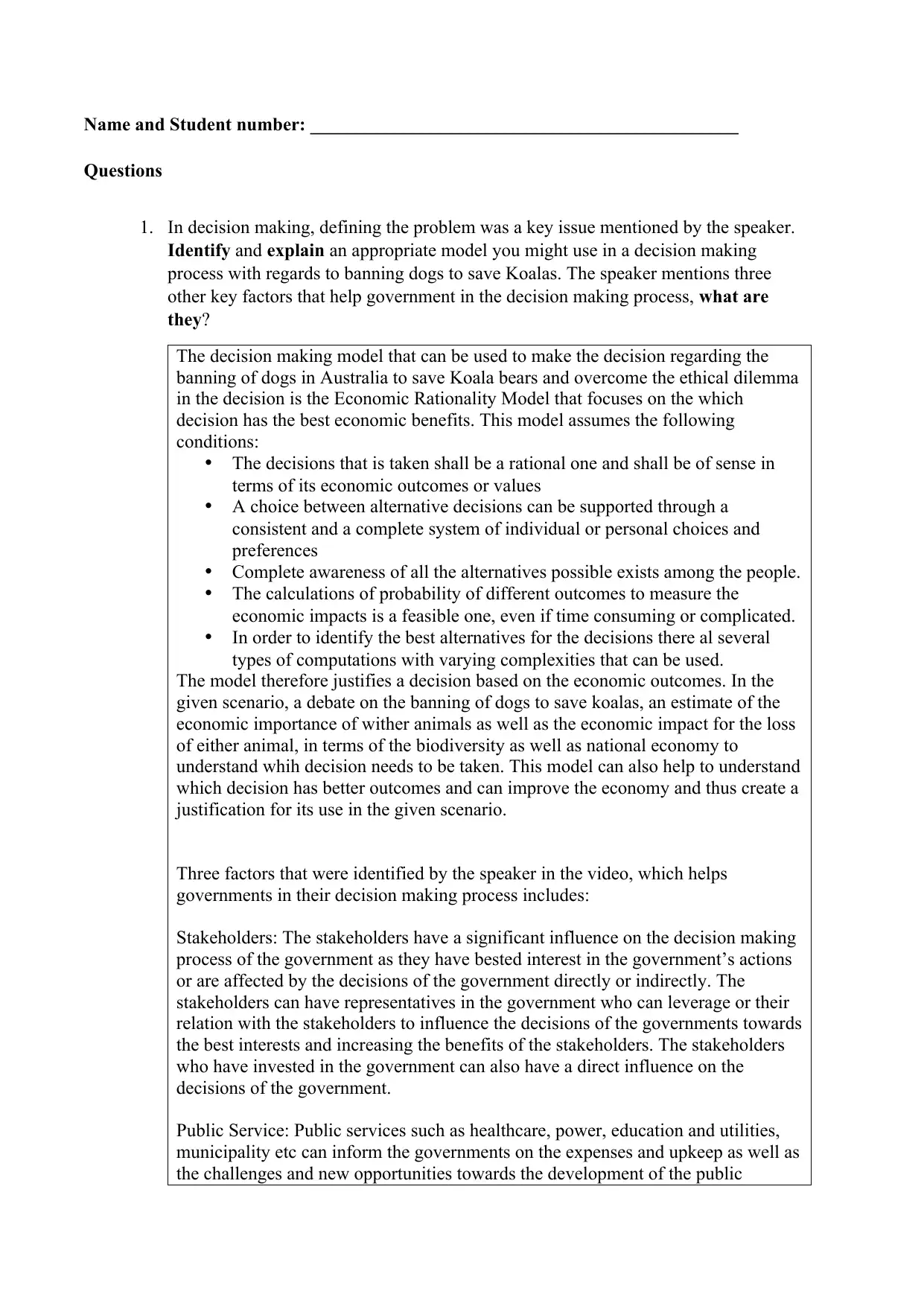
Name and Student number: ______________________________________________
Questions
1. In decision making, defining the problem was a key issue mentioned by the speaker.
Identify and explain an appropriate model you might use in a decision making
process with regards to banning dogs to save Koalas. The speaker mentions three
other key factors that help government in the decision making process, what are
they?
The decision making model that can be used to make the decision regarding the
banning of dogs in Australia to save Koala bears and overcome the ethical dilemma
in the decision is the Economic Rationality Model that focuses on the which
decision has the best economic benefits. This model assumes the following
conditions:
The decisions that is taken shall be a rational one and shall be of sense in
terms of its economic outcomes or values
A choice between alternative decisions can be supported through a
consistent and a complete system of individual or personal choices and
preferences
Complete awareness of all the alternatives possible exists among the people.
The calculations of probability of different outcomes to measure the
economic impacts is a feasible one, even if time consuming or complicated.
In order to identify the best alternatives for the decisions there al several
types of computations with varying complexities that can be used.
The model therefore justifies a decision based on the economic outcomes. In the
given scenario, a debate on the banning of dogs to save koalas, an estimate of the
economic importance of wither animals as well as the economic impact for the loss
of either animal, in terms of the biodiversity as well as national economy to
understand whih decision needs to be taken. This model can also help to understand
which decision has better outcomes and can improve the economy and thus create a
justification for its use in the given scenario.
Three factors that were identified by the speaker in the video, which helps
governments in their decision making process includes:
Stakeholders: The stakeholders have a significant influence on the decision making
process of the government as they have bested interest in the government’s actions
or are affected by the decisions of the government directly or indirectly. The
stakeholders can have representatives in the government who can leverage or their
relation with the stakeholders to influence the decisions of the governments towards
the best interests and increasing the benefits of the stakeholders. The stakeholders
who have invested in the government can also have a direct influence on the
decisions of the government.
Public Service: Public services such as healthcare, power, education and utilities,
municipality etc can inform the governments on the expenses and upkeep as well as
the challenges and new opportunities towards the development of the public
Questions
1. In decision making, defining the problem was a key issue mentioned by the speaker.
Identify and explain an appropriate model you might use in a decision making
process with regards to banning dogs to save Koalas. The speaker mentions three
other key factors that help government in the decision making process, what are
they?
The decision making model that can be used to make the decision regarding the
banning of dogs in Australia to save Koala bears and overcome the ethical dilemma
in the decision is the Economic Rationality Model that focuses on the which
decision has the best economic benefits. This model assumes the following
conditions:
The decisions that is taken shall be a rational one and shall be of sense in
terms of its economic outcomes or values
A choice between alternative decisions can be supported through a
consistent and a complete system of individual or personal choices and
preferences
Complete awareness of all the alternatives possible exists among the people.
The calculations of probability of different outcomes to measure the
economic impacts is a feasible one, even if time consuming or complicated.
In order to identify the best alternatives for the decisions there al several
types of computations with varying complexities that can be used.
The model therefore justifies a decision based on the economic outcomes. In the
given scenario, a debate on the banning of dogs to save koalas, an estimate of the
economic importance of wither animals as well as the economic impact for the loss
of either animal, in terms of the biodiversity as well as national economy to
understand whih decision needs to be taken. This model can also help to understand
which decision has better outcomes and can improve the economy and thus create a
justification for its use in the given scenario.
Three factors that were identified by the speaker in the video, which helps
governments in their decision making process includes:
Stakeholders: The stakeholders have a significant influence on the decision making
process of the government as they have bested interest in the government’s actions
or are affected by the decisions of the government directly or indirectly. The
stakeholders can have representatives in the government who can leverage or their
relation with the stakeholders to influence the decisions of the governments towards
the best interests and increasing the benefits of the stakeholders. The stakeholders
who have invested in the government can also have a direct influence on the
decisions of the government.
Public Service: Public services such as healthcare, power, education and utilities,
municipality etc can inform the governments on the expenses and upkeep as well as
the challenges and new opportunities towards the development of the public
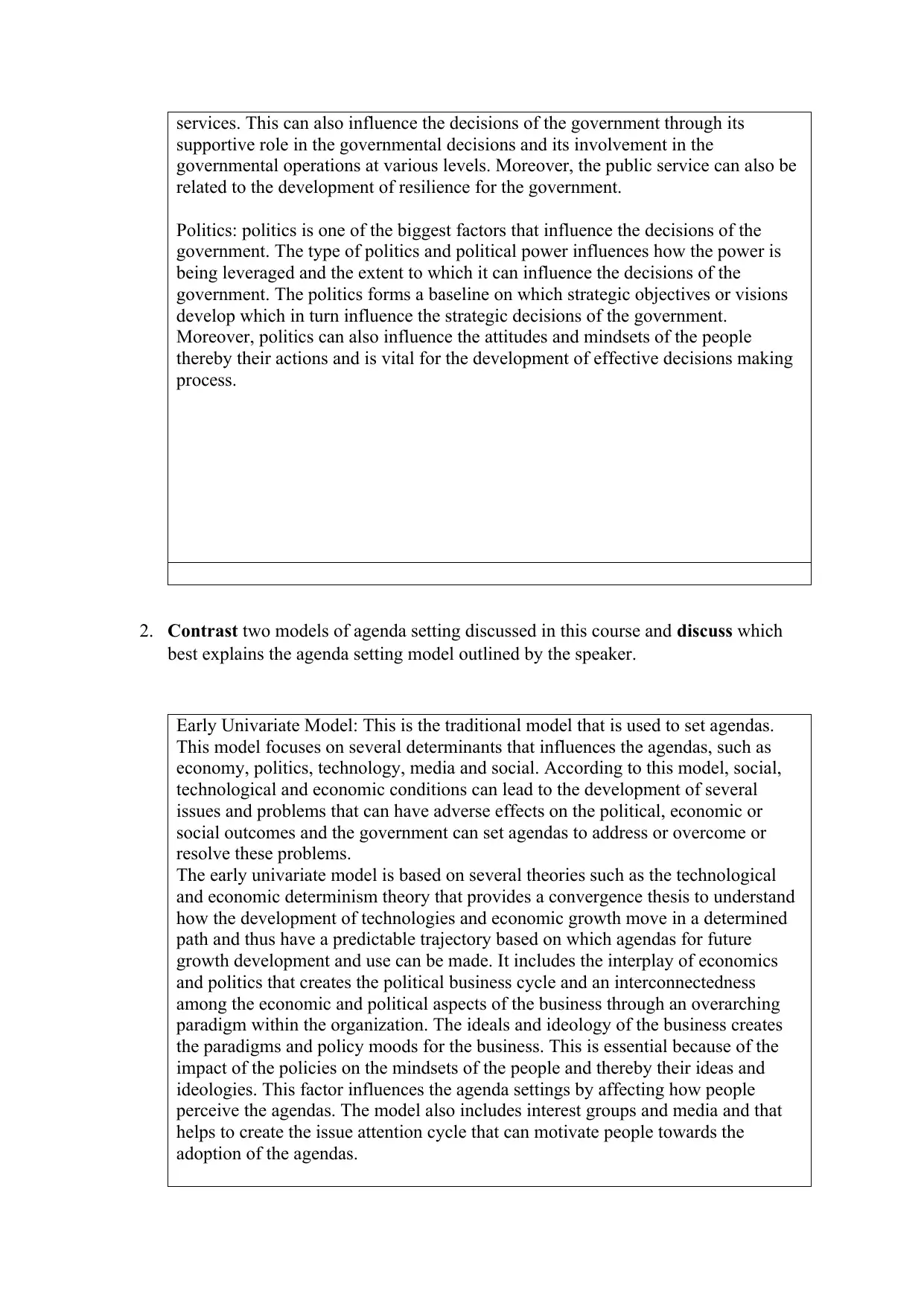
services. This can also influence the decisions of the government through its
supportive role in the governmental decisions and its involvement in the
governmental operations at various levels. Moreover, the public service can also be
related to the development of resilience for the government.
Politics: politics is one of the biggest factors that influence the decisions of the
government. The type of politics and political power influences how the power is
being leveraged and the extent to which it can influence the decisions of the
government. The politics forms a baseline on which strategic objectives or visions
develop which in turn influence the strategic decisions of the government.
Moreover, politics can also influence the attitudes and mindsets of the people
thereby their actions and is vital for the development of effective decisions making
process.
2. Contrast two models of agenda setting discussed in this course and discuss which
best explains the agenda setting model outlined by the speaker.
Early Univariate Model: This is the traditional model that is used to set agendas.
This model focuses on several determinants that influences the agendas, such as
economy, politics, technology, media and social. According to this model, social,
technological and economic conditions can lead to the development of several
issues and problems that can have adverse effects on the political, economic or
social outcomes and the government can set agendas to address or overcome or
resolve these problems.
The early univariate model is based on several theories such as the technological
and economic determinism theory that provides a convergence thesis to understand
how the development of technologies and economic growth move in a determined
path and thus have a predictable trajectory based on which agendas for future
growth development and use can be made. It includes the interplay of economics
and politics that creates the political business cycle and an interconnectedness
among the economic and political aspects of the business through an overarching
paradigm within the organization. The ideals and ideology of the business creates
the paradigms and policy moods for the business. This is essential because of the
impact of the policies on the mindsets of the people and thereby their ideas and
ideologies. This factor influences the agenda settings by affecting how people
perceive the agendas. The model also includes interest groups and media and that
helps to create the issue attention cycle that can motivate people towards the
adoption of the agendas.
supportive role in the governmental decisions and its involvement in the
governmental operations at various levels. Moreover, the public service can also be
related to the development of resilience for the government.
Politics: politics is one of the biggest factors that influence the decisions of the
government. The type of politics and political power influences how the power is
being leveraged and the extent to which it can influence the decisions of the
government. The politics forms a baseline on which strategic objectives or visions
develop which in turn influence the strategic decisions of the government.
Moreover, politics can also influence the attitudes and mindsets of the people
thereby their actions and is vital for the development of effective decisions making
process.
2. Contrast two models of agenda setting discussed in this course and discuss which
best explains the agenda setting model outlined by the speaker.
Early Univariate Model: This is the traditional model that is used to set agendas.
This model focuses on several determinants that influences the agendas, such as
economy, politics, technology, media and social. According to this model, social,
technological and economic conditions can lead to the development of several
issues and problems that can have adverse effects on the political, economic or
social outcomes and the government can set agendas to address or overcome or
resolve these problems.
The early univariate model is based on several theories such as the technological
and economic determinism theory that provides a convergence thesis to understand
how the development of technologies and economic growth move in a determined
path and thus have a predictable trajectory based on which agendas for future
growth development and use can be made. It includes the interplay of economics
and politics that creates the political business cycle and an interconnectedness
among the economic and political aspects of the business through an overarching
paradigm within the organization. The ideals and ideology of the business creates
the paradigms and policy moods for the business. This is essential because of the
impact of the policies on the mindsets of the people and thereby their ideas and
ideologies. This factor influences the agenda settings by affecting how people
perceive the agendas. The model also includes interest groups and media and that
helps to create the issue attention cycle that can motivate people towards the
adoption of the agendas.
⊘ This is a preview!⊘
Do you want full access?
Subscribe today to unlock all pages.

Trusted by 1+ million students worldwide
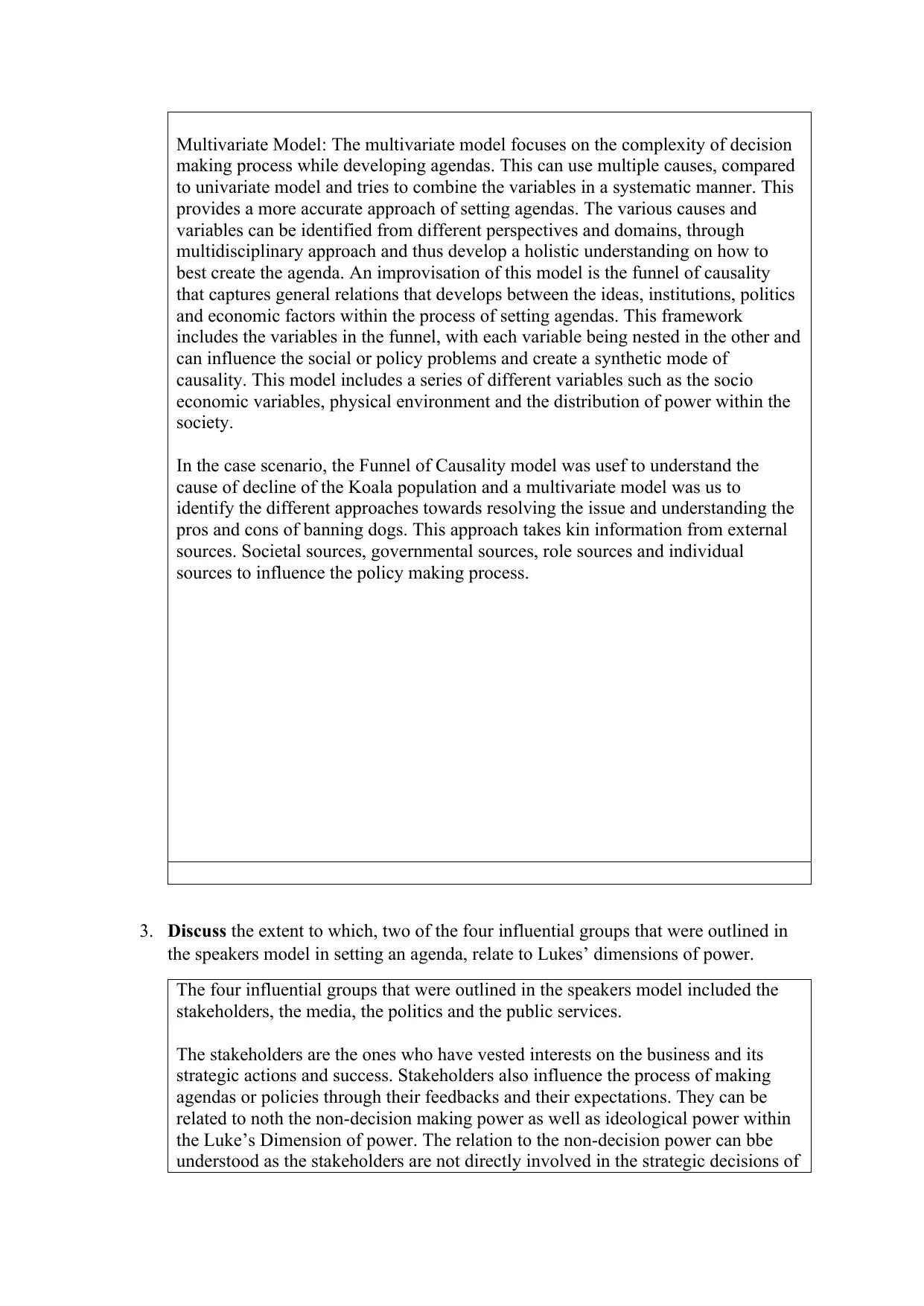
Multivariate Model: The multivariate model focuses on the complexity of decision
making process while developing agendas. This can use multiple causes, compared
to univariate model and tries to combine the variables in a systematic manner. This
provides a more accurate approach of setting agendas. The various causes and
variables can be identified from different perspectives and domains, through
multidisciplinary approach and thus develop a holistic understanding on how to
best create the agenda. An improvisation of this model is the funnel of causality
that captures general relations that develops between the ideas, institutions, politics
and economic factors within the process of setting agendas. This framework
includes the variables in the funnel, with each variable being nested in the other and
can influence the social or policy problems and create a synthetic mode of
causality. This model includes a series of different variables such as the socio
economic variables, physical environment and the distribution of power within the
society.
In the case scenario, the Funnel of Causality model was usef to understand the
cause of decline of the Koala population and a multivariate model was us to
identify the different approaches towards resolving the issue and understanding the
pros and cons of banning dogs. This approach takes kin information from external
sources. Societal sources, governmental sources, role sources and individual
sources to influence the policy making process.
3. Discuss the extent to which, two of the four influential groups that were outlined in
the speakers model in setting an agenda, relate to Lukes’ dimensions of power.
The four influential groups that were outlined in the speakers model included the
stakeholders, the media, the politics and the public services.
The stakeholders are the ones who have vested interests on the business and its
strategic actions and success. Stakeholders also influence the process of making
agendas or policies through their feedbacks and their expectations. They can be
related to noth the non-decision making power as well as ideological power within
the Luke’s Dimension of power. The relation to the non-decision power can bbe
understood as the stakeholders are not directly involved in the strategic decisions of
making process while developing agendas. This can use multiple causes, compared
to univariate model and tries to combine the variables in a systematic manner. This
provides a more accurate approach of setting agendas. The various causes and
variables can be identified from different perspectives and domains, through
multidisciplinary approach and thus develop a holistic understanding on how to
best create the agenda. An improvisation of this model is the funnel of causality
that captures general relations that develops between the ideas, institutions, politics
and economic factors within the process of setting agendas. This framework
includes the variables in the funnel, with each variable being nested in the other and
can influence the social or policy problems and create a synthetic mode of
causality. This model includes a series of different variables such as the socio
economic variables, physical environment and the distribution of power within the
society.
In the case scenario, the Funnel of Causality model was usef to understand the
cause of decline of the Koala population and a multivariate model was us to
identify the different approaches towards resolving the issue and understanding the
pros and cons of banning dogs. This approach takes kin information from external
sources. Societal sources, governmental sources, role sources and individual
sources to influence the policy making process.
3. Discuss the extent to which, two of the four influential groups that were outlined in
the speakers model in setting an agenda, relate to Lukes’ dimensions of power.
The four influential groups that were outlined in the speakers model included the
stakeholders, the media, the politics and the public services.
The stakeholders are the ones who have vested interests on the business and its
strategic actions and success. Stakeholders also influence the process of making
agendas or policies through their feedbacks and their expectations. They can be
related to noth the non-decision making power as well as ideological power within
the Luke’s Dimension of power. The relation to the non-decision power can bbe
understood as the stakeholders are not directly involved in the strategic decisions of
Paraphrase This Document
Need a fresh take? Get an instant paraphrase of this document with our AI Paraphraser
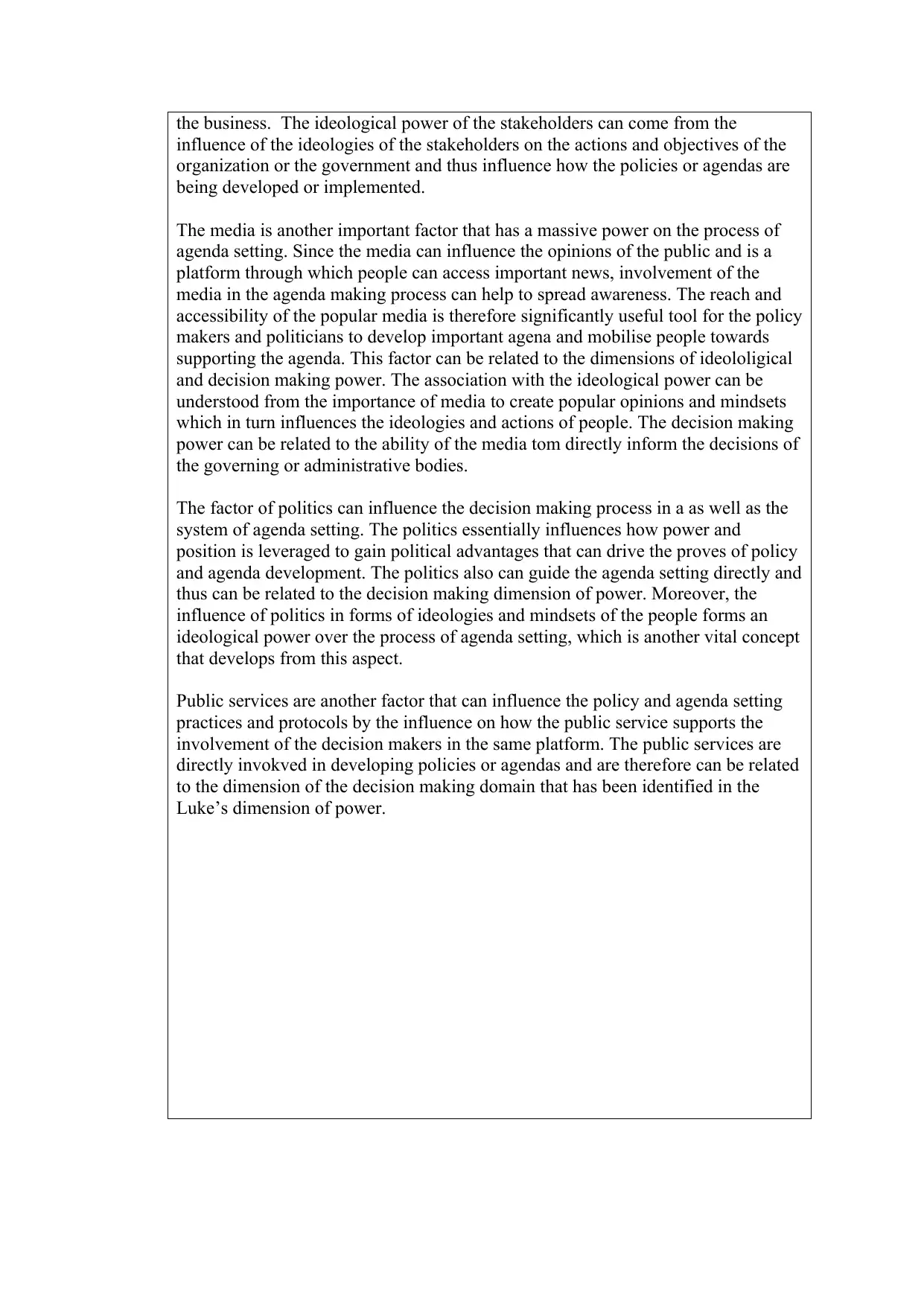
the business. The ideological power of the stakeholders can come from the
influence of the ideologies of the stakeholders on the actions and objectives of the
organization or the government and thus influence how the policies or agendas are
being developed or implemented.
The media is another important factor that has a massive power on the process of
agenda setting. Since the media can influence the opinions of the public and is a
platform through which people can access important news, involvement of the
media in the agenda making process can help to spread awareness. The reach and
accessibility of the popular media is therefore significantly useful tool for the policy
makers and politicians to develop important agena and mobilise people towards
supporting the agenda. This factor can be related to the dimensions of ideololigical
and decision making power. The association with the ideological power can be
understood from the importance of media to create popular opinions and mindsets
which in turn influences the ideologies and actions of people. The decision making
power can be related to the ability of the media tom directly inform the decisions of
the governing or administrative bodies.
The factor of politics can influence the decision making process in a as well as the
system of agenda setting. The politics essentially influences how power and
position is leveraged to gain political advantages that can drive the proves of policy
and agenda development. The politics also can guide the agenda setting directly and
thus can be related to the decision making dimension of power. Moreover, the
influence of politics in forms of ideologies and mindsets of the people forms an
ideological power over the process of agenda setting, which is another vital concept
that develops from this aspect.
Public services are another factor that can influence the policy and agenda setting
practices and protocols by the influence on how the public service supports the
involvement of the decision makers in the same platform. The public services are
directly invokved in developing policies or agendas and are therefore can be related
to the dimension of the decision making domain that has been identified in the
Luke’s dimension of power.
influence of the ideologies of the stakeholders on the actions and objectives of the
organization or the government and thus influence how the policies or agendas are
being developed or implemented.
The media is another important factor that has a massive power on the process of
agenda setting. Since the media can influence the opinions of the public and is a
platform through which people can access important news, involvement of the
media in the agenda making process can help to spread awareness. The reach and
accessibility of the popular media is therefore significantly useful tool for the policy
makers and politicians to develop important agena and mobilise people towards
supporting the agenda. This factor can be related to the dimensions of ideololigical
and decision making power. The association with the ideological power can be
understood from the importance of media to create popular opinions and mindsets
which in turn influences the ideologies and actions of people. The decision making
power can be related to the ability of the media tom directly inform the decisions of
the governing or administrative bodies.
The factor of politics can influence the decision making process in a as well as the
system of agenda setting. The politics essentially influences how power and
position is leveraged to gain political advantages that can drive the proves of policy
and agenda development. The politics also can guide the agenda setting directly and
thus can be related to the decision making dimension of power. Moreover, the
influence of politics in forms of ideologies and mindsets of the people forms an
ideological power over the process of agenda setting, which is another vital concept
that develops from this aspect.
Public services are another factor that can influence the policy and agenda setting
practices and protocols by the influence on how the public service supports the
involvement of the decision makers in the same platform. The public services are
directly invokved in developing policies or agendas and are therefore can be related
to the dimension of the decision making domain that has been identified in the
Luke’s dimension of power.
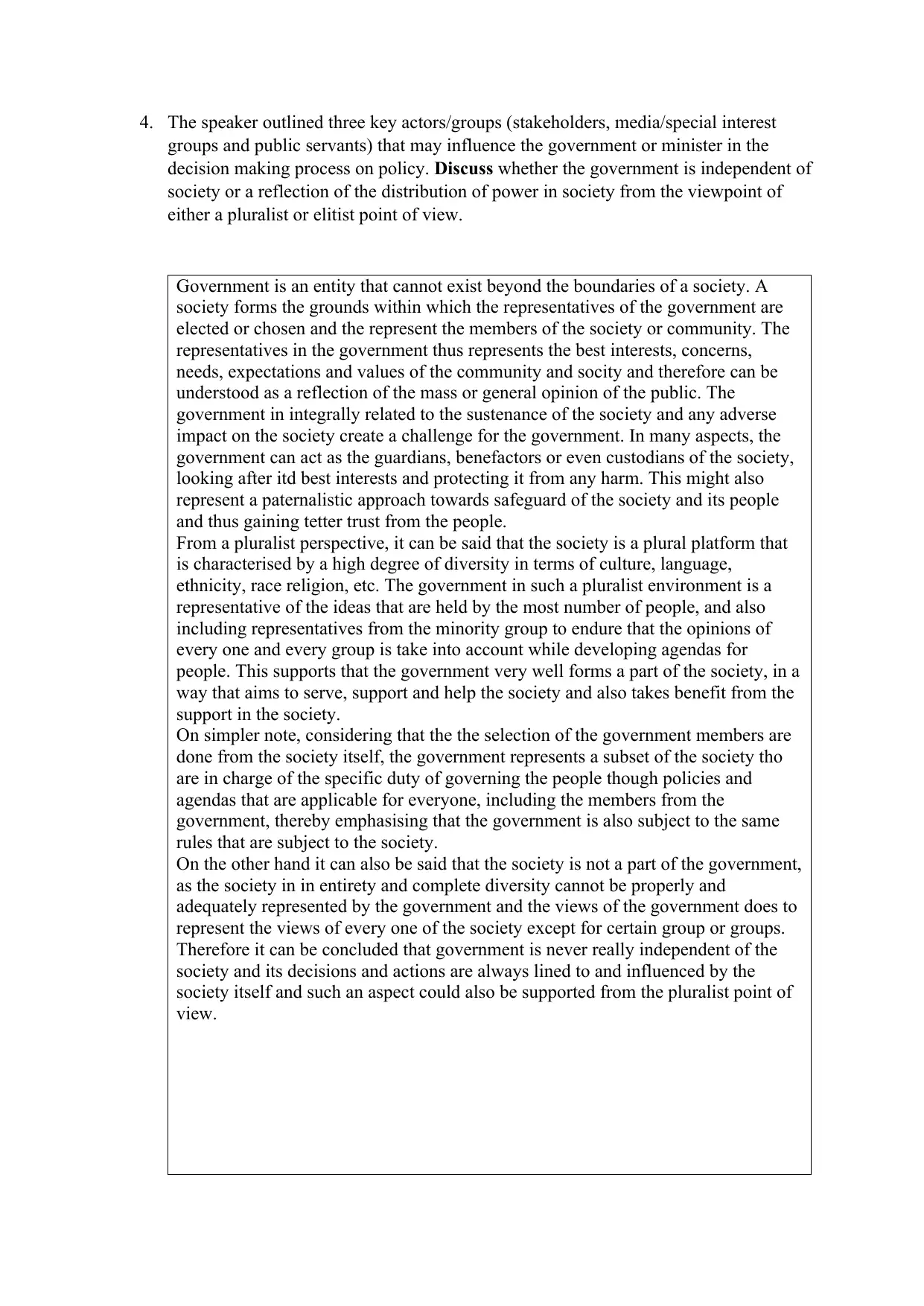
4. The speaker outlined three key actors/groups (stakeholders, media/special interest
groups and public servants) that may influence the government or minister in the
decision making process on policy. Discuss whether the government is independent of
society or a reflection of the distribution of power in society from the viewpoint of
either a pluralist or elitist point of view.
Government is an entity that cannot exist beyond the boundaries of a society. A
society forms the grounds within which the representatives of the government are
elected or chosen and the represent the members of the society or community. The
representatives in the government thus represents the best interests, concerns,
needs, expectations and values of the community and socity and therefore can be
understood as a reflection of the mass or general opinion of the public. The
government in integrally related to the sustenance of the society and any adverse
impact on the society create a challenge for the government. In many aspects, the
government can act as the guardians, benefactors or even custodians of the society,
looking after itd best interests and protecting it from any harm. This might also
represent a paternalistic approach towards safeguard of the society and its people
and thus gaining tetter trust from the people.
From a pluralist perspective, it can be said that the society is a plural platform that
is characterised by a high degree of diversity in terms of culture, language,
ethnicity, race religion, etc. The government in such a pluralist environment is a
representative of the ideas that are held by the most number of people, and also
including representatives from the minority group to endure that the opinions of
every one and every group is take into account while developing agendas for
people. This supports that the government very well forms a part of the society, in a
way that aims to serve, support and help the society and also takes benefit from the
support in the society.
On simpler note, considering that the the selection of the government members are
done from the society itself, the government represents a subset of the society tho
are in charge of the specific duty of governing the people though policies and
agendas that are applicable for everyone, including the members from the
government, thereby emphasising that the government is also subject to the same
rules that are subject to the society.
On the other hand it can also be said that the society is not a part of the government,
as the society in in entirety and complete diversity cannot be properly and
adequately represented by the government and the views of the government does to
represent the views of every one of the society except for certain group or groups.
Therefore it can be concluded that government is never really independent of the
society and its decisions and actions are always lined to and influenced by the
society itself and such an aspect could also be supported from the pluralist point of
view.
groups and public servants) that may influence the government or minister in the
decision making process on policy. Discuss whether the government is independent of
society or a reflection of the distribution of power in society from the viewpoint of
either a pluralist or elitist point of view.
Government is an entity that cannot exist beyond the boundaries of a society. A
society forms the grounds within which the representatives of the government are
elected or chosen and the represent the members of the society or community. The
representatives in the government thus represents the best interests, concerns,
needs, expectations and values of the community and socity and therefore can be
understood as a reflection of the mass or general opinion of the public. The
government in integrally related to the sustenance of the society and any adverse
impact on the society create a challenge for the government. In many aspects, the
government can act as the guardians, benefactors or even custodians of the society,
looking after itd best interests and protecting it from any harm. This might also
represent a paternalistic approach towards safeguard of the society and its people
and thus gaining tetter trust from the people.
From a pluralist perspective, it can be said that the society is a plural platform that
is characterised by a high degree of diversity in terms of culture, language,
ethnicity, race religion, etc. The government in such a pluralist environment is a
representative of the ideas that are held by the most number of people, and also
including representatives from the minority group to endure that the opinions of
every one and every group is take into account while developing agendas for
people. This supports that the government very well forms a part of the society, in a
way that aims to serve, support and help the society and also takes benefit from the
support in the society.
On simpler note, considering that the the selection of the government members are
done from the society itself, the government represents a subset of the society tho
are in charge of the specific duty of governing the people though policies and
agendas that are applicable for everyone, including the members from the
government, thereby emphasising that the government is also subject to the same
rules that are subject to the society.
On the other hand it can also be said that the society is not a part of the government,
as the society in in entirety and complete diversity cannot be properly and
adequately represented by the government and the views of the government does to
represent the views of every one of the society except for certain group or groups.
Therefore it can be concluded that government is never really independent of the
society and its decisions and actions are always lined to and influenced by the
society itself and such an aspect could also be supported from the pluralist point of
view.
⊘ This is a preview!⊘
Do you want full access?
Subscribe today to unlock all pages.
Trusted by 1+ million students worldwide

Paraphrase This Document
Need a fresh take? Get an instant paraphrase of this document with our AI Paraphraser
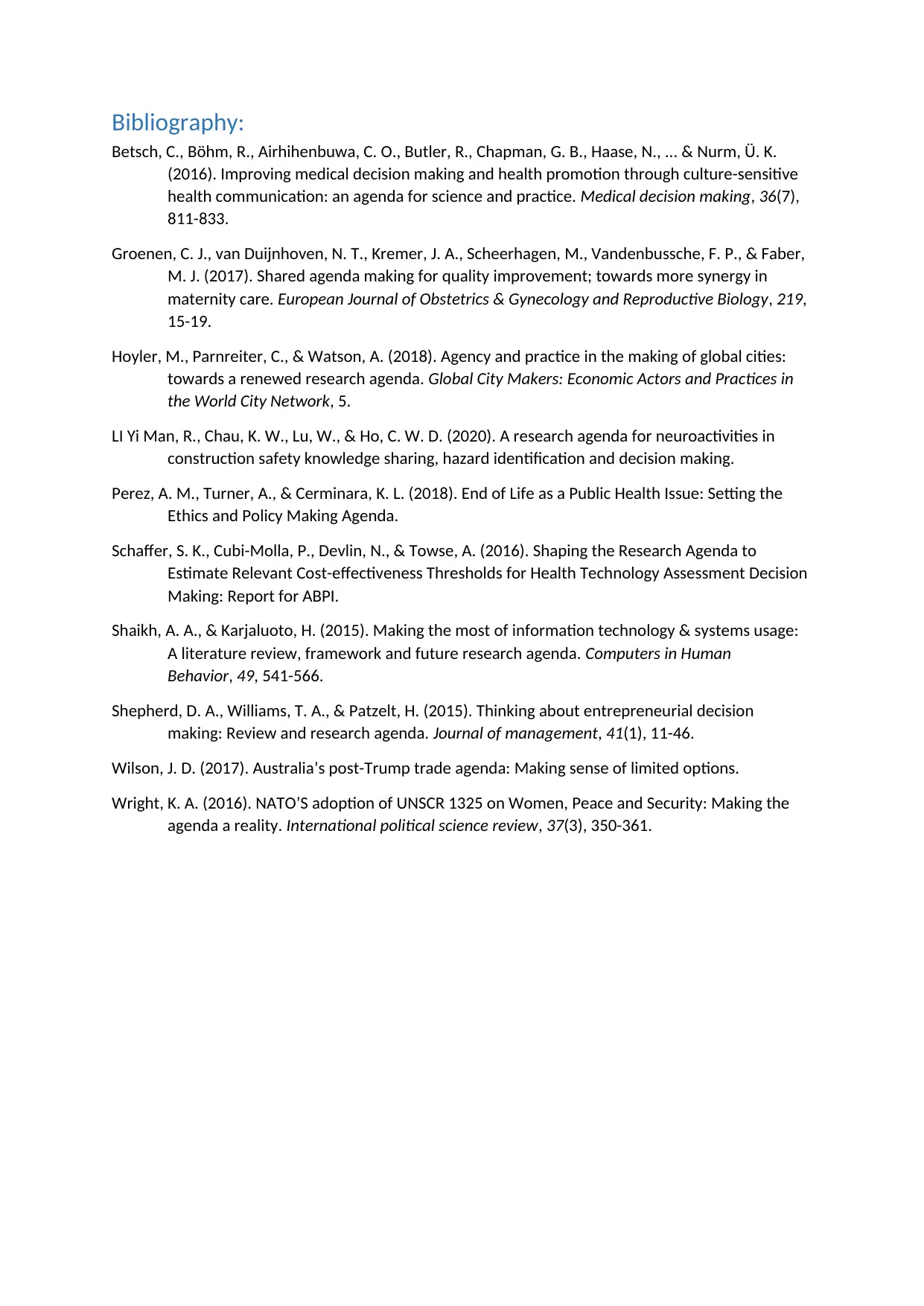
Bibliography:
Betsch, C., Böhm, R., Airhihenbuwa, C. O., Butler, R., Chapman, G. B., Haase, N., ... & Nurm, Ü. K.
(2016). Improving medical decision making and health promotion through culture-sensitive
health communication: an agenda for science and practice. Medical decision making, 36(7),
811-833.
Groenen, C. J., van Duijnhoven, N. T., Kremer, J. A., Scheerhagen, M., Vandenbussche, F. P., & Faber,
M. J. (2017). Shared agenda making for quality improvement; towards more synergy in
maternity care. European Journal of Obstetrics & Gynecology and Reproductive Biology, 219,
15-19.
Hoyler, M., Parnreiter, C., & Watson, A. (2018). Agency and practice in the making of global cities:
towards a renewed research agenda. Global City Makers: Economic Actors and Practices in
the World City Network, 5.
LI Yi Man, R., Chau, K. W., Lu, W., & Ho, C. W. D. (2020). A research agenda for neuroactivities in
construction safety knowledge sharing, hazard identification and decision making.
Perez, A. M., Turner, A., & Cerminara, K. L. (2018). End of Life as a Public Health Issue: Setting the
Ethics and Policy Making Agenda.
Schaffer, S. K., Cubi-Molla, P., Devlin, N., & Towse, A. (2016). Shaping the Research Agenda to
Estimate Relevant Cost-effectiveness Thresholds for Health Technology Assessment Decision
Making: Report for ABPI.
Shaikh, A. A., & Karjaluoto, H. (2015). Making the most of information technology & systems usage:
A literature review, framework and future research agenda. Computers in Human
Behavior, 49, 541-566.
Shepherd, D. A., Williams, T. A., & Patzelt, H. (2015). Thinking about entrepreneurial decision
making: Review and research agenda. Journal of management, 41(1), 11-46.
Wilson, J. D. (2017). Australia’s post-Trump trade agenda: Making sense of limited options.
Wright, K. A. (2016). NATO’S adoption of UNSCR 1325 on Women, Peace and Security: Making the
agenda a reality. International political science review, 37(3), 350-361.
Betsch, C., Böhm, R., Airhihenbuwa, C. O., Butler, R., Chapman, G. B., Haase, N., ... & Nurm, Ü. K.
(2016). Improving medical decision making and health promotion through culture-sensitive
health communication: an agenda for science and practice. Medical decision making, 36(7),
811-833.
Groenen, C. J., van Duijnhoven, N. T., Kremer, J. A., Scheerhagen, M., Vandenbussche, F. P., & Faber,
M. J. (2017). Shared agenda making for quality improvement; towards more synergy in
maternity care. European Journal of Obstetrics & Gynecology and Reproductive Biology, 219,
15-19.
Hoyler, M., Parnreiter, C., & Watson, A. (2018). Agency and practice in the making of global cities:
towards a renewed research agenda. Global City Makers: Economic Actors and Practices in
the World City Network, 5.
LI Yi Man, R., Chau, K. W., Lu, W., & Ho, C. W. D. (2020). A research agenda for neuroactivities in
construction safety knowledge sharing, hazard identification and decision making.
Perez, A. M., Turner, A., & Cerminara, K. L. (2018). End of Life as a Public Health Issue: Setting the
Ethics and Policy Making Agenda.
Schaffer, S. K., Cubi-Molla, P., Devlin, N., & Towse, A. (2016). Shaping the Research Agenda to
Estimate Relevant Cost-effectiveness Thresholds for Health Technology Assessment Decision
Making: Report for ABPI.
Shaikh, A. A., & Karjaluoto, H. (2015). Making the most of information technology & systems usage:
A literature review, framework and future research agenda. Computers in Human
Behavior, 49, 541-566.
Shepherd, D. A., Williams, T. A., & Patzelt, H. (2015). Thinking about entrepreneurial decision
making: Review and research agenda. Journal of management, 41(1), 11-46.
Wilson, J. D. (2017). Australia’s post-Trump trade agenda: Making sense of limited options.
Wright, K. A. (2016). NATO’S adoption of UNSCR 1325 on Women, Peace and Security: Making the
agenda a reality. International political science review, 37(3), 350-361.

1 out of 8


Related Documents


Your All-in-One AI-Powered Toolkit for Academic Success.
+13062052269
info@desklib.com
Available 24*7 on WhatsApp / Email
![[object Object]](/_next/static/media/star-bottom.7253800d.svg)
Unlock your academic potential
Copyright © 2020–2026 A2Z Services. All Rights Reserved. Developed and managed by ZUCOL.