Health Promotion Program Analysis: Paradigm Essay on Youth Obesity
VerifiedAdded on 2021/05/27
|12
|2829
|33
Essay
AI Summary
This essay analyzes health promotion programs through the lens of the at-risk and resilience paradigms, focusing on a program addressing youth food habits and obesity in Australia. The essay begins by defining and contrasting the at-risk and resilience paradigms, outlining their principles and applications in healthcare. It then explores the shift towards the resilience paradigm, highlighting its importance in managing complex health challenges and uncertainties. The core of the essay examines a specific health promotion program targeting youth obesity, detailing its objectives, initiatives, and the health trends it addresses. The analysis includes a discussion of how the program aligns with the resilience paradigm, emphasizing its proactive approach to risk management and its focus on building resilience within the target population. Finally, the essay concludes by comparing the effectiveness of the resilience paradigm with the at-risk paradigm, supported by both qualitative and quantitative data, and underscores the benefits of resilience-based health promotion strategies in achieving desired outcomes.
Running head: PARADIGM
Paradigm
Name of the Student
Name of the University
Author Note
Paradigm
Name of the Student
Name of the University
Author Note

Paraphrase This Document
Need a fresh take? Get an instant paraphrase of this document with our AI Paraphraser
PARADIGM
Part 1
Definition of Paradigm
According to the Faist (2013), at paradigm is a framework which contains the basic
assumptions or patterns of thinking and other commonly accepted methodology used for
addressing certain specific issues. The main purpose of this essay is to analyse a health
promotion program under the umbrella of the at-risk paradigm and resilience paradigm. The
chosen health promotion program under this context is youth food habits and obesity. The
essay initiates via throwing a brief light on the overview of at-risk paradigm, resilience
paradigm followed by the principles and ideas underlying the at-risk and resilience paradigm.
The essay wills then attempt to explain the possible reason behind the shift of the overall
paradigm concept over resilience from risk management. Finally the essay will analyse the
chosen youth health promotion program under the context of resilience and at-risk paradigm
and at the end the essay will summaries with on overview of the success of the chosen health
promotion program in addressing health trends via employing qualitative and quantitative
data.
At-risk paradigm
In relation to paradigm, at risk-paradigm mainly highlights the factors or the
individuals who are more prone to get affected with the risk factor underlined by that
particular paradigm (Lerner, Whang & Nipper, 2013).
Resilience paradigm
A resilience paradigm is defined a particular framework that help communities or an
individual not just to mitigate or heal the overall damage but also a distinct path to thrive
(Wulff, Donato & Lurie, 2015). Some of the common steps which are undertaken under the
Part 1
Definition of Paradigm
According to the Faist (2013), at paradigm is a framework which contains the basic
assumptions or patterns of thinking and other commonly accepted methodology used for
addressing certain specific issues. The main purpose of this essay is to analyse a health
promotion program under the umbrella of the at-risk paradigm and resilience paradigm. The
chosen health promotion program under this context is youth food habits and obesity. The
essay initiates via throwing a brief light on the overview of at-risk paradigm, resilience
paradigm followed by the principles and ideas underlying the at-risk and resilience paradigm.
The essay wills then attempt to explain the possible reason behind the shift of the overall
paradigm concept over resilience from risk management. Finally the essay will analyse the
chosen youth health promotion program under the context of resilience and at-risk paradigm
and at the end the essay will summaries with on overview of the success of the chosen health
promotion program in addressing health trends via employing qualitative and quantitative
data.
At-risk paradigm
In relation to paradigm, at risk-paradigm mainly highlights the factors or the
individuals who are more prone to get affected with the risk factor underlined by that
particular paradigm (Lerner, Whang & Nipper, 2013).
Resilience paradigm
A resilience paradigm is defined a particular framework that help communities or an
individual not just to mitigate or heal the overall damage but also a distinct path to thrive
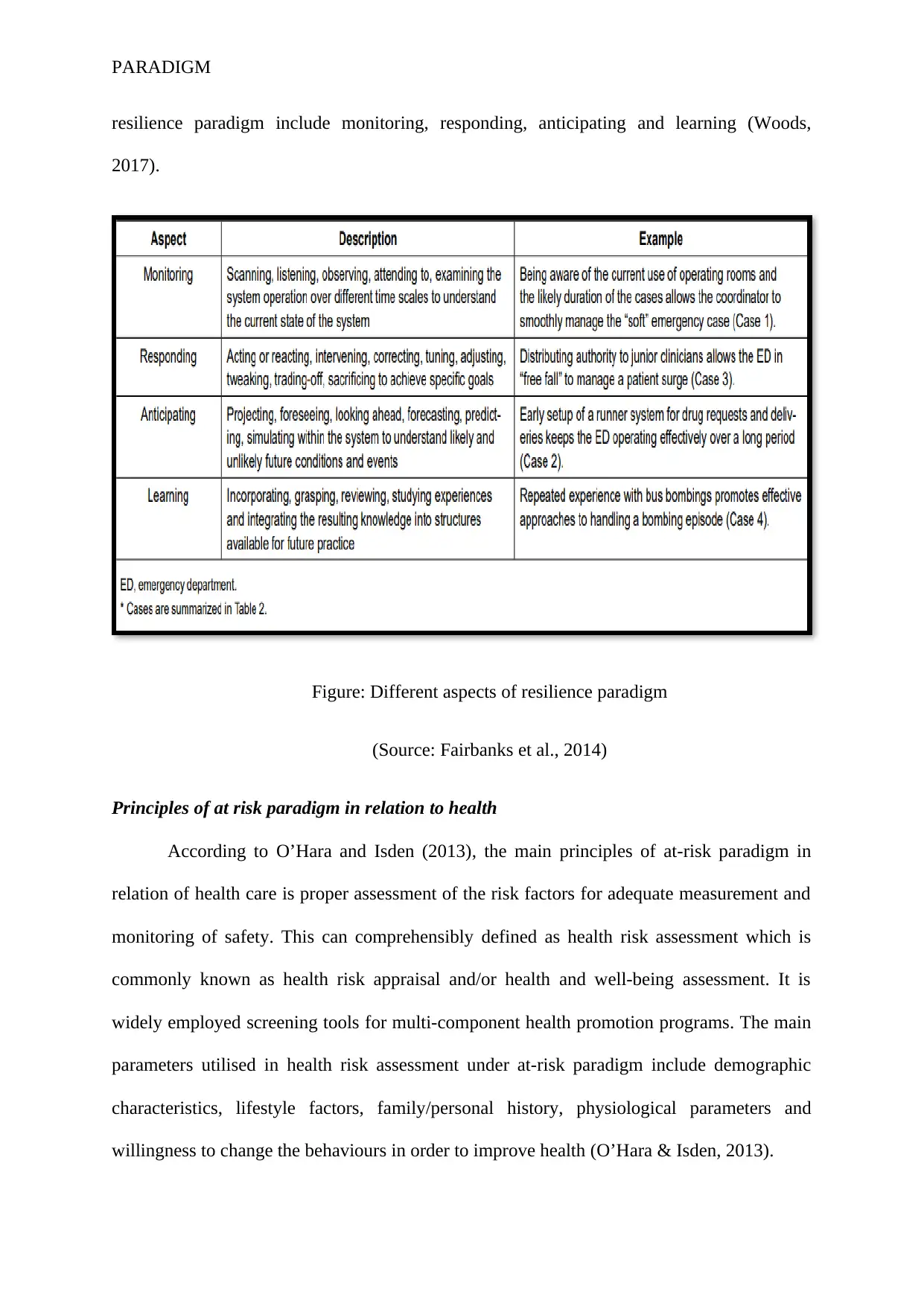
(Wulff, Donato & Lurie, 2015). Some of the common steps which are undertaken under the
PARADIGM
resilience paradigm include monitoring, responding, anticipating and learning (Woods,
2017).
Figure: Different aspects of resilience paradigm
(Source: Fairbanks et al., 2014)
Principles of at risk paradigm in relation to health
According to O’Hara and Isden (2013), the main principles of at-risk paradigm in
relation of health care is proper assessment of the risk factors for adequate measurement and
monitoring of safety. This can comprehensibly defined as health risk assessment which is
commonly known as health risk appraisal and/or health and well-being assessment. It is
widely employed screening tools for multi-component health promotion programs. The main
parameters utilised in health risk assessment under at-risk paradigm include demographic
characteristics, lifestyle factors, family/personal history, physiological parameters and
willingness to change the behaviours in order to improve health (O’Hara & Isden, 2013).
resilience paradigm include monitoring, responding, anticipating and learning (Woods,
2017).
Figure: Different aspects of resilience paradigm
(Source: Fairbanks et al., 2014)
Principles of at risk paradigm in relation to health
According to O’Hara and Isden (2013), the main principles of at-risk paradigm in
relation of health care is proper assessment of the risk factors for adequate measurement and
monitoring of safety. This can comprehensibly defined as health risk assessment which is
commonly known as health risk appraisal and/or health and well-being assessment. It is
widely employed screening tools for multi-component health promotion programs. The main
parameters utilised in health risk assessment under at-risk paradigm include demographic
characteristics, lifestyle factors, family/personal history, physiological parameters and
willingness to change the behaviours in order to improve health (O’Hara & Isden, 2013).
⊘ This is a preview!⊘
Do you want full access?
Subscribe today to unlock all pages.

Trusted by 1+ million students worldwide
PARADIGM
Principles of resilience paradigm in relation to health
No single domain can comprehensively explain the principles associated with
resilience paradigm. According to Wulff, Donato and Lurie (2015), resilience in health care is
a function of not only of economic prosperity and community competence but also
encompasses the individuals’ state of mental and physical health along with the social
connections and collaboration of government entities for successful recovery from the health
complications.
Part 2
Explaining shift towards resilience paradigm
Resilience is about how fast a community can bounce back to their initial position
during a public health emergency (Epstein & Krasner, 2013). In other words, it can be said
that resilience paradigm goes far beyond the risk management in order to address the
complexities of integrated system of health and the uncertainty associated with future threats
(Epstein & Krasner, 2013). Though resilience is conceptually messy, it is at present gaining
prime importance in the present day scenario. According to Wulff, Donato & Lurie (2015),
by the end of 2050, at least 75% of the global population will survive in increasingly dense
and large urban areas. This significant demographic shift is associated with change in
demands of the urban infrastructure, health structure and the ability of the different
organisational sectors to satisfy the needs of the residents in a comprehensive manner. As the
groups of population will aggregate at an increasing rate, the overall consequences of failure
in healthcare system will be more catastrophic (Chassin & Loeb, 2013). Thus only assessing
the risk factors or the highlighting the susceptible communities which are prone to get
endangered with the risk will not be comprehensive in tackling the overall risk. Chassin and
Loeb (2013) argued that although different sectors define the important components of
Principles of resilience paradigm in relation to health
No single domain can comprehensively explain the principles associated with
resilience paradigm. According to Wulff, Donato and Lurie (2015), resilience in health care is
a function of not only of economic prosperity and community competence but also
encompasses the individuals’ state of mental and physical health along with the social
connections and collaboration of government entities for successful recovery from the health
complications.
Part 2
Explaining shift towards resilience paradigm
Resilience is about how fast a community can bounce back to their initial position
during a public health emergency (Epstein & Krasner, 2013). In other words, it can be said
that resilience paradigm goes far beyond the risk management in order to address the
complexities of integrated system of health and the uncertainty associated with future threats
(Epstein & Krasner, 2013). Though resilience is conceptually messy, it is at present gaining
prime importance in the present day scenario. According to Wulff, Donato & Lurie (2015),
by the end of 2050, at least 75% of the global population will survive in increasingly dense
and large urban areas. This significant demographic shift is associated with change in
demands of the urban infrastructure, health structure and the ability of the different
organisational sectors to satisfy the needs of the residents in a comprehensive manner. As the
groups of population will aggregate at an increasing rate, the overall consequences of failure
in healthcare system will be more catastrophic (Chassin & Loeb, 2013). Thus only assessing
the risk factors or the highlighting the susceptible communities which are prone to get
endangered with the risk will not be comprehensive in tackling the overall risk. Chassin and
Loeb (2013) argued that although different sectors define the important components of
Paraphrase This Document
Need a fresh take? Get an instant paraphrase of this document with our AI Paraphraser
PARADIGM
resilience with a different approach, it is obvious that no single approach is capable of
reflecting what is enable the community to successfully withstand the stress of a community
disaster or a healthcare care and thereby improving the quality of life in the aftermath. Here
comes the importance of the concept of comprehensive resilience paradigm in comparison to
the at-risk paradigm (Chassin & Loeb, 2013).
In relation to shift in the concept of paradigm from risk management and resilience,
Fairbanks et al. (2014) is of the opinion that resilience is important for the systems which are
buffered by a combination of both usual and unusual demands; environmental disruptions;
conflicted goals; variations in staffing or other resources and certain critically incessant
change. It is the resilience of the particular systems that provides them the ability of generates
success in spite of conditions that can easily lead towards failure - and that enables them for
quick recovery and safety even after encountering failure. Thus resilience is evolving as a
better paradigm in comparison to at-risk paradigm in high stakes domains which are at
substantial risk and where workloads and operational tempos vary widely. The domains
where resilience is gradually gaining importance include healthcare sectors or more
specifically operating rooms, ICUs, clinics and other home care settings, military mission and
air traffic control rooms (Fairbanks et al., 2014).
Another important aspect of shift towards resilience paradigm is, resilience paradigm
does not simply encompass success in the face of threat of failure. Although, resilience
paradigm can and at times does fail, they represents a repertoire of behaviours like qualitative
shifts in performance in relation to varying demands, meaningful responses represented by
goal trade-offs and a tenacity of efforts to answer even when confronted via increasing
demands or existential threats (Woods. 2017). Woods (2017) argued that resilient paradigm
forestall failure, dodge failure or attempts to redirect failure to make the recovery smooth,
easy and less costly. This highlights a sharp difference with at-risk paradigm because at-risk
resilience with a different approach, it is obvious that no single approach is capable of
reflecting what is enable the community to successfully withstand the stress of a community
disaster or a healthcare care and thereby improving the quality of life in the aftermath. Here
comes the importance of the concept of comprehensive resilience paradigm in comparison to
the at-risk paradigm (Chassin & Loeb, 2013).
In relation to shift in the concept of paradigm from risk management and resilience,
Fairbanks et al. (2014) is of the opinion that resilience is important for the systems which are
buffered by a combination of both usual and unusual demands; environmental disruptions;
conflicted goals; variations in staffing or other resources and certain critically incessant
change. It is the resilience of the particular systems that provides them the ability of generates
success in spite of conditions that can easily lead towards failure - and that enables them for
quick recovery and safety even after encountering failure. Thus resilience is evolving as a
better paradigm in comparison to at-risk paradigm in high stakes domains which are at
substantial risk and where workloads and operational tempos vary widely. The domains
where resilience is gradually gaining importance include healthcare sectors or more
specifically operating rooms, ICUs, clinics and other home care settings, military mission and
air traffic control rooms (Fairbanks et al., 2014).
Another important aspect of shift towards resilience paradigm is, resilience paradigm
does not simply encompass success in the face of threat of failure. Although, resilience
paradigm can and at times does fail, they represents a repertoire of behaviours like qualitative
shifts in performance in relation to varying demands, meaningful responses represented by
goal trade-offs and a tenacity of efforts to answer even when confronted via increasing
demands or existential threats (Woods. 2017). Woods (2017) argued that resilient paradigm
forestall failure, dodge failure or attempts to redirect failure to make the recovery smooth,
easy and less costly. This highlights a sharp difference with at-risk paradigm because at-risk
PARADIGM
paradigm only states the risk factors but does not provides any direct overview of how to
successful overcome those risk factors.
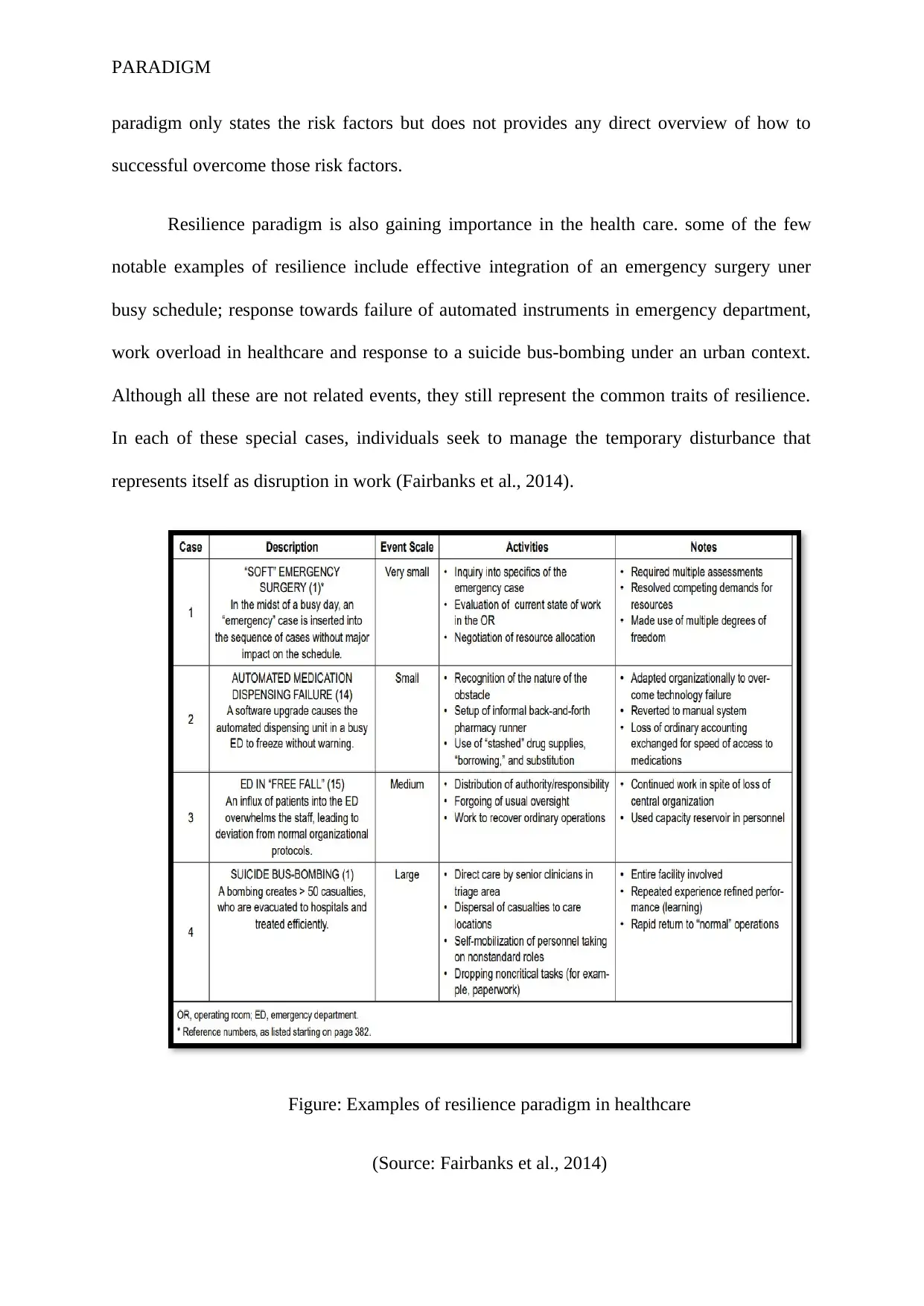
Resilience paradigm is also gaining importance in the health care. some of the few
notable examples of resilience include effective integration of an emergency surgery uner
busy schedule; response towards failure of automated instruments in emergency department,
work overload in healthcare and response to a suicide bus-bombing under an urban context.
Although all these are not related events, they still represent the common traits of resilience.
In each of these special cases, individuals seek to manage the temporary disturbance that
represents itself as disruption in work (Fairbanks et al., 2014).
Figure: Examples of resilience paradigm in healthcare
(Source: Fairbanks et al., 2014)
paradigm only states the risk factors but does not provides any direct overview of how to
successful overcome those risk factors.
Resilience paradigm is also gaining importance in the health care. some of the few
notable examples of resilience include effective integration of an emergency surgery uner
busy schedule; response towards failure of automated instruments in emergency department,
work overload in healthcare and response to a suicide bus-bombing under an urban context.
Although all these are not related events, they still represent the common traits of resilience.
In each of these special cases, individuals seek to manage the temporary disturbance that
represents itself as disruption in work (Fairbanks et al., 2014).
Figure: Examples of resilience paradigm in healthcare
(Source: Fairbanks et al., 2014)
⊘ This is a preview!⊘
Do you want full access?
Subscribe today to unlock all pages.
Trusted by 1+ million students worldwide
PARADIGM
Part 3
Analyzing the chosen youth health promotion
Description of the selected health promotion program
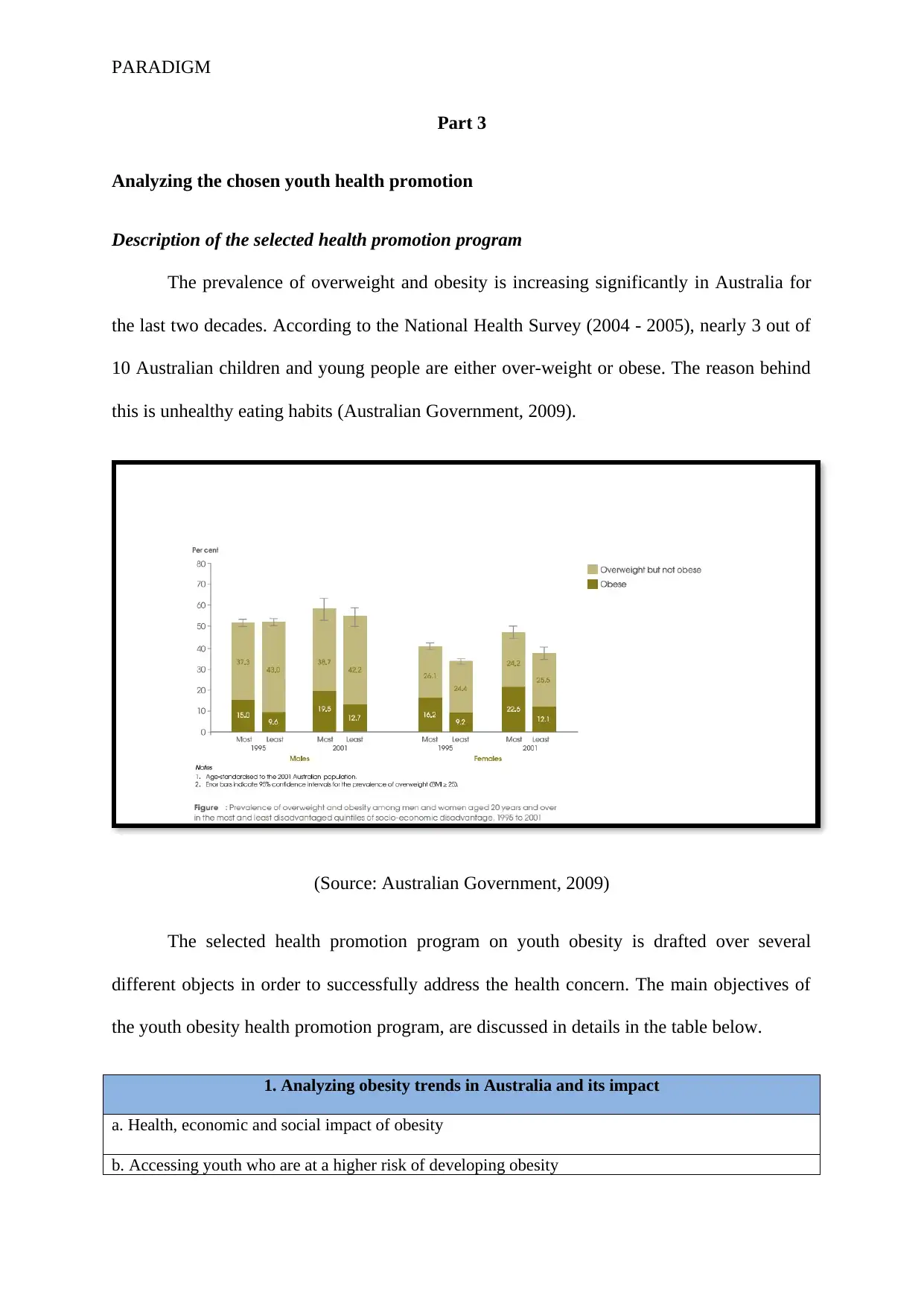
The prevalence of overweight and obesity is increasing significantly in Australia for
the last two decades. According to the National Health Survey (2004 - 2005), nearly 3 out of
10 Australian children and young people are either over-weight or obese. The reason behind
this is unhealthy eating habits (Australian Government, 2009).
(Source: Australian Government, 2009)
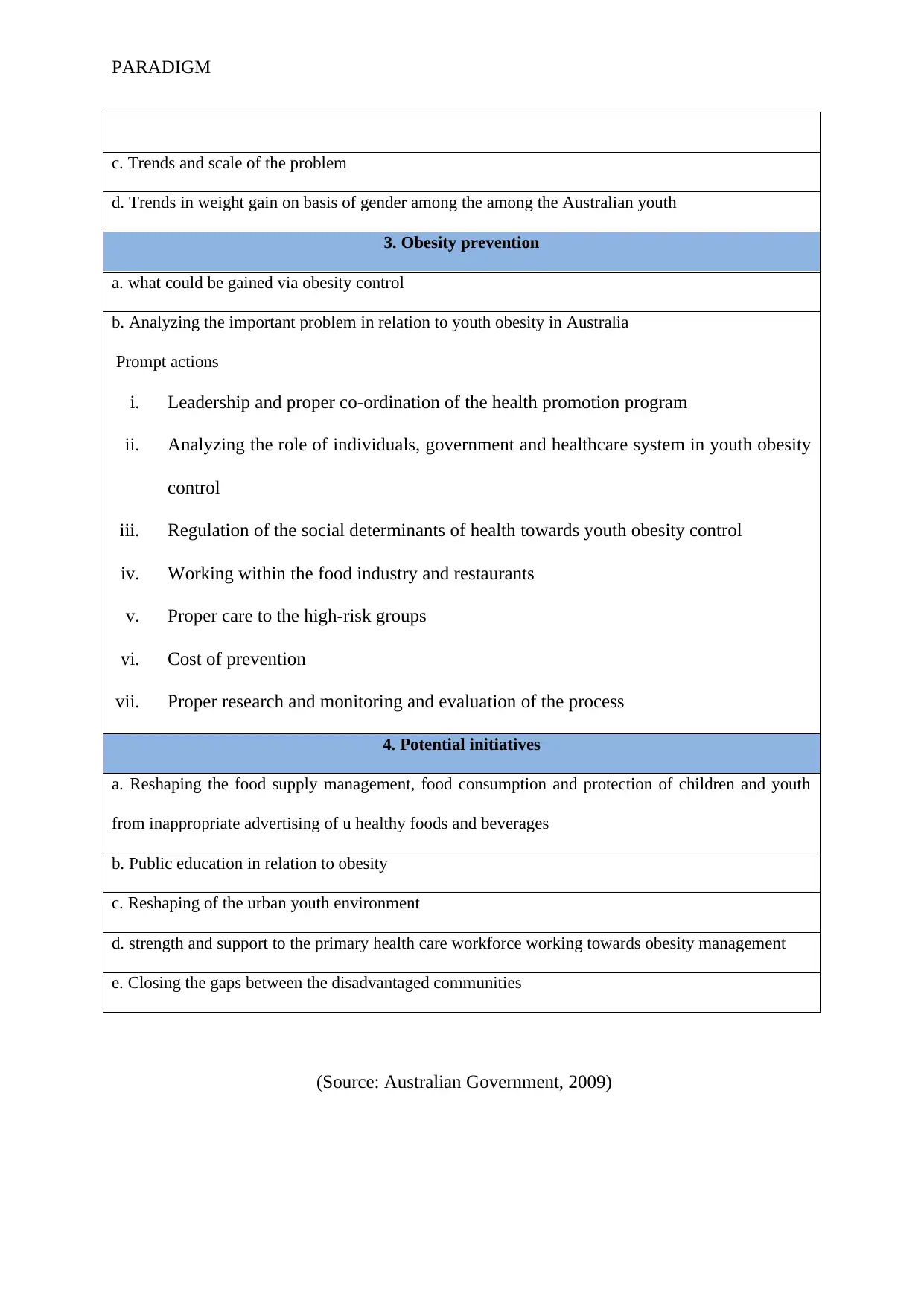
The selected health promotion program on youth obesity is drafted over several
different objects in order to successfully address the health concern. The main objectives of
the youth obesity health promotion program, are discussed in details in the table below.
1. Analyzing obesity trends in Australia and its impact
a. Health, economic and social impact of obesity
b. Accessing youth who are at a higher risk of developing obesity
Part 3
Analyzing the chosen youth health promotion
Description of the selected health promotion program
The prevalence of overweight and obesity is increasing significantly in Australia for
the last two decades. According to the National Health Survey (2004 - 2005), nearly 3 out of
10 Australian children and young people are either over-weight or obese. The reason behind
this is unhealthy eating habits (Australian Government, 2009).
(Source: Australian Government, 2009)
The selected health promotion program on youth obesity is drafted over several
different objects in order to successfully address the health concern. The main objectives of
the youth obesity health promotion program, are discussed in details in the table below.
1. Analyzing obesity trends in Australia and its impact
a. Health, economic and social impact of obesity
b. Accessing youth who are at a higher risk of developing obesity
Paraphrase This Document
Need a fresh take? Get an instant paraphrase of this document with our AI Paraphraser
PARADIGM
c. Trends and scale of the problem
d. Trends in weight gain on basis of gender among the among the Australian youth
3. Obesity prevention
a. what could be gained via obesity control
b. Analyzing the important problem in relation to youth obesity in Australia
Prompt actions
i. Leadership and proper co-ordination of the health promotion program
ii. Analyzing the role of individuals, government and healthcare system in youth obesity
control
iii. Regulation of the social determinants of health towards youth obesity control
iv. Working within the food industry and restaurants
v. Proper care to the high-risk groups
vi. Cost of prevention
vii. Proper research and monitoring and evaluation of the process
4. Potential initiatives
a. Reshaping the food supply management, food consumption and protection of children and youth
from inappropriate advertising of u healthy foods and beverages
b. Public education in relation to obesity
c. Reshaping of the urban youth environment
d. strength and support to the primary health care workforce working towards obesity management
e. Closing the gaps between the disadvantaged communities
(Source: Australian Government, 2009)
c. Trends and scale of the problem
d. Trends in weight gain on basis of gender among the among the Australian youth
3. Obesity prevention
a. what could be gained via obesity control
b. Analyzing the important problem in relation to youth obesity in Australia
Prompt actions
i. Leadership and proper co-ordination of the health promotion program
ii. Analyzing the role of individuals, government and healthcare system in youth obesity
control
iii. Regulation of the social determinants of health towards youth obesity control
iv. Working within the food industry and restaurants
v. Proper care to the high-risk groups
vi. Cost of prevention
vii. Proper research and monitoring and evaluation of the process
4. Potential initiatives
a. Reshaping the food supply management, food consumption and protection of children and youth
from inappropriate advertising of u healthy foods and beverages
b. Public education in relation to obesity
c. Reshaping of the urban youth environment
d. strength and support to the primary health care workforce working towards obesity management
e. Closing the gaps between the disadvantaged communities
(Source: Australian Government, 2009)
PARADIGM
The health trend addressed by the selected program
The main health trend that is addressed by the selected health promotion program,
"Australia: The Healthiest Country by 2020" by Australian Government: Preventative Health
Taskforce is obesity in Australia with a special mention to the youth of Australia. This is
because, according to Sanders et al. (2015), the gain in weight is mostly common among the
younger population of Australia. O’Dea and Dibley (2014) highlighted that the Australians
who are aged in between 14 to 18 years consume more than 40% of their total daily energy
via consuming junk food and sugary drinks. Another reason cited behind the increased trends
in obesity if high consumption of alcohol.
Health promotion campaign and resilience program
The selected health promotion program has adopted resilience program via not only
accessing the risk of the youth of developing obesity but also guides through the proper
selection of the control measures that will be helpful in reducing weight and other threats
associated with obesity (Australian Government, 2009). Moreover, the health promotion
program also aims to create an environment via working with young people and diverse
partners that increase resilience along with social connections of young people residing in
Australia (Australian Government, 2009). The potential initiatives and obesity prevention
approaches taken in this health promotion program will provide the youth of Australia the
ability of cope up with the adversity of obesity (Ball et al., 2012).
Part 4
Conclusion
Thus from the above discussion it can be concluded that adopting resilience paradigm
in health promotion program helps to achieve the desired outcomes at the population level in
The health trend addressed by the selected program
The main health trend that is addressed by the selected health promotion program,
"Australia: The Healthiest Country by 2020" by Australian Government: Preventative Health
Taskforce is obesity in Australia with a special mention to the youth of Australia. This is
because, according to Sanders et al. (2015), the gain in weight is mostly common among the
younger population of Australia. O’Dea and Dibley (2014) highlighted that the Australians
who are aged in between 14 to 18 years consume more than 40% of their total daily energy
via consuming junk food and sugary drinks. Another reason cited behind the increased trends
in obesity if high consumption of alcohol.
Health promotion campaign and resilience program
The selected health promotion program has adopted resilience program via not only
accessing the risk of the youth of developing obesity but also guides through the proper
selection of the control measures that will be helpful in reducing weight and other threats
associated with obesity (Australian Government, 2009). Moreover, the health promotion
program also aims to create an environment via working with young people and diverse
partners that increase resilience along with social connections of young people residing in
Australia (Australian Government, 2009). The potential initiatives and obesity prevention
approaches taken in this health promotion program will provide the youth of Australia the
ability of cope up with the adversity of obesity (Ball et al., 2012).
Part 4
Conclusion
Thus from the above discussion it can be concluded that adopting resilience paradigm
in health promotion program helps to achieve the desired outcomes at the population level in
⊘ This is a preview!⊘
Do you want full access?
Subscribe today to unlock all pages.
Trusted by 1+ million students worldwide
PARADIGM
comparison to the at-risk paradigm health promotion approach. Proper resilience paradigm
provides proper risk management schemes which help the target group population to bounce
back to the healthy condition once again via overcoming the health-related complications.
For example, mental health promotion among the Australian youth mostly provides
emphasis on the prevalence of the mental health problems, depressive disorders associated
with mental health and health-related quality of life in mental health (Government of
Australia – Department of Health, 2000). Thus it can clearly be seen that the mental health
promotion program is based on at-risk paradigm and hence the success rate is must more
compromise in comparison to the obesity prevention program among the Australian youth as
undertaken by the government of Australia. The outcome of the at-risk based paradigm in
mental health is Australian youth is not satisfactory this is because according to reports
published by Charis Chang in News.com.au (2018), the mental health trend in Australia is
still disturbing with an increase trends in suicidal attempts among the Australian youth. This
report coincides with the statistics of Australian Government (2016) which highlights that
14% of Australian youth suffers anxiety and major depressive disorders. However, the
obesity and change in food habit prevention health care program which is based on resilience
paradigm is a huge success. According to the Australian Government (2017), metropolitan
obesity index among the younger population of Australia have decreased considerably in
comparison to the previous year statistics. In northern Sydney, youth obesity % is 53.4
(earlier % = 73.3).
Overall it can be said that resilience paradigm must be selected as the main mode of
health promotion program and which will eventually help the target group of to bounce back
to normal life via overcoming all the complexities.
comparison to the at-risk paradigm health promotion approach. Proper resilience paradigm
provides proper risk management schemes which help the target group population to bounce
back to the healthy condition once again via overcoming the health-related complications.
For example, mental health promotion among the Australian youth mostly provides
emphasis on the prevalence of the mental health problems, depressive disorders associated
with mental health and health-related quality of life in mental health (Government of
Australia – Department of Health, 2000). Thus it can clearly be seen that the mental health
promotion program is based on at-risk paradigm and hence the success rate is must more
compromise in comparison to the obesity prevention program among the Australian youth as
undertaken by the government of Australia. The outcome of the at-risk based paradigm in
mental health is Australian youth is not satisfactory this is because according to reports
published by Charis Chang in News.com.au (2018), the mental health trend in Australia is
still disturbing with an increase trends in suicidal attempts among the Australian youth. This
report coincides with the statistics of Australian Government (2016) which highlights that
14% of Australian youth suffers anxiety and major depressive disorders. However, the
obesity and change in food habit prevention health care program which is based on resilience
paradigm is a huge success. According to the Australian Government (2017), metropolitan
obesity index among the younger population of Australia have decreased considerably in
comparison to the previous year statistics. In northern Sydney, youth obesity % is 53.4
(earlier % = 73.3).
Overall it can be said that resilience paradigm must be selected as the main mode of
health promotion program and which will eventually help the target group of to bounce back
to normal life via overcoming all the complexities.
Paraphrase This Document
Need a fresh take? Get an instant paraphrase of this document with our AI Paraphraser
PARADIGM
References
Australian Government (2017) Healthy Communities: Overweight and obesity rates across
Australia, 2014–15. Access date: 16th May. Retrieved from:
https://www.myhealthycommunities.gov.au/our-reports/overweight-and-obesity-
rates/december-2016
Australian Government. (2016). 5.5 Mental health of Australia’s young people and
adolescents. Access date: 16th May. Retrieved from:
https://www.aihw.gov.au/getmedia/42e2f292-4ebb-4e8d-944c-32c014ad2796/ah16-5-
5-mental-health-australias-young-people-adolescents.pdf.aspx
Australian Government., (2009). Australia: The Healthiest Country by 2020. Australian
Government: Preventative Health Taskforce. Access date: 16th May. Retrieved from:
http://www.health.gov.au/internet/preventativehealth/publishing.nsf/content/
E233F8695823F16CCA2574DD00818E64/$File/obesity-jul09.pdf
Ball, K., Abbott, G., Cleland, V., Timperio, A., Thornton, L., Mishra, G., ... & Crawford, D.
(2012). Resilience to obesity among socioeconomically disadvantaged women: the
READI study. International journal of obesity, 36(6), 855.
Chassin, M. R., & Loeb, J. M. (2013). High‐reliability health care: getting there from
here. The Milbank Quarterly, 91(3), 459-490.
Epstein, R. M., & Krasner, M. S. (2013). Physician resilience: what it means, why it matters,
and how to promote it. Academic Medicine, 88(3), 301-303.
Fairbanks, R. J., Wears, R. L., Woods, D. D., Hollnagel, E., Plsek, P., & Cook, R. I. (2014).
Resilience and resilience engineering in health care. Joint Commission journal on
quality and patient safety, 40(8), 376-383.
Faist, T. (2013). The mobility turn: a new paradigm for the social sciences?. Ethnic and
Racial Studies, 36(11), 1637-1646.
Government of Australia – Department of Health, (2000). Mental health of young people in
Australia. Access date: 16th May. Retrieved from:
http://www.health.gov.au/internet/main/publishing.nsf/content/mental-pubs-m-young
Lerner, H., Whang, J., & Nipper, R. (2013). Benefit-risk paradigm for clinical trial design of
obesity devices: FDA proposal. Surgical endoscopy, 27(3), 702-707.
O’Dea, J. A., & Dibley, M. J. (2014). Prevalence of obesity, overweight and thinness in
Australian children and adolescents by socioeconomic status and ethnic/cultural group
in 2006 and 2012. International journal of public health, 59(5), 819-828.
O’Hara, J., & Isden, R. (2013). Identifying risks and monitoring safety: the role of patients
and citizens. London: The Health Foundation.
References
Australian Government (2017) Healthy Communities: Overweight and obesity rates across
Australia, 2014–15. Access date: 16th May. Retrieved from:
https://www.myhealthycommunities.gov.au/our-reports/overweight-and-obesity-
rates/december-2016
Australian Government. (2016). 5.5 Mental health of Australia’s young people and
adolescents. Access date: 16th May. Retrieved from:
https://www.aihw.gov.au/getmedia/42e2f292-4ebb-4e8d-944c-32c014ad2796/ah16-5-
5-mental-health-australias-young-people-adolescents.pdf.aspx
Australian Government., (2009). Australia: The Healthiest Country by 2020. Australian
Government: Preventative Health Taskforce. Access date: 16th May. Retrieved from:
http://www.health.gov.au/internet/preventativehealth/publishing.nsf/content/
E233F8695823F16CCA2574DD00818E64/$File/obesity-jul09.pdf
Ball, K., Abbott, G., Cleland, V., Timperio, A., Thornton, L., Mishra, G., ... & Crawford, D.
(2012). Resilience to obesity among socioeconomically disadvantaged women: the
READI study. International journal of obesity, 36(6), 855.
Chassin, M. R., & Loeb, J. M. (2013). High‐reliability health care: getting there from
here. The Milbank Quarterly, 91(3), 459-490.
Epstein, R. M., & Krasner, M. S. (2013). Physician resilience: what it means, why it matters,
and how to promote it. Academic Medicine, 88(3), 301-303.
Fairbanks, R. J., Wears, R. L., Woods, D. D., Hollnagel, E., Plsek, P., & Cook, R. I. (2014).
Resilience and resilience engineering in health care. Joint Commission journal on
quality and patient safety, 40(8), 376-383.
Faist, T. (2013). The mobility turn: a new paradigm for the social sciences?. Ethnic and
Racial Studies, 36(11), 1637-1646.
Government of Australia – Department of Health, (2000). Mental health of young people in
Australia. Access date: 16th May. Retrieved from:
http://www.health.gov.au/internet/main/publishing.nsf/content/mental-pubs-m-young
Lerner, H., Whang, J., & Nipper, R. (2013). Benefit-risk paradigm for clinical trial design of
obesity devices: FDA proposal. Surgical endoscopy, 27(3), 702-707.
O’Dea, J. A., & Dibley, M. J. (2014). Prevalence of obesity, overweight and thinness in
Australian children and adolescents by socioeconomic status and ethnic/cultural group
in 2006 and 2012. International journal of public health, 59(5), 819-828.
O’Hara, J., & Isden, R. (2013). Identifying risks and monitoring safety: the role of patients
and citizens. London: The Health Foundation.
PARADIGM
Sanders, R. H., Han, A., Baker, J. S., & Cobley, S. (2015). Childhood obesity and its physical
and psychological co-morbidities: a systematic review of Australian children and
adolescents. European journal of pediatrics, 174(6), 715-746.
Woods, D. D. (2017). Essential characteristics of resilience. In Resilience engineering (pp.
33-46). CRC Press.
Wulff, K., Donato, D., & Lurie, N. (2015). What is health resilience and how can we build
it?. Annual review of public health, 36, 361-374.
Sanders, R. H., Han, A., Baker, J. S., & Cobley, S. (2015). Childhood obesity and its physical
and psychological co-morbidities: a systematic review of Australian children and
adolescents. European journal of pediatrics, 174(6), 715-746.
Woods, D. D. (2017). Essential characteristics of resilience. In Resilience engineering (pp.
33-46). CRC Press.
Wulff, K., Donato, D., & Lurie, N. (2015). What is health resilience and how can we build
it?. Annual review of public health, 36, 361-374.
⊘ This is a preview!⊘
Do you want full access?
Subscribe today to unlock all pages.
Trusted by 1+ million students worldwide

1 out of 12


Your All-in-One AI-Powered Toolkit for Academic Success.
+13062052269
info@desklib.com
Available 24*7 on WhatsApp / Email
![[object Object]](/_next/static/media/star-bottom.7253800d.svg)
Unlock your academic potential
Copyright © 2020–2026 A2Z Services. All Rights Reserved. Developed and managed by ZUCOL.