Opportunities, Benefits, and Challenges for Health Promotion
VerifiedAdded on 2022/11/14
|11
|3571
|329
Report
AI Summary
This report examines the opportunities, benefits, and challenges of health promotion in addressing sustainable development goals. It highlights the integration of health promotion into global health initiatives, emphasizing the role of community formation, policy integration, and food systems in improving health outcomes. The report discusses the benefits of health promotion, including its alignment with SDGs like gender equality, clean water, and reduced inequalities, which enhance global health coverage. It also identifies challenges such as resource allocation, stakeholder coordination, and the existence of trade-offs in implementing SDGs. The report underscores the importance of addressing these challenges through multi-sectoral approaches, effective leadership, and the empowerment of individuals and communities to achieve sustainable health outcomes. The report concludes by emphasizing the crucial role of health promotion in achieving an inclusive health policy environment.
Opportunities, Benefits and Challenges for the health promotion in addressing dimensions of
sustainable development
By
Student’s Name
Course
Tutor
Institution
Date
sustainable development
By
Student’s Name
Course
Tutor
Institution
Date

Paraphrase This Document
Need a fresh take? Get an instant paraphrase of this document with our AI Paraphraser
Introduction
The growing burden of chronic disease has elevated the need for health prevention of
diseases and avenues of health promotion being entrenched in the public health domain. In
the current 20th century, health promotion has emerged as the most ambitious health
associated enterprise. Health promotion has been viewed from a global perspective with
timely consideration on public health rather than a separate entity in the health care
continuum. Health promotion is an important aspect of the development and health arena
implementation of health care practices. Its coverage has seen a top-down approach aiming at
various levels such as multi-levels, multi-sectorial and multidisciplinary involvements. The
implementation of health promotion initiatives has achieved various outcomes (McQueen,
2014). There are marked beneficial outputs and outcomes which have been observed,
opportunities and numerous challenges which have rocked certain population setups. Despite
this, the beneficial effects need to be promoted and implemented across the board with
emerging opportunities being utilized, there is a need for cross-board reception of constraints
and countering challenges which have risen in the current arena (Stevenson & Thompson,
2014). It is this perspective that sustainable development objectives and goals have aligned
their priorities on health promotion so as to reduce the growing trends and global prevalence
of noncommunicable diseases which are the leading causes of death across the globe. This
commentary attempts to unravel this experienced benefits, uncover challenges and emerging
opportunities in light of entrenchment of sustainable developments goals and objectives
towards the realization of a healthy society.
Opportunities in health promotion
The conceptualization and integration of health promotion on and its interrelation
have offered renewed opportunities for improving health promotion across the board. This
has initiated an understanding of health promotion as a sustainable way of improving the
health outcomes of the population. The formation of community formation has laid down an
elaborate aspect of forming a link between health and the overall social sustainability through
the community networks (Edington et al., 2016). The underlying unequal societal distribution
and knowledge on health and environment has a tremendous effect on the social and political
environment and available health policies. The integration of policy and the transition of
social care have shown an integrative approach to health and sustainability on complex
factors which are interrelated on different agendas. The focus of health and sustainable
development with regards to food issues has demonstrated how food dimension is connected
to the food system in the form of food security (Kjӕrgård, Land & Bransholm, 2013).
The growing burden of chronic disease has elevated the need for health prevention of
diseases and avenues of health promotion being entrenched in the public health domain. In
the current 20th century, health promotion has emerged as the most ambitious health
associated enterprise. Health promotion has been viewed from a global perspective with
timely consideration on public health rather than a separate entity in the health care
continuum. Health promotion is an important aspect of the development and health arena
implementation of health care practices. Its coverage has seen a top-down approach aiming at
various levels such as multi-levels, multi-sectorial and multidisciplinary involvements. The
implementation of health promotion initiatives has achieved various outcomes (McQueen,
2014). There are marked beneficial outputs and outcomes which have been observed,
opportunities and numerous challenges which have rocked certain population setups. Despite
this, the beneficial effects need to be promoted and implemented across the board with
emerging opportunities being utilized, there is a need for cross-board reception of constraints
and countering challenges which have risen in the current arena (Stevenson & Thompson,
2014). It is this perspective that sustainable development objectives and goals have aligned
their priorities on health promotion so as to reduce the growing trends and global prevalence
of noncommunicable diseases which are the leading causes of death across the globe. This
commentary attempts to unravel this experienced benefits, uncover challenges and emerging
opportunities in light of entrenchment of sustainable developments goals and objectives
towards the realization of a healthy society.
Opportunities in health promotion
The conceptualization and integration of health promotion on and its interrelation
have offered renewed opportunities for improving health promotion across the board. This
has initiated an understanding of health promotion as a sustainable way of improving the
health outcomes of the population. The formation of community formation has laid down an
elaborate aspect of forming a link between health and the overall social sustainability through
the community networks (Edington et al., 2016). The underlying unequal societal distribution
and knowledge on health and environment has a tremendous effect on the social and political
environment and available health policies. The integration of policy and the transition of
social care have shown an integrative approach to health and sustainability on complex
factors which are interrelated on different agendas. The focus of health and sustainable
development with regards to food issues has demonstrated how food dimension is connected
to the food system in the form of food security (Kjӕrgård, Land & Bransholm, 2013).
Issues of food systems and social sustainability have often been interconnected and
portray an opportunity with the aim of focusing on and improving food access so as to
promote positive health. Another avenue which has portrayed a significant opportunity entails
policy integration in relation to the interaction of policy development to aligning itself on
health and environmental policies. The focus needs to align on barriers linked to integrating
health and sustainability on dietary guidelines (Rice, Hancock & Equity, 2016).
A promising avenue entails the formulation and integration of policy into action in
the health arena. The deterioration of the public health arena profile and then the environment
has been associated with the link of health promotion and its dimensional sustainability issues
at local, regional and global levels. Health and sustainability issues have emerged as a
consequence of the exploitation of natural resources and environmental resources and strain
on biodiversity. There is a need for a collective assessment on the sustainability framework
on health promotion so as to improve the livelihoods of the people. The increased intense
action focusing on public health and environmental issues in food production and health
systems do not guarantee sustainable dimensions (Hosseinpoor et al., 2012).
Further another avenue for support entails the entrenchment of the duality concept of
health promotion and sustainable health in health care. These direct focus on avenues which
uncover the structural issues which constrain the sustainability nature of health initiatives are
paramount. The strategies available for public health arena have not sufficiently integrated
aspects of sustainable development aimed at solving health-related problems and
sustainability issues and other related health link problems (Kickbusch & Reddy, 2016). The
relation between health and sustainability has been documented well in international policies
and frameworks such as the SDGs, thus there is a need for the development of the
understanding between health promotion and sustainability. Food production and health
sustainability have shown an exclusive mutuality and focus on enabling and constraining
factors of health promotion (Whitmee et al., 2015).
The renewed focus on food security and inequalities arising have brought into focus
the issues of health and sustainability aspects into the food system web and sustainability
issues. This emerging duality has brought into focus the aspects of health and sustainability in
drawing critical aspects of the market-oriented food system. Focuses and duality lines are
aimed at integrating health promotion avenues towards sustainability on improving duality
aspects bile levels. Thus focus shift on integrating sustainability on health persistence to
promote the general population health status (Lafferty & Eckerberg, 2013).
In general, health promotion has focussed on various aspects of sustainable
portray an opportunity with the aim of focusing on and improving food access so as to
promote positive health. Another avenue which has portrayed a significant opportunity entails
policy integration in relation to the interaction of policy development to aligning itself on
health and environmental policies. The focus needs to align on barriers linked to integrating
health and sustainability on dietary guidelines (Rice, Hancock & Equity, 2016).
A promising avenue entails the formulation and integration of policy into action in
the health arena. The deterioration of the public health arena profile and then the environment
has been associated with the link of health promotion and its dimensional sustainability issues
at local, regional and global levels. Health and sustainability issues have emerged as a
consequence of the exploitation of natural resources and environmental resources and strain
on biodiversity. There is a need for a collective assessment on the sustainability framework
on health promotion so as to improve the livelihoods of the people. The increased intense
action focusing on public health and environmental issues in food production and health
systems do not guarantee sustainable dimensions (Hosseinpoor et al., 2012).
Further another avenue for support entails the entrenchment of the duality concept of
health promotion and sustainable health in health care. These direct focus on avenues which
uncover the structural issues which constrain the sustainability nature of health initiatives are
paramount. The strategies available for public health arena have not sufficiently integrated
aspects of sustainable development aimed at solving health-related problems and
sustainability issues and other related health link problems (Kickbusch & Reddy, 2016). The
relation between health and sustainability has been documented well in international policies
and frameworks such as the SDGs, thus there is a need for the development of the
understanding between health promotion and sustainability. Food production and health
sustainability have shown an exclusive mutuality and focus on enabling and constraining
factors of health promotion (Whitmee et al., 2015).
The renewed focus on food security and inequalities arising have brought into focus
the issues of health and sustainability aspects into the food system web and sustainability
issues. This emerging duality has brought into focus the aspects of health and sustainability in
drawing critical aspects of the market-oriented food system. Focuses and duality lines are
aimed at integrating health promotion avenues towards sustainability on improving duality
aspects bile levels. Thus focus shift on integrating sustainability on health persistence to
promote the general population health status (Lafferty & Eckerberg, 2013).
In general, health promotion has focussed on various aspects of sustainable
⊘ This is a preview!⊘
Do you want full access?
Subscribe today to unlock all pages.

Trusted by 1+ million students worldwide
development goals which cut across other goals such as SDG 5 on gender equality, SDG 6 on
clean water and sanitation, SDG 10 reduced inequalities and SDG 17 on the partnership on
goals (WHO, 2013). The implementation and continuous entrenchment of SDGs are geared
towards inclusive and reflective on health promotion. The goals are more reflective on global
concerns and commitments to aspects of health promotion and objectives of associative
factors and areas such as those covering universal health coverage, rendering the SDGs as a
beneficial opportunity of enhancing global health promotion (WHO, 2011).
Benefits available
Sustainable development goals have laid the foundation on the aspect of supporting
global health and focus on international development work progress the Ottawa Charter has
defined health promotion as key fundamental principles for global action on health care
which entails the critical support for advocating, enabling and mediating issues pertaining
health equity. The human right focus on health and importance of advocating, enabling and
meditation on health equity. Aspects of enabling health promotion are essential in
empowering people and communities aimed at controlling health aspirations. The critical
gateway of inter-sectorial partnerships is geared towards addressing the underlying social and
health inequities (Takian & Akbari-Sari, 2016).
The transformational agenda of the global arena and the 2030 sustainable
development goals have entrenched critical innovative approaches to tackling glaring
inequities on health care. The critical role of suitable agendas entrenched on local and
national health agendas. Health promotion on the other end aims at enabling the population in
taking control of health which is aligned to the SDGs (Kusakabe, 2012).
The transformation agenda of the SDG is geared at improving the sector commitments
and driving action of players in international development. The MDGs have greatly
influenced the action which drives health-related performance indicators. Health promotion
has played a fundamental role which is geared towards realizing the entire agenda. SDG has
highlighted all aspects of health promotion as an equitable and sustainable process. The link
between the SDGs has highlighted the complex and relevance of health promotion
perspectives as a way of equity, enabling communities and protecting human rights
(Kickbusch & Nutbeam, 2017).
The progress on the development of healthy settings has offered widespread settings
which put health promotion into practice and ties on universal coverage. The achievement has
enabled a multi-sectoral approach to address these issues. Various approaches have been
formulated in line with SDGs and health promotion. The health promotion initiatives and
clean water and sanitation, SDG 10 reduced inequalities and SDG 17 on the partnership on
goals (WHO, 2013). The implementation and continuous entrenchment of SDGs are geared
towards inclusive and reflective on health promotion. The goals are more reflective on global
concerns and commitments to aspects of health promotion and objectives of associative
factors and areas such as those covering universal health coverage, rendering the SDGs as a
beneficial opportunity of enhancing global health promotion (WHO, 2011).
Benefits available
Sustainable development goals have laid the foundation on the aspect of supporting
global health and focus on international development work progress the Ottawa Charter has
defined health promotion as key fundamental principles for global action on health care
which entails the critical support for advocating, enabling and mediating issues pertaining
health equity. The human right focus on health and importance of advocating, enabling and
meditation on health equity. Aspects of enabling health promotion are essential in
empowering people and communities aimed at controlling health aspirations. The critical
gateway of inter-sectorial partnerships is geared towards addressing the underlying social and
health inequities (Takian & Akbari-Sari, 2016).
The transformational agenda of the global arena and the 2030 sustainable
development goals have entrenched critical innovative approaches to tackling glaring
inequities on health care. The critical role of suitable agendas entrenched on local and
national health agendas. Health promotion on the other end aims at enabling the population in
taking control of health which is aligned to the SDGs (Kusakabe, 2012).
The transformation agenda of the SDG is geared at improving the sector commitments
and driving action of players in international development. The MDGs have greatly
influenced the action which drives health-related performance indicators. Health promotion
has played a fundamental role which is geared towards realizing the entire agenda. SDG has
highlighted all aspects of health promotion as an equitable and sustainable process. The link
between the SDGs has highlighted the complex and relevance of health promotion
perspectives as a way of equity, enabling communities and protecting human rights
(Kickbusch & Nutbeam, 2017).
The progress on the development of healthy settings has offered widespread settings
which put health promotion into practice and ties on universal coverage. The achievement has
enabled a multi-sectoral approach to address these issues. Various approaches have been
formulated in line with SDGs and health promotion. The health promotion initiatives and
Paraphrase This Document
Need a fresh take? Get an instant paraphrase of this document with our AI Paraphraser
sustainable development initiatives are crucial in entrenching shared priorities and exploiting
the mutual relevance on shared priorities. The overlap of goals and priorities available in
sustainable development goals are linked to health promotion. Approaches to health
promotion on SDGs have offered that advances health promotions are essential in
implementing health outputs. These approaches are essential in ensuring shared values are
entrenched in the health care arena (WHO, 2015).
The SGDS have an intent relation on the health and well being on aims and
approaches and principles of health promotion. Health discipline is key in principles of
human rights, equity, and empowerment. The DGS aspects have entrenched health promotion
in all aspects which is vital in essential
Challenges
The implementation of SDGs has been shown to cut across health promotion cutting
across and other goals. The implementation framework of the SDGS cuts across the health
promotion frameworks. Differential analysis has shown that some of the SDGs transverses
across other components compared to other issues. Some SDGs have been shown to have a
precedence over others such as SDG no 3 on HV/AIDS and mortality trends, has a continued
interest on greater resource allocation and investment compared to other areas such as alcohol
and drug abuse and relevant to the political and economic trends in the wider avenue of
global health governance. This signifies the urgency of aligning economic fiancés and
economic trends towards shaping this agenda and the general political goodwill and activism
on health promotion avenues (Ayo, 2012).
The implementation of the SGDs underpins the mechanism of various stakeholders in
operating in various scales cutting across various national entities, transnational’s,
nongovernmental organizations and many more entities. Achieving a unison language among
these stakeholders often proofs a tough challenge in enabling them to solve complex issues
pertaining to poverty and sustainability problems. Challenges pertaining address on poverty,
health, food and education, and many issues often signify a challenge (Spencer, Corbin &
Miedema, 2018)
Existence of tradeoffs across various boundaries signifies a challenge in health
promotion avenues. Tradeoffs in SDGs implementation signify that there will be winners and
losers both at short term and long term a classical example is that the threat of biodiversity is
a threat when the forest is cut down for agricultural usage as a means of food security. on the
other end, food security is threatened when food crops are interchanged to biofuel production.
Further, a threat to water security could be generated which determines the intensity of
the mutual relevance on shared priorities. The overlap of goals and priorities available in
sustainable development goals are linked to health promotion. Approaches to health
promotion on SDGs have offered that advances health promotions are essential in
implementing health outputs. These approaches are essential in ensuring shared values are
entrenched in the health care arena (WHO, 2015).
The SGDS have an intent relation on the health and well being on aims and
approaches and principles of health promotion. Health discipline is key in principles of
human rights, equity, and empowerment. The DGS aspects have entrenched health promotion
in all aspects which is vital in essential
Challenges
The implementation of SDGs has been shown to cut across health promotion cutting
across and other goals. The implementation framework of the SDGS cuts across the health
promotion frameworks. Differential analysis has shown that some of the SDGs transverses
across other components compared to other issues. Some SDGs have been shown to have a
precedence over others such as SDG no 3 on HV/AIDS and mortality trends, has a continued
interest on greater resource allocation and investment compared to other areas such as alcohol
and drug abuse and relevant to the political and economic trends in the wider avenue of
global health governance. This signifies the urgency of aligning economic fiancés and
economic trends towards shaping this agenda and the general political goodwill and activism
on health promotion avenues (Ayo, 2012).
The implementation of the SGDs underpins the mechanism of various stakeholders in
operating in various scales cutting across various national entities, transnational’s,
nongovernmental organizations and many more entities. Achieving a unison language among
these stakeholders often proofs a tough challenge in enabling them to solve complex issues
pertaining to poverty and sustainability problems. Challenges pertaining address on poverty,
health, food and education, and many issues often signify a challenge (Spencer, Corbin &
Miedema, 2018)
Existence of tradeoffs across various boundaries signifies a challenge in health
promotion avenues. Tradeoffs in SDGs implementation signify that there will be winners and
losers both at short term and long term a classical example is that the threat of biodiversity is
a threat when the forest is cut down for agricultural usage as a means of food security. on the
other end, food security is threatened when food crops are interchanged to biofuel production.
Further, a threat to water security could be generated which determines the intensity of
agriculture production which has a direct role in health promotion food availability for the
population (Bente, Birgit & Kirsten, 2014).
Further another critical aspect facing the implementation of SDG and integration
entails financial backing and resources needed to integrate the SDG sand health promotion
into action. The role of governments is to mobilize resources and entrench programs aligned
with health promotion. However, to achieve it requires a multi-sectoral approach to
leveraging funding through partnership beholding which is currently limited in the health care
arena. Lack of adoption of successful intervention in the general population identification has
been shown to be a significant issue. the limited opportunity for mainstreaming health
promotion across the health settings in the SDG framework portrays a significant challenge
(Eckermann, 2016).
Health promotion intervention avenues have been shown not to reach the target
populations. Majority of the marginalized and vulnerable populations do not get access to
these opportunities, limited their access to such interventions. Development of an effective
health strategy and literacy is often essential in empowering people and strengthening the
collective approach and capacity for sustainable health (Evans, 2009).
Moreover, the infrastructure for implementing health promotion and the overall
ability is still lacking across various settings. This has hindered the overall implementation of
health care approaches and attainment of SDG goals. In engaging an approach for solving
these issues, there is the need for authority and maturity skills and effective leadership and
diplomacy ability to enable informed decisions and act on shared goals (Rabbani et al., 2016).
Conclusion
Sustainable development goals have reflected the interconnected angle of
development challenges and an avenue for mobilizing action on health promotion. This has
offered the means of ensuring that the SDGs are equipped and focusing on empowering
individual and community setups in entrenching an all round of inclusive health policy
environment. The role SGD has carefully and deliberately entrenched health promotion in its
goals and policy environment. The beneficial effects of this approach are essential so as to
make awareness and make health promotion initiatives to be part of the global and national
agenda. Despite the remarked advantages, there arise challenges which go unnoticed in the
health arena. There is a need for attention to these challenges and ensures an appropriate
platform for health promotion implementation.
population (Bente, Birgit & Kirsten, 2014).
Further another critical aspect facing the implementation of SDG and integration
entails financial backing and resources needed to integrate the SDG sand health promotion
into action. The role of governments is to mobilize resources and entrench programs aligned
with health promotion. However, to achieve it requires a multi-sectoral approach to
leveraging funding through partnership beholding which is currently limited in the health care
arena. Lack of adoption of successful intervention in the general population identification has
been shown to be a significant issue. the limited opportunity for mainstreaming health
promotion across the health settings in the SDG framework portrays a significant challenge
(Eckermann, 2016).
Health promotion intervention avenues have been shown not to reach the target
populations. Majority of the marginalized and vulnerable populations do not get access to
these opportunities, limited their access to such interventions. Development of an effective
health strategy and literacy is often essential in empowering people and strengthening the
collective approach and capacity for sustainable health (Evans, 2009).
Moreover, the infrastructure for implementing health promotion and the overall
ability is still lacking across various settings. This has hindered the overall implementation of
health care approaches and attainment of SDG goals. In engaging an approach for solving
these issues, there is the need for authority and maturity skills and effective leadership and
diplomacy ability to enable informed decisions and act on shared goals (Rabbani et al., 2016).
Conclusion
Sustainable development goals have reflected the interconnected angle of
development challenges and an avenue for mobilizing action on health promotion. This has
offered the means of ensuring that the SDGs are equipped and focusing on empowering
individual and community setups in entrenching an all round of inclusive health policy
environment. The role SGD has carefully and deliberately entrenched health promotion in its
goals and policy environment. The beneficial effects of this approach are essential so as to
make awareness and make health promotion initiatives to be part of the global and national
agenda. Despite the remarked advantages, there arise challenges which go unnoticed in the
health arena. There is a need for attention to these challenges and ensures an appropriate
platform for health promotion implementation.
⊘ This is a preview!⊘
Do you want full access?
Subscribe today to unlock all pages.
Trusted by 1+ million students worldwide
Reflection
In India, sustainable development goals offer an avenue for reflecting on the
interconnected nature of the current global challenges and goals. The key aim is to ensure that
the vulnerable population has the ability to fulfill the underlying potential. The underlying
focus being the 2030 vision agenda on a sustainable development plan for future generations.
Health care dynamics in India offers a health promotion options for the implementation of
SDG through improving on health literacy, community empowerment, inclusive governance
model, engaging on health public policies and adoption of health promotion which is geared
towards cutting through the various disciplines and approaches.
The fundamental tenet of health promotion and sustainable development is essential
in its role of entrenching in shared priorities and exploiting the mutual knowledge relevancy.
Promoting open communication and devotion of resources which is geared towards
acceleration and advancing health promotion avenues in India. Health promotion approaches
are relevant to the success and achievement of SDGs. The role of health equity plays a
fundamental role in improving access to the health care network.
The fundamental role as a health promoter in the era of sustainable development goals
calls for an urgent need for the equipping self with adequate skills so as to implement
effective strategies which entrench health promotion. Strategizing and implementing life
skills which are education based are essential in improving individual and community action
plan aligning to sustainable development goals. Promoting good health across societies is a
productive aspect which is essential in the health process. In the India’s context of sustainable
development goals, health is recognized as a goal of its own at SDG 3 aimed at ensuring
healthy lives and promoting the overall well being of the general population and acting on
social determinants hindering health access.
The need for raising awareness and conscious on critical areas such as antimicrobial
resistance, the rise of noncommunicable diseases such as cancer, diabetes, and cardiovascular
diseases are essential in ensuring that there are adequate policy framework advocacy and its
overall implementation in the society.
With the current social, political and health challenges, there is for me as a health
promotion stakeholder, there is need for more action and attention on health promotion and
protection using a wide variety of approaches. As a health promoter, improving the food
health environment of the people means encouraging the masses to make healthier food
choices and empowering them to know and understand the implications of these food
choices.
In India, sustainable development goals offer an avenue for reflecting on the
interconnected nature of the current global challenges and goals. The key aim is to ensure that
the vulnerable population has the ability to fulfill the underlying potential. The underlying
focus being the 2030 vision agenda on a sustainable development plan for future generations.
Health care dynamics in India offers a health promotion options for the implementation of
SDG through improving on health literacy, community empowerment, inclusive governance
model, engaging on health public policies and adoption of health promotion which is geared
towards cutting through the various disciplines and approaches.
The fundamental tenet of health promotion and sustainable development is essential
in its role of entrenching in shared priorities and exploiting the mutual knowledge relevancy.
Promoting open communication and devotion of resources which is geared towards
acceleration and advancing health promotion avenues in India. Health promotion approaches
are relevant to the success and achievement of SDGs. The role of health equity plays a
fundamental role in improving access to the health care network.
The fundamental role as a health promoter in the era of sustainable development goals
calls for an urgent need for the equipping self with adequate skills so as to implement
effective strategies which entrench health promotion. Strategizing and implementing life
skills which are education based are essential in improving individual and community action
plan aligning to sustainable development goals. Promoting good health across societies is a
productive aspect which is essential in the health process. In the India’s context of sustainable
development goals, health is recognized as a goal of its own at SDG 3 aimed at ensuring
healthy lives and promoting the overall well being of the general population and acting on
social determinants hindering health access.
The need for raising awareness and conscious on critical areas such as antimicrobial
resistance, the rise of noncommunicable diseases such as cancer, diabetes, and cardiovascular
diseases are essential in ensuring that there are adequate policy framework advocacy and its
overall implementation in the society.
With the current social, political and health challenges, there is for me as a health
promotion stakeholder, there is need for more action and attention on health promotion and
protection using a wide variety of approaches. As a health promoter, improving the food
health environment of the people means encouraging the masses to make healthier food
choices and empowering them to know and understand the implications of these food
choices.
Paraphrase This Document
Need a fresh take? Get an instant paraphrase of this document with our AI Paraphraser
The Declaration made in Shanghai on health promotion endorsed SDGs on health
promotion and identified it as a key aspect of health literacy which needs attention in order to
realize the benefits of sustainable development. As a health promoter engaging in health
literacy is an important avenue for advocating for a positive impact on health care. Improved
literacy outcomes offer n equity in terms of opportunity access for health and ensure support
for health systems. In view of this, health promotion activities in India play a fundamental
role in bridging the SDG and health promotion to reach the critical masses, there is a need for
improved advocacy skills on the same among the larger network of health promoters so as to
initiate positive action towards improved health.
promotion and identified it as a key aspect of health literacy which needs attention in order to
realize the benefits of sustainable development. As a health promoter engaging in health
literacy is an important avenue for advocating for a positive impact on health care. Improved
literacy outcomes offer n equity in terms of opportunity access for health and ensure support
for health systems. In view of this, health promotion activities in India play a fundamental
role in bridging the SDG and health promotion to reach the critical masses, there is a need for
improved advocacy skills on the same among the larger network of health promoters so as to
initiate positive action towards improved health.
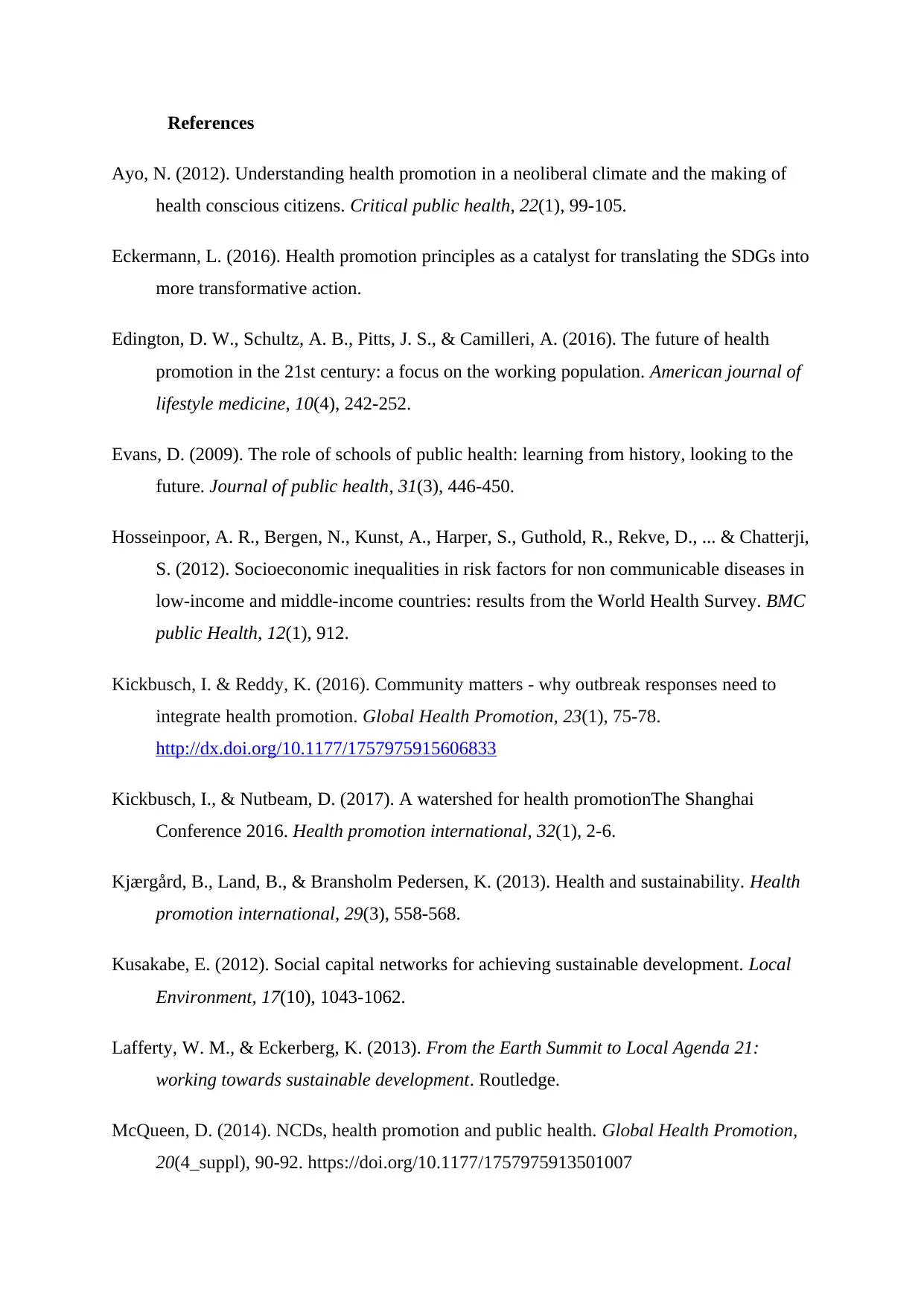
References
Ayo, N. (2012). Understanding health promotion in a neoliberal climate and the making of
health conscious citizens. Critical public health, 22(1), 99-105.
Eckermann, L. (2016). Health promotion principles as a catalyst for translating the SDGs into
more transformative action.
Edington, D. W., Schultz, A. B., Pitts, J. S., & Camilleri, A. (2016). The future of health
promotion in the 21st century: a focus on the working population. American journal of
lifestyle medicine, 10(4), 242-252.
Evans, D. (2009). The role of schools of public health: learning from history, looking to the
future. Journal of public health, 31(3), 446-450.
Hosseinpoor, A. R., Bergen, N., Kunst, A., Harper, S., Guthold, R., Rekve, D., ... & Chatterji,
S. (2012). Socioeconomic inequalities in risk factors for non communicable diseases in
low-income and middle-income countries: results from the World Health Survey. BMC
public Health, 12(1), 912.
Kickbusch, I. & Reddy, K. (2016). Community matters - why outbreak responses need to
integrate health promotion. Global Health Promotion, 23(1), 75-78.
http://dx.doi.org/10.1177/1757975915606833
Kickbusch, I., & Nutbeam, D. (2017). A watershed for health promotionThe Shanghai
Conference 2016. Health promotion international, 32(1), 2-6.
Kjӕrgård, B., Land, B., & Bransholm Pedersen, K. (2013). Health and sustainability. Health
promotion international, 29(3), 558-568.
Kusakabe, E. (2012). Social capital networks for achieving sustainable development. Local
Environment, 17(10), 1043-1062.
Lafferty, W. M., & Eckerberg, K. (2013). From the Earth Summit to Local Agenda 21:
working towards sustainable development. Routledge.
McQueen, D. (2014). NCDs, health promotion and public health. Global Health Promotion,
20(4_suppl), 90-92. https://doi.org/10.1177/1757975913501007
Ayo, N. (2012). Understanding health promotion in a neoliberal climate and the making of
health conscious citizens. Critical public health, 22(1), 99-105.
Eckermann, L. (2016). Health promotion principles as a catalyst for translating the SDGs into
more transformative action.
Edington, D. W., Schultz, A. B., Pitts, J. S., & Camilleri, A. (2016). The future of health
promotion in the 21st century: a focus on the working population. American journal of
lifestyle medicine, 10(4), 242-252.
Evans, D. (2009). The role of schools of public health: learning from history, looking to the
future. Journal of public health, 31(3), 446-450.
Hosseinpoor, A. R., Bergen, N., Kunst, A., Harper, S., Guthold, R., Rekve, D., ... & Chatterji,
S. (2012). Socioeconomic inequalities in risk factors for non communicable diseases in
low-income and middle-income countries: results from the World Health Survey. BMC
public Health, 12(1), 912.
Kickbusch, I. & Reddy, K. (2016). Community matters - why outbreak responses need to
integrate health promotion. Global Health Promotion, 23(1), 75-78.
http://dx.doi.org/10.1177/1757975915606833
Kickbusch, I., & Nutbeam, D. (2017). A watershed for health promotionThe Shanghai
Conference 2016. Health promotion international, 32(1), 2-6.
Kjӕrgård, B., Land, B., & Bransholm Pedersen, K. (2013). Health and sustainability. Health
promotion international, 29(3), 558-568.
Kusakabe, E. (2012). Social capital networks for achieving sustainable development. Local
Environment, 17(10), 1043-1062.
Lafferty, W. M., & Eckerberg, K. (2013). From the Earth Summit to Local Agenda 21:
working towards sustainable development. Routledge.
McQueen, D. (2014). NCDs, health promotion and public health. Global Health Promotion,
20(4_suppl), 90-92. https://doi.org/10.1177/1757975913501007
⊘ This is a preview!⊘
Do you want full access?
Subscribe today to unlock all pages.
Trusted by 1+ million students worldwide
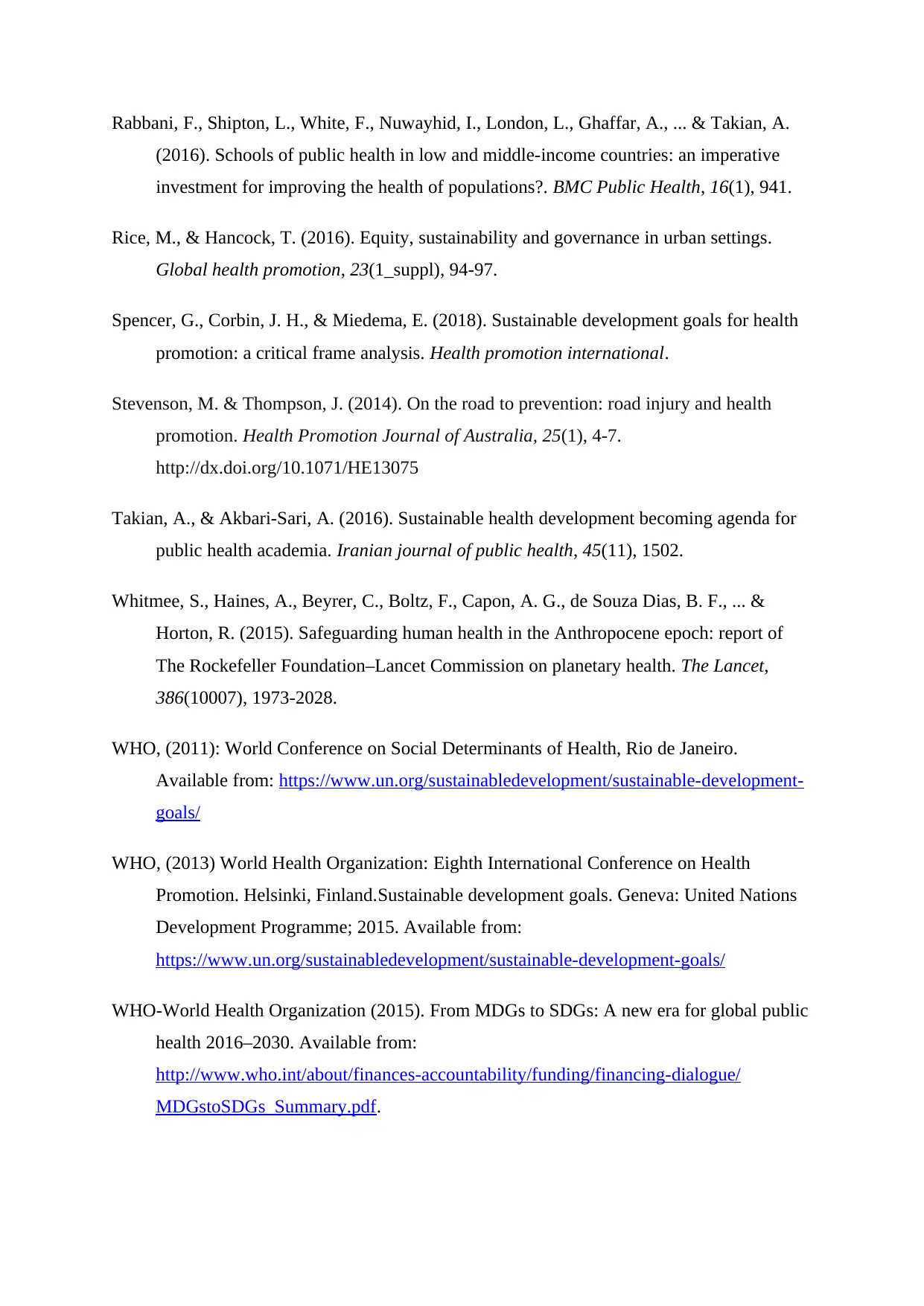
Rabbani, F., Shipton, L., White, F., Nuwayhid, I., London, L., Ghaffar, A., ... & Takian, A.
(2016). Schools of public health in low and middle-income countries: an imperative
investment for improving the health of populations?. BMC Public Health, 16(1), 941.
Rice, M., & Hancock, T. (2016). Equity, sustainability and governance in urban settings.
Global health promotion, 23(1_suppl), 94-97.
Spencer, G., Corbin, J. H., & Miedema, E. (2018). Sustainable development goals for health
promotion: a critical frame analysis. Health promotion international.
Stevenson, M. & Thompson, J. (2014). On the road to prevention: road injury and health
promotion. Health Promotion Journal of Australia, 25(1), 4-7.
http://dx.doi.org/10.1071/HE13075
Takian, A., & Akbari-Sari, A. (2016). Sustainable health development becoming agenda for
public health academia. Iranian journal of public health, 45(11), 1502.
Whitmee, S., Haines, A., Beyrer, C., Boltz, F., Capon, A. G., de Souza Dias, B. F., ... &
Horton, R. (2015). Safeguarding human health in the Anthropocene epoch: report of
The Rockefeller Foundation–Lancet Commission on planetary health. The Lancet,
386(10007), 1973-2028.
WHO, (2011): World Conference on Social Determinants of Health, Rio de Janeiro.
Available from: https://www.un.org/sustainabledevelopment/sustainable-development-
goals/
WHO, (2013) World Health Organization: Eighth International Conference on Health
Promotion. Helsinki, Finland.Sustainable development goals. Geneva: United Nations
Development Programme; 2015. Available from:
https://www.un.org/sustainabledevelopment/sustainable-development-goals/
WHO-World Health Organization (2015). From MDGs to SDGs: A new era for global public
health 2016–2030. Available from:
http://www.who.int/about/finances-accountability/funding/financing-dialogue/
MDGstoSDGs_Summary.pdf.
(2016). Schools of public health in low and middle-income countries: an imperative
investment for improving the health of populations?. BMC Public Health, 16(1), 941.
Rice, M., & Hancock, T. (2016). Equity, sustainability and governance in urban settings.
Global health promotion, 23(1_suppl), 94-97.
Spencer, G., Corbin, J. H., & Miedema, E. (2018). Sustainable development goals for health
promotion: a critical frame analysis. Health promotion international.
Stevenson, M. & Thompson, J. (2014). On the road to prevention: road injury and health
promotion. Health Promotion Journal of Australia, 25(1), 4-7.
http://dx.doi.org/10.1071/HE13075
Takian, A., & Akbari-Sari, A. (2016). Sustainable health development becoming agenda for
public health academia. Iranian journal of public health, 45(11), 1502.
Whitmee, S., Haines, A., Beyrer, C., Boltz, F., Capon, A. G., de Souza Dias, B. F., ... &
Horton, R. (2015). Safeguarding human health in the Anthropocene epoch: report of
The Rockefeller Foundation–Lancet Commission on planetary health. The Lancet,
386(10007), 1973-2028.
WHO, (2011): World Conference on Social Determinants of Health, Rio de Janeiro.
Available from: https://www.un.org/sustainabledevelopment/sustainable-development-
goals/
WHO, (2013) World Health Organization: Eighth International Conference on Health
Promotion. Helsinki, Finland.Sustainable development goals. Geneva: United Nations
Development Programme; 2015. Available from:
https://www.un.org/sustainabledevelopment/sustainable-development-goals/
WHO-World Health Organization (2015). From MDGs to SDGs: A new era for global public
health 2016–2030. Available from:
http://www.who.int/about/finances-accountability/funding/financing-dialogue/
MDGstoSDGs_Summary.pdf.
Paraphrase This Document
Need a fresh take? Get an instant paraphrase of this document with our AI Paraphraser


1 out of 11


Related Documents


Your All-in-One AI-Powered Toolkit for Academic Success.
+13062052269
info@desklib.com
Available 24*7 on WhatsApp / Email
![[object Object]](/_next/static/media/star-bottom.7253800d.svg)
Unlock your academic potential
Copyright © 2020–2026 A2Z Services. All Rights Reserved. Developed and managed by ZUCOL.