Accident Investigation Report: Principles of Health & Safety, HSD1
VerifiedAdded on 2023/05/30
|8
|2604
|147
Report
AI Summary
This report presents a detailed investigation into a workplace accident, examining the immediate and underlying causes, including the company's negligence in conducting thorough risk assessments, lack of health and safety training, and inadequate adherence to the Health and Safety at Work Act 1974. The report identifies the office manager's negligence and the company's weak health and safety policy as contributing factors. It also highlights the failure to train employees, leading to unsafe practices. The report recommends revising the health and safety policy, providing comprehensive training, and implementing control measures such as restricting tasks to trained employees and ensuring safe working conditions. Furthermore, the report outlines the legal duties of the company and individuals involved, potential prosecutions, and the likely outcomes of HSE investigations. It concludes by emphasizing the company's non-compliance with legal obligations and suggests improvements to prevent future incidents, including the need for thorough risk assessments, employee training, and adherence to safety regulations.
Principles of Health & Safety
Student name
Professor’s name
Affiliation
Date
Student name
Professor’s name
Affiliation
Date

Paraphrase This Document
Need a fresh take? Get an instant paraphrase of this document with our AI Paraphraser
The immediate and underlying causes of the accident
The major cause of this unfortunate incident is the negligence of the company
management. The company should have conducted a wholesome safety assessment that
must have included all probable risks. Had this been the case, the manager would not
have allowed Brian to deal with the pump who had no expertise in it. Had the health and
safety policy of the company considered all risks, this incident would not have happened.
Furthermore, the manager of the office in which Richard died, had not received health
and safety training, which makes her unfit to handle logistics to deal with health and
safety. This could be an indication that other managers are also not trained, which is a
serious concern for the company. Concerning the safety of the employees of the
company, the office manager is directly responsible for the incident. The office manager
has shown her negligence in failing to manage properly the employees in the office. The
company management should take all the blame for this unfortunate incident.
The health and safety policy of the company is very weak, in that it does not capture all
the legal requirements of the law, according to the Health and Safety at Work Act 1974.
The act provides that employees be not required to be assigned tasks for which they do
not have appropriate skills and competencies to handle.1 In this case, Brian was assigned
the duty of operating a pump despite the fact that he did not have the required skills. His
failure to read the instructions on the pump before using it is the result of him being not
trained in operating it. Furthermore, the general principles of prevention, which are
provided in the Health and Safety at Work Act 1974, were not followed in developing the
company’s health and safety policies. Therefore, the root cause of the problem is the
negligence of the company management, in that it failed to initiate a complete and
wholesome health and safety policy. The management failed to follow all the provisions
of the Health and Safety at Work Act 1974. The act provides that no employee shall be
given a task beyond her or his competencies or physical ability.2
1De Sadeleer, N. (2012). The Precautionary Principle in European Community Health and
Environment Law: Sword or Shield for the Nordic Countries? In Implementing the Precautionary
Principle (pp. 46-94). Routledge.
2Dollard, M. & Bakker, A. (2010). Psychosocial safety climate as a precursor to conducive work
environments, psychological health problems, and employee engagement. Journal of Occupational and
Organizational Psychology, 83(3), 579-599.
The major cause of this unfortunate incident is the negligence of the company
management. The company should have conducted a wholesome safety assessment that
must have included all probable risks. Had this been the case, the manager would not
have allowed Brian to deal with the pump who had no expertise in it. Had the health and
safety policy of the company considered all risks, this incident would not have happened.
Furthermore, the manager of the office in which Richard died, had not received health
and safety training, which makes her unfit to handle logistics to deal with health and
safety. This could be an indication that other managers are also not trained, which is a
serious concern for the company. Concerning the safety of the employees of the
company, the office manager is directly responsible for the incident. The office manager
has shown her negligence in failing to manage properly the employees in the office. The
company management should take all the blame for this unfortunate incident.
The health and safety policy of the company is very weak, in that it does not capture all
the legal requirements of the law, according to the Health and Safety at Work Act 1974.
The act provides that employees be not required to be assigned tasks for which they do
not have appropriate skills and competencies to handle.1 In this case, Brian was assigned
the duty of operating a pump despite the fact that he did not have the required skills. His
failure to read the instructions on the pump before using it is the result of him being not
trained in operating it. Furthermore, the general principles of prevention, which are
provided in the Health and Safety at Work Act 1974, were not followed in developing the
company’s health and safety policies. Therefore, the root cause of the problem is the
negligence of the company management, in that it failed to initiate a complete and
wholesome health and safety policy. The management failed to follow all the provisions
of the Health and Safety at Work Act 1974. The act provides that no employee shall be
given a task beyond her or his competencies or physical ability.2
1De Sadeleer, N. (2012). The Precautionary Principle in European Community Health and
Environment Law: Sword or Shield for the Nordic Countries? In Implementing the Precautionary
Principle (pp. 46-94). Routledge.
2Dollard, M. & Bakker, A. (2010). Psychosocial safety climate as a precursor to conducive work
environments, psychological health problems, and employee engagement. Journal of Occupational and
Organizational Psychology, 83(3), 579-599.
Another cause of this unfortunate incident is the failure of the company to train its
employees on health and safety information inscribed in the Health and Safety at Work
Act 1974. The case would have been different had the employees been thus trained. Brian
would not have started the pump without checking on the instructions to see what was
required of him. The same case is with the manager of the office where Richard died. In
her case, she had no health and safety training and hence, she should not have taken it
upon herself to manage the clearing of the water without health and safety considerations.
She should have consulted from her senior, even though he was on holiday. From the
witnesses account, the regional manager had undertaken some training in health and
safety, and he could have advised appropriately if he was consulted.
However, according to the Management of Health and Safety at Work Regulations 1999,
Brian could easily escape any charges because the act provides that an employer should
make provisions and arrangements that are appropriate to the employee’s skills and
competencies.3The employer is required to ensure that there is effective planning in
organization, monitoring and controlling of all the review and preventive actions to
ensure the health and safety of his employees.4
However, notwithstanding all the negligence that marred the case, the individual with the
instruction on how the pump should be operated, was held. Owing to this, the manager
and the employee, who were assigned to operate the pump, could easily be charged with
gross negligence resulting in manslaughter. Brian could be charged with manslaughter
because both murder and manslaughter have the same foundations; recklessness or
negligence that leads to death in both cases.5
Recommendations to Prevent a Recurrence
3Makin, A. M., and C. Winder. "A new conceptual framework to improve the application of
occupational health and safety management systems." Safety Science 46.6 (2008): 935-948.
4Truth, A. (2013). No Health without a workforce. World Health Organisation (WHO) Report.
5Dingsdag et al (2008). Understanding and defining OH&S competency for construction site
positions: Worker perceptions. Safety Science, 46(4), 619-633.
employees on health and safety information inscribed in the Health and Safety at Work
Act 1974. The case would have been different had the employees been thus trained. Brian
would not have started the pump without checking on the instructions to see what was
required of him. The same case is with the manager of the office where Richard died. In
her case, she had no health and safety training and hence, she should not have taken it
upon herself to manage the clearing of the water without health and safety considerations.
She should have consulted from her senior, even though he was on holiday. From the
witnesses account, the regional manager had undertaken some training in health and
safety, and he could have advised appropriately if he was consulted.
However, according to the Management of Health and Safety at Work Regulations 1999,
Brian could easily escape any charges because the act provides that an employer should
make provisions and arrangements that are appropriate to the employee’s skills and
competencies.3The employer is required to ensure that there is effective planning in
organization, monitoring and controlling of all the review and preventive actions to
ensure the health and safety of his employees.4
However, notwithstanding all the negligence that marred the case, the individual with the
instruction on how the pump should be operated, was held. Owing to this, the manager
and the employee, who were assigned to operate the pump, could easily be charged with
gross negligence resulting in manslaughter. Brian could be charged with manslaughter
because both murder and manslaughter have the same foundations; recklessness or
negligence that leads to death in both cases.5
Recommendations to Prevent a Recurrence
3Makin, A. M., and C. Winder. "A new conceptual framework to improve the application of
occupational health and safety management systems." Safety Science 46.6 (2008): 935-948.
4Truth, A. (2013). No Health without a workforce. World Health Organisation (WHO) Report.
5Dingsdag et al (2008). Understanding and defining OH&S competency for construction site
positions: Worker perceptions. Safety Science, 46(4), 619-633.
⊘ This is a preview!⊘
Do you want full access?
Subscribe today to unlock all pages.

Trusted by 1+ million students worldwide
Primarily, in order to avoid further recurrence of this unfortunate incident, the health and
safety policy of the company should be thoroughly revised to include all the statutory
standings of the Health and Safety at Work Act 1974.6 Furthermore, all the employees
should receive a health and safety training, including the managers and the
administrators. The training will help employees to:7
i. Be able to detect any shortcoming concerning health and safety preparation.
ii. Immediately report situations that involve risk
iii. Use any machinery equipment in the work places according to the instructions given
during the training.
iv. Able to take care of their individual health and safety and those associated with them
who may be affected by their actions.
The following additions should be made to the risk assessment form of the company as
control measures:
i. No employee shall be assigned a task for which they are not trained.
ii. No single employee shall be left in the office after working hours.
iii. More than one employee should be present when technical work is being carried out
in the work place.
iv. All machines should be thoroughly investigated, and their warning taken seriously.
v. All employees should be trained on how to handle portable machines for common
duties, which may be required in the work place from time to time.
According to the health and safety laws of the UK, employees have right to work in
environments that are safe and sufficiently manned. Employers must be encouraged to
verse themselves with knowledge on their health and safety provisions while at work.
The employers should use the following:
i. Know what can cause them harm while working and take enough precautions to
stop it.
6Tombs, S., & Whyte, D. (2013). Transcending the deregulation debate? Regulation, risk, and the
enforcement of health and safety law in the UK. Regulation & Governance, 7(1), 61-79.
7Makin, A, & Winder, C. (2008). A new conceptual framework to improve the application of
occupational health and safety management systems. Safety Science, 46(6), 935-948.
safety policy of the company should be thoroughly revised to include all the statutory
standings of the Health and Safety at Work Act 1974.6 Furthermore, all the employees
should receive a health and safety training, including the managers and the
administrators. The training will help employees to:7
i. Be able to detect any shortcoming concerning health and safety preparation.
ii. Immediately report situations that involve risk
iii. Use any machinery equipment in the work places according to the instructions given
during the training.
iv. Able to take care of their individual health and safety and those associated with them
who may be affected by their actions.
The following additions should be made to the risk assessment form of the company as
control measures:
i. No employee shall be assigned a task for which they are not trained.
ii. No single employee shall be left in the office after working hours.
iii. More than one employee should be present when technical work is being carried out
in the work place.
iv. All machines should be thoroughly investigated, and their warning taken seriously.
v. All employees should be trained on how to handle portable machines for common
duties, which may be required in the work place from time to time.
According to the health and safety laws of the UK, employees have right to work in
environments that are safe and sufficiently manned. Employers must be encouraged to
verse themselves with knowledge on their health and safety provisions while at work.
The employers should use the following:
i. Know what can cause them harm while working and take enough precautions to
stop it.
6Tombs, S., & Whyte, D. (2013). Transcending the deregulation debate? Regulation, risk, and the
enforcement of health and safety law in the UK. Regulation & Governance, 7(1), 61-79.
7Makin, A, & Winder, C. (2008). A new conceptual framework to improve the application of
occupational health and safety management systems. Safety Science, 46(6), 935-948.
Paraphrase This Document
Need a fresh take? Get an instant paraphrase of this document with our AI Paraphraser
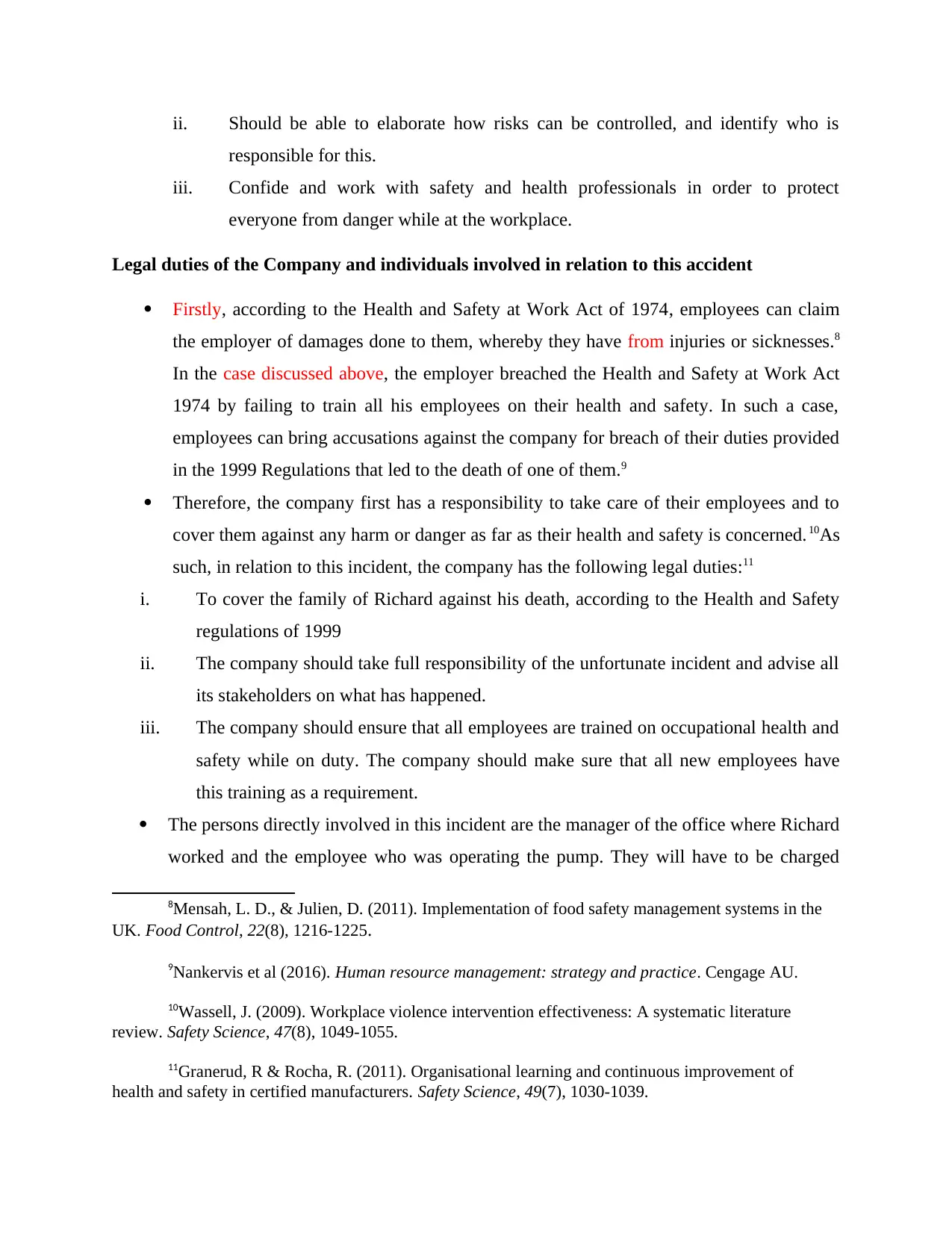
ii. Should be able to elaborate how risks can be controlled, and identify who is
responsible for this.
iii. Confide and work with safety and health professionals in order to protect
everyone from danger while at the workplace.
Legal duties of the Company and individuals involved in relation to this accident
Firstly, according to the Health and Safety at Work Act of 1974, employees can claim
the employer of damages done to them, whereby they have from injuries or sicknesses.8
In the case discussed above, the employer breached the Health and Safety at Work Act
1974 by failing to train all his employees on their health and safety. In such a case,
employees can bring accusations against the company for breach of their duties provided
in the 1999 Regulations that led to the death of one of them.9
Therefore, the company first has a responsibility to take care of their employees and to
cover them against any harm or danger as far as their health and safety is concerned.10As
such, in relation to this incident, the company has the following legal duties:11
i. To cover the family of Richard against his death, according to the Health and Safety
regulations of 1999
ii. The company should take full responsibility of the unfortunate incident and advise all
its stakeholders on what has happened.
iii. The company should ensure that all employees are trained on occupational health and
safety while on duty. The company should make sure that all new employees have
this training as a requirement.
The persons directly involved in this incident are the manager of the office where Richard
worked and the employee who was operating the pump. They will have to be charged
8Mensah, L. D., & Julien, D. (2011). Implementation of food safety management systems in the
UK. Food Control, 22(8), 1216-1225.
9Nankervis et al (2016). Human resource management: strategy and practice. Cengage AU.
10Wassell, J. (2009). Workplace violence intervention effectiveness: A systematic literature
review. Safety Science, 47(8), 1049-1055.
11Granerud, R & Rocha, R. (2011). Organisational learning and continuous improvement of
health and safety in certified manufacturers. Safety Science, 49(7), 1030-1039.
responsible for this.
iii. Confide and work with safety and health professionals in order to protect
everyone from danger while at the workplace.
Legal duties of the Company and individuals involved in relation to this accident
Firstly, according to the Health and Safety at Work Act of 1974, employees can claim
the employer of damages done to them, whereby they have from injuries or sicknesses.8
In the case discussed above, the employer breached the Health and Safety at Work Act
1974 by failing to train all his employees on their health and safety. In such a case,
employees can bring accusations against the company for breach of their duties provided
in the 1999 Regulations that led to the death of one of them.9
Therefore, the company first has a responsibility to take care of their employees and to
cover them against any harm or danger as far as their health and safety is concerned.10As
such, in relation to this incident, the company has the following legal duties:11
i. To cover the family of Richard against his death, according to the Health and Safety
regulations of 1999
ii. The company should take full responsibility of the unfortunate incident and advise all
its stakeholders on what has happened.
iii. The company should ensure that all employees are trained on occupational health and
safety while on duty. The company should make sure that all new employees have
this training as a requirement.
The persons directly involved in this incident are the manager of the office where Richard
worked and the employee who was operating the pump. They will have to be charged
8Mensah, L. D., & Julien, D. (2011). Implementation of food safety management systems in the
UK. Food Control, 22(8), 1216-1225.
9Nankervis et al (2016). Human resource management: strategy and practice. Cengage AU.
10Wassell, J. (2009). Workplace violence intervention effectiveness: A systematic literature
review. Safety Science, 47(8), 1049-1055.
11Granerud, R & Rocha, R. (2011). Organisational learning and continuous improvement of
health and safety in certified manufacturers. Safety Science, 49(7), 1030-1039.
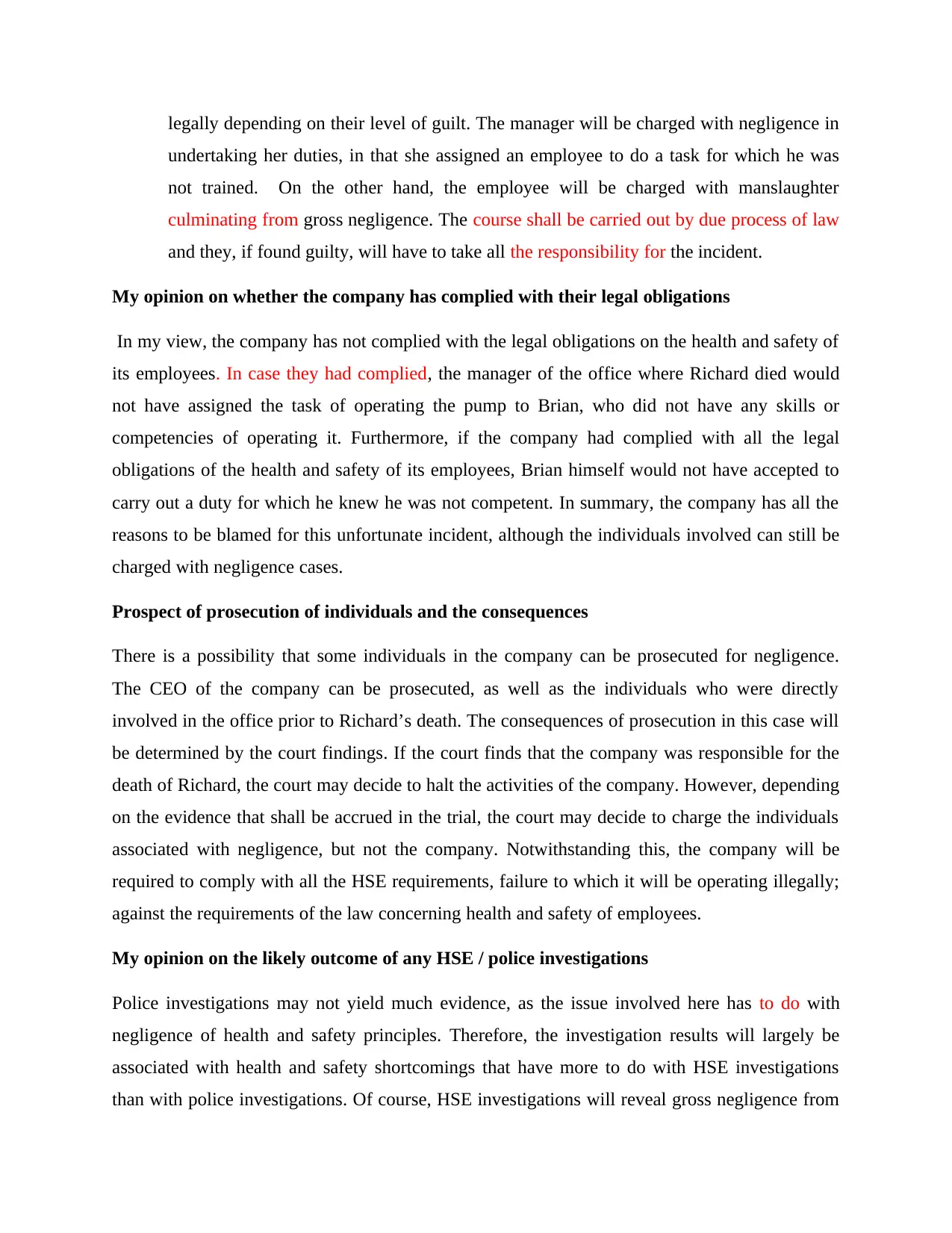
legally depending on their level of guilt. The manager will be charged with negligence in
undertaking her duties, in that she assigned an employee to do a task for which he was
not trained. On the other hand, the employee will be charged with manslaughter
culminating from gross negligence. The course shall be carried out by due process of law
and they, if found guilty, will have to take all the responsibility for the incident.
My opinion on whether the company has complied with their legal obligations
In my view, the company has not complied with the legal obligations on the health and safety of
its employees. In case they had complied, the manager of the office where Richard died would
not have assigned the task of operating the pump to Brian, who did not have any skills or
competencies of operating it. Furthermore, if the company had complied with all the legal
obligations of the health and safety of its employees, Brian himself would not have accepted to
carry out a duty for which he knew he was not competent. In summary, the company has all the
reasons to be blamed for this unfortunate incident, although the individuals involved can still be
charged with negligence cases.
Prospect of prosecution of individuals and the consequences
There is a possibility that some individuals in the company can be prosecuted for negligence.
The CEO of the company can be prosecuted, as well as the individuals who were directly
involved in the office prior to Richard’s death. The consequences of prosecution in this case will
be determined by the court findings. If the court finds that the company was responsible for the
death of Richard, the court may decide to halt the activities of the company. However, depending
on the evidence that shall be accrued in the trial, the court may decide to charge the individuals
associated with negligence, but not the company. Notwithstanding this, the company will be
required to comply with all the HSE requirements, failure to which it will be operating illegally;
against the requirements of the law concerning health and safety of employees.
My opinion on the likely outcome of any HSE / police investigations
Police investigations may not yield much evidence, as the issue involved here has to do with
negligence of health and safety principles. Therefore, the investigation results will largely be
associated with health and safety shortcomings that have more to do with HSE investigations
than with police investigations. Of course, HSE investigations will reveal gross negligence from
undertaking her duties, in that she assigned an employee to do a task for which he was
not trained. On the other hand, the employee will be charged with manslaughter
culminating from gross negligence. The course shall be carried out by due process of law
and they, if found guilty, will have to take all the responsibility for the incident.
My opinion on whether the company has complied with their legal obligations
In my view, the company has not complied with the legal obligations on the health and safety of
its employees. In case they had complied, the manager of the office where Richard died would
not have assigned the task of operating the pump to Brian, who did not have any skills or
competencies of operating it. Furthermore, if the company had complied with all the legal
obligations of the health and safety of its employees, Brian himself would not have accepted to
carry out a duty for which he knew he was not competent. In summary, the company has all the
reasons to be blamed for this unfortunate incident, although the individuals involved can still be
charged with negligence cases.
Prospect of prosecution of individuals and the consequences
There is a possibility that some individuals in the company can be prosecuted for negligence.
The CEO of the company can be prosecuted, as well as the individuals who were directly
involved in the office prior to Richard’s death. The consequences of prosecution in this case will
be determined by the court findings. If the court finds that the company was responsible for the
death of Richard, the court may decide to halt the activities of the company. However, depending
on the evidence that shall be accrued in the trial, the court may decide to charge the individuals
associated with negligence, but not the company. Notwithstanding this, the company will be
required to comply with all the HSE requirements, failure to which it will be operating illegally;
against the requirements of the law concerning health and safety of employees.
My opinion on the likely outcome of any HSE / police investigations
Police investigations may not yield much evidence, as the issue involved here has to do with
negligence of health and safety principles. Therefore, the investigation results will largely be
associated with health and safety shortcomings that have more to do with HSE investigations
than with police investigations. Of course, HSE investigations will reveal gross negligence from
⊘ This is a preview!⊘
Do you want full access?
Subscribe today to unlock all pages.
Trusted by 1+ million students worldwide

the company itself, and more specifically with the individuals who were directly involved in the
unfortunate incident.
unfortunate incident.
Paraphrase This Document
Need a fresh take? Get an instant paraphrase of this document with our AI Paraphraser
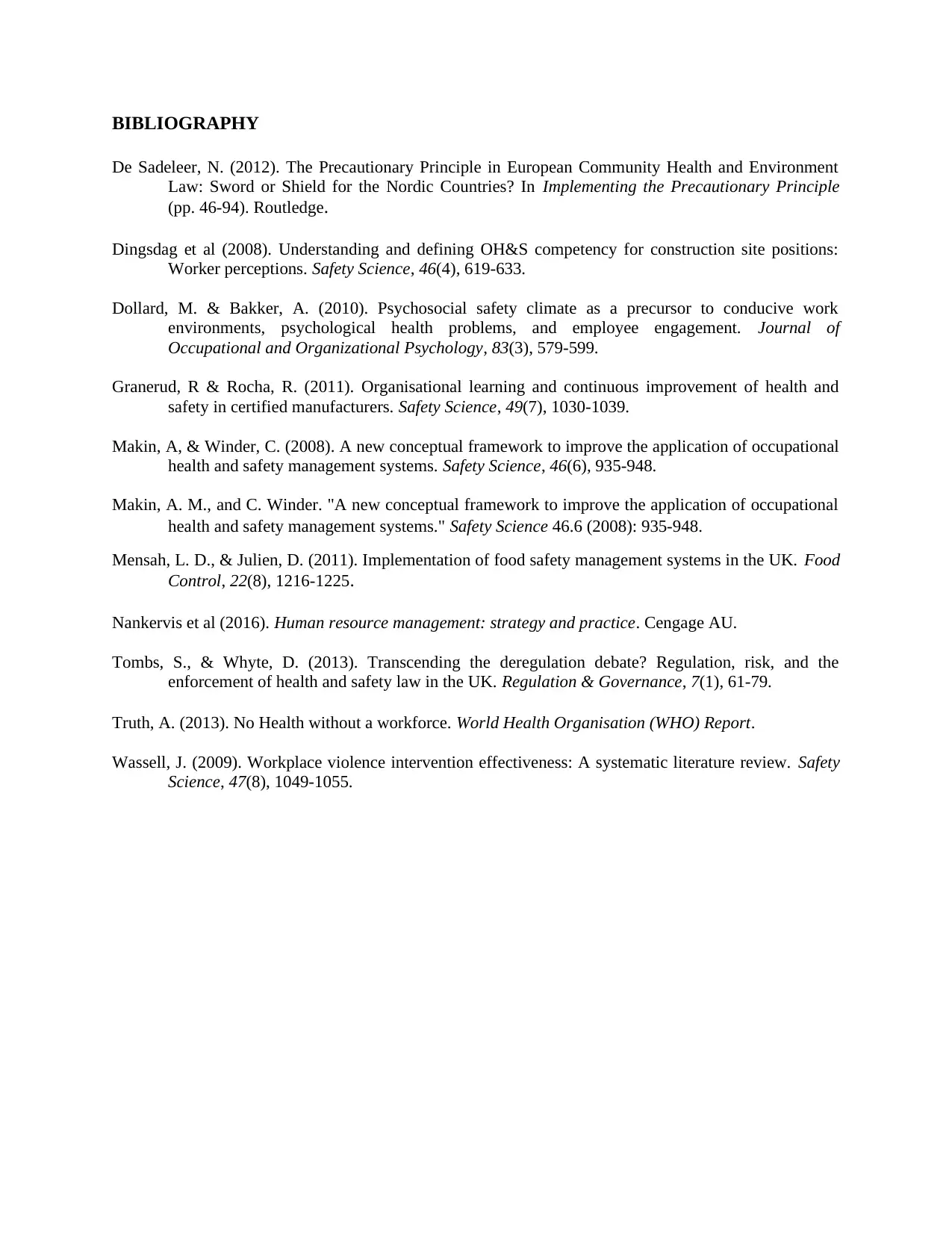
BIBLIOGRAPHY
De Sadeleer, N. (2012). The Precautionary Principle in European Community Health and Environment
Law: Sword or Shield for the Nordic Countries? In Implementing the Precautionary Principle
(pp. 46-94). Routledge.
Dingsdag et al (2008). Understanding and defining OH&S competency for construction site positions:
Worker perceptions. Safety Science, 46(4), 619-633.
Dollard, M. & Bakker, A. (2010). Psychosocial safety climate as a precursor to conducive work
environments, psychological health problems, and employee engagement. Journal of
Occupational and Organizational Psychology, 83(3), 579-599.
Granerud, R & Rocha, R. (2011). Organisational learning and continuous improvement of health and
safety in certified manufacturers. Safety Science, 49(7), 1030-1039.
Makin, A, & Winder, C. (2008). A new conceptual framework to improve the application of occupational
health and safety management systems. Safety Science, 46(6), 935-948.
Makin, A. M., and C. Winder. "A new conceptual framework to improve the application of occupational
health and safety management systems." Safety Science 46.6 (2008): 935-948.
Mensah, L. D., & Julien, D. (2011). Implementation of food safety management systems in the UK. Food
Control, 22(8), 1216-1225.
Nankervis et al (2016). Human resource management: strategy and practice. Cengage AU.
Tombs, S., & Whyte, D. (2013). Transcending the deregulation debate? Regulation, risk, and the
enforcement of health and safety law in the UK. Regulation & Governance, 7(1), 61-79.
Truth, A. (2013). No Health without a workforce. World Health Organisation (WHO) Report.
Wassell, J. (2009). Workplace violence intervention effectiveness: A systematic literature review. Safety
Science, 47(8), 1049-1055.
De Sadeleer, N. (2012). The Precautionary Principle in European Community Health and Environment
Law: Sword or Shield for the Nordic Countries? In Implementing the Precautionary Principle
(pp. 46-94). Routledge.
Dingsdag et al (2008). Understanding and defining OH&S competency for construction site positions:
Worker perceptions. Safety Science, 46(4), 619-633.
Dollard, M. & Bakker, A. (2010). Psychosocial safety climate as a precursor to conducive work
environments, psychological health problems, and employee engagement. Journal of
Occupational and Organizational Psychology, 83(3), 579-599.
Granerud, R & Rocha, R. (2011). Organisational learning and continuous improvement of health and
safety in certified manufacturers. Safety Science, 49(7), 1030-1039.
Makin, A, & Winder, C. (2008). A new conceptual framework to improve the application of occupational
health and safety management systems. Safety Science, 46(6), 935-948.
Makin, A. M., and C. Winder. "A new conceptual framework to improve the application of occupational
health and safety management systems." Safety Science 46.6 (2008): 935-948.
Mensah, L. D., & Julien, D. (2011). Implementation of food safety management systems in the UK. Food
Control, 22(8), 1216-1225.
Nankervis et al (2016). Human resource management: strategy and practice. Cengage AU.
Tombs, S., & Whyte, D. (2013). Transcending the deregulation debate? Regulation, risk, and the
enforcement of health and safety law in the UK. Regulation & Governance, 7(1), 61-79.
Truth, A. (2013). No Health without a workforce. World Health Organisation (WHO) Report.
Wassell, J. (2009). Workplace violence intervention effectiveness: A systematic literature review. Safety
Science, 47(8), 1049-1055.

1 out of 8


Related Documents


Your All-in-One AI-Powered Toolkit for Academic Success.
+13062052269
info@desklib.com
Available 24*7 on WhatsApp / Email
![[object Object]](/_next/static/media/star-bottom.7253800d.svg)
Unlock your academic potential
Copyright © 2020–2025 A2Z Services. All Rights Reserved. Developed and managed by ZUCOL.