Health Services Assistant: Transportation, Conflicts, and Duties
VerifiedAdded on 2021/09/16
|24
|7814
|115
Homework Assignment
AI Summary
This document provides a comprehensive solution to a Health Services Assistant assignment, addressing key aspects of the role within a healthcare setting. The assignment delves into the importance of identifying and reporting variations in service quality, emphasizing continuous improvement and customer satisfaction. It explores the required competencies, including service delivery, communication, teamwork, problem-solving, and leadership, along with the professional development needs for the role. The assignment also covers personal skills development, such as communication and computer skills, and self-confidence, providing strategies for achieving these. It outlines the reporting structure within a healthcare environment, including key personnel and other job roles. Furthermore, the assignment presents a scenario involving a patient requiring additional medication and displays signs of stress/agitation, providing a sample note to a supervisor. It also addresses conflict management, including strategies for handling mistrust and interpersonal conflicts. The assignment further examines procedures for safe patient transportation, including actions to ensure timely and safe transport, equipment checks, and wheelchair safety. It also explores relevant documentation and policies within healthcare organizations, as well as potential conflicts that need to be reported. Finally, it lists potential barriers to communication that may affect the assistant's ability to identify patient needs.
Running head: HEALTH SERVICES ASSISTANT 1
Health Services Assistant
Student’s Name
Institutional Affiliation
Health Services Assistant
Student’s Name
Institutional Affiliation

Paraphrase This Document
Need a fresh take? Get an instant paraphrase of this document with our AI Paraphraser
HEALTH SERVICES ASSISTANT 2
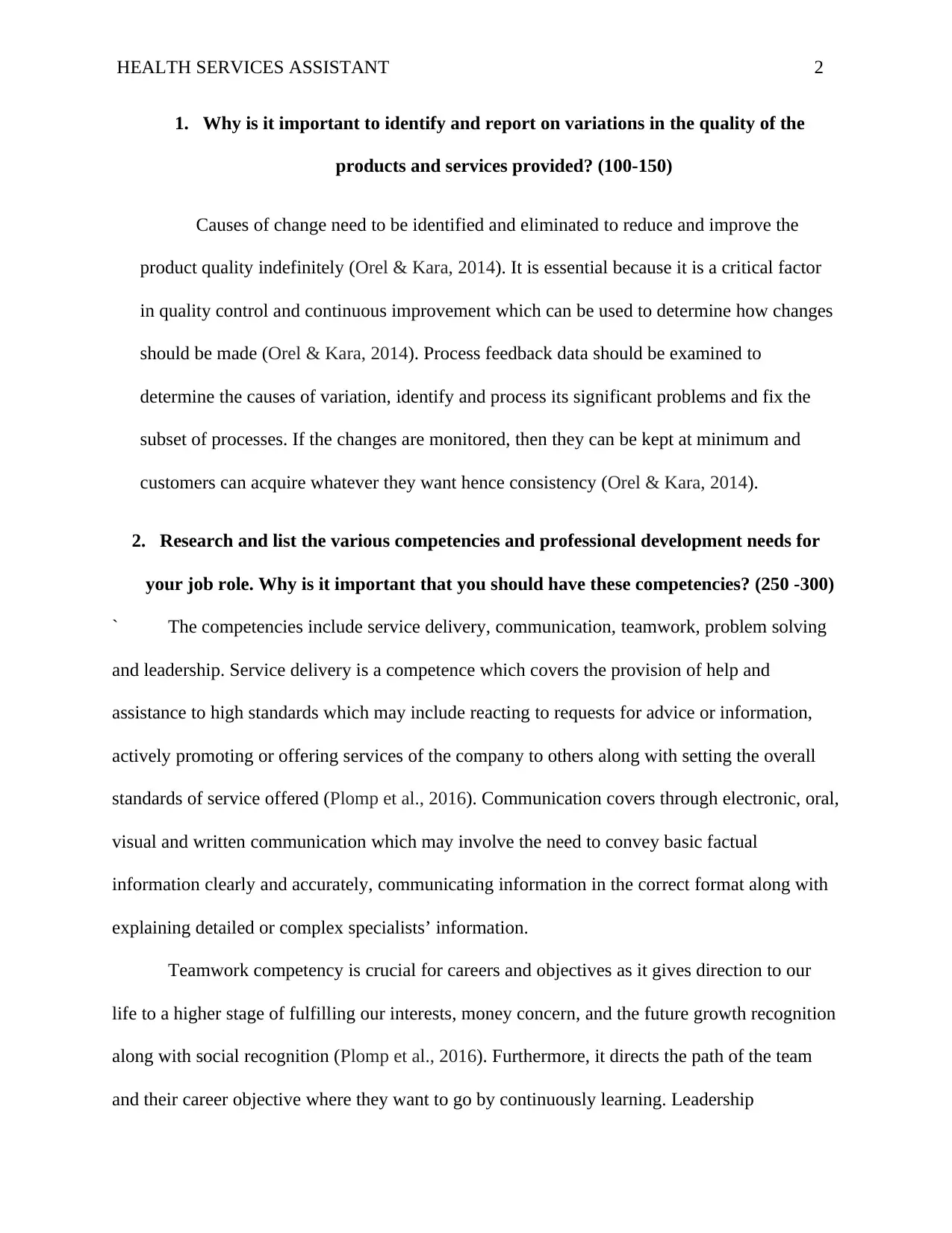
1. Why is it important to identify and report on variations in the quality of the
products and services provided? (100-150)
Causes of change need to be identified and eliminated to reduce and improve the
product quality indefinitely (Orel & Kara, 2014). It is essential because it is a critical factor
in quality control and continuous improvement which can be used to determine how changes
should be made (Orel & Kara, 2014). Process feedback data should be examined to
determine the causes of variation, identify and process its significant problems and fix the
subset of processes. If the changes are monitored, then they can be kept at minimum and
customers can acquire whatever they want hence consistency (Orel & Kara, 2014).
2. Research and list the various competencies and professional development needs for
your job role. Why is it important that you should have these competencies? (250 -300)
` The competencies include service delivery, communication, teamwork, problem solving
and leadership. Service delivery is a competence which covers the provision of help and
assistance to high standards which may include reacting to requests for advice or information,
actively promoting or offering services of the company to others along with setting the overall
standards of service offered (Plomp et al., 2016). Communication covers through electronic, oral,
visual and written communication which may involve the need to convey basic factual
information clearly and accurately, communicating information in the correct format along with
explaining detailed or complex specialists’ information.
Teamwork competency is crucial for careers and objectives as it gives direction to our
life to a higher stage of fulfilling our interests, money concern, and the future growth recognition
along with social recognition (Plomp et al., 2016). Furthermore, it directs the path of the team
and their career objective where they want to go by continuously learning. Leadership
1. Why is it important to identify and report on variations in the quality of the
products and services provided? (100-150)
Causes of change need to be identified and eliminated to reduce and improve the
product quality indefinitely (Orel & Kara, 2014). It is essential because it is a critical factor
in quality control and continuous improvement which can be used to determine how changes
should be made (Orel & Kara, 2014). Process feedback data should be examined to
determine the causes of variation, identify and process its significant problems and fix the
subset of processes. If the changes are monitored, then they can be kept at minimum and
customers can acquire whatever they want hence consistency (Orel & Kara, 2014).
2. Research and list the various competencies and professional development needs for
your job role. Why is it important that you should have these competencies? (250 -300)
` The competencies include service delivery, communication, teamwork, problem solving
and leadership. Service delivery is a competence which covers the provision of help and
assistance to high standards which may include reacting to requests for advice or information,
actively promoting or offering services of the company to others along with setting the overall
standards of service offered (Plomp et al., 2016). Communication covers through electronic, oral,
visual and written communication which may involve the need to convey basic factual
information clearly and accurately, communicating information in the correct format along with
explaining detailed or complex specialists’ information.
Teamwork competency is crucial for careers and objectives as it gives direction to our
life to a higher stage of fulfilling our interests, money concern, and the future growth recognition
along with social recognition (Plomp et al., 2016). Furthermore, it directs the path of the team
and their career objective where they want to go by continuously learning. Leadership
HEALTH SERVICES ASSISTANT 3
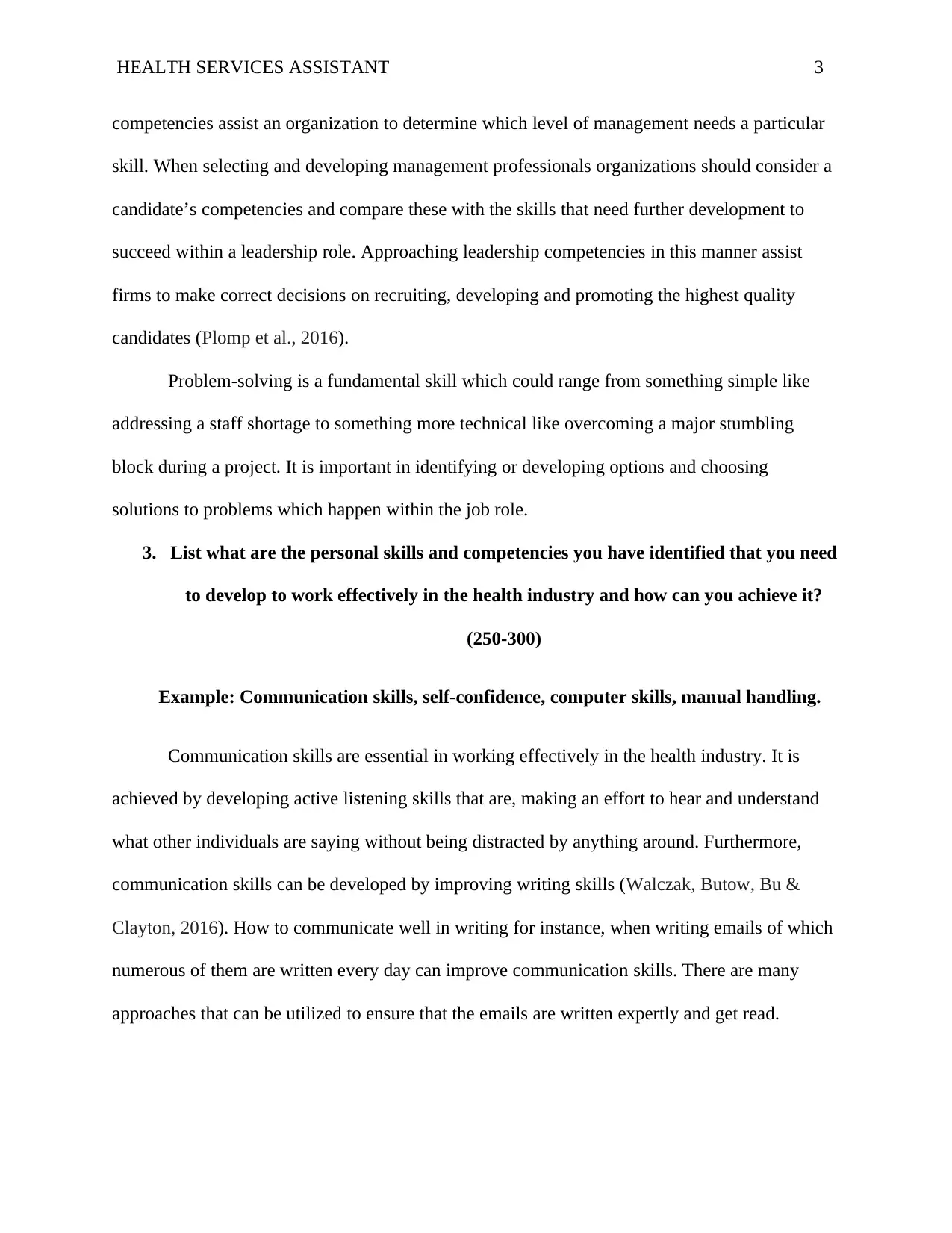
competencies assist an organization to determine which level of management needs a particular
skill. When selecting and developing management professionals organizations should consider a
candidate’s competencies and compare these with the skills that need further development to
succeed within a leadership role. Approaching leadership competencies in this manner assist
firms to make correct decisions on recruiting, developing and promoting the highest quality
candidates (Plomp et al., 2016).
Problem-solving is a fundamental skill which could range from something simple like
addressing a staff shortage to something more technical like overcoming a major stumbling
block during a project. It is important in identifying or developing options and choosing
solutions to problems which happen within the job role.
3. List what are the personal skills and competencies you have identified that you need
to develop to work effectively in the health industry and how can you achieve it?
(250-300)
Example: Communication skills, self-confidence, computer skills, manual handling.
Communication skills are essential in working effectively in the health industry. It is
achieved by developing active listening skills that are, making an effort to hear and understand
what other individuals are saying without being distracted by anything around. Furthermore,
communication skills can be developed by improving writing skills (Walczak, Butow, Bu &
Clayton, 2016). How to communicate well in writing for instance, when writing emails of which
numerous of them are written every day can improve communication skills. There are many
approaches that can be utilized to ensure that the emails are written expertly and get read.
competencies assist an organization to determine which level of management needs a particular
skill. When selecting and developing management professionals organizations should consider a
candidate’s competencies and compare these with the skills that need further development to
succeed within a leadership role. Approaching leadership competencies in this manner assist
firms to make correct decisions on recruiting, developing and promoting the highest quality
candidates (Plomp et al., 2016).
Problem-solving is a fundamental skill which could range from something simple like
addressing a staff shortage to something more technical like overcoming a major stumbling
block during a project. It is important in identifying or developing options and choosing
solutions to problems which happen within the job role.
3. List what are the personal skills and competencies you have identified that you need
to develop to work effectively in the health industry and how can you achieve it?
(250-300)
Example: Communication skills, self-confidence, computer skills, manual handling.
Communication skills are essential in working effectively in the health industry. It is
achieved by developing active listening skills that are, making an effort to hear and understand
what other individuals are saying without being distracted by anything around. Furthermore,
communication skills can be developed by improving writing skills (Walczak, Butow, Bu &
Clayton, 2016). How to communicate well in writing for instance, when writing emails of which
numerous of them are written every day can improve communication skills. There are many
approaches that can be utilized to ensure that the emails are written expertly and get read.
⊘ This is a preview!⊘
Do you want full access?
Subscribe today to unlock all pages.

Trusted by 1+ million students worldwide
HEALTH SERVICES ASSISTANT 4
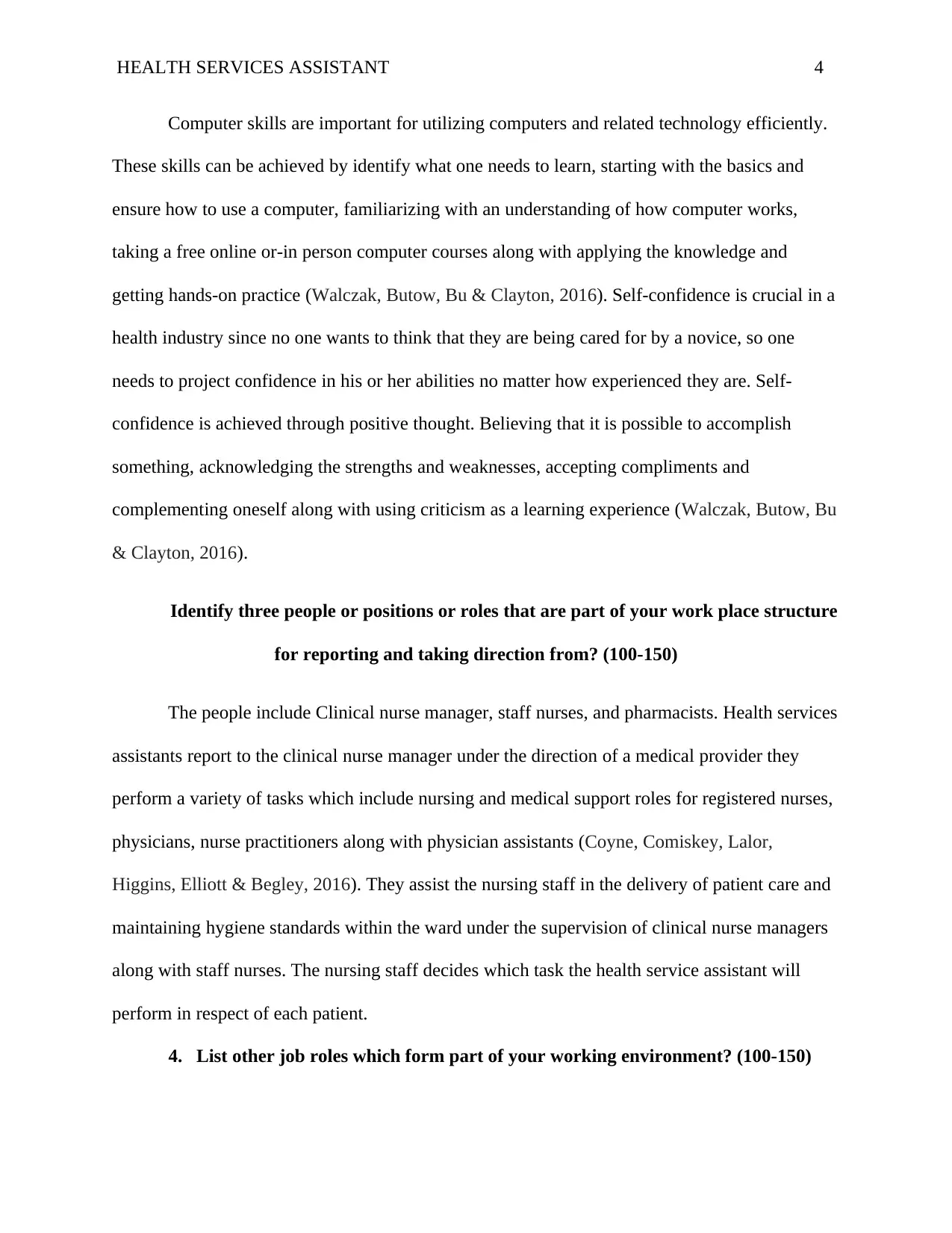
Computer skills are important for utilizing computers and related technology efficiently.
These skills can be achieved by identify what one needs to learn, starting with the basics and
ensure how to use a computer, familiarizing with an understanding of how computer works,
taking a free online or-in person computer courses along with applying the knowledge and
getting hands-on practice (Walczak, Butow, Bu & Clayton, 2016). Self-confidence is crucial in a
health industry since no one wants to think that they are being cared for by a novice, so one
needs to project confidence in his or her abilities no matter how experienced they are. Self-
confidence is achieved through positive thought. Believing that it is possible to accomplish
something, acknowledging the strengths and weaknesses, accepting compliments and
complementing oneself along with using criticism as a learning experience (Walczak, Butow, Bu
& Clayton, 2016).
Identify three people or positions or roles that are part of your work place structure
for reporting and taking direction from? (100-150)
The people include Clinical nurse manager, staff nurses, and pharmacists. Health services
assistants report to the clinical nurse manager under the direction of a medical provider they
perform a variety of tasks which include nursing and medical support roles for registered nurses,
physicians, nurse practitioners along with physician assistants (Coyne, Comiskey, Lalor,
Higgins, Elliott & Begley, 2016). They assist the nursing staff in the delivery of patient care and
maintaining hygiene standards within the ward under the supervision of clinical nurse managers
along with staff nurses. The nursing staff decides which task the health service assistant will
perform in respect of each patient.
4. List other job roles which form part of your working environment? (100-150)
Computer skills are important for utilizing computers and related technology efficiently.
These skills can be achieved by identify what one needs to learn, starting with the basics and
ensure how to use a computer, familiarizing with an understanding of how computer works,
taking a free online or-in person computer courses along with applying the knowledge and
getting hands-on practice (Walczak, Butow, Bu & Clayton, 2016). Self-confidence is crucial in a
health industry since no one wants to think that they are being cared for by a novice, so one
needs to project confidence in his or her abilities no matter how experienced they are. Self-
confidence is achieved through positive thought. Believing that it is possible to accomplish
something, acknowledging the strengths and weaknesses, accepting compliments and
complementing oneself along with using criticism as a learning experience (Walczak, Butow, Bu
& Clayton, 2016).
Identify three people or positions or roles that are part of your work place structure
for reporting and taking direction from? (100-150)
The people include Clinical nurse manager, staff nurses, and pharmacists. Health services
assistants report to the clinical nurse manager under the direction of a medical provider they
perform a variety of tasks which include nursing and medical support roles for registered nurses,
physicians, nurse practitioners along with physician assistants (Coyne, Comiskey, Lalor,
Higgins, Elliott & Begley, 2016). They assist the nursing staff in the delivery of patient care and
maintaining hygiene standards within the ward under the supervision of clinical nurse managers
along with staff nurses. The nursing staff decides which task the health service assistant will
perform in respect of each patient.
4. List other job roles which form part of your working environment? (100-150)
Paraphrase This Document
Need a fresh take? Get an instant paraphrase of this document with our AI Paraphraser
HEALTH SERVICES ASSISTANT 5
Health care assistants work within a hospital setting alongside nurses, clinicians, doctors
and other medical professionals across a huge variety of tasks to assist with the treatment of
patients and the running of wards (Coyne, Comiskey, Lalor, Higgins, Elliott & Begley, 2016).
They address the physical needs of patients like helping with baths and showers, changing bed
sheets along with emptying bedpans. They clean and tidy the hospital environment and maintain
equipment in departments and wards together with helping patients move about the wards and
interacting with family. Furthermore, they help with particular procedures like recording medical
observations, blood pressure along with temperature measurements.
5. Write a note to your supervisor regarding the following matter :
A client has visited your service to ask for assistance with a health care matter he requires
additional medication. He is displaying signs of stress/agitation and has requested a quick
response.
Provide an account of this below in a clear manner for passing to the appropriate person.
(200-250)
Dear Supervisor
Am writing this note regarding the patient I have here. The patient has signs of stress and
agitation, and there needs immediate attention. The patient seems to be restless and gains anger
easily. Under those circumstances, he might be dangerous in particular situations since some
people are more likely to resort to violence. Accordingly, he seems to be moving from one place
to the other and hence cannot concentrate at one place.
He also shows an inability to focus, which also indicates erratic and forgetful behavior. In that
case, he is unable to complete any task assigned to him. He also seems to lack the thinking
Health care assistants work within a hospital setting alongside nurses, clinicians, doctors
and other medical professionals across a huge variety of tasks to assist with the treatment of
patients and the running of wards (Coyne, Comiskey, Lalor, Higgins, Elliott & Begley, 2016).
They address the physical needs of patients like helping with baths and showers, changing bed
sheets along with emptying bedpans. They clean and tidy the hospital environment and maintain
equipment in departments and wards together with helping patients move about the wards and
interacting with family. Furthermore, they help with particular procedures like recording medical
observations, blood pressure along with temperature measurements.
5. Write a note to your supervisor regarding the following matter :
A client has visited your service to ask for assistance with a health care matter he requires
additional medication. He is displaying signs of stress/agitation and has requested a quick
response.
Provide an account of this below in a clear manner for passing to the appropriate person.
(200-250)
Dear Supervisor
Am writing this note regarding the patient I have here. The patient has signs of stress and
agitation, and there needs immediate attention. The patient seems to be restless and gains anger
easily. Under those circumstances, he might be dangerous in particular situations since some
people are more likely to resort to violence. Accordingly, he seems to be moving from one place
to the other and hence cannot concentrate at one place.
He also shows an inability to focus, which also indicates erratic and forgetful behavior. In that
case, he is unable to complete any task assigned to him. He also seems to lack the thinking
HEALTH SERVICES ASSISTANT 6
ability and also his physical health is not good. Furthermore, he is not comfortable and would
like to see a doctor with immediate effect. Kindly accord him permission.
Thank you for your consideration
Best Regards
6. Explain about below conflicts and how you would deal with them (150-200):
Mistrust and conflict
This conflict can be dealt with through defining of responsibilities in which if every
individual knows exactly what he or she should be doing at all times miscommunication amidst
management and workers is reduced hence generating a lack of mistrust (Kalra, Unnikrishnan &
Baruah, 2017). Addressing the issue by watching the employees interact with each other and
identify some signs of mistrust and schedule a meeting to address the issue immediately.
Interpersonal conflict
Interpersonal conflict occurs when a team of individuals or a person frustrates or
interferes with another individual’s effort at achieving a goal. Stress as a result of this conflict
might be influenced by support on the effective coping procedures to be employed to deal with
it. Also, it can be dealt with by just walking up to the person and talk to them in a mature way
and sort out the problem (Liu, Wang, Chang, Shi, Zhou & Shao, 2015). Also, one could pretend
there is no conflict or stop interacting with the person causing problems and consciously
avoiding all contact. Frustrations in the conflict can be handled through channeling the negative
energy into something positive.
ability and also his physical health is not good. Furthermore, he is not comfortable and would
like to see a doctor with immediate effect. Kindly accord him permission.
Thank you for your consideration
Best Regards
6. Explain about below conflicts and how you would deal with them (150-200):
Mistrust and conflict
This conflict can be dealt with through defining of responsibilities in which if every
individual knows exactly what he or she should be doing at all times miscommunication amidst
management and workers is reduced hence generating a lack of mistrust (Kalra, Unnikrishnan &
Baruah, 2017). Addressing the issue by watching the employees interact with each other and
identify some signs of mistrust and schedule a meeting to address the issue immediately.
Interpersonal conflict
Interpersonal conflict occurs when a team of individuals or a person frustrates or
interferes with another individual’s effort at achieving a goal. Stress as a result of this conflict
might be influenced by support on the effective coping procedures to be employed to deal with
it. Also, it can be dealt with by just walking up to the person and talk to them in a mature way
and sort out the problem (Liu, Wang, Chang, Shi, Zhou & Shao, 2015). Also, one could pretend
there is no conflict or stop interacting with the person causing problems and consciously
avoiding all contact. Frustrations in the conflict can be handled through channeling the negative
energy into something positive.
⊘ This is a preview!⊘
Do you want full access?
Subscribe today to unlock all pages.
Trusted by 1+ million students worldwide
HEALTH SERVICES ASSISTANT 7
7. Provide three examples of actions that could be taken to ensure that you transport
individuals on time? (100-150)
The unnecessary delays caused by transfer personnel carrying out further procedures
should be avoided (Lindholm & Blinge, 2014). Secondly, the easiest and the shortest route
should be followed as planned. Here, elevators should be available and secured to prevent any
delays along with crowds. Finally, the fastest mode of transport should be utilized such as the air
transport so that the minimum time possible can be taken to make sure the patient is safe
(Vercruysse et al., 2015) The use of air ambulances are useful in overcoming time together with
geographical barriers to access to medical care.
8. What checks should you complete to ensure that the equipment is attached safely
before transporting a client? (150-200)
Checks like routine maintenance of the equipment by the manufacturers’
recommendations such as the brakes of a car or items on a hoist such as actuators, straps, and
batteries should be completed. Also, the LOLER examination that is the Lifting Operations and
Lifting Equipment Regulations should be certified that during testing all elements that has a
bearing on safety has formally been inspected and evaluated as being in a safe state. For the case
of wheelchairs the brakes should be locked before getting in power turned off for the example of
power wheelchairs (Boschin, Brusque, Carvalho, Galle & Smith, 2015). For the elevator, the
battery should be fully charged and fitted correctly, the emergency stop button should be set
correctly, the lifting tape should be intact and not frayed, and there should be no fluid leaks. All
stitching of slings must be kept intact and ensure that it is compatible with the client and the
elevator. Moreover, checks on the slings must be completed on all the labels to make sure they
are legible and indicate safe working load along with a unique identifier.
7. Provide three examples of actions that could be taken to ensure that you transport
individuals on time? (100-150)
The unnecessary delays caused by transfer personnel carrying out further procedures
should be avoided (Lindholm & Blinge, 2014). Secondly, the easiest and the shortest route
should be followed as planned. Here, elevators should be available and secured to prevent any
delays along with crowds. Finally, the fastest mode of transport should be utilized such as the air
transport so that the minimum time possible can be taken to make sure the patient is safe
(Vercruysse et al., 2015) The use of air ambulances are useful in overcoming time together with
geographical barriers to access to medical care.
8. What checks should you complete to ensure that the equipment is attached safely
before transporting a client? (150-200)
Checks like routine maintenance of the equipment by the manufacturers’
recommendations such as the brakes of a car or items on a hoist such as actuators, straps, and
batteries should be completed. Also, the LOLER examination that is the Lifting Operations and
Lifting Equipment Regulations should be certified that during testing all elements that has a
bearing on safety has formally been inspected and evaluated as being in a safe state. For the case
of wheelchairs the brakes should be locked before getting in power turned off for the example of
power wheelchairs (Boschin, Brusque, Carvalho, Galle & Smith, 2015). For the elevator, the
battery should be fully charged and fitted correctly, the emergency stop button should be set
correctly, the lifting tape should be intact and not frayed, and there should be no fluid leaks. All
stitching of slings must be kept intact and ensure that it is compatible with the client and the
elevator. Moreover, checks on the slings must be completed on all the labels to make sure they
are legible and indicate safe working load along with a unique identifier.
Paraphrase This Document
Need a fresh take? Get an instant paraphrase of this document with our AI Paraphraser
HEALTH SERVICES ASSISTANT 8
9. If you are transporting individuals in a wheel chair that has no seat belts, what
actions can you take to ensure the safety of the client during the journey? (150-200)
The action to be taken is to avoid hard turns, avoid sudden stops or acceleration, avoid
driving over curbs or through potholes and most of all being involved in a collision.
Accordingly, you should let the patient hold your hands to avoid falling (Erickson et al., 2016).
10. What documentation exists within health care organizations that outline
information about how you should transport individuals? Provide some examples of
specific policies that must be followed? (150-200)
Documentation is the critical vehicle which is used to convey essential clinical
information concerning each patient diagnosis, treatment together with the outcomes. In that
case, the complete documentation of the encounter has to be made available to the referring
provider. Some of the specific policies which have to be followed are that patients should be
receiving treatments from the Trust and its clinics (Fritz, Slowther & Perkins, 2017). It's also
vital for the transport provider to be notified of any contagious illness on the request form.
11. Discuss as a group the types of conflicts that you would have to report to your
organization or other agencies if they take place during transportation? (150-200)
Some of the conflicts which can be reported to an organization during transportation are
as highlighted below. The first one is prioritizing Key tasks (Lippi & Mattiuzzi, 2016). As an
illustration, one nurse might think of helping a patient in the middle of a draining emotional
display. The other conflict can be between the nurses together with the spouse of her patient.
They might has a misunderstanding on what needs to be done during transportation.
9. If you are transporting individuals in a wheel chair that has no seat belts, what
actions can you take to ensure the safety of the client during the journey? (150-200)
The action to be taken is to avoid hard turns, avoid sudden stops or acceleration, avoid
driving over curbs or through potholes and most of all being involved in a collision.
Accordingly, you should let the patient hold your hands to avoid falling (Erickson et al., 2016).
10. What documentation exists within health care organizations that outline
information about how you should transport individuals? Provide some examples of
specific policies that must be followed? (150-200)
Documentation is the critical vehicle which is used to convey essential clinical
information concerning each patient diagnosis, treatment together with the outcomes. In that
case, the complete documentation of the encounter has to be made available to the referring
provider. Some of the specific policies which have to be followed are that patients should be
receiving treatments from the Trust and its clinics (Fritz, Slowther & Perkins, 2017). It's also
vital for the transport provider to be notified of any contagious illness on the request form.
11. Discuss as a group the types of conflicts that you would have to report to your
organization or other agencies if they take place during transportation? (150-200)
Some of the conflicts which can be reported to an organization during transportation are
as highlighted below. The first one is prioritizing Key tasks (Lippi & Mattiuzzi, 2016). As an
illustration, one nurse might think of helping a patient in the middle of a draining emotional
display. The other conflict can be between the nurses together with the spouse of her patient.
They might has a misunderstanding on what needs to be done during transportation.
HEALTH SERVICES ASSISTANT 9
12. List the potential barriers that may affect the communication between you and the
client that may prevent you from identifying what you need to assist with
transportation? (150-200)
Physiological barriers are as a result of the client's physical state. If the client has a
reduced hearing, he or she many not wholly grasp the content of a spoken conversation more so
if there is significant background noise. Attitudinal barriers are perceptions or behaviors that
prevent people from communicating effectively and are as a result of personality conflicts.
Language is another potential barrier which may occur when terminologies used are not
understood by the client although they are using the same language (Bee, Price, Baker & Lovell,
2015). If the communication includes too much of specialist jargon and abbreviations the client
might not understand and his or her transportation needs may not be met. Finally, psychological
barriers such as low self-esteem anger and stress prevent effective communication. If the client is
not feeling comfortable when communicating his or her transportation needs may not be known
and hence not met.
13. What are extra considerations needed for clients with disabilities during
transportation? (150-200)
Example: Hearing impaired, visually impaired
For the hearing impaired clients, the transportation team should use the patient's preferred
method like lip reading or pen and a paper and look at the patient while speaking and listening.
Also, they should face the patient in good light especially for the lip readers and speak clearly
but not too slowly and should not exaggerate their speech or shout (Jalongo, M. R., & Breece, L.
(2018). On the other hand, when transporting visually impaired clients, the transporting staff
should use verbal responses and avoid nods, and head shakes, gain the client’s attention by
12. List the potential barriers that may affect the communication between you and the
client that may prevent you from identifying what you need to assist with
transportation? (150-200)
Physiological barriers are as a result of the client's physical state. If the client has a
reduced hearing, he or she many not wholly grasp the content of a spoken conversation more so
if there is significant background noise. Attitudinal barriers are perceptions or behaviors that
prevent people from communicating effectively and are as a result of personality conflicts.
Language is another potential barrier which may occur when terminologies used are not
understood by the client although they are using the same language (Bee, Price, Baker & Lovell,
2015). If the communication includes too much of specialist jargon and abbreviations the client
might not understand and his or her transportation needs may not be met. Finally, psychological
barriers such as low self-esteem anger and stress prevent effective communication. If the client is
not feeling comfortable when communicating his or her transportation needs may not be known
and hence not met.
13. What are extra considerations needed for clients with disabilities during
transportation? (150-200)
Example: Hearing impaired, visually impaired
For the hearing impaired clients, the transportation team should use the patient's preferred
method like lip reading or pen and a paper and look at the patient while speaking and listening.
Also, they should face the patient in good light especially for the lip readers and speak clearly
but not too slowly and should not exaggerate their speech or shout (Jalongo, M. R., & Breece, L.
(2018). On the other hand, when transporting visually impaired clients, the transporting staff
should use verbal responses and avoid nods, and head shakes, gain the client’s attention by
⊘ This is a preview!⊘
Do you want full access?
Subscribe today to unlock all pages.
Trusted by 1+ million students worldwide
HEALTH SERVICES ASSISTANT 10
speaking first or by a gentle touch on the arm along with talking to the person directly instead of
facing their sighted companion. Moreover, the transportation staff should verbalize their actions
and ask if support or guidance is needed.
14. Your client needs to be transported to the endoscopy department for a procedure.
He has and MRSA infection and have a wound that is covered on his lower left leg.
He is also on oxygen, has IV fluids, and an Indwelling Catheter (IDC).
You have his medical file and two scan reports to handover to the staff in the
endoscopy department. What are the steps and precautions that you need to bear in
mind while transporting this client? Also, include the necessary reporting and
documentation needed for the process? (250-300)
The precaution that should be taken is to ensure the tubes along with the attachments are
properly placed before the procedure to prevent any accidental removal. Accordingly, the slider
board together with the full-size sheet or the friction reducing sheet needs to be used during the
transfer. The patient privacy and dignity also needs to be ensured. On the other hand, some of the
steps are that the number of staff which is required to safely transfer the patient needs to be
predetermined (Singh, Lancioni, Karazsia, Chan & Winton, 2016).
The patient has to roll over and then places the slider board halfway under the patient thus
forming a bridge between the bed and the stretcher taking care of the wound on the left leg and
the oxygen tubes. The patient is then returned to the supine position. The designated leader has to
count one two three and then start the move. The pillow has to be replaced under the head to
ensure the patient is comfortable and be covered with the sheet.
speaking first or by a gentle touch on the arm along with talking to the person directly instead of
facing their sighted companion. Moreover, the transportation staff should verbalize their actions
and ask if support or guidance is needed.
14. Your client needs to be transported to the endoscopy department for a procedure.
He has and MRSA infection and have a wound that is covered on his lower left leg.
He is also on oxygen, has IV fluids, and an Indwelling Catheter (IDC).
You have his medical file and two scan reports to handover to the staff in the
endoscopy department. What are the steps and precautions that you need to bear in
mind while transporting this client? Also, include the necessary reporting and
documentation needed for the process? (250-300)
The precaution that should be taken is to ensure the tubes along with the attachments are
properly placed before the procedure to prevent any accidental removal. Accordingly, the slider
board together with the full-size sheet or the friction reducing sheet needs to be used during the
transfer. The patient privacy and dignity also needs to be ensured. On the other hand, some of the
steps are that the number of staff which is required to safely transfer the patient needs to be
predetermined (Singh, Lancioni, Karazsia, Chan & Winton, 2016).
The patient has to roll over and then places the slider board halfway under the patient thus
forming a bridge between the bed and the stretcher taking care of the wound on the left leg and
the oxygen tubes. The patient is then returned to the supine position. The designated leader has to
count one two three and then start the move. The pillow has to be replaced under the head to
ensure the patient is comfortable and be covered with the sheet.
Paraphrase This Document
Need a fresh take? Get an instant paraphrase of this document with our AI Paraphraser
HEALTH SERVICES ASSISTANT 11
15. A client named Tom is under Jasper's care and has fallen in the bath room. He is
conscious but unable to stand by himself. The bathroom is very small, and space is
limited. There is no room for the hoist. Jasper decides to use a slide sheet to move
Tom to a place that will allow enough room for a hoist to be used. There are no
other workers around, so he decides to do this alone. He rolls Tom onto his side and
puts the slide sheet against his spine. He then rolls Tom onto his other side and
unrolls the rest of the sheet. He notices that the slide sheet is slightly smaller than
the person he is moving but decides to carry on using it. He stands at the bottom of
the sheet and grabs the slide sheet without bending his knees. He hasn't tucked
Tom's elbows in and, as he pulls Tom through the doorway quickly, he bumps
Tom's left elbow.
List all the things that Jasper did wrong and explain the right method of doing it? (250-
300)
At least two carers should be present to perform patient transfer but in this case, although
there were no other workers around Jasper ignores looking for another person but decides to do it
alone. It is required that the carer should ask the patient before being moved the kind of help he
or she might want to give. Although Tom was unable to stand by himself he was conscious and
Jasper should have talked to him about the assistance he would offer, but he didn't (Kales, Gitlin
& Lyketsos, 2015). Moreover, Jasper used only one slide sheet to roll Tom instead of folding it
or using two of them such that he could use the top slide sheet to move the patient which slides
against the bottom slide sheet hence creating a smooth and easy transfer for both Tom and
Jasper.
15. A client named Tom is under Jasper's care and has fallen in the bath room. He is
conscious but unable to stand by himself. The bathroom is very small, and space is
limited. There is no room for the hoist. Jasper decides to use a slide sheet to move
Tom to a place that will allow enough room for a hoist to be used. There are no
other workers around, so he decides to do this alone. He rolls Tom onto his side and
puts the slide sheet against his spine. He then rolls Tom onto his other side and
unrolls the rest of the sheet. He notices that the slide sheet is slightly smaller than
the person he is moving but decides to carry on using it. He stands at the bottom of
the sheet and grabs the slide sheet without bending his knees. He hasn't tucked
Tom's elbows in and, as he pulls Tom through the doorway quickly, he bumps
Tom's left elbow.
List all the things that Jasper did wrong and explain the right method of doing it? (250-
300)
At least two carers should be present to perform patient transfer but in this case, although
there were no other workers around Jasper ignores looking for another person but decides to do it
alone. It is required that the carer should ask the patient before being moved the kind of help he
or she might want to give. Although Tom was unable to stand by himself he was conscious and
Jasper should have talked to him about the assistance he would offer, but he didn't (Kales, Gitlin
& Lyketsos, 2015). Moreover, Jasper used only one slide sheet to roll Tom instead of folding it
or using two of them such that he could use the top slide sheet to move the patient which slides
against the bottom slide sheet hence creating a smooth and easy transfer for both Tom and
Jasper.
HEALTH SERVICES ASSISTANT 12
Furthermore, when Jasper found out that the sliding sheet was smaller than Tom, he
decided to continue using it instead of using a small tubular sheet under Tom's calves and heels.
This would prevent damage of skin because of shearing forces. Before rolling the slide sheet
Jasper should have put Tom’s arms across his chest and bend his far knee, and because of his
ignorance, he failed to tuck Tom’s elbows in the sheet resulting to bumping his left elbow. Jasper
did a mistake in grabbing the slide sheet without bending his knees. He should have stood with
one foot in front of the other foot on opposite sides.
16. List the common medical check-ups people should have (Including gender specific,
age and frequency)? (250-300)
Medical check-ups identify any signs of health issues. Bowel cancer is tested for men and
women who are aged between 50 and 74 years and those at increased risk should start screening
earlier and are tested at a frequency of every two years which may be different for those at an
increased risk. High blood pressure is tested for men and women aged 18 years and older at a
frequency of at least two years. Moreover, a check-up of high cholesterol is on men and women
at the age of 45 and above and 35 years and above for the Aboriginal and Torres Strait Islander
people at least every five years (Kales, Gitlin & Lyketsos, 2015).
Cervical cancer screening tests for all women between 25 and 74 years after every five
years and women at increased risk of cervical cancer may require more frequent testing. A
cardiovascular disease like heart attack and disease is tested for women and men of 45 years and
Aboriginal and Torres Strait Islander adults of 35 years. Its frequency depends on initial risk
assessment, and if the risk is low it is tested after every two years, 6 to 12 months for moderate
risk and regular review for high risk (Kales, Gitlin & Lyketsos, 2015). Men at average risk of
prostate cancer who decide to have a prostate-specific (PSA) screening can be offered testing
Furthermore, when Jasper found out that the sliding sheet was smaller than Tom, he
decided to continue using it instead of using a small tubular sheet under Tom's calves and heels.
This would prevent damage of skin because of shearing forces. Before rolling the slide sheet
Jasper should have put Tom’s arms across his chest and bend his far knee, and because of his
ignorance, he failed to tuck Tom’s elbows in the sheet resulting to bumping his left elbow. Jasper
did a mistake in grabbing the slide sheet without bending his knees. He should have stood with
one foot in front of the other foot on opposite sides.
16. List the common medical check-ups people should have (Including gender specific,
age and frequency)? (250-300)
Medical check-ups identify any signs of health issues. Bowel cancer is tested for men and
women who are aged between 50 and 74 years and those at increased risk should start screening
earlier and are tested at a frequency of every two years which may be different for those at an
increased risk. High blood pressure is tested for men and women aged 18 years and older at a
frequency of at least two years. Moreover, a check-up of high cholesterol is on men and women
at the age of 45 and above and 35 years and above for the Aboriginal and Torres Strait Islander
people at least every five years (Kales, Gitlin & Lyketsos, 2015).
Cervical cancer screening tests for all women between 25 and 74 years after every five
years and women at increased risk of cervical cancer may require more frequent testing. A
cardiovascular disease like heart attack and disease is tested for women and men of 45 years and
Aboriginal and Torres Strait Islander adults of 35 years. Its frequency depends on initial risk
assessment, and if the risk is low it is tested after every two years, 6 to 12 months for moderate
risk and regular review for high risk (Kales, Gitlin & Lyketsos, 2015). Men at average risk of
prostate cancer who decide to have a prostate-specific (PSA) screening can be offered testing
⊘ This is a preview!⊘
Do you want full access?
Subscribe today to unlock all pages.
Trusted by 1+ million students worldwide

1 out of 24


Related Documents


Your All-in-One AI-Powered Toolkit for Academic Success.
+13062052269
info@desklib.com
Available 24*7 on WhatsApp / Email
![[object Object]](/_next/static/media/star-bottom.7253800d.svg)
Unlock your academic potential
Copyright © 2020–2026 A2Z Services. All Rights Reserved. Developed and managed by ZUCOL.