University of Example: Health and Social Care Changes Analysis Report
VerifiedAdded on 2020/11/23
|14
|4642
|239
Report
AI Summary
This report delves into the dynamic landscape of health and social care, examining the factors driving change within the National Health Service (NHS) in the UK. It employs PESTLE analysis to identify external influences, such as government policies, economic fluctuations, and technological advancements, that shape the sector. The report also addresses the challenges stemming from these changes, including management, workforce, financial, and communication issues. Furthermore, it explores strategies for measuring the impact of recent changes, emphasizing data collection through primary and secondary sources like interviews and questionnaires. The report also examines the key principles of change management and how these principles are applied in the planning and monitoring of changes within the health and social care sector. The report concludes by highlighting the importance of proactive strategies to navigate emerging threats and maintain a competitive advantage.
Facilitating Change in Health
and Social care
and Social care

Paraphrase This Document
Need a fresh take? Get an instant paraphrase of this document with our AI Paraphraser
TABLE OF CONTENTS
INTRODUCTION...........................................................................................................................1
PART 1............................................................................................................................................1
1.1 Factors driving the changes in health and care services.......................................................1
1.2 Challenges in health and social care services due to key factors of change.........................2
PART 2............................................................................................................................................3
2.1 Strategy for devising and measuring recent changes in health and social care sector..........3
2.2 Measuring the impact of recent changes...............................................................................4
2.3 Evaluating over all impact of recent changes.......................................................................5
2.4 Appropriate service response for recent changes..................................................................5
PART 3............................................................................................................................................6
3.1 Key principles of change management.................................................................................6
3.2 Planning for changes in health and social sector..................................................................8
3.3 Monitoring the recent changes in health and social sector...................................................8
CONCLUSIONS..............................................................................................................................9
REFERENCES................................................................................................................................9
INTRODUCTION...........................................................................................................................1
PART 1............................................................................................................................................1
1.1 Factors driving the changes in health and care services.......................................................1
1.2 Challenges in health and social care services due to key factors of change.........................2
PART 2............................................................................................................................................3
2.1 Strategy for devising and measuring recent changes in health and social care sector..........3
2.2 Measuring the impact of recent changes...............................................................................4
2.3 Evaluating over all impact of recent changes.......................................................................5
2.4 Appropriate service response for recent changes..................................................................5
PART 3............................................................................................................................................6
3.1 Key principles of change management.................................................................................6
3.2 Planning for changes in health and social sector..................................................................8
3.3 Monitoring the recent changes in health and social sector...................................................8
CONCLUSIONS..............................................................................................................................9
REFERENCES................................................................................................................................9
INTRODUCTION
Health and Social Care, both the terms are related to the kind of services which are
available from health and social care providers. Health and social care sector operate with an aim
of improving the quality of life of an individual and also help the individuals to reach their
potential. Health and social care combines various elements of biology, sociology, law, ethics
and nutrition in order to serve humanity (Erb and et.al., 2017). Health and social care includes
the provisions of health and social work activities which includes the health care services
provided by medical professionals and social care activities are provided without any
involvement of heath care professionals (Bareil and et.al., 2015). In this report National Health
Services (NHS) UK is taken as an organization, which is a health and social are organization
which over sees planning, budget delivery and day to day operations of England. Present report
is based on the case study of Health and Social care changes that take place in this sector and
what are the factors which drive the changes in health and social care. This report also discusses
about the recent changes that are taking place in this sector and what are the key principles of
change management and how this change is planned in health and social care sector.
PART 1
1.1 Factors driving the changes in health and care services
There are various factors that are responsible for bringing the changes in NHS. Health
and social care industry mainly depends up on the legislation, fluctuations in economic rates, and
major changes in technical advancements. These factors are also main drivers of change in the
services of NHS. These drivers can be explained by using Pestle analysis.
PESTLE Analysis: It is a framework or a tool which is used by the organisation to analyse
micro environmental factors which have an impact on the organisation. Some of external factors
which have an impact on NHS are as follows:
Government subsidies: NHS is mainly impacted by many government factors like tax
legislation, insurance, consumer protection and local authorities. Changes in the government can
have effect on NHS especially related to health care bills and plans (Dupuis and et.al., 2016).
Changes in care act 2014, which has brought significant changes in the system also has an
impact on the organization. This factor have resulted in the changes in their bill plans with in the
organization.
1
Health and Social Care, both the terms are related to the kind of services which are
available from health and social care providers. Health and social care sector operate with an aim
of improving the quality of life of an individual and also help the individuals to reach their
potential. Health and social care combines various elements of biology, sociology, law, ethics
and nutrition in order to serve humanity (Erb and et.al., 2017). Health and social care includes
the provisions of health and social work activities which includes the health care services
provided by medical professionals and social care activities are provided without any
involvement of heath care professionals (Bareil and et.al., 2015). In this report National Health
Services (NHS) UK is taken as an organization, which is a health and social are organization
which over sees planning, budget delivery and day to day operations of England. Present report
is based on the case study of Health and Social care changes that take place in this sector and
what are the factors which drive the changes in health and social care. This report also discusses
about the recent changes that are taking place in this sector and what are the key principles of
change management and how this change is planned in health and social care sector.
PART 1
1.1 Factors driving the changes in health and care services
There are various factors that are responsible for bringing the changes in NHS. Health
and social care industry mainly depends up on the legislation, fluctuations in economic rates, and
major changes in technical advancements. These factors are also main drivers of change in the
services of NHS. These drivers can be explained by using Pestle analysis.
PESTLE Analysis: It is a framework or a tool which is used by the organisation to analyse
micro environmental factors which have an impact on the organisation. Some of external factors
which have an impact on NHS are as follows:
Government subsidies: NHS is mainly impacted by many government factors like tax
legislation, insurance, consumer protection and local authorities. Changes in the government can
have effect on NHS especially related to health care bills and plans (Dupuis and et.al., 2016).
Changes in care act 2014, which has brought significant changes in the system also has an
impact on the organization. This factor have resulted in the changes in their bill plans with in the
organization.
1
⊘ This is a preview!⊘
Do you want full access?
Subscribe today to unlock all pages.

Trusted by 1+ million students worldwide
Loss of services: NHS is also affected with the economic factors such as inflation rates, interest
rates, unemployment, financial instability etc. For example, NHS is manufacturing a health care
equipment and high unemployment rate means less people will be able to purchase the products.
It has brought the change in the rates of their products and are offering at lower rates to the
patients.
Change in beliefs: Changes in public value and demographics have an impact on NHS. People
of various communities share beliefs, fear and cultural norms and NHS has to be aware of these
conditions when an organization treats to the problems of public. For example NHS has to
understand why people are turning to particular type of remedies and new trends in eating in
order to provide services to the people. It has result in developing the cross cultural relationships
within NHS.
Technology: Advancements in the technology can have effect on the performance of NHS in
providing the service to the public (Davis and et.al., 2015). Developments in providing medical
services to the patients can help NHS in serving the people in better ways. For example advanced
in their contact lenses or simple lenses which can provide crystal clear vision to eye patients.
NHS has upgraded its technology and have raised its technical standards.
Corporate social responsibilities: CSR practices have both financial and environmental
benefits for NHS. The factors like waste disposal programs, eco-friendly products and
certification of environmental friendly designs come under the scrutiny of CSR. CSR should be
under the strategic plan of NHS in order to contribute towards green environmental practices.
NHS is contributing towards CSR programs and has changed its process to maintain the
environmental sustainability.
Legal procedures: NHS has to follow the legal procedures of UK as there have been recent
changes in immigration Act 2014 and also UK government is responsible for NHS's health and
social care department. Failure to follow the new laws and legal procedures could result in
creating the problems for NHS and also may result in the failure of business strategy. Now NHS
are following the laws like immigration Act 2014 and other laws as there has been changes in it.
Understanding these drives of change can help NHS in framing the strategies to address
various challenges of drivers of changes and can Health care laws in UKremain proactive about
the emerging threats. By analysing these drivers of change NHS can develop a strategy and can
gain the competitive advantage.
2
rates, unemployment, financial instability etc. For example, NHS is manufacturing a health care
equipment and high unemployment rate means less people will be able to purchase the products.
It has brought the change in the rates of their products and are offering at lower rates to the
patients.
Change in beliefs: Changes in public value and demographics have an impact on NHS. People
of various communities share beliefs, fear and cultural norms and NHS has to be aware of these
conditions when an organization treats to the problems of public. For example NHS has to
understand why people are turning to particular type of remedies and new trends in eating in
order to provide services to the people. It has result in developing the cross cultural relationships
within NHS.
Technology: Advancements in the technology can have effect on the performance of NHS in
providing the service to the public (Davis and et.al., 2015). Developments in providing medical
services to the patients can help NHS in serving the people in better ways. For example advanced
in their contact lenses or simple lenses which can provide crystal clear vision to eye patients.
NHS has upgraded its technology and have raised its technical standards.
Corporate social responsibilities: CSR practices have both financial and environmental
benefits for NHS. The factors like waste disposal programs, eco-friendly products and
certification of environmental friendly designs come under the scrutiny of CSR. CSR should be
under the strategic plan of NHS in order to contribute towards green environmental practices.
NHS is contributing towards CSR programs and has changed its process to maintain the
environmental sustainability.
Legal procedures: NHS has to follow the legal procedures of UK as there have been recent
changes in immigration Act 2014 and also UK government is responsible for NHS's health and
social care department. Failure to follow the new laws and legal procedures could result in
creating the problems for NHS and also may result in the failure of business strategy. Now NHS
are following the laws like immigration Act 2014 and other laws as there has been changes in it.
Understanding these drives of change can help NHS in framing the strategies to address
various challenges of drivers of changes and can Health care laws in UKremain proactive about
the emerging threats. By analysing these drivers of change NHS can develop a strategy and can
gain the competitive advantage.
2
Paraphrase This Document
Need a fresh take? Get an instant paraphrase of this document with our AI Paraphraser
1.2 Challenges in health and social care services due to key factors of change
NHS can face different challenges due to the various key factors of change and can affect
the services provide by NHS in order to serve the public. Following are the challenges which are
faced by NHS due to key factors of change.
Management Challenges NHS cannot tackle the changes in key factors if the
organization has not proper management support. This is challenge which is faced by NHS as the
organization has totally depend up on its management in order to face the changes (Ell, 2018).
Managers of NHS have to motivate and adapt their employees towards the change in order to
provide quality services to the patients. A manager have to meet the requirement of political and
legal factor of UK in order to function smoothly and also has to frame the strategies in
accordance to recent changes in the Acts.
Work force challenges: NHS cannot operate without the skilled and valued work force
and cannot fulfil its role of helping the patients. So NHS has to develop a work force which is
capable of meeting the challenges. NHS has to provide training to the employees of the
organization in order to understand government regulatory requirements of working as the
employees of health and social care sector. NHS can address this challenge by providing proper
training and developmental programs or even can employ skilled and experienced employees for
an organization in order to achieve competency of the need of employees to become a care
worker. These challenges arises due to difference in employees culture and beliefs.
Financial Challenges: In order to implement the change within NHS, NHS can have to
face the challenge of insufficient in financial resources. As in the case study organisation is
facing the doubts about the feasibility of ambitions related to the existing financial settlements.
NHS has to attain the financial stability in the organisation in order to face the changes (Celis-
Morales, Lara and Mathers, 2015). Due the financial stability organization can face other
challenges too like challenges in acquiring equipment for providing medical treatments,
challenges in providing sufficient training programs to the employees, challenges in employee
retention etc are challenges which NHS has to face due to financial instability.
Challenges of communication and coordination: NHS may have to face the challenges
of proper coordination and communication due the change in the organization employees of
NHS will be focusing on the tasks rather than supporting the people and there will be lack of
consistency in the performance of the employees due to these changes in the organization.
3
NHS can face different challenges due to the various key factors of change and can affect
the services provide by NHS in order to serve the public. Following are the challenges which are
faced by NHS due to key factors of change.
Management Challenges NHS cannot tackle the changes in key factors if the
organization has not proper management support. This is challenge which is faced by NHS as the
organization has totally depend up on its management in order to face the changes (Ell, 2018).
Managers of NHS have to motivate and adapt their employees towards the change in order to
provide quality services to the patients. A manager have to meet the requirement of political and
legal factor of UK in order to function smoothly and also has to frame the strategies in
accordance to recent changes in the Acts.
Work force challenges: NHS cannot operate without the skilled and valued work force
and cannot fulfil its role of helping the patients. So NHS has to develop a work force which is
capable of meeting the challenges. NHS has to provide training to the employees of the
organization in order to understand government regulatory requirements of working as the
employees of health and social care sector. NHS can address this challenge by providing proper
training and developmental programs or even can employ skilled and experienced employees for
an organization in order to achieve competency of the need of employees to become a care
worker. These challenges arises due to difference in employees culture and beliefs.
Financial Challenges: In order to implement the change within NHS, NHS can have to
face the challenge of insufficient in financial resources. As in the case study organisation is
facing the doubts about the feasibility of ambitions related to the existing financial settlements.
NHS has to attain the financial stability in the organisation in order to face the changes (Celis-
Morales, Lara and Mathers, 2015). Due the financial stability organization can face other
challenges too like challenges in acquiring equipment for providing medical treatments,
challenges in providing sufficient training programs to the employees, challenges in employee
retention etc are challenges which NHS has to face due to financial instability.
Challenges of communication and coordination: NHS may have to face the challenges
of proper coordination and communication due the change in the organization employees of
NHS will be focusing on the tasks rather than supporting the people and there will be lack of
consistency in the performance of the employees due to these changes in the organization.
3
Therefore the managers and leaders of NHS need to the roles and responsibilities of the
employees on the regular basis so that the quality of the employee performance can be improved.
Also leaders and managers should set meeting with the employees in order to set proper
coordination and effective communication with the workers. These challenges may arise in NHS
due to different cultural norms, beliefs and values.
PART 2
2.1 Strategy for devising and measuring recent changes in health and social care sector
RCN is a membership organisation and a trade union in UK which describes its missions
as representing nurses in order to promote excellence in practice and shaping health policies.
RCN works with government and other stakeholders to support nurses. RCN understands the
importance of privacy in order to protect the rights of customers, as RCN wants customers to be
aware of the information collected and handled by RCN. Customers of RCN are agreeing and the
terms of its policies and revisions are made to the polices from time to time.
NHS can use various strategies in order to measure the recent changes that take place in
health and social industry. The best strategy for NHS to measure the recent change in the sector
by using a method of data collection from the primary sources and secondary sources then
measure the information. A strategy of data collection will help NHS to know what the recent
changes are and how these changes have an impact on the organization. By framing the proper
strategy NHS can make improvements in the organization and can assess which change is vital
for the organization. A Strategy for measuring the changes in health and social care sector are as
follows:
Primary Sources: Primary source is the collection of data or information from the
original sources in which data is collected at first hand for a specific purpose (El Miedany and
et.al., 2018). With the help of this method NHS can get accurate data and NHS can collect the
data by two ways
Interviews: It is an approach of collecting the information from the participants through
asking questions and getting the answers form the individuals related to the topic. NHS can
conduct interviews by different ways such as face to face interviews of an individuals and group
interviews (Huges, 2019). NHS can collect the data from the patients and other stakeholders
which can provide information to NHS about the recent changes in health and social care sector
which may be utilized by the organization.
4
employees on the regular basis so that the quality of the employee performance can be improved.
Also leaders and managers should set meeting with the employees in order to set proper
coordination and effective communication with the workers. These challenges may arise in NHS
due to different cultural norms, beliefs and values.
PART 2
2.1 Strategy for devising and measuring recent changes in health and social care sector
RCN is a membership organisation and a trade union in UK which describes its missions
as representing nurses in order to promote excellence in practice and shaping health policies.
RCN works with government and other stakeholders to support nurses. RCN understands the
importance of privacy in order to protect the rights of customers, as RCN wants customers to be
aware of the information collected and handled by RCN. Customers of RCN are agreeing and the
terms of its policies and revisions are made to the polices from time to time.
NHS can use various strategies in order to measure the recent changes that take place in
health and social industry. The best strategy for NHS to measure the recent change in the sector
by using a method of data collection from the primary sources and secondary sources then
measure the information. A strategy of data collection will help NHS to know what the recent
changes are and how these changes have an impact on the organization. By framing the proper
strategy NHS can make improvements in the organization and can assess which change is vital
for the organization. A Strategy for measuring the changes in health and social care sector are as
follows:
Primary Sources: Primary source is the collection of data or information from the
original sources in which data is collected at first hand for a specific purpose (El Miedany and
et.al., 2018). With the help of this method NHS can get accurate data and NHS can collect the
data by two ways
Interviews: It is an approach of collecting the information from the participants through
asking questions and getting the answers form the individuals related to the topic. NHS can
conduct interviews by different ways such as face to face interviews of an individuals and group
interviews (Huges, 2019). NHS can collect the data from the patients and other stakeholders
which can provide information to NHS about the recent changes in health and social care sector
which may be utilized by the organization.
4
⊘ This is a preview!⊘
Do you want full access?
Subscribe today to unlock all pages.
Trusted by 1+ million students worldwide
Questionnaire: It is a method by which NHS can collect the data by giving written set of
questions to the respondents in order to collect the information about the topic. It is cheaper and
effective way of collecting the information and also it will provide NHS fast results.
Secondary source: Secondary source of data collection is the process of collection of
information which has been already collected by someone else (Eldredge and et.al., 2016). NHS
can collect the information from scholarly journal articles on the topic “Recent changes in Health
and social care”. NHS can use the strategy of measuring the recent changes by collecting prmary
source of data through questionnaires.
2.2 Measuring the impact of recent changes
Redbridge is a district in Llford in London Borough of Redbridge in east of London. It is
London's greenest Boroughs with more than 35 parks. Its total population is 301,800 and its
density is 5,400 per square kilometre.
As per the report of CQC inspection ratings 2018 the services provided by London
Borough of Redbridge has got good ratings and is considered as safe, effective, caring,
responsive and well-led. These were the five questions asked about the services
Is the service effective?
Is the service safe?
Is the service caring?
Is the service responsive?
Is the service well- led?
London Borough Redbridge received a good rating for its services.
NHS can measure the impact of recent changes in health and social care against the set
criteria by using various measurement tools such as surveys, regular inspections, Care quality
commission and feedbacks within the organization.
Surveys: With the help of the surveys NHS can properly assess the impact of the recent changes
in the organization and can help the organization in decision makings. With the help of the
surveys NHS can get reliable data and can uncover various answers as respondents provide more
honest answers. So with the help of survey NHS can measure the impact of the recent changes on
NHS.
Regular inspections: With the help of the regular inspections, NHS can measure the
impact of the changes easily as regular inspections can provide NHS with an objective and
5
questions to the respondents in order to collect the information about the topic. It is cheaper and
effective way of collecting the information and also it will provide NHS fast results.
Secondary source: Secondary source of data collection is the process of collection of
information which has been already collected by someone else (Eldredge and et.al., 2016). NHS
can collect the information from scholarly journal articles on the topic “Recent changes in Health
and social care”. NHS can use the strategy of measuring the recent changes by collecting prmary
source of data through questionnaires.
2.2 Measuring the impact of recent changes
Redbridge is a district in Llford in London Borough of Redbridge in east of London. It is
London's greenest Boroughs with more than 35 parks. Its total population is 301,800 and its
density is 5,400 per square kilometre.
As per the report of CQC inspection ratings 2018 the services provided by London
Borough of Redbridge has got good ratings and is considered as safe, effective, caring,
responsive and well-led. These were the five questions asked about the services
Is the service effective?
Is the service safe?
Is the service caring?
Is the service responsive?
Is the service well- led?
London Borough Redbridge received a good rating for its services.
NHS can measure the impact of recent changes in health and social care against the set
criteria by using various measurement tools such as surveys, regular inspections, Care quality
commission and feedbacks within the organization.
Surveys: With the help of the surveys NHS can properly assess the impact of the recent changes
in the organization and can help the organization in decision makings. With the help of the
surveys NHS can get reliable data and can uncover various answers as respondents provide more
honest answers. So with the help of survey NHS can measure the impact of the recent changes on
NHS.
Regular inspections: With the help of the regular inspections, NHS can measure the
impact of the changes easily as regular inspections can provide NHS with an objective and
5
Paraphrase This Document
Need a fresh take? Get an instant paraphrase of this document with our AI Paraphraser
impartial information about the organizational conditions and systems which are affected by the
recent changes (Andermann, 2016). Regular inspections will provide the information to the
organization on the regular basis and assess the potential impact of the changes in the
organization.
Care Quality Commission: Care quality commission of UK function is to inspect
whether or not NHS is following the standards of health and social care. NHS can also measure
the impact of the recent changes in the organization with the help of Care Quality Commission
by checking whether NHS follows the standards or not.
Feedbacks: It is the effective way to measure the impact of the change by asking the
feedback from patients, employees and other stakeholders of an organization. By asking the
feedbacks NHS can assess the results easily against the set criteria and NHS can come across the
various issues faced by employees and other stakeholders during the implementation of the
change.
Employee observations: Observing employee engagements with service users,
compliance, issues and errors and feedbacks can provide NHS a crucial information about the
impact of the changes on the organization.
2.3 Evaluating overall impact of recent changes
With the recent changes in the health and social service have made management of NHS
to improve its quality of services to be provided to the patients. An organisation has installed
new machines and equipment in order to improve its technical standards. NHS is providing
training and developmental programs to the workers in order to ensure that workers are able to
provide better services to patients. Also it is revealed the NHS is open to change and is capable
of implementing the change in the organization (Doppelt, 2017). NHS has to bring the financial
stability in the organization and have to build effective modes of communication and set
coordination among the various departments of organization. NHS have to amend their policies
and procedures with respect to the changes which have taken place is heath and social care, and
it has to improve the quality of its service in order to offer better service to its patients. NHS
should regularly keep on tracking the performance of its organisation so that it should not fail to
impress care quality commissions.
6
recent changes (Andermann, 2016). Regular inspections will provide the information to the
organization on the regular basis and assess the potential impact of the changes in the
organization.
Care Quality Commission: Care quality commission of UK function is to inspect
whether or not NHS is following the standards of health and social care. NHS can also measure
the impact of the recent changes in the organization with the help of Care Quality Commission
by checking whether NHS follows the standards or not.
Feedbacks: It is the effective way to measure the impact of the change by asking the
feedback from patients, employees and other stakeholders of an organization. By asking the
feedbacks NHS can assess the results easily against the set criteria and NHS can come across the
various issues faced by employees and other stakeholders during the implementation of the
change.
Employee observations: Observing employee engagements with service users,
compliance, issues and errors and feedbacks can provide NHS a crucial information about the
impact of the changes on the organization.
2.3 Evaluating overall impact of recent changes
With the recent changes in the health and social service have made management of NHS
to improve its quality of services to be provided to the patients. An organisation has installed
new machines and equipment in order to improve its technical standards. NHS is providing
training and developmental programs to the workers in order to ensure that workers are able to
provide better services to patients. Also it is revealed the NHS is open to change and is capable
of implementing the change in the organization (Doppelt, 2017). NHS has to bring the financial
stability in the organization and have to build effective modes of communication and set
coordination among the various departments of organization. NHS have to amend their policies
and procedures with respect to the changes which have taken place is heath and social care, and
it has to improve the quality of its service in order to offer better service to its patients. NHS
should regularly keep on tracking the performance of its organisation so that it should not fail to
impress care quality commissions.
6
2.4 Appropriate service response for recent changes
NHS can use various techniques and approaches in order to respond to the recent change
within the health and social care sector. The changes like recent one in Immigration Act 2014
and Care Act 2014 etc which have impact on the organization, NHS can respond to these
changes as follows:
Quality Service: NHS should keep on improving the quality of services which needs to be
delivered through effective management. NHS can improve quality of its services with help of
various quality control tools like Quality cycle of Deming or Kaizen quality control (Cummings,
Bridgman and Brown, 2016). But this quality management model requires effective planning and
collecting the relevant information form the both ends.
Provide required training: NHS should provide appropriate training to the employees specially
to finance team which are facing the problems in financial settlement. By providing training to
the employees NHS can improve the skills of the employees or can hire skilled employees in
order to improve organizational efficiency.
Compliance with regulatory bodies: NHS need to follow the new changes in the Care Act
2014 and immigration Act 2014 and should not breach the government regulations in order to
operate smoothly.
Measuring the standards of performance: NHS should measure the performance of its
employees by using different techniques of performance measurement. This will keep
organisation's performance on track and adjust the short comings.
Up gradation and amendments: NHS should upgrade their technologies in order to provide
better service and amend their policies with the recent changes which will best suit to the
organisation.
PART 3
3.1 Key principles of change management
Change management is an approach which deals with the transformation or the transition
of organizational goals. Its main purpose is to develop and implement the strategies for
controlling change, effecting change and adapting the change. NHS can use various principles of
change management in order to achieve the organizational objectives of providing better services
to patients (Morission, 2019). Manager or leaders of NHS can use Kurt Lewin's change
7
NHS can use various techniques and approaches in order to respond to the recent change
within the health and social care sector. The changes like recent one in Immigration Act 2014
and Care Act 2014 etc which have impact on the organization, NHS can respond to these
changes as follows:
Quality Service: NHS should keep on improving the quality of services which needs to be
delivered through effective management. NHS can improve quality of its services with help of
various quality control tools like Quality cycle of Deming or Kaizen quality control (Cummings,
Bridgman and Brown, 2016). But this quality management model requires effective planning and
collecting the relevant information form the both ends.
Provide required training: NHS should provide appropriate training to the employees specially
to finance team which are facing the problems in financial settlement. By providing training to
the employees NHS can improve the skills of the employees or can hire skilled employees in
order to improve organizational efficiency.
Compliance with regulatory bodies: NHS need to follow the new changes in the Care Act
2014 and immigration Act 2014 and should not breach the government regulations in order to
operate smoothly.
Measuring the standards of performance: NHS should measure the performance of its
employees by using different techniques of performance measurement. This will keep
organisation's performance on track and adjust the short comings.
Up gradation and amendments: NHS should upgrade their technologies in order to provide
better service and amend their policies with the recent changes which will best suit to the
organisation.
PART 3
3.1 Key principles of change management
Change management is an approach which deals with the transformation or the transition
of organizational goals. Its main purpose is to develop and implement the strategies for
controlling change, effecting change and adapting the change. NHS can use various principles of
change management in order to achieve the organizational objectives of providing better services
to patients (Morission, 2019). Manager or leaders of NHS can use Kurt Lewin's change
7
⊘ This is a preview!⊘
Do you want full access?
Subscribe today to unlock all pages.
Trusted by 1+ million students worldwide
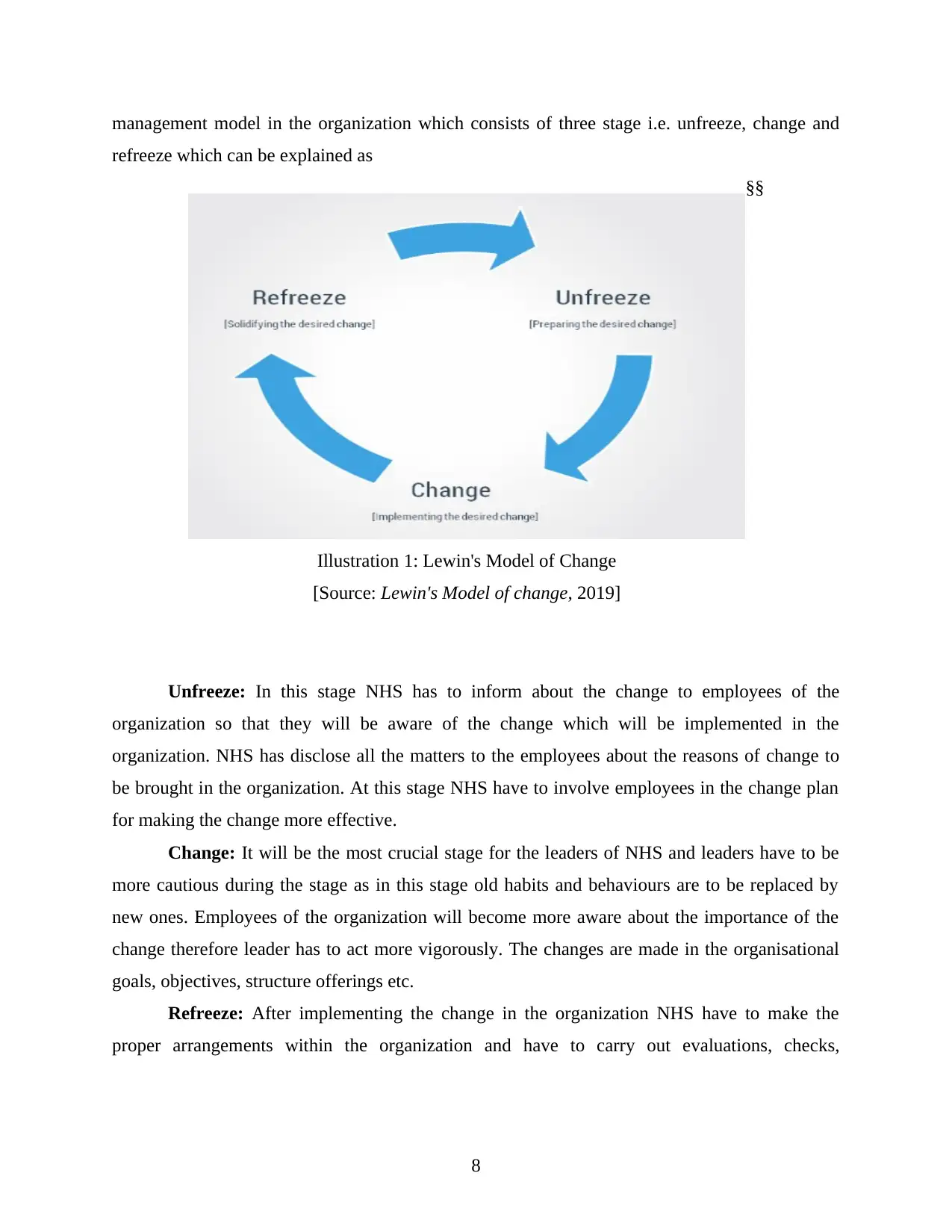
management model in the organization which consists of three stage i.e. unfreeze, change and
refreeze which can be explained as
Illustration 1: Lewin's Model of Change
[Source: Lewin's Model of change, 2019]
§§
Unfreeze: In this stage NHS has to inform about the change to employees of the
organization so that they will be aware of the change which will be implemented in the
organization. NHS has disclose all the matters to the employees about the reasons of change to
be brought in the organization. At this stage NHS have to involve employees in the change plan
for making the change more effective.
Change: It will be the most crucial stage for the leaders of NHS and leaders have to be
more cautious during the stage as in this stage old habits and behaviours are to be replaced by
new ones. Employees of the organization will become more aware about the importance of the
change therefore leader has to act more vigorously. The changes are made in the organisational
goals, objectives, structure offerings etc.
Refreeze: After implementing the change in the organization NHS have to make the
proper arrangements within the organization and have to carry out evaluations, checks,
8
refreeze which can be explained as
Illustration 1: Lewin's Model of Change
[Source: Lewin's Model of change, 2019]
§§
Unfreeze: In this stage NHS has to inform about the change to employees of the
organization so that they will be aware of the change which will be implemented in the
organization. NHS has disclose all the matters to the employees about the reasons of change to
be brought in the organization. At this stage NHS have to involve employees in the change plan
for making the change more effective.
Change: It will be the most crucial stage for the leaders of NHS and leaders have to be
more cautious during the stage as in this stage old habits and behaviours are to be replaced by
new ones. Employees of the organization will become more aware about the importance of the
change therefore leader has to act more vigorously. The changes are made in the organisational
goals, objectives, structure offerings etc.
Refreeze: After implementing the change in the organization NHS have to make the
proper arrangements within the organization and have to carry out evaluations, checks,
8
Paraphrase This Document
Need a fresh take? Get an instant paraphrase of this document with our AI Paraphraser
inspections and have to make necessary adjustments according to the new goals, objectives,
offerings systems etc.
Change management principles:
1. lead with a culture: leaders of NHS have to address the cultural of the organization and
needs to overcome the cultural resistances within the organization.
2. Start at the top: Before bringing a new approach within the organization leaders of NHS
have to embrace it on themselves before implementing on the employees.
3. Engage, engage, engage: Leades of NHS have to establish powerful and effective
communication and need to communicate constantly with the employees to develop the
employee engagement.
3.2 Planning for changes in health and social sector
NHS can use various approaches and techniques for managing and planning for the
change in the organization. But it is important for NHS to identify the key areas in the
organization which needs to be changed or improved. NHS needs a change and effective
planning in their management, accounts department and development of staff.
Proper management style: NHS have to implement the proper management style within
the organization which will include proper techniques, methods and abilities which a managers
uses within the organization. By implementing proper management style NHS's manager would
be able to communicate properly, devising the role and responsibilities of the employees and can
set the organization in to proper direction.
Proper training and developmental programs: NHS should provide proper training
and developmental programs to its employees as NHS employees of finance team lack the skill
and capabilities of managing the economic feasibility in the organisation so NHS should provide
proper training and developmental programs to the employees (Lozano, Ceulemans and Seatter,
2015). Also NHS should find key areas were employees lack the skills and knowledge and
should provide training accordingly.
Setting proper goal and objectives: NHS should set proper goals and objectives of an
organization to meet the criteria as well as the regulations of the sector. NHS needs to evaluate
the government regulations and legislations which NHS has to follow in order to meet the
expectation of service users.
9
offerings systems etc.
Change management principles:
1. lead with a culture: leaders of NHS have to address the cultural of the organization and
needs to overcome the cultural resistances within the organization.
2. Start at the top: Before bringing a new approach within the organization leaders of NHS
have to embrace it on themselves before implementing on the employees.
3. Engage, engage, engage: Leades of NHS have to establish powerful and effective
communication and need to communicate constantly with the employees to develop the
employee engagement.
3.2 Planning for changes in health and social sector
NHS can use various approaches and techniques for managing and planning for the
change in the organization. But it is important for NHS to identify the key areas in the
organization which needs to be changed or improved. NHS needs a change and effective
planning in their management, accounts department and development of staff.
Proper management style: NHS have to implement the proper management style within
the organization which will include proper techniques, methods and abilities which a managers
uses within the organization. By implementing proper management style NHS's manager would
be able to communicate properly, devising the role and responsibilities of the employees and can
set the organization in to proper direction.
Proper training and developmental programs: NHS should provide proper training
and developmental programs to its employees as NHS employees of finance team lack the skill
and capabilities of managing the economic feasibility in the organisation so NHS should provide
proper training and developmental programs to the employees (Lozano, Ceulemans and Seatter,
2015). Also NHS should find key areas were employees lack the skills and knowledge and
should provide training accordingly.
Setting proper goal and objectives: NHS should set proper goals and objectives of an
organization to meet the criteria as well as the regulations of the sector. NHS needs to evaluate
the government regulations and legislations which NHS has to follow in order to meet the
expectation of service users.
9
3.3 Monitoring the recent changes in health and social sector
Monitoring the changes that takes place in the health and social care is import for the
organization which involves systematic analysis of the information which had been collected to
measure the change. NHS can monitor the change internally and externally to measure the
change. Internally NHS can collect the information from the managers, supervisors, leaders,
clinical teams and the important persons (Ceptureanu and Ceptureanu, 2015). But NHS can
monitor the change externally by collecting the information form Care Quality Commission,
Audit commissions, local health inspectors etc.
Monitoring is important for NHS as it will help to track the implementation of change
and the outcomes of the change systematically. By monitoring NHS can measure the
effectiveness of its programs and strategies which is been implemented in the organization. NHS
can monitor recent changes by using various techniques like observations, feedbacks, service
delivery feedbacks, questionnaire, audits and interviews. With the help of these techniques NHS
can monitor the recent changes and take the decisions accordingly within the organisation.
Audits- By using this technique NHS can get the individual opinions from the different
shareholders. It will help the organization to assess the change processes, procedures and
strategies of the change implemented in the organization. It will give NHS the exact picture of
the company in terms of implementing the change.
CONCLUSIONS
It can be concluded from the report that changes in various factors externally and
internally have impact on the organization. There are various factors that bring change in the
organization. Which implementing the change in the organisation, an organization has to face
number of challenges with in the health and service sector. This report also concludes that it is
important for the organization to measure the impact of the recent changes in health and social
care sector against the set criteria. This report also concludes that changes have an overall impact
on the organisation. It can also be concluded that an organization should propose appropriate
services responses to the recent changes in order to stay competitive in the industry. Also
organizations can user several principles of change management in order to implement the
change successfully and organization has to frame a proper plan to implement the change in the
organization. This report also concludes that an organization can use various techniques in order
10
Monitoring the changes that takes place in the health and social care is import for the
organization which involves systematic analysis of the information which had been collected to
measure the change. NHS can monitor the change internally and externally to measure the
change. Internally NHS can collect the information from the managers, supervisors, leaders,
clinical teams and the important persons (Ceptureanu and Ceptureanu, 2015). But NHS can
monitor the change externally by collecting the information form Care Quality Commission,
Audit commissions, local health inspectors etc.
Monitoring is important for NHS as it will help to track the implementation of change
and the outcomes of the change systematically. By monitoring NHS can measure the
effectiveness of its programs and strategies which is been implemented in the organization. NHS
can monitor recent changes by using various techniques like observations, feedbacks, service
delivery feedbacks, questionnaire, audits and interviews. With the help of these techniques NHS
can monitor the recent changes and take the decisions accordingly within the organisation.
Audits- By using this technique NHS can get the individual opinions from the different
shareholders. It will help the organization to assess the change processes, procedures and
strategies of the change implemented in the organization. It will give NHS the exact picture of
the company in terms of implementing the change.
CONCLUSIONS
It can be concluded from the report that changes in various factors externally and
internally have impact on the organization. There are various factors that bring change in the
organization. Which implementing the change in the organisation, an organization has to face
number of challenges with in the health and service sector. This report also concludes that it is
important for the organization to measure the impact of the recent changes in health and social
care sector against the set criteria. This report also concludes that changes have an overall impact
on the organisation. It can also be concluded that an organization should propose appropriate
services responses to the recent changes in order to stay competitive in the industry. Also
organizations can user several principles of change management in order to implement the
change successfully and organization has to frame a proper plan to implement the change in the
organization. This report also concludes that an organization can use various techniques in order
10
⊘ This is a preview!⊘
Do you want full access?
Subscribe today to unlock all pages.
Trusted by 1+ million students worldwide

1 out of 14


Related Documents


Your All-in-One AI-Powered Toolkit for Academic Success.
+13062052269
info@desklib.com
Available 24*7 on WhatsApp / Email
![[object Object]](/_next/static/media/star-bottom.7253800d.svg)
Unlock your academic potential
Copyright © 2020–2026 A2Z Services. All Rights Reserved. Developed and managed by ZUCOL.