International HRM Policies for Health and Social Care Organizations
VerifiedAdded on 2023/01/13
|13
|3828
|65
Report
AI Summary
This report delves into the application of Human Resource Management (HRM) strategies within the health and social care sector, focusing on a hypothetical international organization, ABC. The report explores the impact of economic pressures on health services and their effects on management, examines the recruitment and selection processes, and identifies the importance of Human Resource Planning (HRP). It also analyzes the role of government agencies in enforcing Equal Employment Opportunity (EEO), ways to avoid illegal discrimination, and employers' duties under the Equalities Law. Furthermore, the report discusses the significance of employee training, reward systems, and methods to promote positive employee relations, concluding with the use of work behaviors and job performance to plan employee development. The report provides a comprehensive overview of HRM practices in the health and social care context, offering insights into key policies, strategies, and legal considerations.

Health and Social Care

Paraphrase This Document
Need a fresh take? Get an instant paraphrase of this document with our AI Paraphraser
Table of Contents
Introduction......................................................................................................................................1
Task 1...............................................................................................................................................1
AC 1.1 Economic pressure on health services and effects on management................................1
AC 1.2 Recruitment and selection process..................................................................................1
AC 1.3 Identifying available information in the workplace for Human Resource Planning
(HRP)...........................................................................................................................................2
Task 2...............................................................................................................................................3
A.C. 2.1 The role of government agencies to enforce Equal Employment Opportunity (EEO). 3
A.C. 2.2 Ways to avoid illegal discrimination and provide reasonable accommodation 250.....4
A.C. 2.3 Employers' duties under the Equalities Law.................................................................5
A.C. 2.4 Employers promotes worker safety and health.............................................................6
Task 3...............................................................................................................................................6
A.C 3.1 Importance of employees training after selection..........................................................6
A.C. 3.2 Choices for health and social care organizations to reward staff..................................7
A.C 3.3 Methods to promote positive employee relations in the organizations..........................7
A.C 3.4 Use of work behaviors and job performance to plan employee development...............8
Conclusions......................................................................................................................................8
References........................................................................................................................................9
List of Figures
Figure 1: Recruitment and Selection procedure..............................................................................2
Figure 2: The process of Human Resource Planning......................................................................3
Introduction......................................................................................................................................1
Task 1...............................................................................................................................................1
AC 1.1 Economic pressure on health services and effects on management................................1
AC 1.2 Recruitment and selection process..................................................................................1
AC 1.3 Identifying available information in the workplace for Human Resource Planning
(HRP)...........................................................................................................................................2
Task 2...............................................................................................................................................3
A.C. 2.1 The role of government agencies to enforce Equal Employment Opportunity (EEO). 3
A.C. 2.2 Ways to avoid illegal discrimination and provide reasonable accommodation 250.....4
A.C. 2.3 Employers' duties under the Equalities Law.................................................................5
A.C. 2.4 Employers promotes worker safety and health.............................................................6
Task 3...............................................................................................................................................6
A.C 3.1 Importance of employees training after selection..........................................................6
A.C. 3.2 Choices for health and social care organizations to reward staff..................................7
A.C 3.3 Methods to promote positive employee relations in the organizations..........................7
A.C 3.4 Use of work behaviors and job performance to plan employee development...............8
Conclusions......................................................................................................................................8
References........................................................................................................................................9
List of Figures
Figure 1: Recruitment and Selection procedure..............................................................................2
Figure 2: The process of Human Resource Planning......................................................................3
Introduction
Human Resource Management (HRM) is the strategic approach which is used for
effective management of people in an organization that helps to achieve the competitive
advantages (Noe, Hollenbeck, Gerhart and Wright, 2017). In this context, the current report is
based on the people management at the international level by using the management strategies
such as recruitment, selection, performance appraisal etc. For this purpose, the scenario of health
and social care organisation is considered which sells varied products and services across the
countries. The assumed name of the business organisation is ABC which is operating in the UK.
In this regard, the issues, structure, employees planning of the business have been identified.
Apart from this, the theories and practices related to human resources management have been
identified. Moreover, the policies applied for the recruitment and selection are applied and
analyzed.
Task 1
AC 1.1 Economic pressure on health services and effects on management
According to Ghantoji, Sail, Lairson, DuPont and Garey (2010), the economic pressure of
ever-increasing health care costs and suboptimal health results are deriving the search for new
strategies to health management. For example, in the current era, the health care organizations
are emphasizing on the inclusion of electronic health records for the population which demands
the patient-centered health care. Furthermore, patient care organizations need to enhance the role
of consumers in managing their own health by a partnership with health care providers. In this
context, ABC social care needs to implement the e-health resources and tools to help the clients
and manage the heavy demands of health management but it demands huge cost (Ginter, Duncan
and Swayne, 2018). Besides this, management of health organizations gets affected because they
have to change the structure of management and set disease management for the effectual
relations with patients to services provided through digital tools (Shi, 2010).
AC 1.2 Recruitment and selection process
The ABC social care organization has a specific recruitment and selection process which
is helpful to identify and select the qualified workers for the organization. The health and social
organizations always demand the capable personals to perform the different kinds of social
1
Human Resource Management (HRM) is the strategic approach which is used for
effective management of people in an organization that helps to achieve the competitive
advantages (Noe, Hollenbeck, Gerhart and Wright, 2017). In this context, the current report is
based on the people management at the international level by using the management strategies
such as recruitment, selection, performance appraisal etc. For this purpose, the scenario of health
and social care organisation is considered which sells varied products and services across the
countries. The assumed name of the business organisation is ABC which is operating in the UK.
In this regard, the issues, structure, employees planning of the business have been identified.
Apart from this, the theories and practices related to human resources management have been
identified. Moreover, the policies applied for the recruitment and selection are applied and
analyzed.
Task 1
AC 1.1 Economic pressure on health services and effects on management
According to Ghantoji, Sail, Lairson, DuPont and Garey (2010), the economic pressure of
ever-increasing health care costs and suboptimal health results are deriving the search for new
strategies to health management. For example, in the current era, the health care organizations
are emphasizing on the inclusion of electronic health records for the population which demands
the patient-centered health care. Furthermore, patient care organizations need to enhance the role
of consumers in managing their own health by a partnership with health care providers. In this
context, ABC social care needs to implement the e-health resources and tools to help the clients
and manage the heavy demands of health management but it demands huge cost (Ginter, Duncan
and Swayne, 2018). Besides this, management of health organizations gets affected because they
have to change the structure of management and set disease management for the effectual
relations with patients to services provided through digital tools (Shi, 2010).
AC 1.2 Recruitment and selection process
The ABC social care organization has a specific recruitment and selection process which
is helpful to identify and select the qualified workers for the organization. The health and social
organizations always demand the capable personals to perform the different kinds of social
1
⊘ This is a preview!⊘
Do you want full access?
Subscribe today to unlock all pages.

Trusted by 1+ million students worldwide
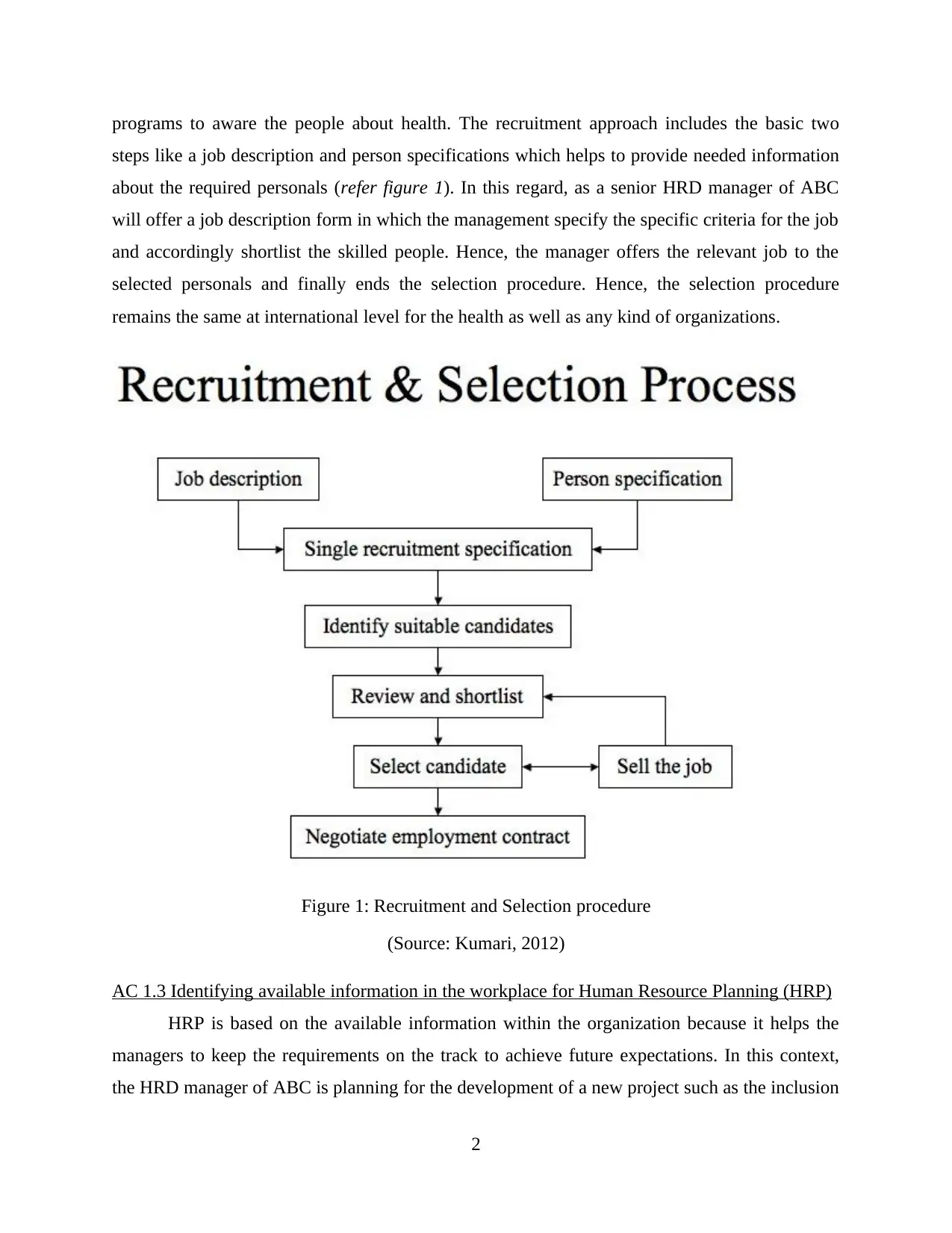
programs to aware the people about health. The recruitment approach includes the basic two
steps like a job description and person specifications which helps to provide needed information
about the required personals (refer figure 1). In this regard, as a senior HRD manager of ABC
will offer a job description form in which the management specify the specific criteria for the job
and accordingly shortlist the skilled people. Hence, the manager offers the relevant job to the
selected personals and finally ends the selection procedure. Hence, the selection procedure
remains the same at international level for the health as well as any kind of organizations.
Figure 1: Recruitment and Selection procedure
(Source: Kumari, 2012)
AC 1.3 Identifying available information in the workplace for Human Resource Planning (HRP)
HRP is based on the available information within the organization because it helps the
managers to keep the requirements on the track to achieve future expectations. In this context,
the HRD manager of ABC is planning for the development of a new project such as the inclusion
2
steps like a job description and person specifications which helps to provide needed information
about the required personals (refer figure 1). In this regard, as a senior HRD manager of ABC
will offer a job description form in which the management specify the specific criteria for the job
and accordingly shortlist the skilled people. Hence, the manager offers the relevant job to the
selected personals and finally ends the selection procedure. Hence, the selection procedure
remains the same at international level for the health as well as any kind of organizations.
Figure 1: Recruitment and Selection procedure
(Source: Kumari, 2012)
AC 1.3 Identifying available information in the workplace for Human Resource Planning (HRP)
HRP is based on the available information within the organization because it helps the
managers to keep the requirements on the track to achieve future expectations. In this context,
the HRD manager of ABC is planning for the development of a new project such as the inclusion
2
Paraphrase This Document
Need a fresh take? Get an instant paraphrase of this document with our AI Paraphraser
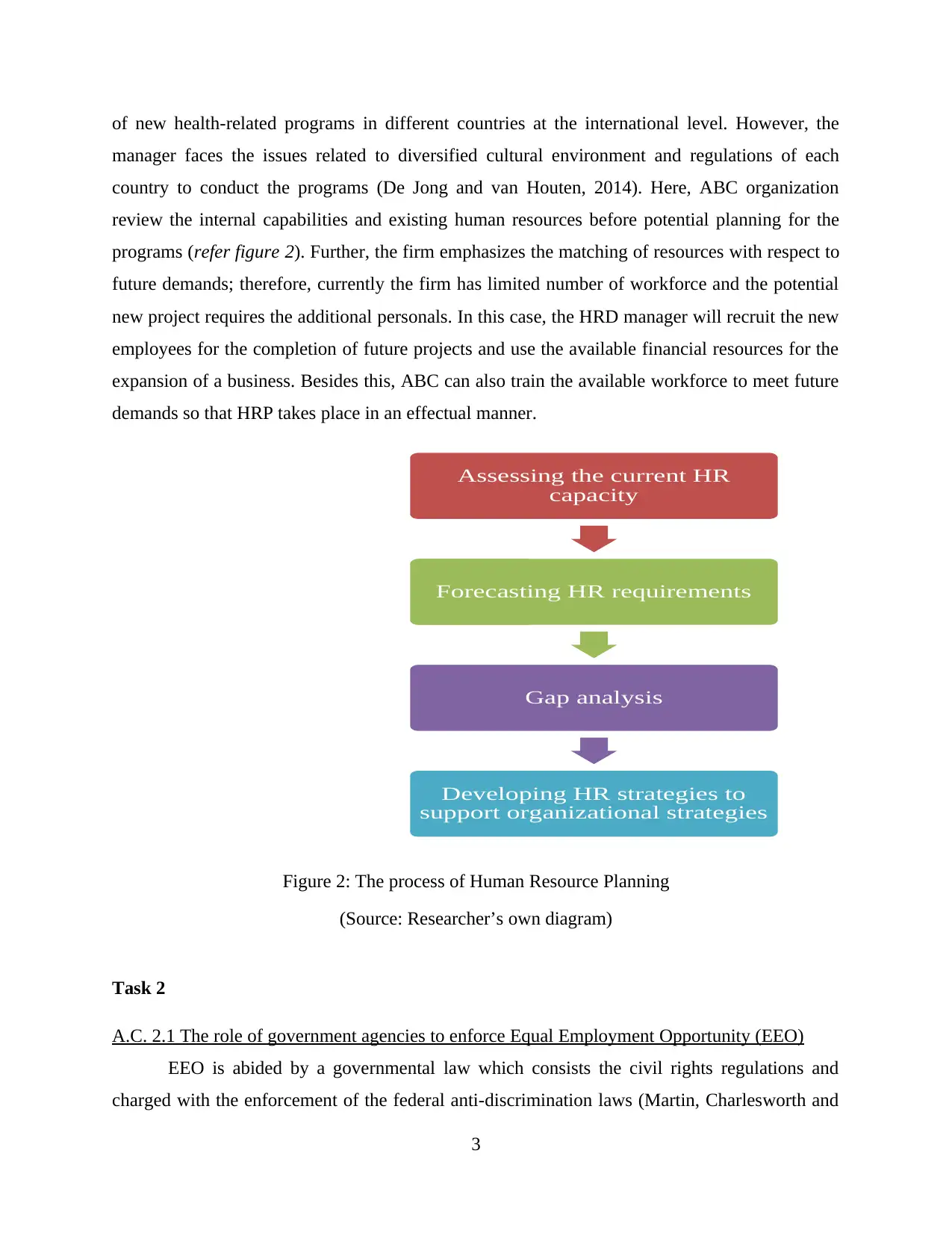
of new health-related programs in different countries at the international level. However, the
manager faces the issues related to diversified cultural environment and regulations of each
country to conduct the programs (De Jong and van Houten, 2014). Here, ABC organization
review the internal capabilities and existing human resources before potential planning for the
programs (refer figure 2). Further, the firm emphasizes the matching of resources with respect to
future demands; therefore, currently the firm has limited number of workforce and the potential
new project requires the additional personals. In this case, the HRD manager will recruit the new
employees for the completion of future projects and use the available financial resources for the
expansion of a business. Besides this, ABC can also train the available workforce to meet future
demands so that HRP takes place in an effectual manner.
Figure 2: The process of Human Resource Planning
(Source: Researcher’s own diagram)
Task 2
A.C. 2.1 The role of government agencies to enforce Equal Employment Opportunity (EEO)
EEO is abided by a governmental law which consists the civil rights regulations and
charged with the enforcement of the federal anti-discrimination laws (Martin, Charlesworth and
3
Assessing the current HR
capacity
Forecasting HR requirements
Gap analysis
Developing HR strategies to
support organizational strategies
manager faces the issues related to diversified cultural environment and regulations of each
country to conduct the programs (De Jong and van Houten, 2014). Here, ABC organization
review the internal capabilities and existing human resources before potential planning for the
programs (refer figure 2). Further, the firm emphasizes the matching of resources with respect to
future demands; therefore, currently the firm has limited number of workforce and the potential
new project requires the additional personals. In this case, the HRD manager will recruit the new
employees for the completion of future projects and use the available financial resources for the
expansion of a business. Besides this, ABC can also train the available workforce to meet future
demands so that HRP takes place in an effectual manner.
Figure 2: The process of Human Resource Planning
(Source: Researcher’s own diagram)
Task 2
A.C. 2.1 The role of government agencies to enforce Equal Employment Opportunity (EEO)
EEO is abided by a governmental law which consists the civil rights regulations and
charged with the enforcement of the federal anti-discrimination laws (Martin, Charlesworth and
3
Assessing the current HR
capacity
Forecasting HR requirements
Gap analysis
Developing HR strategies to
support organizational strategies
Henderson, 2010). In this context, government agencies play an important role to enforce the
EEO in all sectors to follow the equal policies in the recruitment process. Furthermore, EEO
commission is responsible to offer the laws for employment which makes the organizations
illegal to discriminate against job applicants because of religion, sex, nationality, disability etc.
(Abe, 2011). Here, EEO commission has a role to investigate the charges of discrimination
against the employers who are lies under the law. In this case, EEO is obliged to identify the
allegations which are posed by the accused on the respective organization to reduce the level of
discrimination within the firm (Gutman, Koppes and Vodanovich, 2012). For example, EEO
commission focuses on the identification of allegations and if the EEO found it successfully then
the agencies put the charges on the company. However, if EEO commission found it wrong then
there is an authority to EEO to file a lawsuit against the company in favor of the public interests.
Moreover, EEO plays a role of leadership for the companies and provides guidance regarding
equal employment policies for the applicants. Furthermore, EEO is responsible to conduct
affirmative employment programs, develops and distributes federal health care recruitment
related materials to the health care (Selden, 2015).
A.C. 2.2 Ways to avoid illegal discrimination and provide reasonable accommodation 250
HRD manager of ABC social care can implement and integrate a strict policy regarding
employment which makes the employment discrimination of any type unacceptable at the
workplace.
The employers are supposed to avoid disability discrimination at the time of hiring new
employees so that illegal discriminations cannot arise in the firm. Here, employers focus
on the hiring of skilled people who can actually perform the job without any barriers. In
this case, the employer has a right to ask about the applicant's capabilities to perform a
particular job. Furthermore, the employer can provide a detailed job description to the
applicants at the time of job interview (Kamiran, Žliobaitė and Calders, 2013). Hence, the
employer will be in a position to follow the policies of the company and will also be able
to avoid illegal discrimination regarding applicants’ disabilities.
The employers can develop an effective workplace policy which helps to prohibit
discrimination at the workplace and encourages the employees to respect each other's
differences at the common workplace (Lauster and Easterbrook, 2011).
4
EEO in all sectors to follow the equal policies in the recruitment process. Furthermore, EEO
commission is responsible to offer the laws for employment which makes the organizations
illegal to discriminate against job applicants because of religion, sex, nationality, disability etc.
(Abe, 2011). Here, EEO commission has a role to investigate the charges of discrimination
against the employers who are lies under the law. In this case, EEO is obliged to identify the
allegations which are posed by the accused on the respective organization to reduce the level of
discrimination within the firm (Gutman, Koppes and Vodanovich, 2012). For example, EEO
commission focuses on the identification of allegations and if the EEO found it successfully then
the agencies put the charges on the company. However, if EEO commission found it wrong then
there is an authority to EEO to file a lawsuit against the company in favor of the public interests.
Moreover, EEO plays a role of leadership for the companies and provides guidance regarding
equal employment policies for the applicants. Furthermore, EEO is responsible to conduct
affirmative employment programs, develops and distributes federal health care recruitment
related materials to the health care (Selden, 2015).
A.C. 2.2 Ways to avoid illegal discrimination and provide reasonable accommodation 250
HRD manager of ABC social care can implement and integrate a strict policy regarding
employment which makes the employment discrimination of any type unacceptable at the
workplace.
The employers are supposed to avoid disability discrimination at the time of hiring new
employees so that illegal discriminations cannot arise in the firm. Here, employers focus
on the hiring of skilled people who can actually perform the job without any barriers. In
this case, the employer has a right to ask about the applicant's capabilities to perform a
particular job. Furthermore, the employer can provide a detailed job description to the
applicants at the time of job interview (Kamiran, Žliobaitė and Calders, 2013). Hence, the
employer will be in a position to follow the policies of the company and will also be able
to avoid illegal discrimination regarding applicants’ disabilities.
The employers can develop an effective workplace policy which helps to prohibit
discrimination at the workplace and encourages the employees to respect each other's
differences at the common workplace (Lauster and Easterbrook, 2011).
4
⊘ This is a preview!⊘
Do you want full access?
Subscribe today to unlock all pages.
Trusted by 1+ million students worldwide
The HRD manager always is honest and consistent towards all the employees to avoid
discrimination. For example, do not take the positive reviews of employees over
exaggerate because it affects the manager’s termination decision regarding the employees
who crossed fired line.
The HRD manager has a responsibility to maintain a workplace free from sexual
harassment to keep the organization away from illegal discrimination.
By considering this, the HRD manager of ABC health care can offer reasonable
accommodations in case of disabilities to avoid illegal discrimination. Furthermore, it helps to
reduce the discrimination between disable and capable employees who are going to be selected
on the basis of abilities.
A.C. 2.3 Employers' duties under the Equalities Law
The Equality Act brings a wide range of laws into one place to make things favorable for
everyone in the organization and it remains the same at the international level to avoid the
discrimination (Hepple, 2014). Additionally, it helps to set out the individual’s characteristics
which are protected by law and the behavior that is unlawful. In this context, the employer
performs distinctive duties as per the equality act to set out responsibilities at the time of
providing services to the public.
As per the Equality act, the employer has a duty that does not perform any discrimination
against the current or potential employees on the basis of vocational training, work
experience, collective agreements etc.
The employer has a duty to provide equal pay for the same work to a similarly capable
workforce to reduce the discrimination at the workplace
Under the Equality Act, the employer may not refuse to recruit a pregnant woman
although the candidate has the caliber to perform the job. Here, the HRD manager of
ABC health care has a right to appoint women to improve the people management to
provide the services internationally. Besides this, the employers may not deny providing
maternity leave to the female employees at the time of maturity (Kumra, Manfredi and
Vickers, 2012).
The employer has a responsibility to provide equal career development opportunities to
improve productivity, boost morale and to retain at the workplace.
5
discrimination. For example, do not take the positive reviews of employees over
exaggerate because it affects the manager’s termination decision regarding the employees
who crossed fired line.
The HRD manager has a responsibility to maintain a workplace free from sexual
harassment to keep the organization away from illegal discrimination.
By considering this, the HRD manager of ABC health care can offer reasonable
accommodations in case of disabilities to avoid illegal discrimination. Furthermore, it helps to
reduce the discrimination between disable and capable employees who are going to be selected
on the basis of abilities.
A.C. 2.3 Employers' duties under the Equalities Law
The Equality Act brings a wide range of laws into one place to make things favorable for
everyone in the organization and it remains the same at the international level to avoid the
discrimination (Hepple, 2014). Additionally, it helps to set out the individual’s characteristics
which are protected by law and the behavior that is unlawful. In this context, the employer
performs distinctive duties as per the equality act to set out responsibilities at the time of
providing services to the public.
As per the Equality act, the employer has a duty that does not perform any discrimination
against the current or potential employees on the basis of vocational training, work
experience, collective agreements etc.
The employer has a duty to provide equal pay for the same work to a similarly capable
workforce to reduce the discrimination at the workplace
Under the Equality Act, the employer may not refuse to recruit a pregnant woman
although the candidate has the caliber to perform the job. Here, the HRD manager of
ABC health care has a right to appoint women to improve the people management to
provide the services internationally. Besides this, the employers may not deny providing
maternity leave to the female employees at the time of maturity (Kumra, Manfredi and
Vickers, 2012).
The employer has a responsibility to provide equal career development opportunities to
improve productivity, boost morale and to retain at the workplace.
5
Paraphrase This Document
Need a fresh take? Get an instant paraphrase of this document with our AI Paraphraser
A.C. 2.4 Employers promotes worker safety and health
Make use of job hazard analysis and risk mapping procedures within the firm (Baicker,
Cutler and Song, 2010). In this context, HRD manager of ABC can map the risky
activities by examining the areas where the employees go for work and it can be done by
the closer investigation at the physical work.
The organization can focus on safety measures such as fire alarm at every corner, to
operate the hazardous activities in well-constructed areas to reduce the effects of
inflammable gases.
The HRD manager can conduct the programs to bring awareness about health and safety
precautions which helps the employees to deal with the injuries in a frequent workplace
environment. Here, in ABC health care, the employer offers the safety masks, hygiene
gloves to treat the patients so that infection may not transfer to employees.
The management is responsible to encourage employees to report about the things which
seem unsafe in the workplace (Shi, 2010).
Task 3
A.C 3.1 Importance of employees training after selection
According to Kapp (2012), training and development are important for the employees
after getting selection because it helps to enhance the capabilities and boost the confidence to
perform the task in any situation. In this context, training is more important for the new
employees to describe the job and functionalities to perform in an effectual manner. Further,
training plays an important role for the individuals because it helps to deal with the shortcoming
which arises during the work (Grossman and Salas, 2011). Furthermore, training needs to
increase the productivity of employees because the employees get training regarding the use of
technical resources which improve quality of work. Besides this, after selecting the new
hiring’s, the training and continuous supervision is foremost required because a new person does
not have a practical knowledge to use the applications and technical tools (Collis and Moonen,
2012). In this context, the HRD manager of ABC organization needs to provide the training to
new hires who are going to perform at the international level regarding the conduction of health
programs to aware the people. Additionally, it helps the manager to build a strong and
6
Make use of job hazard analysis and risk mapping procedures within the firm (Baicker,
Cutler and Song, 2010). In this context, HRD manager of ABC can map the risky
activities by examining the areas where the employees go for work and it can be done by
the closer investigation at the physical work.
The organization can focus on safety measures such as fire alarm at every corner, to
operate the hazardous activities in well-constructed areas to reduce the effects of
inflammable gases.
The HRD manager can conduct the programs to bring awareness about health and safety
precautions which helps the employees to deal with the injuries in a frequent workplace
environment. Here, in ABC health care, the employer offers the safety masks, hygiene
gloves to treat the patients so that infection may not transfer to employees.
The management is responsible to encourage employees to report about the things which
seem unsafe in the workplace (Shi, 2010).
Task 3
A.C 3.1 Importance of employees training after selection
According to Kapp (2012), training and development are important for the employees
after getting selection because it helps to enhance the capabilities and boost the confidence to
perform the task in any situation. In this context, training is more important for the new
employees to describe the job and functionalities to perform in an effectual manner. Further,
training plays an important role for the individuals because it helps to deal with the shortcoming
which arises during the work (Grossman and Salas, 2011). Furthermore, training needs to
increase the productivity of employees because the employees get training regarding the use of
technical resources which improve quality of work. Besides this, after selecting the new
hiring’s, the training and continuous supervision is foremost required because a new person does
not have a practical knowledge to use the applications and technical tools (Collis and Moonen,
2012). In this context, the HRD manager of ABC organization needs to provide the training to
new hires who are going to perform at the international level regarding the conduction of health
programs to aware the people. Additionally, it helps the manager to build a strong and
6
competitive team to reflect the image of the organization at a global level. Furthermore, the
employees will be able to perform more competitively because by the training they come to
know about the complete scenario of the job and get the ability to deal with diversified cultural
people in the society.
A.C. 3.2 Choices for health and social care organizations to reward staff
The health and social care organizations need to identify the choices to reward the staff
members in the organization which helps to motivate the workers. In this context, health care
organizations can create a culture of recognition in the working environment. In this case, the
culture of recognition helps to identify the staff members. Here, recognition is also itself a
reward for the staff because the recognition is based on the better performance of services (Serra,
Serneels and Barr, 2011). In this context, recognition takes places in different ways such as
monetary gifts and non-monetary terms. Apart from this, health care organizations can assign
responsibilities to staff members to show that they are qualified for a particular task. Here, the
employees are supposed to perform the work at own responsibility to achieve the goals of the
firm. On the other hand, the organizations have an option to conduct the small events to
encourage the staff and offer the unique facilities in the form of rewards such as celebrate
monthly birthdays, company anniversary with the announcement of relevant skilled employees’
names (Pfeffer, 2010). Besides this, health care organizations have a choice to offer the gift cards
once in a while to popular coffee chain and another kind of benefits, incentives for better
performance in health care.
A.C 3.3 Methods to promote positive employee relations in the organizations
There are several methods such as provide opportunities for growth, offer timely rewards
and incentives, encourage the individuals to share the work with each other etc. which are used
by the organizations to promote the positive employee relations within the workplace. In this
context, to build the strong relationships with employees, the employers need to assign the
targets to the respective staff members to contribute equally and achieve the targets within a
decided time period (Anitha, 2014). Here, the employees would work more enthusiastically to
attain the objectives because they have to work according to targets. On the other hand, the
management needs to encourage effective communication among the team members to create a
more collaborative environment in the firm (Kapp, 2012). In this regard, a strong relationship
7
employees will be able to perform more competitively because by the training they come to
know about the complete scenario of the job and get the ability to deal with diversified cultural
people in the society.
A.C. 3.2 Choices for health and social care organizations to reward staff
The health and social care organizations need to identify the choices to reward the staff
members in the organization which helps to motivate the workers. In this context, health care
organizations can create a culture of recognition in the working environment. In this case, the
culture of recognition helps to identify the staff members. Here, recognition is also itself a
reward for the staff because the recognition is based on the better performance of services (Serra,
Serneels and Barr, 2011). In this context, recognition takes places in different ways such as
monetary gifts and non-monetary terms. Apart from this, health care organizations can assign
responsibilities to staff members to show that they are qualified for a particular task. Here, the
employees are supposed to perform the work at own responsibility to achieve the goals of the
firm. On the other hand, the organizations have an option to conduct the small events to
encourage the staff and offer the unique facilities in the form of rewards such as celebrate
monthly birthdays, company anniversary with the announcement of relevant skilled employees’
names (Pfeffer, 2010). Besides this, health care organizations have a choice to offer the gift cards
once in a while to popular coffee chain and another kind of benefits, incentives for better
performance in health care.
A.C 3.3 Methods to promote positive employee relations in the organizations
There are several methods such as provide opportunities for growth, offer timely rewards
and incentives, encourage the individuals to share the work with each other etc. which are used
by the organizations to promote the positive employee relations within the workplace. In this
context, to build the strong relationships with employees, the employers need to assign the
targets to the respective staff members to contribute equally and achieve the targets within a
decided time period (Anitha, 2014). Here, the employees would work more enthusiastically to
attain the objectives because they have to work according to targets. On the other hand, the
management needs to encourage effective communication among the team members to create a
more collaborative environment in the firm (Kapp, 2012). In this regard, a strong relationship
7
⊘ This is a preview!⊘
Do you want full access?
Subscribe today to unlock all pages.
Trusted by 1+ million students worldwide
would be maintained between employees and employers because in a team the staff members are
supposed to share the work-related issues and information. In this case, the conflict would not
arise among employees as well as improve the relations with the team leader. Besides this,
morning meeting with subordinates is another way to improve and strengthens the relationships
because it provides a common platform for all to come together and discuss the issues and
resolve.
A.C 3.4 Use of work behaviors and job performance to plan employee development
Most of the organizations use different assessment options like personality type, work
behavior and job performance to plan employee development (Edien, 2015). Here, the
organizations mostly adopt the performance appraisal approach for the development of the
employees. Performance appraisal is a beneficial technique to asses the employees on the basis
of work performance and accordingly offer growth opportunities or promotional ways.
Furthermore, organizations can use the Graphic rating scale approach to evaluate the
performance of the employees. In this situation, the employees get the ratings on the basis of
work performance and get the analytical position in the firm. Here, the employees will be rated
according to the poor to excellent performance (Knoch, 2011). On the other hand, on the basis of
work behavior and personality of the employees also used to plan for staff development. Here,
the positive attitude of employees towards work is considered for the growth opportunities
because it offers the optimum results.
Conclusions
On the basis of the report, it has been concluded that health and social care organizations face
the economic pressure to implement the new services which affect the overall management. The
organizations use internally available information for the HRP to remove the gap. On the other
hand, it has been summarized that the government agencies enforce the organizations to use the
equal employment laws and do not create discrimination at the workplace. At the end, it has also
been concluded that organizations use the rewards and target-based approach to promoting a
positive relationship with employees.
8
supposed to share the work-related issues and information. In this case, the conflict would not
arise among employees as well as improve the relations with the team leader. Besides this,
morning meeting with subordinates is another way to improve and strengthens the relationships
because it provides a common platform for all to come together and discuss the issues and
resolve.
A.C 3.4 Use of work behaviors and job performance to plan employee development
Most of the organizations use different assessment options like personality type, work
behavior and job performance to plan employee development (Edien, 2015). Here, the
organizations mostly adopt the performance appraisal approach for the development of the
employees. Performance appraisal is a beneficial technique to asses the employees on the basis
of work performance and accordingly offer growth opportunities or promotional ways.
Furthermore, organizations can use the Graphic rating scale approach to evaluate the
performance of the employees. In this situation, the employees get the ratings on the basis of
work performance and get the analytical position in the firm. Here, the employees will be rated
according to the poor to excellent performance (Knoch, 2011). On the other hand, on the basis of
work behavior and personality of the employees also used to plan for staff development. Here,
the positive attitude of employees towards work is considered for the growth opportunities
because it offers the optimum results.
Conclusions
On the basis of the report, it has been concluded that health and social care organizations face
the economic pressure to implement the new services which affect the overall management. The
organizations use internally available information for the HRP to remove the gap. On the other
hand, it has been summarized that the government agencies enforce the organizations to use the
equal employment laws and do not create discrimination at the workplace. At the end, it has also
been concluded that organizations use the rewards and target-based approach to promoting a
positive relationship with employees.
8
Paraphrase This Document
Need a fresh take? Get an instant paraphrase of this document with our AI Paraphraser
References
Abe, Y., 2011. The Equal Employment Opportunity Law and labor force behavior of women in
Japan. Journal of the Japanese and International Economies, 25(1), pp.39-55.
Anitha, J., 2014. Determinants of employee engagement and their impact on employee
performance. International journal of productivity and performance management, 63(3), p.308.
Baicker, K., Cutler, D. and Song, Z., 2010. Workplace wellness programs can generate
savings. Health affairs, 29(2), pp.304-311.
Collis, B. and Moonen, J., 2012. Flexible learning in a digital world: Experiences and
expectations. Routledge.
De Jong, G. and van Houten, J., 2014. The impact of MNE cultural diversity on the
internationalization-performance relationship: Theory and evidence from European multinational
enterprises. International Business Review, 23(1), pp.313-326.
Edien, A.G.A., 2015. Effects of job analysis on personnel innovation. International Journal of
Business and Management Invention, 4(10), pp.9-18.
Ghantoji, S.S., Sail, K., Lairson, D.R., DuPont, H.L. and Garey, K.W., 2010. Economic
healthcare costs of Clostridium difficile infection: a systematic review. Journal of Hospital
Infection, 74(4), pp.309-318.
Ginter, P.M., Duncan, W.J. and Swayne, L.E., 2018. The strategic management of health care
organizations. John Wiley & Sons.
Grossman, R. and Salas, E., 2011. The transfer of training: what really matters. International
Journal of Training and Development, 15(2), pp.103-120.
Gutman, A., Koppes, L.L. and Vodanovich, S.J., 2012. EEO law and personnel practices.
Psychology Press.
Hepple, B., 2014. Equality: The legal framework. Bloomsbury Publishing.
9
Abe, Y., 2011. The Equal Employment Opportunity Law and labor force behavior of women in
Japan. Journal of the Japanese and International Economies, 25(1), pp.39-55.
Anitha, J., 2014. Determinants of employee engagement and their impact on employee
performance. International journal of productivity and performance management, 63(3), p.308.
Baicker, K., Cutler, D. and Song, Z., 2010. Workplace wellness programs can generate
savings. Health affairs, 29(2), pp.304-311.
Collis, B. and Moonen, J., 2012. Flexible learning in a digital world: Experiences and
expectations. Routledge.
De Jong, G. and van Houten, J., 2014. The impact of MNE cultural diversity on the
internationalization-performance relationship: Theory and evidence from European multinational
enterprises. International Business Review, 23(1), pp.313-326.
Edien, A.G.A., 2015. Effects of job analysis on personnel innovation. International Journal of
Business and Management Invention, 4(10), pp.9-18.
Ghantoji, S.S., Sail, K., Lairson, D.R., DuPont, H.L. and Garey, K.W., 2010. Economic
healthcare costs of Clostridium difficile infection: a systematic review. Journal of Hospital
Infection, 74(4), pp.309-318.
Ginter, P.M., Duncan, W.J. and Swayne, L.E., 2018. The strategic management of health care
organizations. John Wiley & Sons.
Grossman, R. and Salas, E., 2011. The transfer of training: what really matters. International
Journal of Training and Development, 15(2), pp.103-120.
Gutman, A., Koppes, L.L. and Vodanovich, S.J., 2012. EEO law and personnel practices.
Psychology Press.
Hepple, B., 2014. Equality: The legal framework. Bloomsbury Publishing.
9
Kamiran, F., Žliobaitė, I. and Calders, T., 2013. Quantifying explainable discrimination and
removing illegal discrimination in automated decision making. Knowledge and information
systems, 35(3), pp.613-644.
Kapp, K.M., 2012. The gamification of learning and instruction(p. 93). San Francisco: Wiley.
Knoch, U., 2011. Rating scales for diagnostic assessment of writing: What should they look like
and where should the criteria come from?. Assessing Writing, 16(2), pp.81-96.
Kumari, N., 2012. A Study of the Recruitment and Selection process: SMC Global. Industrial
Engineering Letters, 2(1), pp.34-43.
Kumra, S., Manfredi, S. and Vickers, L., 2012. Managing equality and diversity: Theory and
practice. Oxford University Press.
Lauster, N. and Easterbrook, A., 2011. No room for new families? A field experiment measuring
rental discrimination against same-sex couples and single parents. Social Problems, 58(3),
pp.389-409.
Martin, V., Charlesworth, J. and Henderson, E., 2010. Managing in health and social care.
Routledge.
Noe, R.A., Hollenbeck, J.R., Gerhart, B. and Wright, P.M., 2017. Human resource management:
Gaining a competitive advantage. New York, NY: McGraw-Hill Education.
Pfeffer, J., 2010. Building sustainable organizations: The human factor. Academy of management
perspectives, 24(1), pp.34-45.
Selden, S.C., 2015. The Promise of Representative Bureaucracy: Diversity and Responsiveness
in a Government Agency: Diversity and Responsiveness in a Government Agency. Routledge.
Serra, D., Serneels, P. and Barr, A., 2011. Intrinsic motivations and the non-profit health sector:
Evidence from Ethiopia. Personality and Individual Differences, 51(3), pp.309-314.
Shi, L., 2010. Managing human resources in health care organizations. Jones & Bartlett
Publishers.
10
removing illegal discrimination in automated decision making. Knowledge and information
systems, 35(3), pp.613-644.
Kapp, K.M., 2012. The gamification of learning and instruction(p. 93). San Francisco: Wiley.
Knoch, U., 2011. Rating scales for diagnostic assessment of writing: What should they look like
and where should the criteria come from?. Assessing Writing, 16(2), pp.81-96.
Kumari, N., 2012. A Study of the Recruitment and Selection process: SMC Global. Industrial
Engineering Letters, 2(1), pp.34-43.
Kumra, S., Manfredi, S. and Vickers, L., 2012. Managing equality and diversity: Theory and
practice. Oxford University Press.
Lauster, N. and Easterbrook, A., 2011. No room for new families? A field experiment measuring
rental discrimination against same-sex couples and single parents. Social Problems, 58(3),
pp.389-409.
Martin, V., Charlesworth, J. and Henderson, E., 2010. Managing in health and social care.
Routledge.
Noe, R.A., Hollenbeck, J.R., Gerhart, B. and Wright, P.M., 2017. Human resource management:
Gaining a competitive advantage. New York, NY: McGraw-Hill Education.
Pfeffer, J., 2010. Building sustainable organizations: The human factor. Academy of management
perspectives, 24(1), pp.34-45.
Selden, S.C., 2015. The Promise of Representative Bureaucracy: Diversity and Responsiveness
in a Government Agency: Diversity and Responsiveness in a Government Agency. Routledge.
Serra, D., Serneels, P. and Barr, A., 2011. Intrinsic motivations and the non-profit health sector:
Evidence from Ethiopia. Personality and Individual Differences, 51(3), pp.309-314.
Shi, L., 2010. Managing human resources in health care organizations. Jones & Bartlett
Publishers.
10
⊘ This is a preview!⊘
Do you want full access?
Subscribe today to unlock all pages.
Trusted by 1+ million students worldwide

1 out of 13


Related Documents


Your All-in-One AI-Powered Toolkit for Academic Success.
+13062052269
info@desklib.com
Available 24*7 on WhatsApp / Email
![[object Object]](/_next/static/media/star-bottom.7253800d.svg)
Unlock your academic potential
Copyright © 2020–2026 A2Z Services. All Rights Reserved. Developed and managed by ZUCOL.