Report on Partnership Working in Health and Social Care Management
VerifiedAdded on 2023/04/21
|6
|1503
|346
Report
AI Summary
This report provides a comprehensive overview of partnership working in health and social care, examining its features, importance, and the outcomes it delivers. It highlights the benefits of collaboration with colleagues, other professionals, and service users, emphasizing improved service access and support. The report also delves into the barriers that can hinder effective partnerships, such as power dynamics and communication issues, and suggests strategies to overcome these challenges, including training, better communication, and a focus on building trust. The analysis covers how partnership working contributes to better health and social care outcomes by avoiding fragmentation and providing seamless care. The report also includes references to support its findings.
Running Head: PARTNERSHIP 0
Health and social care management
Paraphrase This Document
Need a fresh take? Get an instant paraphrase of this document with our AI Paraphraser

PARTNERSHIP 1
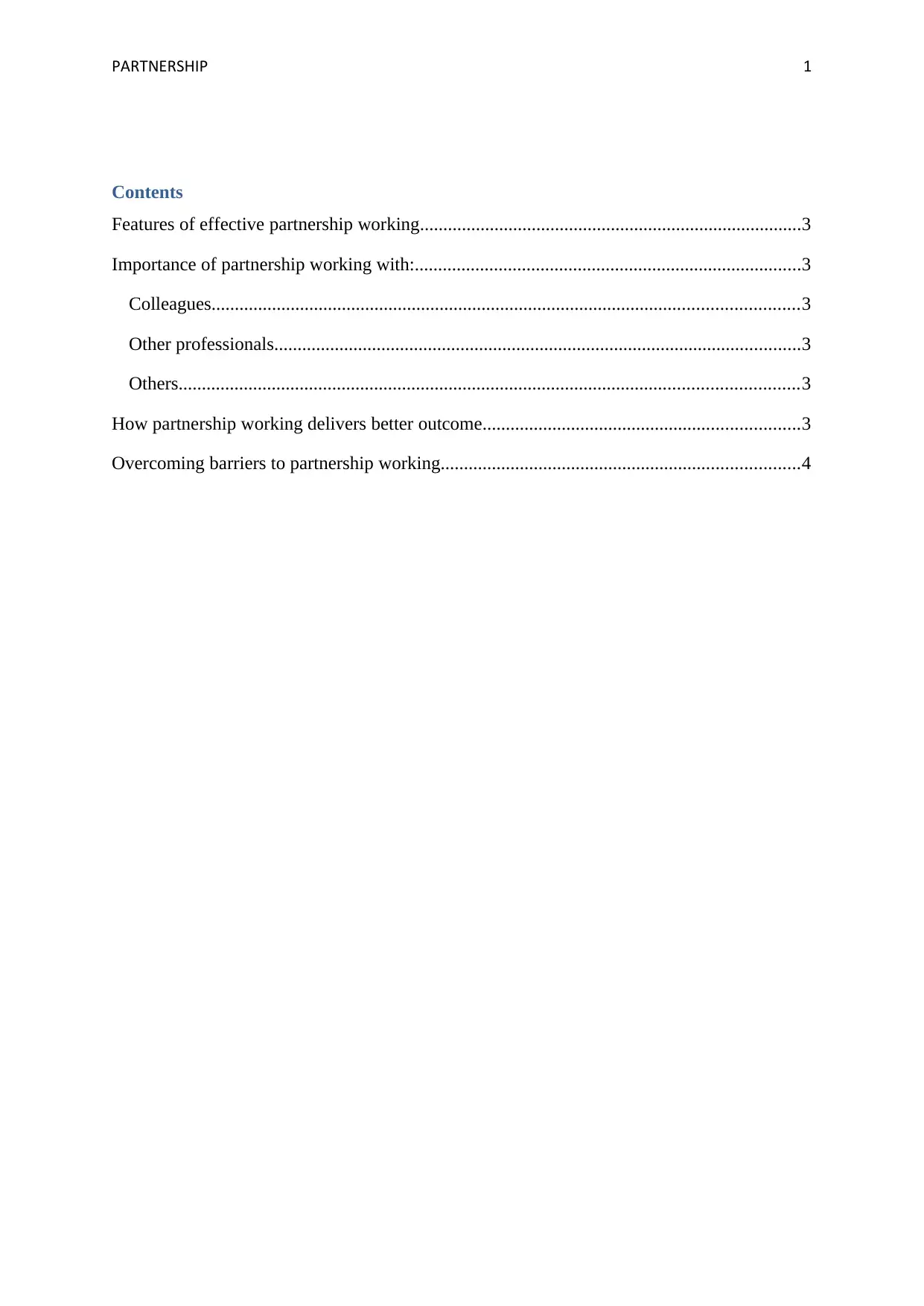
Contents
Features of effective partnership working..................................................................................3
Importance of partnership working with:...................................................................................3
Colleagues..............................................................................................................................3
Other professionals.................................................................................................................3
Others.....................................................................................................................................3
How partnership working delivers better outcome....................................................................3
Overcoming barriers to partnership working.............................................................................4
Contents
Features of effective partnership working..................................................................................3
Importance of partnership working with:...................................................................................3
Colleagues..............................................................................................................................3
Other professionals.................................................................................................................3
Others.....................................................................................................................................3
How partnership working delivers better outcome....................................................................3
Overcoming barriers to partnership working.............................................................................4

PARTNERSHIP 2
Features of effective partnership working
Partnership working has been the regular public policy from the last 40 years in health and
social care. Previous as well as current attempts in the partnership working have also risen.
The legislation of 1940 has set up the current welfare state. It is based on the assumption that
it was quite simple to differentiate the sick people and that person who has some health needs
as well as to those who are disabled. These stated assumptions has created the various
organizations with different structures with varied ways of working including those
complexities that partnership working necessitates (Rincón-Gallardo and Fullan, 2016). The
delivery of services in the partnership working not only focused on the social and health care,
but also between the service users themselves. This is demonstrated in a paper that “shifting
the balance of power within the NHS.” It set out the strategy implementation for the plan of
NHS. However, it also seemed to stress the leading role of health rather than on the social
care (Baker, 2010).
Importance of partnership working with:
Colleagues
partnership working has demonstrated the various benefits for the staff members; it provides
more clear understanding regarding responsibilities and roles. It also decreases the level of
stress. Members who are working in partnership with the service user family become more
attentive to the individual need of family member (Webb, 2016).
Other professionals
An effective and efficient partnership among the care home workers as well as other
professionals like health care workers more relies on the recognition that whole part care
about the same objective. It is done for promoting the health of service user. It is possible that
each member will take the different way to achieve the goal but it will be the common
outline. Partnership can also be enhanced by certifying the place of service user in centre
(Jelphs and Dickinson, 2016). It is true that partnership working can be improve when all the
professionals in health, home and social care link together for searching the problems and
take more anticipatory approach for health.
Features of effective partnership working
Partnership working has been the regular public policy from the last 40 years in health and
social care. Previous as well as current attempts in the partnership working have also risen.
The legislation of 1940 has set up the current welfare state. It is based on the assumption that
it was quite simple to differentiate the sick people and that person who has some health needs
as well as to those who are disabled. These stated assumptions has created the various
organizations with different structures with varied ways of working including those
complexities that partnership working necessitates (Rincón-Gallardo and Fullan, 2016). The
delivery of services in the partnership working not only focused on the social and health care,
but also between the service users themselves. This is demonstrated in a paper that “shifting
the balance of power within the NHS.” It set out the strategy implementation for the plan of
NHS. However, it also seemed to stress the leading role of health rather than on the social
care (Baker, 2010).
Importance of partnership working with:
Colleagues
partnership working has demonstrated the various benefits for the staff members; it provides
more clear understanding regarding responsibilities and roles. It also decreases the level of
stress. Members who are working in partnership with the service user family become more
attentive to the individual need of family member (Webb, 2016).
Other professionals
An effective and efficient partnership among the care home workers as well as other
professionals like health care workers more relies on the recognition that whole part care
about the same objective. It is done for promoting the health of service user. It is possible that
each member will take the different way to achieve the goal but it will be the common
outline. Partnership can also be enhanced by certifying the place of service user in centre
(Jelphs and Dickinson, 2016). It is true that partnership working can be improve when all the
professionals in health, home and social care link together for searching the problems and
take more anticipatory approach for health.
⊘ This is a preview!⊘
Do you want full access?
Subscribe today to unlock all pages.

Trusted by 1+ million students worldwide

PARTNERSHIP 3
Others
The major impact on the service user is improvement in their service access through proper
referral, speedy and great focus on the early intervention as well as prevention. Working in
partnership also helps in improving the lives of service users through best support. Working
in partnership also builds a non-judgemental and positive relationship with the concerned
family. In addition to this, through partnership it is ensured that family can tell the story only
once (Trotter, 2015).
How partnership working delivers better outcome
Partnership working across social and health care is seen as the heart of avoiding
fragmentation and providing seamless care. Professionals who all are involved in partnership
working report enjoy it and find it stimulating as well as rewarding. There is also an element
of job satisfaction from autonomy and creativity. In a study, it is founded that services are
improved for those clients who were retrieving more than one organization as well as
services. It also helps in reducing the stigma attached to the accessing services. There may be
various numbers of negative influences on the professional identities, which can arise from
the partnership working between social and health care agencies.
Professions who are involved in partnership work states that they really enjoy this and
find it stimulating and rewarding.
Those members who are involved in development of new approaches, it creates the
job satisfaction from the experience.
It also helps in gaining the confidence among professionals.
Overcoming barriers to partnership working
Barriers in partnership are needed for the mutual respect between all the agencies who are
involved in service care. Sometimes health professions are seen as condescending by pointing
out the obvious for the older people caring. There is also concern about the recognition of
home care. There can also be power dynamics that means that health professionals who are
working in the NHS will more professional, powerful as well as will feel the higher status
(Ramaswamy, Kallam, Kopic, Pujic and Owen, 2016). It will put direct impact on the equal
partnership working. There is also the need to put emphasis on the building of good quality of
relationship that will be based on the greater quality in relationships and trust between the
Others
The major impact on the service user is improvement in their service access through proper
referral, speedy and great focus on the early intervention as well as prevention. Working in
partnership also helps in improving the lives of service users through best support. Working
in partnership also builds a non-judgemental and positive relationship with the concerned
family. In addition to this, through partnership it is ensured that family can tell the story only
once (Trotter, 2015).
How partnership working delivers better outcome
Partnership working across social and health care is seen as the heart of avoiding
fragmentation and providing seamless care. Professionals who all are involved in partnership
working report enjoy it and find it stimulating as well as rewarding. There is also an element
of job satisfaction from autonomy and creativity. In a study, it is founded that services are
improved for those clients who were retrieving more than one organization as well as
services. It also helps in reducing the stigma attached to the accessing services. There may be
various numbers of negative influences on the professional identities, which can arise from
the partnership working between social and health care agencies.
Professions who are involved in partnership work states that they really enjoy this and
find it stimulating and rewarding.
Those members who are involved in development of new approaches, it creates the
job satisfaction from the experience.
It also helps in gaining the confidence among professionals.
Overcoming barriers to partnership working
Barriers in partnership are needed for the mutual respect between all the agencies who are
involved in service care. Sometimes health professions are seen as condescending by pointing
out the obvious for the older people caring. There is also concern about the recognition of
home care. There can also be power dynamics that means that health professionals who are
working in the NHS will more professional, powerful as well as will feel the higher status
(Ramaswamy, Kallam, Kopic, Pujic and Owen, 2016). It will put direct impact on the equal
partnership working. There is also the need to put emphasis on the building of good quality of
relationship that will be based on the greater quality in relationships and trust between the
Paraphrase This Document
Need a fresh take? Get an instant paraphrase of this document with our AI Paraphraser

PARTNERSHIP 4
agencies. Therefore, in order to improve the working relationships, there need to be great
blurring of boundaries. This will also promote the joined-up working.
The working concept of joined-up will enhance when the paper work will be done more
common or communication system will become more equitable (Mason, Goddard, Meatherly
and Chalkley, 2015).
Training, sharing education and workforce development can also help in improving
matters.
Effective and better communication is also essential for the agencies for good
working of partnership. It can also happen that some staff members also feel lonely
and this is required to reduce through creating support networks and making partner
group. Interaction also needs to be continue as well as various agencies required to be
mindful for reducing the jargons and promoting more clear understanding.
Including the reviews of carers and patients is also essential for the better
communication process. It is best method for helping the staff members to look at the
things in new ways and bring some creativity in the process (Reid, Compton,
Grossman and Fanjiang, 2015).
Poor attitude in the society is also required to change related to care sector for
promoting the care provision and better working. For addressing the poor attitude in
the care sector, there is needed to start addressing the attitude in the sector. Better
training of home care staff can also reduce the demand for healthcare professionals.
Joint-working among individuals and advocates is also required to enhance if paper
work is to be made common.
Interaction is also required to be regular in order to promote the clarity of
understanding.
Carer can also benefit by building the relationship with individuals in organization.
By working in partnership, individuals also learn to fill the personality differences
such as problem of open communication, over hesitation.
Work on time is also learned with the help of partnership.
agencies. Therefore, in order to improve the working relationships, there need to be great
blurring of boundaries. This will also promote the joined-up working.
The working concept of joined-up will enhance when the paper work will be done more
common or communication system will become more equitable (Mason, Goddard, Meatherly
and Chalkley, 2015).
Training, sharing education and workforce development can also help in improving
matters.
Effective and better communication is also essential for the agencies for good
working of partnership. It can also happen that some staff members also feel lonely
and this is required to reduce through creating support networks and making partner
group. Interaction also needs to be continue as well as various agencies required to be
mindful for reducing the jargons and promoting more clear understanding.
Including the reviews of carers and patients is also essential for the better
communication process. It is best method for helping the staff members to look at the
things in new ways and bring some creativity in the process (Reid, Compton,
Grossman and Fanjiang, 2015).
Poor attitude in the society is also required to change related to care sector for
promoting the care provision and better working. For addressing the poor attitude in
the care sector, there is needed to start addressing the attitude in the sector. Better
training of home care staff can also reduce the demand for healthcare professionals.
Joint-working among individuals and advocates is also required to enhance if paper
work is to be made common.
Interaction is also required to be regular in order to promote the clarity of
understanding.
Carer can also benefit by building the relationship with individuals in organization.
By working in partnership, individuals also learn to fill the personality differences
such as problem of open communication, over hesitation.
Work on time is also learned with the help of partnership.

PARTNERSHIP 5
References
Rincón-Gallardo, S. and Fullan, M. (2016) Essential features of effective networks in
education. Journal of Professional Capital and Community, 1(1), pp.5-22.
Webb, A. (2016) Features of effective partnership working in social and health care. [online]
Available from: http://www.thespark.org.uk/tag/features-of-effective-partnership-working-in-
health-and-social-care/ [accessed 10/1/19].
Jelphs, K. and Dickinson, H. (2016) Working in teams 2e. United Kingdom: Routledge.
Ramaswamy, R., Kallam, B., Kopic, D., Pujic, B. and Owen, M.D. (2016) Global health
partnerships: building multi-national collaborations to achieve lasting improvements in
maternal and neonatal health. Globalization and health, 12(1), p.22.
Mason, A., Goddard, M., Weatherly, H. and Chalkley, M. (2015) Integrating funds for health
and social care: an evidence review. Journal of health services research & policy, 20(3),
pp.177-188.
Trotter, C. (2015) Working with involuntary clients: A guide to practice. Routledge: United
Kingdom.
Reid, P.P., Compton, W.D., Grossman, J.H. and Fanjiang, G. (2015) Building a better
delivery system: a new engineering/health care partnership (Vol. 15). Washington, DC:
National Academies Press.
Baker, R., Camosso-Stefinovic, J., Gillies, C., Shaw, E.J., Cheater, F., Flottorp, S. and
Robertson, N., (2010) Tailored interventions to overcome identified barriers to change:
effects on professional practice and health care outcomes. The Cochrane database of
systematic reviews, (3), p.CD005470.
References
Rincón-Gallardo, S. and Fullan, M. (2016) Essential features of effective networks in
education. Journal of Professional Capital and Community, 1(1), pp.5-22.
Webb, A. (2016) Features of effective partnership working in social and health care. [online]
Available from: http://www.thespark.org.uk/tag/features-of-effective-partnership-working-in-
health-and-social-care/ [accessed 10/1/19].
Jelphs, K. and Dickinson, H. (2016) Working in teams 2e. United Kingdom: Routledge.
Ramaswamy, R., Kallam, B., Kopic, D., Pujic, B. and Owen, M.D. (2016) Global health
partnerships: building multi-national collaborations to achieve lasting improvements in
maternal and neonatal health. Globalization and health, 12(1), p.22.
Mason, A., Goddard, M., Weatherly, H. and Chalkley, M. (2015) Integrating funds for health
and social care: an evidence review. Journal of health services research & policy, 20(3),
pp.177-188.
Trotter, C. (2015) Working with involuntary clients: A guide to practice. Routledge: United
Kingdom.
Reid, P.P., Compton, W.D., Grossman, J.H. and Fanjiang, G. (2015) Building a better
delivery system: a new engineering/health care partnership (Vol. 15). Washington, DC:
National Academies Press.
Baker, R., Camosso-Stefinovic, J., Gillies, C., Shaw, E.J., Cheater, F., Flottorp, S. and
Robertson, N., (2010) Tailored interventions to overcome identified barriers to change:
effects on professional practice and health care outcomes. The Cochrane database of
systematic reviews, (3), p.CD005470.
⊘ This is a preview!⊘
Do you want full access?
Subscribe today to unlock all pages.

Trusted by 1+ million students worldwide
1 out of 6
Related Documents
Your All-in-One AI-Powered Toolkit for Academic Success.
+13062052269
info@desklib.com
Available 24*7 on WhatsApp / Email
Unlock your academic potential
Copyright © 2020–2026 A2Z Services. All Rights Reserved. Developed and managed by ZUCOL.