OTHM0704 Level 7: Health and Social Care Strategies and Policies
VerifiedAdded on 2023/06/07
|9
|3025
|64
Report
AI Summary
This report provides an in-depth analysis of health and social care strategies and policies, focusing on international healthcare policy development, internal and external environments of healthcare organizations, strategic and business plans based on environmental analysis, and the contribution of public and health promotion. It addresses the challenges and issues in the global health and social care industry, emphasizing the importance of health equity highlighted by the COVID-19 pandemic. The report explores strategies such as the Equality, Equity, and policy approach, considering political, economic, social, and cultural factors. It also examines internal factors like organizational structure and culture, and external factors like technological advancements and cultural preferences, affecting the quality of care services. Furthermore, the report discusses strategic planning, environmental analysis, and the role of health promotion in enhancing well-being and preventing premature deaths, highlighting the interconnectedness of health education and promotion.
Level 7 Health and Social Care
Strategies and Policies
OTHM0704L7DHSCM
Strategies and Policies
OTHM0704L7DHSCM

Paraphrase This Document
Need a fresh take? Get an instant paraphrase of this document with our AI Paraphraser
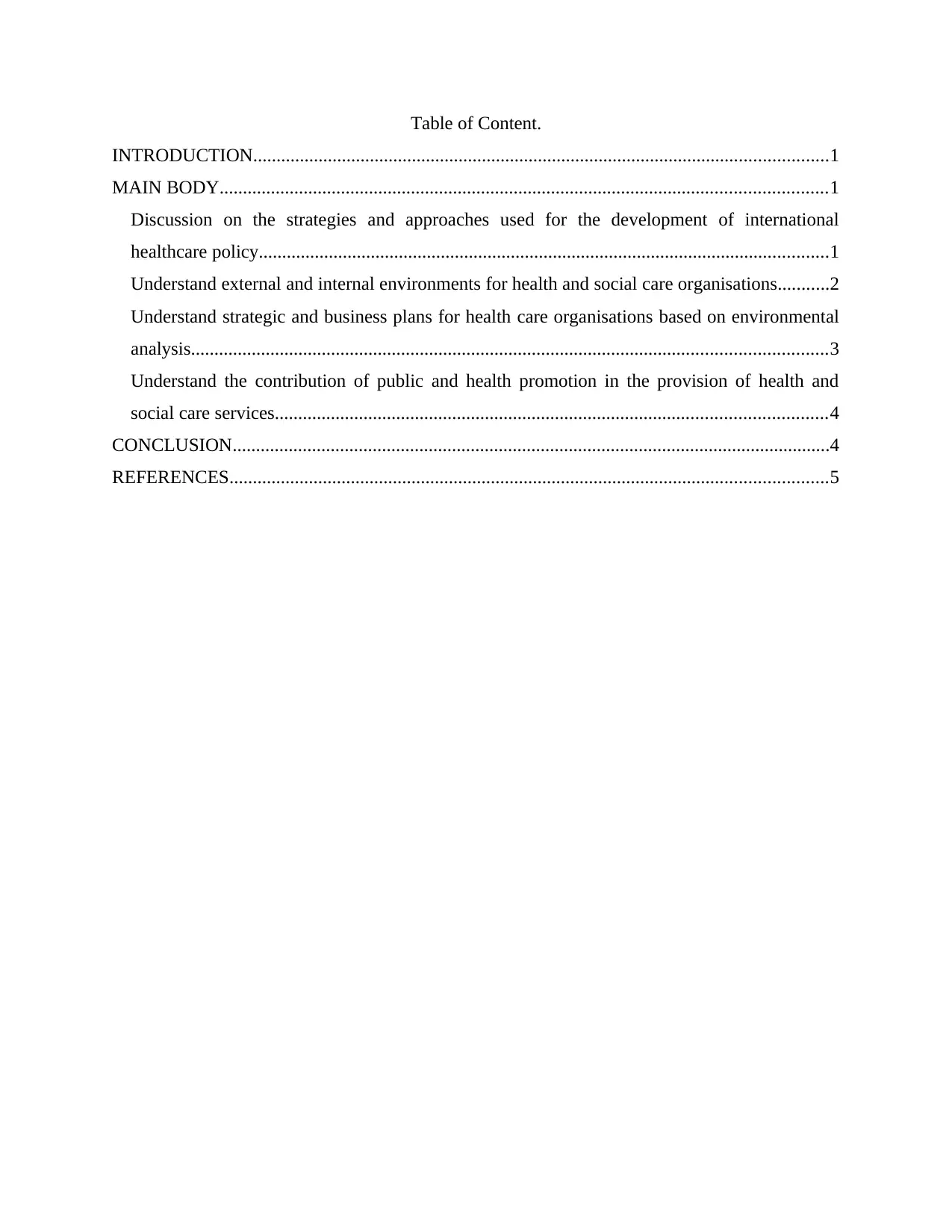
Table of Content.
INTRODUCTION...........................................................................................................................1
MAIN BODY..................................................................................................................................1
Discussion on the strategies and approaches used for the development of international
healthcare policy..........................................................................................................................1
Understand external and internal environments for health and social care organisations...........2
Understand strategic and business plans for health care organisations based on environmental
analysis........................................................................................................................................3
Understand the contribution of public and health promotion in the provision of health and
social care services......................................................................................................................4
CONCLUSION................................................................................................................................4
REFERENCES................................................................................................................................5
INTRODUCTION...........................................................................................................................1
MAIN BODY..................................................................................................................................1
Discussion on the strategies and approaches used for the development of international
healthcare policy..........................................................................................................................1
Understand external and internal environments for health and social care organisations...........2
Understand strategic and business plans for health care organisations based on environmental
analysis........................................................................................................................................3
Understand the contribution of public and health promotion in the provision of health and
social care services......................................................................................................................4
CONCLUSION................................................................................................................................4
REFERENCES................................................................................................................................5
INTRODUCTION
The concept of strategic planning within the healthcare settings mainly outlines the
actionable steps which are required to reach towards significant objectives or goals. In this, there
are various unique strategy types as well as the levels, the purpose of overall strategies is to bring
all the possible and effective actions into an alignment with its defined aims or the values.
Currently, the well-being care providers generally need more patient-centric, the value-based
methods, whereas various current system can follow older, more traditional strategy models as
well. More progressively, the companies are having to recalibrate their effective well-being care
strategies to suit the recent trends within the market as well as altering the methods towards the
patient care (Chen, & Antonelli, (2020)). In this, the strategic planning within the healthcare
organization can particularly entails taking proactive steps towards an objective, not only
addressing an immediate issue as they improve. In order to present the report, it will cover the
effective strategies and methods which can be used for the improvement of an international
healthcare policy. There is a discussion about the concepts of external and internal environments
for health and social care organisations. Furthermore, there is discussion about the contribution
of public and health promotion within the provision of health and social care services.
MAIN BODY
Discussion on the strategies and approaches used for the development of international healthcare
policy.
The health and social care industry has been facing many challenges and issues on the
global level. This is mainly due to the shift in the preferences and health related behaviour of the
service users. The health care industry is rapidly introducing digital technology which is the need
of the hour. Currently achieving the target of health equity is the main concern of the health care
industry. The pandemic of COVID which completely shattered the health industry have made the
issue of equity in terms of health services quite evident. The pandemic also changed the people's
perception about the pharmaceutical industry increasing its value by many folds. The current
situation of the pharmaceutical industry is becoming more complex as the expectations of the
consumers are increasing at a great pace which is resulting in growing competitions for the
already existing pharma companies. Also with the increasing demand, disruptions in the supply
chains is also being increasingly seen. With evolution in the causative organisms the requirement
1
The concept of strategic planning within the healthcare settings mainly outlines the
actionable steps which are required to reach towards significant objectives or goals. In this, there
are various unique strategy types as well as the levels, the purpose of overall strategies is to bring
all the possible and effective actions into an alignment with its defined aims or the values.
Currently, the well-being care providers generally need more patient-centric, the value-based
methods, whereas various current system can follow older, more traditional strategy models as
well. More progressively, the companies are having to recalibrate their effective well-being care
strategies to suit the recent trends within the market as well as altering the methods towards the
patient care (Chen, & Antonelli, (2020)). In this, the strategic planning within the healthcare
organization can particularly entails taking proactive steps towards an objective, not only
addressing an immediate issue as they improve. In order to present the report, it will cover the
effective strategies and methods which can be used for the improvement of an international
healthcare policy. There is a discussion about the concepts of external and internal environments
for health and social care organisations. Furthermore, there is discussion about the contribution
of public and health promotion within the provision of health and social care services.
MAIN BODY
Discussion on the strategies and approaches used for the development of international healthcare
policy.
The health and social care industry has been facing many challenges and issues on the
global level. This is mainly due to the shift in the preferences and health related behaviour of the
service users. The health care industry is rapidly introducing digital technology which is the need
of the hour. Currently achieving the target of health equity is the main concern of the health care
industry. The pandemic of COVID which completely shattered the health industry have made the
issue of equity in terms of health services quite evident. The pandemic also changed the people's
perception about the pharmaceutical industry increasing its value by many folds. The current
situation of the pharmaceutical industry is becoming more complex as the expectations of the
consumers are increasing at a great pace which is resulting in growing competitions for the
already existing pharma companies. Also with the increasing demand, disruptions in the supply
chains is also being increasingly seen. With evolution in the causative organisms the requirement
1
⊘ This is a preview!⊘
Do you want full access?
Subscribe today to unlock all pages.

Trusted by 1+ million students worldwide
of evolved drugs is increasing which is resulting in increased spending on the testing of new
formulations and drugs. The political agenda of shifting the concept of health care provision
more towards promoting public health is also an upcoming issue for the health industry. Along
with the example of health issues that are at priority of the industry are mental health, cancer,
Corona virus, AIDS, malaria, obesity etc. The strategies and approaches that the health
organisations like NHS and other local and private health service organisations are utilising for
formation of health and social care policies is the Equality, Equity and policy approach in which
a health policy triangle is used for ensuring the focus to all the factors that can affect the policies
formed. It consists of four components, actors being the first of which is related to the
individuals, organisations, groups that the policy will have its effect on. Context is the second
component that covers all the situational, structural and cultural factors that might affect the
formulation of the policy. Content includes the subjects and topic covered by the policy and
process is the manner in which the policies are formulated, communicated, implemented and in
the end evaluated. The policy is formulated keeping in mind the funds that have been allotted to
a particular industry. The policies are formulated in such a way that the funds that have been
provided to the health care industry are utilised in a very cost effective and efficient manner. The
policies are formulated keeping in all the aspects or factors like political, economic, social and
cultural aspects on both national and international levels (Fancourt & Finn, (2019)).
The health care sector of the country can be public funded, private funded, or can be
funded by religious or charitable means. The United Kingdom's health and social care policy
states principles for practising good methods in the management and conduct of health and social
care services and should be provided while keeping in mind the legal requirements and
standards. UK's health policies emphasize on the four principles namely autonomy, non-m
maleficence, beneficence and justice. The health care organisation of UK, NHS is primarily
funded by the government and its services are free at the point of use. The health policies cab be
bifurcated into a number of types which include Global health policy, mental health policy,
personal health care policies, pharmaceutical policies, public health policies such as vaccination
or control or prohibition policies.
Understand external and internal environments for health and social care organisations
Quality of health care being a critical factor in the health industry is the main deciding
factor for the number of positive outcomes obtained by any health care organisation. The quality
2
formulations and drugs. The political agenda of shifting the concept of health care provision
more towards promoting public health is also an upcoming issue for the health industry. Along
with the example of health issues that are at priority of the industry are mental health, cancer,
Corona virus, AIDS, malaria, obesity etc. The strategies and approaches that the health
organisations like NHS and other local and private health service organisations are utilising for
formation of health and social care policies is the Equality, Equity and policy approach in which
a health policy triangle is used for ensuring the focus to all the factors that can affect the policies
formed. It consists of four components, actors being the first of which is related to the
individuals, organisations, groups that the policy will have its effect on. Context is the second
component that covers all the situational, structural and cultural factors that might affect the
formulation of the policy. Content includes the subjects and topic covered by the policy and
process is the manner in which the policies are formulated, communicated, implemented and in
the end evaluated. The policy is formulated keeping in mind the funds that have been allotted to
a particular industry. The policies are formulated in such a way that the funds that have been
provided to the health care industry are utilised in a very cost effective and efficient manner. The
policies are formulated keeping in all the aspects or factors like political, economic, social and
cultural aspects on both national and international levels (Fancourt & Finn, (2019)).
The health care sector of the country can be public funded, private funded, or can be
funded by religious or charitable means. The United Kingdom's health and social care policy
states principles for practising good methods in the management and conduct of health and social
care services and should be provided while keeping in mind the legal requirements and
standards. UK's health policies emphasize on the four principles namely autonomy, non-m
maleficence, beneficence and justice. The health care organisation of UK, NHS is primarily
funded by the government and its services are free at the point of use. The health policies cab be
bifurcated into a number of types which include Global health policy, mental health policy,
personal health care policies, pharmaceutical policies, public health policies such as vaccination
or control or prohibition policies.
Understand external and internal environments for health and social care organisations
Quality of health care being a critical factor in the health industry is the main deciding
factor for the number of positive outcomes obtained by any health care organisation. The quality
2
Paraphrase This Document
Need a fresh take? Get an instant paraphrase of this document with our AI Paraphraser
of the health and social care services provided to the service users can be affected by two sets of
factors, first being the external factors and the second is the internal factors. The management
and leaders of any health and social care organisation should have a sound knowledge of these
internal and external factors and about these can affect the health services. The management
should formulate the health care policies and strategies in such a way that it incorporates all the
elements of the external and internal factors in the process of service providing (Greenhalgh, &
Papoutsi, (2018)).
Internal factor: Internal factors that can affect the quality of the care services consist of
the structure and culture of the health care organisation, competency level of the health care
providers, organisational infrastructure, leaders and management of the organisation and the
collaboration of the whole organisation for delivering quality care to the service users. The
structure of the organisation warrants the activities that are required to be performed in order to
meet the ultimate objective. The organisational structure is responsible for the decision making
process for the delivery of care services and for the roles and responsibilities of the individual
entities of the organisation. The culture that is being followed in the organisation gives an insight
of the nature of practices that are being practised with in the organisation and also provides
information about the believes and assumptions of the employees and the value of the services
and facilities. The organisational should have quality embedded in its culture. Working
environment of the organisation is another internal factor that can have its effect on the other
internal factors like the competency and performance of the employees. Therefore, an
organisation should focus on maintaining a healthy working environment for its employees to
ensure provision of quality care services to its service users (Salim, Ab Rahman & Abd Wahab,
(2019)).
External factors: The external factors that affect the quality of the care services include the
social and cultural factors, economic factors, the legal factors and the current technological
advancements. These factors enable the organisation to be able to provide the best care services
by ensuring that the employees of the organisation are equipped with the most technologically
updated resources. This also ensures the proper utilisation of the skills of the employees. For
example, as per the current trends the use of artificial intelligence in the health care industry is
increasing. Use of artificial intelligence will contribute positively to the levels of quality of care
services that are being provided at a health care setting. The health care organisations should
3
factors, first being the external factors and the second is the internal factors. The management
and leaders of any health and social care organisation should have a sound knowledge of these
internal and external factors and about these can affect the health services. The management
should formulate the health care policies and strategies in such a way that it incorporates all the
elements of the external and internal factors in the process of service providing (Greenhalgh, &
Papoutsi, (2018)).
Internal factor: Internal factors that can affect the quality of the care services consist of
the structure and culture of the health care organisation, competency level of the health care
providers, organisational infrastructure, leaders and management of the organisation and the
collaboration of the whole organisation for delivering quality care to the service users. The
structure of the organisation warrants the activities that are required to be performed in order to
meet the ultimate objective. The organisational structure is responsible for the decision making
process for the delivery of care services and for the roles and responsibilities of the individual
entities of the organisation. The culture that is being followed in the organisation gives an insight
of the nature of practices that are being practised with in the organisation and also provides
information about the believes and assumptions of the employees and the value of the services
and facilities. The organisational should have quality embedded in its culture. Working
environment of the organisation is another internal factor that can have its effect on the other
internal factors like the competency and performance of the employees. Therefore, an
organisation should focus on maintaining a healthy working environment for its employees to
ensure provision of quality care services to its service users (Salim, Ab Rahman & Abd Wahab,
(2019)).
External factors: The external factors that affect the quality of the care services include the
social and cultural factors, economic factors, the legal factors and the current technological
advancements. These factors enable the organisation to be able to provide the best care services
by ensuring that the employees of the organisation are equipped with the most technologically
updated resources. This also ensures the proper utilisation of the skills of the employees. For
example, as per the current trends the use of artificial intelligence in the health care industry is
increasing. Use of artificial intelligence will contribute positively to the levels of quality of care
services that are being provided at a health care setting. The health care organisations should
3
practice provision of culturally competent services i.e. the social and cultural preferences of the
service users should be respected by the health care organisations. This will result in promoting
health equity irrespective of the race, gender, caste or cultural and traditional preferences of the
patients (Yusliza & et. al., (2019)).
Understand strategic and business plans for health care organisations based on environmental
analysis.
Strategic plan for health care organisation implies to deciding the steps that are required
to be brought to action in order to achieve a specific goal. Environmental analysis in strategic
planning includes analyses of the internal and external factors that might affect the health care
setting either in a positive or negative manner. This includes analysis of the factors in such a way
that the effects of the factors are revealed and the opportunities and the threats that those factors
can pose to the health care business can be anticipated. Environmental analysis thus allows the
management of the health care setting to formulate strategies that can benefit the provision of
health care services. As the health care industry is very uncertain and complicated in nature,
environmental analysis can help the organisation to design strategies that are compatible and can
be implemented with ease to increase the level of quality of the care services. The strategies
build after this type of analysis very efficiently address the key issues that are proving to be a
hindrance to the vision and goals of the organisation (Taliento, Favino & Netti, (2019)).
The majority of healthcare organization can develop a thorough plan in order to prepare
for the future problems which can influence their facilities as well as the well-being care field at
great. These such providers should concentrate over creating the effective strategies which can
anticipate the potential requirements for extra resources like the personnel and capital as well.
Such type of long-term planning is called as prospective strategy. In this, the prospective strategy
must also enable for the flexibility in case unforeseen improvements happen within the
healthcare settings. Strategic planning is crucial within healthcare settings as it can enhance the
communication within all the chains, improving and sharing a vision, enhanced worker’s
motivation as well as engagement, the transformational leadership and authority, enhanced team
cooperation and collaboration and many more.
4
service users should be respected by the health care organisations. This will result in promoting
health equity irrespective of the race, gender, caste or cultural and traditional preferences of the
patients (Yusliza & et. al., (2019)).
Understand strategic and business plans for health care organisations based on environmental
analysis.
Strategic plan for health care organisation implies to deciding the steps that are required
to be brought to action in order to achieve a specific goal. Environmental analysis in strategic
planning includes analyses of the internal and external factors that might affect the health care
setting either in a positive or negative manner. This includes analysis of the factors in such a way
that the effects of the factors are revealed and the opportunities and the threats that those factors
can pose to the health care business can be anticipated. Environmental analysis thus allows the
management of the health care setting to formulate strategies that can benefit the provision of
health care services. As the health care industry is very uncertain and complicated in nature,
environmental analysis can help the organisation to design strategies that are compatible and can
be implemented with ease to increase the level of quality of the care services. The strategies
build after this type of analysis very efficiently address the key issues that are proving to be a
hindrance to the vision and goals of the organisation (Taliento, Favino & Netti, (2019)).
The majority of healthcare organization can develop a thorough plan in order to prepare
for the future problems which can influence their facilities as well as the well-being care field at
great. These such providers should concentrate over creating the effective strategies which can
anticipate the potential requirements for extra resources like the personnel and capital as well.
Such type of long-term planning is called as prospective strategy. In this, the prospective strategy
must also enable for the flexibility in case unforeseen improvements happen within the
healthcare settings. Strategic planning is crucial within healthcare settings as it can enhance the
communication within all the chains, improving and sharing a vision, enhanced worker’s
motivation as well as engagement, the transformational leadership and authority, enhanced team
cooperation and collaboration and many more.
4
⊘ This is a preview!⊘
Do you want full access?
Subscribe today to unlock all pages.
Trusted by 1+ million students worldwide
Understand the contribution of public and health promotion in the provision of health and social
care services.
Promotion of health is generally a process which can enable the people to effectively control
over, as well as to enhance their well-being. In this, as a core function of the public health, the
promotion of the well-being can encourage the higher authorities, the communities as well as the
people to overcome with as well as can address the well-being challenges. It is mainly
accomplished by establishing the healthy public policies, creating the supportive and effective
environment as well as can strengthen the community actions and personal skills as well. Having
health promotions can effectively decreases the premature deaths. By concentrating over the
prevention, the well-being promotions can decrease the costs which people, the workers, the
family members, the clinical facilities, communities as well as the nation which can spend over
clinical care treatment. In this, the health education as well as the health promotion are mainly
the two concepts that are mostly used interchangeably. In this, the well-being education is all
about furnishing well-being data as well as the understanding to a person or the community and
furnishing the effective skills to allow the people to acquire a healthy behaviour voluntarily. It is
generally a combination of the learning experiences that is designed to aid the people and their
communities can enhance their well-being by advancing their understanding or can impact their
attitudes as well (Vaishnavi, Suresh & Dutta, (2019)).
In the social issues context, there are some of the issues grown within the society in contrast
with health promotion, which can make it quite challenging for the people to attain their full
potential. These such can include unemployment, racism, poverty, having unequal opportunities
and malnutrition as well. while talking about racism, it can take a direct toll over the colour of
people, causing an unhealthy stress level, the feeling of powerlessness, having negative impact to
physical and mental well-being. In addition to this, the accumulation of the regular stressors
generally linked with an exposure of discrimination and racism can cause a toxic stress generally
beginning at a prior stage of life. These such stress can influence the mental, physical as well as
the behavioural well-being via their lives. In addition to this, a core function of the public well-
being, the well-being promotion can encourage the higher authorities, communities and a person
to cope with as well as can address the well-being difficulties. It is mainly accomplished by
building the healthy public policies, specifically producing a supportive environment as well as
strengthening the effective actions of the community and personal skills as well. The well-being
5
care services.
Promotion of health is generally a process which can enable the people to effectively control
over, as well as to enhance their well-being. In this, as a core function of the public health, the
promotion of the well-being can encourage the higher authorities, the communities as well as the
people to overcome with as well as can address the well-being challenges. It is mainly
accomplished by establishing the healthy public policies, creating the supportive and effective
environment as well as can strengthen the community actions and personal skills as well. Having
health promotions can effectively decreases the premature deaths. By concentrating over the
prevention, the well-being promotions can decrease the costs which people, the workers, the
family members, the clinical facilities, communities as well as the nation which can spend over
clinical care treatment. In this, the health education as well as the health promotion are mainly
the two concepts that are mostly used interchangeably. In this, the well-being education is all
about furnishing well-being data as well as the understanding to a person or the community and
furnishing the effective skills to allow the people to acquire a healthy behaviour voluntarily. It is
generally a combination of the learning experiences that is designed to aid the people and their
communities can enhance their well-being by advancing their understanding or can impact their
attitudes as well (Vaishnavi, Suresh & Dutta, (2019)).
In the social issues context, there are some of the issues grown within the society in contrast
with health promotion, which can make it quite challenging for the people to attain their full
potential. These such can include unemployment, racism, poverty, having unequal opportunities
and malnutrition as well. while talking about racism, it can take a direct toll over the colour of
people, causing an unhealthy stress level, the feeling of powerlessness, having negative impact to
physical and mental well-being. In addition to this, the accumulation of the regular stressors
generally linked with an exposure of discrimination and racism can cause a toxic stress generally
beginning at a prior stage of life. These such stress can influence the mental, physical as well as
the behavioural well-being via their lives. In addition to this, a core function of the public well-
being, the well-being promotion can encourage the higher authorities, communities and a person
to cope with as well as can address the well-being difficulties. It is mainly accomplished by
building the healthy public policies, specifically producing a supportive environment as well as
strengthening the effective actions of the community and personal skills as well. The well-being
5
Paraphrase This Document
Need a fresh take? Get an instant paraphrase of this document with our AI Paraphraser
campaigns are mainly used to enhance awareness of the essential well-being problems and can
enhances the group or people to seek the services and information as well. Via any stimulation in
knowledge, a person can with time alter its attitude and the longer term, more specifically when
the other specific intervention programmes are used, altered their behaviour effectively (World
Health Organization. (2019)).
CONCLUSION
From the above discussion, it is being concluded that the healthcare organization is greatly
impacted by its extrinsic environment of an individual, organization, various enterprises as well
as the sectors of the community. Such environment also includes social, cultural, financial,
technological, political as well as several other forces which can both positively and negatively
affect the healthcare organization. In addition to this, it is quite essential to develop plannings
within organization as it can give the leaders or key stakeholders with the effective data mainly
required to make significant decisions regarding the practice or healthcare organization. It is get
to know by the study that health promotions and public well-being can be encouraged by the
higher authorities, the communities as well as a person to cope with as well as can address the
specific well-being difficulties.
6
enhances the group or people to seek the services and information as well. Via any stimulation in
knowledge, a person can with time alter its attitude and the longer term, more specifically when
the other specific intervention programmes are used, altered their behaviour effectively (World
Health Organization. (2019)).
CONCLUSION
From the above discussion, it is being concluded that the healthcare organization is greatly
impacted by its extrinsic environment of an individual, organization, various enterprises as well
as the sectors of the community. Such environment also includes social, cultural, financial,
technological, political as well as several other forces which can both positively and negatively
affect the healthcare organization. In addition to this, it is quite essential to develop plannings
within organization as it can give the leaders or key stakeholders with the effective data mainly
required to make significant decisions regarding the practice or healthcare organization. It is get
to know by the study that health promotions and public well-being can be encouraged by the
higher authorities, the communities as well as a person to cope with as well as can address the
specific well-being difficulties.
6
REFERENCES
Books and Journals:
Chen, P. J., & Antonelli, M. (2020). Conceptual models of food choice: influential factors
related to foods, individual differences, and society. Foods, 9(12), 1898.
Fancourt, D., & Finn, S. (2019). What is the evidence on the role of the arts in improving health
and well-being? A scoping review. World Health Organization. Regional Office for Europe.
Greenhalgh, T., & Papoutsi, C. (2018). Studying complexity in health services research:
desperately seeking an overdue paradigm shift. BMC medicine, 16(1), 1-6.
Salim, N., Ab Rahman, M. N., & Abd Wahab, D. (2019). A systematic literature review of
internal capabilities for enhancing eco-innovation performance of manufacturing firms. Journal
of cleaner production, 209, 1445-1460.
Sue, D. W., Alsaidi, S., Awad, M. N., Glaeser, E., Calle, C. Z., & Mendez, N. (2019). Disarming
racial microaggressions: Microintervention strategies for targets, White allies, and
bystanders. American Psychologist, 74(1), 128.
Taliento, M., Favino, C., & Netti, A. (2019). Impact of environmental, social, and governance
information on economic performance: Evidence of a corporate ‘sustainability advantage’from
Europe. Sustainability, 11(6), 1738.
Vaishnavi, V., Suresh, M., & Dutta, P. (2019). A study on the influence of factors associated
with organizational readiness for change in healthcare organizations using
TISM. Benchmarking: An International Journal.
World Health Organization. (2019). Global action plan on physical activity 2018-2030: more
active people for a healthier world. World Health Organization.
Yusliza, M. Y., Norazmi, N. A., Jabbour, C. J. C., Fernando, Y., Fawehinmi, O., & Seles, B. M.
R. P. (2019). Top management commitment, corporate social responsibility and green human
resource management: A Malaysian study. Benchmarking: An International Journal.
7
Books and Journals:
Chen, P. J., & Antonelli, M. (2020). Conceptual models of food choice: influential factors
related to foods, individual differences, and society. Foods, 9(12), 1898.
Fancourt, D., & Finn, S. (2019). What is the evidence on the role of the arts in improving health
and well-being? A scoping review. World Health Organization. Regional Office for Europe.
Greenhalgh, T., & Papoutsi, C. (2018). Studying complexity in health services research:
desperately seeking an overdue paradigm shift. BMC medicine, 16(1), 1-6.
Salim, N., Ab Rahman, M. N., & Abd Wahab, D. (2019). A systematic literature review of
internal capabilities for enhancing eco-innovation performance of manufacturing firms. Journal
of cleaner production, 209, 1445-1460.
Sue, D. W., Alsaidi, S., Awad, M. N., Glaeser, E., Calle, C. Z., & Mendez, N. (2019). Disarming
racial microaggressions: Microintervention strategies for targets, White allies, and
bystanders. American Psychologist, 74(1), 128.
Taliento, M., Favino, C., & Netti, A. (2019). Impact of environmental, social, and governance
information on economic performance: Evidence of a corporate ‘sustainability advantage’from
Europe. Sustainability, 11(6), 1738.
Vaishnavi, V., Suresh, M., & Dutta, P. (2019). A study on the influence of factors associated
with organizational readiness for change in healthcare organizations using
TISM. Benchmarking: An International Journal.
World Health Organization. (2019). Global action plan on physical activity 2018-2030: more
active people for a healthier world. World Health Organization.
Yusliza, M. Y., Norazmi, N. A., Jabbour, C. J. C., Fernando, Y., Fawehinmi, O., & Seles, B. M.
R. P. (2019). Top management commitment, corporate social responsibility and green human
resource management: A Malaysian study. Benchmarking: An International Journal.
7
⊘ This is a preview!⊘
Do you want full access?
Subscribe today to unlock all pages.
Trusted by 1+ million students worldwide

1 out of 9


Related Documents


Your All-in-One AI-Powered Toolkit for Academic Success.
+13062052269
info@desklib.com
Available 24*7 on WhatsApp / Email
![[object Object]](/_next/static/media/star-bottom.7253800d.svg)
Unlock your academic potential
Copyright © 2020–2026 A2Z Services. All Rights Reserved. Developed and managed by ZUCOL.