Health and Social Care: Information Management and Security Report

Verified

Added on  2020/02/14

|7
|1727
|341
Report
AI Summary
This report provides a comprehensive overview of information management and security within the health and social care (HSC) sector. It explores the legal framework, including the Data Protection Act 2008 and the Freedom of Information Act 2000, emphasizing their role in safeguarding patient data and ensuring privacy. The report details various information handling practices, such as manual and electronic record-keeping systems, and discusses the importance of organizational policies and procedures to comply with legal and ethical standards. It also highlights the measures taken to secure confidential information, including login systems and physical security protocols. Furthermore, the report examines the significance of employee and patient awareness campaigns in promoting best practices for information handling, ultimately aiming to protect sensitive data and maintain the integrity of HSC operations. The document is contributed by a student to be published on the website Desklib. Desklib is a platform which provides all the necessary AI based study tools for students.

Document Page
HEALTH AND SOCIAL CARE
1
tabler-icon-diamond-filled.svg

Paraphrase This Document

Need a fresh take? Get an instant paraphrase of this document with our AI Paraphraser
Document Page
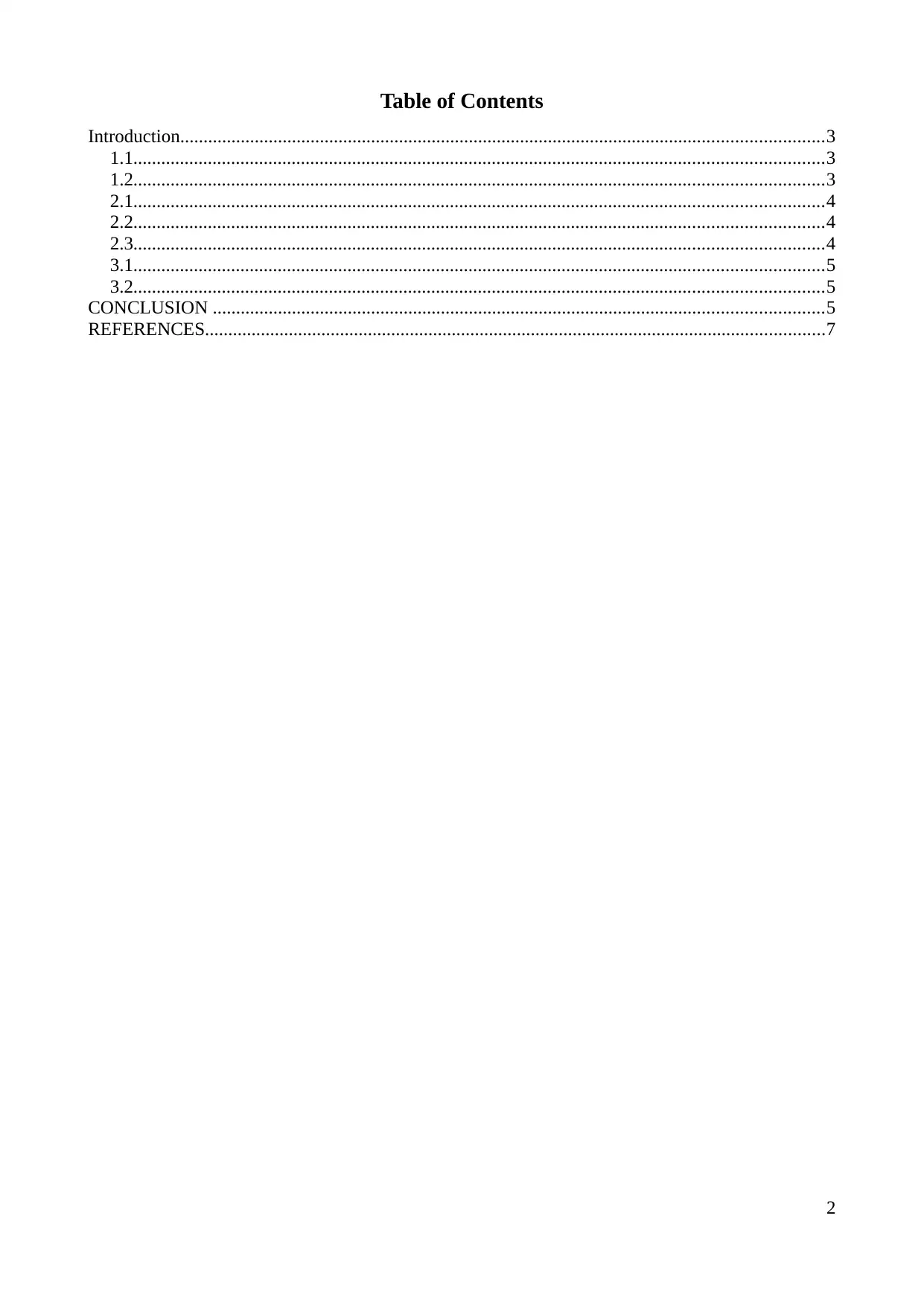
Table of Contents
Introduction..........................................................................................................................................3
1.1....................................................................................................................................................3
1.2....................................................................................................................................................3
2.1....................................................................................................................................................4
2.2....................................................................................................................................................4
2.3....................................................................................................................................................4
3.1....................................................................................................................................................5
3.2....................................................................................................................................................5
CONCLUSION ...................................................................................................................................5
REFERENCES.....................................................................................................................................7
2
Document Page
INTRODUCTION
Health and social care is emerging sector which demands highly refined knowledge and
patience to handle tough business situations. The complex organisational structure increases the
demand of protecting the overall systems to restrict the entry of unauthorised users by placing
barriers in the form of technologies and supervisors in manual system of storage of the records.
1.1
There are various rules and regulations framed by legal authority related to handling
complex information in health and social care by imposing different acts which are given as below:
Data protection Act 2008- This act come into existence in order to provide personal
privacy to protect all the confidential information held by these institutions (Braveman,
2016). The information belongs to the patients to be held by an enterprise for specific period
determined by the government. The act also prescribes the way of storing the data into tow
commonly used forms that is manually using data by management systems in offline way
and cloud system is an online storage of the data.
Freedom of information act 2000- This act gives equal right to an individual to seek
information from all the available public sources (Höög and Lysholm, 2016). The records
such as census about the population on specific reasons are available in the public records. It
also imposes restriction on getting the information in a good manner as taking information
for malicious objective will not be permitted by thus act as the public resources can be
accessed using appropriate procedures.
1.2
Information handling is a complex task which needs to be properly monitored in order avoid
any legal consequences (Hasan and Kobeissi, 2016). In an organisation several organisational
policies and guidelines are imposed by the external environment which needs to be comply by them
to protect the common interest of the firm that is the basic aim to achieve all its goals in given
period. Complying all the legal requirements is the primary objective of every firm as it provides
complete direction to move ahead in business life with less trade barriers and gale complications.
Legal requirements and codes ODF conduct refers to all the guidelines, policies and
procedures used by the owners to adhere with all the principles used in daily routine business.
These guidelines will assist an enterprise to protect itself from committing criminal offences within
legal supervision (Drummond and Sculpher, 2015). It gives an organisation guidance in different
forms which support an enterprise in storing data and handling personal and confidential
information of a person.
3
Document Page
2.1
Every organisation maintains records as an evidence in order to refer on later stage to avoid
any kind of misconceptions regarding business transactions. Perfect way to record the data in the
form of vital business information can be stored using standard format of storage. Efficient method
used in an enterprise is to record all the data using computer which is regarded as safe method to
store the data as in manual form the record can be stolen (Agarwal and Green, 2016). Records can
be stored in online form which should be updated in the system with minor changes takes place in
that records. The restrictions should be imposed by developing standard method of using flexible
information handling system that complies all the requirements of the health and social care which
meets all the business requirements and clinical settings. These records maintained are accurate,
valid, legible for others to form a perfect decisions based on the information collected.
2.2
Confidential information should be backed by perfect security which safeguards the
information to maintain its accuracy and protect it from misuse by unauthorised users. There are
different measures used by an organisation in an enterprise to ensure security when storing and
accessing the information (Braveman, 2016). Login systems can be used by an organisation to
ensure the safety of that information which are stored in a particular system. In login systems
passwords is applied on computers to seal the information to avoid misuse of the data by defaulters.
This login procedures can be modified by using different methods such as thumb impressions and
card scanning in the system which has placed on a gate to monitor the attendance.
The introduction of various interfaces top the system such as telephone, internet medium
which created turbulence in the existing workplace (Bellostas and López-Arceiz, 2016). Wide
number of interfaces will prove dangerous for an enterprise. The information can be kept in a sealed
room with laser technologies to ensure the safety of the premises from the viruses.
2.3
Securities can be placed in tow main different modes such as manual system as well as
electronic systems which is utilised by HSC to safeguard its resources from the external defaulters
to break the confidential seal of the information (Braveman, 2016). There are two kinds of system
methods which are explained below:
Manual system- It is also recognised as paper based system which is a traditional method of
maintaining records using paper and pen which is in the form of forms fill up by the patients
for taking admissions in the hospital, consent form filled by guardians of the patient for
doing operation or further treatments.
4
tabler-icon-diamond-filled.svg

Paraphrase This Document

Need a fresh take? Get an instant paraphrase of this document with our AI Paraphraser
Document Page
Electronic system- It will store all the records in the computer at the time of occurrence of
that transactions which forms legal evidence shown in terms of vouchers (Drummond and
Sculpher, 2015). These vouchers are prepared with date and time of that transaction in order
to reconcile in case of any kind discrepancies with the records.
3.1
HSC should frame such organisational policies and procedures which is flexible to be
adopted by an enterprise with fewer complications (Hasan and Kobeissi, 2016). In this kind of
sector, there are several needs of an individual in terms of handling delicate information with due
care to maintain its accuracy. The awareness campaigns should be organised in an institution to
inform all the workforce. Informing all the personnel regarding the legislation and guidelines
framed by the legal environment helps an enterprise to relief the stress on an organisation in terms
of social obligations.
These specific principles will help an individual in handling the information in appropriate
manner to complete the desired aims and targets of an individual (Höög and Lysholm, 2016). The
instruction manuals are distributed among the organisation which guides the employees to complete
their task by complying with all the standards imposed by the government.
The basic duty of an enterprise is to secure the information as per the prescribed guidelines in the
act like data protection act and the internal code of conduct framed by the business to ensure the
safeguarding of all its resources.
3.2
Increasing awareness among all the employees and the patients is the common used by an
institution to support the strategies to be build by this organisation (Jacobs and de Groot, 2016). The
awareness is not limited to spreading the information but all the advantages and the suitability of the
information in the different sectors are conveyed. This campaign can be conducted by organising
seminars, meetings, conferences. This communication can be done in two ways such as in both the
dimensions internally and externally.
The Public conferences can be called by the institution in which the industry experts such as
doctors, technical experts and all the patients are public are invited to participate in this event
(Kameshwar and Karahalios, 2016). The main purpose of this event is to aware all the persons
regarding the benefits an individual gets by utilising proper format of storage of data.
CONCLUSION
It can be summarised from the above study that the increasing complexities in the form of
interfaces increases the demand of safeguarding of the information. Operating successfully in this
5
Document Page
kind of sector where the need of storing records of all the patients and the external environment are
higher than other kind of industry. The documents of the mergers and acquisitions are also kept as
record due to the legal requirement of the business.
6
Document Page
REFERENCES
Books and Journals
Agarwal, R., Green, 2016. Benchmarking management practices in Australian public healthcare.
Journal of health organization and management. 30(1). pp.31-56.
Bellostas, A. J., López-Arceiz, 2016. Social Value and Economic Value in Social Enterprises: Value
Creation Model of Spanish Sheltered Workshops. VOLUNTAS: International Journal of
Voluntary and Non profit Organizations. 27(1). pp.367-391.
Braveman, B., 2016. Leading & managing occupational therapy services: an evidence-based
approach. FA Davis.
Drummond, M. F., Sculpher, 2015. Methods for the economic evaluation of health care
programmes. Oxford university press.
Hasan, I., Kobeissi, 2016. Corporate social responsibility and firm financial performance: the
mediating role of productivity. Journal of Business Ethics. pp.1-18.
Höög, E., Lysholm, 2016. Quality Improvement in large healthcare organizations: Searching for
system-wide and coherent monitoring and follow-up strategies. Journal of health
organization and management. 30(1). pp.133-153.
Jacobs, B., de Groot, 2016. Financial access to health care for older people in Cambodia: 10-year
trends (2004-14) and determinants of catastrophic health expenses. International Journal for
Equity in Health.15(1). p.1.
Kameshwar, K., Karahalios, 2016. False economies in home-based parenteral antibiotic treatment: a
health-economic case study of management of lower-limb cellulite in Australia. Journal of
Antimicrobial Chemotherapy. 71(3). pp.830-835.
7
chevron_up_icon
1 out of 7
circle_padding
hide_on_mobile
zoom_out_icon
[object Object]