Reporting and Record-Keeping in Health and Social Care - NHS Standards

Verified

Added on  2023/01/19

|1
|589
|85
Presentation
AI Summary
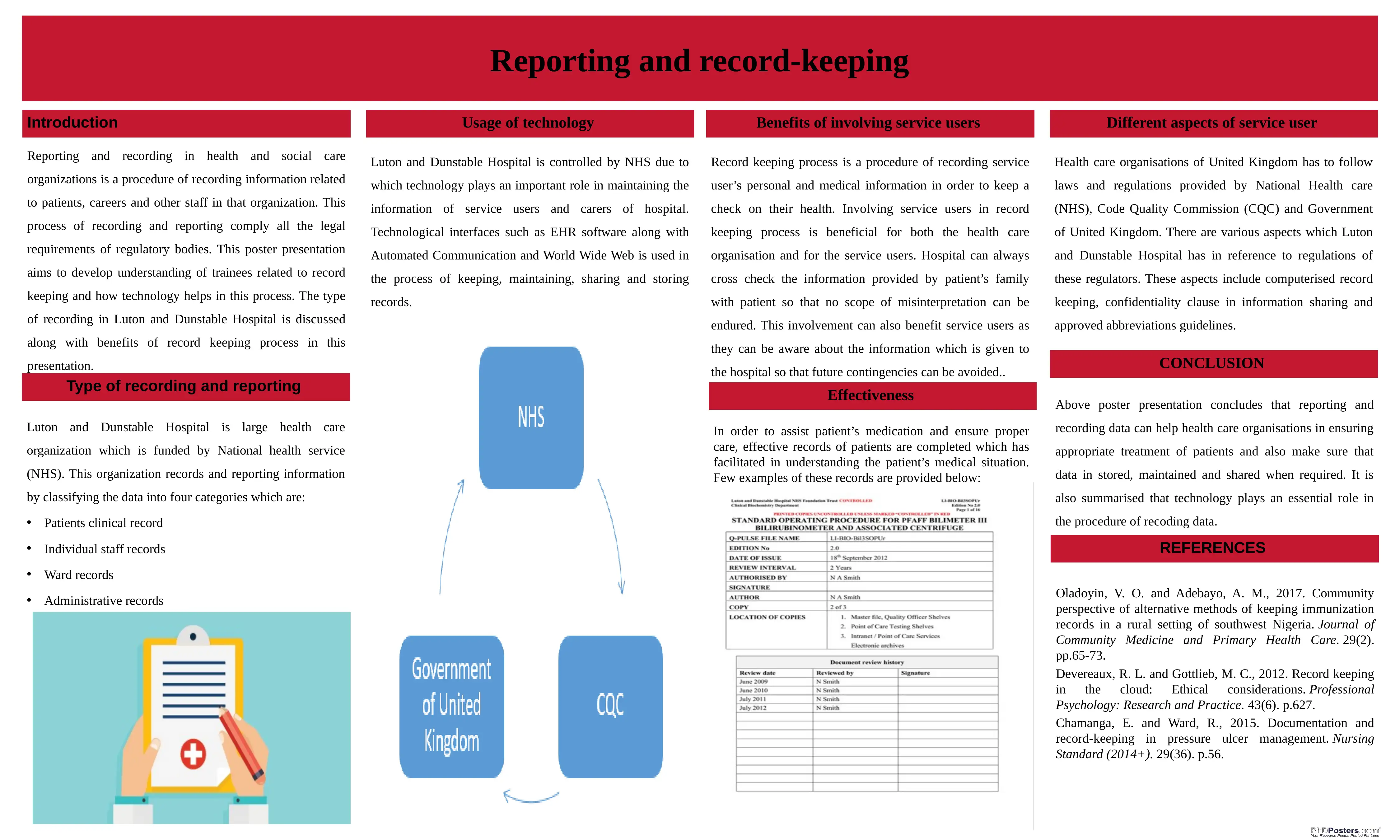
This presentation provides an overview of reporting and record-keeping practices within health and social care, particularly within the context of the Luton and Dunstable Hospital and NHS guidelines. It emphasizes the importance of technology, such as EHR software and automated communication systems, in maintaining accurate patient records and ensuring compliance with regulatory bodies like the National Health Service (NHS) and the Care Quality Commission (CQC). The presentation highlights the benefits of involving service users in the record-keeping process, improving data accuracy and patient awareness. It classifies data into clinical, staff, ward, and administrative categories, and concludes that effective reporting and recording are essential for appropriate patient treatment, data storage, and information sharing. The role of technology in streamlining these processes is also underscored, with references provided for further research.
Document Page
Reporting and record-keeping
Introduction
Reporting and recording in health and social care
organizations is a procedure of recording information related
to patients, careers and other staff in that organization. This
process of recording and reporting comply all the legal
requirements of regulatory bodies. This poster presentation
aims to develop understanding of trainees related to record
keeping and how technology helps in this process. The type
of recording in Luton and Dunstable Hospital is discussed
along with benefits of record keeping process in this
presentation.
Type of recording and reporting
Luton and Dunstable Hospital is large health care
organization which is funded by National health service
(NHS). This organization records and reporting information
by classifying the data into four categories which are:
Patients clinical record
Individual staff records
Ward records
Administrative records
Usage of technology Different aspects of service user
Health care organisations of United Kingdom has to follow
laws and regulations provided by National Health care
(NHS), Code Quality Commission (CQC) and Government
of United Kingdom. There are various aspects which Luton
and Dunstable Hospital has in reference to regulations of
these regulators. These aspects include computerised record
keeping, confidentiality clause in information sharing and
approved abbreviations guidelines.
Luton and Dunstable Hospital is controlled by NHS due to
which technology plays an important role in maintaining the
information of service users and carers of hospital.
Technological interfaces such as EHR software along with
Automated Communication and World Wide Web is used in
the process of keeping, maintaining, sharing and storing
records.
Benefits of involving service users
Record keeping process is a procedure of recording service
user’s personal and medical information in order to keep a
check on their health. Involving service users in record
keeping process is beneficial for both the health care
organisation and for the service users. Hospital can always
cross check the information provided by patient’s family
with patient so that no scope of misinterpretation can be
endured. This involvement can also benefit service users as
they can be aware about the information which is given to
the hospital so that future contingencies can be avoided..
Effectiveness
CONCLUSION
Above poster presentation concludes that reporting and
recording data can help health care organisations in ensuring
appropriate treatment of patients and also make sure that
data in stored, maintained and shared when required. It is
also summarised that technology plays an essential role in
the procedure of recoding data.
REFERENCES
Oladoyin, V. O. and Adebayo, A. M., 2017. Community
perspective of alternative methods of keeping immunization
records in a rural setting of southwest Nigeria. Journal of
Community Medicine and Primary Health Care. 29(2).
pp.65-73.
Devereaux, R. L. and Gottlieb, M. C., 2012. Record keeping
in the cloud: Ethical considerations. Professional
Psychology: Research and Practice. 43(6). p.627.
Chamanga, E. and Ward, R., 2015. Documentation and
record-keeping in pressure ulcer management. Nursing
Standard (2014+). 29(36). p.56.
In order to assist patient’s medication and ensure proper
care, effective records of patients are completed which has
facilitated in understanding the patient’s medical situation.
Few examples of these records are provided below:
tabler-icon-diamond-filled.svg

Paraphrase This Document

Need a fresh take? Get an instant paraphrase of this document with our AI Paraphraser
[object Object]