POPH90227: Healthcare Access for Marginalized Populations in Malawi

Verified

Added on  2023/06/12

|8
|1084
|396
Case Study
AI Summary
This assignment addresses the critical issue of healthcare access for marginalized populations in Malawi, focusing on strategies to improve health equity. It identifies key challenges such as inadequate funding, backward cultural beliefs, and poor transport infrastructure. The proposed solutions include subsidizing healthcare costs, building hospitals in rural areas, empowering marginalized populations through education, policy changes to promote culturally competent care, and improving transport infrastructure. The assignment emphasizes the importance of addressing marginalization to achieve health equity and suggests that the Department of Health (DoH) should prioritize equal distribution of healthcare resources, collaborate with stakeholders, and seek funding from diverse sources to ensure the success of these initiatives. This comprehensive approach aims to create a people-centered care system that benefits all members of the Malawian society. Desklib offers similar solved assignments and past papers for students.
Document Page
1
Public Health
Name
Institution
tabler-icon-diamond-filled.svg

Paraphrase This Document

Need a fresh take? Get an instant paraphrase of this document with our AI Paraphraser
Document Page
2
Public Health
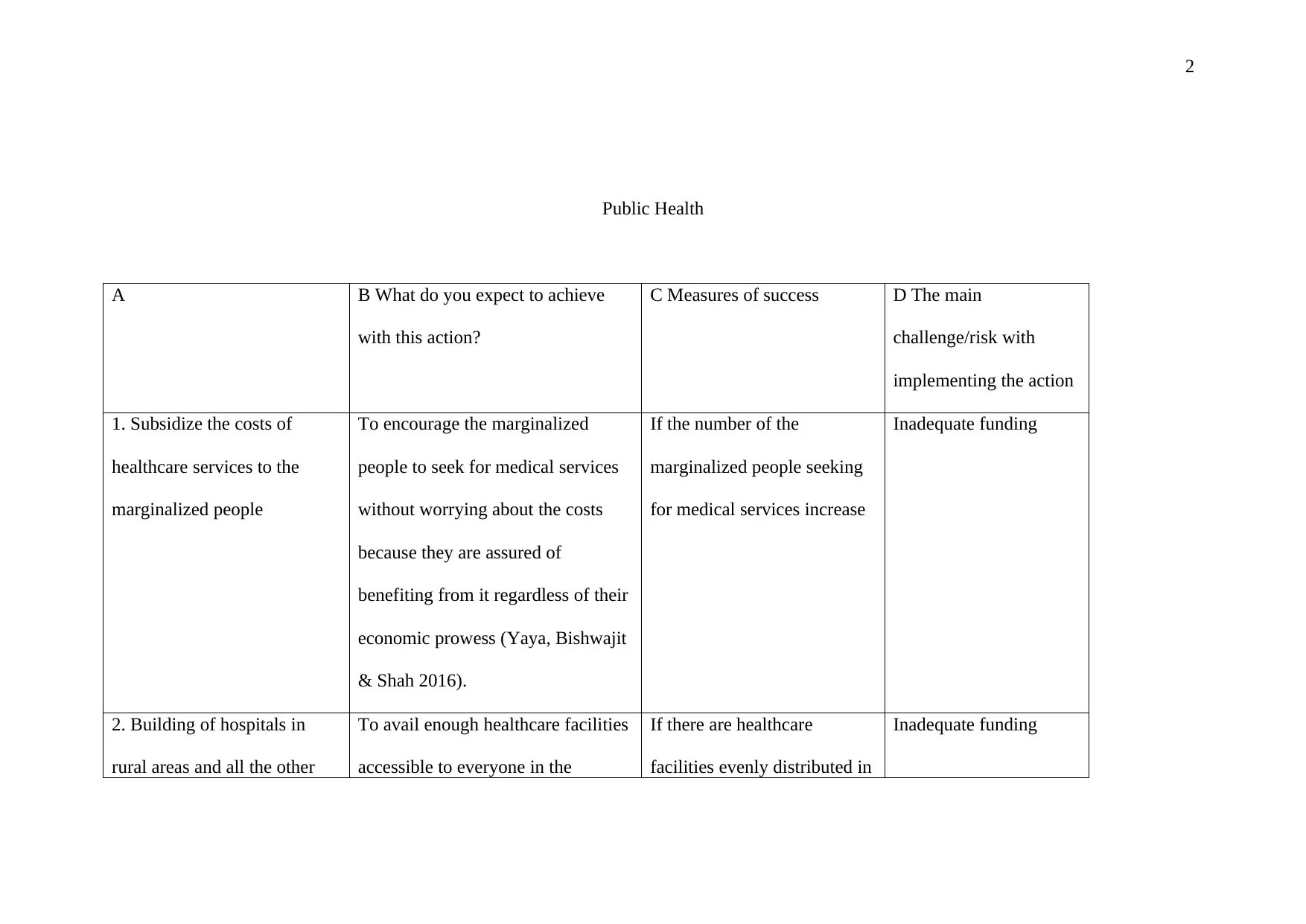
A B What do you expect to achieve
with this action?
C Measures of success D The main
challenge/risk with
implementing the action
1. Subsidize the costs of
healthcare services to the
marginalized people
To encourage the marginalized
people to seek for medical services
without worrying about the costs
because they are assured of
benefiting from it regardless of their
economic prowess (Yaya, Bishwajit
& Shah 2016).
If the number of the
marginalized people seeking
for medical services increase
Inadequate funding
2. Building of hospitals in
rural areas and all the other
To avail enough healthcare facilities
accessible to everyone in the
If there are healthcare
facilities evenly distributed in
Inadequate funding
Document Page
3
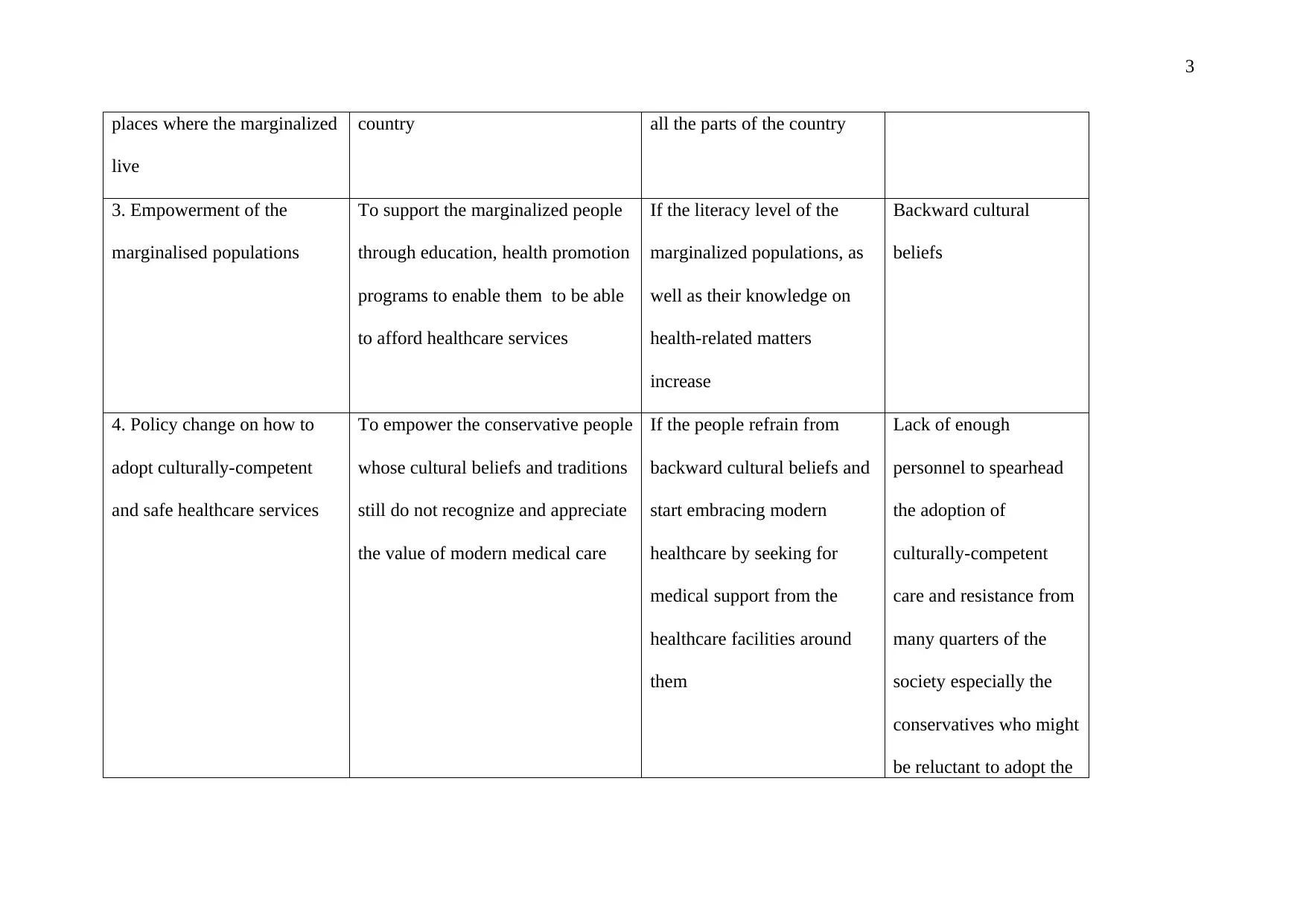
places where the marginalized
live
country all the parts of the country
3. Empowerment of the
marginalised populations
To support the marginalized people
through education, health promotion
programs to enable them to be able
to afford healthcare services
If the literacy level of the
marginalized populations, as
well as their knowledge on
health-related matters
increase
Backward cultural
beliefs
4. Policy change on how to
adopt culturally-competent
and safe healthcare services
To empower the conservative people
whose cultural beliefs and traditions
still do not recognize and appreciate
the value of modern medical care
If the people refrain from
backward cultural beliefs and
start embracing modern
healthcare by seeking for
medical support from the
healthcare facilities around
them
Lack of enough
personnel to spearhead
the adoption of
culturally-competent
care and resistance from
many quarters of the
society especially the
conservatives who might
be reluctant to adopt the
Document Page
4
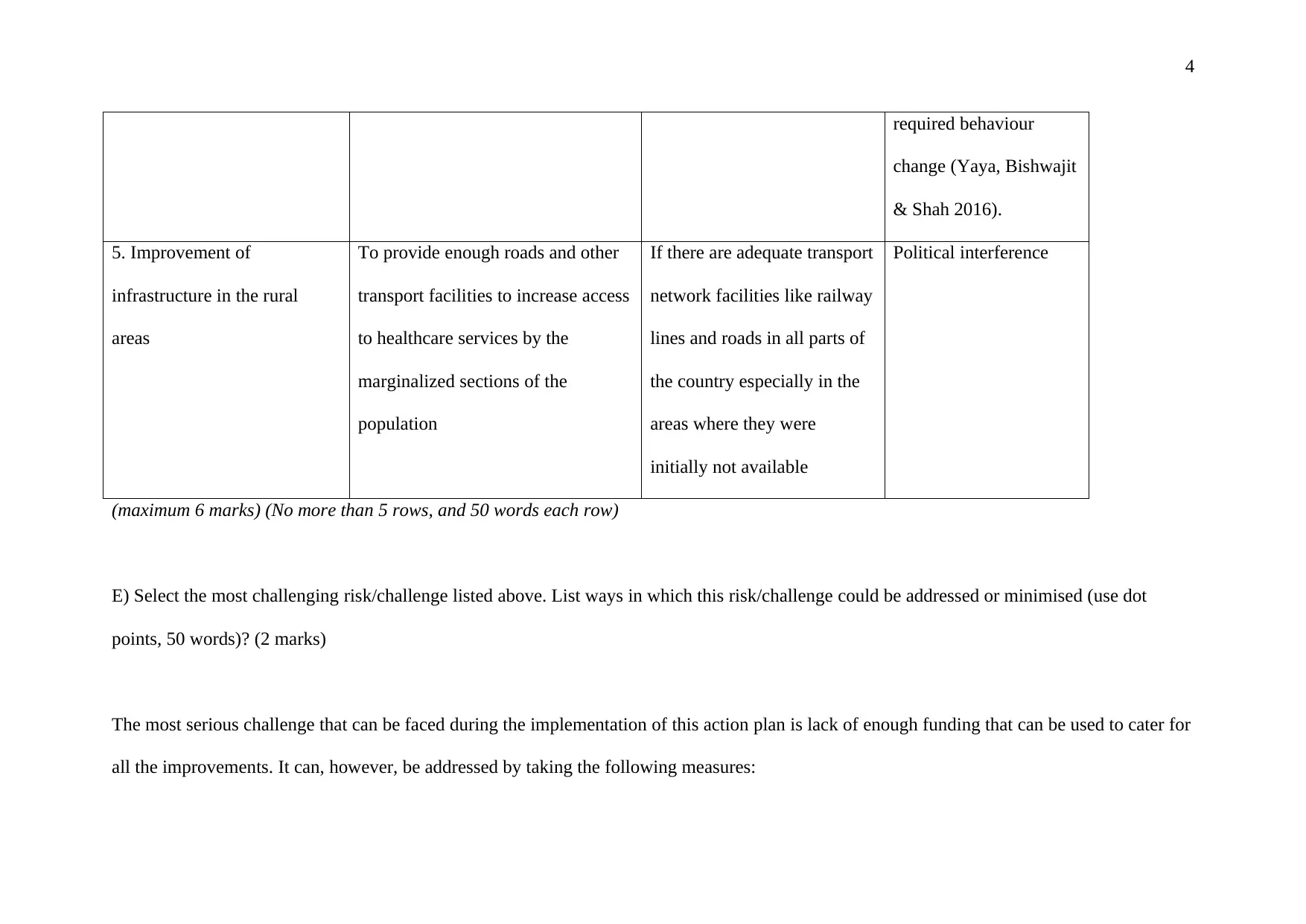
required behaviour
change (Yaya, Bishwajit
& Shah 2016).
5. Improvement of
infrastructure in the rural
areas
To provide enough roads and other
transport facilities to increase access
to healthcare services by the
marginalized sections of the
population
If there are adequate transport
network facilities like railway
lines and roads in all parts of
the country especially in the
areas where they were
initially not available
Political interference
(maximum 6 marks) (No more than 5 rows, and 50 words each row)
E) Select the most challenging risk/challenge listed above. List ways in which this risk/challenge could be addressed or minimised (use dot
points, 50 words)? (2 marks)
The most serious challenge that can be faced during the implementation of this action plan is lack of enough funding that can be used to cater for
all the improvements. It can, however, be addressed by taking the following measures:
tabler-icon-diamond-filled.svg

Paraphrase This Document

Need a fresh take? Get an instant paraphrase of this document with our AI Paraphraser
Document Page
5
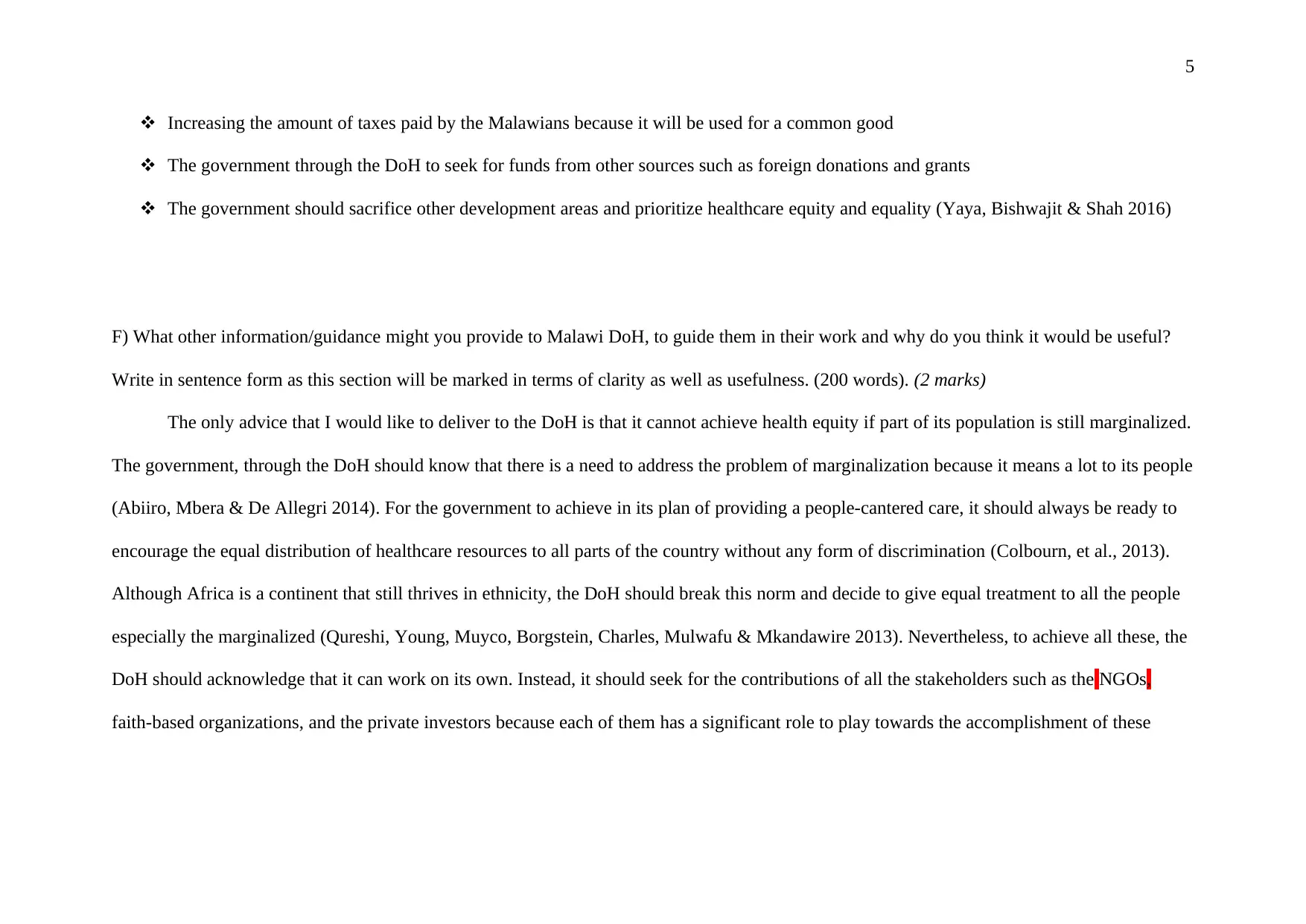
Increasing the amount of taxes paid by the Malawians because it will be used for a common good
The government through the DoH to seek for funds from other sources such as foreign donations and grants
The government should sacrifice other development areas and prioritize healthcare equity and equality (Yaya, Bishwajit & Shah 2016)
F) What other information/guidance might you provide to Malawi DoH, to guide them in their work and why do you think it would be useful?
Write in sentence form as this section will be marked in terms of clarity as well as usefulness. (200 words). (2 marks)
The only advice that I would like to deliver to the DoH is that it cannot achieve health equity if part of its population is still marginalized.
The government, through the DoH should know that there is a need to address the problem of marginalization because it means a lot to its people
(Abiiro, Mbera & De Allegri 2014). For the government to achieve in its plan of providing a people-cantered care, it should always be ready to
encourage the equal distribution of healthcare resources to all parts of the country without any form of discrimination (Colbourn, et al., 2013).
Although Africa is a continent that still thrives in ethnicity, the DoH should break this norm and decide to give equal treatment to all the people
especially the marginalized (Qureshi, Young, Muyco, Borgstein, Charles, Mulwafu & Mkandawire 2013). Nevertheless, to achieve all these, the
DoH should acknowledge that it can work on its own. Instead, it should seek for the contributions of all the stakeholders such as the NGOs,
faith-based organizations, and the private investors because each of them has a significant role to play towards the accomplishment of these
Document Page
6
goals. For example, the church and the private investors can help in the construction and management of hospitals, clinics, dispensaries, and
healthcare centres in different parts of the country (Fuentes-Nieva & Galasso, 2014).
Bibliography
Document Page
7
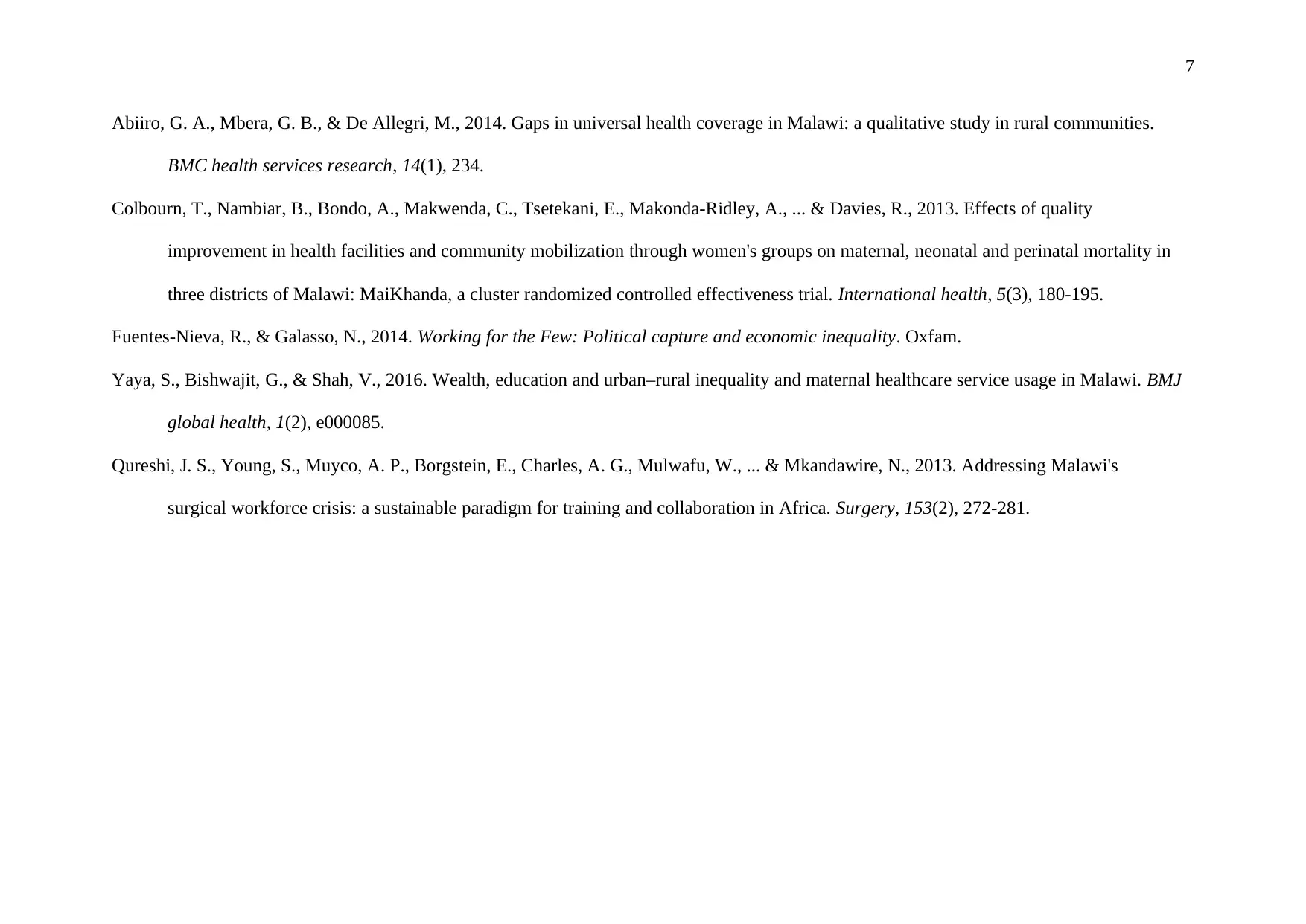
Abiiro, G. A., Mbera, G. B., & De Allegri, M., 2014. Gaps in universal health coverage in Malawi: a qualitative study in rural communities.
BMC health services research, 14(1), 234.
Colbourn, T., Nambiar, B., Bondo, A., Makwenda, C., Tsetekani, E., Makonda-Ridley, A., ... & Davies, R., 2013. Effects of quality
improvement in health facilities and community mobilization through women's groups on maternal, neonatal and perinatal mortality in
three districts of Malawi: MaiKhanda, a cluster randomized controlled effectiveness trial. International health, 5(3), 180-195.
Fuentes-Nieva, R., & Galasso, N., 2014. Working for the Few: Political capture and economic inequality. Oxfam.
Yaya, S., Bishwajit, G., & Shah, V., 2016. Wealth, education and urban–rural inequality and maternal healthcare service usage in Malawi. BMJ
global health, 1(2), e000085.
Qureshi, J. S., Young, S., Muyco, A. P., Borgstein, E., Charles, A. G., Mulwafu, W., ... & Mkandawire, N., 2013. Addressing Malawi's
surgical workforce crisis: a sustainable paradigm for training and collaboration in Africa. Surgery, 153(2), 272-281.
tabler-icon-diamond-filled.svg

Paraphrase This Document

Need a fresh take? Get an instant paraphrase of this document with our AI Paraphraser
Document Page
8
Glossary
DoH: Department of Health
NGOs: Non-Governmental Organisations
chevron_up_icon
1 out of 8
circle_padding
hide_on_mobile
zoom_out_icon
[object Object]