Comprehensive Analysis of Case Management in Healthcare: Unit 13
VerifiedAdded on 2019/12/17
|6
|1685
|217
Report
AI Summary
This report, focusing on healthcare case management, begins by discussing various models like direct service and brokerage, highlighting their roles in assessing, planning, and evaluating services for clients. It then addresses common challenges faced by clients, families, and carers, such as communication barriers and lack of financial support. The report delves into cultural considerations, protocols, and systems relevant to linguistically and culturally diverse clients, particularly Aboriginal Australians, emphasizing the importance of cultural sensitivity and respect. It examines issues related to client confusion, barriers, and concerns, including service duplication, and proposes practices and principles for planning complex service inputs across multiple services. The report concludes by referencing key studies that support the findings.

Running head: UNIT 13
UNIT 13
STUDENT NAME:
STUDENT ID:
PROFESSOR NAME:
UNIT 13
STUDENT NAME:
STUDENT ID:
PROFESSOR NAME:
Paraphrase This Document
Need a fresh take? Get an instant paraphrase of this document with our AI Paraphraser

2
UNIT 13
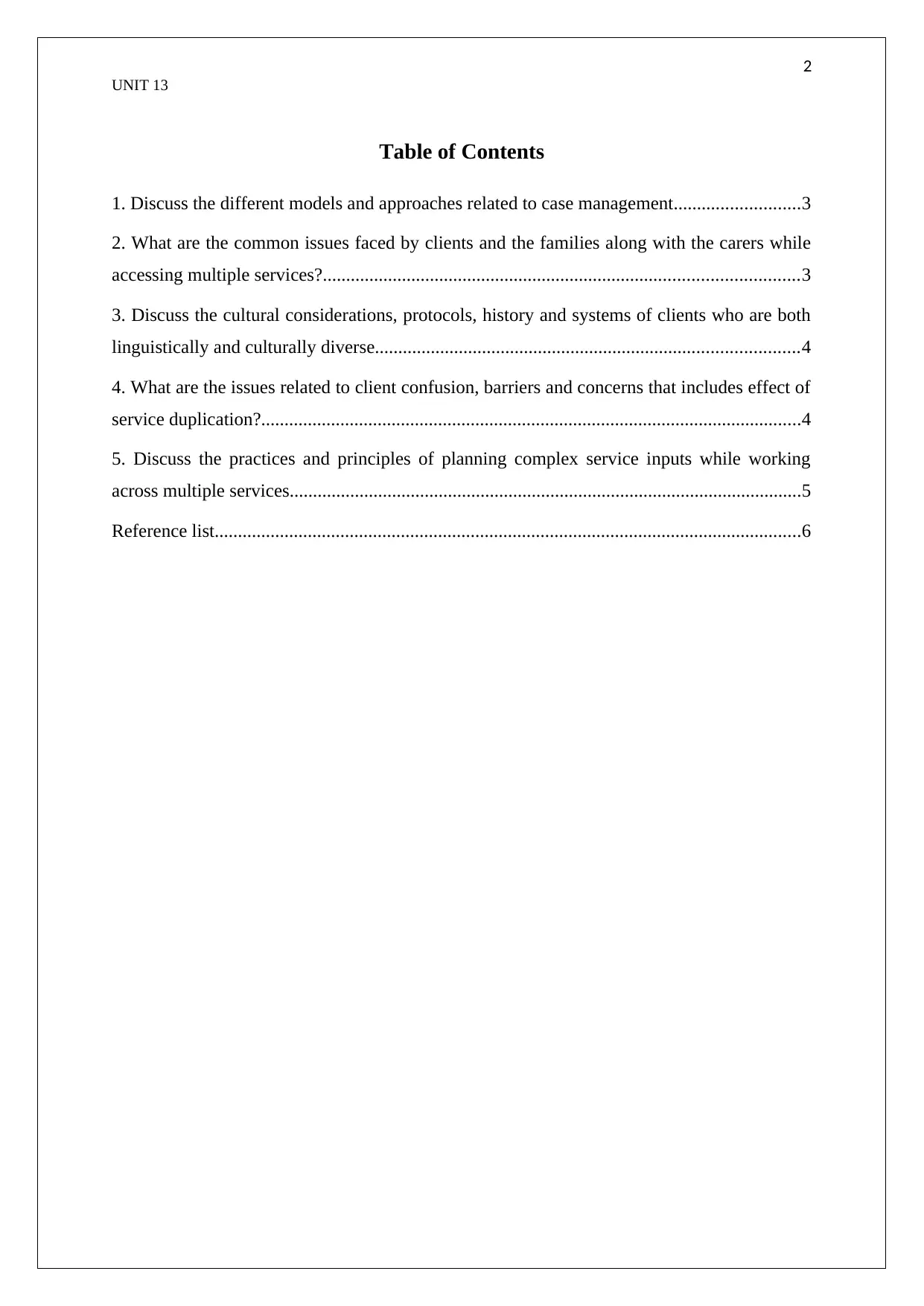
Table of Contents
1. Discuss the different models and approaches related to case management...........................3
2. What are the common issues faced by clients and the families along with the carers while
accessing multiple services?......................................................................................................3
3. Discuss the cultural considerations, protocols, history and systems of clients who are both
linguistically and culturally diverse...........................................................................................4
4. What are the issues related to client confusion, barriers and concerns that includes effect of
service duplication?....................................................................................................................4
5. Discuss the practices and principles of planning complex service inputs while working
across multiple services..............................................................................................................5
Reference list..............................................................................................................................6
UNIT 13
Table of Contents
1. Discuss the different models and approaches related to case management...........................3
2. What are the common issues faced by clients and the families along with the carers while
accessing multiple services?......................................................................................................3
3. Discuss the cultural considerations, protocols, history and systems of clients who are both
linguistically and culturally diverse...........................................................................................4
4. What are the issues related to client confusion, barriers and concerns that includes effect of
service duplication?....................................................................................................................4
5. Discuss the practices and principles of planning complex service inputs while working
across multiple services..............................................................................................................5
Reference list..............................................................................................................................6

3
UNIT 13
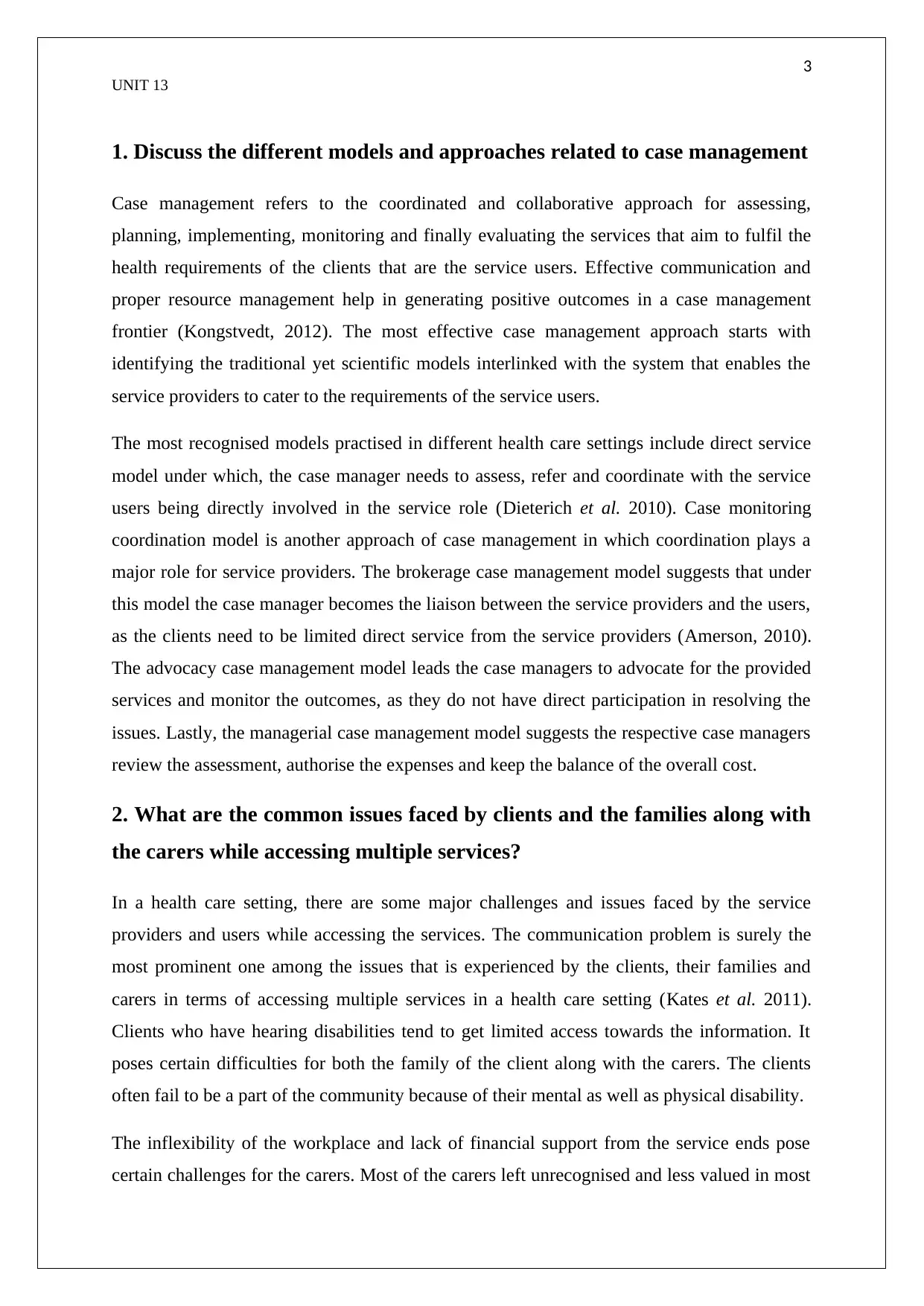
1. Discuss the different models and approaches related to case management
Case management refers to the coordinated and collaborative approach for assessing,
planning, implementing, monitoring and finally evaluating the services that aim to fulfil the
health requirements of the clients that are the service users. Effective communication and
proper resource management help in generating positive outcomes in a case management
frontier (Kongstvedt, 2012). The most effective case management approach starts with
identifying the traditional yet scientific models interlinked with the system that enables the
service providers to cater to the requirements of the service users.
The most recognised models practised in different health care settings include direct service
model under which, the case manager needs to assess, refer and coordinate with the service
users being directly involved in the service role (Dieterich et al. 2010). Case monitoring
coordination model is another approach of case management in which coordination plays a
major role for service providers. The brokerage case management model suggests that under
this model the case manager becomes the liaison between the service providers and the users,
as the clients need to be limited direct service from the service providers (Amerson, 2010).
The advocacy case management model leads the case managers to advocate for the provided
services and monitor the outcomes, as they do not have direct participation in resolving the
issues. Lastly, the managerial case management model suggests the respective case managers
review the assessment, authorise the expenses and keep the balance of the overall cost.
2. What are the common issues faced by clients and the families along with
the carers while accessing multiple services?
In a health care setting, there are some major challenges and issues faced by the service
providers and users while accessing the services. The communication problem is surely the
most prominent one among the issues that is experienced by the clients, their families and
carers in terms of accessing multiple services in a health care setting (Kates et al. 2011).
Clients who have hearing disabilities tend to get limited access towards the information. It
poses certain difficulties for both the family of the client along with the carers. The clients
often fail to be a part of the community because of their mental as well as physical disability.
The inflexibility of the workplace and lack of financial support from the service ends pose
certain challenges for the carers. Most of the carers left unrecognised and less valued in most
UNIT 13
1. Discuss the different models and approaches related to case management
Case management refers to the coordinated and collaborative approach for assessing,
planning, implementing, monitoring and finally evaluating the services that aim to fulfil the
health requirements of the clients that are the service users. Effective communication and
proper resource management help in generating positive outcomes in a case management
frontier (Kongstvedt, 2012). The most effective case management approach starts with
identifying the traditional yet scientific models interlinked with the system that enables the
service providers to cater to the requirements of the service users.
The most recognised models practised in different health care settings include direct service
model under which, the case manager needs to assess, refer and coordinate with the service
users being directly involved in the service role (Dieterich et al. 2010). Case monitoring
coordination model is another approach of case management in which coordination plays a
major role for service providers. The brokerage case management model suggests that under
this model the case manager becomes the liaison between the service providers and the users,
as the clients need to be limited direct service from the service providers (Amerson, 2010).
The advocacy case management model leads the case managers to advocate for the provided
services and monitor the outcomes, as they do not have direct participation in resolving the
issues. Lastly, the managerial case management model suggests the respective case managers
review the assessment, authorise the expenses and keep the balance of the overall cost.
2. What are the common issues faced by clients and the families along with
the carers while accessing multiple services?
In a health care setting, there are some major challenges and issues faced by the service
providers and users while accessing the services. The communication problem is surely the
most prominent one among the issues that is experienced by the clients, their families and
carers in terms of accessing multiple services in a health care setting (Kates et al. 2011).
Clients who have hearing disabilities tend to get limited access towards the information. It
poses certain difficulties for both the family of the client along with the carers. The clients
often fail to be a part of the community because of their mental as well as physical disability.
The inflexibility of the workplace and lack of financial support from the service ends pose
certain challenges for the carers. Most of the carers left unrecognised and less valued in most
⊘ This is a preview!⊘
Do you want full access?
Subscribe today to unlock all pages.

Trusted by 1+ million students worldwide

4
UNIT 13
of the health care settings that leave strong impact on the responsibilities of the carers. Due to
the lack of proper training, the carers often face the issues related to overcoming the linguistic
challenges with the clients, even with their families, in terms of delivering information to
them regarding the health requirements.
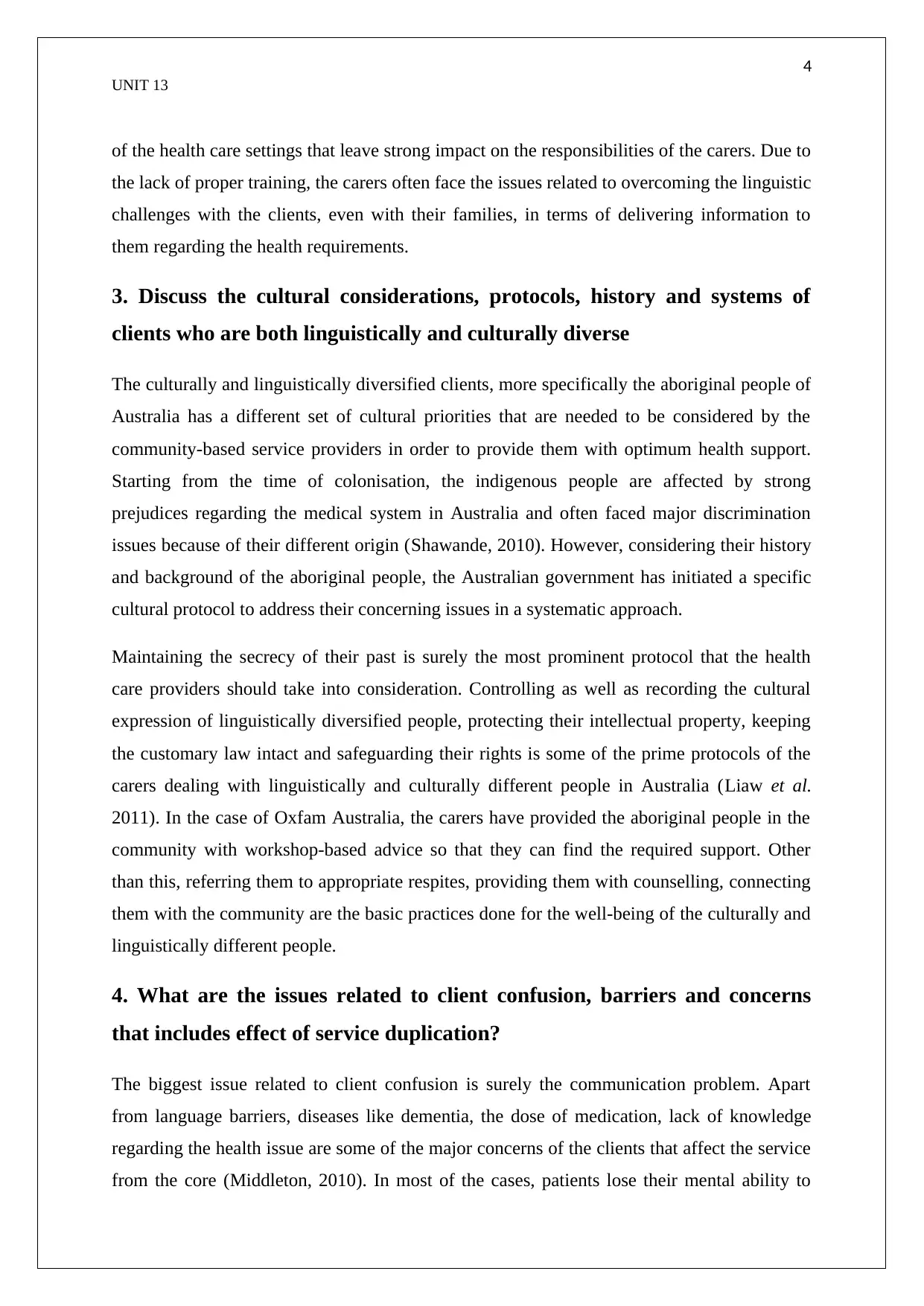
3. Discuss the cultural considerations, protocols, history and systems of
clients who are both linguistically and culturally diverse
The culturally and linguistically diversified clients, more specifically the aboriginal people of
Australia has a different set of cultural priorities that are needed to be considered by the
community-based service providers in order to provide them with optimum health support.
Starting from the time of colonisation, the indigenous people are affected by strong
prejudices regarding the medical system in Australia and often faced major discrimination
issues because of their different origin (Shawande, 2010). However, considering their history
and background of the aboriginal people, the Australian government has initiated a specific
cultural protocol to address their concerning issues in a systematic approach.
Maintaining the secrecy of their past is surely the most prominent protocol that the health
care providers should take into consideration. Controlling as well as recording the cultural
expression of linguistically diversified people, protecting their intellectual property, keeping
the customary law intact and safeguarding their rights is some of the prime protocols of the
carers dealing with linguistically and culturally different people in Australia (Liaw et al.
2011). In the case of Oxfam Australia, the carers have provided the aboriginal people in the
community with workshop-based advice so that they can find the required support. Other
than this, referring them to appropriate respites, providing them with counselling, connecting
them with the community are the basic practices done for the well-being of the culturally and
linguistically different people.
4. What are the issues related to client confusion, barriers and concerns
that includes effect of service duplication?
The biggest issue related to client confusion is surely the communication problem. Apart
from language barriers, diseases like dementia, the dose of medication, lack of knowledge
regarding the health issue are some of the major concerns of the clients that affect the service
from the core (Middleton, 2010). In most of the cases, patients lose their mental ability to
UNIT 13
of the health care settings that leave strong impact on the responsibilities of the carers. Due to
the lack of proper training, the carers often face the issues related to overcoming the linguistic
challenges with the clients, even with their families, in terms of delivering information to
them regarding the health requirements.
3. Discuss the cultural considerations, protocols, history and systems of
clients who are both linguistically and culturally diverse
The culturally and linguistically diversified clients, more specifically the aboriginal people of
Australia has a different set of cultural priorities that are needed to be considered by the
community-based service providers in order to provide them with optimum health support.
Starting from the time of colonisation, the indigenous people are affected by strong
prejudices regarding the medical system in Australia and often faced major discrimination
issues because of their different origin (Shawande, 2010). However, considering their history
and background of the aboriginal people, the Australian government has initiated a specific
cultural protocol to address their concerning issues in a systematic approach.
Maintaining the secrecy of their past is surely the most prominent protocol that the health
care providers should take into consideration. Controlling as well as recording the cultural
expression of linguistically diversified people, protecting their intellectual property, keeping
the customary law intact and safeguarding their rights is some of the prime protocols of the
carers dealing with linguistically and culturally different people in Australia (Liaw et al.
2011). In the case of Oxfam Australia, the carers have provided the aboriginal people in the
community with workshop-based advice so that they can find the required support. Other
than this, referring them to appropriate respites, providing them with counselling, connecting
them with the community are the basic practices done for the well-being of the culturally and
linguistically different people.
4. What are the issues related to client confusion, barriers and concerns
that includes effect of service duplication?
The biggest issue related to client confusion is surely the communication problem. Apart
from language barriers, diseases like dementia, the dose of medication, lack of knowledge
regarding the health issue are some of the major concerns of the clients that affect the service
from the core (Middleton, 2010). In most of the cases, patients lose their mental ability to
Paraphrase This Document
Need a fresh take? Get an instant paraphrase of this document with our AI Paraphraser

5
UNIT 13
express themselves to their respective carers that also affects the carers from handling the
situation. In the case of aboriginal people, the barrier is extremely significant. As they are the
part of a native culture and superstitious background, the clients remain orthodox and refuse
taking medicines due to mistrust for the carers. Moreover, the lack of training and health
literacy of the carers often lead to serious health concerns for the clients and restrict them
from having proper care. Service duplication can also be considered as a major concern and
barrier for the clients, who opt for better service use (McDowell, Messias & Estrada, 2011).
The clients become confused regarding the multiple options of same services offered by
various health care providers.
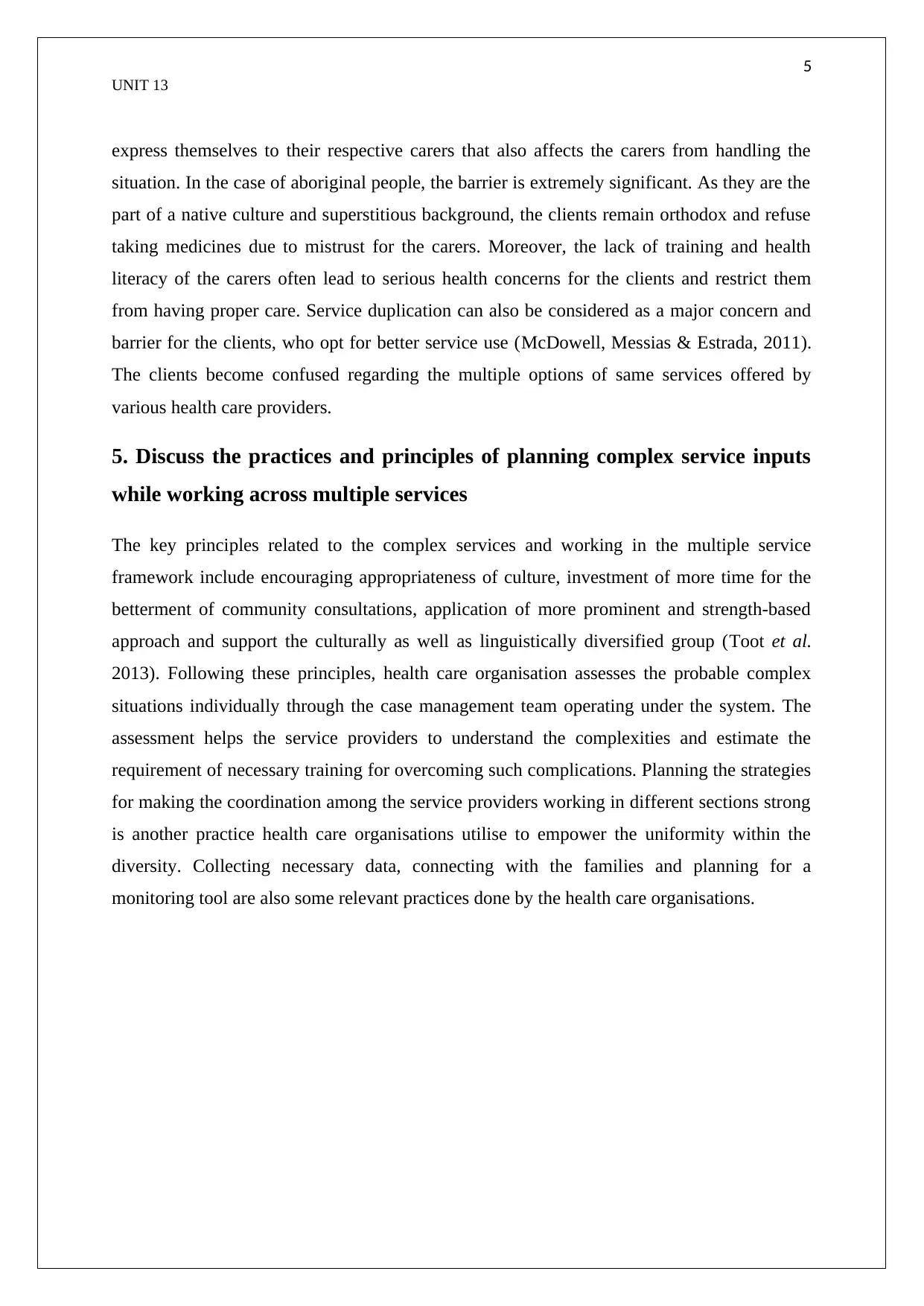
5. Discuss the practices and principles of planning complex service inputs
while working across multiple services
The key principles related to the complex services and working in the multiple service
framework include encouraging appropriateness of culture, investment of more time for the
betterment of community consultations, application of more prominent and strength-based
approach and support the culturally as well as linguistically diversified group (Toot et al.
2013). Following these principles, health care organisation assesses the probable complex
situations individually through the case management team operating under the system. The
assessment helps the service providers to understand the complexities and estimate the
requirement of necessary training for overcoming such complications. Planning the strategies
for making the coordination among the service providers working in different sections strong
is another practice health care organisations utilise to empower the uniformity within the
diversity. Collecting necessary data, connecting with the families and planning for a
monitoring tool are also some relevant practices done by the health care organisations.
UNIT 13
express themselves to their respective carers that also affects the carers from handling the
situation. In the case of aboriginal people, the barrier is extremely significant. As they are the
part of a native culture and superstitious background, the clients remain orthodox and refuse
taking medicines due to mistrust for the carers. Moreover, the lack of training and health
literacy of the carers often lead to serious health concerns for the clients and restrict them
from having proper care. Service duplication can also be considered as a major concern and
barrier for the clients, who opt for better service use (McDowell, Messias & Estrada, 2011).
The clients become confused regarding the multiple options of same services offered by
various health care providers.
5. Discuss the practices and principles of planning complex service inputs
while working across multiple services
The key principles related to the complex services and working in the multiple service
framework include encouraging appropriateness of culture, investment of more time for the
betterment of community consultations, application of more prominent and strength-based
approach and support the culturally as well as linguistically diversified group (Toot et al.
2013). Following these principles, health care organisation assesses the probable complex
situations individually through the case management team operating under the system. The
assessment helps the service providers to understand the complexities and estimate the
requirement of necessary training for overcoming such complications. Planning the strategies
for making the coordination among the service providers working in different sections strong
is another practice health care organisations utilise to empower the uniformity within the
diversity. Collecting necessary data, connecting with the families and planning for a
monitoring tool are also some relevant practices done by the health care organisations.

6
UNIT 13
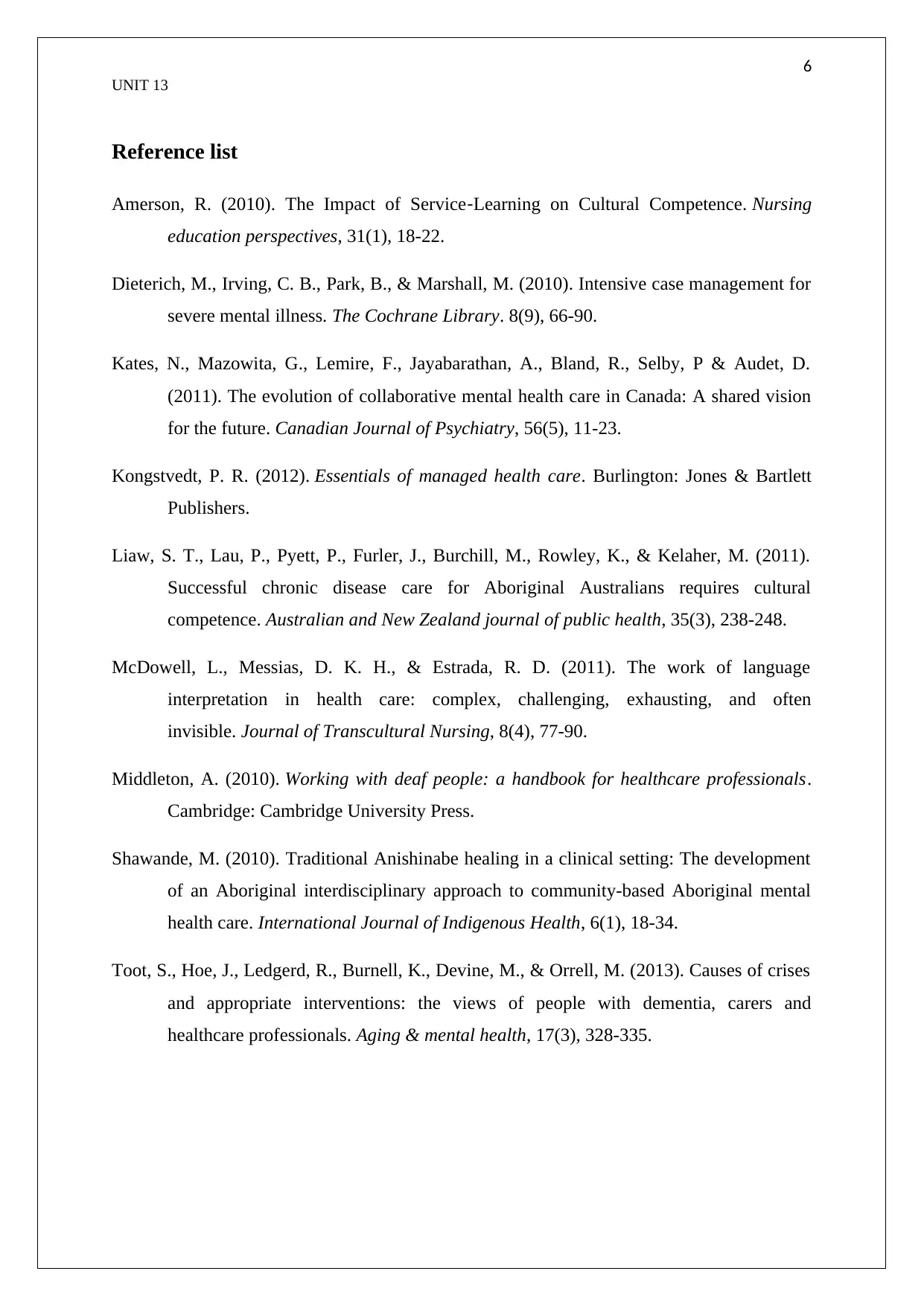
Reference list
Amerson, R. (2010). The Impact of Service‐Learning on Cultural Competence. Nursing
education perspectives, 31(1), 18-22.
Dieterich, M., Irving, C. B., Park, B., & Marshall, M. (2010). Intensive case management for
severe mental illness. The Cochrane Library. 8(9), 66-90.
Kates, N., Mazowita, G., Lemire, F., Jayabarathan, A., Bland, R., Selby, P & Audet, D.
(2011). The evolution of collaborative mental health care in Canada: A shared vision
for the future. Canadian Journal of Psychiatry, 56(5), 11-23.
Kongstvedt, P. R. (2012). Essentials of managed health care. Burlington: Jones & Bartlett
Publishers.
Liaw, S. T., Lau, P., Pyett, P., Furler, J., Burchill, M., Rowley, K., & Kelaher, M. (2011).
Successful chronic disease care for Aboriginal Australians requires cultural
competence. Australian and New Zealand journal of public health, 35(3), 238-248.
McDowell, L., Messias, D. K. H., & Estrada, R. D. (2011). The work of language
interpretation in health care: complex, challenging, exhausting, and often
invisible. Journal of Transcultural Nursing, 8(4), 77-90.
Middleton, A. (2010). Working with deaf people: a handbook for healthcare professionals.
Cambridge: Cambridge University Press.
Shawande, M. (2010). Traditional Anishinabe healing in a clinical setting: The development
of an Aboriginal interdisciplinary approach to community-based Aboriginal mental
health care. International Journal of Indigenous Health, 6(1), 18-34.
Toot, S., Hoe, J., Ledgerd, R., Burnell, K., Devine, M., & Orrell, M. (2013). Causes of crises
and appropriate interventions: the views of people with dementia, carers and
healthcare professionals. Aging & mental health, 17(3), 328-335.
UNIT 13
Reference list
Amerson, R. (2010). The Impact of Service‐Learning on Cultural Competence. Nursing
education perspectives, 31(1), 18-22.
Dieterich, M., Irving, C. B., Park, B., & Marshall, M. (2010). Intensive case management for
severe mental illness. The Cochrane Library. 8(9), 66-90.
Kates, N., Mazowita, G., Lemire, F., Jayabarathan, A., Bland, R., Selby, P & Audet, D.
(2011). The evolution of collaborative mental health care in Canada: A shared vision
for the future. Canadian Journal of Psychiatry, 56(5), 11-23.
Kongstvedt, P. R. (2012). Essentials of managed health care. Burlington: Jones & Bartlett
Publishers.
Liaw, S. T., Lau, P., Pyett, P., Furler, J., Burchill, M., Rowley, K., & Kelaher, M. (2011).
Successful chronic disease care for Aboriginal Australians requires cultural
competence. Australian and New Zealand journal of public health, 35(3), 238-248.
McDowell, L., Messias, D. K. H., & Estrada, R. D. (2011). The work of language
interpretation in health care: complex, challenging, exhausting, and often
invisible. Journal of Transcultural Nursing, 8(4), 77-90.
Middleton, A. (2010). Working with deaf people: a handbook for healthcare professionals.
Cambridge: Cambridge University Press.
Shawande, M. (2010). Traditional Anishinabe healing in a clinical setting: The development
of an Aboriginal interdisciplinary approach to community-based Aboriginal mental
health care. International Journal of Indigenous Health, 6(1), 18-34.
Toot, S., Hoe, J., Ledgerd, R., Burnell, K., Devine, M., & Orrell, M. (2013). Causes of crises
and appropriate interventions: the views of people with dementia, carers and
healthcare professionals. Aging & mental health, 17(3), 328-335.
⊘ This is a preview!⊘
Do you want full access?
Subscribe today to unlock all pages.

Trusted by 1+ million students worldwide
1 out of 6
Related Documents
Your All-in-One AI-Powered Toolkit for Academic Success.
+13062052269
info@desklib.com
Available 24*7 on WhatsApp / Email
Unlock your academic potential
Copyright © 2020–2025 A2Z Services. All Rights Reserved. Developed and managed by ZUCOL.