Healthcare Management Case Study: Alameda Health System Analysis

Verified

Added on  2022/11/30

|8
|1113
|285
Case Study
AI Summary
This case study analyzes the Alameda Health System, exploring its internal and external challenges. The study identifies key issues, including declining profits, increased workload, resistance to change, and poor employee engagement. External challenges include competition and strained relationships with healthcare administration. The major problem areas are financial shortfalls, community reputation issues, problems with key health plan relations, and delayed patient access to care. Short-term problems include reduced patient flow and poor employee engagement, while long-term issues involve reduced profitability and market share. The central underlying problem appears to be large investments with lower returns due to governance changes, which caused resistance to change. The assignment provides an in-depth analysis of the organization's challenges and potential solutions, along with relevant figures and a bibliography.
Document Page
Running head: HEALTHCARE MANAGEMENT
Healthcare Management
-Case Study
Name of the Student
Name of the University
Author Note
tabler-icon-diamond-filled.svg

Paraphrase This Document

Need a fresh take? Get an instant paraphrase of this document with our AI Paraphraser
Document Page
1HEALTHCARE MANAGEMENT
Introduction:
The following case study is the analysis of Alameda Healthcare system, as a case study to
understand the internal and external problems faced by the organization, the significant
problem areas within the organization, the short term and long term problems and their
hierarchies as well as the central underlying problem faced in the case study by the
organization. The study would therefore aim to explore the various challenges that an
organization faced, in context of the case study and therefore help to develop and
understanding on how to best address such situations and therefore promote stability in the
business.
Discussion:
-Internal and External Problems (Portfolio analysis, McKinsey 7S model, Life cycle
analysis, Organizational culture analysis)
Internal Challenges:
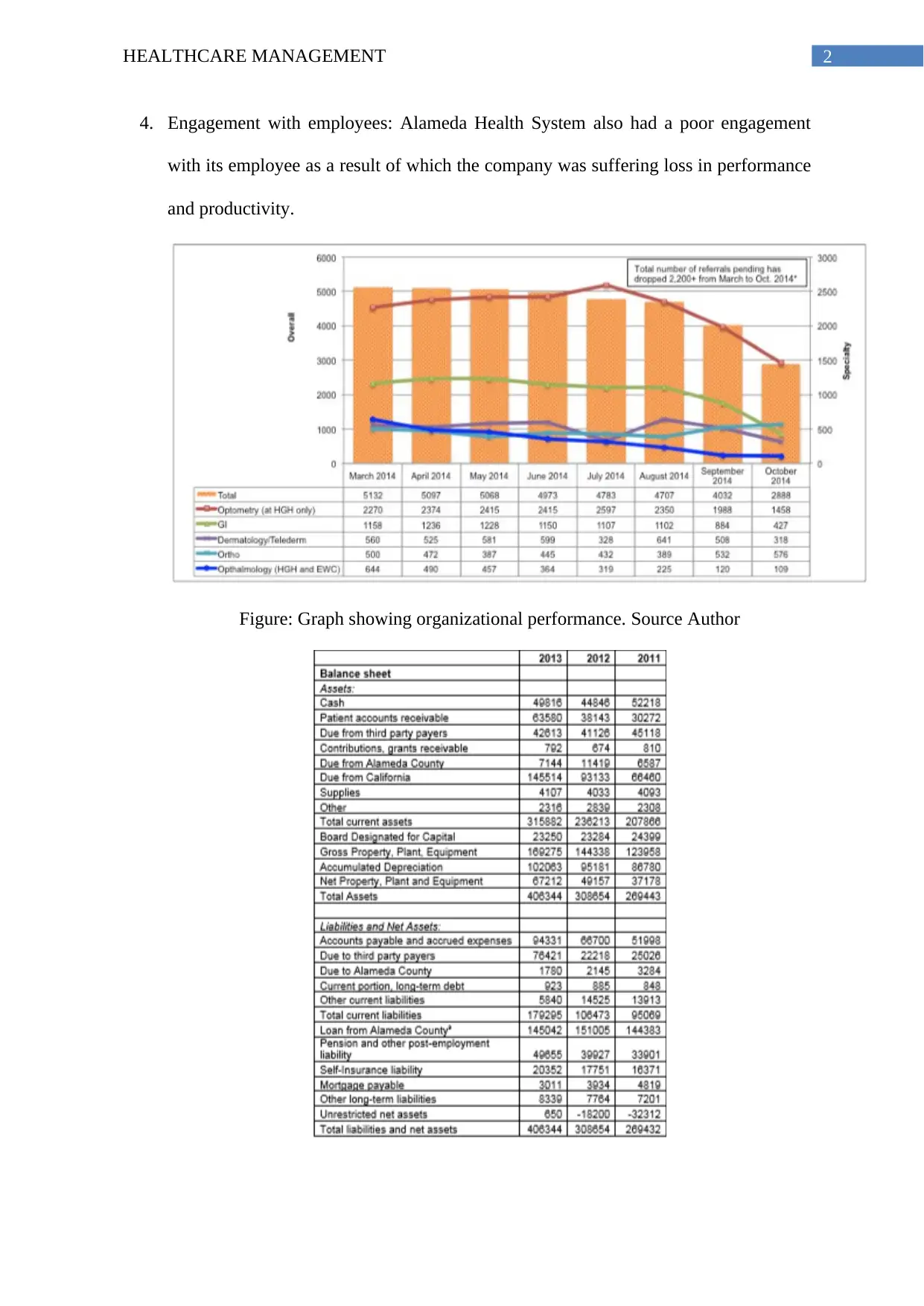
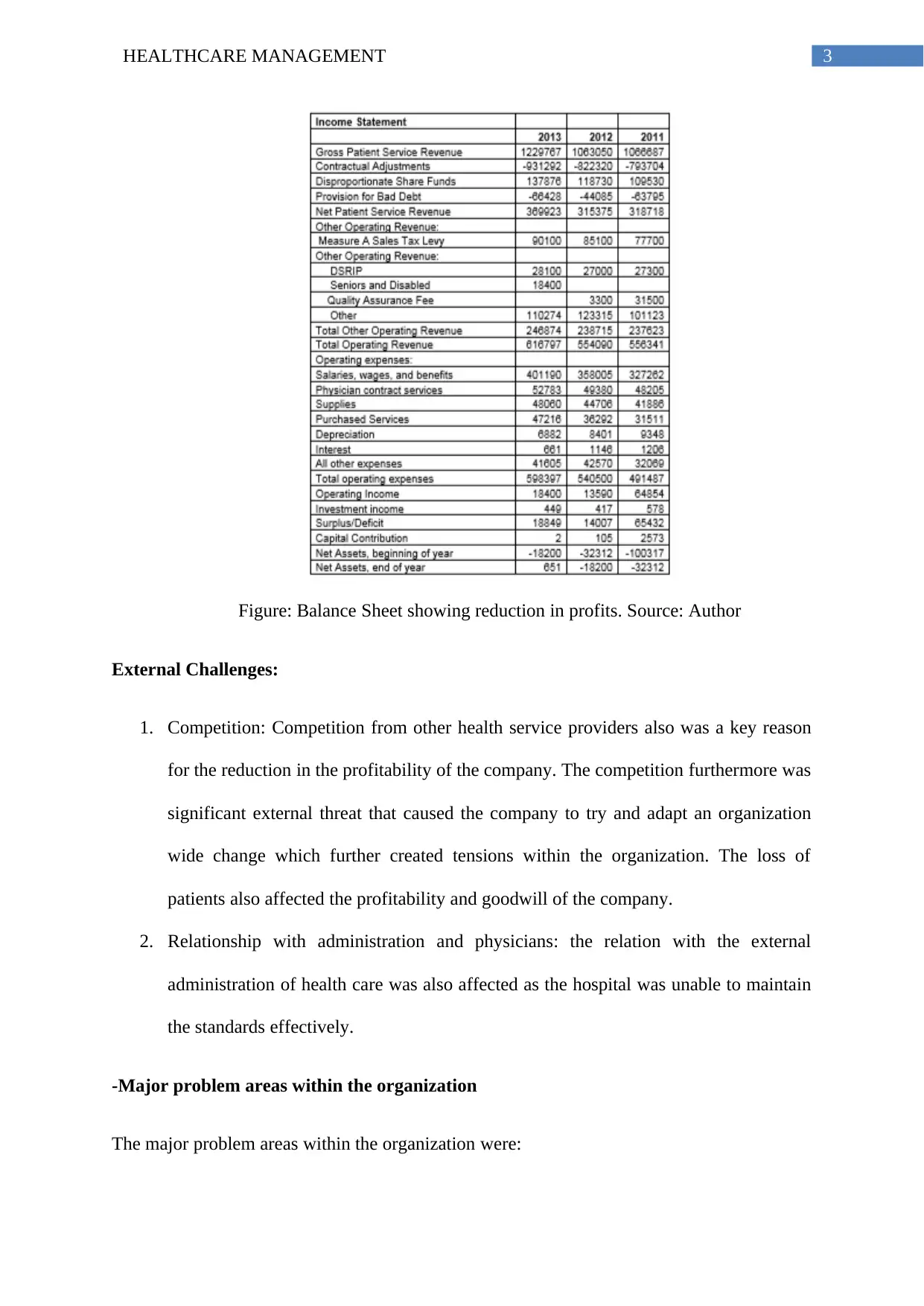
1. Rapidly deteriorating profits: One of the key challenges faced by Alameda Health
System was a reduction in the profitability of the company over the years due to
which its service quality was affected.
2. Increase in work volume: A significant increase in the work load of the employees
also increased their stress caused by over times and affected the service quality.
3. Resistance to change: The organization was facing inter conflicts and the employees
were reluctant to an organization wide change which significantly affected the
progress of the organization.
Document Page
2HEALTHCARE MANAGEMENT
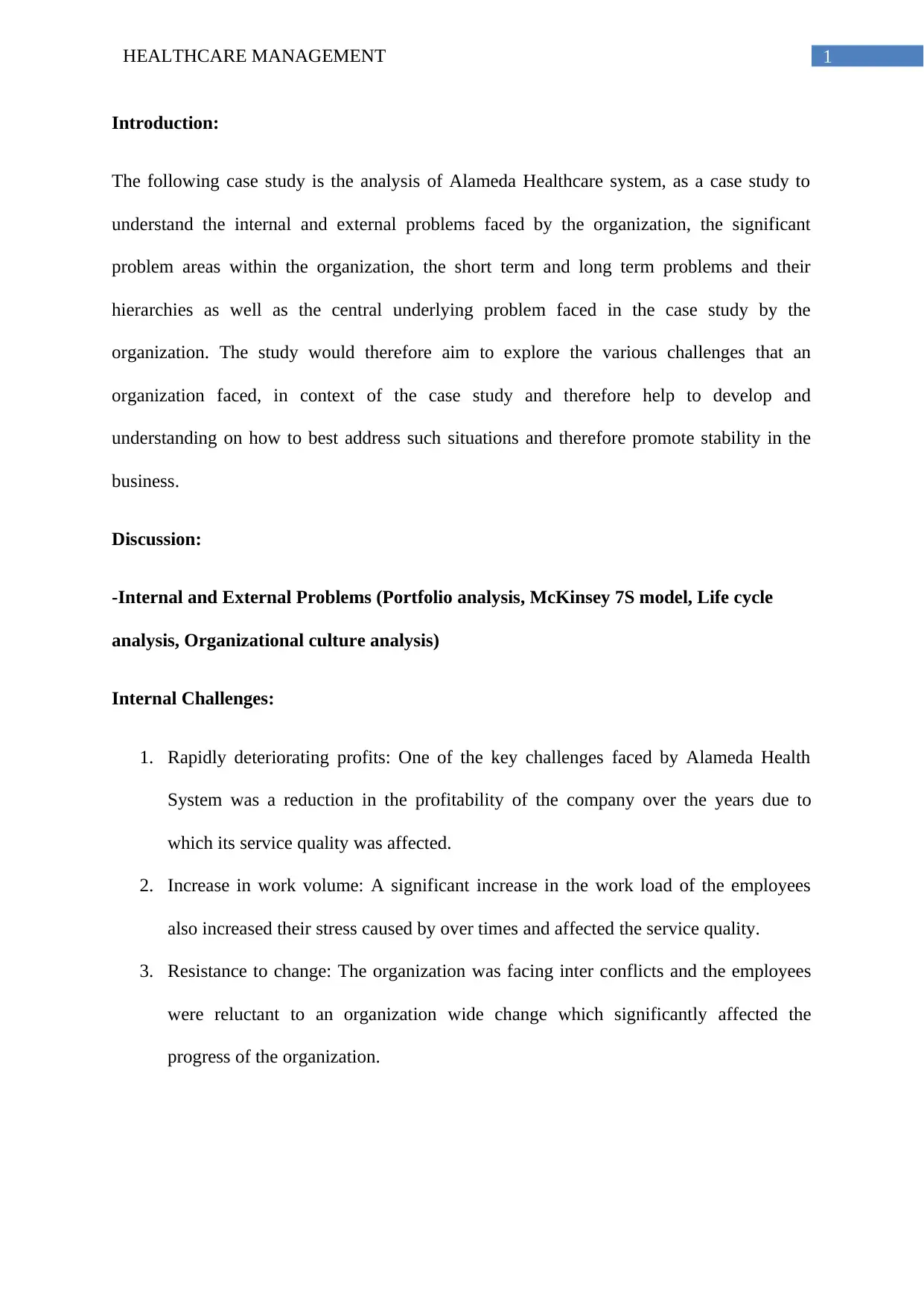
4. Engagement with employees: Alameda Health System also had a poor engagement
with its employee as a result of which the company was suffering loss in performance
and productivity.
Figure: Graph showing organizational performance. Source Author
Document Page
3HEALTHCARE MANAGEMENT
Figure: Balance Sheet showing reduction in profits. Source: Author
External Challenges:
1. Competition: Competition from other health service providers also was a key reason
for the reduction in the profitability of the company. The competition furthermore was
significant external threat that caused the company to try and adapt an organization
wide change which further created tensions within the organization. The loss of
patients also affected the profitability and goodwill of the company.
2. Relationship with administration and physicians: the relation with the external
administration of health care was also affected as the hospital was unable to maintain
the standards effectively.
-Major problem areas within the organization
The major problem areas within the organization were:
tabler-icon-diamond-filled.svg

Paraphrase This Document

Need a fresh take? Get an instant paraphrase of this document with our AI Paraphraser
Document Page
4HEALTHCARE MANAGEMENT
Financial shortfall: A financial shortfall was one of the significant problem areas that
the organization had to deal with as the affected the entire operations within the
organization. This further created a barrier for the system to effectively deliver health
care services to the patient.
Community reputation: The reputation of the health care system in the community
was also affected as the hospital had to turn down several patients due to
unavailability of hospital beds.
Key health plan relations: The relations of the key health plans with the needs of the
patients were also not properly aligned due to which the services were ineffective to
some extent creating a major operational drawback for the health care system. This
also affected the overall performance of the organization.
Patient access to care: The access of the patient to care was delayed due to the long
waiting times and unavailability of physicians or overbooking of the health care
providers.
Document Page
5HEALTHCARE MANAGEMENT
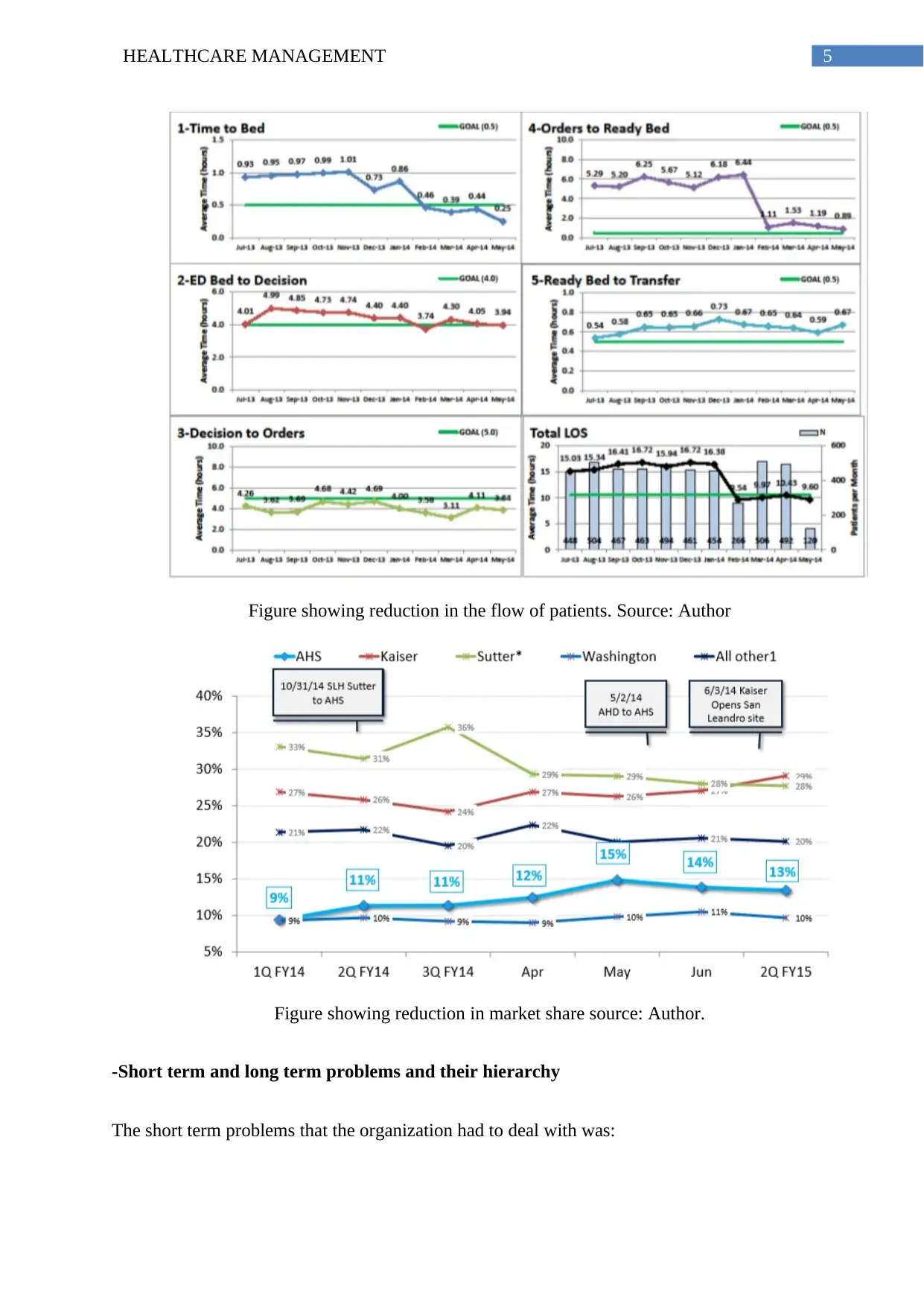
Figure showing reduction in the flow of patients. Source: Author
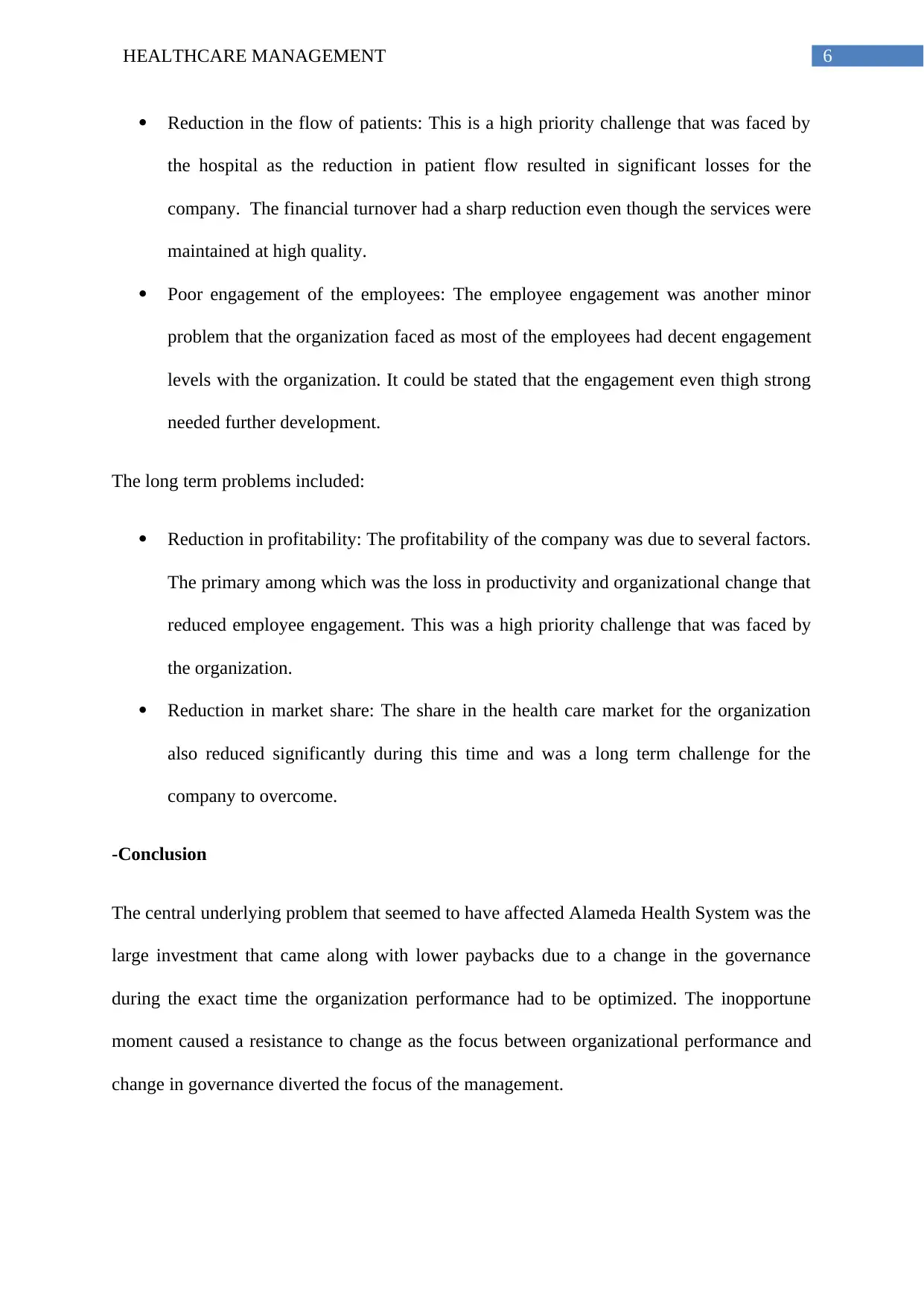
Figure showing reduction in market share source: Author.
-Short term and long term problems and their hierarchy
The short term problems that the organization had to deal with was:
Document Page
6HEALTHCARE MANAGEMENT
Reduction in the flow of patients: This is a high priority challenge that was faced by
the hospital as the reduction in patient flow resulted in significant losses for the
company. The financial turnover had a sharp reduction even though the services were
maintained at high quality.
Poor engagement of the employees: The employee engagement was another minor
problem that the organization faced as most of the employees had decent engagement
levels with the organization. It could be stated that the engagement even thigh strong
needed further development.
The long term problems included:
Reduction in profitability: The profitability of the company was due to several factors.
The primary among which was the loss in productivity and organizational change that
reduced employee engagement. This was a high priority challenge that was faced by
the organization.
Reduction in market share: The share in the health care market for the organization
also reduced significantly during this time and was a long term challenge for the
company to overcome.
-Conclusion
The central underlying problem that seemed to have affected Alameda Health System was the
large investment that came along with lower paybacks due to a change in the governance
during the exact time the organization performance had to be optimized. The inopportune
moment caused a resistance to change as the focus between organizational performance and
change in governance diverted the focus of the management.
tabler-icon-diamond-filled.svg

Paraphrase This Document

Need a fresh take? Get an instant paraphrase of this document with our AI Paraphraser
Document Page
7HEALTHCARE MANAGEMENT
Bibliography:
Belanger, H. G., Curtiss, G., Duchnick, J. J., Bates, J., Pommer, S., Pollack, S., ... & Jones, K.
R. (2018). Satisfaction with psychology training in the Veterans Healthcare
Administration. Professional Psychology: Research and Practice, 49(4), 290.
Madaras-Kelly, K., Jones, M., Remington, R., Caplinger, C. M., Huttner, B., Jones, B., &
Samore, M. (2015). Antimicrobial de-escalation of treatment for healthcare-associated
pneumonia within the Veterans Healthcare Administration. Journal of Antimicrobial
Chemotherapy, 71(2), 539-546.
Roberts, J. P., Fisher, T. R., Trowbridge, M. J., & Bent, C. (2016, March). A design thinking
framework for healthcare management and innovation. In Healthcare (Vol. 4, No. 1,
pp. 11-14). Elsevier.
Wilson, A. B. (2016). Think Like an Administrator: An Instructional Design and Delivery
Template for Healthcare Administration. Journal of Health Administration
Education, 33(1), 179-190.
chevron_up_icon
1 out of 8
circle_padding
hide_on_mobile
zoom_out_icon
[object Object]