Challenges in Contemporary Health Care: Leadership and Solutions
VerifiedAdded on 2023/01/19
|13
|3474
|50
Essay
AI Summary
This essay examines the multifaceted challenges within contemporary healthcare, specifically focusing on the Australian healthcare system. It identifies key issues such as equity concerns, the escalating costs of technology, and the complexities of public and private healthcare financing. The essay then delves into essential leadership factors, including self-awareness, critical thinking, and time management, as identified by healthcare experts. It emphasizes the effectiveness of relational leadership, particularly transformational leadership, in fostering positive patient outcomes and enhancing staff performance. Furthermore, the essay highlights the critical role of effective clinical leadership in ensuring high-quality, safe, and efficient healthcare delivery, emphasizing the need for clinician involvement and leadership at all levels to meet contemporary healthcare demands.
Contemporary Health Care 1
CHALLENGES IN CONTEMPORARY HEALTH CARE
Name
Institution
Course
Tutor
City/State
Date
1
CHALLENGES IN CONTEMPORARY HEALTH CARE
Name
Institution
Course
Tutor
City/State
Date
1

Paraphrase This Document
Need a fresh take? Get an instant paraphrase of this document with our AI Paraphraser
Contemporary Health Care 2
Introduction
The health care division is described by continuous changes directed at the effective provision of
effective, high-quality, and safe health services. Effective leadership is needed to steer and direct
changes at every level of the health structure to realize the goals of the continuous changes in
health care systems. Leadership in the health care segment is spread crosswise management and
medical staff, generating unusual challenges. Hains (2018) denotes that clinical leadership is
provided by clinicians in medical environments to guarantee effective, safe and optimal quality
care. Such duties are normally executed in cooperation with non-medical leadership or
management duties and roles. This essay analyses the responses from a survey carried out on five
health care experts concerning leadership in nursing. From that evaluation, it will discourse
challenges facing the health care system, effectual leadership aspects, and address relational
leadership as the most suitable leadership style to integrate these aspects. Additionally, the essay
will address how the recognized leadership aspects styles may enhance results in health care
environments. The essay centers on the usefulness of leadership in the improvement of the
quality of care in the health care division.
Health Care Challenges
According to Megheirkouni (2016), Australia’s health care structure has a prominent position in
the world. Generally, Australians have some of the optimal health services globally. Normal life
prospect proportions are increasing (excluding in Aboriginal areas, where much has to be
enhanced), and infant death proportions are low. However, Australia experiences considerable
challenges for guaranteeing the sustainability of its health structure. Australia's elderly
population, intensifying the level of chronic diseases, and financing limitations all pose a variety
of significant concerns to address.
2
Introduction
The health care division is described by continuous changes directed at the effective provision of
effective, high-quality, and safe health services. Effective leadership is needed to steer and direct
changes at every level of the health structure to realize the goals of the continuous changes in
health care systems. Leadership in the health care segment is spread crosswise management and
medical staff, generating unusual challenges. Hains (2018) denotes that clinical leadership is
provided by clinicians in medical environments to guarantee effective, safe and optimal quality
care. Such duties are normally executed in cooperation with non-medical leadership or
management duties and roles. This essay analyses the responses from a survey carried out on five
health care experts concerning leadership in nursing. From that evaluation, it will discourse
challenges facing the health care system, effectual leadership aspects, and address relational
leadership as the most suitable leadership style to integrate these aspects. Additionally, the essay
will address how the recognized leadership aspects styles may enhance results in health care
environments. The essay centers on the usefulness of leadership in the improvement of the
quality of care in the health care division.
Health Care Challenges
According to Megheirkouni (2016), Australia’s health care structure has a prominent position in
the world. Generally, Australians have some of the optimal health services globally. Normal life
prospect proportions are increasing (excluding in Aboriginal areas, where much has to be
enhanced), and infant death proportions are low. However, Australia experiences considerable
challenges for guaranteeing the sustainability of its health structure. Australia's elderly
population, intensifying the level of chronic diseases, and financing limitations all pose a variety
of significant concerns to address.
2
Contemporary Health Care 3
The first challenge that was identified by each of the five interviewees was equity concerns and
health inequality. There have been significant enhancements in the health results in Australia (as
identified by risen life prospect, reduced death proportions, and more effective illness
management regulations). However, all interviewees asserted that this has not been equally
shared across segments. For instance, the life prospect of the Aboriginal people (about the age of
70) is considerably lesser than the non-Aboriginal people (about the age of 84). There is
similarly a notable distinction with the health care therapy that wealthy individuals get compared
to the less wealthy.
The second challenge identified by a majority of the interviewees was technology costs. Three of
the interviewees acknowledged that technology and technological innovations have enhanced the
lives of patients in regards to diagnostics and treatment of chronic illnesses in the 21st century.
Nevertheless, the recurrent cost and transmission of technology will inflict severe financial
constraints in sustaining and enhancing health care (Cathcart 2014, p. 45). It is fascinating that
technology in non-health sectors reduces over time; however, technology related to health care
and the particular kind of technology have escalated the weight on state financial plans. The
challenge will be to apply technologies that not solely enhance the wellbeing and health of
residents, but similarly economical treatments.
Additionally, four of the interviewees identified public and private financing of healthcare as a
challenge. In Australia, there is a “notion”, especially from the liberal administrations, that the
health care system in Australia would perform more efficiently if it was left to the market.
Australia has an exceptional combination of private and public, with about 30% of spending
resulting from the private segment (Oc 2018, p. 223). The rise in technological costs, an elderly
population, illness management strategies, amongst others, will force the government of
3
The first challenge that was identified by each of the five interviewees was equity concerns and
health inequality. There have been significant enhancements in the health results in Australia (as
identified by risen life prospect, reduced death proportions, and more effective illness
management regulations). However, all interviewees asserted that this has not been equally
shared across segments. For instance, the life prospect of the Aboriginal people (about the age of
70) is considerably lesser than the non-Aboriginal people (about the age of 84). There is
similarly a notable distinction with the health care therapy that wealthy individuals get compared
to the less wealthy.
The second challenge identified by a majority of the interviewees was technology costs. Three of
the interviewees acknowledged that technology and technological innovations have enhanced the
lives of patients in regards to diagnostics and treatment of chronic illnesses in the 21st century.
Nevertheless, the recurrent cost and transmission of technology will inflict severe financial
constraints in sustaining and enhancing health care (Cathcart 2014, p. 45). It is fascinating that
technology in non-health sectors reduces over time; however, technology related to health care
and the particular kind of technology have escalated the weight on state financial plans. The
challenge will be to apply technologies that not solely enhance the wellbeing and health of
residents, but similarly economical treatments.
Additionally, four of the interviewees identified public and private financing of healthcare as a
challenge. In Australia, there is a “notion”, especially from the liberal administrations, that the
health care system in Australia would perform more efficiently if it was left to the market.
Australia has an exceptional combination of private and public, with about 30% of spending
resulting from the private segment (Oc 2018, p. 223). The rise in technological costs, an elderly
population, illness management strategies, amongst others, will force the government of
3
⊘ This is a preview!⊘
Do you want full access?
Subscribe today to unlock all pages.

Trusted by 1+ million students worldwide
Contemporary Health Care 4
Australia to look for market founded mechanisms in considering the greater budgetary burdens
on consecutive governments (for example GP supplement, and valuing to market of clinical
services)
Hospitals, elderly care amenities, and other healthcare service givers have to ensure access,
guarantee quality, reduce risk (to both workforce and patient), highlight patient care, and do it all
based on the available financial plan. It is definitely not an easy task, however, it is similarly not
an impossible one.
Leadership Factors
The interviewed people were also asked to identify the factors that they thought were necessary
for effective leadership in nursing. The three most common responses were selected for keener
evaluation and scrutiny.
Self-awareness
Three interviewees suggested that an effective medical leader has self-awareness, which implies
familiarizing the aspect of reading an individual’s own emotions and how they may affect others.
For instance, if a nurse is taking care of a patient in a pediatric division and the mother shows her
worries that her baby did not get an average treatment when the nurse had previously delivered
treatment. The nurse might have mixed feelings such as anger or irritation. In such a situation, it
is important that the nurse recognizes these feelings and contemplates how showing them would
impact the situation. The nurse may identify their emotions by journaling, exercising, or
meditating. In addition to this, the nurse medical leader must be answerable, as it will lead to
improved performances (Nursing Management 2019, p. 43).
Critical-thinking
4
Australia to look for market founded mechanisms in considering the greater budgetary burdens
on consecutive governments (for example GP supplement, and valuing to market of clinical
services)
Hospitals, elderly care amenities, and other healthcare service givers have to ensure access,
guarantee quality, reduce risk (to both workforce and patient), highlight patient care, and do it all
based on the available financial plan. It is definitely not an easy task, however, it is similarly not
an impossible one.
Leadership Factors
The interviewed people were also asked to identify the factors that they thought were necessary
for effective leadership in nursing. The three most common responses were selected for keener
evaluation and scrutiny.
Self-awareness
Three interviewees suggested that an effective medical leader has self-awareness, which implies
familiarizing the aspect of reading an individual’s own emotions and how they may affect others.
For instance, if a nurse is taking care of a patient in a pediatric division and the mother shows her
worries that her baby did not get an average treatment when the nurse had previously delivered
treatment. The nurse might have mixed feelings such as anger or irritation. In such a situation, it
is important that the nurse recognizes these feelings and contemplates how showing them would
impact the situation. The nurse may identify their emotions by journaling, exercising, or
meditating. In addition to this, the nurse medical leader must be answerable, as it will lead to
improved performances (Nursing Management 2019, p. 43).
Critical-thinking
4
Paraphrase This Document
Need a fresh take? Get an instant paraphrase of this document with our AI Paraphraser
Contemporary Health Care 5
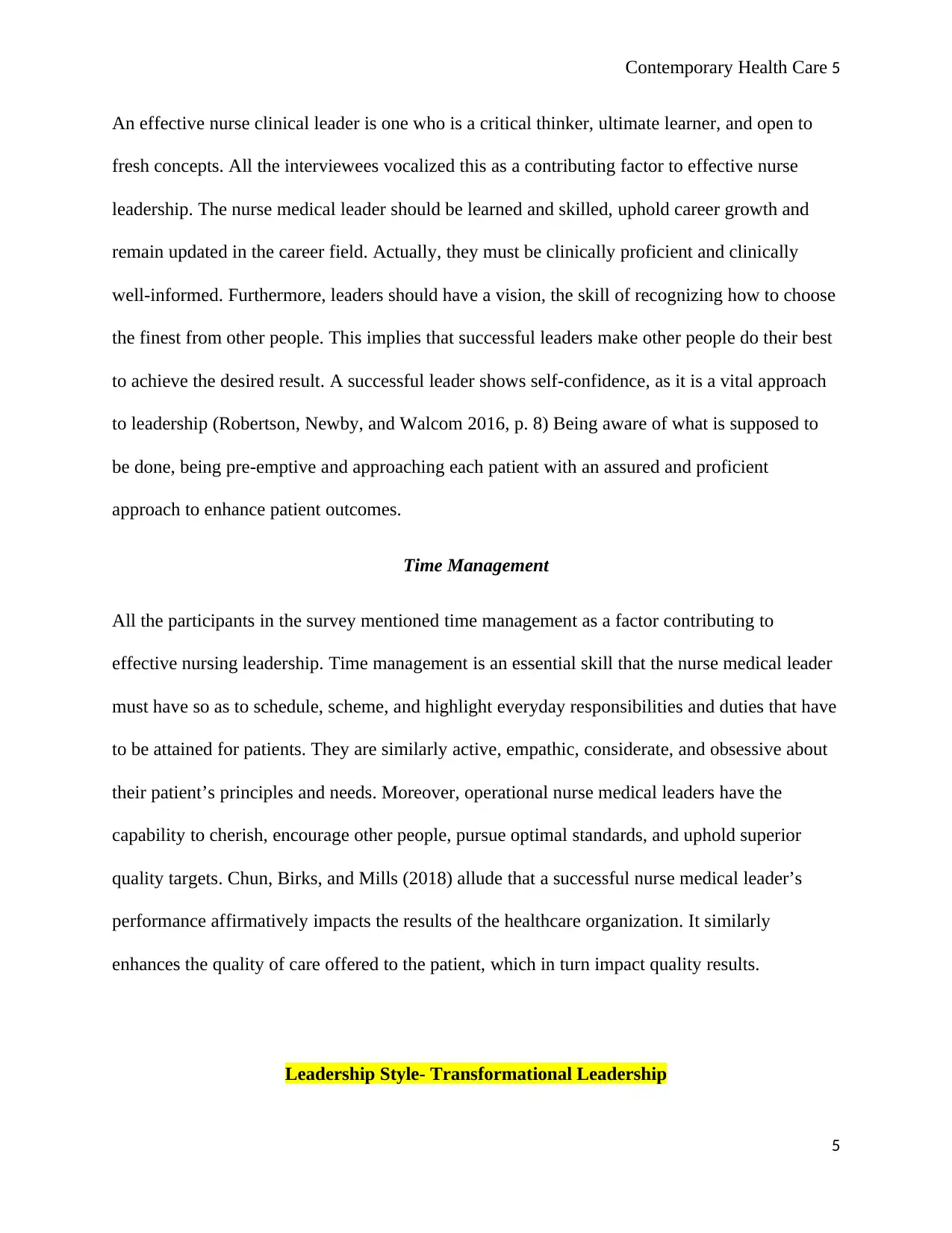
An effective nurse clinical leader is one who is a critical thinker, ultimate learner, and open to
fresh concepts. All the interviewees vocalized this as a contributing factor to effective nurse
leadership. The nurse medical leader should be learned and skilled, uphold career growth and
remain updated in the career field. Actually, they must be clinically proficient and clinically
well-informed. Furthermore, leaders should have a vision, the skill of recognizing how to choose
the finest from other people. This implies that successful leaders make other people do their best
to achieve the desired result. A successful leader shows self-confidence, as it is a vital approach
to leadership (Robertson, Newby, and Walcom 2016, p. 8) Being aware of what is supposed to
be done, being pre-emptive and approaching each patient with an assured and proficient
approach to enhance patient outcomes.
Time Management
All the participants in the survey mentioned time management as a factor contributing to
effective nursing leadership. Time management is an essential skill that the nurse medical leader
must have so as to schedule, scheme, and highlight everyday responsibilities and duties that have
to be attained for patients. They are similarly active, empathic, considerate, and obsessive about
their patient’s principles and needs. Moreover, operational nurse medical leaders have the
capability to cherish, encourage other people, pursue optimal standards, and uphold superior
quality targets. Chun, Birks, and Mills (2018) allude that a successful nurse medical leader’s
performance affirmatively impacts the results of the healthcare organization. It similarly
enhances the quality of care offered to the patient, which in turn impact quality results.
Leadership Style- Transformational Leadership
5
An effective nurse clinical leader is one who is a critical thinker, ultimate learner, and open to
fresh concepts. All the interviewees vocalized this as a contributing factor to effective nurse
leadership. The nurse medical leader should be learned and skilled, uphold career growth and
remain updated in the career field. Actually, they must be clinically proficient and clinically
well-informed. Furthermore, leaders should have a vision, the skill of recognizing how to choose
the finest from other people. This implies that successful leaders make other people do their best
to achieve the desired result. A successful leader shows self-confidence, as it is a vital approach
to leadership (Robertson, Newby, and Walcom 2016, p. 8) Being aware of what is supposed to
be done, being pre-emptive and approaching each patient with an assured and proficient
approach to enhance patient outcomes.
Time Management
All the participants in the survey mentioned time management as a factor contributing to
effective nursing leadership. Time management is an essential skill that the nurse medical leader
must have so as to schedule, scheme, and highlight everyday responsibilities and duties that have
to be attained for patients. They are similarly active, empathic, considerate, and obsessive about
their patient’s principles and needs. Moreover, operational nurse medical leaders have the
capability to cherish, encourage other people, pursue optimal standards, and uphold superior
quality targets. Chun, Birks, and Mills (2018) allude that a successful nurse medical leader’s
performance affirmatively impacts the results of the healthcare organization. It similarly
enhances the quality of care offered to the patient, which in turn impact quality results.
Leadership Style- Transformational Leadership
5
Contemporary Health Care 6
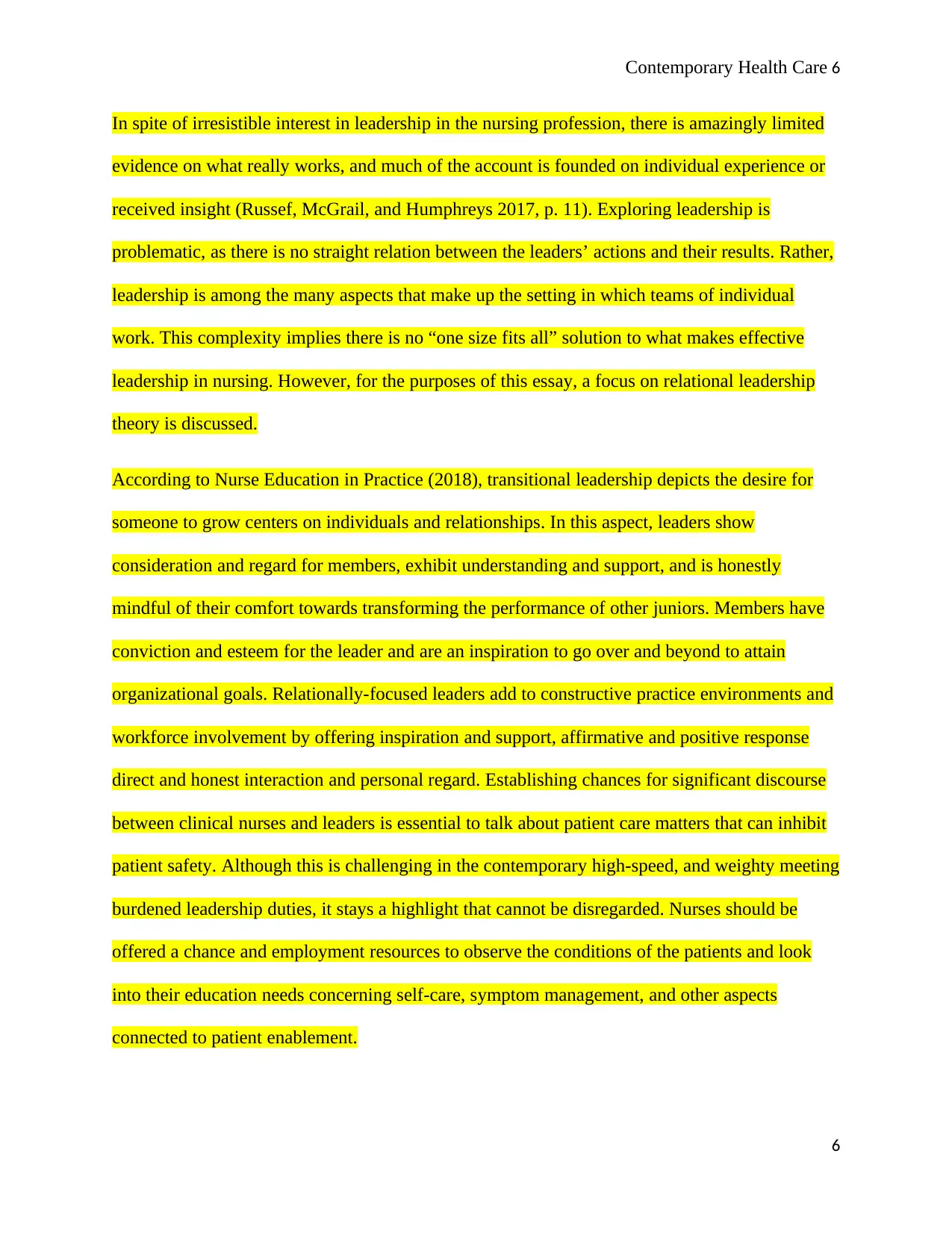
In spite of irresistible interest in leadership in the nursing profession, there is amazingly limited
evidence on what really works, and much of the account is founded on individual experience or
received insight (Russef, McGrail, and Humphreys 2017, p. 11). Exploring leadership is
problematic, as there is no straight relation between the leaders’ actions and their results. Rather,
leadership is among the many aspects that make up the setting in which teams of individual
work. This complexity implies there is no “one size fits all” solution to what makes effective
leadership in nursing. However, for the purposes of this essay, a focus on relational leadership
theory is discussed.
According to Nurse Education in Practice (2018), transitional leadership depicts the desire for
someone to grow centers on individuals and relationships. In this aspect, leaders show
consideration and regard for members, exhibit understanding and support, and is honestly
mindful of their comfort towards transforming the performance of other juniors. Members have
conviction and esteem for the leader and are an inspiration to go over and beyond to attain
organizational goals. Relationally-focused leaders add to constructive practice environments and
workforce involvement by offering inspiration and support, affirmative and positive response
direct and honest interaction and personal regard. Establishing chances for significant discourse
between clinical nurses and leaders is essential to talk about patient care matters that can inhibit
patient safety. Although this is challenging in the contemporary high-speed, and weighty meeting
burdened leadership duties, it stays a highlight that cannot be disregarded. Nurses should be
offered a chance and employment resources to observe the conditions of the patients and look
into their education needs concerning self-care, symptom management, and other aspects
connected to patient enablement.
6
In spite of irresistible interest in leadership in the nursing profession, there is amazingly limited
evidence on what really works, and much of the account is founded on individual experience or
received insight (Russef, McGrail, and Humphreys 2017, p. 11). Exploring leadership is
problematic, as there is no straight relation between the leaders’ actions and their results. Rather,
leadership is among the many aspects that make up the setting in which teams of individual
work. This complexity implies there is no “one size fits all” solution to what makes effective
leadership in nursing. However, for the purposes of this essay, a focus on relational leadership
theory is discussed.
According to Nurse Education in Practice (2018), transitional leadership depicts the desire for
someone to grow centers on individuals and relationships. In this aspect, leaders show
consideration and regard for members, exhibit understanding and support, and is honestly
mindful of their comfort towards transforming the performance of other juniors. Members have
conviction and esteem for the leader and are an inspiration to go over and beyond to attain
organizational goals. Relationally-focused leaders add to constructive practice environments and
workforce involvement by offering inspiration and support, affirmative and positive response
direct and honest interaction and personal regard. Establishing chances for significant discourse
between clinical nurses and leaders is essential to talk about patient care matters that can inhibit
patient safety. Although this is challenging in the contemporary high-speed, and weighty meeting
burdened leadership duties, it stays a highlight that cannot be disregarded. Nurses should be
offered a chance and employment resources to observe the conditions of the patients and look
into their education needs concerning self-care, symptom management, and other aspects
connected to patient enablement.
6
⊘ This is a preview!⊘
Do you want full access?
Subscribe today to unlock all pages.
Trusted by 1+ million students worldwide
Contemporary Health Care 7
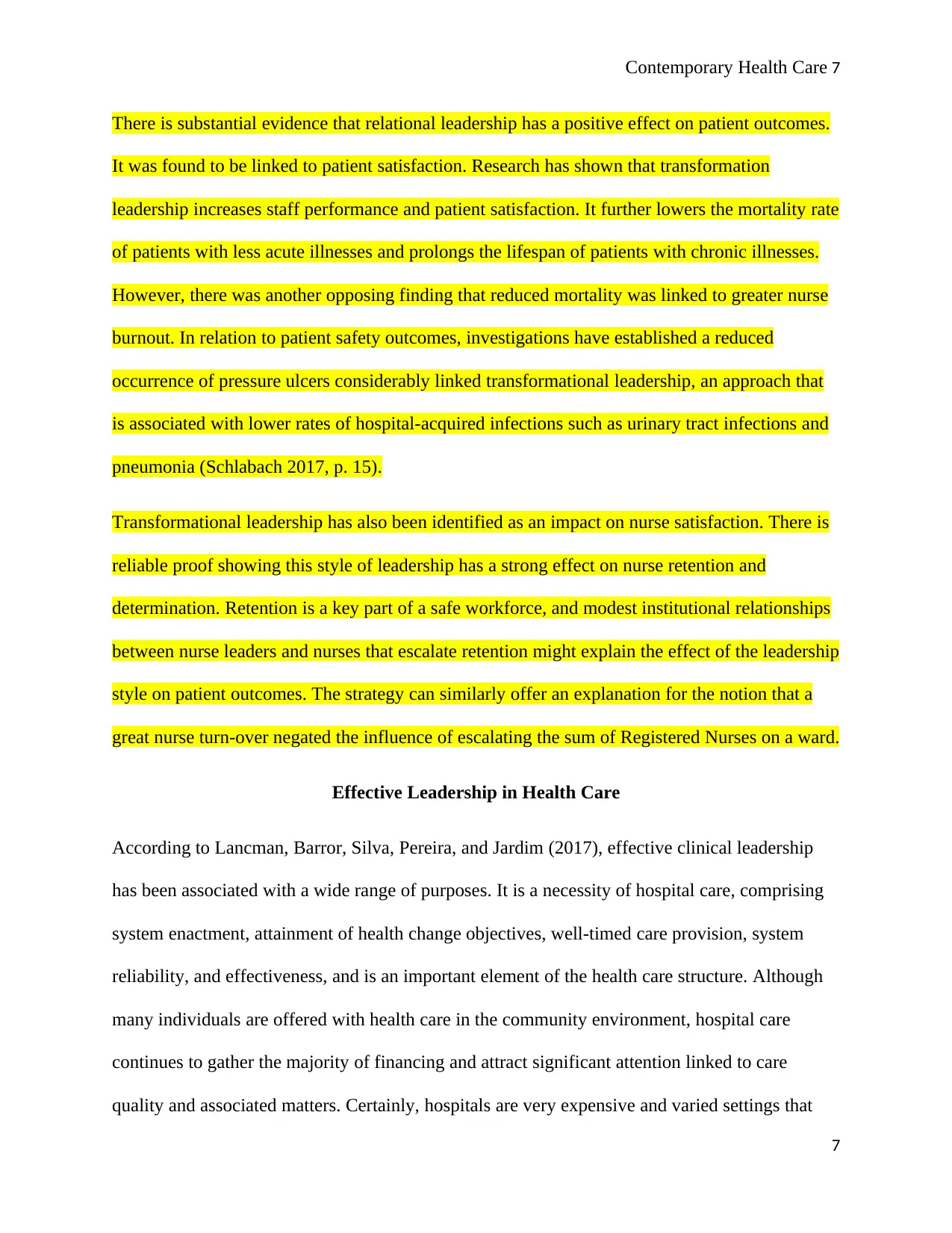
There is substantial evidence that relational leadership has a positive effect on patient outcomes.
It was found to be linked to patient satisfaction. Research has shown that transformation
leadership increases staff performance and patient satisfaction. It further lowers the mortality rate
of patients with less acute illnesses and prolongs the lifespan of patients with chronic illnesses.
However, there was another opposing finding that reduced mortality was linked to greater nurse
burnout. In relation to patient safety outcomes, investigations have established a reduced
occurrence of pressure ulcers considerably linked transformational leadership, an approach that
is associated with lower rates of hospital-acquired infections such as urinary tract infections and
pneumonia (Schlabach 2017, p. 15).
Transformational leadership has also been identified as an impact on nurse satisfaction. There is
reliable proof showing this style of leadership has a strong effect on nurse retention and
determination. Retention is a key part of a safe workforce, and modest institutional relationships
between nurse leaders and nurses that escalate retention might explain the effect of the leadership
style on patient outcomes. The strategy can similarly offer an explanation for the notion that a
great nurse turn-over negated the influence of escalating the sum of Registered Nurses on a ward.
Effective Leadership in Health Care
According to Lancman, Barror, Silva, Pereira, and Jardim (2017), effective clinical leadership
has been associated with a wide range of purposes. It is a necessity of hospital care, comprising
system enactment, attainment of health change objectives, well-timed care provision, system
reliability, and effectiveness, and is an important element of the health care structure. Although
many individuals are offered with health care in the community environment, hospital care
continues to gather the majority of financing and attract significant attention linked to care
quality and associated matters. Certainly, hospitals are very expensive and varied settings that
7
There is substantial evidence that relational leadership has a positive effect on patient outcomes.
It was found to be linked to patient satisfaction. Research has shown that transformation
leadership increases staff performance and patient satisfaction. It further lowers the mortality rate
of patients with less acute illnesses and prolongs the lifespan of patients with chronic illnesses.
However, there was another opposing finding that reduced mortality was linked to greater nurse
burnout. In relation to patient safety outcomes, investigations have established a reduced
occurrence of pressure ulcers considerably linked transformational leadership, an approach that
is associated with lower rates of hospital-acquired infections such as urinary tract infections and
pneumonia (Schlabach 2017, p. 15).
Transformational leadership has also been identified as an impact on nurse satisfaction. There is
reliable proof showing this style of leadership has a strong effect on nurse retention and
determination. Retention is a key part of a safe workforce, and modest institutional relationships
between nurse leaders and nurses that escalate retention might explain the effect of the leadership
style on patient outcomes. The strategy can similarly offer an explanation for the notion that a
great nurse turn-over negated the influence of escalating the sum of Registered Nurses on a ward.
Effective Leadership in Health Care
According to Lancman, Barror, Silva, Pereira, and Jardim (2017), effective clinical leadership
has been associated with a wide range of purposes. It is a necessity of hospital care, comprising
system enactment, attainment of health change objectives, well-timed care provision, system
reliability, and effectiveness, and is an important element of the health care structure. Although
many individuals are offered with health care in the community environment, hospital care
continues to gather the majority of financing and attract significant attention linked to care
quality and associated matters. Certainly, hospitals are very expensive and varied settings that
7
Paraphrase This Document
Need a fresh take? Get an instant paraphrase of this document with our AI Paraphraser
Contemporary Health Care 8
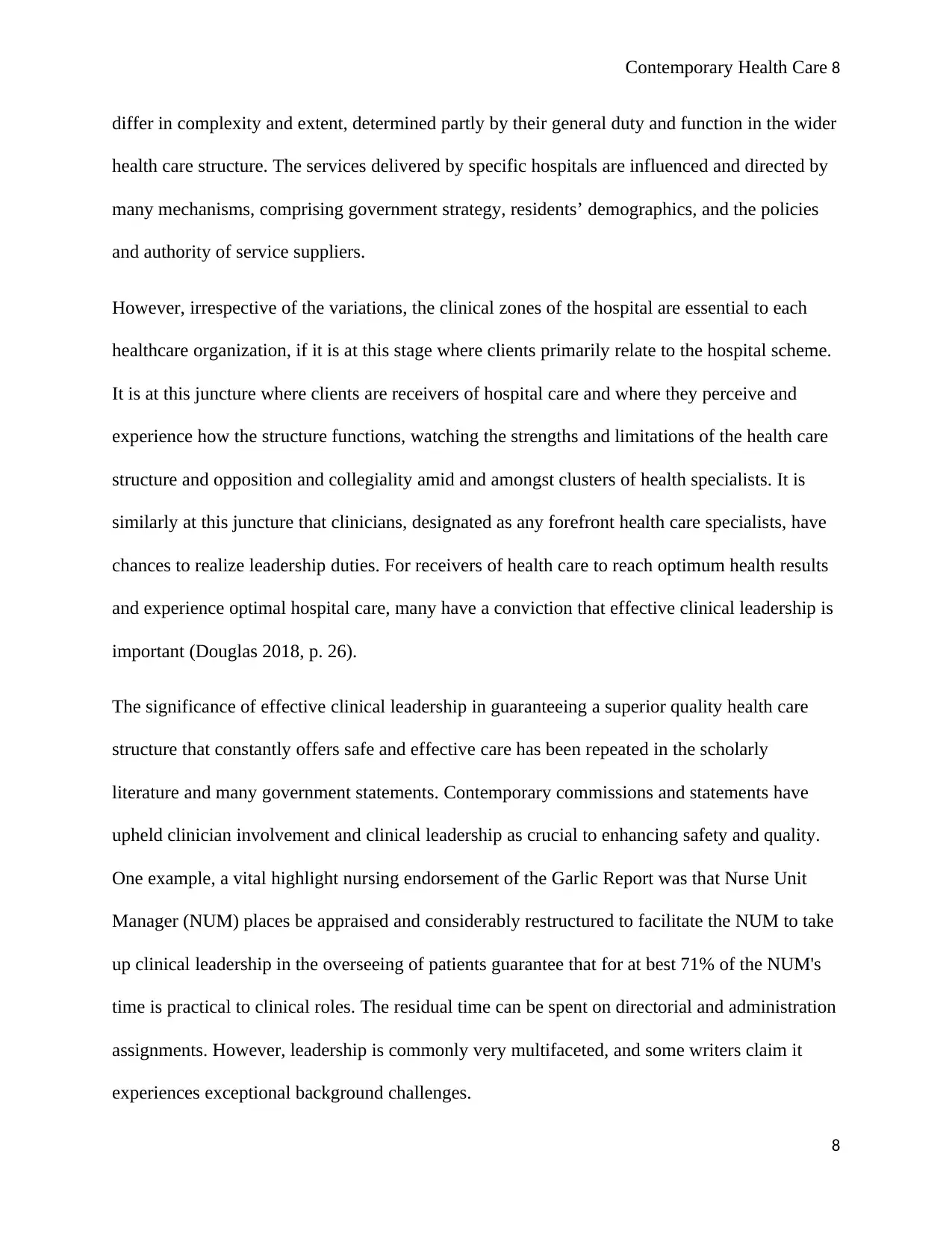
differ in complexity and extent, determined partly by their general duty and function in the wider
health care structure. The services delivered by specific hospitals are influenced and directed by
many mechanisms, comprising government strategy, residents’ demographics, and the policies
and authority of service suppliers.
However, irrespective of the variations, the clinical zones of the hospital are essential to each
healthcare organization, if it is at this stage where clients primarily relate to the hospital scheme.
It is at this juncture where clients are receivers of hospital care and where they perceive and
experience how the structure functions, watching the strengths and limitations of the health care
structure and opposition and collegiality amid and amongst clusters of health specialists. It is
similarly at this juncture that clinicians, designated as any forefront health care specialists, have
chances to realize leadership duties. For receivers of health care to reach optimum health results
and experience optimal hospital care, many have a conviction that effective clinical leadership is
important (Douglas 2018, p. 26).
The significance of effective clinical leadership in guaranteeing a superior quality health care
structure that constantly offers safe and effective care has been repeated in the scholarly
literature and many government statements. Contemporary commissions and statements have
upheld clinician involvement and clinical leadership as crucial to enhancing safety and quality.
One example, a vital highlight nursing endorsement of the Garlic Report was that Nurse Unit
Manager (NUM) places be appraised and considerably restructured to facilitate the NUM to take
up clinical leadership in the overseeing of patients guarantee that for at best 71% of the NUM's
time is practical to clinical roles. The residual time can be spent on directorial and administration
assignments. However, leadership is commonly very multifaceted, and some writers claim it
experiences exceptional background challenges.
8
differ in complexity and extent, determined partly by their general duty and function in the wider
health care structure. The services delivered by specific hospitals are influenced and directed by
many mechanisms, comprising government strategy, residents’ demographics, and the policies
and authority of service suppliers.
However, irrespective of the variations, the clinical zones of the hospital are essential to each
healthcare organization, if it is at this stage where clients primarily relate to the hospital scheme.
It is at this juncture where clients are receivers of hospital care and where they perceive and
experience how the structure functions, watching the strengths and limitations of the health care
structure and opposition and collegiality amid and amongst clusters of health specialists. It is
similarly at this juncture that clinicians, designated as any forefront health care specialists, have
chances to realize leadership duties. For receivers of health care to reach optimum health results
and experience optimal hospital care, many have a conviction that effective clinical leadership is
important (Douglas 2018, p. 26).
The significance of effective clinical leadership in guaranteeing a superior quality health care
structure that constantly offers safe and effective care has been repeated in the scholarly
literature and many government statements. Contemporary commissions and statements have
upheld clinician involvement and clinical leadership as crucial to enhancing safety and quality.
One example, a vital highlight nursing endorsement of the Garlic Report was that Nurse Unit
Manager (NUM) places be appraised and considerably restructured to facilitate the NUM to take
up clinical leadership in the overseeing of patients guarantee that for at best 71% of the NUM's
time is practical to clinical roles. The residual time can be spent on directorial and administration
assignments. However, leadership is commonly very multifaceted, and some writers claim it
experiences exceptional background challenges.
8
Contemporary Health Care 9
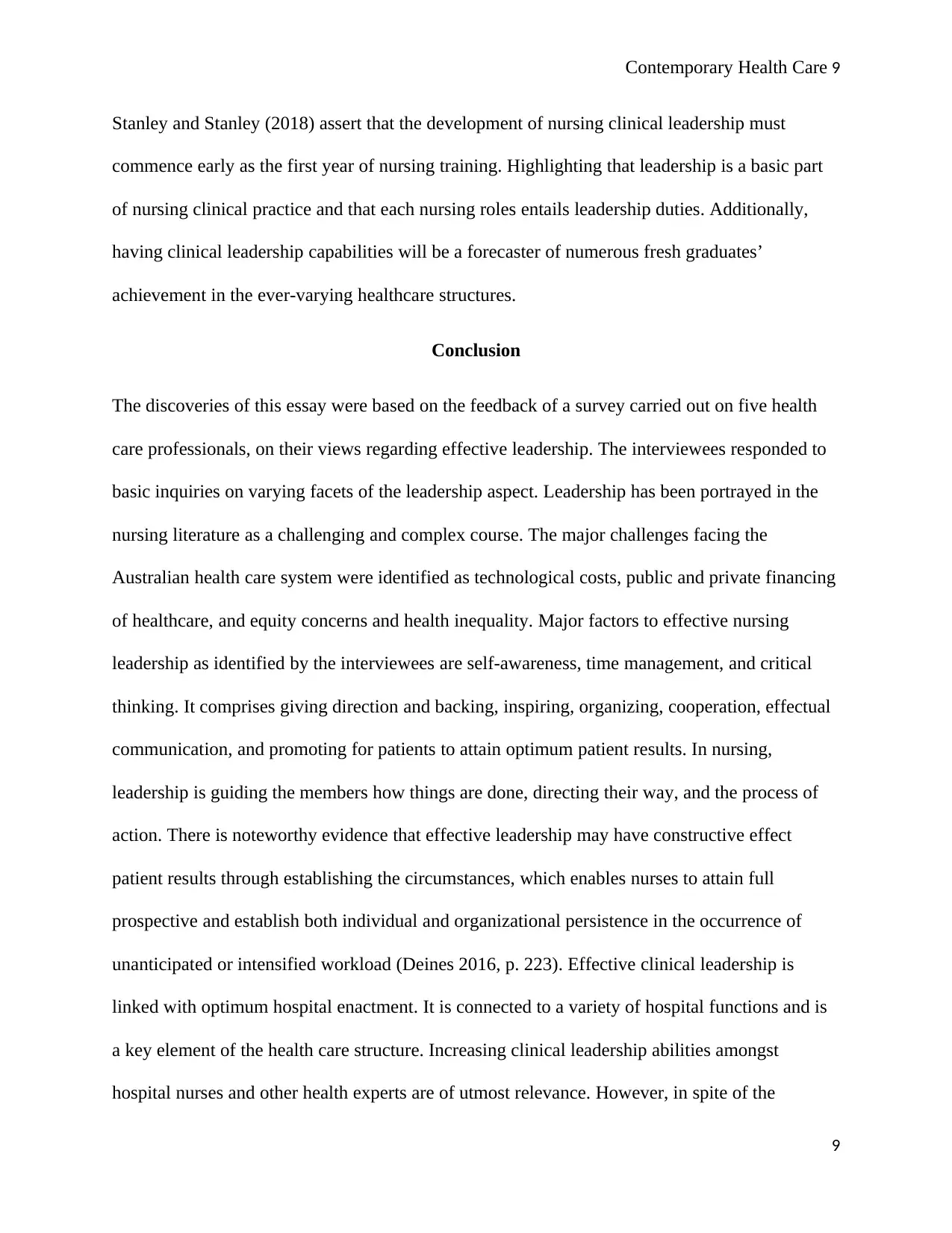
Stanley and Stanley (2018) assert that the development of nursing clinical leadership must
commence early as the first year of nursing training. Highlighting that leadership is a basic part
of nursing clinical practice and that each nursing roles entails leadership duties. Additionally,
having clinical leadership capabilities will be a forecaster of numerous fresh graduates’
achievement in the ever-varying healthcare structures.
Conclusion
The discoveries of this essay were based on the feedback of a survey carried out on five health
care professionals, on their views regarding effective leadership. The interviewees responded to
basic inquiries on varying facets of the leadership aspect. Leadership has been portrayed in the
nursing literature as a challenging and complex course. The major challenges facing the
Australian health care system were identified as technological costs, public and private financing
of healthcare, and equity concerns and health inequality. Major factors to effective nursing
leadership as identified by the interviewees are self-awareness, time management, and critical
thinking. It comprises giving direction and backing, inspiring, organizing, cooperation, effectual
communication, and promoting for patients to attain optimum patient results. In nursing,
leadership is guiding the members how things are done, directing their way, and the process of
action. There is noteworthy evidence that effective leadership may have constructive effect
patient results through establishing the circumstances, which enables nurses to attain full
prospective and establish both individual and organizational persistence in the occurrence of
unanticipated or intensified workload (Deines 2016, p. 223). Effective clinical leadership is
linked with optimum hospital enactment. It is connected to a variety of hospital functions and is
a key element of the health care structure. Increasing clinical leadership abilities amongst
hospital nurses and other health experts are of utmost relevance. However, in spite of the
9
Stanley and Stanley (2018) assert that the development of nursing clinical leadership must
commence early as the first year of nursing training. Highlighting that leadership is a basic part
of nursing clinical practice and that each nursing roles entails leadership duties. Additionally,
having clinical leadership capabilities will be a forecaster of numerous fresh graduates’
achievement in the ever-varying healthcare structures.
Conclusion
The discoveries of this essay were based on the feedback of a survey carried out on five health
care professionals, on their views regarding effective leadership. The interviewees responded to
basic inquiries on varying facets of the leadership aspect. Leadership has been portrayed in the
nursing literature as a challenging and complex course. The major challenges facing the
Australian health care system were identified as technological costs, public and private financing
of healthcare, and equity concerns and health inequality. Major factors to effective nursing
leadership as identified by the interviewees are self-awareness, time management, and critical
thinking. It comprises giving direction and backing, inspiring, organizing, cooperation, effectual
communication, and promoting for patients to attain optimum patient results. In nursing,
leadership is guiding the members how things are done, directing their way, and the process of
action. There is noteworthy evidence that effective leadership may have constructive effect
patient results through establishing the circumstances, which enables nurses to attain full
prospective and establish both individual and organizational persistence in the occurrence of
unanticipated or intensified workload (Deines 2016, p. 223). Effective clinical leadership is
linked with optimum hospital enactment. It is connected to a variety of hospital functions and is
a key element of the health care structure. Increasing clinical leadership abilities amongst
hospital nurses and other health experts are of utmost relevance. However, in spite of the
9
⊘ This is a preview!⊘
Do you want full access?
Subscribe today to unlock all pages.
Trusted by 1+ million students worldwide
Contemporary Health Care 10
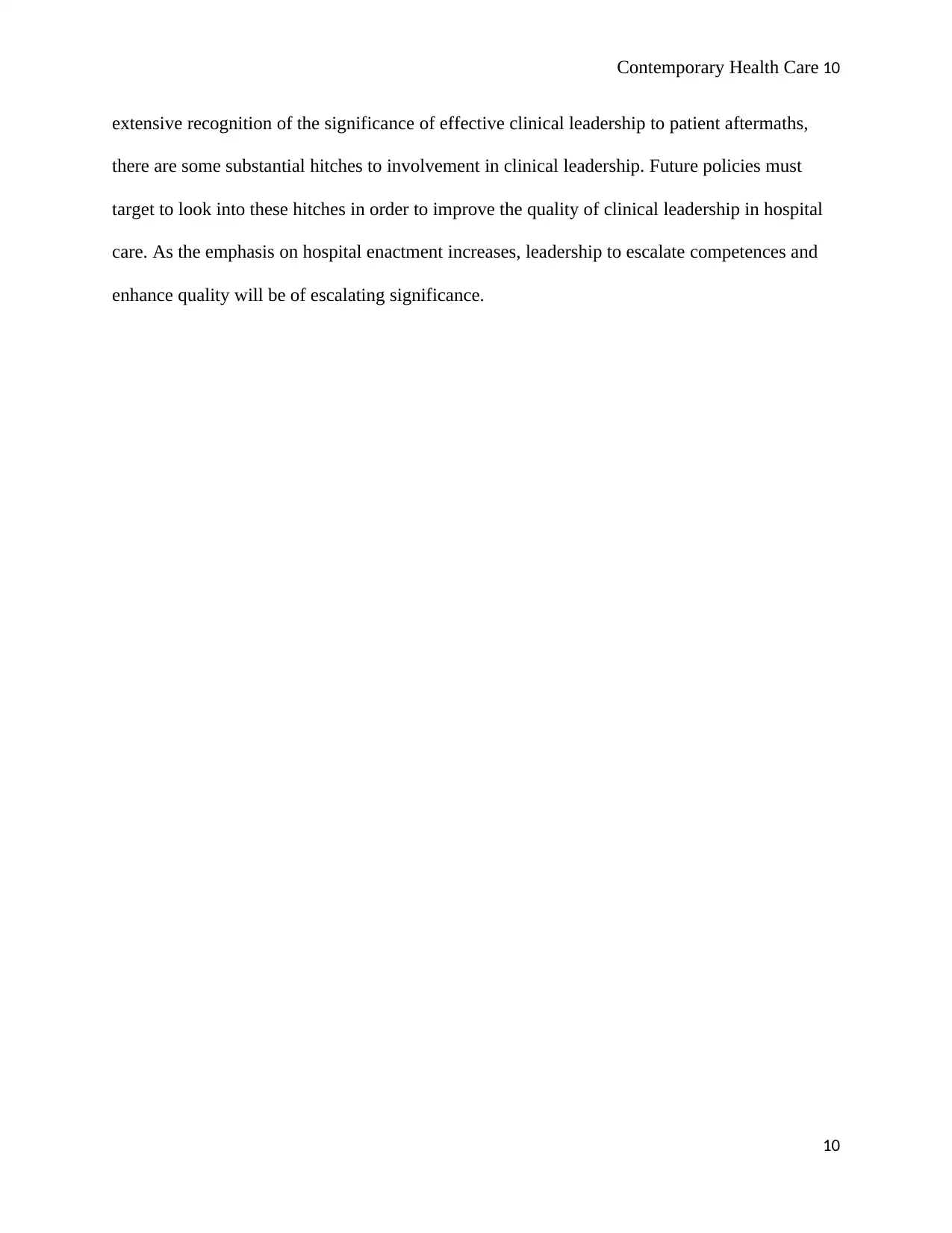
extensive recognition of the significance of effective clinical leadership to patient aftermaths,
there are some substantial hitches to involvement in clinical leadership. Future policies must
target to look into these hitches in order to improve the quality of clinical leadership in hospital
care. As the emphasis on hospital enactment increases, leadership to escalate competences and
enhance quality will be of escalating significance.
10
extensive recognition of the significance of effective clinical leadership to patient aftermaths,
there are some substantial hitches to involvement in clinical leadership. Future policies must
target to look into these hitches in order to improve the quality of clinical leadership in hospital
care. As the emphasis on hospital enactment increases, leadership to escalate competences and
enhance quality will be of escalating significance.
10
Paraphrase This Document
Need a fresh take? Get an instant paraphrase of this document with our AI Paraphraser
Contemporary Health Care 11
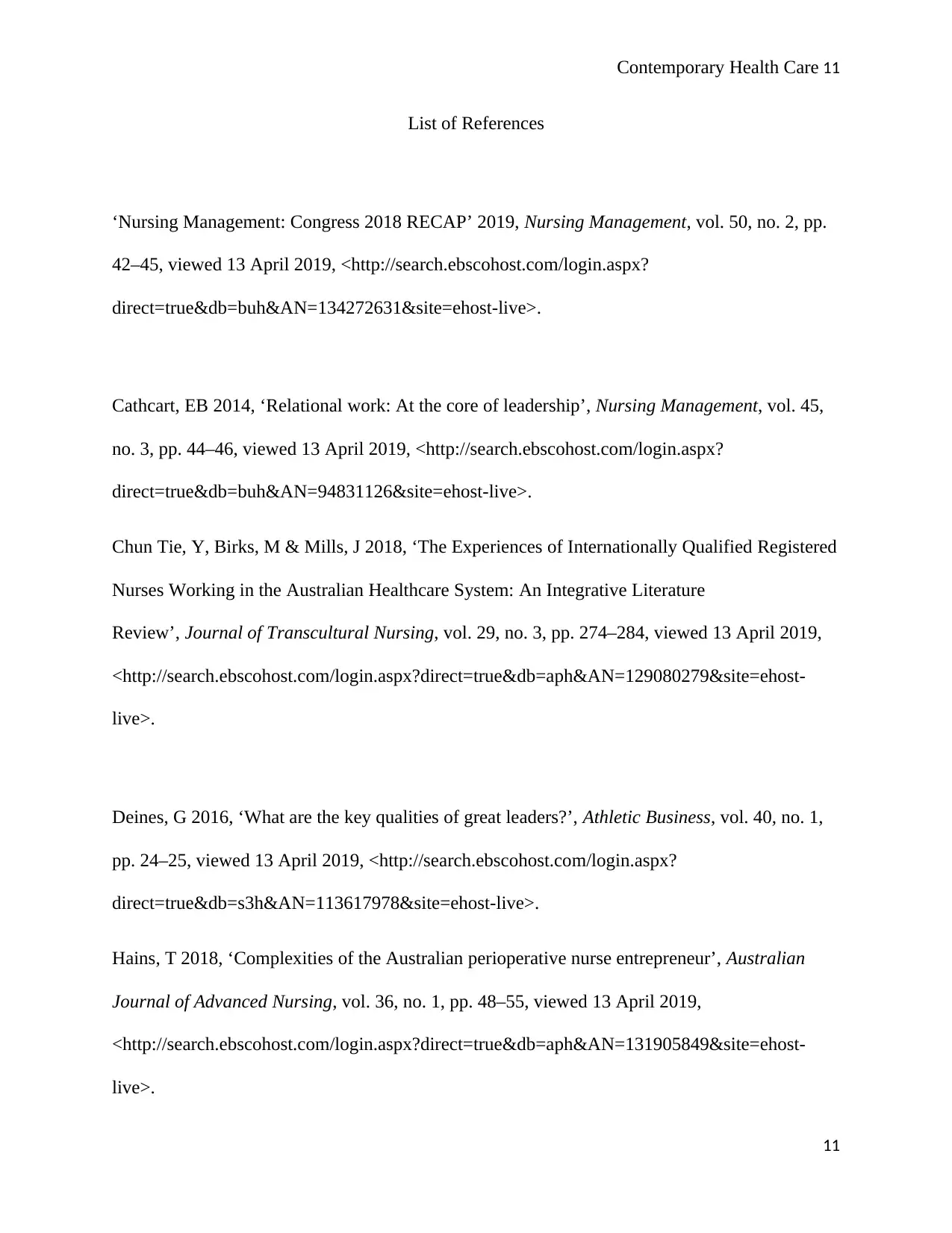
List of References
‘Nursing Management: Congress 2018 RECAP’ 2019, Nursing Management, vol. 50, no. 2, pp.
42–45, viewed 13 April 2019, <http://search.ebscohost.com/login.aspx?
direct=true&db=buh&AN=134272631&site=ehost-live>.
Cathcart, EB 2014, ‘Relational work: At the core of leadership’, Nursing Management, vol. 45,
no. 3, pp. 44–46, viewed 13 April 2019, <http://search.ebscohost.com/login.aspx?
direct=true&db=buh&AN=94831126&site=ehost-live>.
Chun Tie, Y, Birks, M & Mills, J 2018, ‘The Experiences of Internationally Qualified Registered
Nurses Working in the Australian Healthcare System: An Integrative Literature
Review’, Journal of Transcultural Nursing, vol. 29, no. 3, pp. 274–284, viewed 13 April 2019,
<http://search.ebscohost.com/login.aspx?direct=true&db=aph&AN=129080279&site=ehost-
live>.
Deines, G 2016, ‘What are the key qualities of great leaders?’, Athletic Business, vol. 40, no. 1,
pp. 24–25, viewed 13 April 2019, <http://search.ebscohost.com/login.aspx?
direct=true&db=s3h&AN=113617978&site=ehost-live>.
Hains, T 2018, ‘Complexities of the Australian perioperative nurse entrepreneur’, Australian
Journal of Advanced Nursing, vol. 36, no. 1, pp. 48–55, viewed 13 April 2019,
<http://search.ebscohost.com/login.aspx?direct=true&db=aph&AN=131905849&site=ehost-
live>.
11
List of References
‘Nursing Management: Congress 2018 RECAP’ 2019, Nursing Management, vol. 50, no. 2, pp.
42–45, viewed 13 April 2019, <http://search.ebscohost.com/login.aspx?
direct=true&db=buh&AN=134272631&site=ehost-live>.
Cathcart, EB 2014, ‘Relational work: At the core of leadership’, Nursing Management, vol. 45,
no. 3, pp. 44–46, viewed 13 April 2019, <http://search.ebscohost.com/login.aspx?
direct=true&db=buh&AN=94831126&site=ehost-live>.
Chun Tie, Y, Birks, M & Mills, J 2018, ‘The Experiences of Internationally Qualified Registered
Nurses Working in the Australian Healthcare System: An Integrative Literature
Review’, Journal of Transcultural Nursing, vol. 29, no. 3, pp. 274–284, viewed 13 April 2019,
<http://search.ebscohost.com/login.aspx?direct=true&db=aph&AN=129080279&site=ehost-
live>.
Deines, G 2016, ‘What are the key qualities of great leaders?’, Athletic Business, vol. 40, no. 1,
pp. 24–25, viewed 13 April 2019, <http://search.ebscohost.com/login.aspx?
direct=true&db=s3h&AN=113617978&site=ehost-live>.
Hains, T 2018, ‘Complexities of the Australian perioperative nurse entrepreneur’, Australian
Journal of Advanced Nursing, vol. 36, no. 1, pp. 48–55, viewed 13 April 2019,
<http://search.ebscohost.com/login.aspx?direct=true&db=aph&AN=131905849&site=ehost-
live>.
11
Contemporary Health Care 12
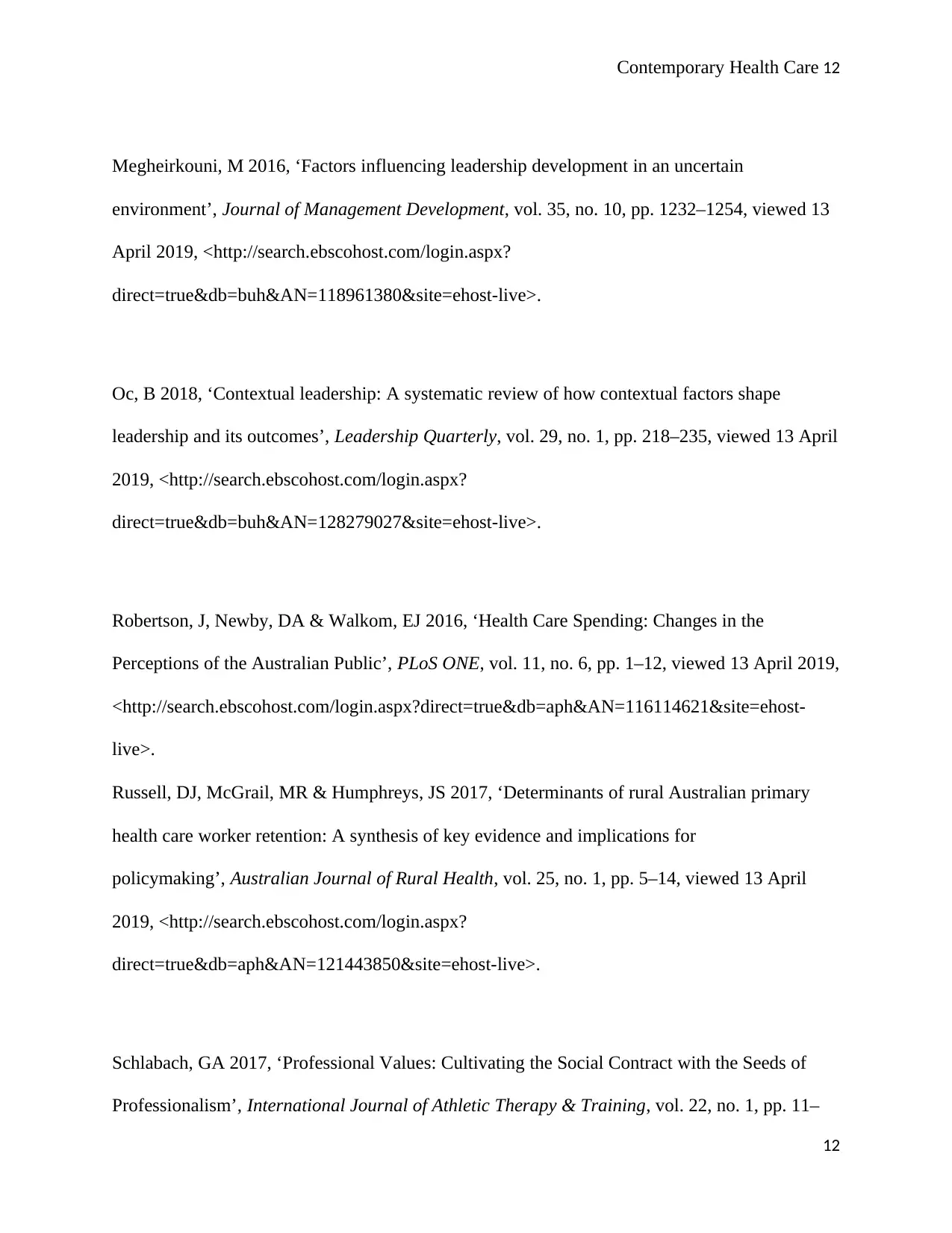
Megheirkouni, M 2016, ‘Factors influencing leadership development in an uncertain
environment’, Journal of Management Development, vol. 35, no. 10, pp. 1232–1254, viewed 13
April 2019, <http://search.ebscohost.com/login.aspx?
direct=true&db=buh&AN=118961380&site=ehost-live>.
Oc, B 2018, ‘Contextual leadership: A systematic review of how contextual factors shape
leadership and its outcomes’, Leadership Quarterly, vol. 29, no. 1, pp. 218–235, viewed 13 April
2019, <http://search.ebscohost.com/login.aspx?
direct=true&db=buh&AN=128279027&site=ehost-live>.
Robertson, J, Newby, DA & Walkom, EJ 2016, ‘Health Care Spending: Changes in the
Perceptions of the Australian Public’, PLoS ONE, vol. 11, no. 6, pp. 1–12, viewed 13 April 2019,
<http://search.ebscohost.com/login.aspx?direct=true&db=aph&AN=116114621&site=ehost-
live>.
Russell, DJ, McGrail, MR & Humphreys, JS 2017, ‘Determinants of rural Australian primary
health care worker retention: A synthesis of key evidence and implications for
policymaking’, Australian Journal of Rural Health, vol. 25, no. 1, pp. 5–14, viewed 13 April
2019, <http://search.ebscohost.com/login.aspx?
direct=true&db=aph&AN=121443850&site=ehost-live>.
Schlabach, GA 2017, ‘Professional Values: Cultivating the Social Contract with the Seeds of
Professionalism’, International Journal of Athletic Therapy & Training, vol. 22, no. 1, pp. 11–
12
Megheirkouni, M 2016, ‘Factors influencing leadership development in an uncertain
environment’, Journal of Management Development, vol. 35, no. 10, pp. 1232–1254, viewed 13
April 2019, <http://search.ebscohost.com/login.aspx?
direct=true&db=buh&AN=118961380&site=ehost-live>.
Oc, B 2018, ‘Contextual leadership: A systematic review of how contextual factors shape
leadership and its outcomes’, Leadership Quarterly, vol. 29, no. 1, pp. 218–235, viewed 13 April
2019, <http://search.ebscohost.com/login.aspx?
direct=true&db=buh&AN=128279027&site=ehost-live>.
Robertson, J, Newby, DA & Walkom, EJ 2016, ‘Health Care Spending: Changes in the
Perceptions of the Australian Public’, PLoS ONE, vol. 11, no. 6, pp. 1–12, viewed 13 April 2019,
<http://search.ebscohost.com/login.aspx?direct=true&db=aph&AN=116114621&site=ehost-
live>.
Russell, DJ, McGrail, MR & Humphreys, JS 2017, ‘Determinants of rural Australian primary
health care worker retention: A synthesis of key evidence and implications for
policymaking’, Australian Journal of Rural Health, vol. 25, no. 1, pp. 5–14, viewed 13 April
2019, <http://search.ebscohost.com/login.aspx?
direct=true&db=aph&AN=121443850&site=ehost-live>.
Schlabach, GA 2017, ‘Professional Values: Cultivating the Social Contract with the Seeds of
Professionalism’, International Journal of Athletic Therapy & Training, vol. 22, no. 1, pp. 11–
12
⊘ This is a preview!⊘
Do you want full access?
Subscribe today to unlock all pages.
Trusted by 1+ million students worldwide

1 out of 13


Related Documents


Your All-in-One AI-Powered Toolkit for Academic Success.
+13062052269
info@desklib.com
Available 24*7 on WhatsApp / Email
![[object Object]](/_next/static/media/star-bottom.7253800d.svg)
Unlock your academic potential
Copyright © 2020–2026 A2Z Services. All Rights Reserved. Developed and managed by ZUCOL.