Healthcare Systems: Medical Records and Telephone Techniques Analysis
VerifiedAdded on 2020/04/07
|7
|1877
|84
Discussion Board Post
AI Summary
This assignment comprises two discussion posts addressing critical aspects of healthcare administration. The first discussion focuses on a scenario involving inappropriate medical abbreviations used by healthcare professionals and explores how a medical office specialist should respond to this ethical breach, emphasizing the importance of patient confidentiality, respect, and reporting unethical behavior. The second discussion delves into telephone techniques, examining incoming call types, appropriate actions for medical administrative assistants, and the application of the PRICE quality of Respect. Both discussions require students to analyze scenarios, provide thoughtful responses, and demonstrate a strong understanding of ethical and professional conduct within a healthcare setting. The student's responses address these issues and provide references to support their arguments.
HEALTHCARE SYSTEMS 1
HEALTHCARE SYSTEMS
Name:
Institution:
Course Code:
HEALTHCARE SYSTEMS
Name:
Institution:
Course Code:

Paraphrase This Document
Need a fresh take? Get an instant paraphrase of this document with our AI Paraphraser
HEALTHCARE SYSTEMS 2
The Medical Record- 111-7A
Here is the Original Discussion Post for the FIRST Discussion Post
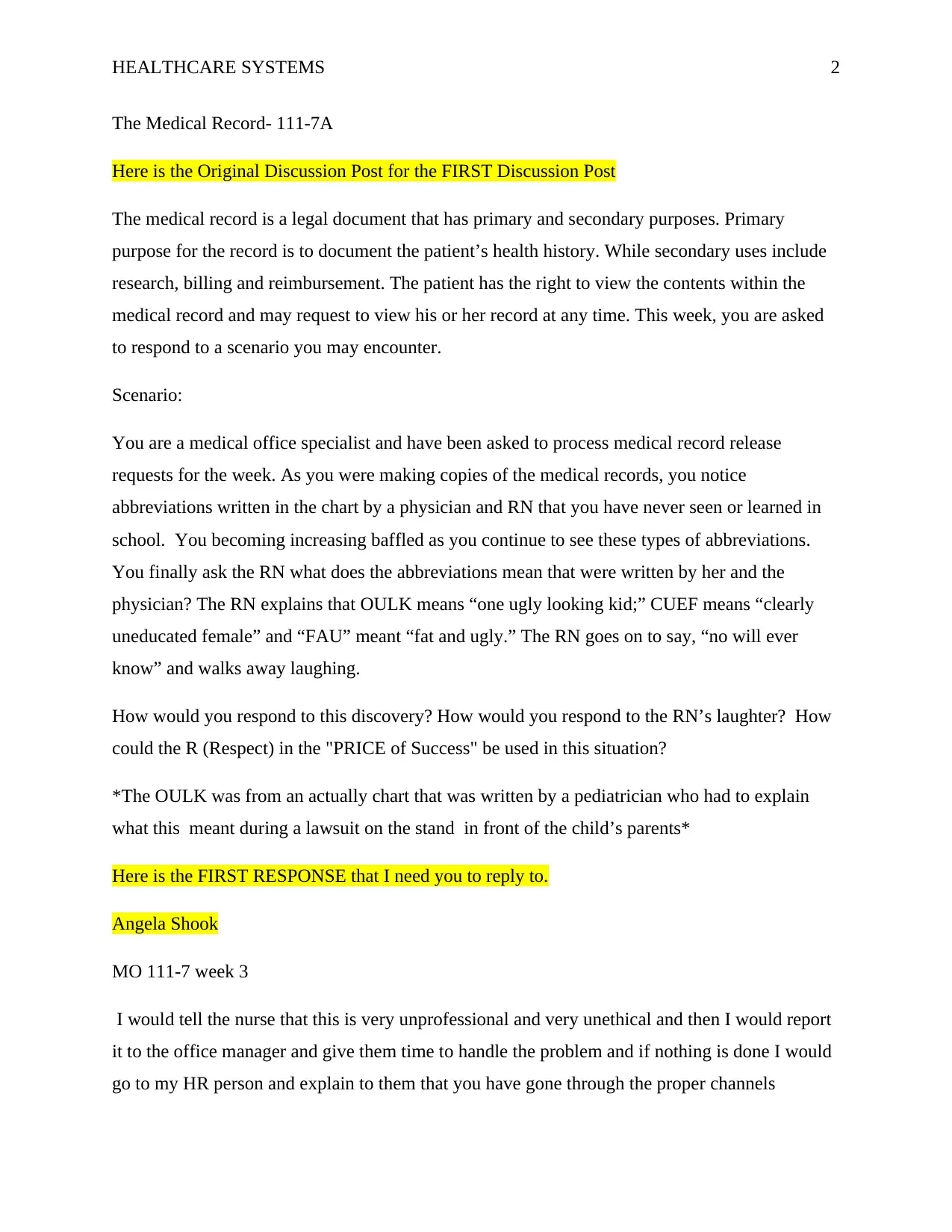
The medical record is a legal document that has primary and secondary purposes. Primary
purpose for the record is to document the patient’s health history. While secondary uses include
research, billing and reimbursement. The patient has the right to view the contents within the
medical record and may request to view his or her record at any time. This week, you are asked
to respond to a scenario you may encounter.
Scenario:
You are a medical office specialist and have been asked to process medical record release
requests for the week. As you were making copies of the medical records, you notice
abbreviations written in the chart by a physician and RN that you have never seen or learned in
school. You becoming increasing baffled as you continue to see these types of abbreviations.
You finally ask the RN what does the abbreviations mean that were written by her and the
physician? The RN explains that OULK means “one ugly looking kid;” CUEF means “clearly
uneducated female” and “FAU” meant “fat and ugly.” The RN goes on to say, “no will ever
know” and walks away laughing.
How would you respond to this discovery? How would you respond to the RN’s laughter? How
could the R (Respect) in the "PRICE of Success" be used in this situation?
*The OULK was from an actually chart that was written by a pediatrician who had to explain
what this meant during a lawsuit on the stand in front of the child’s parents*
Here is the FIRST RESPONSE that I need you to reply to.
Angela Shook
MO 111-7 week 3
I would tell the nurse that this is very unprofessional and very unethical and then I would report
it to the office manager and give them time to handle the problem and if nothing is done I would
go to my HR person and explain to them that you have gone through the proper channels
The Medical Record- 111-7A
Here is the Original Discussion Post for the FIRST Discussion Post
The medical record is a legal document that has primary and secondary purposes. Primary
purpose for the record is to document the patient’s health history. While secondary uses include
research, billing and reimbursement. The patient has the right to view the contents within the
medical record and may request to view his or her record at any time. This week, you are asked
to respond to a scenario you may encounter.
Scenario:
You are a medical office specialist and have been asked to process medical record release
requests for the week. As you were making copies of the medical records, you notice
abbreviations written in the chart by a physician and RN that you have never seen or learned in
school. You becoming increasing baffled as you continue to see these types of abbreviations.
You finally ask the RN what does the abbreviations mean that were written by her and the
physician? The RN explains that OULK means “one ugly looking kid;” CUEF means “clearly
uneducated female” and “FAU” meant “fat and ugly.” The RN goes on to say, “no will ever
know” and walks away laughing.
How would you respond to this discovery? How would you respond to the RN’s laughter? How
could the R (Respect) in the "PRICE of Success" be used in this situation?
*The OULK was from an actually chart that was written by a pediatrician who had to explain
what this meant during a lawsuit on the stand in front of the child’s parents*
Here is the FIRST RESPONSE that I need you to reply to.
Angela Shook
MO 111-7 week 3
I would tell the nurse that this is very unprofessional and very unethical and then I would report
it to the office manager and give them time to handle the problem and if nothing is done I would
go to my HR person and explain to them that you have gone through the proper channels
HEALTHCARE SYSTEMS 3
however nothing has been done. I would find out from HR how I need to handle the records that
have been requested.
My response
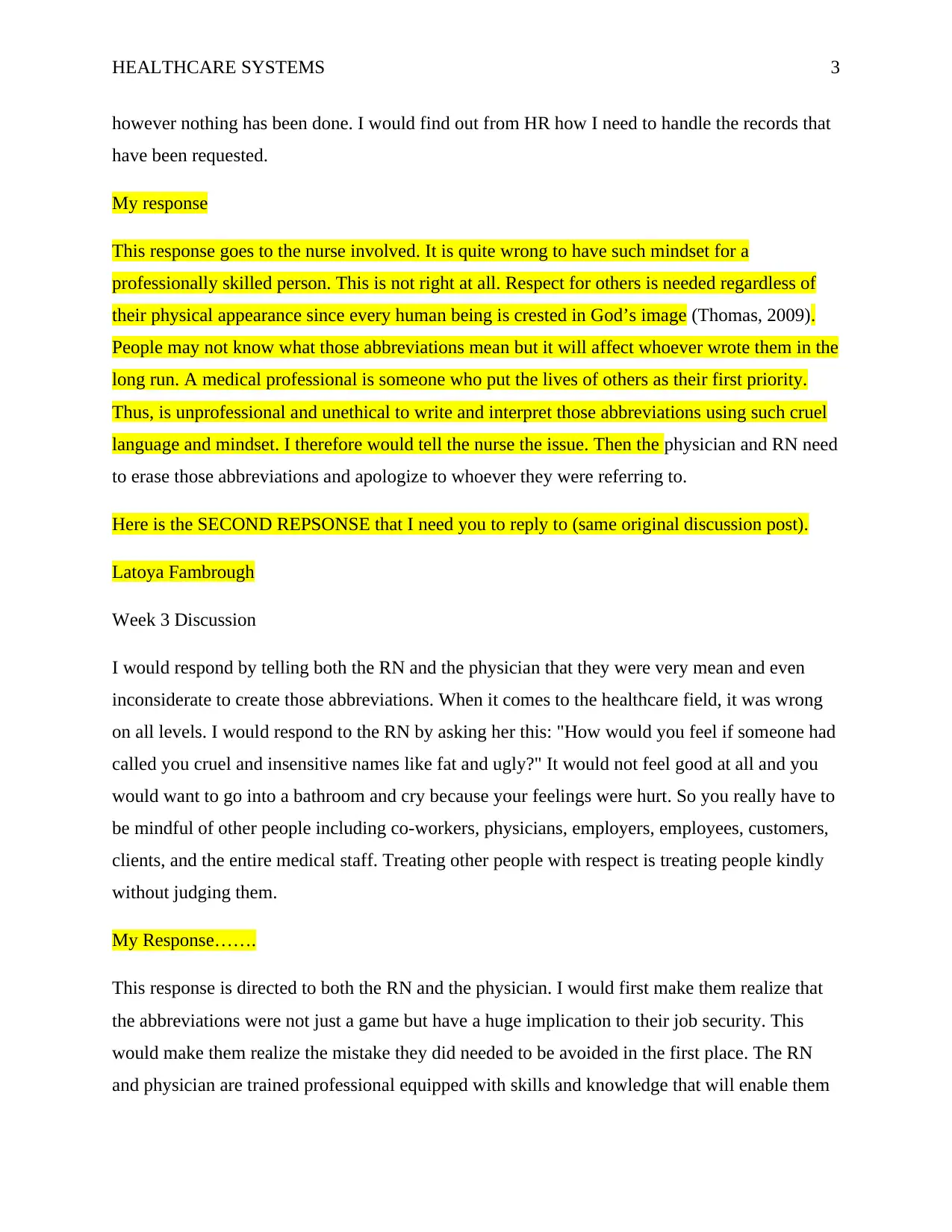
This response goes to the nurse involved. It is quite wrong to have such mindset for a
professionally skilled person. This is not right at all. Respect for others is needed regardless of
their physical appearance since every human being is crested in God’s image (Thomas, 2009).
People may not know what those abbreviations mean but it will affect whoever wrote them in the
long run. A medical professional is someone who put the lives of others as their first priority.
Thus, is unprofessional and unethical to write and interpret those abbreviations using such cruel
language and mindset. I therefore would tell the nurse the issue. Then the physician and RN need
to erase those abbreviations and apologize to whoever they were referring to.
Here is the SECOND REPSONSE that I need you to reply to (same original discussion post).
Latoya Fambrough
Week 3 Discussion
I would respond by telling both the RN and the physician that they were very mean and even
inconsiderate to create those abbreviations. When it comes to the healthcare field, it was wrong
on all levels. I would respond to the RN by asking her this: "How would you feel if someone had
called you cruel and insensitive names like fat and ugly?" It would not feel good at all and you
would want to go into a bathroom and cry because your feelings were hurt. So you really have to
be mindful of other people including co-workers, physicians, employers, employees, customers,
clients, and the entire medical staff. Treating other people with respect is treating people kindly
without judging them.
My Response…….
This response is directed to both the RN and the physician. I would first make them realize that
the abbreviations were not just a game but have a huge implication to their job security. This
would make them realize the mistake they did needed to be avoided in the first place. The RN
and physician are trained professional equipped with skills and knowledge that will enable them
however nothing has been done. I would find out from HR how I need to handle the records that
have been requested.
My response
This response goes to the nurse involved. It is quite wrong to have such mindset for a
professionally skilled person. This is not right at all. Respect for others is needed regardless of
their physical appearance since every human being is crested in God’s image (Thomas, 2009).
People may not know what those abbreviations mean but it will affect whoever wrote them in the
long run. A medical professional is someone who put the lives of others as their first priority.
Thus, is unprofessional and unethical to write and interpret those abbreviations using such cruel
language and mindset. I therefore would tell the nurse the issue. Then the physician and RN need
to erase those abbreviations and apologize to whoever they were referring to.
Here is the SECOND REPSONSE that I need you to reply to (same original discussion post).
Latoya Fambrough
Week 3 Discussion
I would respond by telling both the RN and the physician that they were very mean and even
inconsiderate to create those abbreviations. When it comes to the healthcare field, it was wrong
on all levels. I would respond to the RN by asking her this: "How would you feel if someone had
called you cruel and insensitive names like fat and ugly?" It would not feel good at all and you
would want to go into a bathroom and cry because your feelings were hurt. So you really have to
be mindful of other people including co-workers, physicians, employers, employees, customers,
clients, and the entire medical staff. Treating other people with respect is treating people kindly
without judging them.
My Response…….
This response is directed to both the RN and the physician. I would first make them realize that
the abbreviations were not just a game but have a huge implication to their job security. This
would make them realize the mistake they did needed to be avoided in the first place. The RN
and physician are trained professional equipped with skills and knowledge that will enable them
⊘ This is a preview!⊘
Do you want full access?
Subscribe today to unlock all pages.

Trusted by 1+ million students worldwide
HEALTHCARE SYSTEMS 4
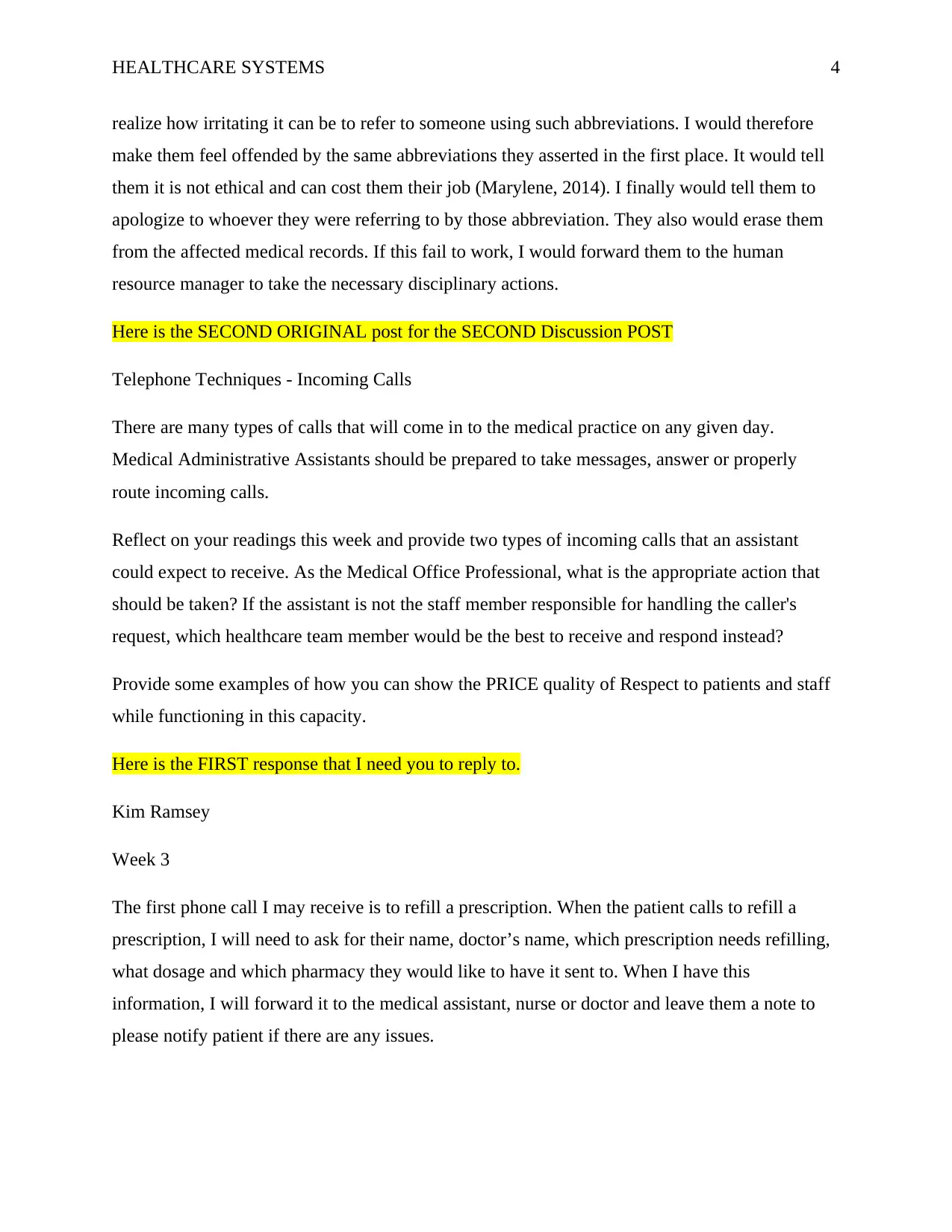
realize how irritating it can be to refer to someone using such abbreviations. I would therefore
make them feel offended by the same abbreviations they asserted in the first place. It would tell
them it is not ethical and can cost them their job (Marylene, 2014). I finally would tell them to
apologize to whoever they were referring to by those abbreviation. They also would erase them
from the affected medical records. If this fail to work, I would forward them to the human
resource manager to take the necessary disciplinary actions.
Here is the SECOND ORIGINAL post for the SECOND Discussion POST
Telephone Techniques - Incoming Calls
There are many types of calls that will come in to the medical practice on any given day.
Medical Administrative Assistants should be prepared to take messages, answer or properly
route incoming calls.
Reflect on your readings this week and provide two types of incoming calls that an assistant
could expect to receive. As the Medical Office Professional, what is the appropriate action that
should be taken? If the assistant is not the staff member responsible for handling the caller's
request, which healthcare team member would be the best to receive and respond instead?
Provide some examples of how you can show the PRICE quality of Respect to patients and staff
while functioning in this capacity.
Here is the FIRST response that I need you to reply to.
Kim Ramsey
Week 3
The first phone call I may receive is to refill a prescription. When the patient calls to refill a
prescription, I will need to ask for their name, doctor’s name, which prescription needs refilling,
what dosage and which pharmacy they would like to have it sent to. When I have this
information, I will forward it to the medical assistant, nurse or doctor and leave them a note to
please notify patient if there are any issues.
realize how irritating it can be to refer to someone using such abbreviations. I would therefore
make them feel offended by the same abbreviations they asserted in the first place. It would tell
them it is not ethical and can cost them their job (Marylene, 2014). I finally would tell them to
apologize to whoever they were referring to by those abbreviation. They also would erase them
from the affected medical records. If this fail to work, I would forward them to the human
resource manager to take the necessary disciplinary actions.
Here is the SECOND ORIGINAL post for the SECOND Discussion POST
Telephone Techniques - Incoming Calls
There are many types of calls that will come in to the medical practice on any given day.
Medical Administrative Assistants should be prepared to take messages, answer or properly
route incoming calls.
Reflect on your readings this week and provide two types of incoming calls that an assistant
could expect to receive. As the Medical Office Professional, what is the appropriate action that
should be taken? If the assistant is not the staff member responsible for handling the caller's
request, which healthcare team member would be the best to receive and respond instead?
Provide some examples of how you can show the PRICE quality of Respect to patients and staff
while functioning in this capacity.
Here is the FIRST response that I need you to reply to.
Kim Ramsey
Week 3
The first phone call I may receive is to refill a prescription. When the patient calls to refill a
prescription, I will need to ask for their name, doctor’s name, which prescription needs refilling,
what dosage and which pharmacy they would like to have it sent to. When I have this
information, I will forward it to the medical assistant, nurse or doctor and leave them a note to
please notify patient if there are any issues.
Paraphrase This Document
Need a fresh take? Get an instant paraphrase of this document with our AI Paraphraser
HEALTHCARE SYSTEMS 5
The second phone call I may receive could be a return call to a doctor or nurse. I would answer
the phone with the proper greeting for that office, I then would transfer them to the nurse or
doctor if they are available and have them leave a voice message if they are unavailable.
I can show respect by listening to what the client is telling me, then respond when they are done.
Respect with my coworkers could be following the rules the office has, and allowing them to tell
me information that could be new that I have not been informed of.
My Response…….
It is very important to ensure proper communication in the medical sector since you are dealing
with patients suffering from different illnesses. The same effective response will be subjected to
the doctors since their nature of work is quite involving (Kanungo & Manuel, 2014). The first
call I may receive is from a patient who was discharged a few weeks ago and may require
readmission to the same hospital. I would asked the patient to provide details of their name, the
doctor who treated them and the illness they suffered. It would also request them to provide dates
that the patient was discharged. I would then ask them whether the illness is back and need
medical attention. I would promise them that I would inform the doctor in charge so as to make
arrangement of their readmission.
The second call would probably be from the doctor who treated the patient before he/she was
discharged. It would tell the doctor about the patient state of condition so as to prepare the
readmission and all the medical requirements for such a patient. I would thank the doctor for the
continued support they are providing to the patient. This may motivate the doctor at the work
they do.
Here is the SECOND response that I need you to reply to.
Ashley Castellonas
Week 3
If I had a call coming in for a patients aunt and she asked for information regarding a procedure
that was done on a patient recently. I would ask for key identifiers to find the patients file. I
would ask name, address, and birthday. I would then ask the aunts name and see if her name is
The second phone call I may receive could be a return call to a doctor or nurse. I would answer
the phone with the proper greeting for that office, I then would transfer them to the nurse or
doctor if they are available and have them leave a voice message if they are unavailable.
I can show respect by listening to what the client is telling me, then respond when they are done.
Respect with my coworkers could be following the rules the office has, and allowing them to tell
me information that could be new that I have not been informed of.
My Response…….
It is very important to ensure proper communication in the medical sector since you are dealing
with patients suffering from different illnesses. The same effective response will be subjected to
the doctors since their nature of work is quite involving (Kanungo & Manuel, 2014). The first
call I may receive is from a patient who was discharged a few weeks ago and may require
readmission to the same hospital. I would asked the patient to provide details of their name, the
doctor who treated them and the illness they suffered. It would also request them to provide dates
that the patient was discharged. I would then ask them whether the illness is back and need
medical attention. I would promise them that I would inform the doctor in charge so as to make
arrangement of their readmission.
The second call would probably be from the doctor who treated the patient before he/she was
discharged. It would tell the doctor about the patient state of condition so as to prepare the
readmission and all the medical requirements for such a patient. I would thank the doctor for the
continued support they are providing to the patient. This may motivate the doctor at the work
they do.
Here is the SECOND response that I need you to reply to.
Ashley Castellonas
Week 3
If I had a call coming in for a patients aunt and she asked for information regarding a procedure
that was done on a patient recently. I would ask for key identifiers to find the patients file. I
would ask name, address, and birthday. I would then ask the aunts name and see if her name is
HEALTHCARE SYSTEMS 6
listed in the patient’s information as someone to give information to. Her name was not listed. I
would tell her I am sorry but your name is not on the paperwork I am not able to disclose any
information to you at this time. Please have so and so come into the office and fill out a form for
you to be added to the paperwork. I would ask if there’s anything else I can help her with today
and if she says no I would say thank you for calling so and so office have a great day.
My Response……..
If I had a call from a relative of a patient regarding how their patient is responding to the
medication, I would request the relative to provide details of the patient, date admitted, doctor in
charge and the medical record number. This will make tracing of the patient easier. If I cannot
trace the name of the patient, I would tell the relative that am really working on it to give him the
relevant information concerning the patient (Arnold, 2010). I would request the relative to visit
the medical facility. However in the meantime the relative may spell out anything he may require
and I would comfortably provide.
listed in the patient’s information as someone to give information to. Her name was not listed. I
would tell her I am sorry but your name is not on the paperwork I am not able to disclose any
information to you at this time. Please have so and so come into the office and fill out a form for
you to be added to the paperwork. I would ask if there’s anything else I can help her with today
and if she says no I would say thank you for calling so and so office have a great day.
My Response……..
If I had a call from a relative of a patient regarding how their patient is responding to the
medication, I would request the relative to provide details of the patient, date admitted, doctor in
charge and the medical record number. This will make tracing of the patient easier. If I cannot
trace the name of the patient, I would tell the relative that am really working on it to give him the
relevant information concerning the patient (Arnold, 2010). I would request the relative to visit
the medical facility. However in the meantime the relative may spell out anything he may require
and I would comfortably provide.
⊘ This is a preview!⊘
Do you want full access?
Subscribe today to unlock all pages.
Trusted by 1+ million students worldwide
HEALTHCARE SYSTEMS 7
References.
Arnold, J. (2010). Coaching Skills for Leaders in the Workplace: How to Develop, Motivate and
Get the Best from Your Staff. How to Books.
Kanungo, R.N., & Manuel, M. (2014). Work Motivation: Models for Developing Countries.
Sage Publication put.
Marylene, G. (2014). The Oxford Handbook of Work Engagement, Motivation and Self-
Determination Theory. OUP USA.
Thomas, K.W. (2009). Intrinsic Motivation: What Really Drives Employees Engagement. Berret-
Koehler publishers.
References.
Arnold, J. (2010). Coaching Skills for Leaders in the Workplace: How to Develop, Motivate and
Get the Best from Your Staff. How to Books.
Kanungo, R.N., & Manuel, M. (2014). Work Motivation: Models for Developing Countries.
Sage Publication put.
Marylene, G. (2014). The Oxford Handbook of Work Engagement, Motivation and Self-
Determination Theory. OUP USA.
Thomas, K.W. (2009). Intrinsic Motivation: What Really Drives Employees Engagement. Berret-
Koehler publishers.

1 out of 7


Your All-in-One AI-Powered Toolkit for Academic Success.
+13062052269
info@desklib.com
Available 24*7 on WhatsApp / Email
![[object Object]](/_next/static/media/star-bottom.7253800d.svg)
Unlock your academic potential
Copyright © 2020–2026 A2Z Services. All Rights Reserved. Developed and managed by ZUCOL.