Healthcare Crisis in the UK: Challenges of an Aging Population
VerifiedAdded on 2020/04/01
|10
|2208
|155
Essay
AI Summary
This essay examines the healthcare crisis facing the United Kingdom, primarily focusing on the challenges presented by an aging population. The analysis begins by highlighting the demographic shift, including the increasing number of elderly individuals and declining fertility rates, and the potential strain on the healthcare system. The essay delves into the specific challenges, such as the rising costs of elderly care, the pressure on social services, and the need for workforce adjustments. It explores the implications of an aging population, including poverty among pensioners and the need for better accommodation. The essay also discusses government initiatives and potential solutions, such as increasing the retirement age, promoting healthy lifestyles, and encouraging skilled labor immigration. The conclusion emphasizes the urgency of addressing these challenges to ensure the sustainability of the UK's healthcare system and the well-being of its population.
Health System in Developing Countries
Paraphrase This Document
Need a fresh take? Get an instant paraphrase of this document with our AI Paraphraser

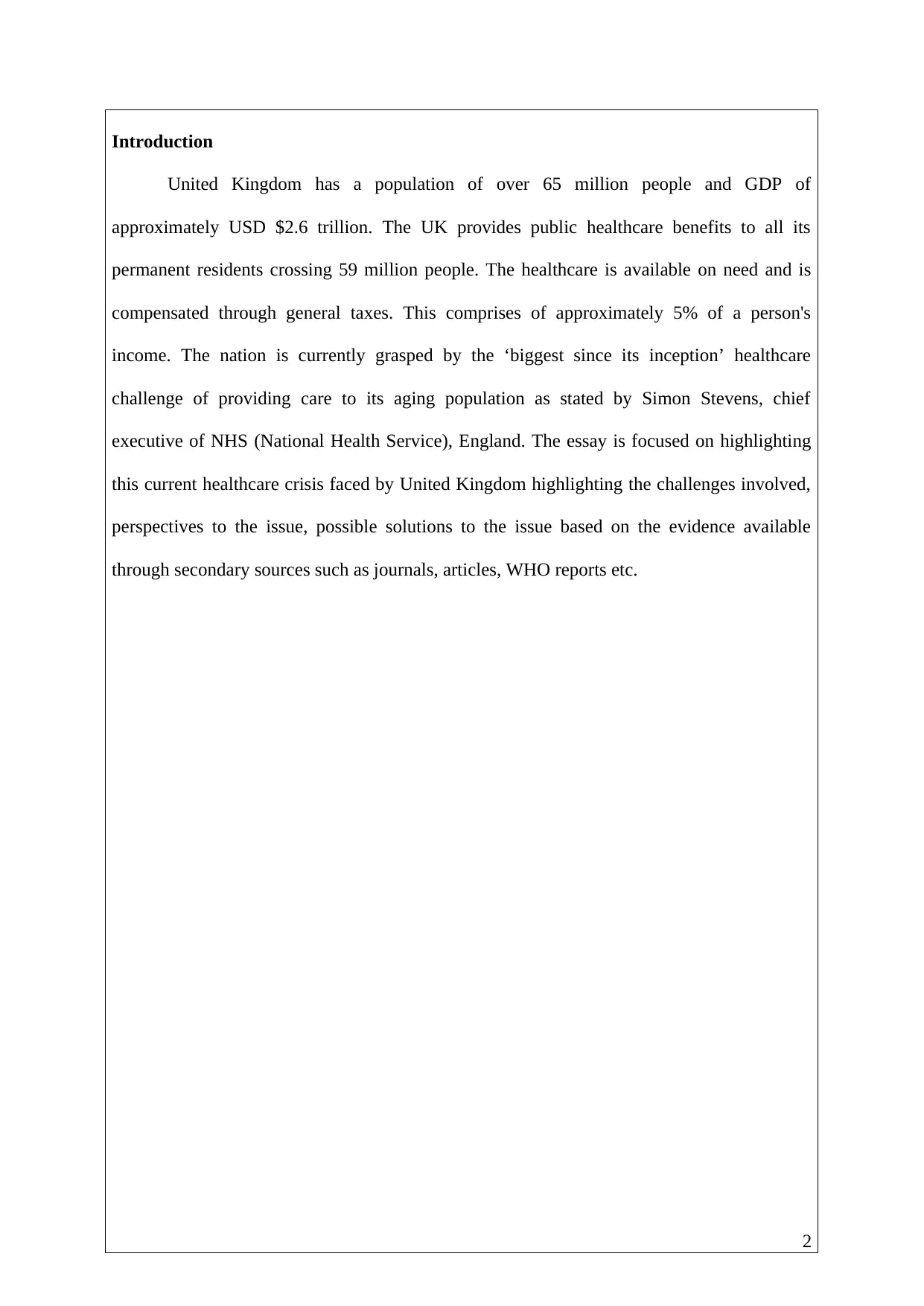
Introduction
United Kingdom has a population of over 65 million people and GDP of
approximately USD $2.6 trillion. The UK provides public healthcare benefits to all its
permanent residents crossing 59 million people. The healthcare is available on need and is
compensated through general taxes. This comprises of approximately 5% of a person's
income. The nation is currently grasped by the ‘biggest since its inception’ healthcare
challenge of providing care to its aging population as stated by Simon Stevens, chief
executive of NHS (National Health Service), England. The essay is focused on highlighting
this current healthcare crisis faced by United Kingdom highlighting the challenges involved,
perspectives to the issue, possible solutions to the issue based on the evidence available
through secondary sources such as journals, articles, WHO reports etc.
2
United Kingdom has a population of over 65 million people and GDP of
approximately USD $2.6 trillion. The UK provides public healthcare benefits to all its
permanent residents crossing 59 million people. The healthcare is available on need and is
compensated through general taxes. This comprises of approximately 5% of a person's
income. The nation is currently grasped by the ‘biggest since its inception’ healthcare
challenge of providing care to its aging population as stated by Simon Stevens, chief
executive of NHS (National Health Service), England. The essay is focused on highlighting
this current healthcare crisis faced by United Kingdom highlighting the challenges involved,
perspectives to the issue, possible solutions to the issue based on the evidence available
through secondary sources such as journals, articles, WHO reports etc.
2

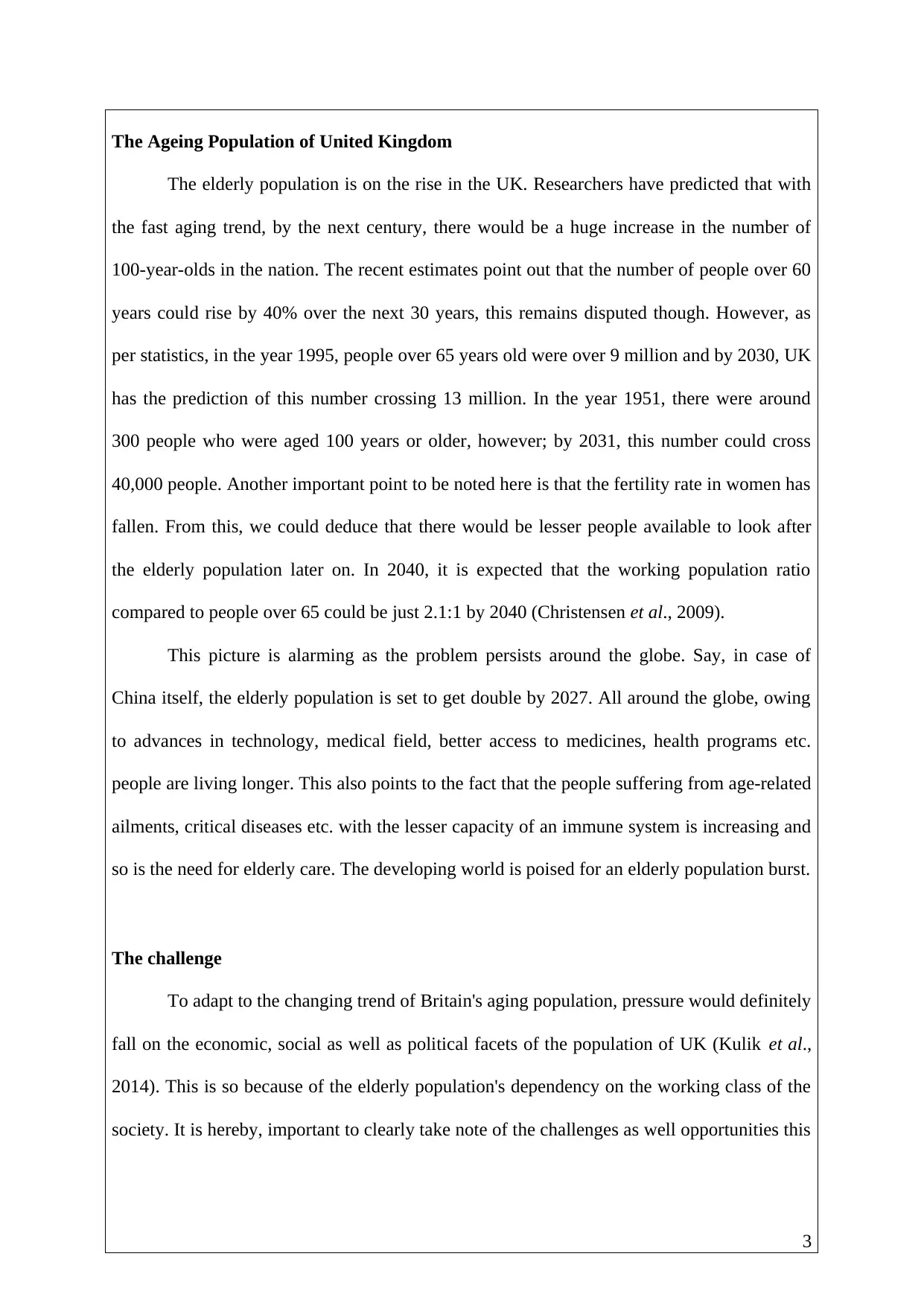
The Ageing Population of United Kingdom
The elderly population is on the rise in the UK. Researchers have predicted that with
the fast aging trend, by the next century, there would be a huge increase in the number of
100-year-olds in the nation. The recent estimates point out that the number of people over 60
years could rise by 40% over the next 30 years, this remains disputed though. However, as
per statistics, in the year 1995, people over 65 years old were over 9 million and by 2030, UK
has the prediction of this number crossing 13 million. In the year 1951, there were around
300 people who were aged 100 years or older, however; by 2031, this number could cross
40,000 people. Another important point to be noted here is that the fertility rate in women has
fallen. From this, we could deduce that there would be lesser people available to look after
the elderly population later on. In 2040, it is expected that the working population ratio
compared to people over 65 could be just 2.1:1 by 2040 (Christensen et al., 2009).
This picture is alarming as the problem persists around the globe. Say, in case of
China itself, the elderly population is set to get double by 2027. All around the globe, owing
to advances in technology, medical field, better access to medicines, health programs etc.
people are living longer. This also points to the fact that the people suffering from age-related
ailments, critical diseases etc. with the lesser capacity of an immune system is increasing and
so is the need for elderly care. The developing world is poised for an elderly population burst.
The challenge
To adapt to the changing trend of Britain's aging population, pressure would definitely
fall on the economic, social as well as political facets of the population of UK (Kulik et al.,
2014). This is so because of the elderly population's dependency on the working class of the
society. It is hereby, important to clearly take note of the challenges as well opportunities this
3
The elderly population is on the rise in the UK. Researchers have predicted that with
the fast aging trend, by the next century, there would be a huge increase in the number of
100-year-olds in the nation. The recent estimates point out that the number of people over 60
years could rise by 40% over the next 30 years, this remains disputed though. However, as
per statistics, in the year 1995, people over 65 years old were over 9 million and by 2030, UK
has the prediction of this number crossing 13 million. In the year 1951, there were around
300 people who were aged 100 years or older, however; by 2031, this number could cross
40,000 people. Another important point to be noted here is that the fertility rate in women has
fallen. From this, we could deduce that there would be lesser people available to look after
the elderly population later on. In 2040, it is expected that the working population ratio
compared to people over 65 could be just 2.1:1 by 2040 (Christensen et al., 2009).
This picture is alarming as the problem persists around the globe. Say, in case of
China itself, the elderly population is set to get double by 2027. All around the globe, owing
to advances in technology, medical field, better access to medicines, health programs etc.
people are living longer. This also points to the fact that the people suffering from age-related
ailments, critical diseases etc. with the lesser capacity of an immune system is increasing and
so is the need for elderly care. The developing world is poised for an elderly population burst.
The challenge
To adapt to the changing trend of Britain's aging population, pressure would definitely
fall on the economic, social as well as political facets of the population of UK (Kulik et al.,
2014). This is so because of the elderly population's dependency on the working class of the
society. It is hereby, important to clearly take note of the challenges as well opportunities this
3
⊘ This is a preview!⊘
Do you want full access?
Subscribe today to unlock all pages.

Trusted by 1+ million students worldwide

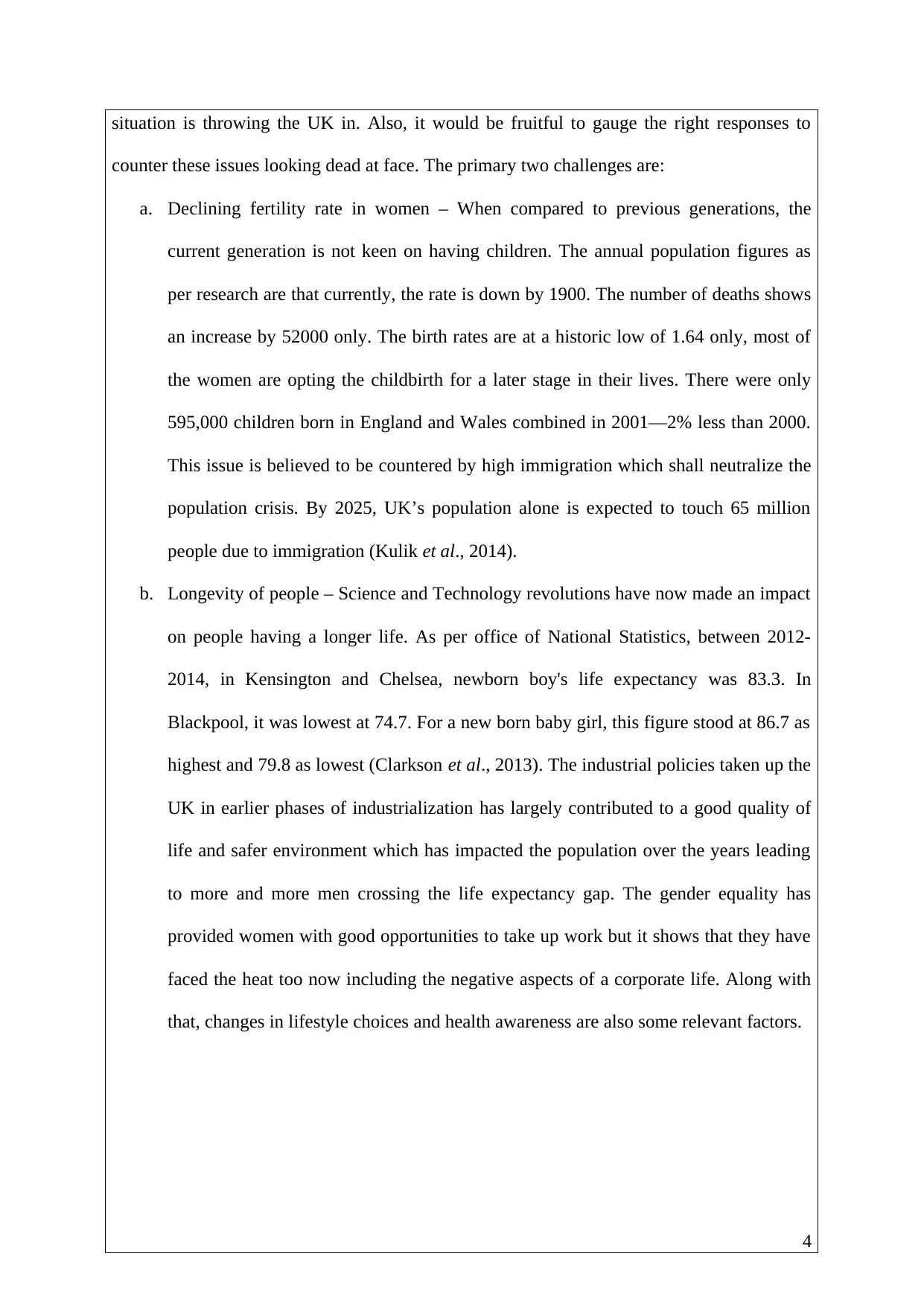
situation is throwing the UK in. Also, it would be fruitful to gauge the right responses to
counter these issues looking dead at face. The primary two challenges are:
a. Declining fertility rate in women – When compared to previous generations, the
current generation is not keen on having children. The annual population figures as
per research are that currently, the rate is down by 1900. The number of deaths shows
an increase by 52000 only. The birth rates are at a historic low of 1.64 only, most of
the women are opting the childbirth for a later stage in their lives. There were only
595,000 children born in England and Wales combined in 2001—2% less than 2000.
This issue is believed to be countered by high immigration which shall neutralize the
population crisis. By 2025, UK’s population alone is expected to touch 65 million
people due to immigration (Kulik et al., 2014).
b. Longevity of people – Science and Technology revolutions have now made an impact
on people having a longer life. As per office of National Statistics, between 2012-
2014, in Kensington and Chelsea, newborn boy's life expectancy was 83.3. In
Blackpool, it was lowest at 74.7. For a new born baby girl, this figure stood at 86.7 as
highest and 79.8 as lowest (Clarkson et al., 2013). The industrial policies taken up the
UK in earlier phases of industrialization has largely contributed to a good quality of
life and safer environment which has impacted the population over the years leading
to more and more men crossing the life expectancy gap. The gender equality has
provided women with good opportunities to take up work but it shows that they have
faced the heat too now including the negative aspects of a corporate life. Along with
that, changes in lifestyle choices and health awareness are also some relevant factors.
4
counter these issues looking dead at face. The primary two challenges are:
a. Declining fertility rate in women – When compared to previous generations, the
current generation is not keen on having children. The annual population figures as
per research are that currently, the rate is down by 1900. The number of deaths shows
an increase by 52000 only. The birth rates are at a historic low of 1.64 only, most of
the women are opting the childbirth for a later stage in their lives. There were only
595,000 children born in England and Wales combined in 2001—2% less than 2000.
This issue is believed to be countered by high immigration which shall neutralize the
population crisis. By 2025, UK’s population alone is expected to touch 65 million
people due to immigration (Kulik et al., 2014).
b. Longevity of people – Science and Technology revolutions have now made an impact
on people having a longer life. As per office of National Statistics, between 2012-
2014, in Kensington and Chelsea, newborn boy's life expectancy was 83.3. In
Blackpool, it was lowest at 74.7. For a new born baby girl, this figure stood at 86.7 as
highest and 79.8 as lowest (Clarkson et al., 2013). The industrial policies taken up the
UK in earlier phases of industrialization has largely contributed to a good quality of
life and safer environment which has impacted the population over the years leading
to more and more men crossing the life expectancy gap. The gender equality has
provided women with good opportunities to take up work but it shows that they have
faced the heat too now including the negative aspects of a corporate life. Along with
that, changes in lifestyle choices and health awareness are also some relevant factors.
4
Paraphrase This Document
Need a fresh take? Get an instant paraphrase of this document with our AI Paraphraser

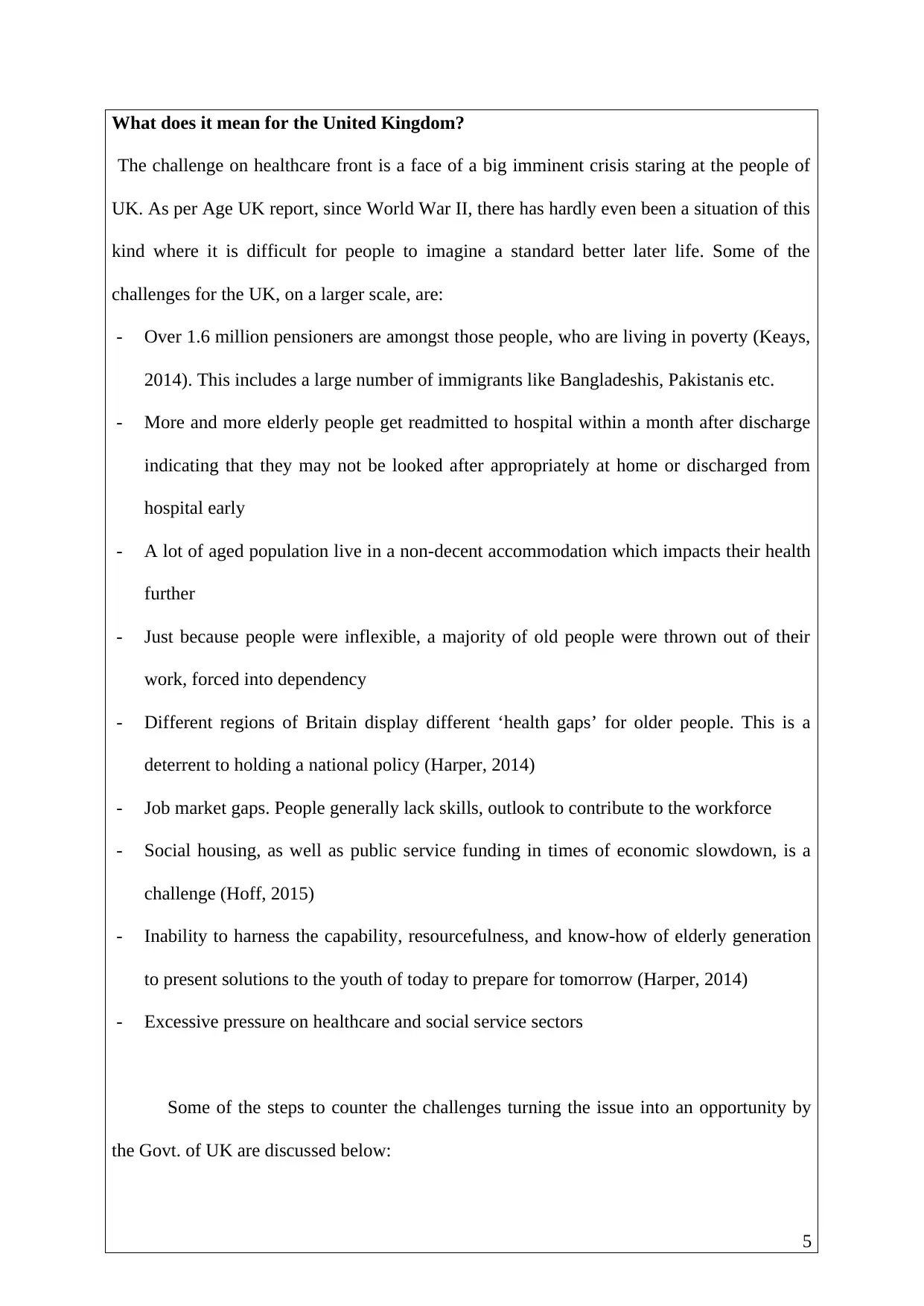
What does it mean for the United Kingdom?
The challenge on healthcare front is a face of a big imminent crisis staring at the people of
UK. As per Age UK report, since World War II, there has hardly even been a situation of this
kind where it is difficult for people to imagine a standard better later life. Some of the
challenges for the UK, on a larger scale, are:
- Over 1.6 million pensioners are amongst those people, who are living in poverty (Keays,
2014). This includes a large number of immigrants like Bangladeshis, Pakistanis etc.
- More and more elderly people get readmitted to hospital within a month after discharge
indicating that they may not be looked after appropriately at home or discharged from
hospital early
- A lot of aged population live in a non-decent accommodation which impacts their health
further
- Just because people were inflexible, a majority of old people were thrown out of their
work, forced into dependency
- Different regions of Britain display different ‘health gaps’ for older people. This is a
deterrent to holding a national policy (Harper, 2014)
- Job market gaps. People generally lack skills, outlook to contribute to the workforce
- Social housing, as well as public service funding in times of economic slowdown, is a
challenge (Hoff, 2015)
- Inability to harness the capability, resourcefulness, and know-how of elderly generation
to present solutions to the youth of today to prepare for tomorrow (Harper, 2014)
- Excessive pressure on healthcare and social service sectors
Some of the steps to counter the challenges turning the issue into an opportunity by
the Govt. of UK are discussed below:
5
The challenge on healthcare front is a face of a big imminent crisis staring at the people of
UK. As per Age UK report, since World War II, there has hardly even been a situation of this
kind where it is difficult for people to imagine a standard better later life. Some of the
challenges for the UK, on a larger scale, are:
- Over 1.6 million pensioners are amongst those people, who are living in poverty (Keays,
2014). This includes a large number of immigrants like Bangladeshis, Pakistanis etc.
- More and more elderly people get readmitted to hospital within a month after discharge
indicating that they may not be looked after appropriately at home or discharged from
hospital early
- A lot of aged population live in a non-decent accommodation which impacts their health
further
- Just because people were inflexible, a majority of old people were thrown out of their
work, forced into dependency
- Different regions of Britain display different ‘health gaps’ for older people. This is a
deterrent to holding a national policy (Harper, 2014)
- Job market gaps. People generally lack skills, outlook to contribute to the workforce
- Social housing, as well as public service funding in times of economic slowdown, is a
challenge (Hoff, 2015)
- Inability to harness the capability, resourcefulness, and know-how of elderly generation
to present solutions to the youth of today to prepare for tomorrow (Harper, 2014)
- Excessive pressure on healthcare and social service sectors
Some of the steps to counter the challenges turning the issue into an opportunity by
the Govt. of UK are discussed below:
5

With citizens getting ‘mature’, it is indeed a point of triumph and rejoice post taking into
consideration the fact that the current generation is healthier and have longevity than previous
generations. This poses before the Government an opportunity to gather the knowledge and
expertise from the elderly generation. The Age and Employment Network (TAEN), states
that the change in demographics could be a business opportunity. This is because there is a
larger pool of available talent and better skills and expertise levels which could result in good
utilization and productive work environment. That could impact the bottom line positively.
Opting to increase the retirement age is tricky but the UK Government is still considering the
issue. Encouraging the working class to opt for pension schemes for their later age is also
another option (Tampubolon, 2015). People should be made aware of good healthy lifestyle
choices and repeatedly reminded of it as a way of encouragement to stay away from health
deteriorating activities (Bauman et al., 2016). Introduction of a single-tier pension for elderly
and introducing cap on costs of social care is another milestone achieved by UK Government
in this direction. Increasing the retirement age to aid independent nature and use private
insurance for medical. The alternative is to inspire greater workforce partaking. In
industrialized economies, a tall fraction of men of working age tends to work, though
contribution proportions are comparatively lesser for women and older workers aged 55-64
(Oliver, Foot & Humphries, 2014). The exceptional effort is also required to keep the ‘keep
working' factor attractive for both men and women folks in the nation along with the old
population. Not only that, even when the age of retirement is passed, such folks should be
engaged in activities that could be self-challenging and provide financial gains (Spijker &
MacInnes, 2013). Thereafter, is the option of immigration of skilled labor force. They could
easily benefit enhancing the labor market. This could only be achieved by drastically
increasing the immigration opportunities. That could assist in offsetting the demographic
changes’ impact (Hansen, 2016).
6
consideration the fact that the current generation is healthier and have longevity than previous
generations. This poses before the Government an opportunity to gather the knowledge and
expertise from the elderly generation. The Age and Employment Network (TAEN), states
that the change in demographics could be a business opportunity. This is because there is a
larger pool of available talent and better skills and expertise levels which could result in good
utilization and productive work environment. That could impact the bottom line positively.
Opting to increase the retirement age is tricky but the UK Government is still considering the
issue. Encouraging the working class to opt for pension schemes for their later age is also
another option (Tampubolon, 2015). People should be made aware of good healthy lifestyle
choices and repeatedly reminded of it as a way of encouragement to stay away from health
deteriorating activities (Bauman et al., 2016). Introduction of a single-tier pension for elderly
and introducing cap on costs of social care is another milestone achieved by UK Government
in this direction. Increasing the retirement age to aid independent nature and use private
insurance for medical. The alternative is to inspire greater workforce partaking. In
industrialized economies, a tall fraction of men of working age tends to work, though
contribution proportions are comparatively lesser for women and older workers aged 55-64
(Oliver, Foot & Humphries, 2014). The exceptional effort is also required to keep the ‘keep
working' factor attractive for both men and women folks in the nation along with the old
population. Not only that, even when the age of retirement is passed, such folks should be
engaged in activities that could be self-challenging and provide financial gains (Spijker &
MacInnes, 2013). Thereafter, is the option of immigration of skilled labor force. They could
easily benefit enhancing the labor market. This could only be achieved by drastically
increasing the immigration opportunities. That could assist in offsetting the demographic
changes’ impact (Hansen, 2016).
6
⊘ This is a preview!⊘
Do you want full access?
Subscribe today to unlock all pages.

Trusted by 1+ million students worldwide

7
Paraphrase This Document
Need a fresh take? Get an instant paraphrase of this document with our AI Paraphraser

Conclusion
As is evident from the findings researched on the issue of the ageing population of UK, two-
fifths of NHS budget is usually spent on age group above 65 years old and the health
spending cost shall only rise with the longevity of people (Maresova, Mohelska & Kuca,
2015). The figure would only go up with the current situation of demographics in the country.
When compared to a man in his 30s, NHS would be spending three times more on an elderly
above 85. With the improvement in the field of technology, science, and medicines, people
have only become more resistant to most of the health-related issues which were responsible
to cut their lives short. This is a constant challenge for the UK which is bound to become a
critical issue as this situation would only get worse in future and put pressure on the current
public services and healthcare systems meant for the welfare of people of its nation.
8
As is evident from the findings researched on the issue of the ageing population of UK, two-
fifths of NHS budget is usually spent on age group above 65 years old and the health
spending cost shall only rise with the longevity of people (Maresova, Mohelska & Kuca,
2015). The figure would only go up with the current situation of demographics in the country.
When compared to a man in his 30s, NHS would be spending three times more on an elderly
above 85. With the improvement in the field of technology, science, and medicines, people
have only become more resistant to most of the health-related issues which were responsible
to cut their lives short. This is a constant challenge for the UK which is bound to become a
critical issue as this situation would only get worse in future and put pressure on the current
public services and healthcare systems meant for the welfare of people of its nation.
8

References
Books
Clarkson, P. J., Coleman, R., Keates, S., & Lebbon, C. (2013). Inclusive design: Design for
the whole population. Springer Science & Business Media.
Harper, S. (2014). Ageing societies. Routledge.
Oliver, D., Foot, C., & Humphries, R. (2014). Making our health and care systems fit for an
ageing population. King's Fund.
Journals
Bauman, A., Merom, D., Bull, F. C., Buchner, D. M., & Fiatarone Singh, M. A. (2016).
Updating the evidence for physical activity: summative reviews of the epidemiological
evidence, prevalence, and interventions to promote “Active Aging”. The
Gerontologist, 56(Suppl_2), S268-S280.
Christensen, K., Doblhammer, G., Rau, R., & Vaupel, J. W. (2009). Ageing populations: the
challenges ahead. The lancet, 374(9696), 1196-1208.
Hansen, R. (2016). Making immigration work: How Britain and Europe can cope with their
immigration crises (The Government and Opposition/Leonard Schapiro Lecture,
2015). Government and Opposition, 51(2), 183-208.
9
Books
Clarkson, P. J., Coleman, R., Keates, S., & Lebbon, C. (2013). Inclusive design: Design for
the whole population. Springer Science & Business Media.
Harper, S. (2014). Ageing societies. Routledge.
Oliver, D., Foot, C., & Humphries, R. (2014). Making our health and care systems fit for an
ageing population. King's Fund.
Journals
Bauman, A., Merom, D., Bull, F. C., Buchner, D. M., & Fiatarone Singh, M. A. (2016).
Updating the evidence for physical activity: summative reviews of the epidemiological
evidence, prevalence, and interventions to promote “Active Aging”. The
Gerontologist, 56(Suppl_2), S268-S280.
Christensen, K., Doblhammer, G., Rau, R., & Vaupel, J. W. (2009). Ageing populations: the
challenges ahead. The lancet, 374(9696), 1196-1208.
Hansen, R. (2016). Making immigration work: How Britain and Europe can cope with their
immigration crises (The Government and Opposition/Leonard Schapiro Lecture,
2015). Government and Opposition, 51(2), 183-208.
9
⊘ This is a preview!⊘
Do you want full access?
Subscribe today to unlock all pages.

Trusted by 1+ million students worldwide

Harper, S. (2014). Economic and social implications of aging societies. Science, 346(6209),
587-591.
Hoff, A. (2015). Current and future challenges of family care in the UK: future of an ageing
population. Evidence review: March 2015.
Keays, R. T. (2014). The ageing patient–sans everything?. Anaesthesia, 69(s1), 3-7.
Kulik, C. T., Ryan, S., Harper, S., & George, G. (2014). Aging populations and
management. Academy of Management Journal, 57(4), 929-935.
Marešová, P., Mohelská, H., & Kuča, K. (2015). Economics aspects of ageing
population. Procedia Economics and Finance, 23, 534-538.
Spijker, J., & MacInnes, J. (2013). Population ageing: the timebomb that
isn’t. BMJ, 347(nov12 1), f6598-f6598.
Tampubolon, G. (2015). Delineating the third age: joint models of older people's quality of
life and attrition in Britain 2002–2010. Aging & mental health, 19(7), 576-583.
10
587-591.
Hoff, A. (2015). Current and future challenges of family care in the UK: future of an ageing
population. Evidence review: March 2015.
Keays, R. T. (2014). The ageing patient–sans everything?. Anaesthesia, 69(s1), 3-7.
Kulik, C. T., Ryan, S., Harper, S., & George, G. (2014). Aging populations and
management. Academy of Management Journal, 57(4), 929-935.
Marešová, P., Mohelská, H., & Kuča, K. (2015). Economics aspects of ageing
population. Procedia Economics and Finance, 23, 534-538.
Spijker, J., & MacInnes, J. (2013). Population ageing: the timebomb that
isn’t. BMJ, 347(nov12 1), f6598-f6598.
Tampubolon, G. (2015). Delineating the third age: joint models of older people's quality of
life and attrition in Britain 2002–2010. Aging & mental health, 19(7), 576-583.
10
1 out of 10
Related Documents
Your All-in-One AI-Powered Toolkit for Academic Success.
+13062052269
info@desklib.com
Available 24*7 on WhatsApp / Email
Unlock your academic potential
Copyright © 2020–2025 A2Z Services. All Rights Reserved. Developed and managed by ZUCOL.