Economics of Health and Healthcare: Demand, Supply and Improvement
VerifiedAdded on 2023/06/04
|17
|3732
|234
Report
AI Summary
This report analyzes the economics of health and healthcare, focusing on strategies for aligning with economic indicators to maintain supply and demand, and measures for healthcare improvement. It examines the roles of stakeholders like the WHO in providing reliable healthcare information and the key drivers of healthcare expenditure. Task 1 analyzes inputs and outputs of different data sources in healthcare improvement, highlighting the role of the World Health Organization in health measurement improvement and methods to measure health improvement through efficiency and effectiveness evaluations. Task 2 focuses on the demand for healthcare, noting its price inelasticity, and analyzes the structure of the health sector and its influence on demand and supply. The report concludes by providing recommendations for senior managers to enhance healthcare strategies.
The Economics of Health and Health Care 1
THE ECONOMICS OF HEALTH AND HEALTH CARE
by (Name)
The Name of the Class (Course)
Professor (Tutor)
The Name of the School (University)
The City and State where it is located
The Date
THE ECONOMICS OF HEALTH AND HEALTH CARE
by (Name)
The Name of the Class (Course)
Professor (Tutor)
The Name of the School (University)
The City and State where it is located
The Date

Paraphrase This Document
Need a fresh take? Get an instant paraphrase of this document with our AI Paraphraser
The Economics of Health and Health Care 2
Abstract
The purpose of this article is to enable the Senior Manager to create strategies which enable the
company to aline itself with economic indicators and data sources that maintain supply and
demand of company services and products. Furthermore, the article identifies the measures that
influence healthcare improvement which determine the efficiency of the healthcare program.
Four evaluation stages are essential for determining the appropriate measures of health
improvement. Also, there are various roles played World Health Organizations in ensuring
proper provision of the healthcare programs. For instance, WHO uses strategic approaches in
providing information that is reliable and valid through its measurement. Some of the strategies
involved include rating scales and reports which combine with field test and cognition. Some of
the main healthcare expenditure drivers include demographics, income, productivity, technology
and policy measures (Lorenzoni, James, and Marino, 2017, p.15). However, this article focuses
on the recent trends in healthcare expenditure.
Abstract
The purpose of this article is to enable the Senior Manager to create strategies which enable the
company to aline itself with economic indicators and data sources that maintain supply and
demand of company services and products. Furthermore, the article identifies the measures that
influence healthcare improvement which determine the efficiency of the healthcare program.
Four evaluation stages are essential for determining the appropriate measures of health
improvement. Also, there are various roles played World Health Organizations in ensuring
proper provision of the healthcare programs. For instance, WHO uses strategic approaches in
providing information that is reliable and valid through its measurement. Some of the strategies
involved include rating scales and reports which combine with field test and cognition. Some of
the main healthcare expenditure drivers include demographics, income, productivity, technology
and policy measures (Lorenzoni, James, and Marino, 2017, p.15). However, this article focuses
on the recent trends in healthcare expenditure.
The Economics of Health and Health Care 3
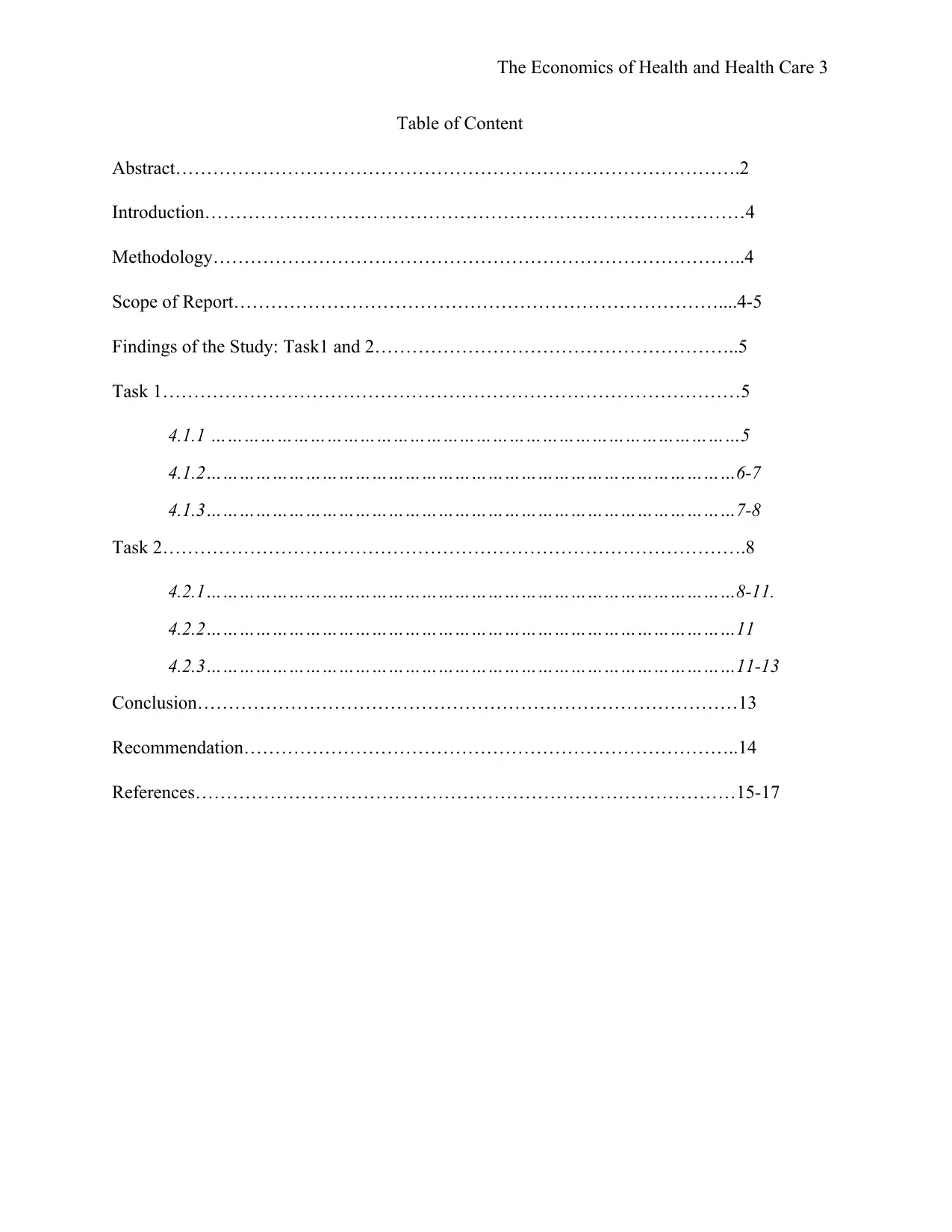
Table of Content
Abstract……………………………………………………………………………….2
Introduction……………………………………………………………………………4
Methodology…………………………………………………………………………..4
Scope of Report……………………………………………………………………....4-5
Findings of the Study: Task1 and 2…………………………………………………..5
Task 1…………………………………………………………………………………5
4.1.1 ……………………………………………………………………………………5
4.1.2……………………………………………………………………………………6-7
4.1.3……………………………………………………………………………………7-8
Task 2………………………………………………………………………………….8
4.2.1……………………………………………………………………………………8-11.
4.2.2……………………………………………………………………………………11
4.2.3……………………………………………………………………………………11-13
Conclusion……………………………………………………………………………13
Recommendation……………………………………………………………………..14
References……………………………………………………………………………15-17
Table of Content
Abstract……………………………………………………………………………….2
Introduction……………………………………………………………………………4
Methodology…………………………………………………………………………..4
Scope of Report……………………………………………………………………....4-5
Findings of the Study: Task1 and 2…………………………………………………..5
Task 1…………………………………………………………………………………5
4.1.1 ……………………………………………………………………………………5
4.1.2……………………………………………………………………………………6-7
4.1.3……………………………………………………………………………………7-8
Task 2………………………………………………………………………………….8
4.2.1……………………………………………………………………………………8-11.
4.2.2……………………………………………………………………………………11
4.2.3……………………………………………………………………………………11-13
Conclusion……………………………………………………………………………13
Recommendation……………………………………………………………………..14
References……………………………………………………………………………15-17
⊘ This is a preview!⊘
Do you want full access?
Subscribe today to unlock all pages.

Trusted by 1+ million students worldwide
The Economics of Health and Health Care 4
1. Introduction
According to Folland, Goodman, and Stano (2007, p.1), health economics involves health
economists who examine the field and draw various disciplines such as economics training.
These training may include industrial organisation, labour finance, cost-benefit analysis and
public finance. Also, health economics are dependent on the cost-effectiveness of the system
applied which may involve technology costs. Smith, Mossialos, and Papanicolas (2008, p.2) state
that the performance measures in healthcare improvement seek to monitor, communicate and
evaluate the extent that various health system aspects meet their key objectives. Moreover, health
system performance gets measured with different entities (stakeholders) such as clinicians,
patients, purchaser organisation, healthcare providers and the government. Therefore, the main
role of identifying and analysing the performance of healthcare improvement is to help in
holding the various entities into account by involving the stakeholders in making decisions. The
purpose of this article is to identify and analyse how various stakeholders are involved in
providing improved health care and the structure of the healthcare sector.
2. Methodology
Various methods have got used in task 1 and task 2 in analysing the measures of healthcare
improvement which influenced by the effectiveness of the health program. The four evaluation
stages may help the Senior Manager in constructing measures that influence healthcare
improvement.
3. Scope of the Report
1. Introduction
According to Folland, Goodman, and Stano (2007, p.1), health economics involves health
economists who examine the field and draw various disciplines such as economics training.
These training may include industrial organisation, labour finance, cost-benefit analysis and
public finance. Also, health economics are dependent on the cost-effectiveness of the system
applied which may involve technology costs. Smith, Mossialos, and Papanicolas (2008, p.2) state
that the performance measures in healthcare improvement seek to monitor, communicate and
evaluate the extent that various health system aspects meet their key objectives. Moreover, health
system performance gets measured with different entities (stakeholders) such as clinicians,
patients, purchaser organisation, healthcare providers and the government. Therefore, the main
role of identifying and analysing the performance of healthcare improvement is to help in
holding the various entities into account by involving the stakeholders in making decisions. The
purpose of this article is to identify and analyse how various stakeholders are involved in
providing improved health care and the structure of the healthcare sector.
2. Methodology
Various methods have got used in task 1 and task 2 in analysing the measures of healthcare
improvement which influenced by the effectiveness of the health program. The four evaluation
stages may help the Senior Manager in constructing measures that influence healthcare
improvement.
3. Scope of the Report
Paraphrase This Document
Need a fresh take? Get an instant paraphrase of this document with our AI Paraphraser
The Economics of Health and Health Care 5
The research report details the various studies that got made while per taking task 1 and task 2 of
the assignment. In task 1, the report analyses the various inputs and outputs of data sources
which help in healthcare improvement. In spite of that, task 2 analyses the structure of the
demand in healthcare provision and how demand of medicine is rarely affected by the price of
the price of healthcare. Also, in task 2 there is the structure of the health sector and how it
influences demand and supply of health care.
4. Findings of the Study: Task 1 and 2
4.1 Task 1
4.1.1 Analyzing Inputs and Outputs of Different Data Sources in Healthcare Improvement
According to Parsons, Gokey, and Thornton (2013, p.13), when assessing the performance of
health information systems and data quality generated it is important to consider whether they
are input or output data sources. Input data sources monitor the availability of essential resources
providing early warning of various challenges during healthcare improvement. Parsons et al.
states, “For example, as part of a project to address problems of pretrial detention in South
Sudan, the United Nations provided computerised case management systems to prisons across
the country” (p.14). On the other hand, output data sources explain the delivery of products
though they are not limited to providing training and technical assistance. Furthermore, they also
create standards and relevant legislative documents required for investing in a building and other
infrastructure. Moreover, Tinker (n.d) states that the importance of output sources of data is to
improve the patient’s experience of healthcare, improving health in its population and reduce the
cost per capita of the healthcare.
4.1.2 Role of World Health Organizations in Health Measurement Improvement
The research report details the various studies that got made while per taking task 1 and task 2 of
the assignment. In task 1, the report analyses the various inputs and outputs of data sources
which help in healthcare improvement. In spite of that, task 2 analyses the structure of the
demand in healthcare provision and how demand of medicine is rarely affected by the price of
the price of healthcare. Also, in task 2 there is the structure of the health sector and how it
influences demand and supply of health care.
4. Findings of the Study: Task 1 and 2
4.1 Task 1
4.1.1 Analyzing Inputs and Outputs of Different Data Sources in Healthcare Improvement
According to Parsons, Gokey, and Thornton (2013, p.13), when assessing the performance of
health information systems and data quality generated it is important to consider whether they
are input or output data sources. Input data sources monitor the availability of essential resources
providing early warning of various challenges during healthcare improvement. Parsons et al.
states, “For example, as part of a project to address problems of pretrial detention in South
Sudan, the United Nations provided computerised case management systems to prisons across
the country” (p.14). On the other hand, output data sources explain the delivery of products
though they are not limited to providing training and technical assistance. Furthermore, they also
create standards and relevant legislative documents required for investing in a building and other
infrastructure. Moreover, Tinker (n.d) states that the importance of output sources of data is to
improve the patient’s experience of healthcare, improving health in its population and reduce the
cost per capita of the healthcare.
4.1.2 Role of World Health Organizations in Health Measurement Improvement
The Economics of Health and Health Care 6
According to Darby, Valentine, De Silva, Murray, and World Health Organization (2003,
p.6), the WHO strategy gets drawn from the research approach which provides reliable
information and valid measurements. Some of these measurements that improve health include
the use of rating scales and reports in combination with field tests acquired and cognition. For
instance, the reliable and valid measures in improving health care performance measures provide
an assessment of responsive distribution. Darby et al. (2003) states, “WHO in its responsiveness
strategy is implementing measurement tools that provide as close a report of what happened as
possible. The strategy includes reports from those who are served by the health system and
methods for assessing how those reports compare with other observations of what happens”
(p.7). Furthermore, WHO uses the reporting and rating strategy in measuring consumer’s reports
and their experience ratings.
Also, the World Health Organization uses cognitive and field testing to get a responsive
survey in various countries with health systems and cultures. WHO uses this strategic approach
together in providing credible evidence on the validity and reliability of the instruments that
measure health improvement. The essence of this design is to survey data collected cost-
effectively and ensuring that measurement errors get addressed such as sampling (Darby et al.,
2003, p.8). The cognitive testing may get used by WHO in assessing respondents understanding
and interpreting questionnaire items presented to them. The assessment of the respondents gets
done by the ability of them to recall information that applied to the question asked and the
various judgements they may make regarding which information to use. According to Darby et
al. (2003), “The two most frequently used cognitive testing techniques are the ‘think aloud’
interview and debriefing. In the think-aloud procedure, respondents say out loud what they are
thinking about with regard to the questions they are answering what the questions mean to them,
According to Darby, Valentine, De Silva, Murray, and World Health Organization (2003,
p.6), the WHO strategy gets drawn from the research approach which provides reliable
information and valid measurements. Some of these measurements that improve health include
the use of rating scales and reports in combination with field tests acquired and cognition. For
instance, the reliable and valid measures in improving health care performance measures provide
an assessment of responsive distribution. Darby et al. (2003) states, “WHO in its responsiveness
strategy is implementing measurement tools that provide as close a report of what happened as
possible. The strategy includes reports from those who are served by the health system and
methods for assessing how those reports compare with other observations of what happens”
(p.7). Furthermore, WHO uses the reporting and rating strategy in measuring consumer’s reports
and their experience ratings.
Also, the World Health Organization uses cognitive and field testing to get a responsive
survey in various countries with health systems and cultures. WHO uses this strategic approach
together in providing credible evidence on the validity and reliability of the instruments that
measure health improvement. The essence of this design is to survey data collected cost-
effectively and ensuring that measurement errors get addressed such as sampling (Darby et al.,
2003, p.8). The cognitive testing may get used by WHO in assessing respondents understanding
and interpreting questionnaire items presented to them. The assessment of the respondents gets
done by the ability of them to recall information that applied to the question asked and the
various judgements they may make regarding which information to use. According to Darby et
al. (2003), “The two most frequently used cognitive testing techniques are the ‘think aloud’
interview and debriefing. In the think-aloud procedure, respondents say out loud what they are
thinking about with regard to the questions they are answering what the questions mean to them,
⊘ This is a preview!⊘
Do you want full access?
Subscribe today to unlock all pages.
Trusted by 1+ million students worldwide
The Economics of Health and Health Care 7
what information they are drawing upon to answer the questions and how they are forming their
responses as they complete the questionnaire. Interviewers may probe to get the respondents to
elaborate or clarify. In debriefing, interviewers ask respondents to provide similar information;
but after they have completed the questionnaire” (p.8).
4.1.3 How to Measure Health Improvement
According to Johansen, Mangolini, Chan, and Peacock (2001, p.33), irrespective of the
techniques used in evaluating measures of health improvement it should get noted that they get
based on efficiency and effectiveness of the health program. Therefore, the healthcare
performance can get measured depending on the supply and demand and the study design which
assesses the efficiency, acceptability and effectiveness of health care (Asteraye, 2002, p.90).
Patient satisfaction, experience and patient reports act as perfect measures for healthcare
improvement. Some of the tried and tested surveys done on patients got carried out by the Picker
Institute and Care Quality Commission to analyse national monitoring performance
(HealthKnowledge, n.d). Moreover, the quality of healthcare may also get improved by guideline
implementation and treatment criteria. The quality assessment may also get carried out by
external organisations (Care Quality Commission) which will help in monitoring and inspecting
the process. Also, the productivity of the healthcare organisation help in measuring health
improvement through bed occupancy and waiting time. Another crucial measure is a financial
performance which helps in determining the healthcare performance (HealthKnowledge, n.d).
Johasen et al. (2003, p. 34) state that four evaluation stages may help the Senior Manager in
creating appropriate measures for healthcare improvement. There are four stages which include;
identifying the study perspective and question, determining the ideal way to identify and measure
benefits and costs, comparing costs and benefits and deriving the decision rule. During the
what information they are drawing upon to answer the questions and how they are forming their
responses as they complete the questionnaire. Interviewers may probe to get the respondents to
elaborate or clarify. In debriefing, interviewers ask respondents to provide similar information;
but after they have completed the questionnaire” (p.8).
4.1.3 How to Measure Health Improvement
According to Johansen, Mangolini, Chan, and Peacock (2001, p.33), irrespective of the
techniques used in evaluating measures of health improvement it should get noted that they get
based on efficiency and effectiveness of the health program. Therefore, the healthcare
performance can get measured depending on the supply and demand and the study design which
assesses the efficiency, acceptability and effectiveness of health care (Asteraye, 2002, p.90).
Patient satisfaction, experience and patient reports act as perfect measures for healthcare
improvement. Some of the tried and tested surveys done on patients got carried out by the Picker
Institute and Care Quality Commission to analyse national monitoring performance
(HealthKnowledge, n.d). Moreover, the quality of healthcare may also get improved by guideline
implementation and treatment criteria. The quality assessment may also get carried out by
external organisations (Care Quality Commission) which will help in monitoring and inspecting
the process. Also, the productivity of the healthcare organisation help in measuring health
improvement through bed occupancy and waiting time. Another crucial measure is a financial
performance which helps in determining the healthcare performance (HealthKnowledge, n.d).
Johasen et al. (2003, p. 34) state that four evaluation stages may help the Senior Manager in
creating appropriate measures for healthcare improvement. There are four stages which include;
identifying the study perspective and question, determining the ideal way to identify and measure
benefits and costs, comparing costs and benefits and deriving the decision rule. During the
Paraphrase This Document
Need a fresh take? Get an instant paraphrase of this document with our AI Paraphraser
The Economics of Health and Health Care 8
economic evaluation, the research question helps in identifying the specific set of healthcare
programs which assist in addressing current programs. Also, the perspective of the research helps
in creating a measure for healthcare improvement by decision making on what it may cause and
consequences concerned (Johansen et al., 2003, p.34). The second step on the evaluation stage
involves identifying and measuring costs and benefits which relate to the therapeutic effects,
resource savings on health programs and changes in life quality for patients.
Furthermore, the consequences and costs may get measured inappropriate physical units
which allow generalisation and replication of resources. Some of the cost units may include
nursing time, pharmaceuticals used and some physician units. The third stage of the evaluation
may involve analysing benefits and costs where the analysis gets made on the cost period
incurred and benefits it may bring in the future. The third stage helps in the evaluation of the
decision-making process which helps in assessing the distribution benefits of the improved
health care system.
4.2 Task 2
4.2.1 Analyzing the Demand for Health Care
Shri Guru Ram Rai Institute of Technology and Science (n.d, p.1) states that health care
demand involves the allocation of resources which enable consumption and production of health.
The extent and nature of demand depending on the changing factors in resources and supply of
health demand. Therefore, the healthcare price and its services play a crucial role in the demand
and supply of health economics. Though, the demand for health care may be an urgent life
necessity its price does not necessarily determine it since sometimes it may be a matter of life or
death which may cause one to borrow. In spite of that, when the type of medical care is relatively
expensive, consumers may opt for more affordable medical care which results in a decline of
economic evaluation, the research question helps in identifying the specific set of healthcare
programs which assist in addressing current programs. Also, the perspective of the research helps
in creating a measure for healthcare improvement by decision making on what it may cause and
consequences concerned (Johansen et al., 2003, p.34). The second step on the evaluation stage
involves identifying and measuring costs and benefits which relate to the therapeutic effects,
resource savings on health programs and changes in life quality for patients.
Furthermore, the consequences and costs may get measured inappropriate physical units
which allow generalisation and replication of resources. Some of the cost units may include
nursing time, pharmaceuticals used and some physician units. The third stage of the evaluation
may involve analysing benefits and costs where the analysis gets made on the cost period
incurred and benefits it may bring in the future. The third stage helps in the evaluation of the
decision-making process which helps in assessing the distribution benefits of the improved
health care system.
4.2 Task 2
4.2.1 Analyzing the Demand for Health Care
Shri Guru Ram Rai Institute of Technology and Science (n.d, p.1) states that health care
demand involves the allocation of resources which enable consumption and production of health.
The extent and nature of demand depending on the changing factors in resources and supply of
health demand. Therefore, the healthcare price and its services play a crucial role in the demand
and supply of health economics. Though, the demand for health care may be an urgent life
necessity its price does not necessarily determine it since sometimes it may be a matter of life or
death which may cause one to borrow. In spite of that, when the type of medical care is relatively
expensive, consumers may opt for more affordable medical care which results in a decline of
The Economics of Health and Health Care 9
original medical products. When some consumers expect prices of health care to drop in the
future, they may postpone the purchase of certain medical items. Such actions may lead to health
care demand to drop resulting in the prices decreasing relatively. Therefore the health care
demand is directly related to the pricing of the quality health care item. Also, the demand for
quality healthcare items may also rise from diseases and medical problems that consumers may
face. Also, the demand for proper health care items and services may not get affected by
expected future or a sudden drop in the prices of quality healthcare items. The reason that keeps
this constant demand for health care services and items is that consumers do not use stock
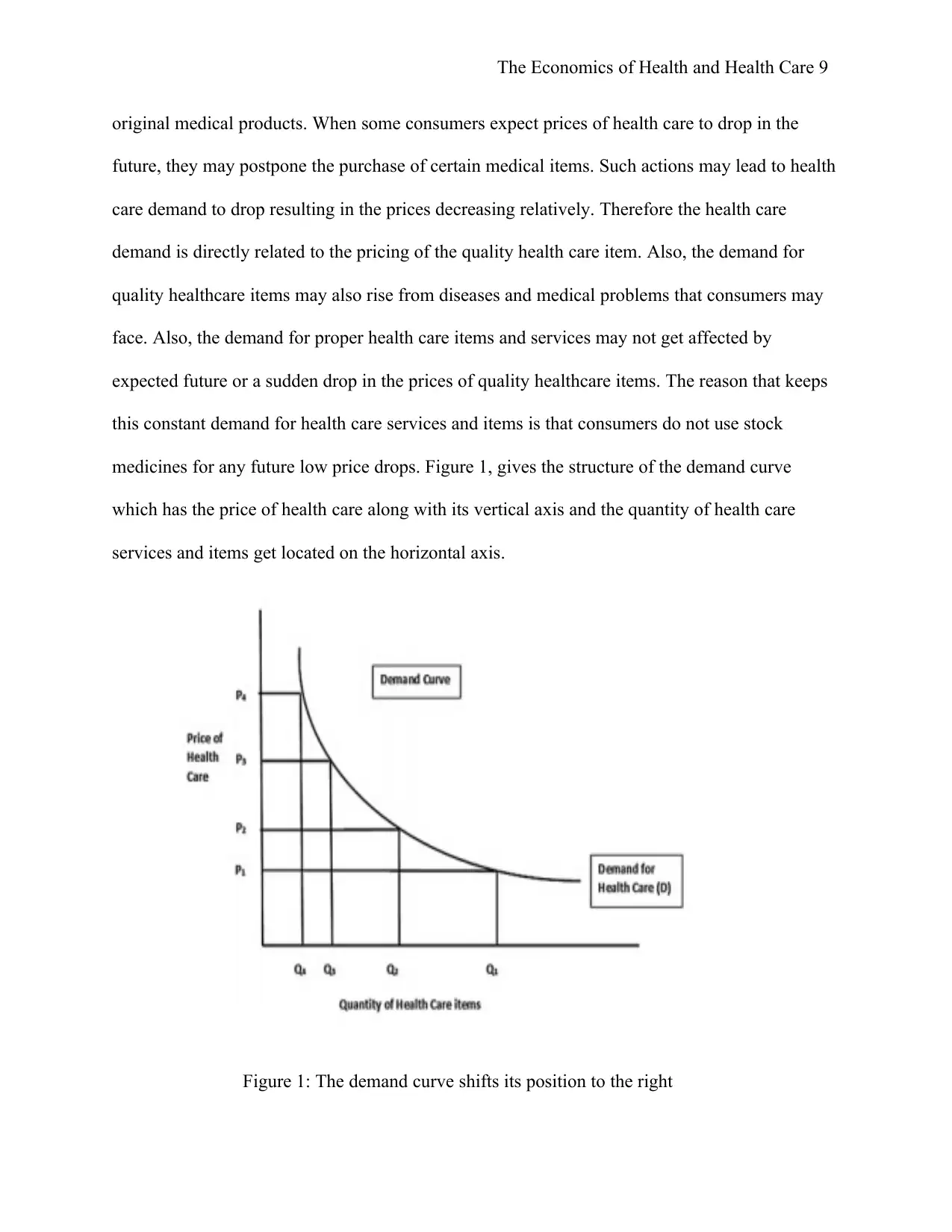
medicines for any future low price drops. Figure 1, gives the structure of the demand curve
which has the price of health care along with its vertical axis and the quantity of health care
services and items get located on the horizontal axis.
Figure 1: The demand curve shifts its position to the right
original medical products. When some consumers expect prices of health care to drop in the
future, they may postpone the purchase of certain medical items. Such actions may lead to health
care demand to drop resulting in the prices decreasing relatively. Therefore the health care
demand is directly related to the pricing of the quality health care item. Also, the demand for
quality healthcare items may also rise from diseases and medical problems that consumers may
face. Also, the demand for proper health care items and services may not get affected by
expected future or a sudden drop in the prices of quality healthcare items. The reason that keeps
this constant demand for health care services and items is that consumers do not use stock
medicines for any future low price drops. Figure 1, gives the structure of the demand curve
which has the price of health care along with its vertical axis and the quantity of health care
services and items get located on the horizontal axis.
Figure 1: The demand curve shifts its position to the right
⊘ This is a preview!⊘
Do you want full access?
Subscribe today to unlock all pages.
Trusted by 1+ million students worldwide
The Economics of Health and Health Care 10
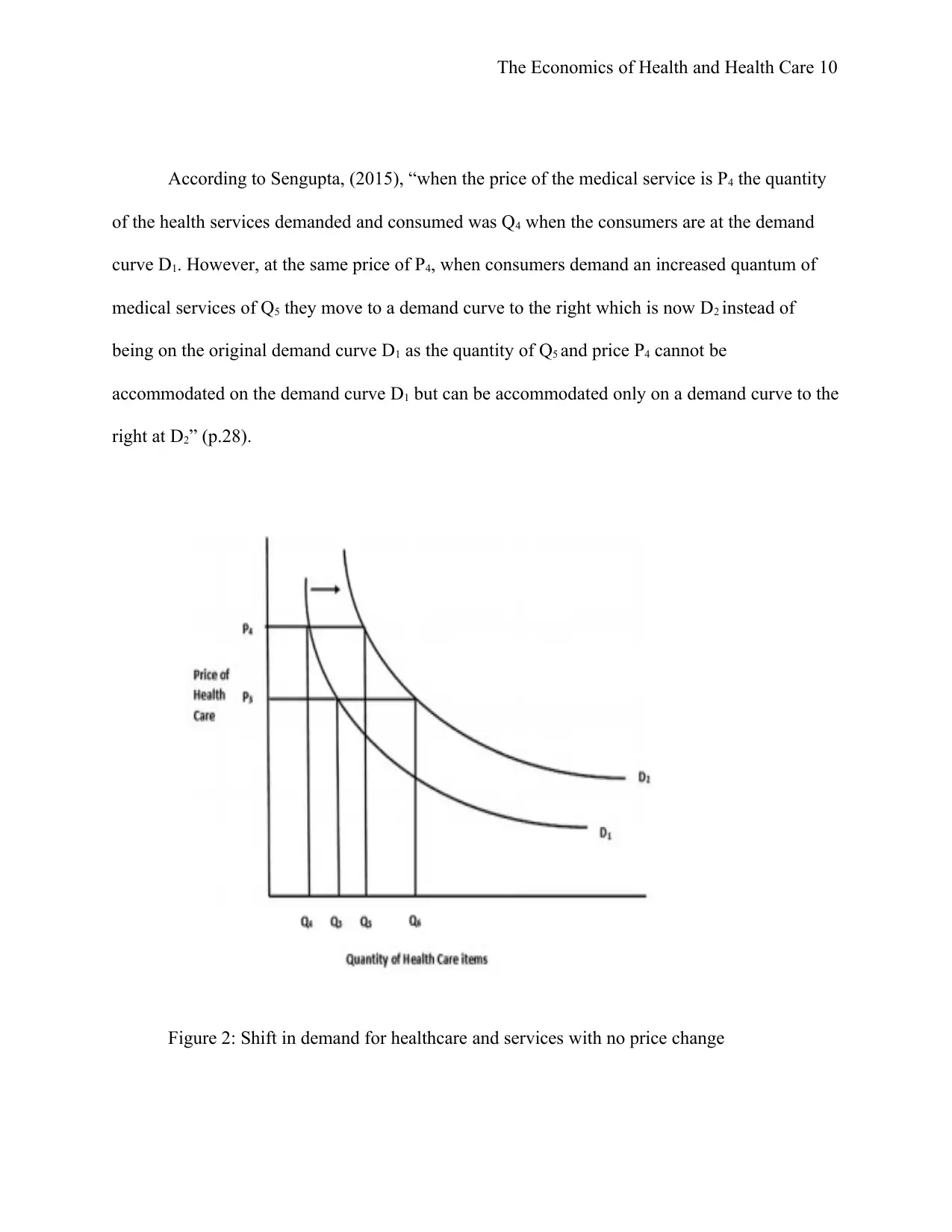
According to Sengupta, (2015), “when the price of the medical service is P4 the quantity
of the health services demanded and consumed was Q4 when the consumers are at the demand
curve D1. However, at the same price of P4, when consumers demand an increased quantum of
medical services of Q5 they move to a demand curve to the right which is now D2 instead of
being on the original demand curve D1 as the quantity of Q5 and price P4 cannot be
accommodated on the demand curve D1 but can be accommodated only on a demand curve to the
right at D2” (p.28).
Figure 2: Shift in demand for healthcare and services with no price change
According to Sengupta, (2015), “when the price of the medical service is P4 the quantity
of the health services demanded and consumed was Q4 when the consumers are at the demand
curve D1. However, at the same price of P4, when consumers demand an increased quantum of
medical services of Q5 they move to a demand curve to the right which is now D2 instead of
being on the original demand curve D1 as the quantity of Q5 and price P4 cannot be
accommodated on the demand curve D1 but can be accommodated only on a demand curve to the
right at D2” (p.28).
Figure 2: Shift in demand for healthcare and services with no price change
Paraphrase This Document
Need a fresh take? Get an instant paraphrase of this document with our AI Paraphraser
The Economics of Health and Health Care 11
Figure 2, also identifies that a decline in the incidences of malaria or any other illness may result
in a decline in the demand and consumption of health care services and items. Sengupta (2015)
states, “The result of this will be a shift of the demand curve to the left from D2 to D1 when the
demand decreases from Q6 to Q3 at the same price of P3. Under such circumstances, the
government department, health sector as well as the health industry has to gear itself up
accordingly. Being guided only by the price of health service in such a situation will bring about
distortion in the sector, which would result in a misallocation of scarce resources in the health
sector. These features associated with principals of the demand side of health” (p.29).
4.2.2 Structure of Health Care Sector
According to Doheny (2015, p.2), the National Health Service (NHS) focuses on care
provision which gets delivered by using resources requiring maintenance, management and
development. The importance of the health care sector seeks to evaluate which inputs in the
healthcare system are essential in ensuring a credible performance of the health program (Smith,
Papanicolas, and Cylus, 2016, p.1). Furthermore, the system structure shapes how specialists
relate with each other and their patients. Another point to note is that the health care systems can
either lever types in the market (competition, relying on pricing and contracts) or bureaucratic
levers (performance management, direct control and standards). The use of these levers relates
to the structure of the health sector and how they interact. For instance, the bureaucratic system
flows its operation down the health care system and service providers and holds them
accountable for their work. A market system separates health care service providers into various
entities that offer services in the market. Furthermore, the market system also facilitates the
competing of customers solely based on price and quality. Doheny (2015) states, “So whereas in
Figure 2, also identifies that a decline in the incidences of malaria or any other illness may result
in a decline in the demand and consumption of health care services and items. Sengupta (2015)
states, “The result of this will be a shift of the demand curve to the left from D2 to D1 when the
demand decreases from Q6 to Q3 at the same price of P3. Under such circumstances, the
government department, health sector as well as the health industry has to gear itself up
accordingly. Being guided only by the price of health service in such a situation will bring about
distortion in the sector, which would result in a misallocation of scarce resources in the health
sector. These features associated with principals of the demand side of health” (p.29).
4.2.2 Structure of Health Care Sector
According to Doheny (2015, p.2), the National Health Service (NHS) focuses on care
provision which gets delivered by using resources requiring maintenance, management and
development. The importance of the health care sector seeks to evaluate which inputs in the
healthcare system are essential in ensuring a credible performance of the health program (Smith,
Papanicolas, and Cylus, 2016, p.1). Furthermore, the system structure shapes how specialists
relate with each other and their patients. Another point to note is that the health care systems can
either lever types in the market (competition, relying on pricing and contracts) or bureaucratic
levers (performance management, direct control and standards). The use of these levers relates
to the structure of the health sector and how they interact. For instance, the bureaucratic system
flows its operation down the health care system and service providers and holds them
accountable for their work. A market system separates health care service providers into various
entities that offer services in the market. Furthermore, the market system also facilitates the
competing of customers solely based on price and quality. Doheny (2015) states, “So whereas in
The Economics of Health and Health Care 12
a bureaucracy, providers are made accountable to the Minister through managers, a market
encourages providers to be more accountable to patients” (p.2).
4.2.3 Recent Trends in Health Care Expenditures
According to the Care Quality Commission (2016, p.55), some of the trends in health
care expenditure include; adult social care, primary medical services and health equality. In adult
social care the quality of care still varies though the good health care systems and management
support staff delivering better health services. Some of the health services got rated as inadequate
Moreover, some of the health services performed better compared to others, for instance,
services that specialise in hospices and community social care performed better. The community
social care and hospices scored 84 per cent and 94 per cent respectively. In spite of that,
domiciliary care services and residential homes had a similar performance while nursing homes
which had a relatively bad score of 41 per cent. The reason for this conclusion in the assessment
is that nursing homes did not have sufficient staff and experienced mismanagement of medicine
(Care Quality Commission, 2016, p.59). From figure 3, small care homes had a generally better
performance compared to medium and large care homes. However, the pattern was partly due to
the attribution of smaller services getting dominated by health care providers for all ages who
experience learning disability.
a bureaucracy, providers are made accountable to the Minister through managers, a market
encourages providers to be more accountable to patients” (p.2).
4.2.3 Recent Trends in Health Care Expenditures
According to the Care Quality Commission (2016, p.55), some of the trends in health
care expenditure include; adult social care, primary medical services and health equality. In adult
social care the quality of care still varies though the good health care systems and management
support staff delivering better health services. Some of the health services got rated as inadequate
Moreover, some of the health services performed better compared to others, for instance,
services that specialise in hospices and community social care performed better. The community
social care and hospices scored 84 per cent and 94 per cent respectively. In spite of that,
domiciliary care services and residential homes had a similar performance while nursing homes
which had a relatively bad score of 41 per cent. The reason for this conclusion in the assessment
is that nursing homes did not have sufficient staff and experienced mismanagement of medicine
(Care Quality Commission, 2016, p.59). From figure 3, small care homes had a generally better
performance compared to medium and large care homes. However, the pattern was partly due to
the attribution of smaller services getting dominated by health care providers for all ages who
experience learning disability.
⊘ This is a preview!⊘
Do you want full access?
Subscribe today to unlock all pages.
Trusted by 1+ million students worldwide

1 out of 17


Related Documents


Your All-in-One AI-Powered Toolkit for Academic Success.
+13062052269
info@desklib.com
Available 24*7 on WhatsApp / Email
![[object Object]](/_next/static/media/star-bottom.7253800d.svg)
Unlock your academic potential
Copyright © 2020–2026 A2Z Services. All Rights Reserved. Developed and managed by ZUCOL.