Report on Ethical Decision-Making in Healthcare: Case Studies Analysis
VerifiedAdded on 2022/09/14
|6
|1542
|18
Report
AI Summary
This report delves into ethical decision-making within healthcare, addressing various scenarios and dilemmas. It examines a case where a healthcare professional faces ethical challenges in responding to patient requests, considering principles of ethical decision-making, potential criticisms, and disagreements. The report further analyzes a conflict of interest involving a doctor's dual role as a stakeholder in a medical device company, discussing the ethical principles involved, such as concern for others, leadership skills, loyalty, and fairness, along with the doctor's right to make decisions regarding patient care. Additionally, the report explores a case involving parents' decision to proceed with a surgery for their child, considering the ethical principles applied and the role of the Potter box methodology in evaluating the situation. The report provides references to relevant literature to support the analysis and conclusions.
Running head: ETHICAL DECISION MAKING
Health law
Name
ID
Course
Unit
Lecturer
Date
Health law
Name
ID
Course
Unit
Lecturer
Date
Paraphrase This Document
Need a fresh take? Get an instant paraphrase of this document with our AI Paraphraser

ETHICAL DECISION MAKING 2
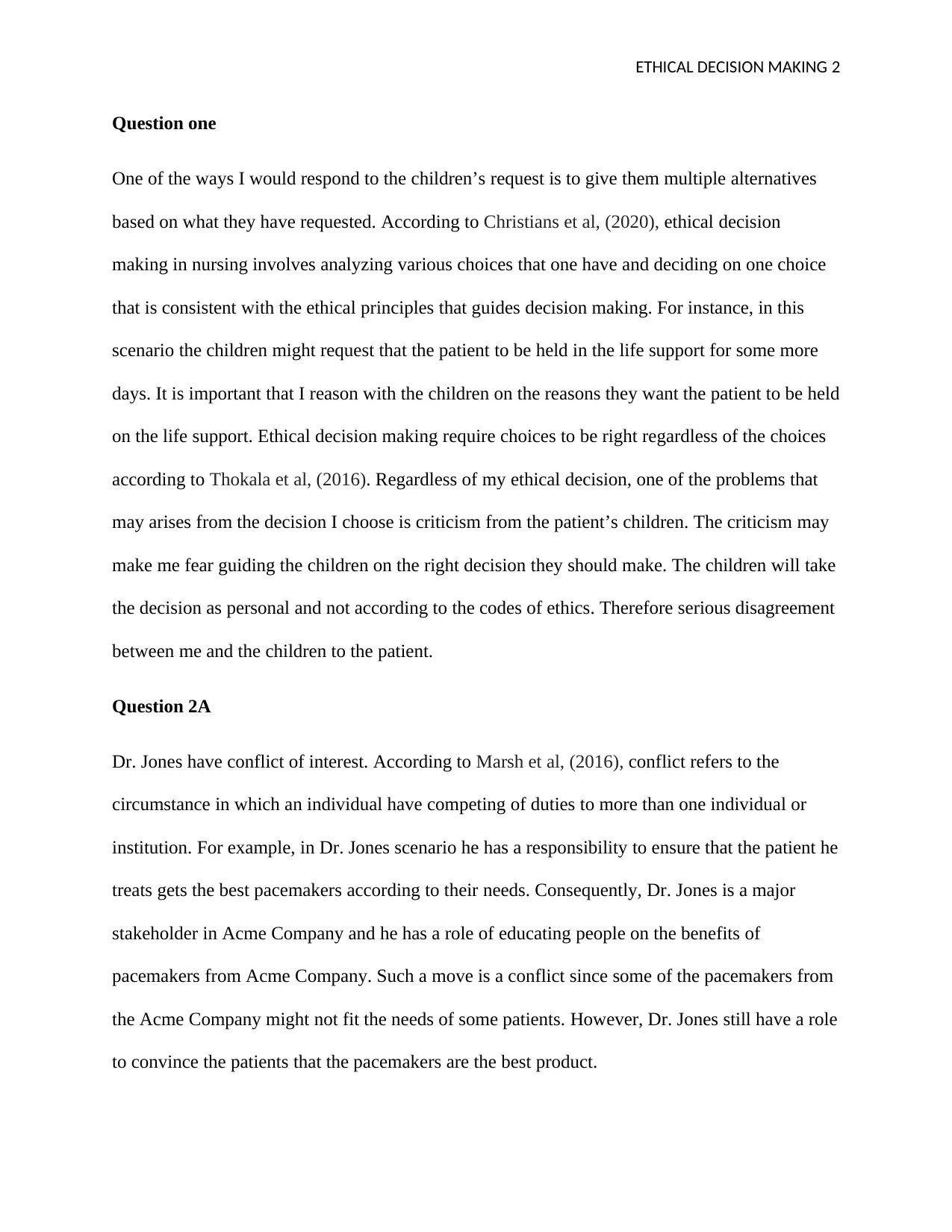
Question one
One of the ways I would respond to the children’s request is to give them multiple alternatives
based on what they have requested. According to Christians et al, (2020), ethical decision
making in nursing involves analyzing various choices that one have and deciding on one choice
that is consistent with the ethical principles that guides decision making. For instance, in this
scenario the children might request that the patient to be held in the life support for some more
days. It is important that I reason with the children on the reasons they want the patient to be held
on the life support. Ethical decision making require choices to be right regardless of the choices
according to Thokala et al, (2016). Regardless of my ethical decision, one of the problems that
may arises from the decision I choose is criticism from the patient’s children. The criticism may
make me fear guiding the children on the right decision they should make. The children will take
the decision as personal and not according to the codes of ethics. Therefore serious disagreement
between me and the children to the patient.
Question 2A
Dr. Jones have conflict of interest. According to Marsh et al, (2016), conflict refers to the
circumstance in which an individual have competing of duties to more than one individual or
institution. For example, in Dr. Jones scenario he has a responsibility to ensure that the patient he
treats gets the best pacemakers according to their needs. Consequently, Dr. Jones is a major
stakeholder in Acme Company and he has a role of educating people on the benefits of
pacemakers from Acme Company. Such a move is a conflict since some of the pacemakers from
the Acme Company might not fit the needs of some patients. However, Dr. Jones still have a role
to convince the patients that the pacemakers are the best product.
Question one
One of the ways I would respond to the children’s request is to give them multiple alternatives
based on what they have requested. According to Christians et al, (2020), ethical decision
making in nursing involves analyzing various choices that one have and deciding on one choice
that is consistent with the ethical principles that guides decision making. For instance, in this
scenario the children might request that the patient to be held in the life support for some more
days. It is important that I reason with the children on the reasons they want the patient to be held
on the life support. Ethical decision making require choices to be right regardless of the choices
according to Thokala et al, (2016). Regardless of my ethical decision, one of the problems that
may arises from the decision I choose is criticism from the patient’s children. The criticism may
make me fear guiding the children on the right decision they should make. The children will take
the decision as personal and not according to the codes of ethics. Therefore serious disagreement
between me and the children to the patient.
Question 2A
Dr. Jones have conflict of interest. According to Marsh et al, (2016), conflict refers to the
circumstance in which an individual have competing of duties to more than one individual or
institution. For example, in Dr. Jones scenario he has a responsibility to ensure that the patient he
treats gets the best pacemakers according to their needs. Consequently, Dr. Jones is a major
stakeholder in Acme Company and he has a role of educating people on the benefits of
pacemakers from Acme Company. Such a move is a conflict since some of the pacemakers from
the Acme Company might not fit the needs of some patients. However, Dr. Jones still have a role
to convince the patients that the pacemakers are the best product.

ETHICAL DECISION MAKING 3
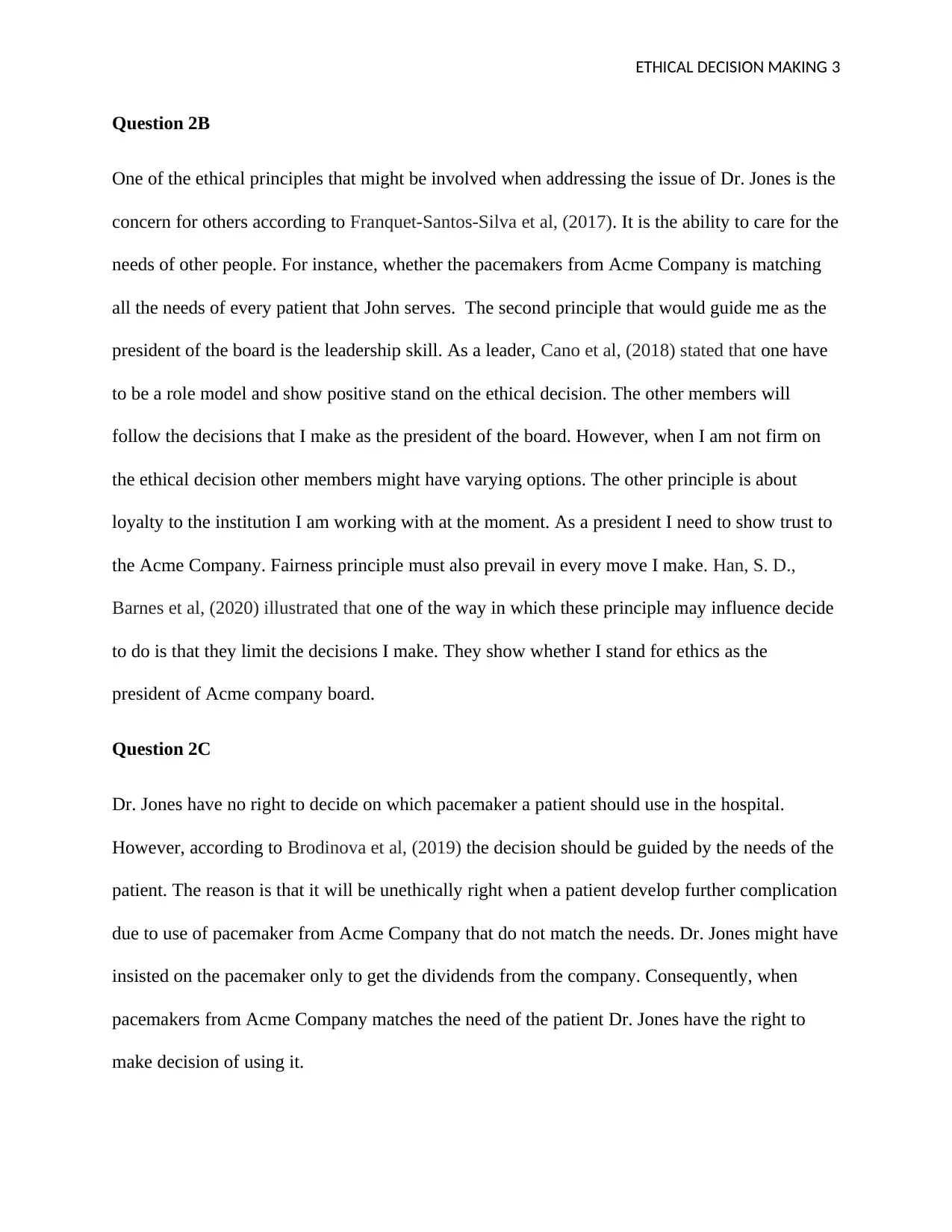
Question 2B
One of the ethical principles that might be involved when addressing the issue of Dr. Jones is the
concern for others according to Franquet-Santos-Silva et al, (2017). It is the ability to care for the
needs of other people. For instance, whether the pacemakers from Acme Company is matching
all the needs of every patient that John serves. The second principle that would guide me as the
president of the board is the leadership skill. As a leader, Cano et al, (2018) stated that one have
to be a role model and show positive stand on the ethical decision. The other members will
follow the decisions that I make as the president of the board. However, when I am not firm on
the ethical decision other members might have varying options. The other principle is about
loyalty to the institution I am working with at the moment. As a president I need to show trust to
the Acme Company. Fairness principle must also prevail in every move I make. Han, S. D.,
Barnes et al, (2020) illustrated that one of the way in which these principle may influence decide
to do is that they limit the decisions I make. They show whether I stand for ethics as the
president of Acme company board.
Question 2C
Dr. Jones have no right to decide on which pacemaker a patient should use in the hospital.
However, according to Brodinova et al, (2019) the decision should be guided by the needs of the
patient. The reason is that it will be unethically right when a patient develop further complication
due to use of pacemaker from Acme Company that do not match the needs. Dr. Jones might have
insisted on the pacemaker only to get the dividends from the company. Consequently, when
pacemakers from Acme Company matches the need of the patient Dr. Jones have the right to
make decision of using it.
Question 2B
One of the ethical principles that might be involved when addressing the issue of Dr. Jones is the
concern for others according to Franquet-Santos-Silva et al, (2017). It is the ability to care for the
needs of other people. For instance, whether the pacemakers from Acme Company is matching
all the needs of every patient that John serves. The second principle that would guide me as the
president of the board is the leadership skill. As a leader, Cano et al, (2018) stated that one have
to be a role model and show positive stand on the ethical decision. The other members will
follow the decisions that I make as the president of the board. However, when I am not firm on
the ethical decision other members might have varying options. The other principle is about
loyalty to the institution I am working with at the moment. As a president I need to show trust to
the Acme Company. Fairness principle must also prevail in every move I make. Han, S. D.,
Barnes et al, (2020) illustrated that one of the way in which these principle may influence decide
to do is that they limit the decisions I make. They show whether I stand for ethics as the
president of Acme company board.
Question 2C
Dr. Jones have no right to decide on which pacemaker a patient should use in the hospital.
However, according to Brodinova et al, (2019) the decision should be guided by the needs of the
patient. The reason is that it will be unethically right when a patient develop further complication
due to use of pacemaker from Acme Company that do not match the needs. Dr. Jones might have
insisted on the pacemaker only to get the dividends from the company. Consequently, when
pacemakers from Acme Company matches the need of the patient Dr. Jones have the right to
make decision of using it.
⊘ This is a preview!⊘
Do you want full access?
Subscribe today to unlock all pages.

Trusted by 1+ million students worldwide

ETHICAL DECISION MAKING 4
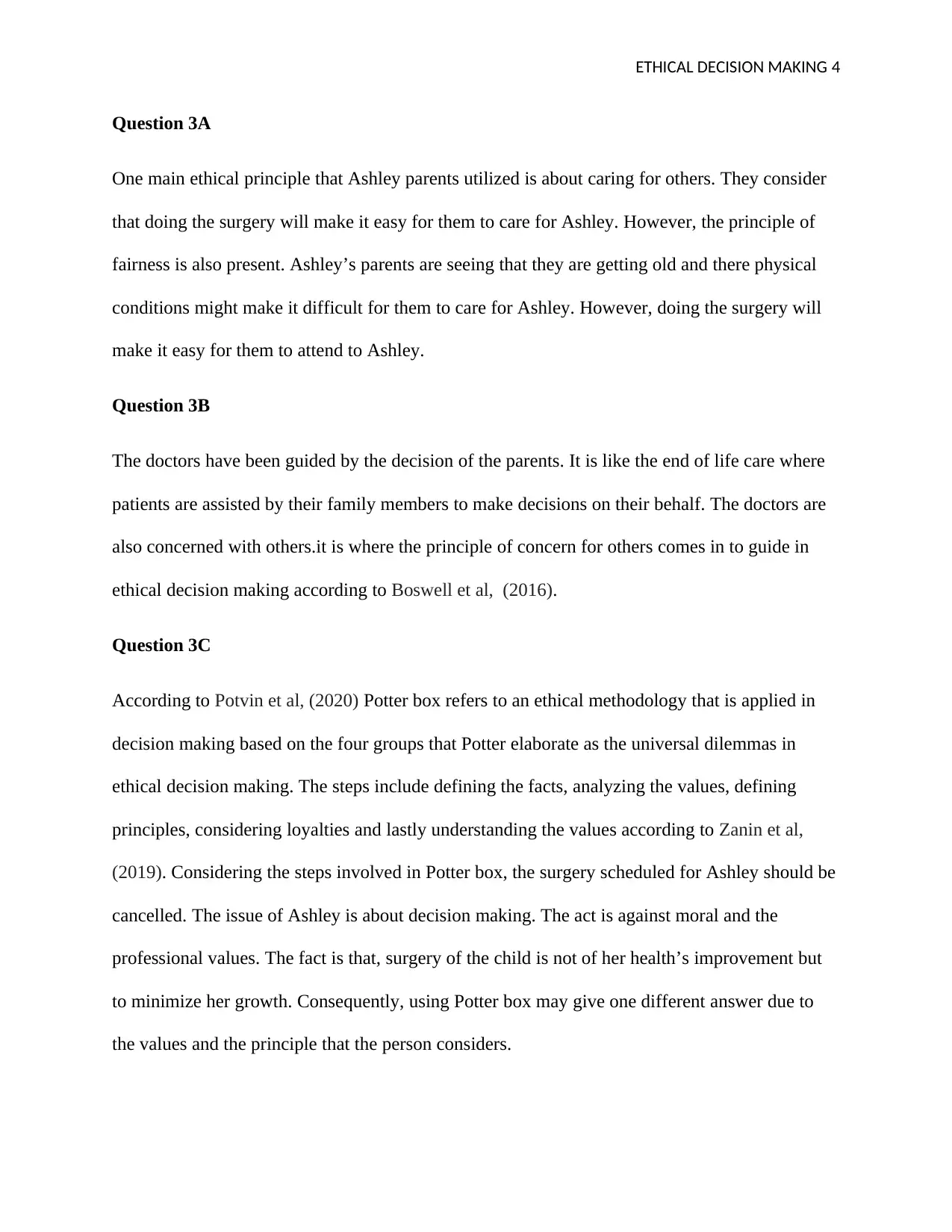
Question 3A
One main ethical principle that Ashley parents utilized is about caring for others. They consider
that doing the surgery will make it easy for them to care for Ashley. However, the principle of
fairness is also present. Ashley’s parents are seeing that they are getting old and there physical
conditions might make it difficult for them to care for Ashley. However, doing the surgery will
make it easy for them to attend to Ashley.
Question 3B
The doctors have been guided by the decision of the parents. It is like the end of life care where
patients are assisted by their family members to make decisions on their behalf. The doctors are
also concerned with others.it is where the principle of concern for others comes in to guide in
ethical decision making according to Boswell et al, (2016).
Question 3C
According to Potvin et al, (2020) Potter box refers to an ethical methodology that is applied in
decision making based on the four groups that Potter elaborate as the universal dilemmas in
ethical decision making. The steps include defining the facts, analyzing the values, defining
principles, considering loyalties and lastly understanding the values according to Zanin et al,
(2019). Considering the steps involved in Potter box, the surgery scheduled for Ashley should be
cancelled. The issue of Ashley is about decision making. The act is against moral and the
professional values. The fact is that, surgery of the child is not of her health’s improvement but
to minimize her growth. Consequently, using Potter box may give one different answer due to
the values and the principle that the person considers.
Question 3A
One main ethical principle that Ashley parents utilized is about caring for others. They consider
that doing the surgery will make it easy for them to care for Ashley. However, the principle of
fairness is also present. Ashley’s parents are seeing that they are getting old and there physical
conditions might make it difficult for them to care for Ashley. However, doing the surgery will
make it easy for them to attend to Ashley.
Question 3B
The doctors have been guided by the decision of the parents. It is like the end of life care where
patients are assisted by their family members to make decisions on their behalf. The doctors are
also concerned with others.it is where the principle of concern for others comes in to guide in
ethical decision making according to Boswell et al, (2016).
Question 3C
According to Potvin et al, (2020) Potter box refers to an ethical methodology that is applied in
decision making based on the four groups that Potter elaborate as the universal dilemmas in
ethical decision making. The steps include defining the facts, analyzing the values, defining
principles, considering loyalties and lastly understanding the values according to Zanin et al,
(2019). Considering the steps involved in Potter box, the surgery scheduled for Ashley should be
cancelled. The issue of Ashley is about decision making. The act is against moral and the
professional values. The fact is that, surgery of the child is not of her health’s improvement but
to minimize her growth. Consequently, using Potter box may give one different answer due to
the values and the principle that the person considers.
Paraphrase This Document
Need a fresh take? Get an instant paraphrase of this document with our AI Paraphraser

ETHICAL DECISION MAKING 5
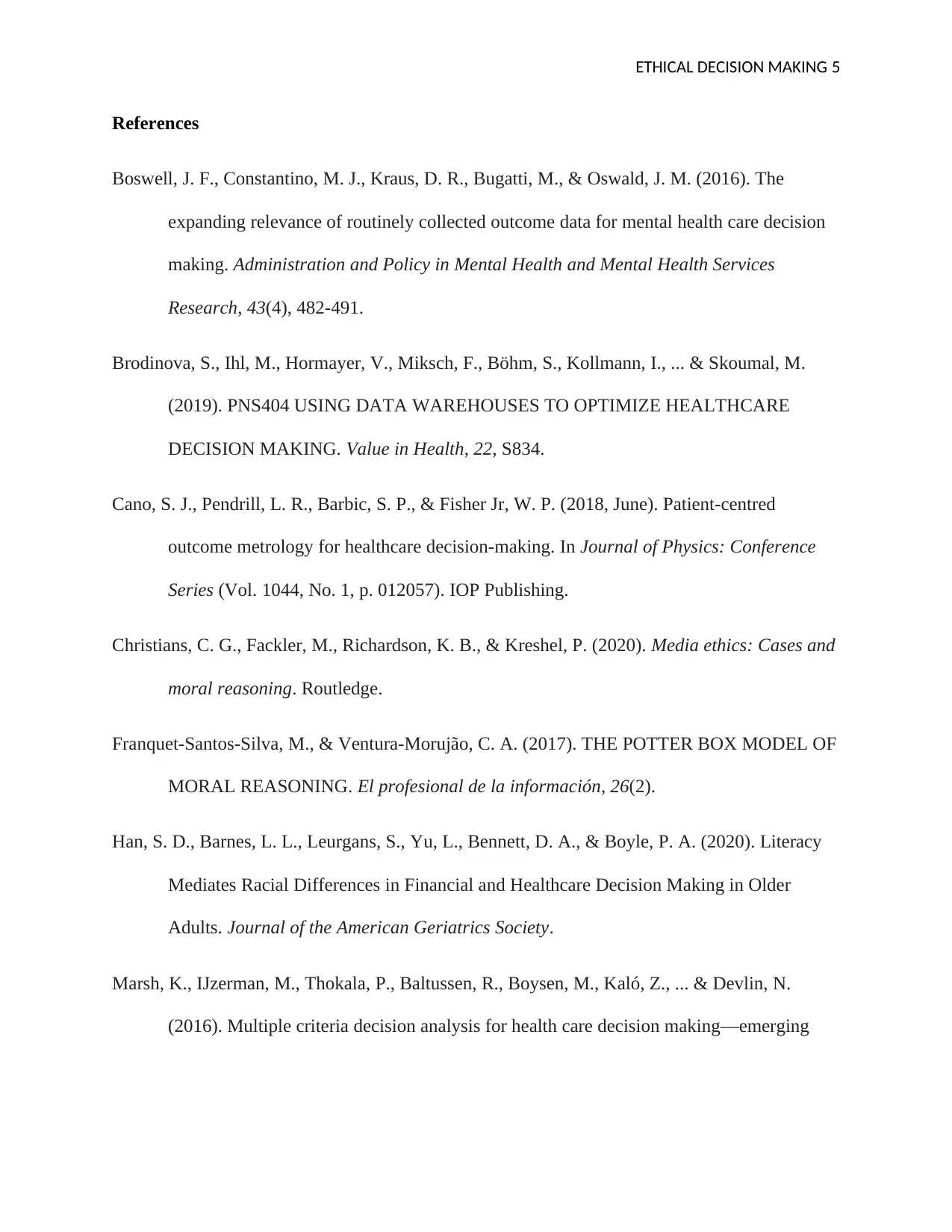
References
Boswell, J. F., Constantino, M. J., Kraus, D. R., Bugatti, M., & Oswald, J. M. (2016). The
expanding relevance of routinely collected outcome data for mental health care decision
making. Administration and Policy in Mental Health and Mental Health Services
Research, 43(4), 482-491.
Brodinova, S., Ihl, M., Hormayer, V., Miksch, F., Böhm, S., Kollmann, I., ... & Skoumal, M.
(2019). PNS404 USING DATA WAREHOUSES TO OPTIMIZE HEALTHCARE
DECISION MAKING. Value in Health, 22, S834.
Cano, S. J., Pendrill, L. R., Barbic, S. P., & Fisher Jr, W. P. (2018, June). Patient-centred
outcome metrology for healthcare decision-making. In Journal of Physics: Conference
Series (Vol. 1044, No. 1, p. 012057). IOP Publishing.
Christians, C. G., Fackler, M., Richardson, K. B., & Kreshel, P. (2020). Media ethics: Cases and
moral reasoning. Routledge.
Franquet-Santos-Silva, M., & Ventura-Morujão, C. A. (2017). THE POTTER BOX MODEL OF
MORAL REASONING. El profesional de la información, 26(2).
Han, S. D., Barnes, L. L., Leurgans, S., Yu, L., Bennett, D. A., & Boyle, P. A. (2020). Literacy
Mediates Racial Differences in Financial and Healthcare Decision Making in Older
Adults. Journal of the American Geriatrics Society.
Marsh, K., IJzerman, M., Thokala, P., Baltussen, R., Boysen, M., Kaló, Z., ... & Devlin, N.
(2016). Multiple criteria decision analysis for health care decision making—emerging
References
Boswell, J. F., Constantino, M. J., Kraus, D. R., Bugatti, M., & Oswald, J. M. (2016). The
expanding relevance of routinely collected outcome data for mental health care decision
making. Administration and Policy in Mental Health and Mental Health Services
Research, 43(4), 482-491.
Brodinova, S., Ihl, M., Hormayer, V., Miksch, F., Böhm, S., Kollmann, I., ... & Skoumal, M.
(2019). PNS404 USING DATA WAREHOUSES TO OPTIMIZE HEALTHCARE
DECISION MAKING. Value in Health, 22, S834.
Cano, S. J., Pendrill, L. R., Barbic, S. P., & Fisher Jr, W. P. (2018, June). Patient-centred
outcome metrology for healthcare decision-making. In Journal of Physics: Conference
Series (Vol. 1044, No. 1, p. 012057). IOP Publishing.
Christians, C. G., Fackler, M., Richardson, K. B., & Kreshel, P. (2020). Media ethics: Cases and
moral reasoning. Routledge.
Franquet-Santos-Silva, M., & Ventura-Morujão, C. A. (2017). THE POTTER BOX MODEL OF
MORAL REASONING. El profesional de la información, 26(2).
Han, S. D., Barnes, L. L., Leurgans, S., Yu, L., Bennett, D. A., & Boyle, P. A. (2020). Literacy
Mediates Racial Differences in Financial and Healthcare Decision Making in Older
Adults. Journal of the American Geriatrics Society.
Marsh, K., IJzerman, M., Thokala, P., Baltussen, R., Boysen, M., Kaló, Z., ... & Devlin, N.
(2016). Multiple criteria decision analysis for health care decision making—emerging

ETHICAL DECISION MAKING 6
good practices: report 2 of the ISPOR MCDA Emerging Good Practices Task
Force. Value in health, 19(2), 125-137.
Potvin, N., Flynn, C., & Storm, J. (2020). Ethical Decision-Making at Intersections of
Spirituality and Music Therapy in End-of-Life Care. Music Therapy Perspectives.
Thokala, P., Devlin, N., Marsh, K., Baltussen, R., Boysen, M., Kalo, Z., ... & Ijzerman, M.
(2016). Multiple criteria decision analysis for health care decision making—an
introduction: report 1 of the ISPOR MCDA Emerging Good Practices Task Force. Value
in health, 19(1), 1-13.
Zanin, A. C., Kamrath, J. K., Ruston, S. W., Posteher, K. A., & Corman, S. R. (2019). Labeling
avoidance in healthcare decision-making: How stakeholders make sense of concussion
events through sport narratives. Health communication, 1-11.
good practices: report 2 of the ISPOR MCDA Emerging Good Practices Task
Force. Value in health, 19(2), 125-137.
Potvin, N., Flynn, C., & Storm, J. (2020). Ethical Decision-Making at Intersections of
Spirituality and Music Therapy in End-of-Life Care. Music Therapy Perspectives.
Thokala, P., Devlin, N., Marsh, K., Baltussen, R., Boysen, M., Kalo, Z., ... & Ijzerman, M.
(2016). Multiple criteria decision analysis for health care decision making—an
introduction: report 1 of the ISPOR MCDA Emerging Good Practices Task Force. Value
in health, 19(1), 1-13.
Zanin, A. C., Kamrath, J. K., Ruston, S. W., Posteher, K. A., & Corman, S. R. (2019). Labeling
avoidance in healthcare decision-making: How stakeholders make sense of concussion
events through sport narratives. Health communication, 1-11.
⊘ This is a preview!⊘
Do you want full access?
Subscribe today to unlock all pages.

Trusted by 1+ million students worldwide
1 out of 6
Related Documents
Your All-in-One AI-Powered Toolkit for Academic Success.
+13062052269
info@desklib.com
Available 24*7 on WhatsApp / Email
Unlock your academic potential
Copyright © 2020–2025 A2Z Services. All Rights Reserved. Developed and managed by ZUCOL.