Analysis of Healthcare Expenditure Management in the US: Report

Verified

Added on  2020/02/18

|3
|439
|158
Report
AI Summary
This report examines the management of healthcare expenditure in the United States, focusing on key aspects such as regulations, costs, and patient care. It discusses the roles of both the federal and state governments in overseeing healthcare, including the impact of the Affordable Care Act. The report highlights the importance of managing healthcare costs at the patient level, emphasizing the need for a comprehensive approach that considers the entire cycle of care. It also explores various interventions aimed at reducing waste and improving efficiency within the healthcare system, such as consumer-directed health plans and alternative payment methods for healthcare officials. The report references relevant literature and provides insights into the challenges and potential solutions for managing healthcare expenditure effectively.
Document Page
Running head: MANAGEMENT OF HEALTHCARE EXPENDITURE IN US
Management of healthcare expenditure in US
Name of the Student
Name of the University
Author note
tabler-icon-diamond-filled.svg

Paraphrase This Document

Need a fresh take? Get an instant paraphrase of this document with our AI Paraphraser
Document Page
1MANAGEMENT OF HEALTHCARE EXPENDITURE IN US
Discussion1:
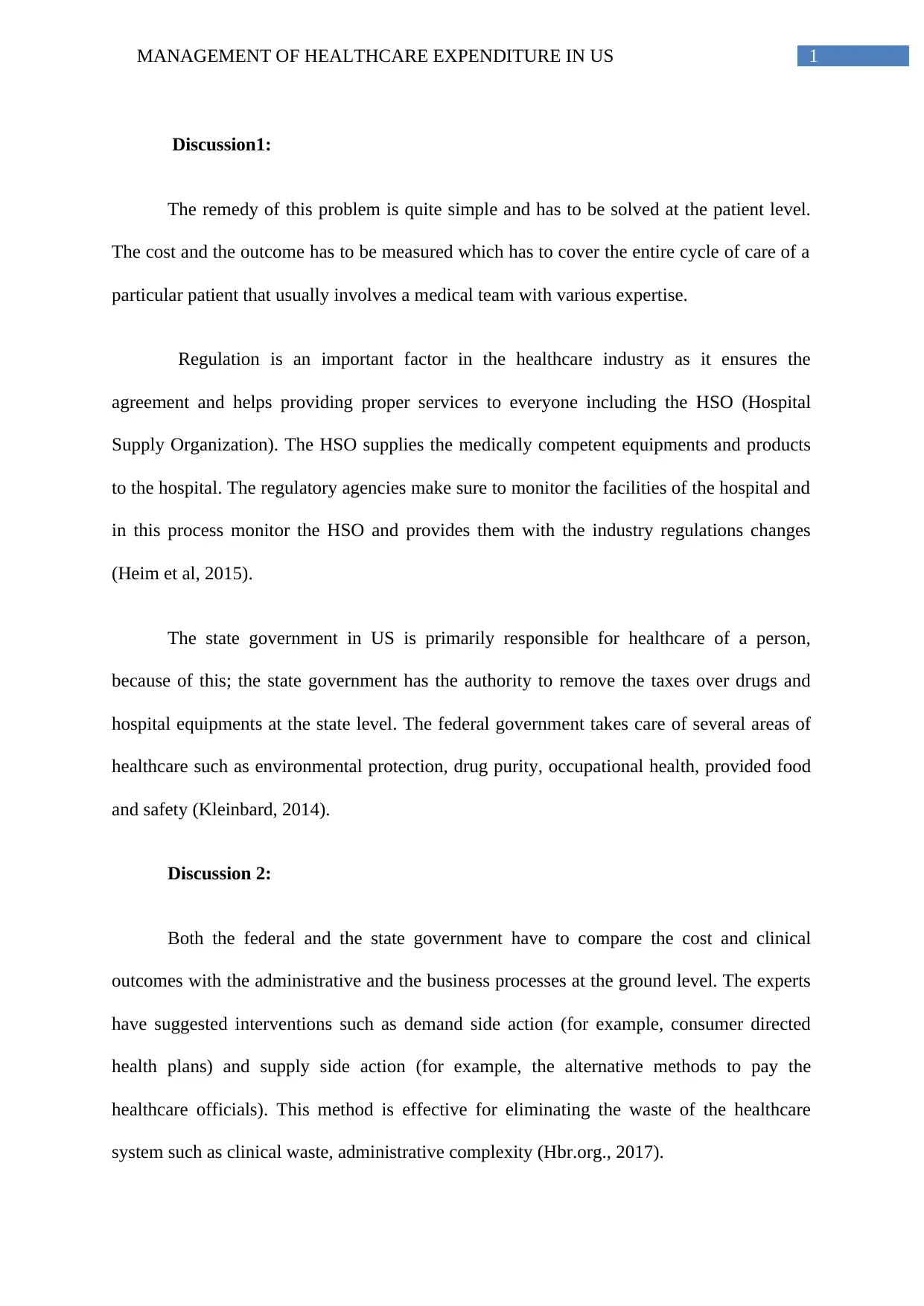
The remedy of this problem is quite simple and has to be solved at the patient level.
The cost and the outcome has to be measured which has to cover the entire cycle of care of a
particular patient that usually involves a medical team with various expertise.
Regulation is an important factor in the healthcare industry as it ensures the
agreement and helps providing proper services to everyone including the HSO (Hospital
Supply Organization). The HSO supplies the medically competent equipments and products
to the hospital. The regulatory agencies make sure to monitor the facilities of the hospital and
in this process monitor the HSO and provides them with the industry regulations changes
(Heim et al, 2015).
The state government in US is primarily responsible for healthcare of a person,
because of this; the state government has the authority to remove the taxes over drugs and
hospital equipments at the state level. The federal government takes care of several areas of
healthcare such as environmental protection, drug purity, occupational health, provided food
and safety (Kleinbard, 2014).
Discussion 2:
Both the federal and the state government have to compare the cost and clinical
outcomes with the administrative and the business processes at the ground level. The experts
have suggested interventions such as demand side action (for example, consumer directed
health plans) and supply side action (for example, the alternative methods to pay the
healthcare officials). This method is effective for eliminating the waste of the healthcare
system such as clinical waste, administrative complexity (Hbr.org., 2017).
Document Page
2MANAGEMENT OF HEALTHCARE EXPENDITURE IN US
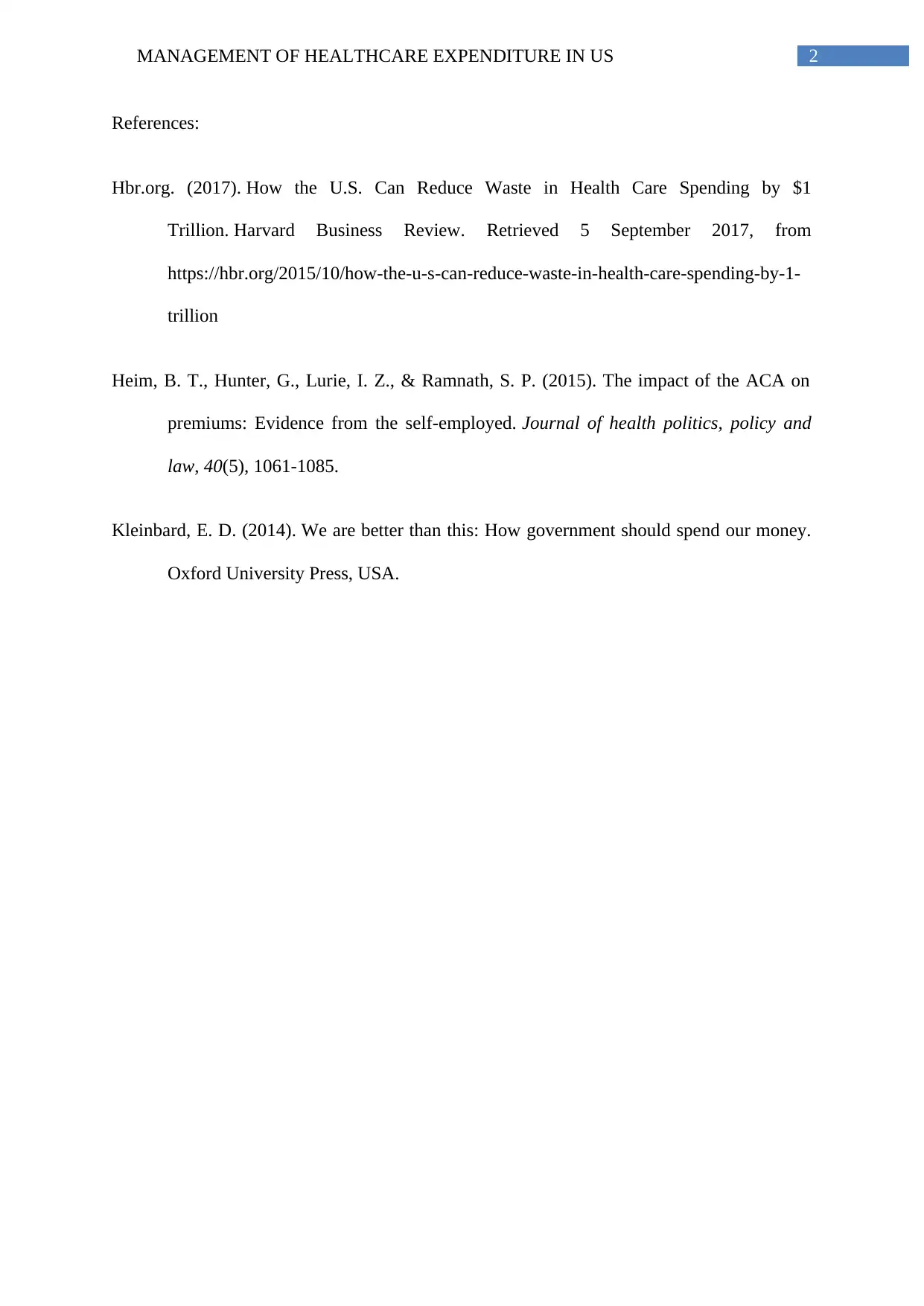
References:
Hbr.org. (2017). How the U.S. Can Reduce Waste in Health Care Spending by $1
Trillion. Harvard Business Review. Retrieved 5 September 2017, from
https://hbr.org/2015/10/how-the-u-s-can-reduce-waste-in-health-care-spending-by-1-
trillion
Heim, B. T., Hunter, G., Lurie, I. Z., & Ramnath, S. P. (2015). The impact of the ACA on
premiums: Evidence from the self-employed. Journal of health politics, policy and
law, 40(5), 1061-1085.
Kleinbard, E. D. (2014). We are better than this: How government should spend our money.
Oxford University Press, USA.
chevron_up_icon
1 out of 3
circle_padding
hide_on_mobile
zoom_out_icon
[object Object]