Healthcare Finance: Analysis of Ambulatory Service Proposal for MHS
VerifiedAdded on 2022/08/12
|8
|1939
|36
Case Study
AI Summary
This case study analyzes the financial aspects of an ambulatory service proposal for the Metropolis Health System (MHS). The analysis includes an examination of the desired goals and alternatives, specifically focusing on an ambulatory service as a potential expansion strategy. The study details the costs associated with the proposed service, including initial investments in vehicles, equipment, and facility modifications, as well as ongoing operational expenses. A comprehensive budget and financial analysis are presented, projecting revenues, costs, and profits over a five-year period, with assumptions regarding service demand, pricing, and financing. The financial analysis employs investment appraisal techniques, calculating the Net Present Value (NPV) and Internal Rate of Return (IRR) to assess the project's feasibility. A sensitivity analysis is conducted to evaluate the impact of changes in demand on the project's financial outcomes. The study concludes that the ambulatory service is financially viable and recommends its adoption by MHS, provided that the anticipated demand is met. References and a bibliography are included to support the findings and analysis.
Running head: HEALTH CARE FINANCE
Health Care Finance
Name of the Student:
Name of the University:
Author’s Note:
Health Care Finance
Name of the Student:
Name of the University:
Author’s Note:
Paraphrase This Document
Need a fresh take? Get an instant paraphrase of this document with our AI Paraphraser

1HEALTH CARE FINANCE
Table of Contents
Desired goals and alternatives:........................................................................................................2
Costs associated with the Proposed Ambulatory service:...............................................................2
Budget and financial analysis of the proposed service:...................................................................3
Conclusion:......................................................................................................................................6
References and bibliography:..........................................................................................................7
Table of Contents
Desired goals and alternatives:........................................................................................................2
Costs associated with the Proposed Ambulatory service:...............................................................2
Budget and financial analysis of the proposed service:...................................................................3
Conclusion:......................................................................................................................................6
References and bibliography:..........................................................................................................7

2HEALTH CARE FINANCE
Desired goals and alternatives:
The Metropolis Health System (MHS) is a provider of health care services in an
integrated way. They provide various diagnostic and health care related services and had been a
well-established brand in the country. The quality of their services and the efficient operations
and management system helped them to become one of the important and renowned health care
service provider. They provide rehabilitation and wellness services for the outpatient, home
health services, same day surgery, skilled nursing facility and community health and wellness
services. Though they have been enjoying a good market share, for ensuring sustainable growth
in their business and improving their quality in services, they have various new business options
for providing some new services are available to them, such as Ambulatory service, Physical
medicine and Rehabilitative services, Cardiovascular services, Oncology Services and
Community services (Akwetey 2015).
As the organization is oriented towards the improvement in their service and a
sustainable growth, the Ambulatory service can be proposed for the organization as an expansion
strategy for them subject to the feasibility and profitability of the service. The objective of the
ambulatory service is to establish an equipment based service to boost the revenue of the
organization as well as to add another service facility to the organization (Akwetey 2015).
Costs associated with the Proposed Ambulatory service:
The ambulatory service requires an initial investment in the ambulance vehicle and
medical instruments and equipment. To operate the service, there will be a requirement of a
driver and an assistant. As the ambulance will be equipped with various advanced medical
Desired goals and alternatives:
The Metropolis Health System (MHS) is a provider of health care services in an
integrated way. They provide various diagnostic and health care related services and had been a
well-established brand in the country. The quality of their services and the efficient operations
and management system helped them to become one of the important and renowned health care
service provider. They provide rehabilitation and wellness services for the outpatient, home
health services, same day surgery, skilled nursing facility and community health and wellness
services. Though they have been enjoying a good market share, for ensuring sustainable growth
in their business and improving their quality in services, they have various new business options
for providing some new services are available to them, such as Ambulatory service, Physical
medicine and Rehabilitative services, Cardiovascular services, Oncology Services and
Community services (Akwetey 2015).
As the organization is oriented towards the improvement in their service and a
sustainable growth, the Ambulatory service can be proposed for the organization as an expansion
strategy for them subject to the feasibility and profitability of the service. The objective of the
ambulatory service is to establish an equipment based service to boost the revenue of the
organization as well as to add another service facility to the organization (Akwetey 2015).
Costs associated with the Proposed Ambulatory service:
The ambulatory service requires an initial investment in the ambulance vehicle and
medical instruments and equipment. To operate the service, there will be a requirement of a
driver and an assistant. As the ambulance will be equipped with various advanced medical
⊘ This is a preview!⊘
Do you want full access?
Subscribe today to unlock all pages.

Trusted by 1+ million students worldwide

3HEALTH CARE FINANCE
instruments and equipment, there will be a daily operating expenses and costs for that. The
organization spends almost $5,000 to research the market related issues and demand for the
proposed service and to assess the feasibility of the proposal. This cost can be considered as the
sunk cost for the proposed ambulatory service. On the other hand, a space will be required for
the garage of the ambulance and another room will be allocated as the emergency unit for the
ambulatory service. The space which will be used as the garage is currently being let out for a
monthly rent of $1,200. This will be considered as the opportunity cost for the proposed
ambulatory service (Alkaraan 2017).
Budget and financial analysis of the proposed service:
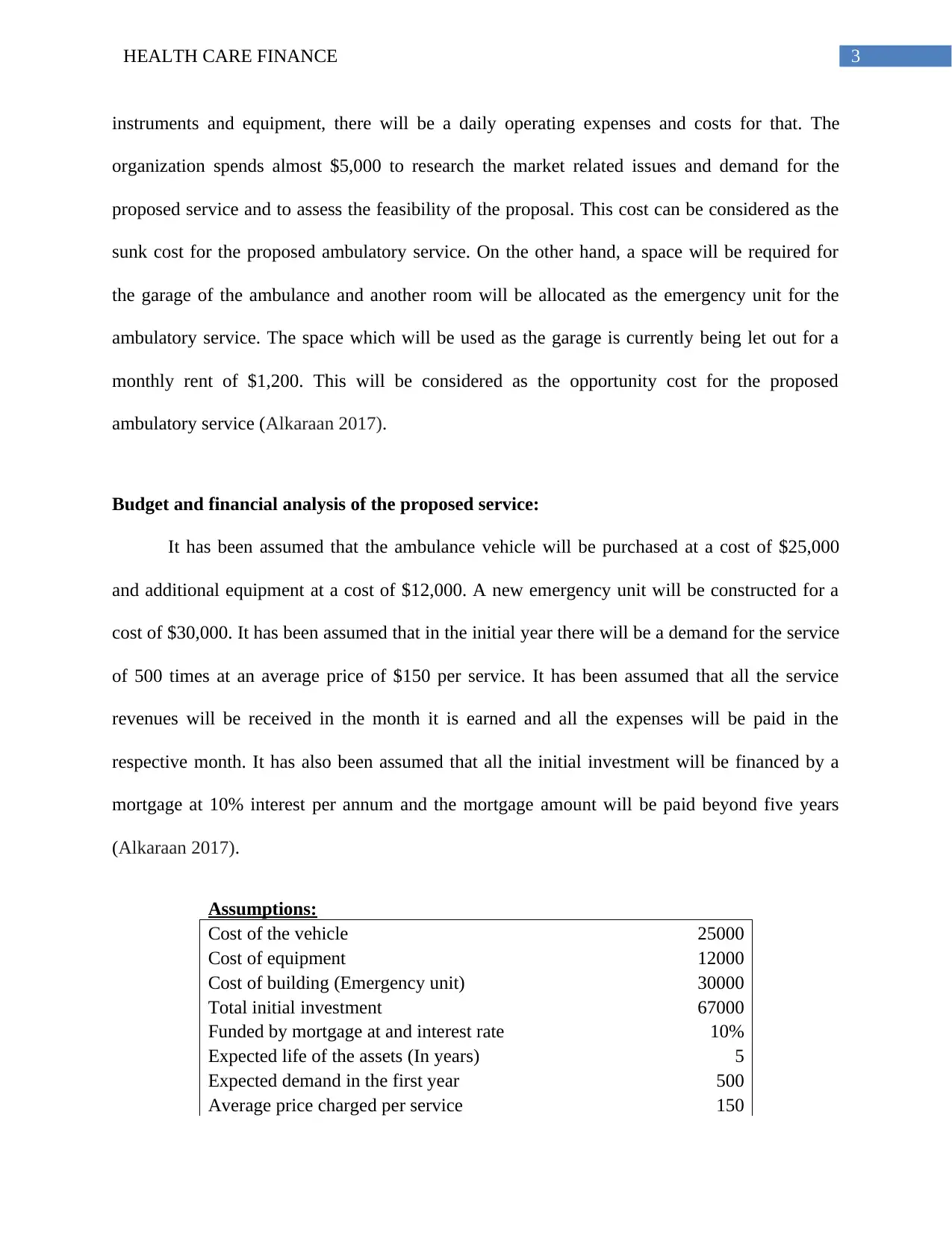
It has been assumed that the ambulance vehicle will be purchased at a cost of $25,000
and additional equipment at a cost of $12,000. A new emergency unit will be constructed for a
cost of $30,000. It has been assumed that in the initial year there will be a demand for the service
of 500 times at an average price of $150 per service. It has been assumed that all the service
revenues will be received in the month it is earned and all the expenses will be paid in the
respective month. It has also been assumed that all the initial investment will be financed by a
mortgage at 10% interest per annum and the mortgage amount will be paid beyond five years
(Alkaraan 2017).
Assumptions:
Cost of the vehicle 25000
Cost of equipment 12000
Cost of building (Emergency unit) 30000
Total initial investment 67000
Funded by mortgage at and interest rate 10%
Expected life of the assets (In years) 5
Expected demand in the first year 500
Average price charged per service 150
instruments and equipment, there will be a daily operating expenses and costs for that. The
organization spends almost $5,000 to research the market related issues and demand for the
proposed service and to assess the feasibility of the proposal. This cost can be considered as the
sunk cost for the proposed ambulatory service. On the other hand, a space will be required for
the garage of the ambulance and another room will be allocated as the emergency unit for the
ambulatory service. The space which will be used as the garage is currently being let out for a
monthly rent of $1,200. This will be considered as the opportunity cost for the proposed
ambulatory service (Alkaraan 2017).
Budget and financial analysis of the proposed service:
It has been assumed that the ambulance vehicle will be purchased at a cost of $25,000
and additional equipment at a cost of $12,000. A new emergency unit will be constructed for a
cost of $30,000. It has been assumed that in the initial year there will be a demand for the service
of 500 times at an average price of $150 per service. It has been assumed that all the service
revenues will be received in the month it is earned and all the expenses will be paid in the
respective month. It has also been assumed that all the initial investment will be financed by a
mortgage at 10% interest per annum and the mortgage amount will be paid beyond five years
(Alkaraan 2017).
Assumptions:
Cost of the vehicle 25000
Cost of equipment 12000
Cost of building (Emergency unit) 30000
Total initial investment 67000
Funded by mortgage at and interest rate 10%
Expected life of the assets (In years) 5
Expected demand in the first year 500
Average price charged per service 150
Paraphrase This Document
Need a fresh take? Get an instant paraphrase of this document with our AI Paraphraser

4HEALTH CARE FINANCE
Service revenue in the first year 75000
Annual expected growth in the revenue 5%
Variable cost of revenue (% of revenue) 40%
Driver's salary per month 1000
Assistant's salary per month 800
Annual other fixed costs 3000
Tax rate 30%
Discounting rate 15%
Statement showing budgeted profits and cash flows:
Year 0 1 2 3 4 5
Annual revenue $ 75,000 $ 78,750 $ 82,688 $ 86,822 $ 91,163
Cost of revenue $ (30,000) $ (31,500) $ (33,075) $ (34,729) $ (36,465)
Gross profit $ 45,000 $ 47,250 $ 49,613 $ 52,093 $ 54,698
Driver's salary $ (12,000) $ (12,000) $ (12,000) $ (12,000) $ (12,000)
Assistant's salary $ (9,600) $ (9,600) $ (9,600) $ (9,600) $ (9,600)
Annual other fixed costs $ (3,000) $ (3,000) $ (3,000) $ (3,000) $ (3,000)
Annual depreciation expense $ (13,400) $ (13,400) $ (13,400) $ (13,400) $ (13,400)
Profit before interest and tax $ 7,000 $ 9,250 $ 11,613 $ 14,093 $ 16,698
Interest expense $ (6,700) $ (6,700) $ (6,700) $ (6,700) $ (6,700)
Profit before tax $ 300 $ 2,550 $ 4,913 $ 7,393 $ 9,998
Provision for tax $ (90) $ (765) $ (1,474) $ (2,218) $ (2,999)
Profit after tax $ 210 $ 1,785 $ 3,439 $ 5,175 $ 6,998
Add: Depreciation $ 13,400 $ 13,400 $ 13,400 $ 13,400 $ 13,400
Add: Interest $ 6,700 $ 6,700 $ 6,700 $ 6,700 $ 6,700
Cash generated by operations $ 20,310 $ 21,885 $ 23,539 $ 25,275 $ 27,098
Initial investment $ (67,000)
Free cash flows $ (67,000) $ 20,310 $ 21,885 $ 23,539 $ 25,275 $ 27,098
Discounting factor 1.0000 0.8696 0.7561 0.6575 0.5718 0.4972
Present value of cash flows $ (67,000) $ 17,661 $ 16,548 $ 15,477 $ 14,451 $ 13,473
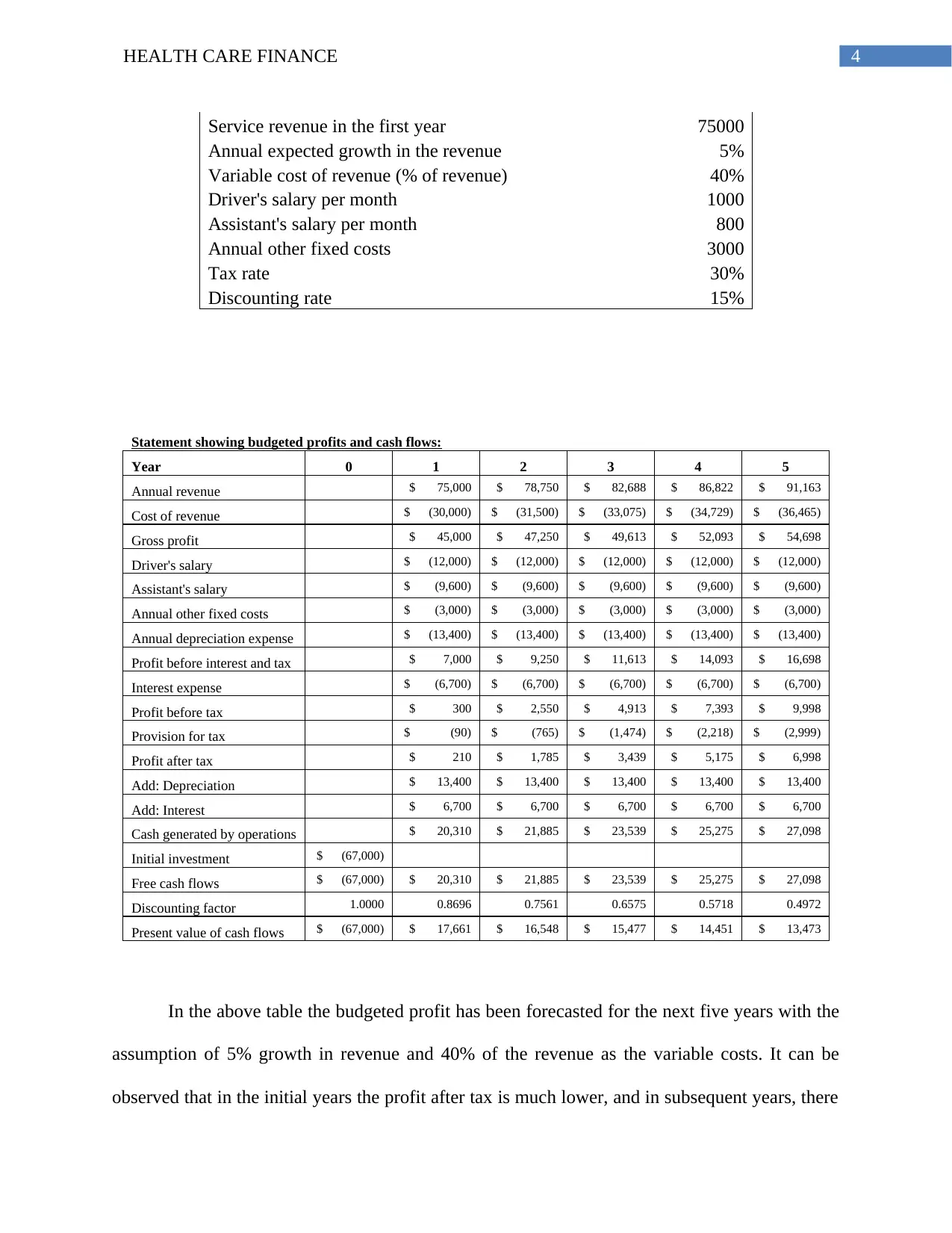
In the above table the budgeted profit has been forecasted for the next five years with the
assumption of 5% growth in revenue and 40% of the revenue as the variable costs. It can be
observed that in the initial years the profit after tax is much lower, and in subsequent years, there
Service revenue in the first year 75000
Annual expected growth in the revenue 5%
Variable cost of revenue (% of revenue) 40%
Driver's salary per month 1000
Assistant's salary per month 800
Annual other fixed costs 3000
Tax rate 30%
Discounting rate 15%
Statement showing budgeted profits and cash flows:
Year 0 1 2 3 4 5
Annual revenue $ 75,000 $ 78,750 $ 82,688 $ 86,822 $ 91,163
Cost of revenue $ (30,000) $ (31,500) $ (33,075) $ (34,729) $ (36,465)
Gross profit $ 45,000 $ 47,250 $ 49,613 $ 52,093 $ 54,698
Driver's salary $ (12,000) $ (12,000) $ (12,000) $ (12,000) $ (12,000)
Assistant's salary $ (9,600) $ (9,600) $ (9,600) $ (9,600) $ (9,600)
Annual other fixed costs $ (3,000) $ (3,000) $ (3,000) $ (3,000) $ (3,000)
Annual depreciation expense $ (13,400) $ (13,400) $ (13,400) $ (13,400) $ (13,400)
Profit before interest and tax $ 7,000 $ 9,250 $ 11,613 $ 14,093 $ 16,698
Interest expense $ (6,700) $ (6,700) $ (6,700) $ (6,700) $ (6,700)
Profit before tax $ 300 $ 2,550 $ 4,913 $ 7,393 $ 9,998
Provision for tax $ (90) $ (765) $ (1,474) $ (2,218) $ (2,999)
Profit after tax $ 210 $ 1,785 $ 3,439 $ 5,175 $ 6,998
Add: Depreciation $ 13,400 $ 13,400 $ 13,400 $ 13,400 $ 13,400
Add: Interest $ 6,700 $ 6,700 $ 6,700 $ 6,700 $ 6,700
Cash generated by operations $ 20,310 $ 21,885 $ 23,539 $ 25,275 $ 27,098
Initial investment $ (67,000)
Free cash flows $ (67,000) $ 20,310 $ 21,885 $ 23,539 $ 25,275 $ 27,098
Discounting factor 1.0000 0.8696 0.7561 0.6575 0.5718 0.4972
Present value of cash flows $ (67,000) $ 17,661 $ 16,548 $ 15,477 $ 14,451 $ 13,473
In the above table the budgeted profit has been forecasted for the next five years with the
assumption of 5% growth in revenue and 40% of the revenue as the variable costs. It can be
observed that in the initial years the profit after tax is much lower, and in subsequent years, there

5HEALTH CARE FINANCE
is an increasing trend in profit after tax. Adding back the depreciation expenses and interest
expense the cash flow generated by the operations have been computed. As the interest rate of
mortgage is 10%, a discounting rate or a required rate or return of 15% has been assumed for
applying the investment appraisal techniques such as net present value and internal rate of return.
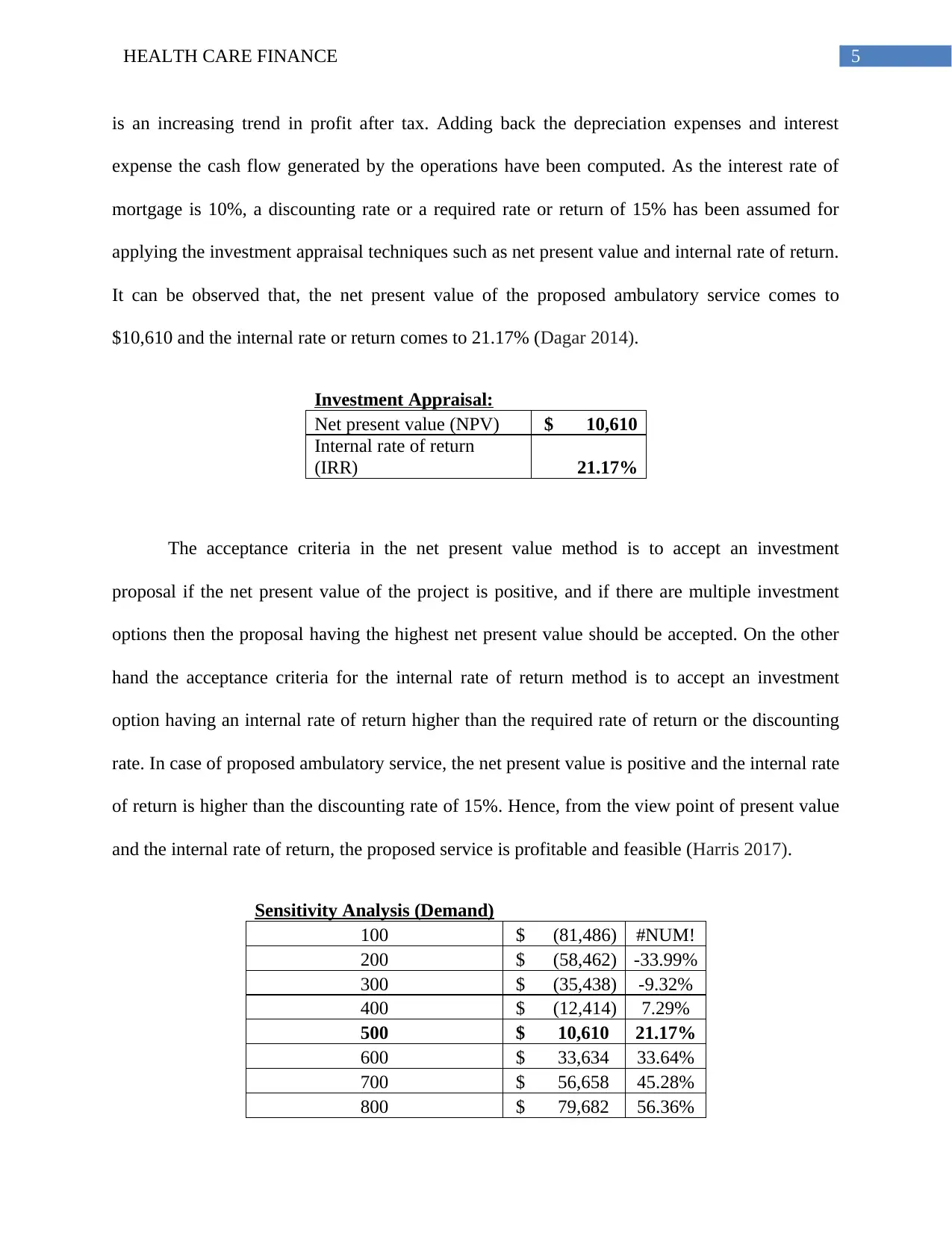
It can be observed that, the net present value of the proposed ambulatory service comes to
$10,610 and the internal rate or return comes to 21.17% (Dagar 2014).
Investment Appraisal:
Net present value (NPV) $ 10,610
Internal rate of return
(IRR) 21.17%
The acceptance criteria in the net present value method is to accept an investment
proposal if the net present value of the project is positive, and if there are multiple investment
options then the proposal having the highest net present value should be accepted. On the other
hand the acceptance criteria for the internal rate of return method is to accept an investment
option having an internal rate of return higher than the required rate of return or the discounting
rate. In case of proposed ambulatory service, the net present value is positive and the internal rate
of return is higher than the discounting rate of 15%. Hence, from the view point of present value
and the internal rate of return, the proposed service is profitable and feasible (Harris 2017).
Sensitivity Analysis (Demand)
100 $ (81,486) #NUM!
200 $ (58,462) -33.99%
300 $ (35,438) -9.32%
400 $ (12,414) 7.29%
500 $ 10,610 21.17%
600 $ 33,634 33.64%
700 $ 56,658 45.28%
800 $ 79,682 56.36%
is an increasing trend in profit after tax. Adding back the depreciation expenses and interest
expense the cash flow generated by the operations have been computed. As the interest rate of
mortgage is 10%, a discounting rate or a required rate or return of 15% has been assumed for
applying the investment appraisal techniques such as net present value and internal rate of return.
It can be observed that, the net present value of the proposed ambulatory service comes to
$10,610 and the internal rate or return comes to 21.17% (Dagar 2014).
Investment Appraisal:
Net present value (NPV) $ 10,610
Internal rate of return
(IRR) 21.17%
The acceptance criteria in the net present value method is to accept an investment
proposal if the net present value of the project is positive, and if there are multiple investment
options then the proposal having the highest net present value should be accepted. On the other
hand the acceptance criteria for the internal rate of return method is to accept an investment
option having an internal rate of return higher than the required rate of return or the discounting
rate. In case of proposed ambulatory service, the net present value is positive and the internal rate
of return is higher than the discounting rate of 15%. Hence, from the view point of present value
and the internal rate of return, the proposed service is profitable and feasible (Harris 2017).
Sensitivity Analysis (Demand)
100 $ (81,486) #NUM!
200 $ (58,462) -33.99%
300 $ (35,438) -9.32%
400 $ (12,414) 7.29%
500 $ 10,610 21.17%
600 $ 33,634 33.64%
700 $ 56,658 45.28%
800 $ 79,682 56.36%
⊘ This is a preview!⊘
Do you want full access?
Subscribe today to unlock all pages.

Trusted by 1+ million students worldwide

6HEALTH CARE FINANCE
900 $ 102,707 67.06%
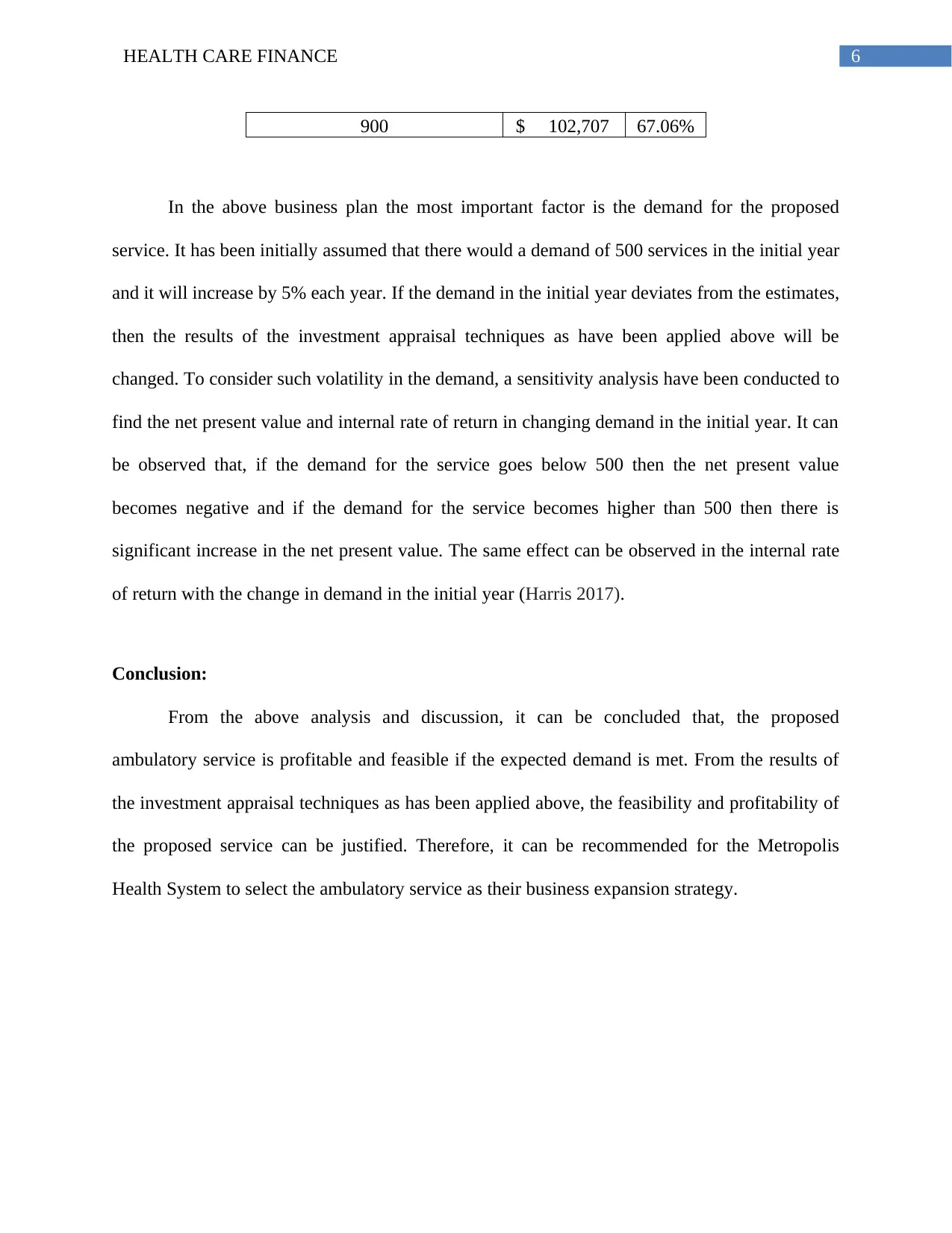
In the above business plan the most important factor is the demand for the proposed
service. It has been initially assumed that there would a demand of 500 services in the initial year
and it will increase by 5% each year. If the demand in the initial year deviates from the estimates,
then the results of the investment appraisal techniques as have been applied above will be
changed. To consider such volatility in the demand, a sensitivity analysis have been conducted to
find the net present value and internal rate of return in changing demand in the initial year. It can
be observed that, if the demand for the service goes below 500 then the net present value
becomes negative and if the demand for the service becomes higher than 500 then there is
significant increase in the net present value. The same effect can be observed in the internal rate
of return with the change in demand in the initial year (Harris 2017).
Conclusion:
From the above analysis and discussion, it can be concluded that, the proposed
ambulatory service is profitable and feasible if the expected demand is met. From the results of
the investment appraisal techniques as has been applied above, the feasibility and profitability of
the proposed service can be justified. Therefore, it can be recommended for the Metropolis
Health System to select the ambulatory service as their business expansion strategy.
900 $ 102,707 67.06%
In the above business plan the most important factor is the demand for the proposed
service. It has been initially assumed that there would a demand of 500 services in the initial year
and it will increase by 5% each year. If the demand in the initial year deviates from the estimates,
then the results of the investment appraisal techniques as have been applied above will be
changed. To consider such volatility in the demand, a sensitivity analysis have been conducted to
find the net present value and internal rate of return in changing demand in the initial year. It can
be observed that, if the demand for the service goes below 500 then the net present value
becomes negative and if the demand for the service becomes higher than 500 then there is
significant increase in the net present value. The same effect can be observed in the internal rate
of return with the change in demand in the initial year (Harris 2017).
Conclusion:
From the above analysis and discussion, it can be concluded that, the proposed
ambulatory service is profitable and feasible if the expected demand is met. From the results of
the investment appraisal techniques as has been applied above, the feasibility and profitability of
the proposed service can be justified. Therefore, it can be recommended for the Metropolis
Health System to select the ambulatory service as their business expansion strategy.
Paraphrase This Document
Need a fresh take? Get an instant paraphrase of this document with our AI Paraphraser

7HEALTH CARE FINANCE
References and bibliography:
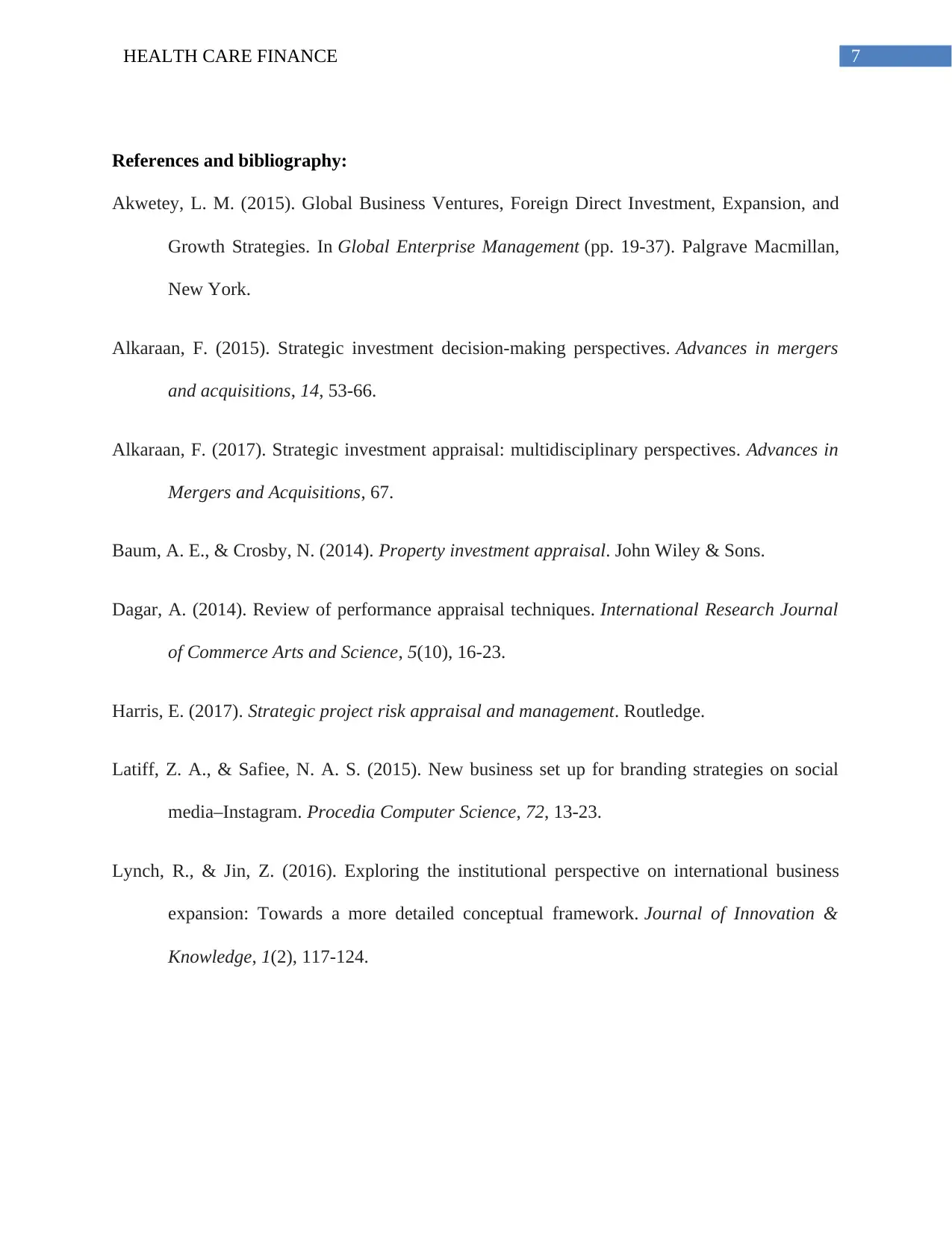
Akwetey, L. M. (2015). Global Business Ventures, Foreign Direct Investment, Expansion, and
Growth Strategies. In Global Enterprise Management (pp. 19-37). Palgrave Macmillan,
New York.
Alkaraan, F. (2015). Strategic investment decision-making perspectives. Advances in mergers
and acquisitions, 14, 53-66.
Alkaraan, F. (2017). Strategic investment appraisal: multidisciplinary perspectives. Advances in
Mergers and Acquisitions, 67.
Baum, A. E., & Crosby, N. (2014). Property investment appraisal. John Wiley & Sons.
Dagar, A. (2014). Review of performance appraisal techniques. International Research Journal
of Commerce Arts and Science, 5(10), 16-23.
Harris, E. (2017). Strategic project risk appraisal and management. Routledge.
Latiff, Z. A., & Safiee, N. A. S. (2015). New business set up for branding strategies on social
media–Instagram. Procedia Computer Science, 72, 13-23.
Lynch, R., & Jin, Z. (2016). Exploring the institutional perspective on international business
expansion: Towards a more detailed conceptual framework. Journal of Innovation &
Knowledge, 1(2), 117-124.
References and bibliography:
Akwetey, L. M. (2015). Global Business Ventures, Foreign Direct Investment, Expansion, and
Growth Strategies. In Global Enterprise Management (pp. 19-37). Palgrave Macmillan,
New York.
Alkaraan, F. (2015). Strategic investment decision-making perspectives. Advances in mergers
and acquisitions, 14, 53-66.
Alkaraan, F. (2017). Strategic investment appraisal: multidisciplinary perspectives. Advances in
Mergers and Acquisitions, 67.
Baum, A. E., & Crosby, N. (2014). Property investment appraisal. John Wiley & Sons.
Dagar, A. (2014). Review of performance appraisal techniques. International Research Journal
of Commerce Arts and Science, 5(10), 16-23.
Harris, E. (2017). Strategic project risk appraisal and management. Routledge.
Latiff, Z. A., & Safiee, N. A. S. (2015). New business set up for branding strategies on social
media–Instagram. Procedia Computer Science, 72, 13-23.
Lynch, R., & Jin, Z. (2016). Exploring the institutional perspective on international business
expansion: Towards a more detailed conceptual framework. Journal of Innovation &
Knowledge, 1(2), 117-124.
1 out of 8
Related Documents
Your All-in-One AI-Powered Toolkit for Academic Success.
+13062052269
info@desklib.com
Available 24*7 on WhatsApp / Email
Unlock your academic potential
Copyright © 2020–2026 A2Z Services. All Rights Reserved. Developed and managed by ZUCOL.