UNCC300: Op-Ed on Healthcare Funding Challenges & Common Good
VerifiedAdded on 2023/06/10
|6
|1275
|184
Essay
AI Summary
This essay critically analyzes the challenges in realizing the aspirations of the common good within the Australian healthcare system, focusing on inadequate funding. It highlights the disparities in healthcare access, particularly for older adults and indigenous populations like the Torres Strait Islanders, and how these inequalities undermine the principles of the common good. The essay references Australia's Intergenerational Report and CEDA's concerns about sustainable healthcare funding. It also draws global comparisons, noting funding issues in the UK's mental health services and the impact of the Affordable Care Act in the USA. The author emphasizes that achieving equitable healthcare requires collective effort and addressing the social determinants of health, while also acknowledging the strain on healthcare professionals due to limited resources. Desklib provides a platform for students to access similar essays and study resources.
Running head: OPINION EDITORIAL
Opinion Editorial
Name of the Student
Name of the University
Author Note
Opinion Editorial
Name of the Student
Name of the University
Author Note
Paraphrase This Document
Need a fresh take? Get an instant paraphrase of this document with our AI Paraphraser

1
OPINION EDITORIAL
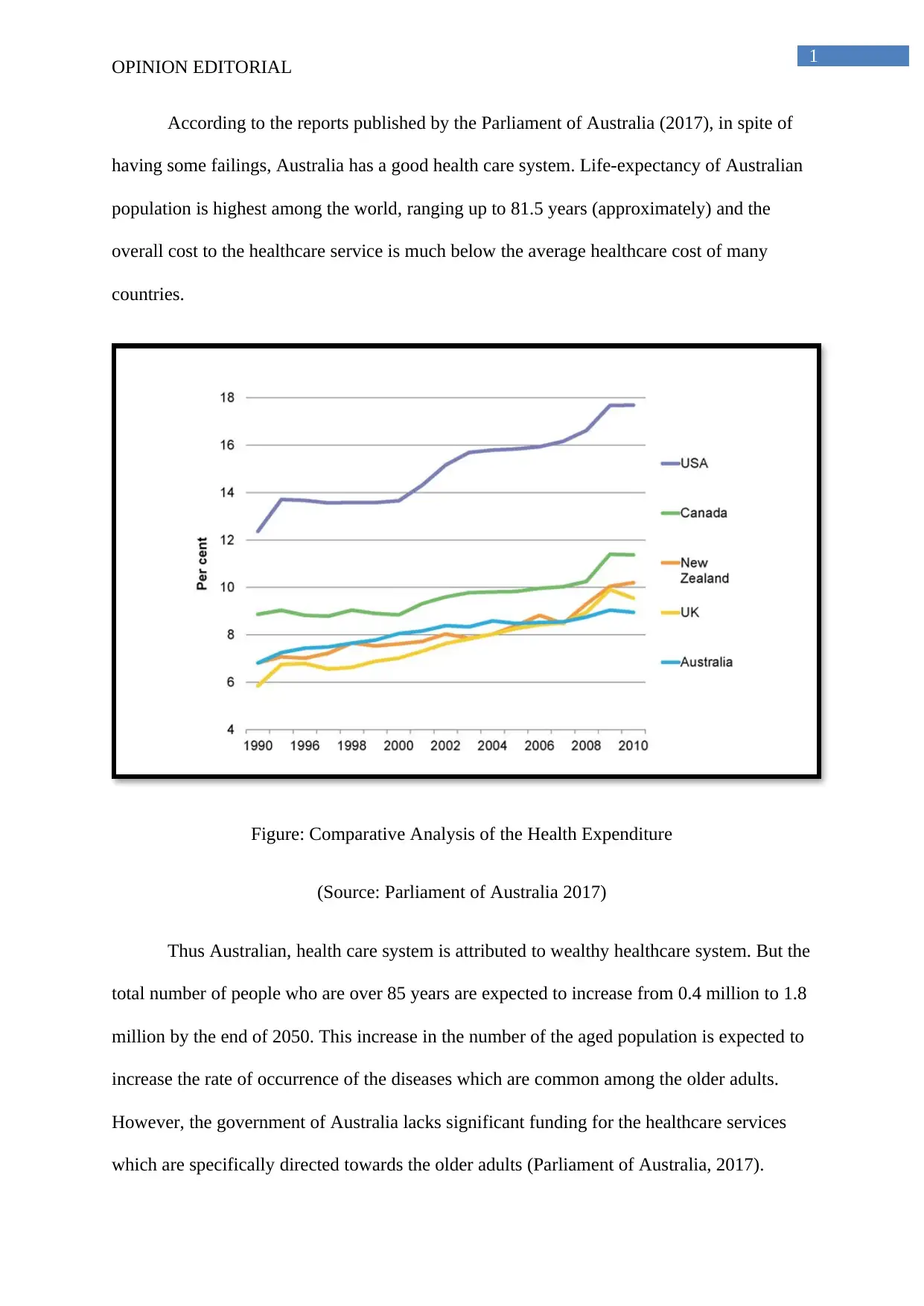
According to the reports published by the Parliament of Australia (2017), in spite of
having some failings, Australia has a good health care system. Life-expectancy of Australian
population is highest among the world, ranging up to 81.5 years (approximately) and the
overall cost to the healthcare service is much below the average healthcare cost of many
countries.
Figure: Comparative Analysis of the Health Expenditure
(Source: Parliament of Australia 2017)
Thus Australian, health care system is attributed to wealthy healthcare system. But the
total number of people who are over 85 years are expected to increase from 0.4 million to 1.8
million by the end of 2050. This increase in the number of the aged population is expected to
increase the rate of occurrence of the diseases which are common among the older adults.
However, the government of Australia lacks significant funding for the healthcare services
which are specifically directed towards the older adults (Parliament of Australia, 2017).
OPINION EDITORIAL
According to the reports published by the Parliament of Australia (2017), in spite of
having some failings, Australia has a good health care system. Life-expectancy of Australian
population is highest among the world, ranging up to 81.5 years (approximately) and the
overall cost to the healthcare service is much below the average healthcare cost of many
countries.
Figure: Comparative Analysis of the Health Expenditure
(Source: Parliament of Australia 2017)
Thus Australian, health care system is attributed to wealthy healthcare system. But the
total number of people who are over 85 years are expected to increase from 0.4 million to 1.8
million by the end of 2050. This increase in the number of the aged population is expected to
increase the rate of occurrence of the diseases which are common among the older adults.
However, the government of Australia lacks significant funding for the healthcare services
which are specifically directed towards the older adults (Parliament of Australia, 2017).

2
OPINION EDITORIAL
Treasury’s Intergenerational Report as published on 2010 by common Wealth of
Australia estimated that expenditure on healthcare by government of Australia as a
percentage of GDP must be doubled by 2050. But the Committee for Economic Development
of Australia (CEDA) highlighted that the present health care funding in Australia is not
sustainable. Though the concept of proposed by CEDA covers one aspect of common good
but fails to cover other aspects of common good.
The catholic social thought of common good is of the opinion that life is cannot be
lived in isolation but via the formation of healthy communities (Australian Catholic Social
Justice Council, 2017). Under this formation of healthy community, every person is required
to contribute while sharing mutual benefits. But in order to generate equitable funding only
the governmental bodies are pressurised. This is hampering the understanding of the common
good. The approach must be undertaken in such a way that every individual must come
forward in order to take a significant step towards fund raising towards equitable access to
the health care (Massaro, 2015).
Common good also promotes the establishment of set of right and duties so that the
minimum standards in quality of life can be achieved (Novak, 2017). But under the
perspective of the Australian healthcare system, it is reviewed that, there is growing burden
for chronic illness and there is a significant gap in the health care funding for the indigenous
group of population residing in Australia. This is generating health inequalities (Donato&
Segal, 2013). According to Uphoff et al. (2013), in spite of the active approach undertaken by
the government of Australia, there is prominent health inequality among the indigenous
population residing in Australia like Torres Strait Islander. This main reason behind this is
lack of equilibrium in the social determinants of health. This disequilibrium in the social
determinants of health among the indigenous population is hampering the principle of the
common good. Here though the fund is being raised to address the health care needs of the
OPINION EDITORIAL
Treasury’s Intergenerational Report as published on 2010 by common Wealth of
Australia estimated that expenditure on healthcare by government of Australia as a
percentage of GDP must be doubled by 2050. But the Committee for Economic Development
of Australia (CEDA) highlighted that the present health care funding in Australia is not
sustainable. Though the concept of proposed by CEDA covers one aspect of common good
but fails to cover other aspects of common good.
The catholic social thought of common good is of the opinion that life is cannot be
lived in isolation but via the formation of healthy communities (Australian Catholic Social
Justice Council, 2017). Under this formation of healthy community, every person is required
to contribute while sharing mutual benefits. But in order to generate equitable funding only
the governmental bodies are pressurised. This is hampering the understanding of the common
good. The approach must be undertaken in such a way that every individual must come
forward in order to take a significant step towards fund raising towards equitable access to
the health care (Massaro, 2015).
Common good also promotes the establishment of set of right and duties so that the
minimum standards in quality of life can be achieved (Novak, 2017). But under the
perspective of the Australian healthcare system, it is reviewed that, there is growing burden
for chronic illness and there is a significant gap in the health care funding for the indigenous
group of population residing in Australia. This is generating health inequalities (Donato&
Segal, 2013). According to Uphoff et al. (2013), in spite of the active approach undertaken by
the government of Australia, there is prominent health inequality among the indigenous
population residing in Australia like Torres Strait Islander. This main reason behind this is
lack of equilibrium in the social determinants of health. This disequilibrium in the social
determinants of health among the indigenous population is hampering the principle of the
common good. Here though the fund is being raised to address the health care needs of the
⊘ This is a preview!⊘
Do you want full access?
Subscribe today to unlock all pages.

Trusted by 1+ million students worldwide

3
OPINION EDITORIAL
older and the young adults in the indigenous group of population, those funds are not
effectively channelized.
Globally, there is also lack of proper funding in the healthcare sectors. Under this lack
of adequate funding, apart from the service users, the nursing professionals also face extreme
challenges. Due to the lack of adequate funding, the nursing professionals are required to
work under the availability of the resources. This limited availability of resources hampers
the overall process of care giving process and thereby hampering the concept of common
good (Lowe, Plummer & Boyd, 2013). In UK physical health services receive proper budgets
but lags behind in mental healthcare services. Improper funding in mental health in UK is
causing slow growth in the overall mental health status (The Guardian, 2018). Globally it is
seen that the lack of availability of the resources help to increase the team bonding among the
healthcare professionals and thereby helping them to work under stringent condition under
limited availability of resources. This team bonding helps to fetch outcomes during rush
hours (McInnes et al., 2015). According to Page (2014), under the global context also proper
availability of funding and resources is mandatory in order to uplift the overall quality of care
and thereby enhancing the concept of common good. In USA the Affordable Care Act had
ensured affordable healthcare insurance to a diverse group of population under negligible
premium and this is causing upliftment of the overall healthcare (HealthCare.gov, 2016). This
is because, under proper funding advanced technological advancement can be introduced into
the healthcare system.
OPINION EDITORIAL
older and the young adults in the indigenous group of population, those funds are not
effectively channelized.
Globally, there is also lack of proper funding in the healthcare sectors. Under this lack
of adequate funding, apart from the service users, the nursing professionals also face extreme
challenges. Due to the lack of adequate funding, the nursing professionals are required to
work under the availability of the resources. This limited availability of resources hampers
the overall process of care giving process and thereby hampering the concept of common
good (Lowe, Plummer & Boyd, 2013). In UK physical health services receive proper budgets
but lags behind in mental healthcare services. Improper funding in mental health in UK is
causing slow growth in the overall mental health status (The Guardian, 2018). Globally it is
seen that the lack of availability of the resources help to increase the team bonding among the
healthcare professionals and thereby helping them to work under stringent condition under
limited availability of resources. This team bonding helps to fetch outcomes during rush
hours (McInnes et al., 2015). According to Page (2014), under the global context also proper
availability of funding and resources is mandatory in order to uplift the overall quality of care
and thereby enhancing the concept of common good. In USA the Affordable Care Act had
ensured affordable healthcare insurance to a diverse group of population under negligible
premium and this is causing upliftment of the overall healthcare (HealthCare.gov, 2016). This
is because, under proper funding advanced technological advancement can be introduced into
the healthcare system.
Paraphrase This Document
Need a fresh take? Get an instant paraphrase of this document with our AI Paraphraser

4
OPINION EDITORIAL
Reference
Australian Catholic Social Justice Council. (2017). Catholic Social Teaching. Retrieved
from: http://www.socialjustice.catholic.org.au/social-teaching
Common Wealth of Australia. (2010). Australia to 2050: future challenges. Access date: 2nd
July 2018. Retrieved from:
http://www.health.gov.au/internet/main/publishing.nsf/content/mental-pubs-n-
servst10
Donato, R., & Segal, L. (2013). Does Australia have the appropriate health reform agenda to
close the gap in Indigenous health?. Australian Health Review, 37(2), 232-238.
http://archive.treasury.gov.au/igr/igr2010/report/pdf/IGR_2010.pdf
Lowe, G., Plummer, V., & Boyd, L. (2013).Nurse practitioner roles in Australian healthcare
settings. Nursing Management, 20(2).
Massaro, T. (2015). Living justice: Catholic social teaching in action.Rowman& Littlefield.
McInnes, S., Peters, K., Bonney, A., &Halcomb, E. (2015). An integrative review of
facilitators and barriers influencing collaboration and teamwork between general
practitioners and nurses working in general practice. Journal of advanced
nursing, 71(9), 1973-1985.
Novak, M. (2017). Catholic Social Thought and Liberal Institutions: Freedom with Justice.
Routledge.
Page, T. (2014). Notions of innovation in healthcare services and products. International
Journal of Innovation and Sustainable Development, 8(3), 217-231.
OPINION EDITORIAL
Reference
Australian Catholic Social Justice Council. (2017). Catholic Social Teaching. Retrieved
from: http://www.socialjustice.catholic.org.au/social-teaching
Common Wealth of Australia. (2010). Australia to 2050: future challenges. Access date: 2nd
July 2018. Retrieved from:
http://www.health.gov.au/internet/main/publishing.nsf/content/mental-pubs-n-
servst10
Donato, R., & Segal, L. (2013). Does Australia have the appropriate health reform agenda to
close the gap in Indigenous health?. Australian Health Review, 37(2), 232-238.
http://archive.treasury.gov.au/igr/igr2010/report/pdf/IGR_2010.pdf
Lowe, G., Plummer, V., & Boyd, L. (2013).Nurse practitioner roles in Australian healthcare
settings. Nursing Management, 20(2).
Massaro, T. (2015). Living justice: Catholic social teaching in action.Rowman& Littlefield.
McInnes, S., Peters, K., Bonney, A., &Halcomb, E. (2015). An integrative review of
facilitators and barriers influencing collaboration and teamwork between general
practitioners and nurses working in general practice. Journal of advanced
nursing, 71(9), 1973-1985.
Novak, M. (2017). Catholic Social Thought and Liberal Institutions: Freedom with Justice.
Routledge.
Page, T. (2014). Notions of innovation in healthcare services and products. International
Journal of Innovation and Sustainable Development, 8(3), 217-231.

5
OPINION EDITORIAL
Parliament of Australia. (2017). Sustainable funding of health care: challenges ahead. Access
date: 2nd July 2018. Retrieved from:
https://www.aph.gov.au/About_Parliament/Parliamentary_Departments/
Parliamentary_Library/pubs/BriefingBook44p/FundingHealthCare
Uphoff, E. P., Pickett, K. E., Cabieses, B., Small, N., & Wright, J. (2013). A systematic
review of the relationships between social capital and socioeconomic inequalities in
health: a contribution to understanding the psychosocial pathway of health
inequalities. International journal for equity in health, 12(1), 54.
The Guardian. (2018). Mental health still losing out in NHS funding., Access date:
09.07.2018. Retrieved from:
https://www.theguardian.com/society/2018/jan/16/mental-health-still-losing-out-in-
nhs-funding-report-finds
HealthCare.gov. (2016). Affordable Care Act (ACA). Access date: 09.07.2018. Retrieved
from: https://www.healthcare.gov/glossary/affordable-care-act/
OPINION EDITORIAL
Parliament of Australia. (2017). Sustainable funding of health care: challenges ahead. Access
date: 2nd July 2018. Retrieved from:
https://www.aph.gov.au/About_Parliament/Parliamentary_Departments/
Parliamentary_Library/pubs/BriefingBook44p/FundingHealthCare
Uphoff, E. P., Pickett, K. E., Cabieses, B., Small, N., & Wright, J. (2013). A systematic
review of the relationships between social capital and socioeconomic inequalities in
health: a contribution to understanding the psychosocial pathway of health
inequalities. International journal for equity in health, 12(1), 54.
The Guardian. (2018). Mental health still losing out in NHS funding., Access date:
09.07.2018. Retrieved from:
https://www.theguardian.com/society/2018/jan/16/mental-health-still-losing-out-in-
nhs-funding-report-finds
HealthCare.gov. (2016). Affordable Care Act (ACA). Access date: 09.07.2018. Retrieved
from: https://www.healthcare.gov/glossary/affordable-care-act/
⊘ This is a preview!⊘
Do you want full access?
Subscribe today to unlock all pages.

Trusted by 1+ million students worldwide
1 out of 6
Related Documents
Your All-in-One AI-Powered Toolkit for Academic Success.
+13062052269
info@desklib.com
Available 24*7 on WhatsApp / Email
Unlock your academic potential
Copyright © 2020–2026 A2Z Services. All Rights Reserved. Developed and managed by ZUCOL.