Integration Strategies: Sunrise Senior Living and Cleveland Clinic
VerifiedAdded on 2020/02/18
|6
|1307
|288
Report
AI Summary
This report examines the integration strategies of two healthcare organizations: Sunrise Senior Living (horizontal integration) and Cleveland Clinic (vertical integration). The report analyzes the rationale behind each organization's integration approach, highlighting factors such as growth and competitiveness. It explores the business and healthcare-related implications of these strategies, including market expansion, economies of scale, improved patient care, and enhanced supply chain coordination. The analysis covers the benefits and potential challenges associated with each integration model, providing insights into how these strategies impact operations, financial valuation, and the overall healthcare landscape. The report uses the provided sources to support the analysis, offering a comprehensive overview of the integration strategies employed by these two leading healthcare providers.

1
Running Head: INTEGRATION
Integration
Student’s Name
Institution
Running Head: INTEGRATION
Integration
Student’s Name
Institution
Paraphrase This Document
Need a fresh take? Get an instant paraphrase of this document with our AI Paraphraser

2
INTEGRATION
Integration
Horizontally integrated system and vertically integrated health system
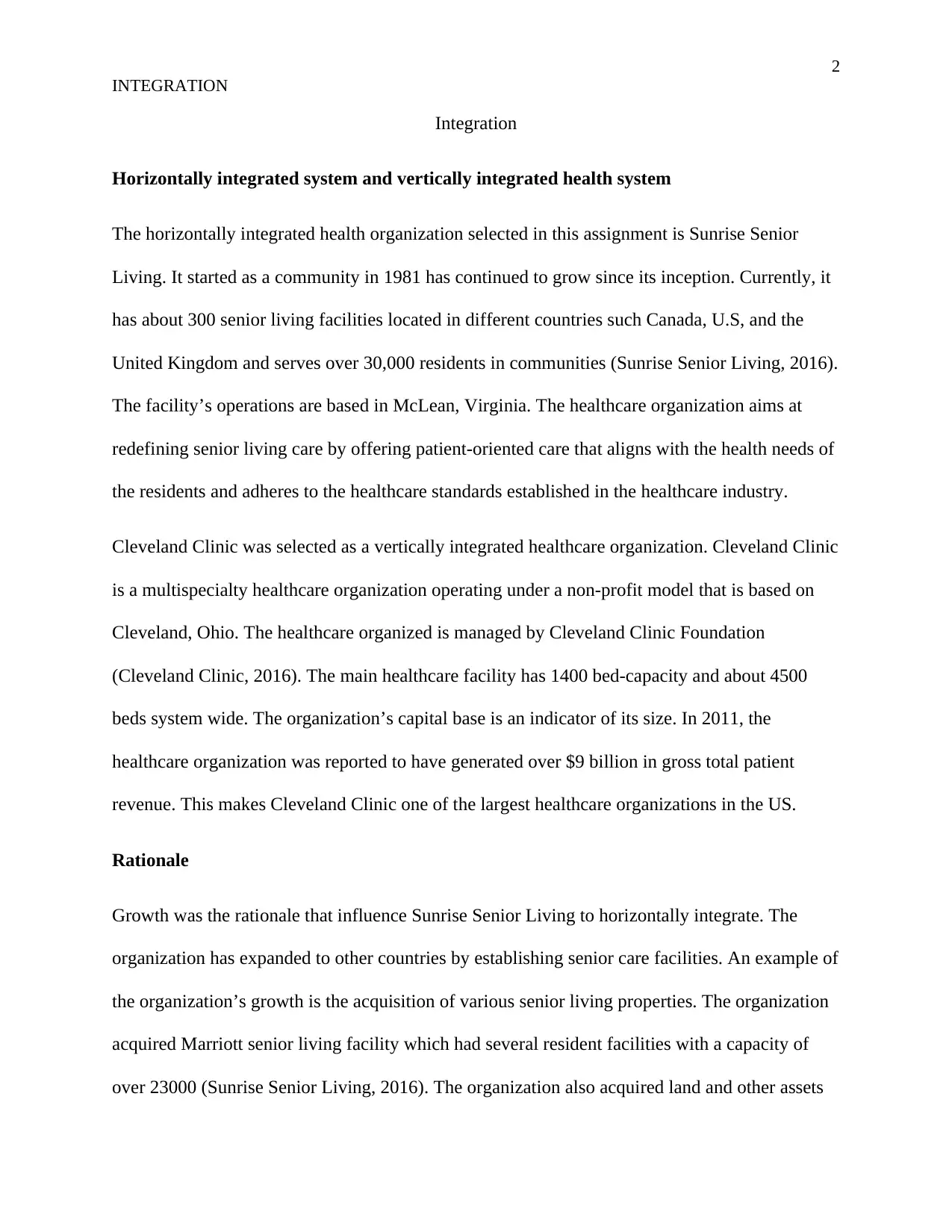
The horizontally integrated health organization selected in this assignment is Sunrise Senior
Living. It started as a community in 1981 has continued to grow since its inception. Currently, it
has about 300 senior living facilities located in different countries such Canada, U.S, and the
United Kingdom and serves over 30,000 residents in communities (Sunrise Senior Living, 2016).
The facility’s operations are based in McLean, Virginia. The healthcare organization aims at
redefining senior living care by offering patient-oriented care that aligns with the health needs of
the residents and adheres to the healthcare standards established in the healthcare industry.
Cleveland Clinic was selected as a vertically integrated healthcare organization. Cleveland Clinic
is a multispecialty healthcare organization operating under a non-profit model that is based on
Cleveland, Ohio. The healthcare organized is managed by Cleveland Clinic Foundation
(Cleveland Clinic, 2016). The main healthcare facility has 1400 bed-capacity and about 4500
beds system wide. The organization’s capital base is an indicator of its size. In 2011, the
healthcare organization was reported to have generated over $9 billion in gross total patient
revenue. This makes Cleveland Clinic one of the largest healthcare organizations in the US.
Rationale
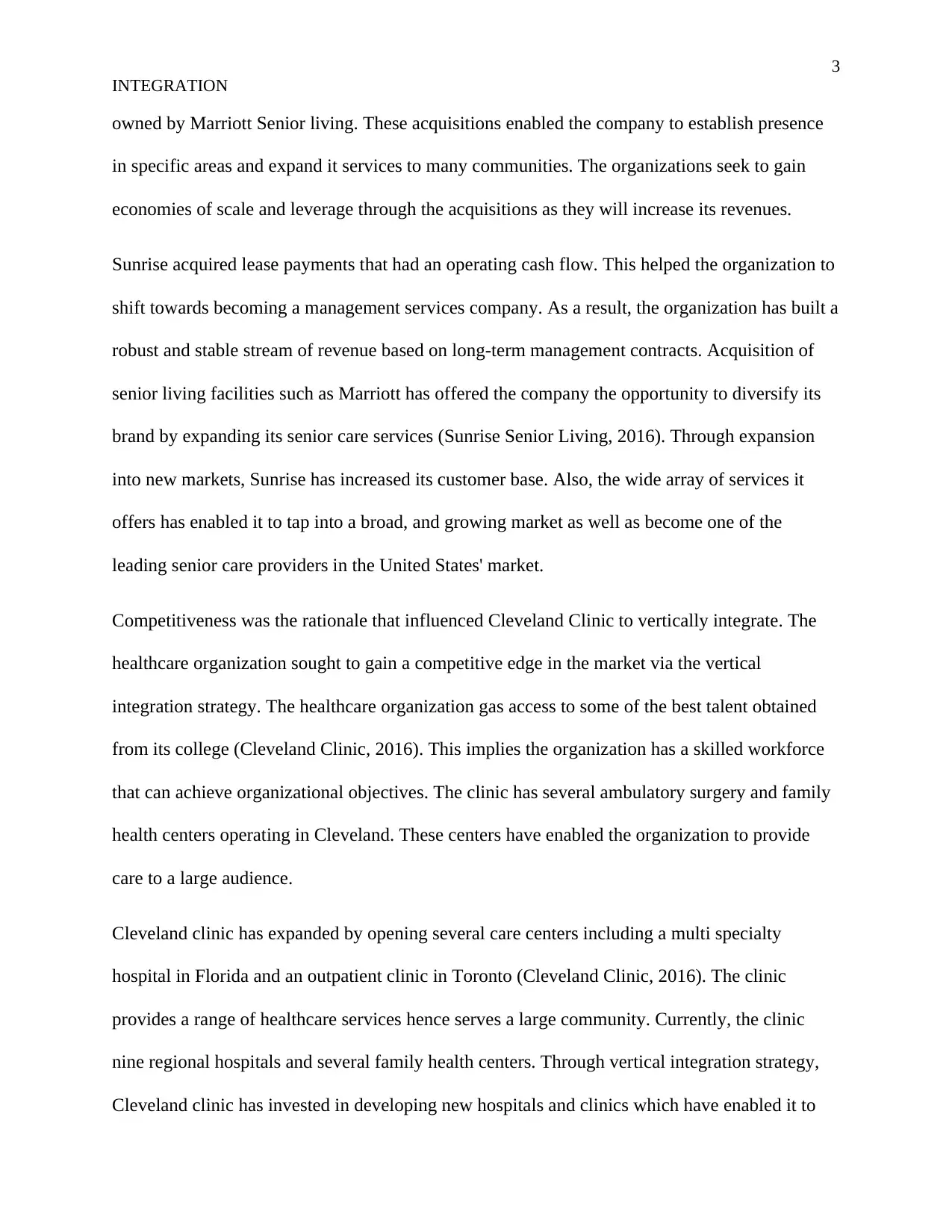
Growth was the rationale that influence Sunrise Senior Living to horizontally integrate. The
organization has expanded to other countries by establishing senior care facilities. An example of
the organization’s growth is the acquisition of various senior living properties. The organization
acquired Marriott senior living facility which had several resident facilities with a capacity of
over 23000 (Sunrise Senior Living, 2016). The organization also acquired land and other assets
INTEGRATION
Integration
Horizontally integrated system and vertically integrated health system
The horizontally integrated health organization selected in this assignment is Sunrise Senior
Living. It started as a community in 1981 has continued to grow since its inception. Currently, it
has about 300 senior living facilities located in different countries such Canada, U.S, and the
United Kingdom and serves over 30,000 residents in communities (Sunrise Senior Living, 2016).
The facility’s operations are based in McLean, Virginia. The healthcare organization aims at
redefining senior living care by offering patient-oriented care that aligns with the health needs of
the residents and adheres to the healthcare standards established in the healthcare industry.
Cleveland Clinic was selected as a vertically integrated healthcare organization. Cleveland Clinic
is a multispecialty healthcare organization operating under a non-profit model that is based on
Cleveland, Ohio. The healthcare organized is managed by Cleveland Clinic Foundation
(Cleveland Clinic, 2016). The main healthcare facility has 1400 bed-capacity and about 4500
beds system wide. The organization’s capital base is an indicator of its size. In 2011, the
healthcare organization was reported to have generated over $9 billion in gross total patient
revenue. This makes Cleveland Clinic one of the largest healthcare organizations in the US.
Rationale
Growth was the rationale that influence Sunrise Senior Living to horizontally integrate. The
organization has expanded to other countries by establishing senior care facilities. An example of
the organization’s growth is the acquisition of various senior living properties. The organization
acquired Marriott senior living facility which had several resident facilities with a capacity of
over 23000 (Sunrise Senior Living, 2016). The organization also acquired land and other assets

3
INTEGRATION
owned by Marriott Senior living. These acquisitions enabled the company to establish presence
in specific areas and expand it services to many communities. The organizations seek to gain
economies of scale and leverage through the acquisitions as they will increase its revenues.
Sunrise acquired lease payments that had an operating cash flow. This helped the organization to
shift towards becoming a management services company. As a result, the organization has built a
robust and stable stream of revenue based on long-term management contracts. Acquisition of
senior living facilities such as Marriott has offered the company the opportunity to diversify its
brand by expanding its senior care services (Sunrise Senior Living, 2016). Through expansion
into new markets, Sunrise has increased its customer base. Also, the wide array of services it
offers has enabled it to tap into a broad, and growing market as well as become one of the
leading senior care providers in the United States' market.
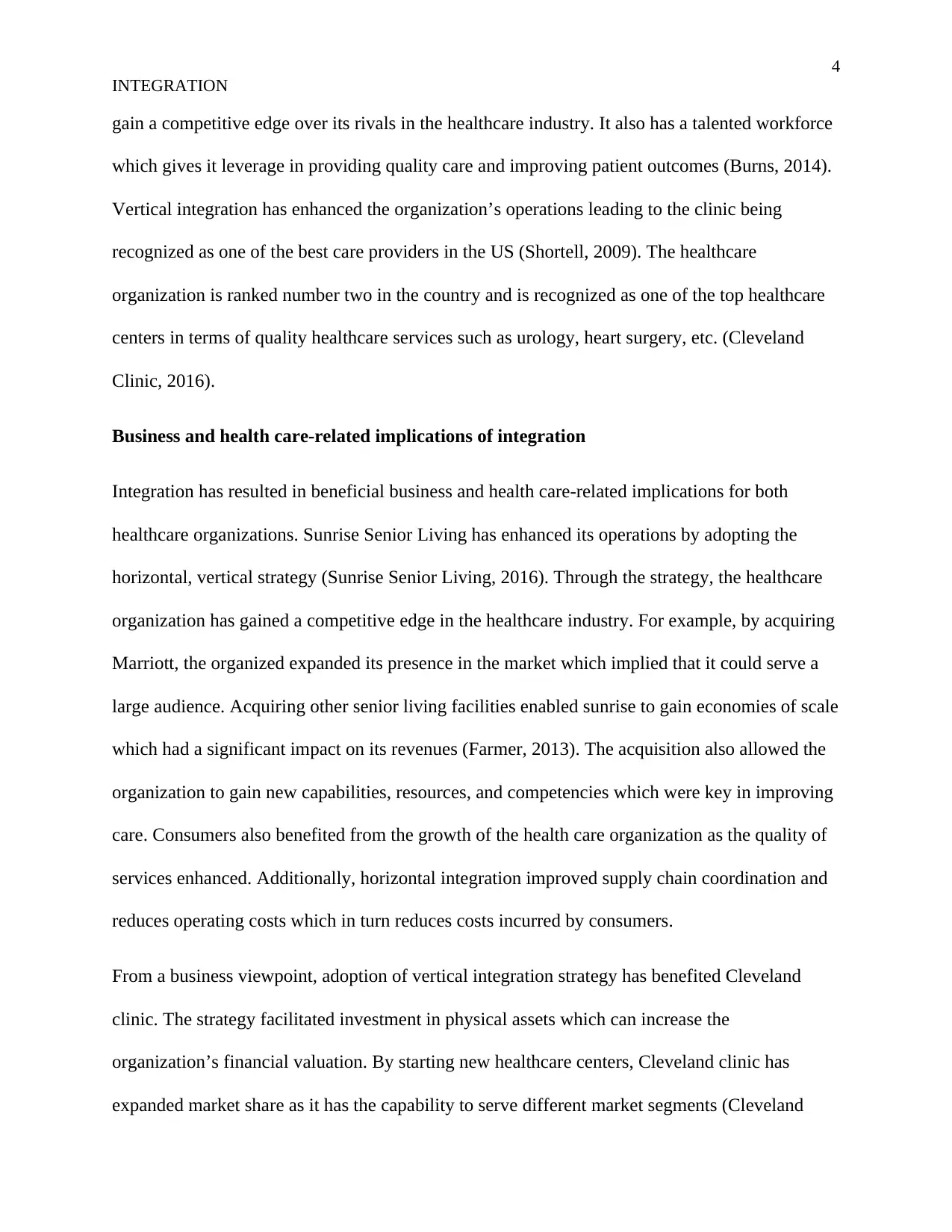
Competitiveness was the rationale that influenced Cleveland Clinic to vertically integrate. The
healthcare organization sought to gain a competitive edge in the market via the vertical
integration strategy. The healthcare organization gas access to some of the best talent obtained
from its college (Cleveland Clinic, 2016). This implies the organization has a skilled workforce
that can achieve organizational objectives. The clinic has several ambulatory surgery and family
health centers operating in Cleveland. These centers have enabled the organization to provide
care to a large audience.
Cleveland clinic has expanded by opening several care centers including a multi specialty
hospital in Florida and an outpatient clinic in Toronto (Cleveland Clinic, 2016). The clinic
provides a range of healthcare services hence serves a large community. Currently, the clinic
nine regional hospitals and several family health centers. Through vertical integration strategy,
Cleveland clinic has invested in developing new hospitals and clinics which have enabled it to
INTEGRATION
owned by Marriott Senior living. These acquisitions enabled the company to establish presence
in specific areas and expand it services to many communities. The organizations seek to gain
economies of scale and leverage through the acquisitions as they will increase its revenues.
Sunrise acquired lease payments that had an operating cash flow. This helped the organization to
shift towards becoming a management services company. As a result, the organization has built a
robust and stable stream of revenue based on long-term management contracts. Acquisition of
senior living facilities such as Marriott has offered the company the opportunity to diversify its
brand by expanding its senior care services (Sunrise Senior Living, 2016). Through expansion
into new markets, Sunrise has increased its customer base. Also, the wide array of services it
offers has enabled it to tap into a broad, and growing market as well as become one of the
leading senior care providers in the United States' market.
Competitiveness was the rationale that influenced Cleveland Clinic to vertically integrate. The
healthcare organization sought to gain a competitive edge in the market via the vertical
integration strategy. The healthcare organization gas access to some of the best talent obtained
from its college (Cleveland Clinic, 2016). This implies the organization has a skilled workforce
that can achieve organizational objectives. The clinic has several ambulatory surgery and family
health centers operating in Cleveland. These centers have enabled the organization to provide
care to a large audience.
Cleveland clinic has expanded by opening several care centers including a multi specialty
hospital in Florida and an outpatient clinic in Toronto (Cleveland Clinic, 2016). The clinic
provides a range of healthcare services hence serves a large community. Currently, the clinic
nine regional hospitals and several family health centers. Through vertical integration strategy,
Cleveland clinic has invested in developing new hospitals and clinics which have enabled it to
⊘ This is a preview!⊘
Do you want full access?
Subscribe today to unlock all pages.

Trusted by 1+ million students worldwide

4
INTEGRATION
gain a competitive edge over its rivals in the healthcare industry. It also has a talented workforce
which gives it leverage in providing quality care and improving patient outcomes (Burns, 2014).
Vertical integration has enhanced the organization’s operations leading to the clinic being
recognized as one of the best care providers in the US (Shortell, 2009). The healthcare
organization is ranked number two in the country and is recognized as one of the top healthcare
centers in terms of quality healthcare services such as urology, heart surgery, etc. (Cleveland
Clinic, 2016).
Business and health care-related implications of integration
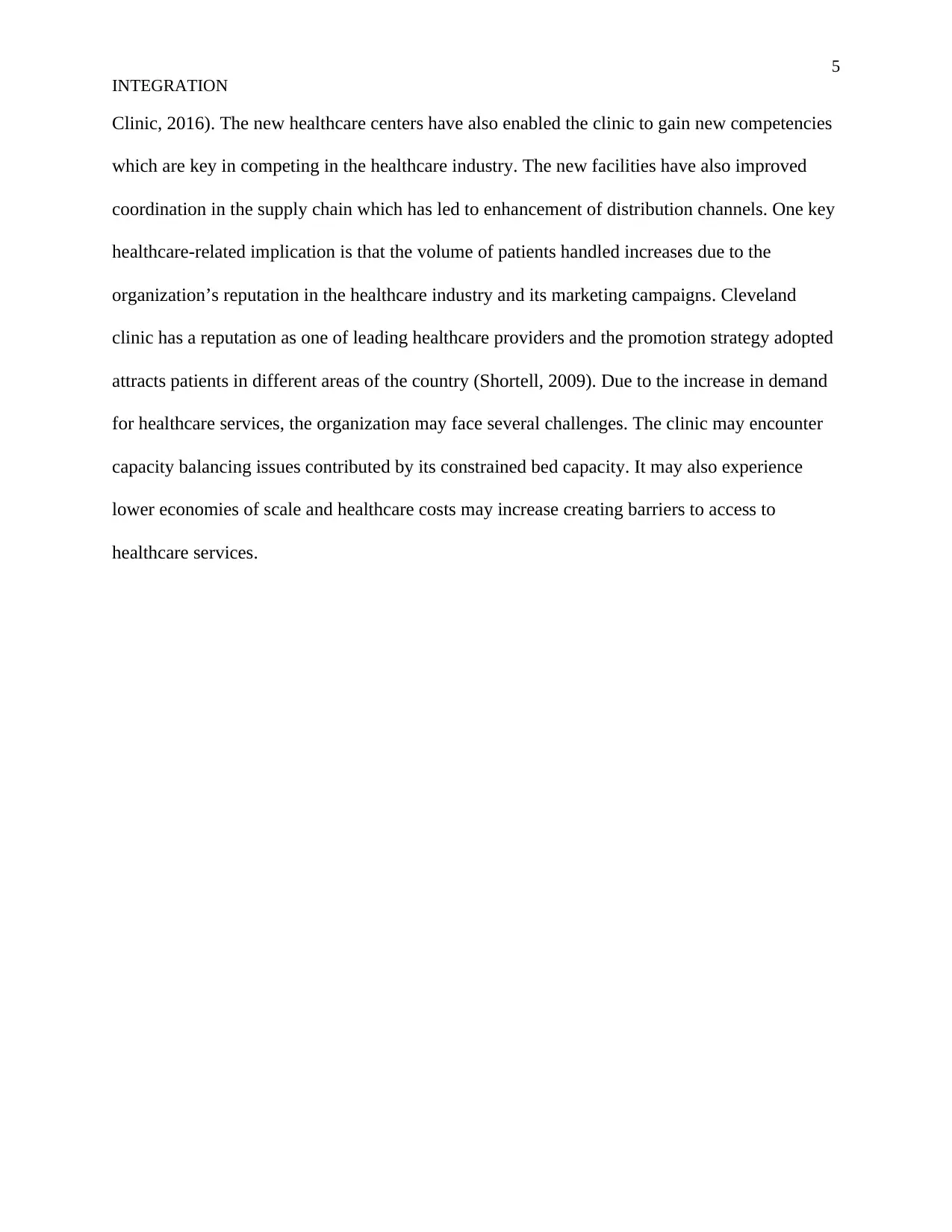
Integration has resulted in beneficial business and health care-related implications for both
healthcare organizations. Sunrise Senior Living has enhanced its operations by adopting the
horizontal, vertical strategy (Sunrise Senior Living, 2016). Through the strategy, the healthcare
organization has gained a competitive edge in the healthcare industry. For example, by acquiring
Marriott, the organized expanded its presence in the market which implied that it could serve a
large audience. Acquiring other senior living facilities enabled sunrise to gain economies of scale
which had a significant impact on its revenues (Farmer, 2013). The acquisition also allowed the
organization to gain new capabilities, resources, and competencies which were key in improving
care. Consumers also benefited from the growth of the health care organization as the quality of
services enhanced. Additionally, horizontal integration improved supply chain coordination and
reduces operating costs which in turn reduces costs incurred by consumers.
From a business viewpoint, adoption of vertical integration strategy has benefited Cleveland
clinic. The strategy facilitated investment in physical assets which can increase the
organization’s financial valuation. By starting new healthcare centers, Cleveland clinic has
expanded market share as it has the capability to serve different market segments (Cleveland
INTEGRATION
gain a competitive edge over its rivals in the healthcare industry. It also has a talented workforce
which gives it leverage in providing quality care and improving patient outcomes (Burns, 2014).
Vertical integration has enhanced the organization’s operations leading to the clinic being
recognized as one of the best care providers in the US (Shortell, 2009). The healthcare
organization is ranked number two in the country and is recognized as one of the top healthcare
centers in terms of quality healthcare services such as urology, heart surgery, etc. (Cleveland
Clinic, 2016).
Business and health care-related implications of integration
Integration has resulted in beneficial business and health care-related implications for both
healthcare organizations. Sunrise Senior Living has enhanced its operations by adopting the
horizontal, vertical strategy (Sunrise Senior Living, 2016). Through the strategy, the healthcare
organization has gained a competitive edge in the healthcare industry. For example, by acquiring
Marriott, the organized expanded its presence in the market which implied that it could serve a
large audience. Acquiring other senior living facilities enabled sunrise to gain economies of scale
which had a significant impact on its revenues (Farmer, 2013). The acquisition also allowed the
organization to gain new capabilities, resources, and competencies which were key in improving
care. Consumers also benefited from the growth of the health care organization as the quality of
services enhanced. Additionally, horizontal integration improved supply chain coordination and
reduces operating costs which in turn reduces costs incurred by consumers.
From a business viewpoint, adoption of vertical integration strategy has benefited Cleveland
clinic. The strategy facilitated investment in physical assets which can increase the
organization’s financial valuation. By starting new healthcare centers, Cleveland clinic has
expanded market share as it has the capability to serve different market segments (Cleveland
Paraphrase This Document
Need a fresh take? Get an instant paraphrase of this document with our AI Paraphraser

5
INTEGRATION
Clinic, 2016). The new healthcare centers have also enabled the clinic to gain new competencies
which are key in competing in the healthcare industry. The new facilities have also improved
coordination in the supply chain which has led to enhancement of distribution channels. One key
healthcare-related implication is that the volume of patients handled increases due to the
organization’s reputation in the healthcare industry and its marketing campaigns. Cleveland
clinic has a reputation as one of leading healthcare providers and the promotion strategy adopted
attracts patients in different areas of the country (Shortell, 2009). Due to the increase in demand
for healthcare services, the organization may face several challenges. The clinic may encounter
capacity balancing issues contributed by its constrained bed capacity. It may also experience
lower economies of scale and healthcare costs may increase creating barriers to access to
healthcare services.
INTEGRATION
Clinic, 2016). The new healthcare centers have also enabled the clinic to gain new competencies
which are key in competing in the healthcare industry. The new facilities have also improved
coordination in the supply chain which has led to enhancement of distribution channels. One key
healthcare-related implication is that the volume of patients handled increases due to the
organization’s reputation in the healthcare industry and its marketing campaigns. Cleveland
clinic has a reputation as one of leading healthcare providers and the promotion strategy adopted
attracts patients in different areas of the country (Shortell, 2009). Due to the increase in demand
for healthcare services, the organization may face several challenges. The clinic may encounter
capacity balancing issues contributed by its constrained bed capacity. It may also experience
lower economies of scale and healthcare costs may increase creating barriers to access to
healthcare services.

6
INTEGRATION
References
Burns, L. R., Goldsmith, J. C., & Sen, A. (2014). Horizontal and vertical integration of physicians: a tale
of two tails. In Annual review of health care management: Revisiting the evolution of health
systems organization (pp. 39-117). Emerald Group Publishing Limited.
Cleveland Clinic. (2016). Retrieved October 12, 2016 from http://my.clevelandclinic.org/
Farmer, K. (2013). Reconnect the aging: residential assisted living for the elders in a Great Plains small
town.
Shortell, S. M., & McCurdy, R. K. (2009). Integrated health systems. Information Knowledge Systems
Management, 8(1-4), 369-382.
Sunrise Senior Living. (2016). Retrieved October 12, 2016 from
https://www.sunriseseniorliving.com/
INTEGRATION
References
Burns, L. R., Goldsmith, J. C., & Sen, A. (2014). Horizontal and vertical integration of physicians: a tale
of two tails. In Annual review of health care management: Revisiting the evolution of health
systems organization (pp. 39-117). Emerald Group Publishing Limited.
Cleveland Clinic. (2016). Retrieved October 12, 2016 from http://my.clevelandclinic.org/
Farmer, K. (2013). Reconnect the aging: residential assisted living for the elders in a Great Plains small
town.
Shortell, S. M., & McCurdy, R. K. (2009). Integrated health systems. Information Knowledge Systems
Management, 8(1-4), 369-382.
Sunrise Senior Living. (2016). Retrieved October 12, 2016 from
https://www.sunriseseniorliving.com/
⊘ This is a preview!⊘
Do you want full access?
Subscribe today to unlock all pages.

Trusted by 1+ million students worldwide
1 out of 6
Related Documents
Your All-in-One AI-Powered Toolkit for Academic Success.
+13062052269
info@desklib.com
Available 24*7 on WhatsApp / Email
Unlock your academic potential
Copyright © 2020–2025 A2Z Services. All Rights Reserved. Developed and managed by ZUCOL.