Analysis of Organisational Behaviour in NHS England: A Report
VerifiedAdded on 2023/06/03
|25
|6899
|474
Report
AI Summary
This report analyzes organisational behaviour within NHS England, examining how personality and situational strength influence employee behaviour. It identifies similarities and differences in cultural values, comparing person-organisation and person-job fit approaches for employee selection. The report defines management, assesses its professionalization, and evaluates the roles and responsibilities of managers. Furthermore, the report explores the nature of decision-making in group settings, clarifying advantages and disadvantages, and critically analyzing the leadership role in this process. The assessment provides insights into managing human resources and improving healthcare services through effective organisational behaviour strategies.
Health care 1
Health and Social Care Management
Health and Social Care Management

Paraphrase This Document
Need a fresh take? Get an instant paraphrase of this document with our AI Paraphraser
Health care 2
Executive summary
There are different circumstances that take place with the employees of an organisation. It is
a matter of fact that people react to different situations. Situations play an important role in
the behaviour of a particular individual. As well as, there are several similarities and
differences in cultural values. In order to management the individuals, it is essential for the
care organizations to have proper understanding about these concerns. The
professionalization for managing things in the organisation is analysed in this assessment.
Responsibilities and roles of the manager in an organisation are assessed in this assessment.
In addition, it is essential for the organizations to consider group decision making for better
outcomes. Group decision making is an effective efforts of improving the capabilities of the
organization. There may be several advantages and disadvantages of group decision making,
but it is essential for the decision makers to consider the group decision making and make
efforts to reduce the disadvantages for the same. In addition, leadership is an effective
managing tool through which the care organizations can manage the human resources in
effective manner and improve the health care services in more professional manner.
Therefore, the management should make efforts to improve the leadership styles to improve
the managerial capabilities in effective manner.
Executive summary
There are different circumstances that take place with the employees of an organisation. It is
a matter of fact that people react to different situations. Situations play an important role in
the behaviour of a particular individual. As well as, there are several similarities and
differences in cultural values. In order to management the individuals, it is essential for the
care organizations to have proper understanding about these concerns. The
professionalization for managing things in the organisation is analysed in this assessment.
Responsibilities and roles of the manager in an organisation are assessed in this assessment.
In addition, it is essential for the organizations to consider group decision making for better
outcomes. Group decision making is an effective efforts of improving the capabilities of the
organization. There may be several advantages and disadvantages of group decision making,
but it is essential for the decision makers to consider the group decision making and make
efforts to reduce the disadvantages for the same. In addition, leadership is an effective
managing tool through which the care organizations can manage the human resources in
effective manner and improve the health care services in more professional manner.
Therefore, the management should make efforts to improve the leadership styles to improve
the managerial capabilities in effective manner.
Health care 3
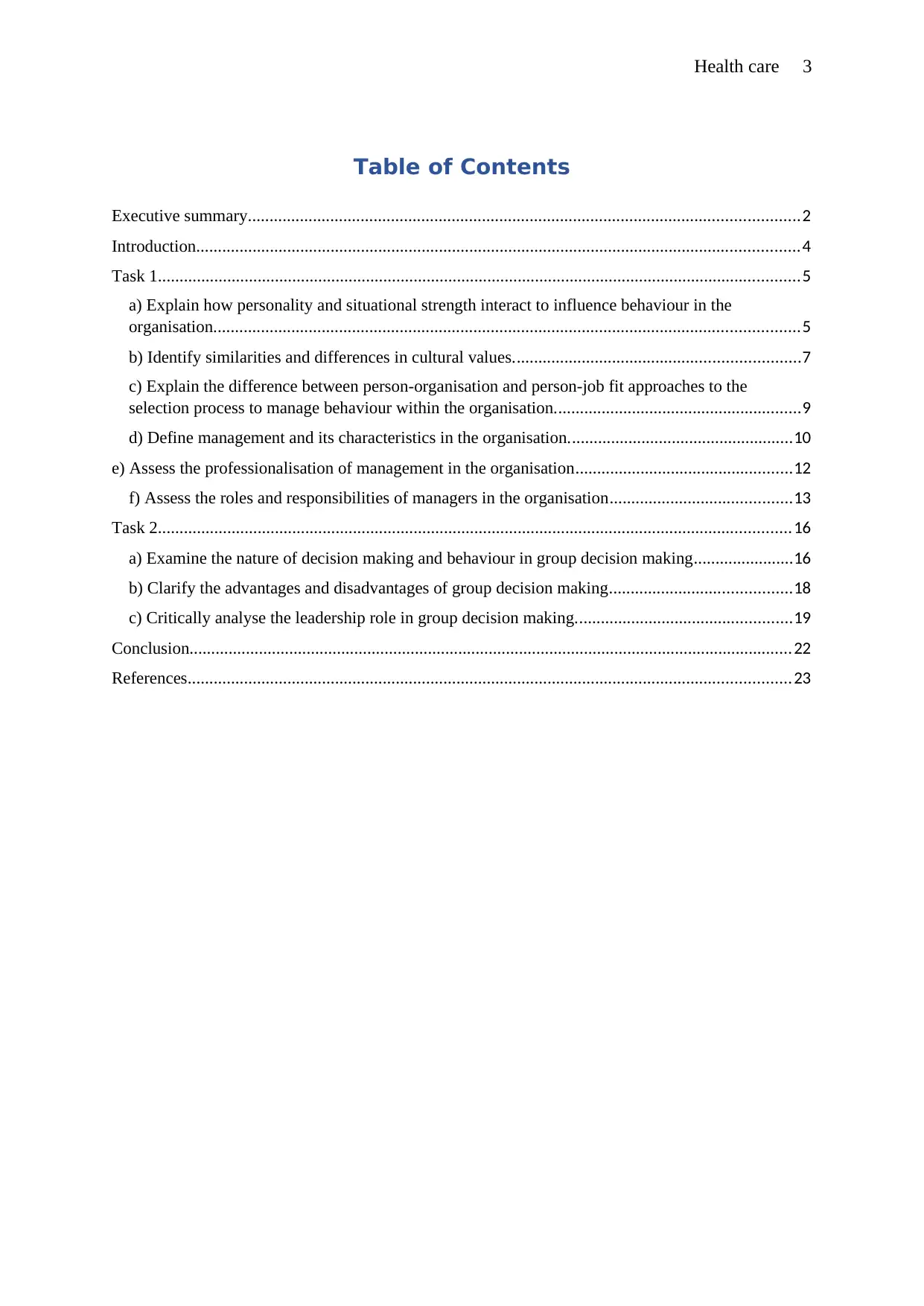
Table of Contents
Executive summary...............................................................................................................................2
Introduction...........................................................................................................................................4
Task 1....................................................................................................................................................5
a) Explain how personality and situational strength interact to influence behaviour in the
organisation.......................................................................................................................................5
b) Identify similarities and differences in cultural values..................................................................7
c) Explain the difference between person-organisation and person-job fit approaches to the
selection process to manage behaviour within the organisation.........................................................9
d) Define management and its characteristics in the organisation....................................................10
e) Assess the professionalisation of management in the organisation..................................................12
f) Assess the roles and responsibilities of managers in the organisation..........................................13
Task 2..................................................................................................................................................16
a) Examine the nature of decision making and behaviour in group decision making.......................16
b) Clarify the advantages and disadvantages of group decision making..........................................18
c) Critically analyse the leadership role in group decision making..................................................19
Conclusion...........................................................................................................................................22
References...........................................................................................................................................23
Table of Contents
Executive summary...............................................................................................................................2
Introduction...........................................................................................................................................4
Task 1....................................................................................................................................................5
a) Explain how personality and situational strength interact to influence behaviour in the
organisation.......................................................................................................................................5
b) Identify similarities and differences in cultural values..................................................................7
c) Explain the difference between person-organisation and person-job fit approaches to the
selection process to manage behaviour within the organisation.........................................................9
d) Define management and its characteristics in the organisation....................................................10
e) Assess the professionalisation of management in the organisation..................................................12
f) Assess the roles and responsibilities of managers in the organisation..........................................13
Task 2..................................................................................................................................................16
a) Examine the nature of decision making and behaviour in group decision making.......................16
b) Clarify the advantages and disadvantages of group decision making..........................................18
c) Critically analyse the leadership role in group decision making..................................................19
Conclusion...........................................................................................................................................22
References...........................................................................................................................................23
⊘ This is a preview!⊘
Do you want full access?
Subscribe today to unlock all pages.

Trusted by 1+ million students worldwide
Health care 4
Introduction
In this assignment, there is the analysis of NHS England. NHS England organisation is the
public funded organisation. This organisation provides free Healthcare medical facility to all
the English residents. The funding for this organisation is possible with the help of general
taxation system of the United Kingdom. Department of health United Kingdom regulates
NHS England. The personality of an individual situation with the individual is having an
impact on the behaviour of a person in the organisation is analysed in this report. The
differences and the similarities in the cultural values followed in NHS England are
understood in this assessment. Different approaches for managing the behaviour of the
organisation is also investigated in this report. Characteristics of Management is having a
crucial role in NHS England is determined in this report. Professionalization for managing
things in the organisation is analysed in this assessment. Responsibilities and roles of the
manager in an organisation are assessed in this assessment. After that, there is analysis
regarding decision making. Pros and cons of group decision making are described in this
assessment. The method that can be used for group decision making is also understood in this
report. For taking the effective decision leadership roles are defined in this assessment.
Introduction
In this assignment, there is the analysis of NHS England. NHS England organisation is the
public funded organisation. This organisation provides free Healthcare medical facility to all
the English residents. The funding for this organisation is possible with the help of general
taxation system of the United Kingdom. Department of health United Kingdom regulates
NHS England. The personality of an individual situation with the individual is having an
impact on the behaviour of a person in the organisation is analysed in this report. The
differences and the similarities in the cultural values followed in NHS England are
understood in this assessment. Different approaches for managing the behaviour of the
organisation is also investigated in this report. Characteristics of Management is having a
crucial role in NHS England is determined in this report. Professionalization for managing
things in the organisation is analysed in this assessment. Responsibilities and roles of the
manager in an organisation are assessed in this assessment. After that, there is analysis
regarding decision making. Pros and cons of group decision making are described in this
assessment. The method that can be used for group decision making is also understood in this
report. For taking the effective decision leadership roles are defined in this assessment.
Paraphrase This Document
Need a fresh take? Get an instant paraphrase of this document with our AI Paraphraser
Health care 5
Task 1
a) Explain how personality and situational strength interact to influence behaviour in
the organisation.
Many circumstances take place with the employees of an organisation. It is a matter of fact
that people react to different situations. Situations play an important role in the behaviour of a
particular individual. This can be understood well with the help of an example. Any person is
in the military or in sports then person will react with aggression. The behaviour of the
person will be aggressive (Shamir & Howell, 2018). The reason behind for such behaviour is
the circumstances and the situation with the militant and the sportsperson respectively. In the
provocation situation, passive people can become aggressive.
The psychological characteristic of the individual can be stable in the present situation. This
is because of the personality of the particular individual. Therefore the influence of
personality on behaviour creates debate on the behaviour of the individual in the organisation.
The prediction of the behaviour can be done with the help of the personality of the individual.
The dynamic situation also plays a role in the good behaviour of the individual. The
behaviour of the individual can be determined by both situation and the personality of the
individual.
The behaviour of the individual can vary in a different situation. Therefore situation can be
helpful in analyzing individual behaviour for the particular point in time. For the prediction
of the future work of the particular person, personality will be helpful. Choices also reflect
the personality of the particular person. Personality shows the behaviour of choices of an
individual. The choices of the situation can also be done because of the personality of an
individual (Crossan, Mazutis and Seijts, 2013). This can be understood with the help of an
Task 1
a) Explain how personality and situational strength interact to influence behaviour in
the organisation.
Many circumstances take place with the employees of an organisation. It is a matter of fact
that people react to different situations. Situations play an important role in the behaviour of a
particular individual. This can be understood well with the help of an example. Any person is
in the military or in sports then person will react with aggression. The behaviour of the
person will be aggressive (Shamir & Howell, 2018). The reason behind for such behaviour is
the circumstances and the situation with the militant and the sportsperson respectively. In the
provocation situation, passive people can become aggressive.
The psychological characteristic of the individual can be stable in the present situation. This
is because of the personality of the particular individual. Therefore the influence of
personality on behaviour creates debate on the behaviour of the individual in the organisation.
The prediction of the behaviour can be done with the help of the personality of the individual.
The dynamic situation also plays a role in the good behaviour of the individual. The
behaviour of the individual can be determined by both situation and the personality of the
individual.
The behaviour of the individual can vary in a different situation. Therefore situation can be
helpful in analyzing individual behaviour for the particular point in time. For the prediction
of the future work of the particular person, personality will be helpful. Choices also reflect
the personality of the particular person. Personality shows the behaviour of choices of an
individual. The choices of the situation can also be done because of the personality of an
individual (Crossan, Mazutis and Seijts, 2013). This can be understood with the help of an
Health care 6
example. For example, if the particular individual is having the courage to lead the team in
NHS England then the person will optimise the opportunities of leading the different task.
The behaviour of the individual also influenced because of the interpretation of the situation.
The person who is having a daring personality will tackle the issues arises in the organisation.
A calm and cool person always remains stable in the problematic situation in the
organisation. The problem of the organisation can be solved easily with this type of person. It
is the interpretation of the person by which different situation can be analysed. The consistent
behaviour can be shown by some of the individuals because of their strong personality. Traits
can arise on the basis of the situation also. Some of the traits can arise for the shots period of
time according to the situation.
Some of the situations can be strongly predicted by the individual. According to the
prediction, an individual can behave. For example, in NHS England if the failure of service
occurs when some of the individuals will unable to find the solution to this situation (Chou,
2014). On the other side, some of the employees of the NHS England will analyse the
problem and make it correct so that other services to patients will not be affected. They will
also make out a solution for the affected goods so that error from the goods can be removed.
In this way, it can be said that personality and situation both play an important role in the
analysis of behaviour in a different context.
example. For example, if the particular individual is having the courage to lead the team in
NHS England then the person will optimise the opportunities of leading the different task.
The behaviour of the individual also influenced because of the interpretation of the situation.
The person who is having a daring personality will tackle the issues arises in the organisation.
A calm and cool person always remains stable in the problematic situation in the
organisation. The problem of the organisation can be solved easily with this type of person. It
is the interpretation of the person by which different situation can be analysed. The consistent
behaviour can be shown by some of the individuals because of their strong personality. Traits
can arise on the basis of the situation also. Some of the traits can arise for the shots period of
time according to the situation.
Some of the situations can be strongly predicted by the individual. According to the
prediction, an individual can behave. For example, in NHS England if the failure of service
occurs when some of the individuals will unable to find the solution to this situation (Chou,
2014). On the other side, some of the employees of the NHS England will analyse the
problem and make it correct so that other services to patients will not be affected. They will
also make out a solution for the affected goods so that error from the goods can be removed.
In this way, it can be said that personality and situation both play an important role in the
analysis of behaviour in a different context.
⊘ This is a preview!⊘
Do you want full access?
Subscribe today to unlock all pages.
Trusted by 1+ million students worldwide
Health care 7
b) Identify similarities and differences in cultural values.
There can be a different type of cultural values that can be followed by an organisation.
Cultural values play a vital role in organisational behaviour. Good organisation behaviour
will lead to good workplace Ambience. Different type of similarities and dissimilarities can
be possible with the cultural values followed in the organisation.
Innovation is the cultural value that can provide large benefits to the organisation. Innovation
brings quality in the Healthcare Services. Transparency is followed in the organisation for
making satisfaction among the patients. Providing good quality services with the help of
innovation and transparency both provide satisfaction to the patients (Chan, Satterfield and
Goldstein, 2012).
Trust among the employees of an organisation can also be created with the help of
transparency followed for them. Innovation cannot be helpful in meeting out the demands and
needs of the employees. Innovation can be used for fulfilling that needs of the organisation.
The need for getting high revenues and profits can be accomplished.
Involvement of the employees in organisation and adaptability according to changes in the
organisation are the cultural values that followed in the organisation. Both cultural values
ensure the effectiveness of the work of the employees for the organisation. These cultural
values also help in creating accountability of employees towards the organisation. These
cultural values also motivate employees to do hard work for the organisation. The
dissimilarity among these cultural values is the involvement of results in less absenteeism
while adaptability to change can result negatively and lead to absenteeism (Ahern, Daminelli
and Fracassi, 2015).
Mission and goal of an organisation provide direction to the Employees for working in an
organisation. The steps can be made according to the core values of the organisation. It is the
b) Identify similarities and differences in cultural values.
There can be a different type of cultural values that can be followed by an organisation.
Cultural values play a vital role in organisational behaviour. Good organisation behaviour
will lead to good workplace Ambience. Different type of similarities and dissimilarities can
be possible with the cultural values followed in the organisation.
Innovation is the cultural value that can provide large benefits to the organisation. Innovation
brings quality in the Healthcare Services. Transparency is followed in the organisation for
making satisfaction among the patients. Providing good quality services with the help of
innovation and transparency both provide satisfaction to the patients (Chan, Satterfield and
Goldstein, 2012).
Trust among the employees of an organisation can also be created with the help of
transparency followed for them. Innovation cannot be helpful in meeting out the demands and
needs of the employees. Innovation can be used for fulfilling that needs of the organisation.
The need for getting high revenues and profits can be accomplished.
Involvement of the employees in organisation and adaptability according to changes in the
organisation are the cultural values that followed in the organisation. Both cultural values
ensure the effectiveness of the work of the employees for the organisation. These cultural
values also help in creating accountability of employees towards the organisation. These
cultural values also motivate employees to do hard work for the organisation. The
dissimilarity among these cultural values is the involvement of results in less absenteeism
while adaptability to change can result negatively and lead to absenteeism (Ahern, Daminelli
and Fracassi, 2015).
Mission and goal of an organisation provide direction to the Employees for working in an
organisation. The steps can be made according to the core values of the organisation. It is the
Paraphrase This Document
Need a fresh take? Get an instant paraphrase of this document with our AI Paraphraser
Health care 8
culture of an organisation to follow its mission. Orientation to time is the cultural value that is
followed in the organisations. The goals and mission should be accomplished within the
decided time frame. Both of the cultural values are helpful in getting results according to the
objectives of the organisation. Thedifference between these cultural value is the mission of an
organisation is a long-term goal that have to be followed by the organisation. The orientation
of time is made according to the specific objectives of an organisation.
Gender equality and right to equal opportunity to the employee are the cultural values that
also followed in the NHS England. It is very necessary for the organisation to provide equal
opportunity to all the employees whether the employee belongs to any ethnicity or
nationality. The hiring of the employees should not be based on the genders of a candidate.
Equal salaries are provided in the organisation on any employee whether the employees male
or female. Therefore these cultural values are having a similarity of equality for all. The
difference is gender equality is limited to gender-based differences (Minkov&Hofstede,
2012). Right to equal opportunity is for all differences that used to take place in the
organisation.
culture of an organisation to follow its mission. Orientation to time is the cultural value that is
followed in the organisations. The goals and mission should be accomplished within the
decided time frame. Both of the cultural values are helpful in getting results according to the
objectives of the organisation. Thedifference between these cultural value is the mission of an
organisation is a long-term goal that have to be followed by the organisation. The orientation
of time is made according to the specific objectives of an organisation.
Gender equality and right to equal opportunity to the employee are the cultural values that
also followed in the NHS England. It is very necessary for the organisation to provide equal
opportunity to all the employees whether the employee belongs to any ethnicity or
nationality. The hiring of the employees should not be based on the genders of a candidate.
Equal salaries are provided in the organisation on any employee whether the employees male
or female. Therefore these cultural values are having a similarity of equality for all. The
difference is gender equality is limited to gender-based differences (Minkov&Hofstede,
2012). Right to equal opportunity is for all differences that used to take place in the
organisation.
Health care 9
c) Explain the difference between person-organisation and person-job fit approaches to
the selection process to manage behaviour within the organisation.
Person organisation fit in the selection process is compatibility between the employee and the
organisation. This theory is based on assumption. The first assumption is the behaviour of
individualism a function of a personality and Ambience around the individual. Another
assumption is that working Ambience and individual are compatible. Person organisation fit
is the theory signifies that if the particular individual is having the same cultural values that
the organisation is having then that individual will be attracted to the organisation
(McCormack, 2017). It can also be said that organisation will hire that employees who are
meeting the cultural value demand of an organisation. Any individual used to see that up to
what extent he or she is congruent to the NHS England. This makes the person decide to join
an organisation. This approach also provides a choice to remain with the company or not.
The organisational behaviour can be managed with the help of person organisation fit
approach. The work attitude of an employee of an organisation can be according to the vision
of an organisation. The employee will be satisfied with the job in the organisation. The
commitment of the employee will be higher towards the organisation.
There will be less employee turnover in the organisation. Stability of the working employees
will be more because of person organisation fit approach. This will be helpful in saving the
cost of an organisation. Job performance of an individual will also become good enough
because of this approach. This will helpful for the organisation growth and development
(Warr&Inceoglu, 2012).
The traits and personality of an individual will decide the adaptability of a person towards the
organisation. The workplace efficacy depends on the personality-job fit approach. If the
adaptability of an individual according to the organisation can be accomplished then the
c) Explain the difference between person-organisation and person-job fit approaches to
the selection process to manage behaviour within the organisation.
Person organisation fit in the selection process is compatibility between the employee and the
organisation. This theory is based on assumption. The first assumption is the behaviour of
individualism a function of a personality and Ambience around the individual. Another
assumption is that working Ambience and individual are compatible. Person organisation fit
is the theory signifies that if the particular individual is having the same cultural values that
the organisation is having then that individual will be attracted to the organisation
(McCormack, 2017). It can also be said that organisation will hire that employees who are
meeting the cultural value demand of an organisation. Any individual used to see that up to
what extent he or she is congruent to the NHS England. This makes the person decide to join
an organisation. This approach also provides a choice to remain with the company or not.
The organisational behaviour can be managed with the help of person organisation fit
approach. The work attitude of an employee of an organisation can be according to the vision
of an organisation. The employee will be satisfied with the job in the organisation. The
commitment of the employee will be higher towards the organisation.
There will be less employee turnover in the organisation. Stability of the working employees
will be more because of person organisation fit approach. This will be helpful in saving the
cost of an organisation. Job performance of an individual will also become good enough
because of this approach. This will helpful for the organisation growth and development
(Warr&Inceoglu, 2012).
The traits and personality of an individual will decide the adaptability of a person towards the
organisation. The workplace efficacy depends on the personality-job fit approach. If the
adaptability of an individual according to the organisation can be accomplished then the
⊘ This is a preview!⊘
Do you want full access?
Subscribe today to unlock all pages.
Trusted by 1+ million students worldwide
Health care 10
performance of the individual will be high. Job description plays an important for recruiting
the individual. The individual according to the needs of workers in NHS England can be
selected with the help of job description. The competencies and skills can also be checked
under personality-job fit approach U
This will be helpful in achieving the organisational goals. The behaviour of the organisation
can be made according to the slogan and vision of an organisation. There will be fewer issues
among the employees for the work because of the implementation of the personality-job fit
approach (Peng& Mao, 2015). for example, if an individual in NHS England is giving an
extraordinary performance as compared to a team then that individual is more adaptable to
organisational behaviour. The compatibility of that particular individual to the organisation
can be created easily with this approach.
d) Define management and its characteristics in the organisation.
The process of dealing and controlling the activities of an organisation is called as
management. Strategy setting for the employees according to the organisational objective is
also known as management. Management is simply managing things. It is the combination of
controlling, organising, forecasting, planning ,coordinating commanding of things and
resources available to the organisation. There can be the different type of characteristics of
management in the organisation. This can be understood as
Management is a goal-oriented process
The organisation is having specific goals. Goals are something that gives the direction of
work. The organisation motivates the employees of the organisation according to the goals.
The task can be accomplished with the help of goal-oriented process in an easy manner.
Continuous process
It is a continuous process that has to be accomplished by the employees of an organisation.
The planning of different processes is a continuous method that has to be implemented for the
performance of the individual will be high. Job description plays an important for recruiting
the individual. The individual according to the needs of workers in NHS England can be
selected with the help of job description. The competencies and skills can also be checked
under personality-job fit approach U
This will be helpful in achieving the organisational goals. The behaviour of the organisation
can be made according to the slogan and vision of an organisation. There will be fewer issues
among the employees for the work because of the implementation of the personality-job fit
approach (Peng& Mao, 2015). for example, if an individual in NHS England is giving an
extraordinary performance as compared to a team then that individual is more adaptable to
organisational behaviour. The compatibility of that particular individual to the organisation
can be created easily with this approach.
d) Define management and its characteristics in the organisation.
The process of dealing and controlling the activities of an organisation is called as
management. Strategy setting for the employees according to the organisational objective is
also known as management. Management is simply managing things. It is the combination of
controlling, organising, forecasting, planning ,coordinating commanding of things and
resources available to the organisation. There can be the different type of characteristics of
management in the organisation. This can be understood as
Management is a goal-oriented process
The organisation is having specific goals. Goals are something that gives the direction of
work. The organisation motivates the employees of the organisation according to the goals.
The task can be accomplished with the help of goal-oriented process in an easy manner.
Continuous process
It is a continuous process that has to be accomplished by the employees of an organisation.
The planning of different processes is a continuous method that has to be implemented for the
Paraphrase This Document
Need a fresh take? Get an instant paraphrase of this document with our AI Paraphraser
Health care 11
growth and success of an organisation. All the different processes that are associated with the
organisation have to be continuous in nature so that effective management can be the output
(Boulware, et. al., 2016).
Multidimensional
Management includes operation management, people management and work management.
Different type of work that is associated with the NHS England is managed under the work
management category. Thenon-living resources are managed under the category of Operation
Management. The living resources in the organisation that is human are managed under the
people management. The management is also applied to the veterinary organisation and
forest management.
Dynamic
It is the dynamic function in which changes in objective have to be accomplished according
to the situation and circumstances. Business environment external forces played an important
role in making changes to the organisation that can be managed with the help of Management
(Chartier, 2014).
Group activity
Management is more pertaining to group activity as compared to individual activity within
the organisational context. The collective decision making is taken so that different things can
be managed easily.
Intangible
Services under the management are intangible services. This type of function cannot be seen
but the presence of this function can be felt. Mismanagement can lead to confusion among
the employees as well as patients of the organisation.
The balance between effectiveness and efficiency
growth and success of an organisation. All the different processes that are associated with the
organisation have to be continuous in nature so that effective management can be the output
(Boulware, et. al., 2016).
Multidimensional
Management includes operation management, people management and work management.
Different type of work that is associated with the NHS England is managed under the work
management category. Thenon-living resources are managed under the category of Operation
Management. The living resources in the organisation that is human are managed under the
people management. The management is also applied to the veterinary organisation and
forest management.
Dynamic
It is the dynamic function in which changes in objective have to be accomplished according
to the situation and circumstances. Business environment external forces played an important
role in making changes to the organisation that can be managed with the help of Management
(Chartier, 2014).
Group activity
Management is more pertaining to group activity as compared to individual activity within
the organisational context. The collective decision making is taken so that different things can
be managed easily.
Intangible
Services under the management are intangible services. This type of function cannot be seen
but the presence of this function can be felt. Mismanagement can lead to confusion among
the employees as well as patients of the organisation.
The balance between effectiveness and efficiency
Health care 12
The balance between effectiveness and efficiency can be accomplished with the help of
management in an organisation. Effective use of the resources present to the organisation can
be accomplished with the help of Management leads to good efficiency in the organisation
(Antheunis, Tates and Nieboer, 2013). The functioning of the different processes in the
organisation can be done well with the help of management results in enhancing the
effectiveness of work in NHS England.
Management is not limited to big firms. It can be used in all type of organisation whether it is
small or large. It is not limited to the business organisation. It can be used in voluntary
organisations also. Management is used in schools, house, Hospital and clubs.
e) Assess the professionalisation of management in the organisation
Professionalization is the method of transformation of trade into the profession of highest
skill and completeness. The profession is a body that is having a specialised knowledge about
the particular work. Professionalism is done for creating a social responsibility for the
society. The services and the product of medical care that can provide ease to the life of
patients are made by the professionals for the patients. Professionalization is the standard that
can be set for governing and managing the organisation and its operation with the help of
clients, employees and public (Manners, 2017).
The professionalization of the management in the organisation can be doneas: -
The organisation can be made a systematic body that is competent in the knowledge of the
work. The process of the organisation can be made specialised so that effective working can
be possible. The proper code of conduct is followed for the functioning of the specific task
for professionalization.
There should be observance from the high level of authorities of NHS England on the work
and functioning. This is the part of management that is followed by high authorities. This is
The balance between effectiveness and efficiency can be accomplished with the help of
management in an organisation. Effective use of the resources present to the organisation can
be accomplished with the help of Management leads to good efficiency in the organisation
(Antheunis, Tates and Nieboer, 2013). The functioning of the different processes in the
organisation can be done well with the help of management results in enhancing the
effectiveness of work in NHS England.
Management is not limited to big firms. It can be used in all type of organisation whether it is
small or large. It is not limited to the business organisation. It can be used in voluntary
organisations also. Management is used in schools, house, Hospital and clubs.
e) Assess the professionalisation of management in the organisation
Professionalization is the method of transformation of trade into the profession of highest
skill and completeness. The profession is a body that is having a specialised knowledge about
the particular work. Professionalism is done for creating a social responsibility for the
society. The services and the product of medical care that can provide ease to the life of
patients are made by the professionals for the patients. Professionalization is the standard that
can be set for governing and managing the organisation and its operation with the help of
clients, employees and public (Manners, 2017).
The professionalization of the management in the organisation can be doneas: -
The organisation can be made a systematic body that is competent in the knowledge of the
work. The process of the organisation can be made specialised so that effective working can
be possible. The proper code of conduct is followed for the functioning of the specific task
for professionalization.
There should be observance from the high level of authorities of NHS England on the work
and functioning. This is the part of management that is followed by high authorities. This is
⊘ This is a preview!⊘
Do you want full access?
Subscribe today to unlock all pages.
Trusted by 1+ million students worldwide

1 out of 25


Related Documents


Your All-in-One AI-Powered Toolkit for Academic Success.
+13062052269
info@desklib.com
Available 24*7 on WhatsApp / Email
![[object Object]](/_next/static/media/star-bottom.7253800d.svg)
Unlock your academic potential
Copyright © 2020–2026 A2Z Services. All Rights Reserved. Developed and managed by ZUCOL.