HRMT20024: Literature Review on Healthcare Management
VerifiedAdded on 2022/09/18
|14
|2820
|31
Report
AI Summary
This document presents a comprehensive literature review focusing on healthcare management in Australia, analyzing four articles. The review examines the impact of walking interventions on healthcare costs, the equity of healthcare financing, the determinants of healthcare expenditure, and the effects of healthcare reforms. Each article is summarized, outlining the objectives, research methods, findings, conclusions, and its contribution to the broader essay. The review highlights key themes such as healthcare financing, policy, expenditure, and the crucial role of human resource management in delivering effective healthcare services and improving health outcomes. The analysis provides insights into the complexities of the healthcare system and the importance of strategic planning in human resources to optimize healthcare outcomes and financial efficiency. The document explores the implications of the research for policymakers and healthcare providers, emphasizing the need for evidence-based practices and equitable resource allocation within the healthcare system.
Running head: REVIEWING THE LITERATURE
Reviewing the literature
Name of the Student:
Name of the University:
Author’s Note:
Course ID:
Reviewing the literature
Name of the Student:
Name of the University:
Author’s Note:
Course ID:

Paraphrase This Document
Need a fresh take? Get an instant paraphrase of this document with our AI Paraphraser
REVIEWING THE LITERATURE
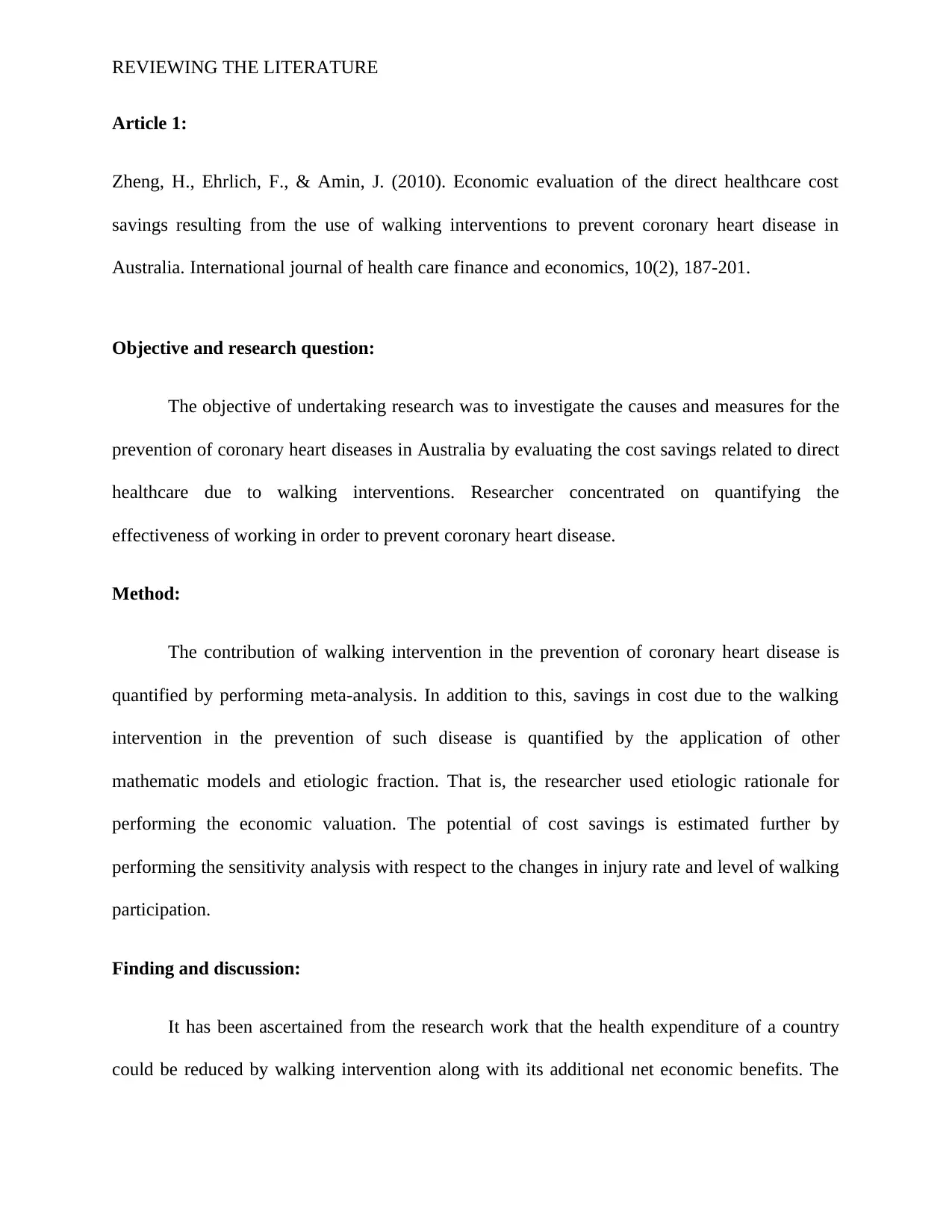
Article 1:
Zheng, H., Ehrlich, F., & Amin, J. (2010). Economic evaluation of the direct healthcare cost
savings resulting from the use of walking interventions to prevent coronary heart disease in
Australia. International journal of health care finance and economics, 10(2), 187-201.
Objective and research question:
The objective of undertaking research was to investigate the causes and measures for the
prevention of coronary heart diseases in Australia by evaluating the cost savings related to direct
healthcare due to walking interventions. Researcher concentrated on quantifying the
effectiveness of working in order to prevent coronary heart disease.
Method:
The contribution of walking intervention in the prevention of coronary heart disease is
quantified by performing meta-analysis. In addition to this, savings in cost due to the walking
intervention in the prevention of such disease is quantified by the application of other
mathematic models and etiologic fraction. That is, the researcher used etiologic rationale for
performing the economic valuation. The potential of cost savings is estimated further by
performing the sensitivity analysis with respect to the changes in injury rate and level of walking
participation.
Finding and discussion:
It has been ascertained from the research work that the health expenditure of a country
could be reduced by walking intervention along with its additional net economic benefits. The
Article 1:
Zheng, H., Ehrlich, F., & Amin, J. (2010). Economic evaluation of the direct healthcare cost
savings resulting from the use of walking interventions to prevent coronary heart disease in
Australia. International journal of health care finance and economics, 10(2), 187-201.
Objective and research question:
The objective of undertaking research was to investigate the causes and measures for the
prevention of coronary heart diseases in Australia by evaluating the cost savings related to direct
healthcare due to walking interventions. Researcher concentrated on quantifying the
effectiveness of working in order to prevent coronary heart disease.
Method:
The contribution of walking intervention in the prevention of coronary heart disease is
quantified by performing meta-analysis. In addition to this, savings in cost due to the walking
intervention in the prevention of such disease is quantified by the application of other
mathematic models and etiologic fraction. That is, the researcher used etiologic rationale for
performing the economic valuation. The potential of cost savings is estimated further by
performing the sensitivity analysis with respect to the changes in injury rate and level of walking
participation.
Finding and discussion:
It has been ascertained from the research work that the health expenditure of a country
could be reduced by walking intervention along with its additional net economic benefits. The
REVIEWING THE LITERATURE
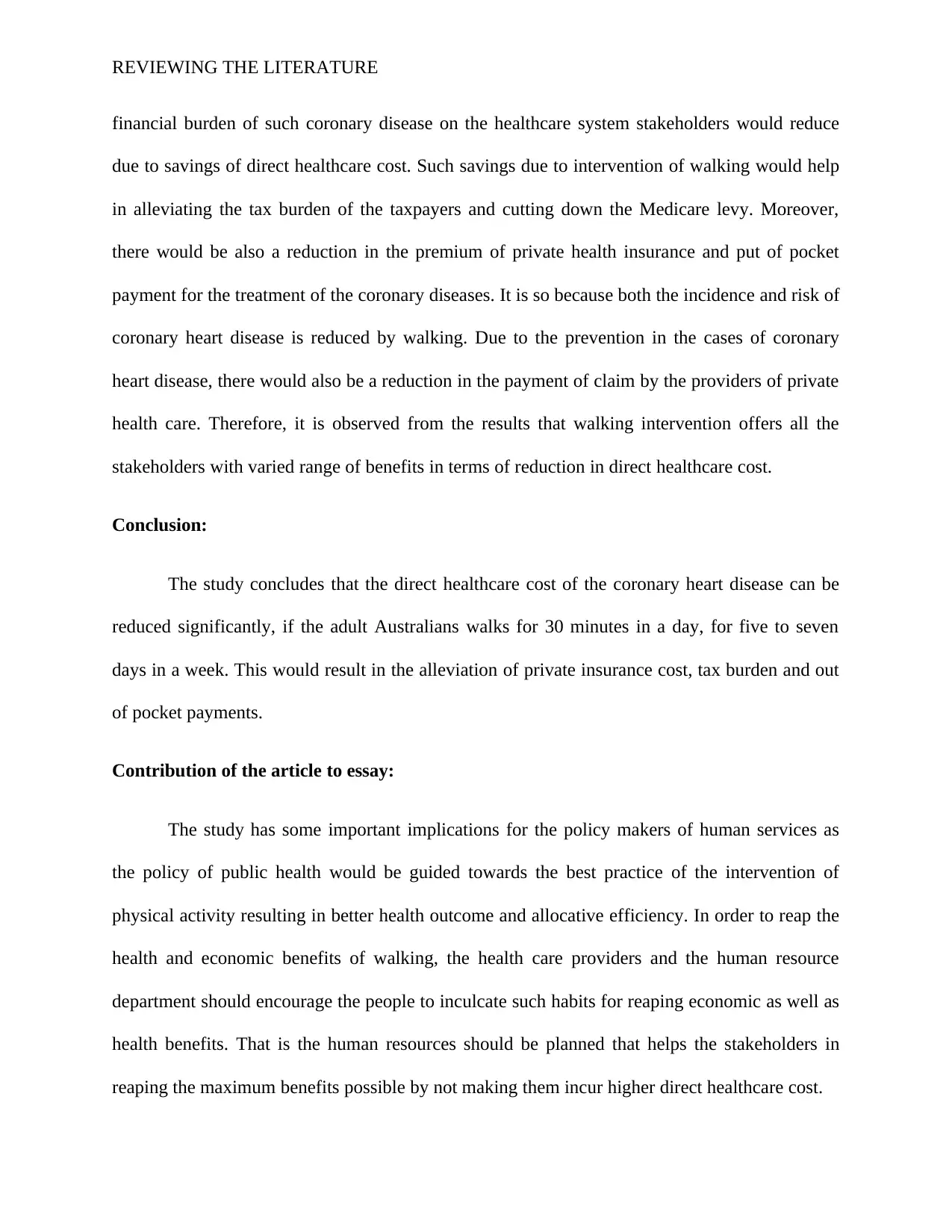
financial burden of such coronary disease on the healthcare system stakeholders would reduce
due to savings of direct healthcare cost. Such savings due to intervention of walking would help
in alleviating the tax burden of the taxpayers and cutting down the Medicare levy. Moreover,
there would be also a reduction in the premium of private health insurance and put of pocket
payment for the treatment of the coronary diseases. It is so because both the incidence and risk of
coronary heart disease is reduced by walking. Due to the prevention in the cases of coronary
heart disease, there would also be a reduction in the payment of claim by the providers of private
health care. Therefore, it is observed from the results that walking intervention offers all the
stakeholders with varied range of benefits in terms of reduction in direct healthcare cost.
Conclusion:
The study concludes that the direct healthcare cost of the coronary heart disease can be
reduced significantly, if the adult Australians walks for 30 minutes in a day, for five to seven
days in a week. This would result in the alleviation of private insurance cost, tax burden and out
of pocket payments.
Contribution of the article to essay:
The study has some important implications for the policy makers of human services as
the policy of public health would be guided towards the best practice of the intervention of
physical activity resulting in better health outcome and allocative efficiency. In order to reap the
health and economic benefits of walking, the health care providers and the human resource
department should encourage the people to inculcate such habits for reaping economic as well as
health benefits. That is the human resources should be planned that helps the stakeholders in
reaping the maximum benefits possible by not making them incur higher direct healthcare cost.
financial burden of such coronary disease on the healthcare system stakeholders would reduce
due to savings of direct healthcare cost. Such savings due to intervention of walking would help
in alleviating the tax burden of the taxpayers and cutting down the Medicare levy. Moreover,
there would be also a reduction in the premium of private health insurance and put of pocket
payment for the treatment of the coronary diseases. It is so because both the incidence and risk of
coronary heart disease is reduced by walking. Due to the prevention in the cases of coronary
heart disease, there would also be a reduction in the payment of claim by the providers of private
health care. Therefore, it is observed from the results that walking intervention offers all the
stakeholders with varied range of benefits in terms of reduction in direct healthcare cost.
Conclusion:
The study concludes that the direct healthcare cost of the coronary heart disease can be
reduced significantly, if the adult Australians walks for 30 minutes in a day, for five to seven
days in a week. This would result in the alleviation of private insurance cost, tax burden and out
of pocket payments.
Contribution of the article to essay:
The study has some important implications for the policy makers of human services as
the policy of public health would be guided towards the best practice of the intervention of
physical activity resulting in better health outcome and allocative efficiency. In order to reap the
health and economic benefits of walking, the health care providers and the human resource
department should encourage the people to inculcate such habits for reaping economic as well as
health benefits. That is the human resources should be planned that helps the stakeholders in
reaping the maximum benefits possible by not making them incur higher direct healthcare cost.
⊘ This is a preview!⊘
Do you want full access?
Subscribe today to unlock all pages.

Trusted by 1+ million students worldwide
REVIEWING THE LITERATURE
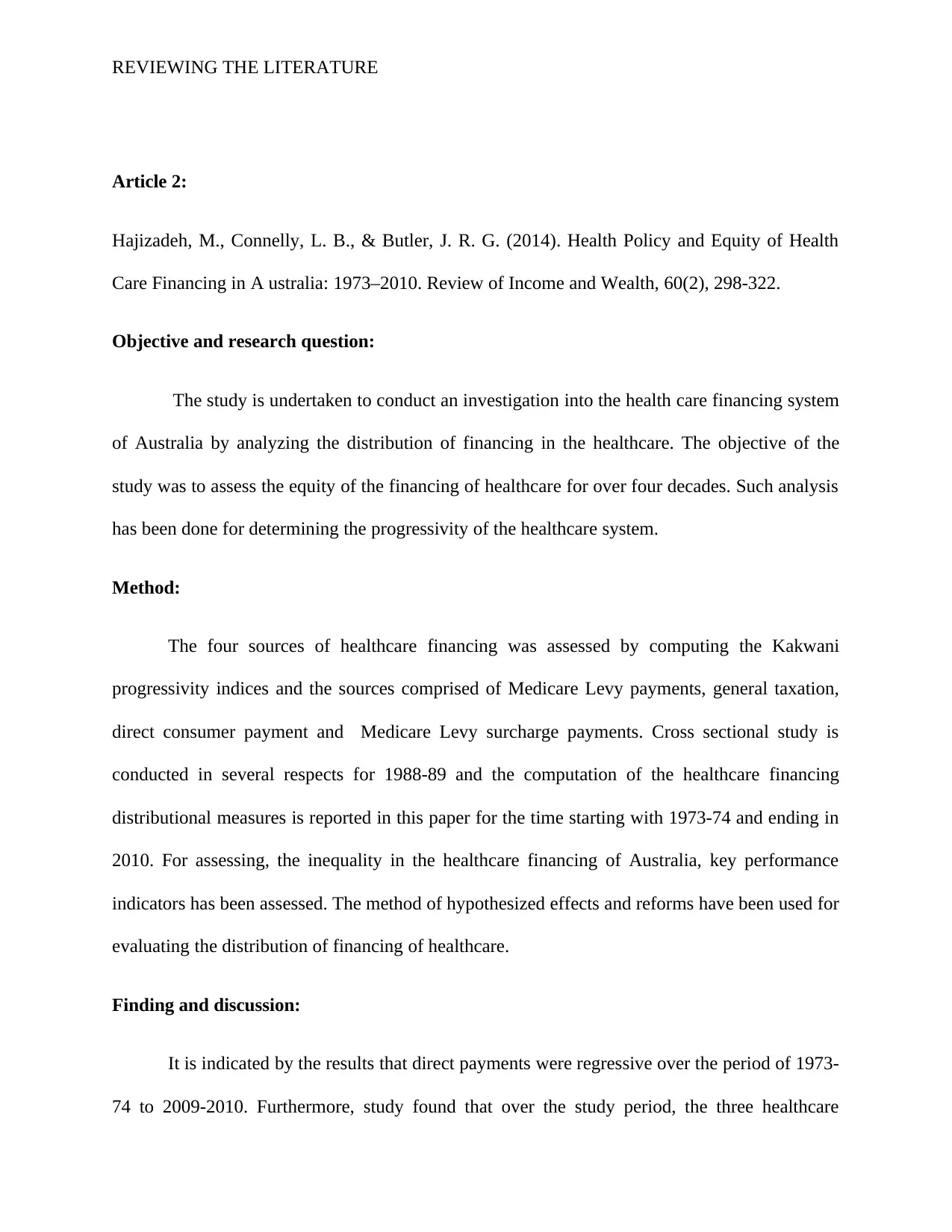
Article 2:
Hajizadeh, M., Connelly, L. B., & Butler, J. R. G. (2014). Health Policy and Equity of Health
Care Financing in A ustralia: 1973–2010. Review of Income and Wealth, 60(2), 298-322.
Objective and research question:
The study is undertaken to conduct an investigation into the health care financing system
of Australia by analyzing the distribution of financing in the healthcare. The objective of the
study was to assess the equity of the financing of healthcare for over four decades. Such analysis
has been done for determining the progressivity of the healthcare system.
Method:
The four sources of healthcare financing was assessed by computing the Kakwani
progressivity indices and the sources comprised of Medicare Levy payments, general taxation,
direct consumer payment and Medicare Levy surcharge payments. Cross sectional study is
conducted in several respects for 1988-89 and the computation of the healthcare financing
distributional measures is reported in this paper for the time starting with 1973-74 and ending in
2010. For assessing, the inequality in the healthcare financing of Australia, key performance
indicators has been assessed. The method of hypothesized effects and reforms have been used for
evaluating the distribution of financing of healthcare.
Finding and discussion:
It is indicated by the results that direct payments were regressive over the period of 1973-
74 to 2009-2010. Furthermore, study found that over the study period, the three healthcare
Article 2:
Hajizadeh, M., Connelly, L. B., & Butler, J. R. G. (2014). Health Policy and Equity of Health
Care Financing in A ustralia: 1973–2010. Review of Income and Wealth, 60(2), 298-322.
Objective and research question:
The study is undertaken to conduct an investigation into the health care financing system
of Australia by analyzing the distribution of financing in the healthcare. The objective of the
study was to assess the equity of the financing of healthcare for over four decades. Such analysis
has been done for determining the progressivity of the healthcare system.
Method:
The four sources of healthcare financing was assessed by computing the Kakwani
progressivity indices and the sources comprised of Medicare Levy payments, general taxation,
direct consumer payment and Medicare Levy surcharge payments. Cross sectional study is
conducted in several respects for 1988-89 and the computation of the healthcare financing
distributional measures is reported in this paper for the time starting with 1973-74 and ending in
2010. For assessing, the inequality in the healthcare financing of Australia, key performance
indicators has been assessed. The method of hypothesized effects and reforms have been used for
evaluating the distribution of financing of healthcare.
Finding and discussion:
It is indicated by the results that direct payments were regressive over the period of 1973-
74 to 2009-2010. Furthermore, study found that over the study period, the three healthcare
Paraphrase This Document
Need a fresh take? Get an instant paraphrase of this document with our AI Paraphraser
REVIEWING THE LITERATURE
financing source that is medical levy payment, medical levy surcharge payment and general
taxation were progressive. Despite the fact that direct payment forms a sizeable proportion of the
total payment and being a regressive source, it is revealed by the study that the total financing of
healthcare in Australia is progressive. It is therefore, indicated by the results that from the mid to
late 1970s and through the late 1980s, the tendency of financing was more regressive. However,
after 1989-99, there was an improvement in the progressivity due to the introduction of Medicare
in 1984. It was further, found that after the implementation of extended Medicare safety net in
year 2004 resulted in decreasing the direct payment regressivity. Mixed findings in terms of
progressive and regressivity on the different measures of health sector financing was identified.
Conclusion:
It is concluded from the analysis of the paper that some useful insights into the different
health reforms on the equity of the health sector is provided by the study. Findings generated by
the study is useful for the countries where the health care equity motivates the reform under
development. In addition to this, findings also throw some light on the effects of changes in
policy in the health sector of Australia.
Contribution of the article to essay:
It is implied by the study that the inequality in the distribution should be addressed and it
is required by the human resource department of healthcare sector to evaluate the allocation and
distribution of resources. For the equitable distribution of financing in the healthcare system of
Australia, the findings of research has an important implication that should be addressed using
the strategic human resource.
financing source that is medical levy payment, medical levy surcharge payment and general
taxation were progressive. Despite the fact that direct payment forms a sizeable proportion of the
total payment and being a regressive source, it is revealed by the study that the total financing of
healthcare in Australia is progressive. It is therefore, indicated by the results that from the mid to
late 1970s and through the late 1980s, the tendency of financing was more regressive. However,
after 1989-99, there was an improvement in the progressivity due to the introduction of Medicare
in 1984. It was further, found that after the implementation of extended Medicare safety net in
year 2004 resulted in decreasing the direct payment regressivity. Mixed findings in terms of
progressive and regressivity on the different measures of health sector financing was identified.
Conclusion:
It is concluded from the analysis of the paper that some useful insights into the different
health reforms on the equity of the health sector is provided by the study. Findings generated by
the study is useful for the countries where the health care equity motivates the reform under
development. In addition to this, findings also throw some light on the effects of changes in
policy in the health sector of Australia.
Contribution of the article to essay:
It is implied by the study that the inequality in the distribution should be addressed and it
is required by the human resource department of healthcare sector to evaluate the allocation and
distribution of resources. For the equitable distribution of financing in the healthcare system of
Australia, the findings of research has an important implication that should be addressed using
the strategic human resource.
REVIEWING THE LITERATURE
Article 3:
Ang, J. B. (2010). The determinants of health care expenditure in Australia. Applied Economics
Letters, 17(7), 639-644.
Objective and research question:
The objective of research paper is to examine the short run dynamics and long run
relationships of the expenditure of healthcare in Australia. Study was conducted for the time
between 1960-2003 for examining the determinants of the expenditure of healthcare in the
country. Empirical estimations was adopted for analyzing the short-term dynamics and the
determinants of healthcare expenditure.
Method:
The paper adopted the analytical framework so that the determinants of the expenditure
of healthcare is modelled. Some determinants that have been modelled using the analytical
framework includes consumption, age structure and per capital income. For the usual statistical
reasons, variables are expressed in the form of natural logarithm. In the econometric
methodology, the study adopted error correction model for estimating the relationship of long
run equilibrium. For this purpose, two indicators are used such as dynamic ordinary lease squares
and unrestricted error correction model.
Finding and discussion:
Similar resulted are obtained from the two approaches adopted for estimating the
elasticity of the expenditure of healthcare. The findings about the relationship between real per
capital GDP and the healthcare expenditure have deduced the fact that healthcare is regarded as
Article 3:
Ang, J. B. (2010). The determinants of health care expenditure in Australia. Applied Economics
Letters, 17(7), 639-644.
Objective and research question:
The objective of research paper is to examine the short run dynamics and long run
relationships of the expenditure of healthcare in Australia. Study was conducted for the time
between 1960-2003 for examining the determinants of the expenditure of healthcare in the
country. Empirical estimations was adopted for analyzing the short-term dynamics and the
determinants of healthcare expenditure.
Method:
The paper adopted the analytical framework so that the determinants of the expenditure
of healthcare is modelled. Some determinants that have been modelled using the analytical
framework includes consumption, age structure and per capital income. For the usual statistical
reasons, variables are expressed in the form of natural logarithm. In the econometric
methodology, the study adopted error correction model for estimating the relationship of long
run equilibrium. For this purpose, two indicators are used such as dynamic ordinary lease squares
and unrestricted error correction model.
Finding and discussion:
Similar resulted are obtained from the two approaches adopted for estimating the
elasticity of the expenditure of healthcare. The findings about the relationship between real per
capital GDP and the healthcare expenditure have deduced the fact that healthcare is regarded as
⊘ This is a preview!⊘
Do you want full access?
Subscribe today to unlock all pages.
Trusted by 1+ million students worldwide
REVIEWING THE LITERATURE
luxury good. An increase in the dependent population with respect to the total population results
in increasing the health care expenditure significantly. In addition to this, any variation in the
expenditure of health care is also impacted by the demographic factors, such as age structure. Per
capital real expenditure on the healthcare is positively impacted by the density of the services of
health care. An increase in the health care expenditure on a per capita basis is impacted by an
increase in the share of the government expenditure in relation to the total expenditure on the
healthcare. Furthermore, an increase in the per capita real expenditure on healthcare also implies
an increase in the accessibility to the services of healthcare.
Conclusion:
It is indicated from the results obtained that an increase in the per capita income is
associated with rise in per capita real expenditure on healthcare. The evolution of the per capita
real expenditure on healthcare can be explained significantly by age structure. From the overall
analysis, it can be concluded that most of the variables under study is positively associated with
the healthcare expenditure. Lastly, it is concluded that healthcare effects the healthcare
expenditure formation in Australia has contributory manner.
Contribution of the article to essay:
Human resource management plays a crucial role in the healthcare system of any country
as they plays an influential role in the delivery of the healthcare services and improving the
health outcome. The quality of healthcare services is determined appropriately when the human
resources are placed strategically. Better outcome in terms of proper funding of the healthcare
system can be done by developing effective strategies of human resource management.
luxury good. An increase in the dependent population with respect to the total population results
in increasing the health care expenditure significantly. In addition to this, any variation in the
expenditure of health care is also impacted by the demographic factors, such as age structure. Per
capital real expenditure on the healthcare is positively impacted by the density of the services of
health care. An increase in the health care expenditure on a per capita basis is impacted by an
increase in the share of the government expenditure in relation to the total expenditure on the
healthcare. Furthermore, an increase in the per capita real expenditure on healthcare also implies
an increase in the accessibility to the services of healthcare.
Conclusion:
It is indicated from the results obtained that an increase in the per capita income is
associated with rise in per capita real expenditure on healthcare. The evolution of the per capita
real expenditure on healthcare can be explained significantly by age structure. From the overall
analysis, it can be concluded that most of the variables under study is positively associated with
the healthcare expenditure. Lastly, it is concluded that healthcare effects the healthcare
expenditure formation in Australia has contributory manner.
Contribution of the article to essay:
Human resource management plays a crucial role in the healthcare system of any country
as they plays an influential role in the delivery of the healthcare services and improving the
health outcome. The quality of healthcare services is determined appropriately when the human
resources are placed strategically. Better outcome in terms of proper funding of the healthcare
system can be done by developing effective strategies of human resource management.
Paraphrase This Document
Need a fresh take? Get an instant paraphrase of this document with our AI Paraphraser

REVIEWING THE LITERATURE
However, the research work also provides a useful insight into the fact that the relationship
between the healthcare and human resource management is complex.
However, the research work also provides a useful insight into the fact that the relationship
between the healthcare and human resource management is complex.
REVIEWING THE LITERATURE
Article 4:
Hall, J. (2010). Health‐care reform in Australia: advancing or side‐stepping?. Health economics,
19(11), 1259-1263.
Objective and research question:
The objective of research work is to conduct an in depth analysis into the healthcare
reforms after the introduction of the most significant reform into the health system and hospitals
in Australia. Introduction of Medicare has been assessed extensively by outlining the outstanding
issues faced by the healthcare system, funding of the public hospitals and discussing on the
hospital network.
Method:
The reforms in the healthcare system and hospitals of Australia has been discussed by
outlining the literature on the background of public hospitals and Australian government. In
addition to this, the cost and role of the private health insurance is explained in terms of the
governance, financing and structure of the system. Funding arrangements of the healthcare
system have been discussed elaborately by outlining the significant changes. Review of literature
has been undertaken by outlining the issues that the reform failed to address. Therefore, it is said
that the research work has been undertaken by conducting the explanatory analysis of the facts of
the healthcare system.
Finding and discussion:
Article 4:
Hall, J. (2010). Health‐care reform in Australia: advancing or side‐stepping?. Health economics,
19(11), 1259-1263.
Objective and research question:
The objective of research work is to conduct an in depth analysis into the healthcare
reforms after the introduction of the most significant reform into the health system and hospitals
in Australia. Introduction of Medicare has been assessed extensively by outlining the outstanding
issues faced by the healthcare system, funding of the public hospitals and discussing on the
hospital network.
Method:
The reforms in the healthcare system and hospitals of Australia has been discussed by
outlining the literature on the background of public hospitals and Australian government. In
addition to this, the cost and role of the private health insurance is explained in terms of the
governance, financing and structure of the system. Funding arrangements of the healthcare
system have been discussed elaborately by outlining the significant changes. Review of literature
has been undertaken by outlining the issues that the reform failed to address. Therefore, it is said
that the research work has been undertaken by conducting the explanatory analysis of the facts of
the healthcare system.
Finding and discussion:
⊘ This is a preview!⊘
Do you want full access?
Subscribe today to unlock all pages.
Trusted by 1+ million students worldwide
REVIEWING THE LITERATURE
It was found that the introduction of reform in the form of network plan has the objective
of improving sustainability and the health outcomes of health system of Australia. Changes have
been reinforced using the reform efforts in terms of financial incentives. It discusses about
channeling the funding of the healthcare system with the states and government using different
mechanism of funding. The reforms in the form of activity based funding and emphasizing on
the public hospitals in Australia was overly narrowed as it offered limited prospects for the
immediate better outcomes. In addition to this, the reform did not introduce any method of
making the funding flexible and no attention was given to the incentive payment and structure.
Criticism of the new arrangement was made on the ground that it simply rearranged the
structures of current hospitals while the in charge of the hospitals remained predominantly with
the states.
Conclusion:
The analysis of the impact and the changes introduced by the reform introduced for the
healthcare system of Australia assisted in evaluating the prospects of the reforms and whether
such changes provided the healthcare system with better outcome. However, the facts evaluated
and ascertained by discussing the reform prospects have generated some facts. It calls for the
funding development, separating the purchase from provision, performance measurement,
monitoring, and introducing the fundamental reforms.
Contribution of the article to essay:
Article demonstrates the outcome of the reforms introduced and the areas where the
adoption of such reform did not brought any changes. The public literature has been explored
and it can be said that human resource can be one of the inputs to the healthcare system in
It was found that the introduction of reform in the form of network plan has the objective
of improving sustainability and the health outcomes of health system of Australia. Changes have
been reinforced using the reform efforts in terms of financial incentives. It discusses about
channeling the funding of the healthcare system with the states and government using different
mechanism of funding. The reforms in the form of activity based funding and emphasizing on
the public hospitals in Australia was overly narrowed as it offered limited prospects for the
immediate better outcomes. In addition to this, the reform did not introduce any method of
making the funding flexible and no attention was given to the incentive payment and structure.
Criticism of the new arrangement was made on the ground that it simply rearranged the
structures of current hospitals while the in charge of the hospitals remained predominantly with
the states.
Conclusion:
The analysis of the impact and the changes introduced by the reform introduced for the
healthcare system of Australia assisted in evaluating the prospects of the reforms and whether
such changes provided the healthcare system with better outcome. However, the facts evaluated
and ascertained by discussing the reform prospects have generated some facts. It calls for the
funding development, separating the purchase from provision, performance measurement,
monitoring, and introducing the fundamental reforms.
Contribution of the article to essay:
Article demonstrates the outcome of the reforms introduced and the areas where the
adoption of such reform did not brought any changes. The public literature has been explored
and it can be said that human resource can be one of the inputs to the healthcare system in
Paraphrase This Document
Need a fresh take? Get an instant paraphrase of this document with our AI Paraphraser

REVIEWING THE LITERATURE
addressing the issues being faced. Impact of such reforms can be observed when strategic human
resource management is incorporated into the system.
addressing the issues being faced. Impact of such reforms can be observed when strategic human
resource management is incorporated into the system.
REVIEWING THE LITERATURE
Article 5:
Callander, E. J., Fox, H., & Lindsay, D. (2019). Out-of-pocket healthcare expenditure in
Australia: trends, inequalities and the impact on household living standards in a high-income
country with a universal health care system. Health economics review, 9(1), 10.
Objective and research question:
The objective of research work is to determine the impact of the healthcare cost on the
living standard of household in an established universal healthcare system of a high-income
country. In addition to this, the paper also intends to identify any inequalities in healthcare
expenditure distribution and documenting the current trend of out of pocket payment on the
healthcare by the households of Australia.
Method:
Analysis was undertaken using the dataset that is nationally representative and
longitudinal and the annual data had been collected from 2006-2014. Labor dynamics in
Australia and the household income survey was utilized that incorporated micro data from the
waves 6 to 14. Also, OECD modified equivalence scale was used to measure the income of
household and assessing the healthcare expenditure distribution. Quantification of the out of
pocket expenditure of households has been done by undertaking initial descriptive analysis.
Finding and discussion:
It is found from the analysis of the facts that an increase in the expenditure of private
health insurance drove the total average total expenditure of the households on the healthcare
items. With the decile income, there is a decrease in the proportion of people with catastrophic
Article 5:
Callander, E. J., Fox, H., & Lindsay, D. (2019). Out-of-pocket healthcare expenditure in
Australia: trends, inequalities and the impact on household living standards in a high-income
country with a universal health care system. Health economics review, 9(1), 10.
Objective and research question:
The objective of research work is to determine the impact of the healthcare cost on the
living standard of household in an established universal healthcare system of a high-income
country. In addition to this, the paper also intends to identify any inequalities in healthcare
expenditure distribution and documenting the current trend of out of pocket payment on the
healthcare by the households of Australia.
Method:
Analysis was undertaken using the dataset that is nationally representative and
longitudinal and the annual data had been collected from 2006-2014. Labor dynamics in
Australia and the household income survey was utilized that incorporated micro data from the
waves 6 to 14. Also, OECD modified equivalence scale was used to measure the income of
household and assessing the healthcare expenditure distribution. Quantification of the out of
pocket expenditure of households has been done by undertaking initial descriptive analysis.
Finding and discussion:
It is found from the analysis of the facts that an increase in the expenditure of private
health insurance drove the total average total expenditure of the households on the healthcare
items. With the decile income, there is a decrease in the proportion of people with catastrophic
⊘ This is a preview!⊘
Do you want full access?
Subscribe today to unlock all pages.
Trusted by 1+ million students worldwide

1 out of 14


Related Documents


Your All-in-One AI-Powered Toolkit for Academic Success.
+13062052269
info@desklib.com
Available 24*7 on WhatsApp / Email
![[object Object]](/_next/static/media/star-bottom.7253800d.svg)
Unlock your academic potential
Copyright © 2020–2026 A2Z Services. All Rights Reserved. Developed and managed by ZUCOL.