Analysis of Value-Based Healthcare Models and Implementation

Verified

Added on  2020/02/18

|4
|634
|39
Report
AI Summary
This report analyzes value-based healthcare models, focusing on their impact on patient care and healthcare reform. It discusses the importance of cost considerations and the quality of services in selecting the right model. The report highlights the accountable care organization as a strategy to reward medical professionals for improving healthcare quality. It also considers the perspectives of various stakeholders, including the CEO, CFO, and HR, in the decision-making process. The author recommends a combination of patient-based and accountable care models to balance patient focus and professional motivation. The report references key literature on value-based healthcare and provides a comprehensive overview of the subject.

Document Page
Running Head: HEALTH CARE 1
Health Care
Name
Institution
tabler-icon-diamond-filled.svg

Paraphrase This Document

Need a fresh take? Get an instant paraphrase of this document with our AI Paraphraser
Document Page
HEALTH CARE 2
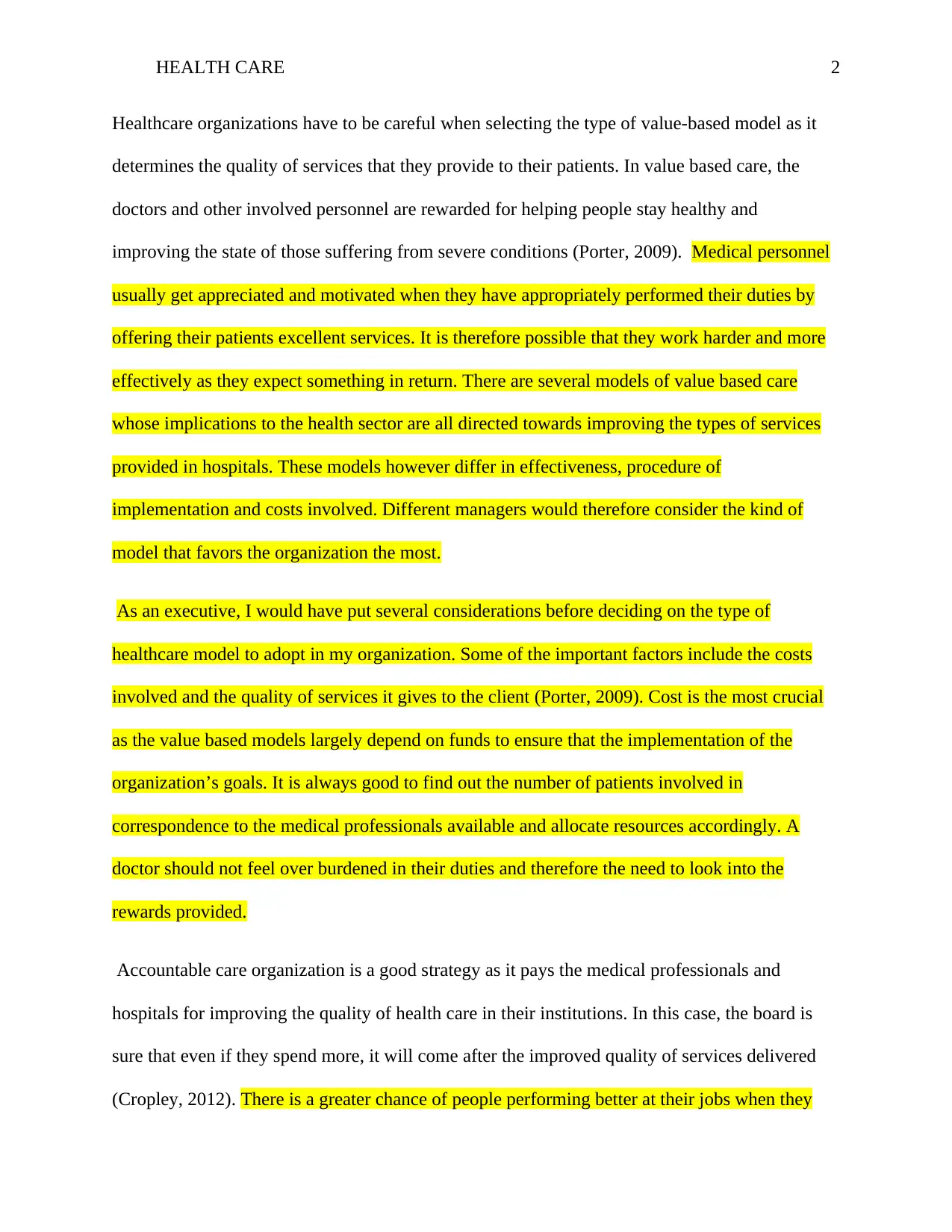
Healthcare organizations have to be careful when selecting the type of value-based model as it
determines the quality of services that they provide to their patients. In value based care, the
doctors and other involved personnel are rewarded for helping people stay healthy and
improving the state of those suffering from severe conditions (Porter, 2009). Medical personnel
usually get appreciated and motivated when they have appropriately performed their duties by
offering their patients excellent services. It is therefore possible that they work harder and more
effectively as they expect something in return. There are several models of value based care
whose implications to the health sector are all directed towards improving the types of services
provided in hospitals. These models however differ in effectiveness, procedure of
implementation and costs involved. Different managers would therefore consider the kind of
model that favors the organization the most.
As an executive, I would have put several considerations before deciding on the type of
healthcare model to adopt in my organization. Some of the important factors include the costs
involved and the quality of services it gives to the client (Porter, 2009). Cost is the most crucial
as the value based models largely depend on funds to ensure that the implementation of the
organization’s goals. It is always good to find out the number of patients involved in
correspondence to the medical professionals available and allocate resources accordingly. A
doctor should not feel over burdened in their duties and therefore the need to look into the
rewards provided.
Accountable care organization is a good strategy as it pays the medical professionals and
hospitals for improving the quality of health care in their institutions. In this case, the board is
sure that even if they spend more, it will come after the improved quality of services delivered
(Cropley, 2012). There is a greater chance of people performing better at their jobs when they
Document Page
HEALTH CARE 3
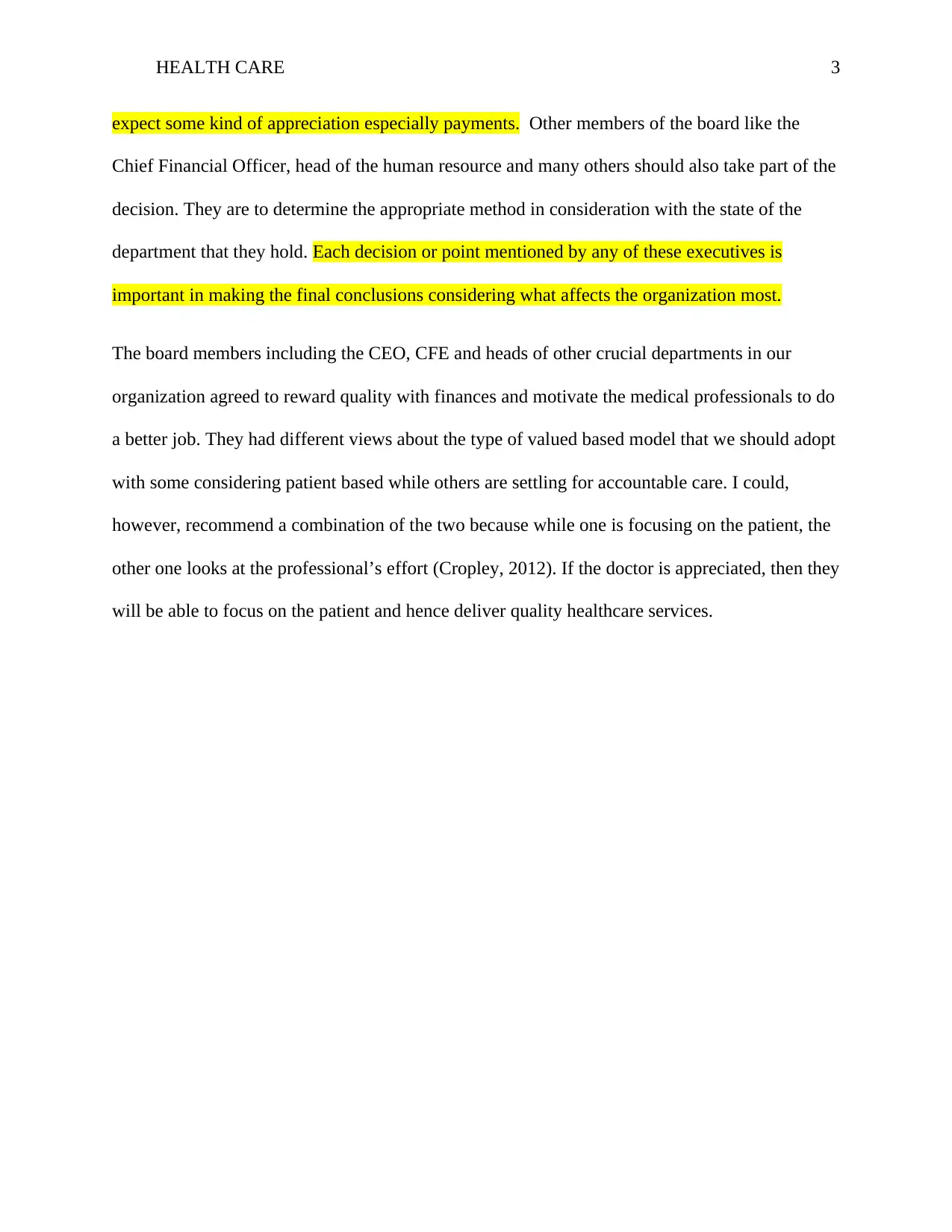
expect some kind of appreciation especially payments. Other members of the board like the
Chief Financial Officer, head of the human resource and many others should also take part of the
decision. They are to determine the appropriate method in consideration with the state of the
department that they hold. Each decision or point mentioned by any of these executives is
important in making the final conclusions considering what affects the organization most.
The board members including the CEO, CFE and heads of other crucial departments in our
organization agreed to reward quality with finances and motivate the medical professionals to do
a better job. They had different views about the type of valued based model that we should adopt
with some considering patient based while others are settling for accountable care. I could,
however, recommend a combination of the two because while one is focusing on the patient, the
other one looks at the professional’s effort (Cropley, 2012). If the doctor is appreciated, then they
will be able to focus on the patient and hence deliver quality healthcare services.
Document Page
HEALTH CARE 4
References
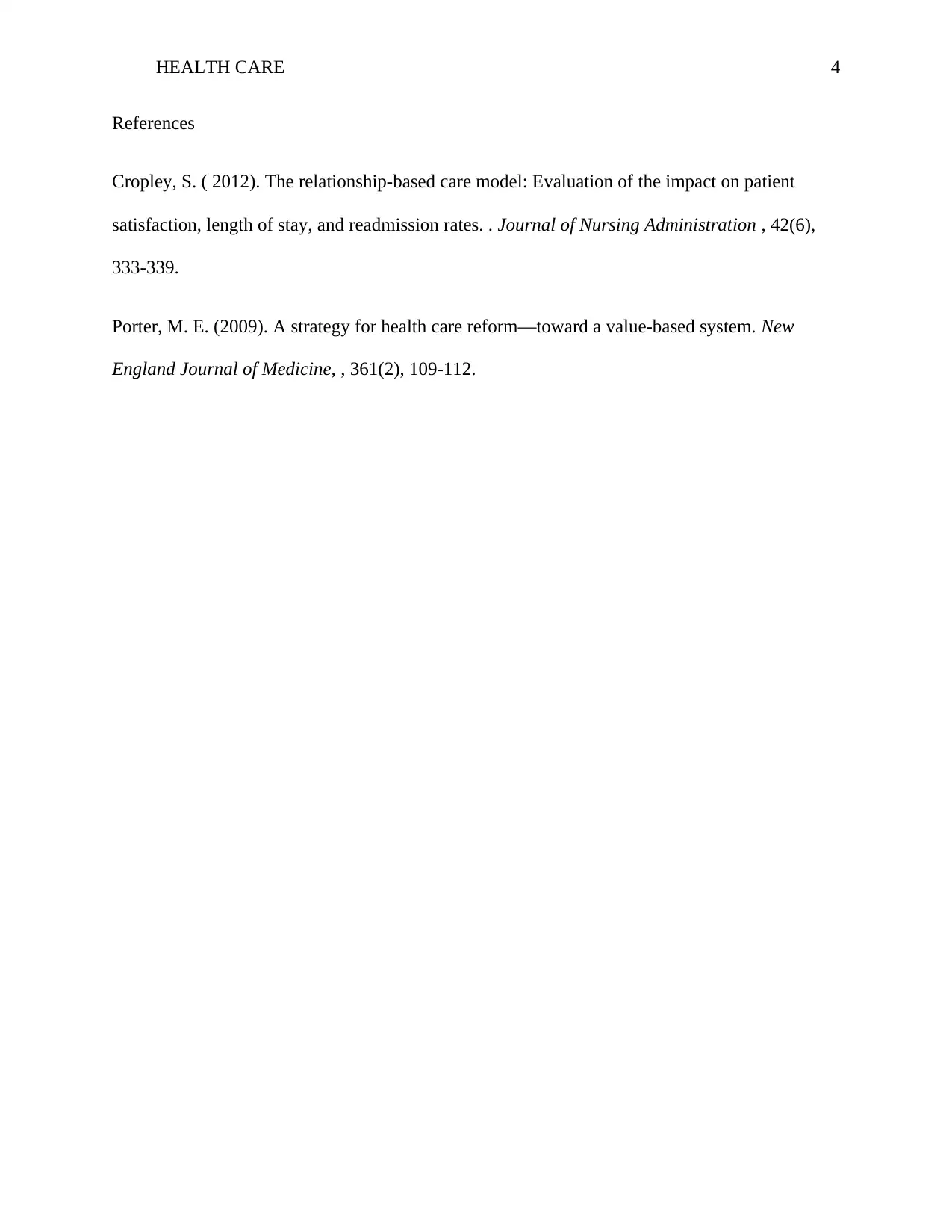
Cropley, S. ( 2012). The relationship-based care model: Evaluation of the impact on patient
satisfaction, length of stay, and readmission rates. . Journal of Nursing Administration , 42(6),
333-339.
Porter, M. E. (2009). A strategy for health care reform—toward a value-based system. New
England Journal of Medicine, , 361(2), 109-112.
chevron_up_icon
1 out of 4
circle_padding
hide_on_mobile
zoom_out_icon
[object Object]