NSW Healthcare System: Comparing LHD and PHN Functions and Roles
VerifiedAdded on 2021/09/16
|11
|2514
|161
Report
AI Summary
This report provides an executive summary of the NSW healthcare system, focusing on Local Health Districts (LHDs) and Primary Health Networks (PHNs). It compares and contrasts their functions, roles, accountability, and budgetary considerations. The report highlights the similarities, such as their shared goals of leading and developing primary and community healthcare, maintaining equity, and utilizing informatics and E-health. It also details the differences in their roles, with PHNs advocating for primary healthcare issues and LHDs ensuring effective governance and strategic planning. The report discusses the challenges faced by these networks, including infrastructure limitations, workforce issues, and health literacy gaps, particularly within aboriginal communities. Finally, the report offers recommendations for improvement, such as enhancing information sharing, strengthening stakeholder skills, and formalizing partnerships to improve healthcare service delivery and address service gaps.
Running Head: HEALTH SERVICE MANAGEMENT
Health Service Management
Name
Institution
Course
Date
Health Service Management
Name
Institution
Course
Date

Paraphrase This Document
Need a fresh take? Get an instant paraphrase of this document with our AI Paraphraser
HEALTH SERVICE MANAGEMENT 2
Executive Summary
The purpose of the NSW health care system is to ensure that there is the provision of
high-quality health care services to all the citizens. NSW health care system also aims at
enhancing and maintaining health and wellbeing of the people in NSW. It aims at creating
openness and keep respect among healthcare professionals and patients by building strong
therapeutic relationships. This has led to the creation of primary health networks (PHN) and
local health districts (LHD) to enhance the quality of healthcare. Findings from studies which
have been conducted in NSW indicates that most of the people living in this country are
aboriginal’s community which values their cultural norms.
Executive Summary
The purpose of the NSW health care system is to ensure that there is the provision of
high-quality health care services to all the citizens. NSW health care system also aims at
enhancing and maintaining health and wellbeing of the people in NSW. It aims at creating
openness and keep respect among healthcare professionals and patients by building strong
therapeutic relationships. This has led to the creation of primary health networks (PHN) and
local health districts (LHD) to enhance the quality of healthcare. Findings from studies which
have been conducted in NSW indicates that most of the people living in this country are
aboriginal’s community which values their cultural norms.
HEALTH SERVICE MANAGEMENT 3
Table of Contents
Executive Summary..............................................................................................................................2
Introduction..........................................................................................................................................4
Compare and Contrast the Function of Local Health Districts (LHD) and Primary Health Network
(PHN)....................................................................................................................................................4
Similarities of LHD and PHN Functions..........................................................................................4
Differences between Local Health Districts (LHD) and Primary Health Networks (PHN)
Regarding the Roles, Accountability, and Budget............................................................................6
Difficulties Which Emerge From the New Arrangements in the Healthcare System of NSW............7
Recommendations for Improvement of the Healthcare System in NSW.............................................8
Conclusion.............................................................................................................................................8
References.............................................................................................................................................9
Table of Contents
Executive Summary..............................................................................................................................2
Introduction..........................................................................................................................................4
Compare and Contrast the Function of Local Health Districts (LHD) and Primary Health Network
(PHN)....................................................................................................................................................4
Similarities of LHD and PHN Functions..........................................................................................4
Differences between Local Health Districts (LHD) and Primary Health Networks (PHN)
Regarding the Roles, Accountability, and Budget............................................................................6
Difficulties Which Emerge From the New Arrangements in the Healthcare System of NSW............7
Recommendations for Improvement of the Healthcare System in NSW.............................................8
Conclusion.............................................................................................................................................8
References.............................................................................................................................................9
⊘ This is a preview!⊘
Do you want full access?
Subscribe today to unlock all pages.

Trusted by 1+ million students worldwide
HEALTH SERVICE MANAGEMENT 4
Introduction
The Australian government established the Primary Health Network (PHN) in 2015
focusing on New South Wale (NSW). PHNs were created with the aim of improving efficiency
and effectiveness in medical services which are offered to patients and enhancing the
coordination of healthcare. This can only be achieved through the provision of better
information, education, and creation of networking opportunities for healthcare professionals so
that it can be easy to establish connections across healthcare system in NSW to ensure that
patients receive high-quality healthcare services which meets their health needs (Booth et al.,
2016). Primary health networks in NSW provides an opportunity to focus efforts at the regional
level to achieve a better health care system in the country. PHNs coordinates across the whole
healthcare system to ensure that healthcare professionals are offering quality healthcare services
to patients. Local health districts were established in 2011 by the NSW government with the
aims of delivering healthcare services across the country. The locals decide LHD, and most
individuals who are involved include clinicians and the community. In NSW there are eight local
health districts which cover the metropolitan region and seven LHDs covering the rural and
regional locations (Joshi et al., 2013). The primary objective of LHD is to enhance unity and
cooperation to improve the health and wellbeing of the community. LHD staffs and healthcare
professionals strive to provide high-quality healthcare services to patients. This paper focus on
comparing and contrasting the various functions of primary health networks (PHN) and local
health districts (LHD).
Introduction
The Australian government established the Primary Health Network (PHN) in 2015
focusing on New South Wale (NSW). PHNs were created with the aim of improving efficiency
and effectiveness in medical services which are offered to patients and enhancing the
coordination of healthcare. This can only be achieved through the provision of better
information, education, and creation of networking opportunities for healthcare professionals so
that it can be easy to establish connections across healthcare system in NSW to ensure that
patients receive high-quality healthcare services which meets their health needs (Booth et al.,
2016). Primary health networks in NSW provides an opportunity to focus efforts at the regional
level to achieve a better health care system in the country. PHNs coordinates across the whole
healthcare system to ensure that healthcare professionals are offering quality healthcare services
to patients. Local health districts were established in 2011 by the NSW government with the
aims of delivering healthcare services across the country. The locals decide LHD, and most
individuals who are involved include clinicians and the community. In NSW there are eight local
health districts which cover the metropolitan region and seven LHDs covering the rural and
regional locations (Joshi et al., 2013). The primary objective of LHD is to enhance unity and
cooperation to improve the health and wellbeing of the community. LHD staffs and healthcare
professionals strive to provide high-quality healthcare services to patients. This paper focus on
comparing and contrasting the various functions of primary health networks (PHN) and local
health districts (LHD).
Paraphrase This Document
Need a fresh take? Get an instant paraphrase of this document with our AI Paraphraser
HEALTH SERVICE MANAGEMENT 5
Compare and Contrast the Function of Local Health Districts (LHD) and Primary Health
Network (PHN)
Similarities of LHD and PHN Functions
The tasks of LHD and PHN in offering healthcare services are similar in some ways.
LHD and PHN aim at leading and developing primary and community healthcare. These
programs aim at ensuring that they continue to produce successful leadership programs which
can be able to support the implementation of primary health care reforms which provides patients
receive high-quality healthcare services. While delivering health care services, local health
districts and primary health networks ensure that they maintain equity (Reyes, Bekemeier &
Issel, 2014). Which means they ensure that all patients all treated equally and individuals who
are from poor backgrounds are not mistreated, but they are shown love and given the healthcare
assistance which they need. This is made possible by the formulation of policies which takes
action against any health care professionals who offends patients because of their poor financial
status. LHD and PHN also ensure that there is the establishment of programs which offer
financial assistance to the poor so that they can be able to seek medical attention when they are
sick. Both LHD and PHN ensures the application of informatics and E-health in the provision of
healthcare services. Informatics and E-health enhance health operations.
With the use of informatics, healthcare professionals are now able to maintain accuracy
and efficiency of the procedures which they perform in healthcare. This is because they can store
patients’ information in save databases which they can retrieve in the future while assessing the
patient’s health. Informatics has made access to healthcare service easy. This is because with the
use of mobile phones patents can trace the best hospitals and healthcare institutions which can
meet their needs. LHD and PHN support application of informatics and E-health in health care
Compare and Contrast the Function of Local Health Districts (LHD) and Primary Health
Network (PHN)
Similarities of LHD and PHN Functions
The tasks of LHD and PHN in offering healthcare services are similar in some ways.
LHD and PHN aim at leading and developing primary and community healthcare. These
programs aim at ensuring that they continue to produce successful leadership programs which
can be able to support the implementation of primary health care reforms which provides patients
receive high-quality healthcare services. While delivering health care services, local health
districts and primary health networks ensure that they maintain equity (Reyes, Bekemeier &
Issel, 2014). Which means they ensure that all patients all treated equally and individuals who
are from poor backgrounds are not mistreated, but they are shown love and given the healthcare
assistance which they need. This is made possible by the formulation of policies which takes
action against any health care professionals who offends patients because of their poor financial
status. LHD and PHN also ensure that there is the establishment of programs which offer
financial assistance to the poor so that they can be able to seek medical attention when they are
sick. Both LHD and PHN ensures the application of informatics and E-health in the provision of
healthcare services. Informatics and E-health enhance health operations.
With the use of informatics, healthcare professionals are now able to maintain accuracy
and efficiency of the procedures which they perform in healthcare. This is because they can store
patients’ information in save databases which they can retrieve in the future while assessing the
patient’s health. Informatics has made access to healthcare service easy. This is because with the
use of mobile phones patents can trace the best hospitals and healthcare institutions which can
meet their needs. LHD and PHN support application of informatics and E-health in health care
HEALTH SERVICE MANAGEMENT 6
system because patients with the use of their mobile phones can evaluate the best diets which
they are supposed to eat so that they can reduce the risk of been infected by various infections
and also reduce complications associated with epidemics such as diabetes and obesity (Polivka &
Chaudry, 2015). Use of healthcare software improves the quality of health care services and
disease control. Software plays a vital role in tracking procedures and billing methods which
reduce paperwork which is tiresome.
Differences between Local Health Districts (LHD) and Primary Health Networks (PHN)
Regarding the Roles, Accountability, and Budget
The functions which are performed by primary health networks (PHN) are very much far
different from the roles of local health districts (LHD). PHN performs the role of negotiating and
advocating for primary healthcare issues which address health inequalities through partnership.
On the other hand, LHD ensures that there are effective clinical and corporate governance
frameworks established in NSW to support healthcare standards of patients care and services
which meets their needs (Beatty et al., 2015). Primary healthcare networks ensures equity of
health care services among patients which drives change in healthcare system of NSW including
savings and efficiencies, while LHDs provides guides and programs which are used to ensure
that all individuals in healthcare institutions of NSW are treated equally with no discrimination,
and it takes actions against health care professionals who are charged with the offense of
mistreating patients due to their poor financial status. PHNs monitors and evaluate measures
which need to be changed in the NSW health care system to enhance healthcare services
provided to patients.
On the other hand, LHDs establishes strategic plans which are used to ensure that the
health care services which are offered to patients meets their needs. The last difference in the
system because patients with the use of their mobile phones can evaluate the best diets which
they are supposed to eat so that they can reduce the risk of been infected by various infections
and also reduce complications associated with epidemics such as diabetes and obesity (Polivka &
Chaudry, 2015). Use of healthcare software improves the quality of health care services and
disease control. Software plays a vital role in tracking procedures and billing methods which
reduce paperwork which is tiresome.
Differences between Local Health Districts (LHD) and Primary Health Networks (PHN)
Regarding the Roles, Accountability, and Budget
The functions which are performed by primary health networks (PHN) are very much far
different from the roles of local health districts (LHD). PHN performs the role of negotiating and
advocating for primary healthcare issues which address health inequalities through partnership.
On the other hand, LHD ensures that there are effective clinical and corporate governance
frameworks established in NSW to support healthcare standards of patients care and services
which meets their needs (Beatty et al., 2015). Primary healthcare networks ensures equity of
health care services among patients which drives change in healthcare system of NSW including
savings and efficiencies, while LHDs provides guides and programs which are used to ensure
that all individuals in healthcare institutions of NSW are treated equally with no discrimination,
and it takes actions against health care professionals who are charged with the offense of
mistreating patients due to their poor financial status. PHNs monitors and evaluate measures
which need to be changed in the NSW health care system to enhance healthcare services
provided to patients.
On the other hand, LHDs establishes strategic plans which are used to ensure that the
health care services which are offered to patients meets their needs. The last difference in the
⊘ This is a preview!⊘
Do you want full access?
Subscribe today to unlock all pages.
Trusted by 1+ million students worldwide
HEALTH SERVICE MANAGEMENT 7
roles of PHN and LHD is that PHN advocates for disinvestments where they are required in the
healthcare system of NSW while LHN approves the healthcare system to support efficient and
economical operations within the districts so that they can be able to ensure that resources are
equally distributed, and they are effectively used (Beck, Leider, Coronado & Harper, 2017).
Regarding accountability, LHDs are more accountable for their operations as compared to PHNs
because they provide that all the set objectives of the framework are achieved through effective
utilization of all the available resources in NSW.Regarding budget, LHDs are more costly to
establish and make them operate effectively as compared to PHNs (Caldwell, 2013). This is
because LHDs are many and each requires a large amount of capital. On the other hand, PHNs
are few in NSW, and thus they do not require a lot of money.
Difficulties Which Emerge From the New Arrangements in the Healthcare System of NSW
LHDs and PHNs in NSW have been facing a lot of challenges. This is because these
programs have to work for all the people in NSW even the indigenous communities who live in
remote areas which have poor infrastructure making transport hard for healthcare professionals
who are sent to attend patients in these areas (Macías-Escrivá, Haber, Del Toro & Hernandez,
2013). NSW does not have enough PHNs which can be used to meet all the primary health care
requirements of the citizens mostly in rural and remote areas. The transitions which are made to
establish PHNs and LHDs are required to shape the public health care professionals in health
institutions (Sturmberg & Lanham, 2014). Therefore these programs are judged because they are
not capable of achieving collaborative advantages by working across stakeholder groups. LHDs
and PHNs in NSW aim at ensuring a reduction in avoidable hospitalization which is very
difficult to achieve. This is because the disconnection between primary health institutions and
hospitals as the Commonwealth role has had to change over the past few years. Another
roles of PHN and LHD is that PHN advocates for disinvestments where they are required in the
healthcare system of NSW while LHN approves the healthcare system to support efficient and
economical operations within the districts so that they can be able to ensure that resources are
equally distributed, and they are effectively used (Beck, Leider, Coronado & Harper, 2017).
Regarding accountability, LHDs are more accountable for their operations as compared to PHNs
because they provide that all the set objectives of the framework are achieved through effective
utilization of all the available resources in NSW.Regarding budget, LHDs are more costly to
establish and make them operate effectively as compared to PHNs (Caldwell, 2013). This is
because LHDs are many and each requires a large amount of capital. On the other hand, PHNs
are few in NSW, and thus they do not require a lot of money.
Difficulties Which Emerge From the New Arrangements in the Healthcare System of NSW
LHDs and PHNs in NSW have been facing a lot of challenges. This is because these
programs have to work for all the people in NSW even the indigenous communities who live in
remote areas which have poor infrastructure making transport hard for healthcare professionals
who are sent to attend patients in these areas (Macías-Escrivá, Haber, Del Toro & Hernandez,
2013). NSW does not have enough PHNs which can be used to meet all the primary health care
requirements of the citizens mostly in rural and remote areas. The transitions which are made to
establish PHNs and LHDs are required to shape the public health care professionals in health
institutions (Sturmberg & Lanham, 2014). Therefore these programs are judged because they are
not capable of achieving collaborative advantages by working across stakeholder groups. LHDs
and PHNs in NSW aim at ensuring a reduction in avoidable hospitalization which is very
difficult to achieve. This is because the disconnection between primary health institutions and
hospitals as the Commonwealth role has had to change over the past few years. Another
Paraphrase This Document
Need a fresh take? Get an instant paraphrase of this document with our AI Paraphraser
HEALTH SERVICE MANAGEMENT 8
challenge which is facing LHDs and PHNs is that the health care services which they have to
provide to patients are not reduced to experimentation but is based on the sound evidence. Health
literacy is a challenge in the NSW health care system (Alvarez-Rosete, Hawkins & Parkhurst,
2013). This is because we only have a few numbers of educated people in NSW because the
majority of people living here are the aboriginals and they value their local education. This
makes it hard for healthcare professionals from LHDs and PHNs to communicate effectively
with them when offering healthcare services because they only understand their first language.
Recommendations for Improvement of the Healthcare System in NSW
Healthcare system in NSW should ensure that they improve mechanisms for sharing
information and innovation must be part of PHNs and LHDs (Meara et al., 2015).
Commonwealth should ensure that these programs allow their healthcare professionals to share
their best health practices which improves the quality of life. The government of NSW should
ensure that bilateral primary healthcare agreements are progressing. The work and roles which
are already commenced in the bilateral healthcare are improved to ensure they capture the
earliest opportunities (Gilligan, Outram & Levett-Jones, 2014). Stakeholders in LHDs and PHNs
should have sufficient skills and abilities so that they can be able to influence and advise the
board correctly. The last recommendation which can be used to enhance improvement in the
healthcare system in NSW is ensuring that partnership between various healthcare programs is
formalized. Formalization of these system improves healthcare service delivery, and they
integrate care addressing healthcare service gaps.
challenge which is facing LHDs and PHNs is that the health care services which they have to
provide to patients are not reduced to experimentation but is based on the sound evidence. Health
literacy is a challenge in the NSW health care system (Alvarez-Rosete, Hawkins & Parkhurst,
2013). This is because we only have a few numbers of educated people in NSW because the
majority of people living here are the aboriginals and they value their local education. This
makes it hard for healthcare professionals from LHDs and PHNs to communicate effectively
with them when offering healthcare services because they only understand their first language.
Recommendations for Improvement of the Healthcare System in NSW
Healthcare system in NSW should ensure that they improve mechanisms for sharing
information and innovation must be part of PHNs and LHDs (Meara et al., 2015).
Commonwealth should ensure that these programs allow their healthcare professionals to share
their best health practices which improves the quality of life. The government of NSW should
ensure that bilateral primary healthcare agreements are progressing. The work and roles which
are already commenced in the bilateral healthcare are improved to ensure they capture the
earliest opportunities (Gilligan, Outram & Levett-Jones, 2014). Stakeholders in LHDs and PHNs
should have sufficient skills and abilities so that they can be able to influence and advise the
board correctly. The last recommendation which can be used to enhance improvement in the
healthcare system in NSW is ensuring that partnership between various healthcare programs is
formalized. Formalization of these system improves healthcare service delivery, and they
integrate care addressing healthcare service gaps.
HEALTH SERVICE MANAGEMENT 9
Conclusion
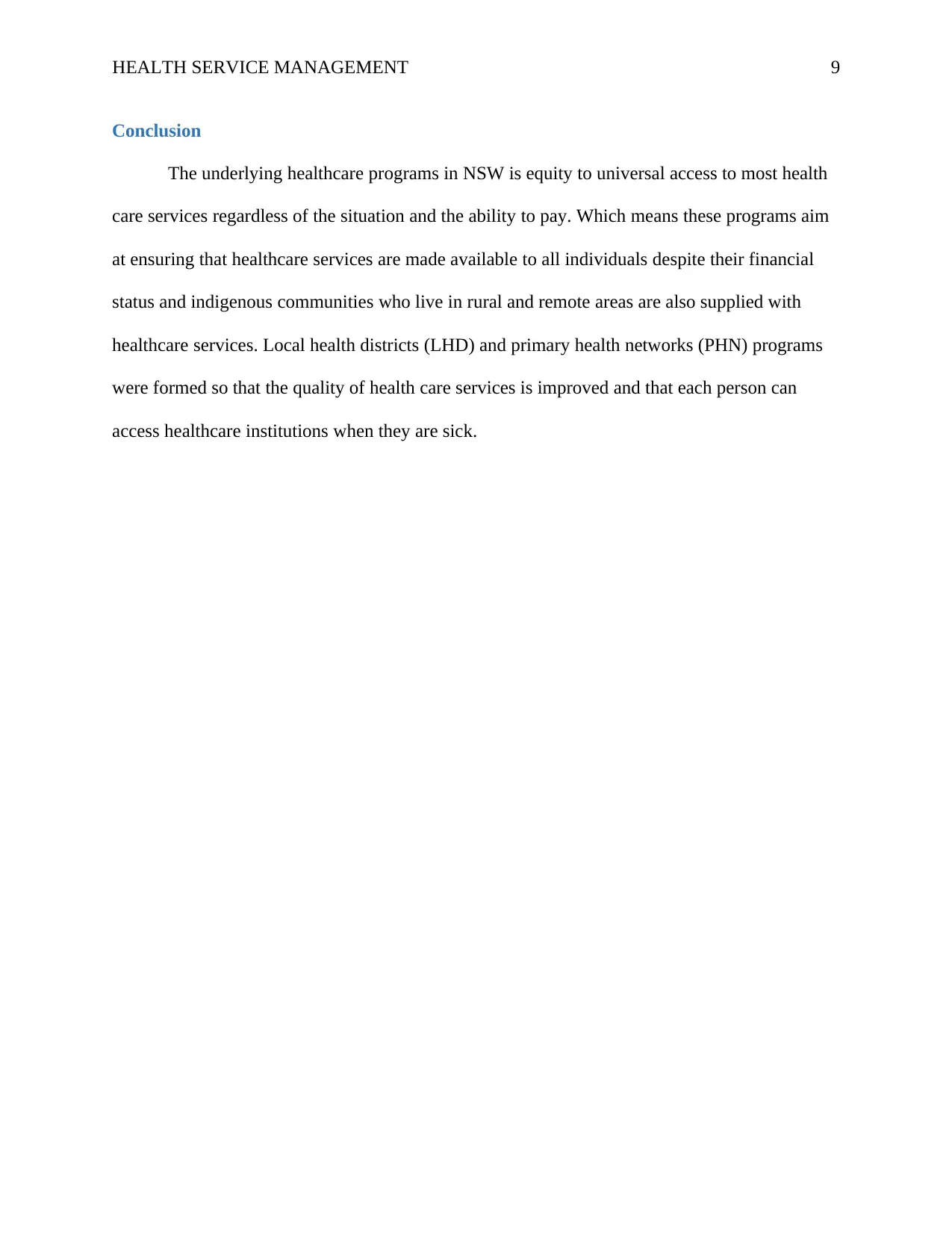
The underlying healthcare programs in NSW is equity to universal access to most health
care services regardless of the situation and the ability to pay. Which means these programs aim
at ensuring that healthcare services are made available to all individuals despite their financial
status and indigenous communities who live in rural and remote areas are also supplied with
healthcare services. Local health districts (LHD) and primary health networks (PHN) programs
were formed so that the quality of health care services is improved and that each person can
access healthcare institutions when they are sick.
Conclusion
The underlying healthcare programs in NSW is equity to universal access to most health
care services regardless of the situation and the ability to pay. Which means these programs aim
at ensuring that healthcare services are made available to all individuals despite their financial
status and indigenous communities who live in rural and remote areas are also supplied with
healthcare services. Local health districts (LHD) and primary health networks (PHN) programs
were formed so that the quality of health care services is improved and that each person can
access healthcare institutions when they are sick.
⊘ This is a preview!⊘
Do you want full access?
Subscribe today to unlock all pages.
Trusted by 1+ million students worldwide
HEALTH SERVICE MANAGEMENT 10
References
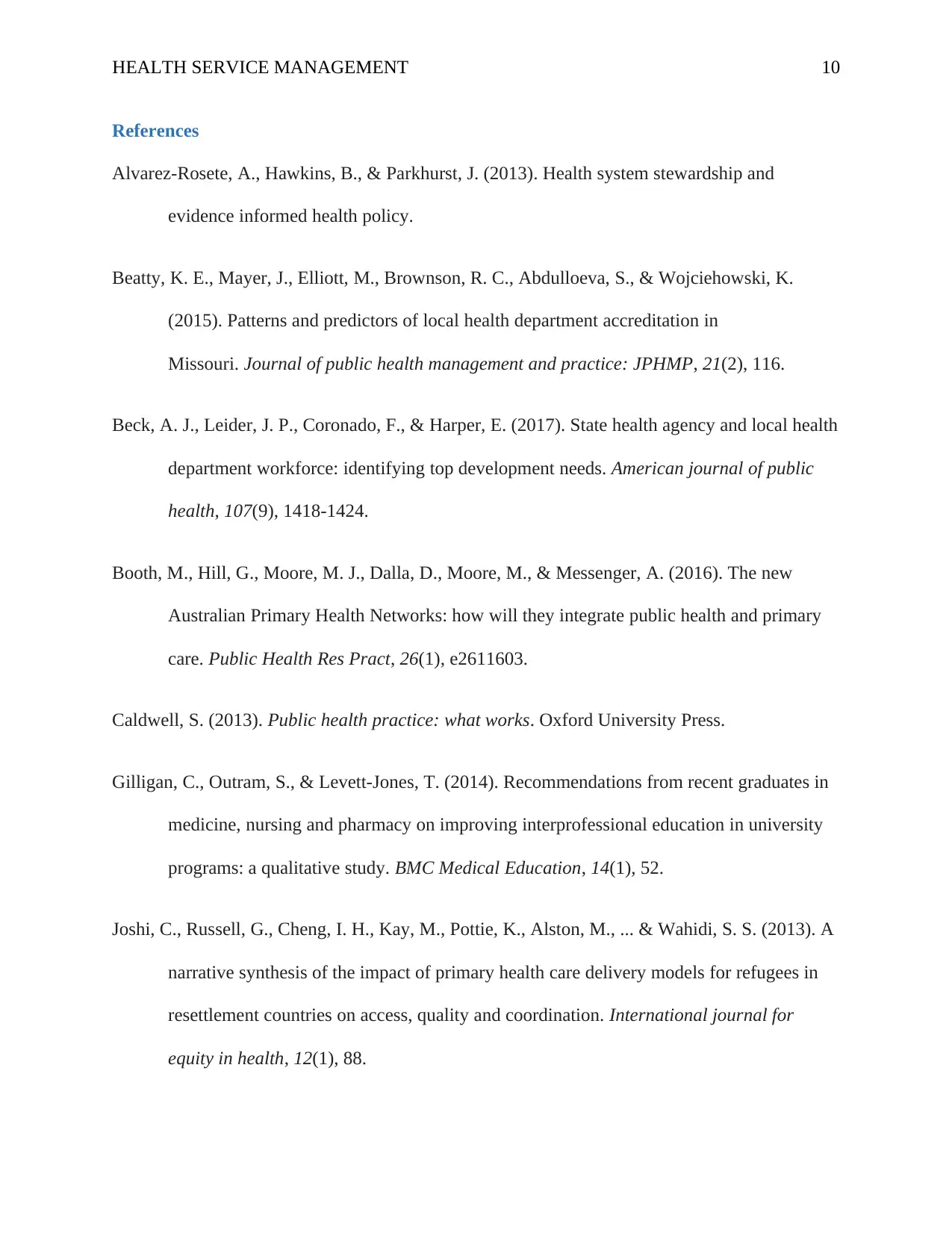
Alvarez-Rosete, A., Hawkins, B., & Parkhurst, J. (2013). Health system stewardship and
evidence informed health policy.
Beatty, K. E., Mayer, J., Elliott, M., Brownson, R. C., Abdulloeva, S., & Wojciehowski, K.
(2015). Patterns and predictors of local health department accreditation in
Missouri. Journal of public health management and practice: JPHMP, 21(2), 116.
Beck, A. J., Leider, J. P., Coronado, F., & Harper, E. (2017). State health agency and local health
department workforce: identifying top development needs. American journal of public
health, 107(9), 1418-1424.
Booth, M., Hill, G., Moore, M. J., Dalla, D., Moore, M., & Messenger, A. (2016). The new
Australian Primary Health Networks: how will they integrate public health and primary
care. Public Health Res Pract, 26(1), e2611603.
Caldwell, S. (2013). Public health practice: what works. Oxford University Press.
Gilligan, C., Outram, S., & Levett-Jones, T. (2014). Recommendations from recent graduates in
medicine, nursing and pharmacy on improving interprofessional education in university
programs: a qualitative study. BMC Medical Education, 14(1), 52.
Joshi, C., Russell, G., Cheng, I. H., Kay, M., Pottie, K., Alston, M., ... & Wahidi, S. S. (2013). A
narrative synthesis of the impact of primary health care delivery models for refugees in
resettlement countries on access, quality and coordination. International journal for
equity in health, 12(1), 88.
References
Alvarez-Rosete, A., Hawkins, B., & Parkhurst, J. (2013). Health system stewardship and
evidence informed health policy.
Beatty, K. E., Mayer, J., Elliott, M., Brownson, R. C., Abdulloeva, S., & Wojciehowski, K.
(2015). Patterns and predictors of local health department accreditation in
Missouri. Journal of public health management and practice: JPHMP, 21(2), 116.
Beck, A. J., Leider, J. P., Coronado, F., & Harper, E. (2017). State health agency and local health
department workforce: identifying top development needs. American journal of public
health, 107(9), 1418-1424.
Booth, M., Hill, G., Moore, M. J., Dalla, D., Moore, M., & Messenger, A. (2016). The new
Australian Primary Health Networks: how will they integrate public health and primary
care. Public Health Res Pract, 26(1), e2611603.
Caldwell, S. (2013). Public health practice: what works. Oxford University Press.
Gilligan, C., Outram, S., & Levett-Jones, T. (2014). Recommendations from recent graduates in
medicine, nursing and pharmacy on improving interprofessional education in university
programs: a qualitative study. BMC Medical Education, 14(1), 52.
Joshi, C., Russell, G., Cheng, I. H., Kay, M., Pottie, K., Alston, M., ... & Wahidi, S. S. (2013). A
narrative synthesis of the impact of primary health care delivery models for refugees in
resettlement countries on access, quality and coordination. International journal for
equity in health, 12(1), 88.
Paraphrase This Document
Need a fresh take? Get an instant paraphrase of this document with our AI Paraphraser
HEALTH SERVICE MANAGEMENT 11
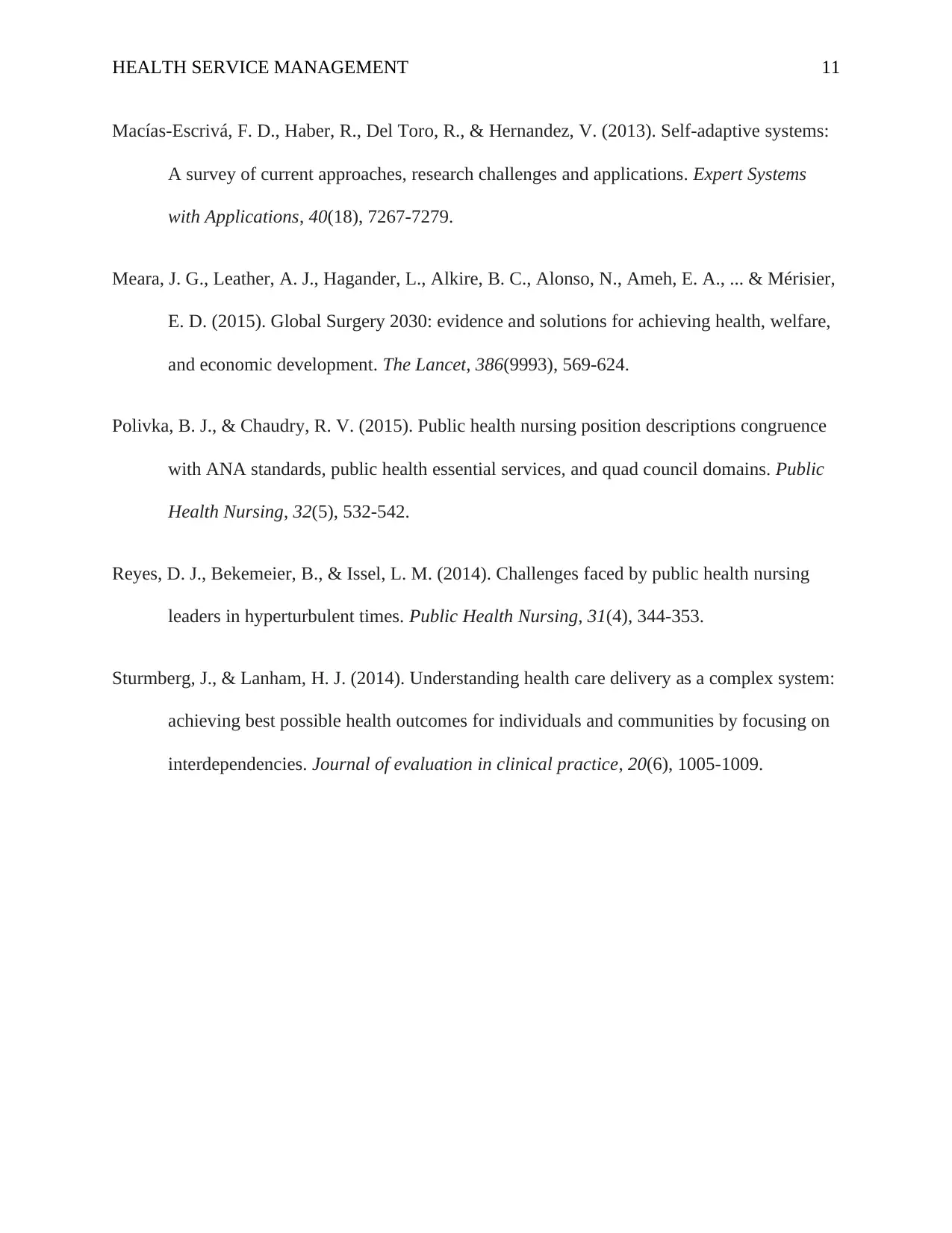
Macías-Escrivá, F. D., Haber, R., Del Toro, R., & Hernandez, V. (2013). Self-adaptive systems:
A survey of current approaches, research challenges and applications. Expert Systems
with Applications, 40(18), 7267-7279.
Meara, J. G., Leather, A. J., Hagander, L., Alkire, B. C., Alonso, N., Ameh, E. A., ... & Mérisier,
E. D. (2015). Global Surgery 2030: evidence and solutions for achieving health, welfare,
and economic development. The Lancet, 386(9993), 569-624.
Polivka, B. J., & Chaudry, R. V. (2015). Public health nursing position descriptions congruence
with ANA standards, public health essential services, and quad council domains. Public
Health Nursing, 32(5), 532-542.
Reyes, D. J., Bekemeier, B., & Issel, L. M. (2014). Challenges faced by public health nursing
leaders in hyperturbulent times. Public Health Nursing, 31(4), 344-353.
Sturmberg, J., & Lanham, H. J. (2014). Understanding health care delivery as a complex system:
achieving best possible health outcomes for individuals and communities by focusing on
interdependencies. Journal of evaluation in clinical practice, 20(6), 1005-1009.
Macías-Escrivá, F. D., Haber, R., Del Toro, R., & Hernandez, V. (2013). Self-adaptive systems:
A survey of current approaches, research challenges and applications. Expert Systems
with Applications, 40(18), 7267-7279.
Meara, J. G., Leather, A. J., Hagander, L., Alkire, B. C., Alonso, N., Ameh, E. A., ... & Mérisier,
E. D. (2015). Global Surgery 2030: evidence and solutions for achieving health, welfare,
and economic development. The Lancet, 386(9993), 569-624.
Polivka, B. J., & Chaudry, R. V. (2015). Public health nursing position descriptions congruence
with ANA standards, public health essential services, and quad council domains. Public
Health Nursing, 32(5), 532-542.
Reyes, D. J., Bekemeier, B., & Issel, L. M. (2014). Challenges faced by public health nursing
leaders in hyperturbulent times. Public Health Nursing, 31(4), 344-353.
Sturmberg, J., & Lanham, H. J. (2014). Understanding health care delivery as a complex system:
achieving best possible health outcomes for individuals and communities by focusing on
interdependencies. Journal of evaluation in clinical practice, 20(6), 1005-1009.

1 out of 11


Related Documents


Your All-in-One AI-Powered Toolkit for Academic Success.
+13062052269
info@desklib.com
Available 24*7 on WhatsApp / Email
![[object Object]](/_next/static/media/star-bottom.7253800d.svg)
Unlock your academic potential
Copyright © 2020–2026 A2Z Services. All Rights Reserved. Developed and managed by ZUCOL.