NVQ Report: Operational Objectives for Registered Nurses in Healthcare
VerifiedAdded on 2023/01/13
|11
|3274
|100
Report
AI Summary
This NVQ report delves into the operational objectives of a registered nurse within a health and social care setting, specifically focusing on the care of children and young people. The report outlines the nurse's key responsibilities, including patient care, medical history management, meal planning, and ensuring a safe and healthy environment. It then correlates these operational objectives with the broader organizational goals of providing quality treatment, employing skilled staff, and maintaining updated policies. The report identifies potential risks, such as irregular forecasting, faulty decision-making, natural calamities, and lack of backup plans, along with contingency arrangements. It also analyzes relevant stakeholders, including committee members, parents, staff, and regulatory bodies. Finally, the report details an operational plan to address staffing needs and improve patient care, including methods for staff training and recruitment.

NVQ

Paraphrase This Document
Need a fresh take? Get an instant paraphrase of this document with our AI Paraphraser
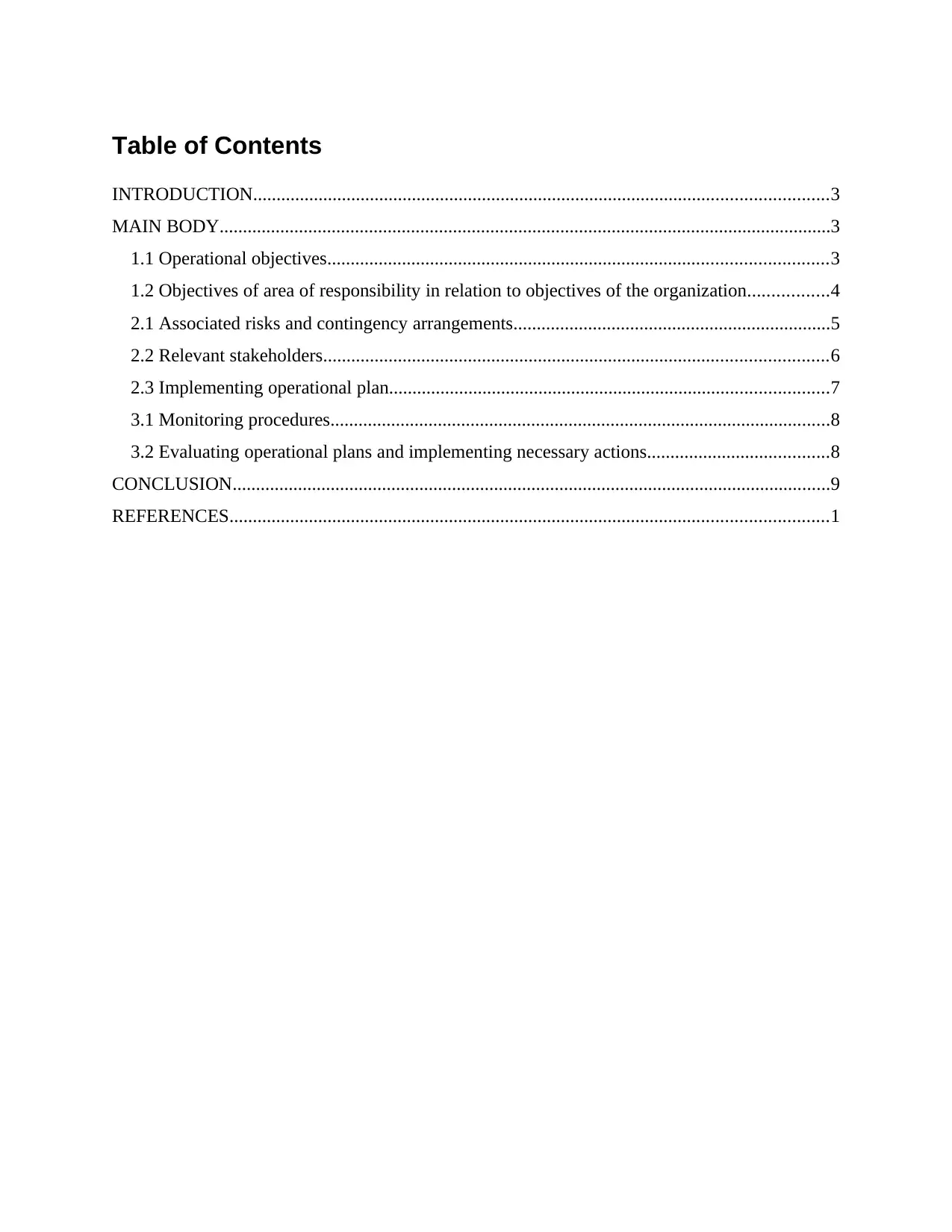
Table of Contents
INTRODUCTION...........................................................................................................................3
MAIN BODY...................................................................................................................................3
1.1 Operational objectives...........................................................................................................3
1.2 Objectives of area of responsibility in relation to objectives of the organization.................4
2.1 Associated risks and contingency arrangements....................................................................5
2.2 Relevant stakeholders............................................................................................................6
2.3 Implementing operational plan..............................................................................................7
3.1 Monitoring procedures...........................................................................................................8
3.2 Evaluating operational plans and implementing necessary actions.......................................8
CONCLUSION................................................................................................................................9
REFERENCES................................................................................................................................1
INTRODUCTION...........................................................................................................................3
MAIN BODY...................................................................................................................................3
1.1 Operational objectives...........................................................................................................3
1.2 Objectives of area of responsibility in relation to objectives of the organization.................4
2.1 Associated risks and contingency arrangements....................................................................5
2.2 Relevant stakeholders............................................................................................................6
2.3 Implementing operational plan..............................................................................................7
3.1 Monitoring procedures...........................................................................................................8
3.2 Evaluating operational plans and implementing necessary actions.......................................8
CONCLUSION................................................................................................................................9
REFERENCES................................................................................................................................1
INTRODUCTION
Operational plans in the health and social care generally pertain to the issues that are
related to operational efficiency of the firm i.e. the staffing related issues or the quality related
aspects etc. The current report will highlight the different operational objectives of a registered
nurse in the health and social care for children and young people and this will be then evaluated
with the perception of the organizational objectives. Further, the report will identify the different
risks that are associated with the operational plan and the impact of relevant stakeholders. Then
the report will develop an operational plan and the monitoring and evaluation procedures will
also be detailed in the report further.
MAIN BODY
1.1 Operational objectives
The major area of responsibilities that I am required to comply with are the duties related
to the nursing of the children and young people that we admit in our hospital and ensure that
each patient has an adequate care plan that has been developed for them. I ensure that the past
medical history of the child is complete and the doctor who is attending them have the entire
knowledge of the patients medical history. Further, I ensure that the meals that are being served
to the children are in accordance with the medical standards, and they have an option to eat
something else if they want, given that it is healthy (Walsh, Kittler and Mahal, 2018). My
responsibilities also include to make children understand why they are being taught to brush their
teeth twice a day or why are they being given certain kind of meals rather than forcing them to
do so.
Apart from the patient centred care duties, I also oversee that the hygiene of the hospital
is maintained at all times i.e. it is not compromised with. The patients i.e. children and young
people often roam on the premises without any protection and it becomes my duty to ensure that
they live in a safe and healthy environment. I also have to ensure that there is a proper
opportunity that are available to children for expanding their knowledge while they are in the
facility. I have developed a schedule for them where they are taught different things, and they
have playing sessions where the importance of physical activity is explained to them. Every child
and younger person admitted in the facility is evaluated consistently on the basis of an
assessment plan where their performance, their behaviour, their medical progress etc. are
evaluated regularly. There are a number of nurses that are working under me and I ensure that all
Operational plans in the health and social care generally pertain to the issues that are
related to operational efficiency of the firm i.e. the staffing related issues or the quality related
aspects etc. The current report will highlight the different operational objectives of a registered
nurse in the health and social care for children and young people and this will be then evaluated
with the perception of the organizational objectives. Further, the report will identify the different
risks that are associated with the operational plan and the impact of relevant stakeholders. Then
the report will develop an operational plan and the monitoring and evaluation procedures will
also be detailed in the report further.
MAIN BODY
1.1 Operational objectives
The major area of responsibilities that I am required to comply with are the duties related
to the nursing of the children and young people that we admit in our hospital and ensure that
each patient has an adequate care plan that has been developed for them. I ensure that the past
medical history of the child is complete and the doctor who is attending them have the entire
knowledge of the patients medical history. Further, I ensure that the meals that are being served
to the children are in accordance with the medical standards, and they have an option to eat
something else if they want, given that it is healthy (Walsh, Kittler and Mahal, 2018). My
responsibilities also include to make children understand why they are being taught to brush their
teeth twice a day or why are they being given certain kind of meals rather than forcing them to
do so.
Apart from the patient centred care duties, I also oversee that the hygiene of the hospital
is maintained at all times i.e. it is not compromised with. The patients i.e. children and young
people often roam on the premises without any protection and it becomes my duty to ensure that
they live in a safe and healthy environment. I also have to ensure that there is a proper
opportunity that are available to children for expanding their knowledge while they are in the
facility. I have developed a schedule for them where they are taught different things, and they
have playing sessions where the importance of physical activity is explained to them. Every child
and younger person admitted in the facility is evaluated consistently on the basis of an
assessment plan where their performance, their behaviour, their medical progress etc. are
evaluated regularly. There are a number of nurses that are working under me and I ensure that all
⊘ This is a preview!⊘
Do you want full access?
Subscribe today to unlock all pages.

Trusted by 1+ million students worldwide
of them work in a coordinated manner where they understand the different duties they are
required to perform, and they recognize the importance of such duties or roles that they have
been assigned (Francetic and et.al., 2019). All the points detailed above consists of the
operational objectives that I am required to perform within my own area of responsibility i.e. as a
registered nurse in the facility.
1.2 Objectives of area of responsibility in relation to objectives of the organization
In order to give a proper care environment to the children and younger people, it is
necessary to ensure that the nurses and care takers that are bing hired in the facility are
adequately trained and recognize the different duties that they are required to perform. As a head
registered nurse, I have to hire skilled and experienced nurses and reviewing their qualifications
so that I can ensure the employment of a good quality staff is my responsibility corresponding
with that of the organizational objective of quality management. I have to work very closely with
the coordinator in developing the individual care plan and assessment plan for the children and to
ensure that quality of care is not compromised with.
There are 3 major organizational objectives i.e. to offer good and quality treatment to the
patients, ensure availability of skilled staff who can treat them adequately and maintaining
updated policies and practices in the healthcare facility (Matthias and Brown, 2016). As a
registered nurse, apart from the implementation of updated policies in the facility, both of the
remaining objectives are synchronized with my objectives. I regularly overview the different
care plan and strategies that are being implemented in the facility, the hygienic state of the
facility and the different treatment and care plans that are developed for the children. I give
emphasis on the development of individual plans so that care can be given to the children in an
exhaustive manner. Another major objective that is covered under my responsibility is that I
have to monitor the performance of the nurses and caretakers working under me. I regularly
check the knowledge and relevant skills of the caretakers that I have hired so that I can check
whether they are able to provide quality care or not to the patients and I rate their performance.
Lastly, I ensure that for meeting the care requirement of the patients I have adequate staff in the
facility i.e. there are adequate number of nurses and caretakers in the facility so that the
requirements of the children can be addressed at all times (Henderson and Seden, 2017).
In this manner, my objectives are inherently aligned with the objectives of the entire
healthcare facility and therefore there are collective efforts to achieve the stated objectives.
required to perform, and they recognize the importance of such duties or roles that they have
been assigned (Francetic and et.al., 2019). All the points detailed above consists of the
operational objectives that I am required to perform within my own area of responsibility i.e. as a
registered nurse in the facility.
1.2 Objectives of area of responsibility in relation to objectives of the organization
In order to give a proper care environment to the children and younger people, it is
necessary to ensure that the nurses and care takers that are bing hired in the facility are
adequately trained and recognize the different duties that they are required to perform. As a head
registered nurse, I have to hire skilled and experienced nurses and reviewing their qualifications
so that I can ensure the employment of a good quality staff is my responsibility corresponding
with that of the organizational objective of quality management. I have to work very closely with
the coordinator in developing the individual care plan and assessment plan for the children and to
ensure that quality of care is not compromised with.
There are 3 major organizational objectives i.e. to offer good and quality treatment to the
patients, ensure availability of skilled staff who can treat them adequately and maintaining
updated policies and practices in the healthcare facility (Matthias and Brown, 2016). As a
registered nurse, apart from the implementation of updated policies in the facility, both of the
remaining objectives are synchronized with my objectives. I regularly overview the different
care plan and strategies that are being implemented in the facility, the hygienic state of the
facility and the different treatment and care plans that are developed for the children. I give
emphasis on the development of individual plans so that care can be given to the children in an
exhaustive manner. Another major objective that is covered under my responsibility is that I
have to monitor the performance of the nurses and caretakers working under me. I regularly
check the knowledge and relevant skills of the caretakers that I have hired so that I can check
whether they are able to provide quality care or not to the patients and I rate their performance.
Lastly, I ensure that for meeting the care requirement of the patients I have adequate staff in the
facility i.e. there are adequate number of nurses and caretakers in the facility so that the
requirements of the children can be addressed at all times (Henderson and Seden, 2017).
In this manner, my objectives are inherently aligned with the objectives of the entire
healthcare facility and therefore there are collective efforts to achieve the stated objectives.
Paraphrase This Document
Need a fresh take? Get an instant paraphrase of this document with our AI Paraphraser
2.1 Associated risks and contingency arrangements
In every organization, business or unit, there are certain risks that are inherent with the
operations of the business. It is necessary to identify and mitigate the potential risks and develop
the contingency plans accordingly. As a registered nurse, there are various risk factors that have
to be considered in order to avoid any prudent losses and act accordingly: Irregular Forecasting: It is necessary to regularly monitor the health security levels and
trends that are ongoing currently. For instance acknowledging the threat of Corona Virus
that is spreading like a plague is a potential health related threat to the children and young
person. It is important to develop the practices that will help in minimizing the trends that
are prevalent in the current market (Murphy, Wankhade and Lakoma, 2019). Developing
proactive measures rather than reactive will help in mitigating the potential risks that
could have otherwise affected severely. Faulty decision-making: While working in a healthcare facilities, every decision needs to
be done in a prudent and careful manner because the lives are at stake. The hiring of the
nurses and caretakers need to be done after the detailed evaluation, the past medial
history of the patient must be recorded in detail and the documents should be maintained
properly so that the care plan that is developed does not prove to be negatively affecting. Natural or Artificial Calamities: There can be any sort of natural calamity such as
floods, draughts, earthquakes etc. and in order to develop appropriate measures, it is
necessary to make he staff and the patients familiar with the safety drills that are
undertaken (Henderson and Seden, 2017). Since majority of the patients are children, the
staff needs to be prepared in a better way to deal with such contingencies. Artificial
problems are man made i.e. leaks in the sanitation pipes etc., can also expose the hygiene
of the facility at a risk thus making the requirement of a proper contingency plan
necessary.
Lack of any backup plan: Risks of all kinds and type can arise in an organization and
therefore it is necessary to develop a back up plan that can be implemented in the
organization so that implementation of appropriate strategies and planning can assist in
minimizing potential losses that might be incurred.
In every organization, business or unit, there are certain risks that are inherent with the
operations of the business. It is necessary to identify and mitigate the potential risks and develop
the contingency plans accordingly. As a registered nurse, there are various risk factors that have
to be considered in order to avoid any prudent losses and act accordingly: Irregular Forecasting: It is necessary to regularly monitor the health security levels and
trends that are ongoing currently. For instance acknowledging the threat of Corona Virus
that is spreading like a plague is a potential health related threat to the children and young
person. It is important to develop the practices that will help in minimizing the trends that
are prevalent in the current market (Murphy, Wankhade and Lakoma, 2019). Developing
proactive measures rather than reactive will help in mitigating the potential risks that
could have otherwise affected severely. Faulty decision-making: While working in a healthcare facilities, every decision needs to
be done in a prudent and careful manner because the lives are at stake. The hiring of the
nurses and caretakers need to be done after the detailed evaluation, the past medial
history of the patient must be recorded in detail and the documents should be maintained
properly so that the care plan that is developed does not prove to be negatively affecting. Natural or Artificial Calamities: There can be any sort of natural calamity such as
floods, draughts, earthquakes etc. and in order to develop appropriate measures, it is
necessary to make he staff and the patients familiar with the safety drills that are
undertaken (Henderson and Seden, 2017). Since majority of the patients are children, the
staff needs to be prepared in a better way to deal with such contingencies. Artificial
problems are man made i.e. leaks in the sanitation pipes etc., can also expose the hygiene
of the facility at a risk thus making the requirement of a proper contingency plan
necessary.
Lack of any backup plan: Risks of all kinds and type can arise in an organization and
therefore it is necessary to develop a back up plan that can be implemented in the
organization so that implementation of appropriate strategies and planning can assist in
minimizing potential losses that might be incurred.
2.2 Relevant stakeholders
Stakeholders are those parties that are interested in the activities that are being
undertaken in the business or in the organization and these stakeholders can at times offer
support in the development of the organization whenever it is required. For the healthcare
services, the major stakeholders are: Committee Members: These are the managers of the healthcare facilities and the majority
of decision-making activities are undertaken by these members (Walsh and et.al., 2019).
Providing additional funds, approving budgets, fund-raising, expenditures or investments
to be made, etc. all are approved by these committee members. This category of
stakeholders can help in implementing some critical measures for the benefit of the
healthcare facility. Parents/ Family Members of the patients: This is another important category of
stakeholders who play a important role in devising the care plan or the treatment that
their child must receive. Since the majority of the patients are either young or are simply
child, the approval of parents is a critical thing that makes their approval an important
part of decision-making. The workers of the facility need to have a peaceful relationship
with the parents where there trust in the treatments being offered is very important. Staff: Staff is also a major participant in coordinating and integrating the efforts
collectively, and they need to understand how the different care polices need to be
applied and the manner in which treatment and assessment of the patients needs to be
done (Shepherd, 2020). Their consent regarding the methods being adopted and the
understanding of such methods is critical in understanding that how care needs to be
provided to the children in the facility.
CQC, Inspectors etc.: These are the most crucial stakeholders who evaluate how the care
takers are working, the treatment methods being adopted in the facility, the hygiene that
is being maintained and ensure that they meet the standards regarding healthcare facilities
that have been developed by such regulatory bodies in the healthcare sector in UK.
Therefore, all these stakeholders are major parties who affect and influence the decisions
that are being made on the way children or young persons are being treated and also the manner
in which the healthcare facility operates.
Stakeholders are those parties that are interested in the activities that are being
undertaken in the business or in the organization and these stakeholders can at times offer
support in the development of the organization whenever it is required. For the healthcare
services, the major stakeholders are: Committee Members: These are the managers of the healthcare facilities and the majority
of decision-making activities are undertaken by these members (Walsh and et.al., 2019).
Providing additional funds, approving budgets, fund-raising, expenditures or investments
to be made, etc. all are approved by these committee members. This category of
stakeholders can help in implementing some critical measures for the benefit of the
healthcare facility. Parents/ Family Members of the patients: This is another important category of
stakeholders who play a important role in devising the care plan or the treatment that
their child must receive. Since the majority of the patients are either young or are simply
child, the approval of parents is a critical thing that makes their approval an important
part of decision-making. The workers of the facility need to have a peaceful relationship
with the parents where there trust in the treatments being offered is very important. Staff: Staff is also a major participant in coordinating and integrating the efforts
collectively, and they need to understand how the different care polices need to be
applied and the manner in which treatment and assessment of the patients needs to be
done (Shepherd, 2020). Their consent regarding the methods being adopted and the
understanding of such methods is critical in understanding that how care needs to be
provided to the children in the facility.
CQC, Inspectors etc.: These are the most crucial stakeholders who evaluate how the care
takers are working, the treatment methods being adopted in the facility, the hygiene that
is being maintained and ensure that they meet the standards regarding healthcare facilities
that have been developed by such regulatory bodies in the healthcare sector in UK.
Therefore, all these stakeholders are major parties who affect and influence the decisions
that are being made on the way children or young persons are being treated and also the manner
in which the healthcare facility operates.
⊘ This is a preview!⊘
Do you want full access?
Subscribe today to unlock all pages.
Trusted by 1+ million students worldwide
2.3 Implementing operational plan
The operational plan consists of the description of the changes that are to be made along
with the manner in which these changes are to be made and the follow-up actions that have been
devised. As a head registered nurse in the facility, currently, the facility is facing the
requirement of more skilled staff that can manage the children in a better way and the care being
given is more prominent (Verrecchia and et.al., 2019). For this, the operational plan that can be
implemented is: Current situation: Currently, the healthcare facility lacks adequately trained staff that can
identify the problem that child is facing as quickly as possible and then develop a care
plan effectively. The requires recruitment of some more trained nurses and caretakers as
well as developing training schedules for the existing nurses so that care plan for the
children can be developed as quickly as possible. Desired Situation: The facility want to make their staff multiskilled where they can
address the multiple problems of their patients and know the correct and most appropriate
patient care plan based on the individual requirements that is to be implemented (Thani
and et.al., 2019). This will help in improving the quality and frequency of the care plan
being developed thus solving the requirements of the patient in a enhanced way of
serving them. Methods to be adopted: In order to enhance the skills of existing staff, training schedules
along with working schedules can be prepared. This will help them in learning new
methods of giving care to patients. In order to recruit new staff, a recruitment procedure
involving test of practical knowledge can be adopted where the quickness and correctness
of the candidate’s in analysing a situation will help them in selecting a better staff.
Performance Measurement tactic: The performance of their employees can be measured
daily, weekly or quarterly where their heads can report their capability of judging the
patient and taking critical decisions (World Health Organization, 2018). This can be
assisted by setting p certain standard criteria that the staff is required to achieve in order
to enhance the overall performance.
Collectively apart from the steps above, in order to implement a operational plan, the
objectives must be ascertained very clearly, the budget should be developed exhaustively and the
communication of such operational plan should be done properly.
The operational plan consists of the description of the changes that are to be made along
with the manner in which these changes are to be made and the follow-up actions that have been
devised. As a head registered nurse in the facility, currently, the facility is facing the
requirement of more skilled staff that can manage the children in a better way and the care being
given is more prominent (Verrecchia and et.al., 2019). For this, the operational plan that can be
implemented is: Current situation: Currently, the healthcare facility lacks adequately trained staff that can
identify the problem that child is facing as quickly as possible and then develop a care
plan effectively. The requires recruitment of some more trained nurses and caretakers as
well as developing training schedules for the existing nurses so that care plan for the
children can be developed as quickly as possible. Desired Situation: The facility want to make their staff multiskilled where they can
address the multiple problems of their patients and know the correct and most appropriate
patient care plan based on the individual requirements that is to be implemented (Thani
and et.al., 2019). This will help in improving the quality and frequency of the care plan
being developed thus solving the requirements of the patient in a enhanced way of
serving them. Methods to be adopted: In order to enhance the skills of existing staff, training schedules
along with working schedules can be prepared. This will help them in learning new
methods of giving care to patients. In order to recruit new staff, a recruitment procedure
involving test of practical knowledge can be adopted where the quickness and correctness
of the candidate’s in analysing a situation will help them in selecting a better staff.
Performance Measurement tactic: The performance of their employees can be measured
daily, weekly or quarterly where their heads can report their capability of judging the
patient and taking critical decisions (World Health Organization, 2018). This can be
assisted by setting p certain standard criteria that the staff is required to achieve in order
to enhance the overall performance.
Collectively apart from the steps above, in order to implement a operational plan, the
objectives must be ascertained very clearly, the budget should be developed exhaustively and the
communication of such operational plan should be done properly.
Paraphrase This Document
Need a fresh take? Get an instant paraphrase of this document with our AI Paraphraser
3.1 Monitoring procedures
It is very important to regularly monitor the progress that is going on and ensuring that
the steps that are being adopted are in the correct context (Tsofa, Molyneux and Goodman,
2016). The monitoring can be done in a variety of methods:
Ensuring that the operational plan that has been developed in being implemented in the
correct manner i.e. while the plan is being implemented, the sole cause of implementing
that [plans does not get lost. For instance, while hiring the managers should keep in mind
that there goal is to hire multiskilled personnel rather than just hiring on qualification
basis.
It can be ensured that the employees understand the purpose behind developing such
policies so that they can integrate their efforts towards the changes that are being made
(Struminger and et.al., 2017). When the training sessions are being developed for new
employees, it is necessary to make them understand why they are required to undergo
some specific changes i.e. they will be able to improve their care taking skills which will
ultimately benefit them only.
Taking regular feedbacks and conducting surveys is another aspect that can be taken in to
consideration so that management can collect the opinions of the caretakers or the
patients and changes if any can be made accordingly.
3.2 Evaluating operational plans and implementing necessary actions
Evaluation can be integrated with the monitoring aspect so that collectively it assists in
ensuring correct implementation of the operational plan and then evaluating the progress being
undertaken. Benchmarking technique under which the standard performance is compared with
the actual performance and the causes of deviation are being evaluated, the key performance
indicator technique under which the key indicators of performance are developed can be counted
as the performance evaluation techniques (Al Shobaki, Amuna and Naser, 2017). However, there
are certain actions that can be recommended in order to enhance the process:
The proper records related to the evaluation can be maintained where the performance of
the employees and the impact of such improved performance on the outcomes is also
evaluated by the management.
It is very important to regularly monitor the progress that is going on and ensuring that
the steps that are being adopted are in the correct context (Tsofa, Molyneux and Goodman,
2016). The monitoring can be done in a variety of methods:
Ensuring that the operational plan that has been developed in being implemented in the
correct manner i.e. while the plan is being implemented, the sole cause of implementing
that [plans does not get lost. For instance, while hiring the managers should keep in mind
that there goal is to hire multiskilled personnel rather than just hiring on qualification
basis.
It can be ensured that the employees understand the purpose behind developing such
policies so that they can integrate their efforts towards the changes that are being made
(Struminger and et.al., 2017). When the training sessions are being developed for new
employees, it is necessary to make them understand why they are required to undergo
some specific changes i.e. they will be able to improve their care taking skills which will
ultimately benefit them only.
Taking regular feedbacks and conducting surveys is another aspect that can be taken in to
consideration so that management can collect the opinions of the caretakers or the
patients and changes if any can be made accordingly.
3.2 Evaluating operational plans and implementing necessary actions
Evaluation can be integrated with the monitoring aspect so that collectively it assists in
ensuring correct implementation of the operational plan and then evaluating the progress being
undertaken. Benchmarking technique under which the standard performance is compared with
the actual performance and the causes of deviation are being evaluated, the key performance
indicator technique under which the key indicators of performance are developed can be counted
as the performance evaluation techniques (Al Shobaki, Amuna and Naser, 2017). However, there
are certain actions that can be recommended in order to enhance the process:
The proper records related to the evaluation can be maintained where the performance of
the employees and the impact of such improved performance on the outcomes is also
evaluated by the management.
Quality assurance is another point that can be evaluated where the management must
ensure that increased training must also be in compliance with the quality norms or
standards that have been developed.
Setting up targets where the achievement of such targets and the manner in which they
have been achieved is evaluated and appropriate conclusions are drawn.
CONCLUSION
The perspective of the registered nurse was taken into evaluation in the report and their
duties were taken into consideration while developing an operational plan. The report evaluated
the different risks that are associated with the operational plan and the implementation,
monitoring and evaluation of the plan such developed was done. The current report identified the
problem inadequately skilled staff and the operational plan discussed different aspects that were
associated with the plan were identified and evaluated in the report.
ensure that increased training must also be in compliance with the quality norms or
standards that have been developed.
Setting up targets where the achievement of such targets and the manner in which they
have been achieved is evaluated and appropriate conclusions are drawn.
CONCLUSION
The perspective of the registered nurse was taken into evaluation in the report and their
duties were taken into consideration while developing an operational plan. The report evaluated
the different risks that are associated with the operational plan and the implementation,
monitoring and evaluation of the plan such developed was done. The current report identified the
problem inadequately skilled staff and the operational plan discussed different aspects that were
associated with the plan were identified and evaluated in the report.
⊘ This is a preview!⊘
Do you want full access?
Subscribe today to unlock all pages.
Trusted by 1+ million students worldwide
REFERENCES
Books and journals
Al Shobaki, M.J., Amuna, Y.M.A. and Naser, S.S.A., 2017. Strategic and Operational Planning
As Approach for Crises Management Field Study on UNRWA.
Francetic, I. and et.al., 2019. Going operational with health systems governance: supervision and
incentives to health workers for increased quality of care in Tanzania. Health policy and
planning. 34(Supplement_2), pp.ii77-ii92.
Henderson, J. and Seden, J., 2017. What do we want from social care managers? Aspirations and
realities. In Questioning the New Public Management (pp. 37-53). Routledge.
Matthias, O. and Brown, S., 2016. Implementing operations strategy through Lean processes
within health care. International Journal of Operations & Production Management.
Murphy, P., Wankhade, P. and Lakoma, K., 2019. The strategic and operational landscape of
emergency services in the UK. International Journal of Emergency Services.
Shepherd, J.G., 2020. Strategizing to improve operational efficiency and healthcare quality
improvement at a rural health network.
Struminger, B. and et.al., 2017. Building virtual communities of practice for health. The
Lancet. 390(10095). pp.632-634.
Thani, P.R. And et.al., 2019. Integrating biodiversity conservation and ecosystem services into
operational plan of community forest in Nepal: status and gaps. Banko Janakari. 29(1).
pp.3-11.
Tsofa, B., Molyneux, S. and Goodman, C., 2016. Health sector operational planning and
budgeting processes in Kenya—“never the twain shall meet”. The International journal of
health planning and management. 31(3). pp.260-276.
Verrecchia, R., Dar, O., Mohamed-Ahmed, O. and Squires, N., 2019. Building operational
public health capacity through collaborative networks of National Public Health
Institutes. BMJ global health. 4(5). p.e001868.
Walsh, M. and et.al., 2019. Designing a recovery-orientated system of care: A community
operational research perspective. European Journal of Operational Research. 272(2).
pp.595-607.
1
Books and journals
Al Shobaki, M.J., Amuna, Y.M.A. and Naser, S.S.A., 2017. Strategic and Operational Planning
As Approach for Crises Management Field Study on UNRWA.
Francetic, I. and et.al., 2019. Going operational with health systems governance: supervision and
incentives to health workers for increased quality of care in Tanzania. Health policy and
planning. 34(Supplement_2), pp.ii77-ii92.
Henderson, J. and Seden, J., 2017. What do we want from social care managers? Aspirations and
realities. In Questioning the New Public Management (pp. 37-53). Routledge.
Matthias, O. and Brown, S., 2016. Implementing operations strategy through Lean processes
within health care. International Journal of Operations & Production Management.
Murphy, P., Wankhade, P. and Lakoma, K., 2019. The strategic and operational landscape of
emergency services in the UK. International Journal of Emergency Services.
Shepherd, J.G., 2020. Strategizing to improve operational efficiency and healthcare quality
improvement at a rural health network.
Struminger, B. and et.al., 2017. Building virtual communities of practice for health. The
Lancet. 390(10095). pp.632-634.
Thani, P.R. And et.al., 2019. Integrating biodiversity conservation and ecosystem services into
operational plan of community forest in Nepal: status and gaps. Banko Janakari. 29(1).
pp.3-11.
Tsofa, B., Molyneux, S. and Goodman, C., 2016. Health sector operational planning and
budgeting processes in Kenya—“never the twain shall meet”. The International journal of
health planning and management. 31(3). pp.260-276.
Verrecchia, R., Dar, O., Mohamed-Ahmed, O. and Squires, N., 2019. Building operational
public health capacity through collaborative networks of National Public Health
Institutes. BMJ global health. 4(5). p.e001868.
Walsh, M. and et.al., 2019. Designing a recovery-orientated system of care: A community
operational research perspective. European Journal of Operational Research. 272(2).
pp.595-607.
1
Paraphrase This Document
Need a fresh take? Get an instant paraphrase of this document with our AI Paraphraser

Walsh, M., Kittler, M.G. and Mahal, D., 2018. Towards a new paradigm of healthcare:
Addressing challenges to professional identities through Community Operational
Research. European Journal of Operational Research. 268(3). pp.1125-1133.
World Health Organization, 2018. Quality, equity, dignity: the network to improve quality of
care for maternal, newborn and child health: strategic objectives.
2
Addressing challenges to professional identities through Community Operational
Research. European Journal of Operational Research. 268(3). pp.1125-1133.
World Health Organization, 2018. Quality, equity, dignity: the network to improve quality of
care for maternal, newborn and child health: strategic objectives.
2

1 out of 11


Related Documents


Your All-in-One AI-Powered Toolkit for Academic Success.
+13062052269
info@desklib.com
Available 24*7 on WhatsApp / Email
![[object Object]](/_next/static/media/star-bottom.7253800d.svg)
Unlock your academic potential
Copyright © 2020–2026 A2Z Services. All Rights Reserved. Developed and managed by ZUCOL.