Healthcare Organization: Structure, Quality, and Nursing Roles
VerifiedAdded on 2020/03/07
|16
|3466
|472
Report
AI Summary
This report provides a comprehensive overview of healthcare organizations, focusing on their structure, the processes involved in delivering patient care, and the measures used to assess outcomes. It delves into the importance of organizational design, including graded structures and the role of various departments like the ICU. The report explores how organizations can plan to meet quality care standards, including incentive systems, decision-making administration, and the impact of organizational culture and telecommunication. It examines the significance of process and outcome measures, using examples like diabetic patient care to illustrate the role of clinical data in maintaining quality and safety. The report also highlights the crucial role of nurses in healthcare, emphasizing their contributions to patient safety and the maintenance of high-quality care, including the impact of nursing staff shortages and the importance of teamwork.

Health Care 1
Name:
Subject:
Professor’s name:
Topic:
Date:
Name:
Subject:
Professor’s name:
Topic:
Date:

Paraphrase This Document
Need a fresh take? Get an instant paraphrase of this document with our AI Paraphraser
Health Care 2
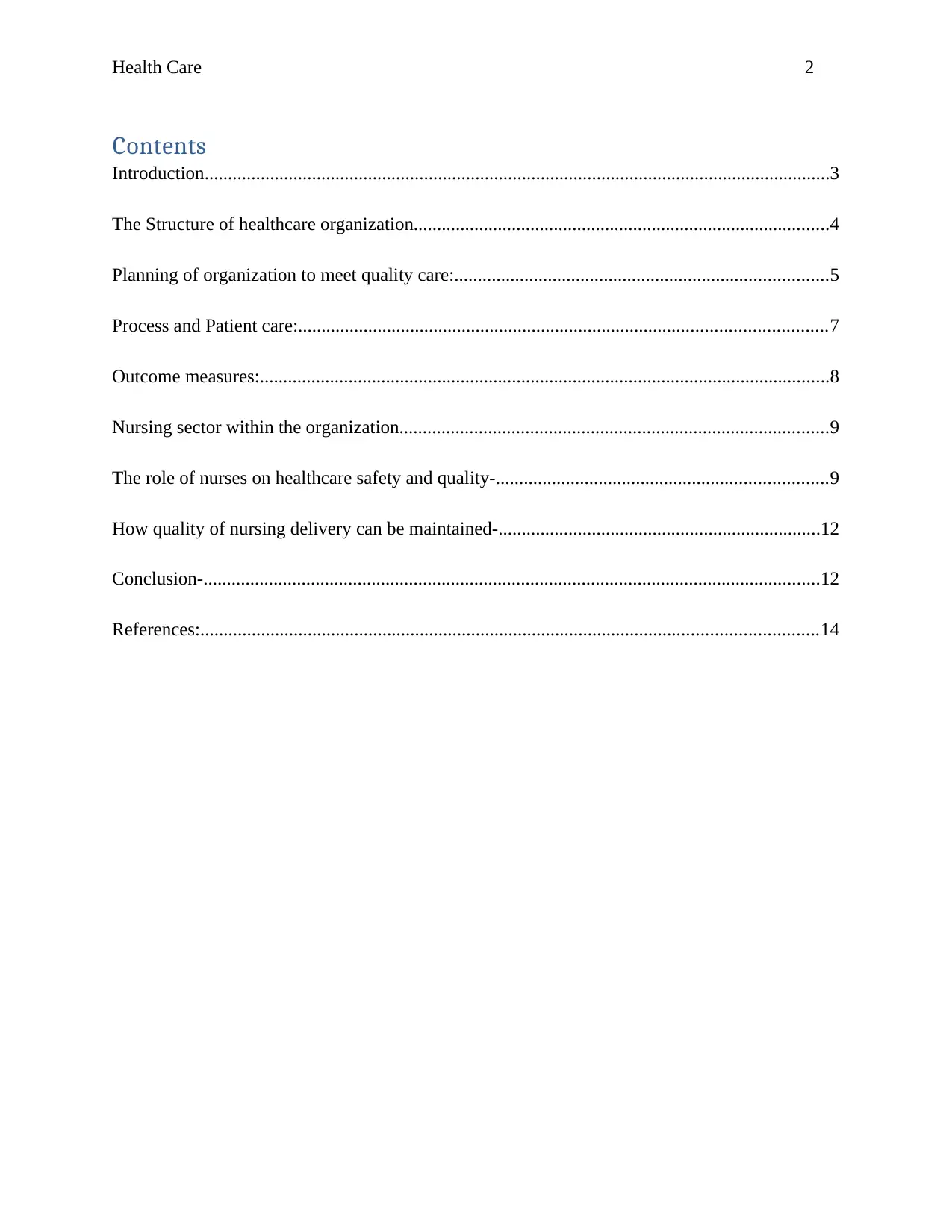
Contents
Introduction......................................................................................................................................3
The Structure of healthcare organization.........................................................................................4
Planning of organization to meet quality care:................................................................................5
Process and Patient care:.................................................................................................................7
Outcome measures:..........................................................................................................................8
Nursing sector within the organization............................................................................................9
The role of nurses on healthcare safety and quality-.......................................................................9
How quality of nursing delivery can be maintained-.....................................................................12
Conclusion-....................................................................................................................................12
References:....................................................................................................................................14
Contents
Introduction......................................................................................................................................3
The Structure of healthcare organization.........................................................................................4
Planning of organization to meet quality care:................................................................................5
Process and Patient care:.................................................................................................................7
Outcome measures:..........................................................................................................................8
Nursing sector within the organization............................................................................................9
The role of nurses on healthcare safety and quality-.......................................................................9
How quality of nursing delivery can be maintained-.....................................................................12
Conclusion-....................................................................................................................................12
References:....................................................................................................................................14
Health Care 3
Introduction
Healthcare is explained as services contributed to persons or communities by health care faculty
for the objective of developing, managing, scanning or strengthening health (WHO). It includes
the power to influence factors of health-improving activities. Satisfying well-being services are
meant to deliver safe, adequate and valuable quality care for needy.
A healthcare organization defined as that workforce who works in responsive, honest and an
efficient manner which leads to the best health results by providing available resources, the
satisfactory number of equally distributed staff who is active and productive (Bartunek, 2011).
A well-organized healthcare system includes (WHO):
Positive impact on the health status of individuals, families, communities
Defending the population from what can cause diseases
Protecting people from the financial burden caused due to illness
Providing equal and easily accessible care to peoples
To achieve above aims, all health organization have to plan and execute some essential activities,
regardless of how they are coordinated: they have to give satisfying deliveries, mobilize and allot
finances, evolve skilled health workers, and ensure health system governance and leadership.
Quality health care organization who follow standards give safety to the patients; the one
following regulations are considered as the quality care providers. Quality may be explained as
an optimal balance between observation and specify values. The quality of care is a
multidimensional concept; it is a system that must certificate each patient the fusion of
therapeutic and symptomatic act which provides the perfect outcomes regarding of health at the
Introduction
Healthcare is explained as services contributed to persons or communities by health care faculty
for the objective of developing, managing, scanning or strengthening health (WHO). It includes
the power to influence factors of health-improving activities. Satisfying well-being services are
meant to deliver safe, adequate and valuable quality care for needy.
A healthcare organization defined as that workforce who works in responsive, honest and an
efficient manner which leads to the best health results by providing available resources, the
satisfactory number of equally distributed staff who is active and productive (Bartunek, 2011).
A well-organized healthcare system includes (WHO):
Positive impact on the health status of individuals, families, communities
Defending the population from what can cause diseases
Protecting people from the financial burden caused due to illness
Providing equal and easily accessible care to peoples
To achieve above aims, all health organization have to plan and execute some essential activities,
regardless of how they are coordinated: they have to give satisfying deliveries, mobilize and allot
finances, evolve skilled health workers, and ensure health system governance and leadership.
Quality health care organization who follow standards give safety to the patients; the one
following regulations are considered as the quality care providers. Quality may be explained as
an optimal balance between observation and specify values. The quality of care is a
multidimensional concept; it is a system that must certificate each patient the fusion of
therapeutic and symptomatic act which provides the perfect outcomes regarding of health at the
⊘ This is a preview!⊘
Do you want full access?
Subscribe today to unlock all pages.

Trusted by 1+ million students worldwide
Health Care 4
lowest cost and for his greatest satisfaction regarding of procedures, result in the health care
system (Brand & L. Barker, 2012).
The Structure of healthcare organization
Good organizational design and structure avoid confusion chaos of conflict: distraction from
work, an absence of arrangement among jobs, collapsing to share ideas, and moderate decision-
making brings supervisors unnecessary intricacy, stress, and clash. Healthcare structure includes
organizational resources, practice conditions, qualifications of professionals. Hospitals composed
and aligned with a graded and divisional organization. Graded structure means the different level
of faculty from higher to lower post is responsible for others within their corresponding
distribution. Structure measure checks out the framework of healthcare ambiances like hospitals
or doctor offices and figures out whether the healthcare environment is capable of delivering
appropriate and proper care to the patient. The above measure accommodates staffing of
facilities and the efficiency of the staff, the policy surrounding in which care has given and
required resources within an institution. Their general features include nurse staffing, great
technology, space, experienced expertize, urban/rural area, learning hospital status.
The Organizational arrangement is an official, supervised system for linking the person,
knowledge, technology of a management and delivers as a particular structural component which
allows association of maximizes value by coordinating their collective layout to overall scenario.
There are several different seats within a hospital’s management to compose the facility to work
accurately. The graded arrangement operates great for accountability function, but it can usually
generate several mangled lines intercommunication within the organization (Owusu Kwateng,
Vivian Osei & EkowAbban, 2014).
Example of structural measures can be: -
lowest cost and for his greatest satisfaction regarding of procedures, result in the health care
system (Brand & L. Barker, 2012).
The Structure of healthcare organization
Good organizational design and structure avoid confusion chaos of conflict: distraction from
work, an absence of arrangement among jobs, collapsing to share ideas, and moderate decision-
making brings supervisors unnecessary intricacy, stress, and clash. Healthcare structure includes
organizational resources, practice conditions, qualifications of professionals. Hospitals composed
and aligned with a graded and divisional organization. Graded structure means the different level
of faculty from higher to lower post is responsible for others within their corresponding
distribution. Structure measure checks out the framework of healthcare ambiances like hospitals
or doctor offices and figures out whether the healthcare environment is capable of delivering
appropriate and proper care to the patient. The above measure accommodates staffing of
facilities and the efficiency of the staff, the policy surrounding in which care has given and
required resources within an institution. Their general features include nurse staffing, great
technology, space, experienced expertize, urban/rural area, learning hospital status.
The Organizational arrangement is an official, supervised system for linking the person,
knowledge, technology of a management and delivers as a particular structural component which
allows association of maximizes value by coordinating their collective layout to overall scenario.
There are several different seats within a hospital’s management to compose the facility to work
accurately. The graded arrangement operates great for accountability function, but it can usually
generate several mangled lines intercommunication within the organization (Owusu Kwateng,
Vivian Osei & EkowAbban, 2014).
Example of structural measures can be: -
Paraphrase This Document
Need a fresh take? Get an instant paraphrase of this document with our AI Paraphraser
Health Care 5
There is a diagnosis care consultant in the ICU or the intensive care unit at all times?
An ICU is particular unit of a healthcare which delivers regular and complete care to the patients
who suffer from serious disease and need exclusive treatment. In ICU, patient need life support
system for breathing and oxygen demand. To fulfill above need, these patients are continuously
attend and scanned by specific team members who includes doctors, nurses, occupational
therapists, dieticians (Frankel & Moss, 2015). In Australia, there is one nurse over two patients
to take care regular responsibility of them. For example-
A) For giving medication and liquids to the patients recommended by the physicians
B) Measuring the breathing rate, blood pressure level, heart rate
Planning of organization to meet quality care:
In hospitals introduction of the bonus-base incentive system that can be shared by all health
system personnel when collective quality aims are achieved. These financial encouragements
could then be accomplished by contributing to clinical service manager and leading authority for
meeting quality targets. The use of monetary incentives to award consistent achievement has
attained new passionate reinforcement. Outstanding business has grown management and
organizational framework that leads to corporate-level goals. At the same time, it reinforces the
efficiency of personnel business units to address their regional opposing surroundings.
A strong-working health system establishes proper access to necessary medical products,
vaccines and automation of guaranteed quality, security, adequacy and cost-effective use. There
should be the collaboration of clinicians in total quality management when the prospective
alteration in organizational structure occurs regarding the physician’s roles in quality
There is a diagnosis care consultant in the ICU or the intensive care unit at all times?
An ICU is particular unit of a healthcare which delivers regular and complete care to the patients
who suffer from serious disease and need exclusive treatment. In ICU, patient need life support
system for breathing and oxygen demand. To fulfill above need, these patients are continuously
attend and scanned by specific team members who includes doctors, nurses, occupational
therapists, dieticians (Frankel & Moss, 2015). In Australia, there is one nurse over two patients
to take care regular responsibility of them. For example-
A) For giving medication and liquids to the patients recommended by the physicians
B) Measuring the breathing rate, blood pressure level, heart rate
Planning of organization to meet quality care:
In hospitals introduction of the bonus-base incentive system that can be shared by all health
system personnel when collective quality aims are achieved. These financial encouragements
could then be accomplished by contributing to clinical service manager and leading authority for
meeting quality targets. The use of monetary incentives to award consistent achievement has
attained new passionate reinforcement. Outstanding business has grown management and
organizational framework that leads to corporate-level goals. At the same time, it reinforces the
efficiency of personnel business units to address their regional opposing surroundings.
A strong-working health system establishes proper access to necessary medical products,
vaccines and automation of guaranteed quality, security, adequacy and cost-effective use. There
should be the collaboration of clinicians in total quality management when the prospective
alteration in organizational structure occurs regarding the physician’s roles in quality
Health Care 6
management at service level along with straight announcement to the chief executive officer of
the hospital (Shojania, 2011).
There are five primary focus elements of a framework that presents a practical explanation of
design: decision-making administration, organizational structure, incentive design, culture,
knowledge network and telecommunication (Mohanty & Rath, 2013).
Decision-making administration- it includes senior responsibility and huge responsibility. It
educates boards regarding quality. It decided on regarding commercial financing in quality and
staff salary.
Organizational structure- Organizational design is a general, manage task for associating person,
technology, knowledge of a healthcare which delivers as a main basic aspect that permits the
collaborations of the maximum by pairing their corporate layout to total strategy.
Incentive design- It improve the quality of care in the hospital, incentive plays a dominant role.
The use of economic incentive to praise the outstanding performance of staff has gained
motivation to serve the good qualities to the patient.
Culture- This quality plays a dominant role in overall organization quality. The culture of
healthcare should consider as the leading aspect of the total strategy of a firm in forming quality
raised steps. Culture allows adapting in the differing surrounding. The civilization effects a staff
leadership trait culture of quality. It has been at some of the healthcare and these results in
improvement in quality management in those healthcare.
management at service level along with straight announcement to the chief executive officer of
the hospital (Shojania, 2011).
There are five primary focus elements of a framework that presents a practical explanation of
design: decision-making administration, organizational structure, incentive design, culture,
knowledge network and telecommunication (Mohanty & Rath, 2013).
Decision-making administration- it includes senior responsibility and huge responsibility. It
educates boards regarding quality. It decided on regarding commercial financing in quality and
staff salary.
Organizational structure- Organizational design is a general, manage task for associating person,
technology, knowledge of a healthcare which delivers as a main basic aspect that permits the
collaborations of the maximum by pairing their corporate layout to total strategy.
Incentive design- It improve the quality of care in the hospital, incentive plays a dominant role.
The use of economic incentive to praise the outstanding performance of staff has gained
motivation to serve the good qualities to the patient.
Culture- This quality plays a dominant role in overall organization quality. The culture of
healthcare should consider as the leading aspect of the total strategy of a firm in forming quality
raised steps. Culture allows adapting in the differing surrounding. The civilization effects a staff
leadership trait culture of quality. It has been at some of the healthcare and these results in
improvement in quality management in those healthcare.
⊘ This is a preview!⊘
Do you want full access?
Subscribe today to unlock all pages.
Trusted by 1+ million students worldwide
Health Care 7
Telecommunication- telecommunication is critical to raised quality. It needs high-investing cost.
If the knowledge process should not have collected correctively then the quality of outcome will
suffer. By maintain proper knowledge about patient aspect, quality within health care can be
improved (Thien, 2016).
Process and Patient care:
Clinical or regulatory working possesses elements of association and care coordination, the
volume of patients, human resource management practices, inter-professional communication.
Occasionally management defined as the system composed of social and scientific services and
activities occurring within organizations for the function to achieve proposed target through
people and other resources (Steuten & Buxton, 2010).
Process measures are used to check the specific services which are given to the patients by staff
are matchable with the suggested protocol for care or not. These areas are occasionally related to
treatment or methods that are well-known to upgrade health status or avoid prospective
complexity or health status.
Process measure often reflects professional regulation of care. A good process measure should
always possess proof that can actually relate a procedure with increased efficiency. Current
process measure is widely aimed at the field of chronic disease management and its prohibition.
It has the limitation that it does not produce regularly assume results and the user should be alert
by this drawback. Process measure has inadequacy in the important field of care which can also
contribute to results for example care systematization and technology (Speziale, 2015). Process
measure which is grown in future should aim at these broad fields.
Telecommunication- telecommunication is critical to raised quality. It needs high-investing cost.
If the knowledge process should not have collected correctively then the quality of outcome will
suffer. By maintain proper knowledge about patient aspect, quality within health care can be
improved (Thien, 2016).
Process and Patient care:
Clinical or regulatory working possesses elements of association and care coordination, the
volume of patients, human resource management practices, inter-professional communication.
Occasionally management defined as the system composed of social and scientific services and
activities occurring within organizations for the function to achieve proposed target through
people and other resources (Steuten & Buxton, 2010).
Process measures are used to check the specific services which are given to the patients by staff
are matchable with the suggested protocol for care or not. These areas are occasionally related to
treatment or methods that are well-known to upgrade health status or avoid prospective
complexity or health status.
Process measure often reflects professional regulation of care. A good process measure should
always possess proof that can actually relate a procedure with increased efficiency. Current
process measure is widely aimed at the field of chronic disease management and its prohibition.
It has the limitation that it does not produce regularly assume results and the user should be alert
by this drawback. Process measure has inadequacy in the important field of care which can also
contribute to results for example care systematization and technology (Speziale, 2015). Process
measure which is grown in future should aim at these broad fields.
Paraphrase This Document
Need a fresh take? Get an instant paraphrase of this document with our AI Paraphraser
Health Care 8
An example of process measures includes:
Nurse practitioners are regularly scanning the feet of diabetes patients for examining wounds-
The person who is suffering from diabetes has higher chances of neuropathy, peripheral arterial
disorder and low capability of eliminating infections. Thus diabetic patient often suffer from foot
problem, and at higher risk of gaining amputation, infection. To avoid the foot from amputation,
nurses regularly check the wounds presence on diabetic patient feet.
Outcome measures:
Outcome measure checks patient’s health as an outcome of the care they have perceived. More
characteristically outcome measures evaluate at the property of the care which effects on patient
health, health status given either intended or unintended. These measures also determine whether
the objective of care achieved or not.
Outcome measure commonly includes the conventional measure of survival, the prevalence of
disease and health related trait of life aspects (Sim & Mackie, 2013).
These measures check the patient report information whether patients are happy with the health
care which they have got or not. But these measures do not determine the overall aspect of the
patient struggle.
Outcome measures reflect the prospective outcome of the patients, so these measures are
developed with patient requirement, standards and choices in mind.
It is necessary to understand the future impact of health along with demanding variability in
patient populations when outcome measures are used and evaluate.
• Outcome measures can be especially profitable for patients when they are selecting workers or
health care services in the context of knowledge on cost.
An example of process measures includes:
Nurse practitioners are regularly scanning the feet of diabetes patients for examining wounds-
The person who is suffering from diabetes has higher chances of neuropathy, peripheral arterial
disorder and low capability of eliminating infections. Thus diabetic patient often suffer from foot
problem, and at higher risk of gaining amputation, infection. To avoid the foot from amputation,
nurses regularly check the wounds presence on diabetic patient feet.
Outcome measures:
Outcome measure checks patient’s health as an outcome of the care they have perceived. More
characteristically outcome measures evaluate at the property of the care which effects on patient
health, health status given either intended or unintended. These measures also determine whether
the objective of care achieved or not.
Outcome measure commonly includes the conventional measure of survival, the prevalence of
disease and health related trait of life aspects (Sim & Mackie, 2013).
These measures check the patient report information whether patients are happy with the health
care which they have got or not. But these measures do not determine the overall aspect of the
patient struggle.
Outcome measures reflect the prospective outcome of the patients, so these measures are
developed with patient requirement, standards and choices in mind.
It is necessary to understand the future impact of health along with demanding variability in
patient populations when outcome measures are used and evaluate.
• Outcome measures can be especially profitable for patients when they are selecting workers or
health care services in the context of knowledge on cost.
Health Care 9
Example of outcome measures include: a patient who is suffering from diabetes, what was his
amputation rate?
Role of clinical data in relation to quality and safety-
As mentioned above, in process and outcome measure, a diabetic patient example has given. On
doing process and outcome measure following data are collected-
By lab result, it has obtained that the patient A1C comes between 7-8
By pharmacy data, it is estimated that 50 units of insulin should be administer in patient.
From the history of patient, it has found that rate of hypertension has 140 over 110
These clinical data are used by healthcares in maintaining quality and safety as-
Process and outcome data gives an assurance that patient is getting improved or not.
By obtaining process and outcome data, it can be assessed that patient is getting the right
care or not
Process and outcome data provides a powerful image of a patient that what is happening
with him, and what healthcare services are provided to him by the practitioners, nurses
and other staff members.
Nursing sector within the organization
In health organization, quality of care is determined by a major aspect which includes nursing
and outcome of patients (Gagnon, Gagnon & Fortin, 2015).
The role of nurses on healthcare safety and quality-
Nurses play a vital part in the delivery of high quality and well-regulated care. The people
think that responsibility of nurses is emotional and physical task, while this is a
Example of outcome measures include: a patient who is suffering from diabetes, what was his
amputation rate?
Role of clinical data in relation to quality and safety-
As mentioned above, in process and outcome measure, a diabetic patient example has given. On
doing process and outcome measure following data are collected-
By lab result, it has obtained that the patient A1C comes between 7-8
By pharmacy data, it is estimated that 50 units of insulin should be administer in patient.
From the history of patient, it has found that rate of hypertension has 140 over 110
These clinical data are used by healthcares in maintaining quality and safety as-
Process and outcome data gives an assurance that patient is getting improved or not.
By obtaining process and outcome data, it can be assessed that patient is getting the right
care or not
Process and outcome data provides a powerful image of a patient that what is happening
with him, and what healthcare services are provided to him by the practitioners, nurses
and other staff members.
Nursing sector within the organization
In health organization, quality of care is determined by a major aspect which includes nursing
and outcome of patients (Gagnon, Gagnon & Fortin, 2015).
The role of nurses on healthcare safety and quality-
Nurses play a vital part in the delivery of high quality and well-regulated care. The people
think that responsibility of nurses is emotional and physical task, while this is a
⊘ This is a preview!⊘
Do you want full access?
Subscribe today to unlock all pages.
Trusted by 1+ million students worldwide
Health Care 10
misunderstanding as nurse’s work includes delivering care to the patient and their families by
providing the emotional, physical and stress-free environment. The shortage of nursing staff in
the hospital will lead to heavy workloads on the staffing level in hospitals (Gardner, Gardner &
O’Connel, 2013).
The quality of nursing care describes the desired execution of judgement and drugs planned to
develop patient results and avoid the adverse event. Such as the duration to which nurses
determine the danger for decline in hospital patient upon entry, implement information based
low-avoidance protocols. Attention to safety issue also includes the quality of nursing care
(Glintborg, Andersen & Poulsen, 2010). For example, the efficiency of medicine intake.
Protected responsibility involves frequent observation to patients’ status to ensure pre
identification of patient degradation and if the complications are recognized, then by making
adequate interdisciplinary team resolves this problem rapidly.
Nurses can also upgrade safe care by playing as an efficient team leader (Manning & Coad,
2015). The services of nursing care are usually a team coordination in which registered nurses
direct non-registered nurses. The kind of responsibility that nurses are conveyed is affected by
particular nurse characteristics such as experience and knowledge along with human aspects like
lethargy.
The essence of responsibility is further measured by the regularity where nurses are working. It
involves not only personal level but also includes the needs of all the patients which are fulfilled
by nurse or nursing staff and the presence of other faculty and support service of organization,
environment and culture maintained by the leader in that framework (Sargent, Forrest & Parker,
2012).
misunderstanding as nurse’s work includes delivering care to the patient and their families by
providing the emotional, physical and stress-free environment. The shortage of nursing staff in
the hospital will lead to heavy workloads on the staffing level in hospitals (Gardner, Gardner &
O’Connel, 2013).
The quality of nursing care describes the desired execution of judgement and drugs planned to
develop patient results and avoid the adverse event. Such as the duration to which nurses
determine the danger for decline in hospital patient upon entry, implement information based
low-avoidance protocols. Attention to safety issue also includes the quality of nursing care
(Glintborg, Andersen & Poulsen, 2010). For example, the efficiency of medicine intake.
Protected responsibility involves frequent observation to patients’ status to ensure pre
identification of patient degradation and if the complications are recognized, then by making
adequate interdisciplinary team resolves this problem rapidly.
Nurses can also upgrade safe care by playing as an efficient team leader (Manning & Coad,
2015). The services of nursing care are usually a team coordination in which registered nurses
direct non-registered nurses. The kind of responsibility that nurses are conveyed is affected by
particular nurse characteristics such as experience and knowledge along with human aspects like
lethargy.
The essence of responsibility is further measured by the regularity where nurses are working. It
involves not only personal level but also includes the needs of all the patients which are fulfilled
by nurse or nursing staff and the presence of other faculty and support service of organization,
environment and culture maintained by the leader in that framework (Sargent, Forrest & Parker,
2012).
Paraphrase This Document
Need a fresh take? Get an instant paraphrase of this document with our AI Paraphraser
Health Care 11
In different work surrounding under irregular staffing condition, the individual nurse may
distribute care of altered quality to patients for identical requirements.
Safety results incorporate rates of mistake in care along with possible avoidable problems in at
risk patients.
That safety practices which involves fewer mistakes and measureable problems of care
considered as a high-quality delivering care but it is often considered as only one aspect of
quality.
Serious mistakes or problems considered as poor clinical results (Råholm, 2010).
The main tasks done by nurses are-
1) Monitoring patient’s condition by analyzing risk or complications
2) Delivering optimum care by coordinating with providers
3) Acknowledgement of patients' individuality
4) Provision of individualized care
5) Development of social relationship with patient
6) Anticipation of need and willingness to help
7) Knowledge of patient as a person
8) Expression of involvement, affection, consciousness towards patient
9) Presence of adequate staff and convenience for the patients.
10) Educating patients and family members about treatment and precautions which can
minimize the risk of post hospital complication and readmission
In different work surrounding under irregular staffing condition, the individual nurse may
distribute care of altered quality to patients for identical requirements.
Safety results incorporate rates of mistake in care along with possible avoidable problems in at
risk patients.
That safety practices which involves fewer mistakes and measureable problems of care
considered as a high-quality delivering care but it is often considered as only one aspect of
quality.
Serious mistakes or problems considered as poor clinical results (Råholm, 2010).
The main tasks done by nurses are-
1) Monitoring patient’s condition by analyzing risk or complications
2) Delivering optimum care by coordinating with providers
3) Acknowledgement of patients' individuality
4) Provision of individualized care
5) Development of social relationship with patient
6) Anticipation of need and willingness to help
7) Knowledge of patient as a person
8) Expression of involvement, affection, consciousness towards patient
9) Presence of adequate staff and convenience for the patients.
10) Educating patients and family members about treatment and precautions which can
minimize the risk of post hospital complication and readmission
Health Care 12
How quality of nursing delivery can be maintained-
Rules and laws can also upgrade safe care of patients. Nurses are obligated to pursue the rules
and laws of licensing authority and ethics of profession which is provided by the differing
nursing association. These regulation, standard and rules incorporate educational qualification,
maintaining proficiency in practice and avoiding to include in any acts of the profession. For
example, misbehavior with patient, incomplete practice, acknowledging identifiable information
of a patient to a wrong person. It is a nurse’s professional responsibility to keep her safe
efficient by learning things for life-long.
Conclusion-
Health organization required to organize their task process to increase quality and public
centeredness to raise the ability of care services. All the nurses and field faculty act an important
role in maintaining quality and safety in healthcare. To achieve appropriate advantages from the
contribution of these staff members, the hospital should acknowledge their potential role.
For making nurses and other faculty actively involved in the organization for raised quality and
enhancing productivity in the hospital, there should be active participation of both within the
institution and by those who calculate their capability and pay for their duties.
Safety can be maintained by decreasing the harm which occasionally occurs in span of delivery
of care by supporting the most efficient cure for the dominant root of mortality, by increasing the
useful intercommunication and coordination of responsibility, satisfying all patients and their
families about delivery of care, engaging with communities to support healthy living, generating
quality care more approachable for patients, their families, government by manufacturing and
enhancing the use of modern healthcare service model. By providing all the requirements for
How quality of nursing delivery can be maintained-
Rules and laws can also upgrade safe care of patients. Nurses are obligated to pursue the rules
and laws of licensing authority and ethics of profession which is provided by the differing
nursing association. These regulation, standard and rules incorporate educational qualification,
maintaining proficiency in practice and avoiding to include in any acts of the profession. For
example, misbehavior with patient, incomplete practice, acknowledging identifiable information
of a patient to a wrong person. It is a nurse’s professional responsibility to keep her safe
efficient by learning things for life-long.
Conclusion-
Health organization required to organize their task process to increase quality and public
centeredness to raise the ability of care services. All the nurses and field faculty act an important
role in maintaining quality and safety in healthcare. To achieve appropriate advantages from the
contribution of these staff members, the hospital should acknowledge their potential role.
For making nurses and other faculty actively involved in the organization for raised quality and
enhancing productivity in the hospital, there should be active participation of both within the
institution and by those who calculate their capability and pay for their duties.
Safety can be maintained by decreasing the harm which occasionally occurs in span of delivery
of care by supporting the most efficient cure for the dominant root of mortality, by increasing the
useful intercommunication and coordination of responsibility, satisfying all patients and their
families about delivery of care, engaging with communities to support healthy living, generating
quality care more approachable for patients, their families, government by manufacturing and
enhancing the use of modern healthcare service model. By providing all the requirements for
⊘ This is a preview!⊘
Do you want full access?
Subscribe today to unlock all pages.
Trusted by 1+ million students worldwide

1 out of 16


Related Documents


Your All-in-One AI-Powered Toolkit for Academic Success.
+13062052269
info@desklib.com
Available 24*7 on WhatsApp / Email
![[object Object]](/_next/static/media/star-bottom.7253800d.svg)
Unlock your academic potential
Copyright © 2020–2026 A2Z Services. All Rights Reserved. Developed and managed by ZUCOL.