Healthcare Essay: Medicalization, Culture, and Patient Life
VerifiedAdded on 2023/04/21
|4
|1277
|369
Essay
AI Summary
This essay delves into two key questions related to healthcare, drawing from chapters discussing cultural influences on illness perception and the medicalization of various aspects of patient life. The first part analyzes how different cultures, such as those in the United States, East Asia, and India, perceive and understand mental health issues like depression, highlighting the impact of genetics, karma, and environmental factors. The second part explores the concept of medicalization, examining how aspects of human life, including obesity, menopause, and infectious diseases, are increasingly treated as medical problems. It discusses the positive outcomes of medicalization, such as advancements in medicine and treatment, and emphasizes the role of diagnostic procedures and screening programs in modern healthcare. The essay concludes by providing a comprehensive overview of these topics, supported by relevant references.
Running Head: HEALTHCARE
0
Healthcare
2/13/2019
0
Healthcare
2/13/2019
Paraphrase This Document
Need a fresh take? Get an instant paraphrase of this document with our AI Paraphraser

HEALTHCARE
1
The essay brings about the discussion which will be based upon the analysis of two
questions, one from the chapter first and second from the next chapter.
Q3.
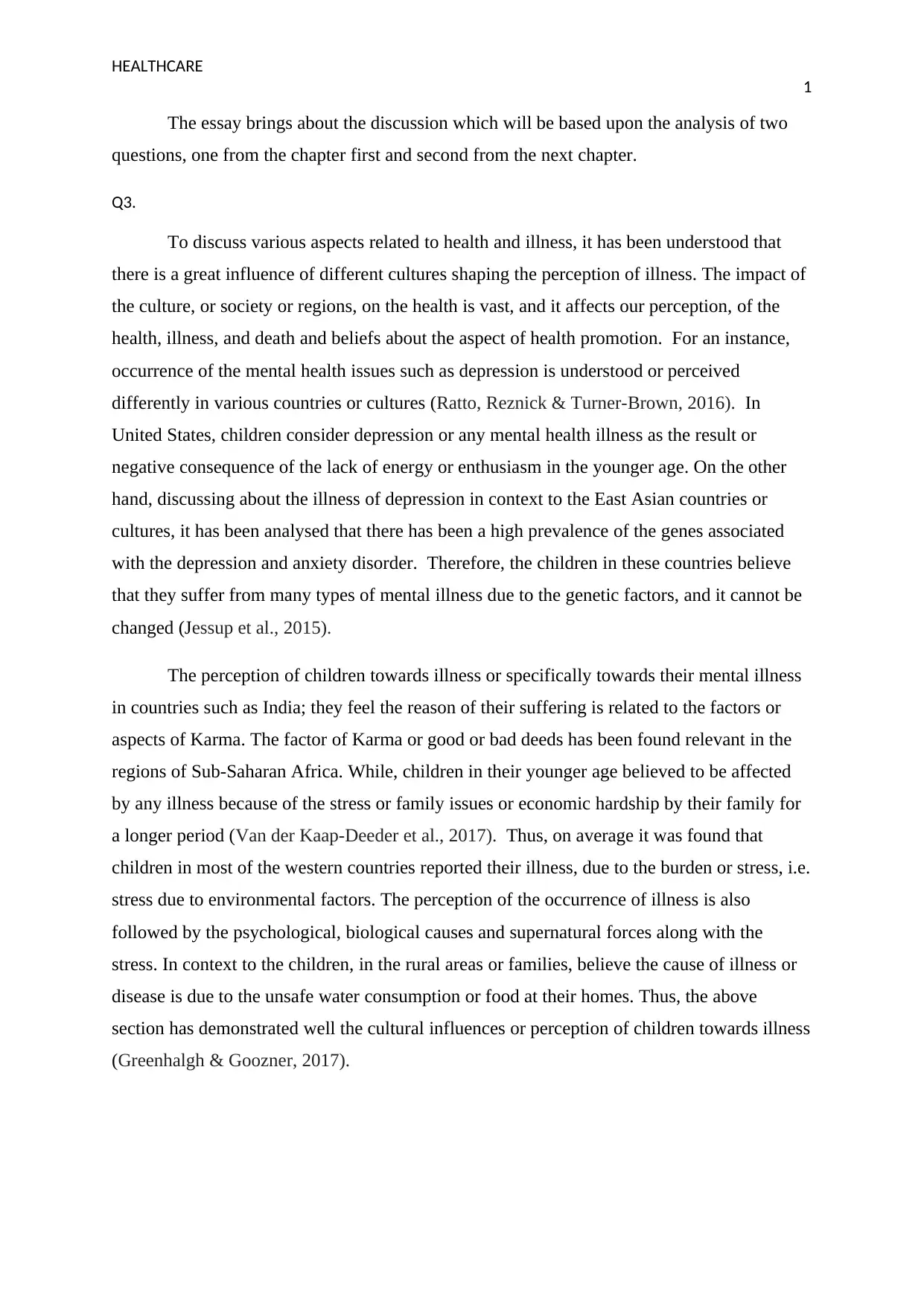
To discuss various aspects related to health and illness, it has been understood that
there is a great influence of different cultures shaping the perception of illness. The impact of
the culture, or society or regions, on the health is vast, and it affects our perception, of the
health, illness, and death and beliefs about the aspect of health promotion. For an instance,
occurrence of the mental health issues such as depression is understood or perceived
differently in various countries or cultures (Ratto, Reznick & Turner-Brown, 2016). In
United States, children consider depression or any mental health illness as the result or
negative consequence of the lack of energy or enthusiasm in the younger age. On the other
hand, discussing about the illness of depression in context to the East Asian countries or
cultures, it has been analysed that there has been a high prevalence of the genes associated
with the depression and anxiety disorder. Therefore, the children in these countries believe
that they suffer from many types of mental illness due to the genetic factors, and it cannot be
changed (Jessup et al., 2015).
The perception of children towards illness or specifically towards their mental illness
in countries such as India; they feel the reason of their suffering is related to the factors or
aspects of Karma. The factor of Karma or good or bad deeds has been found relevant in the
regions of Sub-Saharan Africa. While, children in their younger age believed to be affected
by any illness because of the stress or family issues or economic hardship by their family for
a longer period (Van der Kaap-Deeder et al., 2017). Thus, on average it was found that
children in most of the western countries reported their illness, due to the burden or stress, i.e.
stress due to environmental factors. The perception of the occurrence of illness is also
followed by the psychological, biological causes and supernatural forces along with the
stress. In context to the children, in the rural areas or families, believe the cause of illness or
disease is due to the unsafe water consumption or food at their homes. Thus, the above
section has demonstrated well the cultural influences or perception of children towards illness
(Greenhalgh & Goozner, 2017).
1
The essay brings about the discussion which will be based upon the analysis of two
questions, one from the chapter first and second from the next chapter.
Q3.
To discuss various aspects related to health and illness, it has been understood that
there is a great influence of different cultures shaping the perception of illness. The impact of
the culture, or society or regions, on the health is vast, and it affects our perception, of the
health, illness, and death and beliefs about the aspect of health promotion. For an instance,
occurrence of the mental health issues such as depression is understood or perceived
differently in various countries or cultures (Ratto, Reznick & Turner-Brown, 2016). In
United States, children consider depression or any mental health illness as the result or
negative consequence of the lack of energy or enthusiasm in the younger age. On the other
hand, discussing about the illness of depression in context to the East Asian countries or
cultures, it has been analysed that there has been a high prevalence of the genes associated
with the depression and anxiety disorder. Therefore, the children in these countries believe
that they suffer from many types of mental illness due to the genetic factors, and it cannot be
changed (Jessup et al., 2015).
The perception of children towards illness or specifically towards their mental illness
in countries such as India; they feel the reason of their suffering is related to the factors or
aspects of Karma. The factor of Karma or good or bad deeds has been found relevant in the
regions of Sub-Saharan Africa. While, children in their younger age believed to be affected
by any illness because of the stress or family issues or economic hardship by their family for
a longer period (Van der Kaap-Deeder et al., 2017). Thus, on average it was found that
children in most of the western countries reported their illness, due to the burden or stress, i.e.
stress due to environmental factors. The perception of the occurrence of illness is also
followed by the psychological, biological causes and supernatural forces along with the
stress. In context to the children, in the rural areas or families, believe the cause of illness or
disease is due to the unsafe water consumption or food at their homes. Thus, the above
section has demonstrated well the cultural influences or perception of children towards illness
(Greenhalgh & Goozner, 2017).

HEALTHCARE
2
Q2.
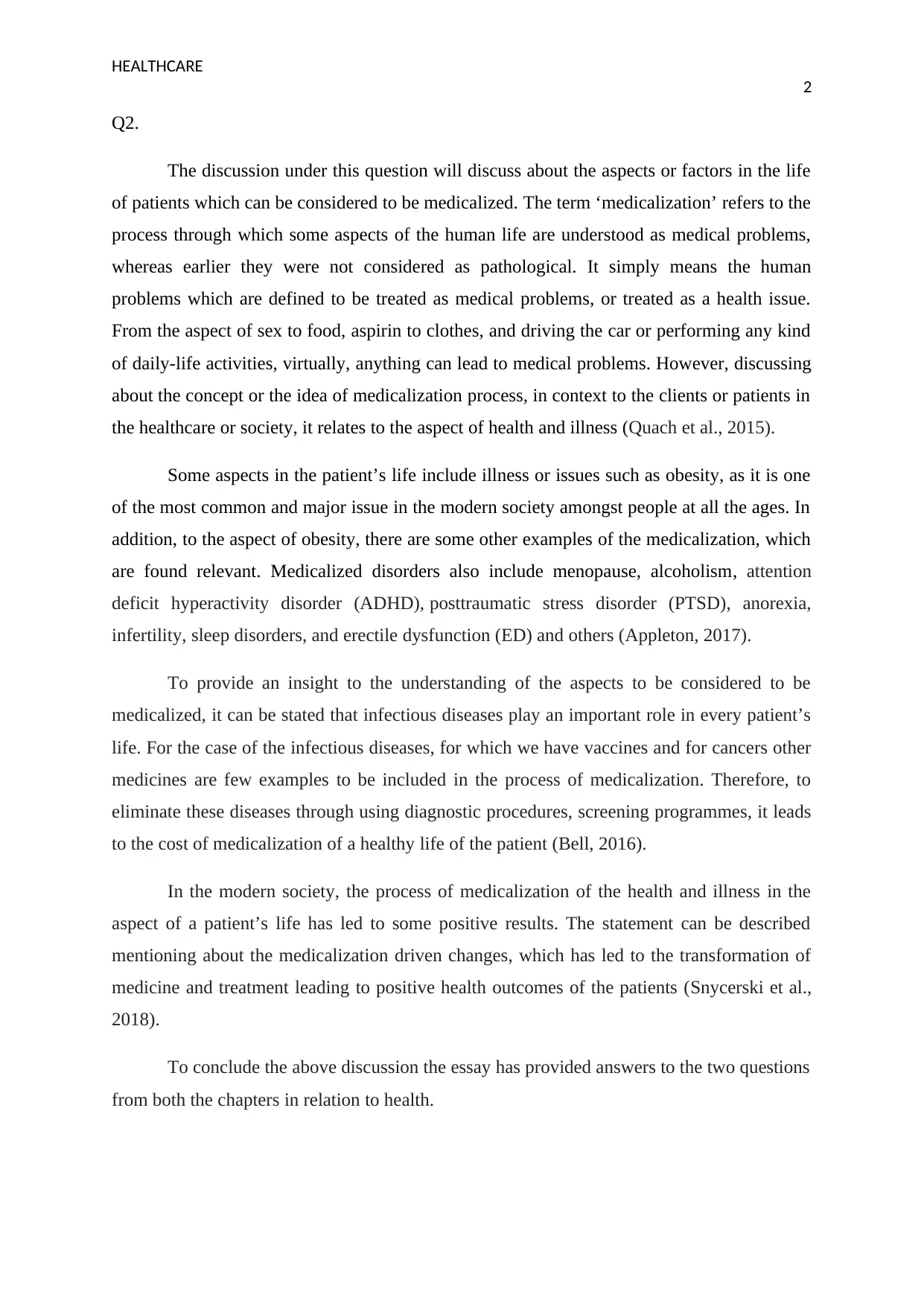
The discussion under this question will discuss about the aspects or factors in the life
of patients which can be considered to be medicalized. The term ‘medicalization’ refers to the
process through which some aspects of the human life are understood as medical problems,
whereas earlier they were not considered as pathological. It simply means the human
problems which are defined to be treated as medical problems, or treated as a health issue.
From the aspect of sex to food, aspirin to clothes, and driving the car or performing any kind
of daily-life activities, virtually, anything can lead to medical problems. However, discussing
about the concept or the idea of medicalization process, in context to the clients or patients in
the healthcare or society, it relates to the aspect of health and illness (Quach et al., 2015).
Some aspects in the patient’s life include illness or issues such as obesity, as it is one
of the most common and major issue in the modern society amongst people at all the ages. In
addition, to the aspect of obesity, there are some other examples of the medicalization, which
are found relevant. Medicalized disorders also include menopause, alcoholism, attention
deficit hyperactivity disorder (ADHD), posttraumatic stress disorder (PTSD), anorexia,
infertility, sleep disorders, and erectile dysfunction (ED) and others (Appleton, 2017).
To provide an insight to the understanding of the aspects to be considered to be
medicalized, it can be stated that infectious diseases play an important role in every patient’s
life. For the case of the infectious diseases, for which we have vaccines and for cancers other
medicines are few examples to be included in the process of medicalization. Therefore, to
eliminate these diseases through using diagnostic procedures, screening programmes, it leads
to the cost of medicalization of a healthy life of the patient (Bell, 2016).
In the modern society, the process of medicalization of the health and illness in the
aspect of a patient’s life has led to some positive results. The statement can be described
mentioning about the medicalization driven changes, which has led to the transformation of
medicine and treatment leading to positive health outcomes of the patients (Snycerski et al.,
2018).
To conclude the above discussion the essay has provided answers to the two questions
from both the chapters in relation to health.
2
Q2.
The discussion under this question will discuss about the aspects or factors in the life
of patients which can be considered to be medicalized. The term ‘medicalization’ refers to the
process through which some aspects of the human life are understood as medical problems,
whereas earlier they were not considered as pathological. It simply means the human
problems which are defined to be treated as medical problems, or treated as a health issue.
From the aspect of sex to food, aspirin to clothes, and driving the car or performing any kind
of daily-life activities, virtually, anything can lead to medical problems. However, discussing
about the concept or the idea of medicalization process, in context to the clients or patients in
the healthcare or society, it relates to the aspect of health and illness (Quach et al., 2015).
Some aspects in the patient’s life include illness or issues such as obesity, as it is one
of the most common and major issue in the modern society amongst people at all the ages. In
addition, to the aspect of obesity, there are some other examples of the medicalization, which
are found relevant. Medicalized disorders also include menopause, alcoholism, attention
deficit hyperactivity disorder (ADHD), posttraumatic stress disorder (PTSD), anorexia,
infertility, sleep disorders, and erectile dysfunction (ED) and others (Appleton, 2017).
To provide an insight to the understanding of the aspects to be considered to be
medicalized, it can be stated that infectious diseases play an important role in every patient’s
life. For the case of the infectious diseases, for which we have vaccines and for cancers other
medicines are few examples to be included in the process of medicalization. Therefore, to
eliminate these diseases through using diagnostic procedures, screening programmes, it leads
to the cost of medicalization of a healthy life of the patient (Bell, 2016).
In the modern society, the process of medicalization of the health and illness in the
aspect of a patient’s life has led to some positive results. The statement can be described
mentioning about the medicalization driven changes, which has led to the transformation of
medicine and treatment leading to positive health outcomes of the patients (Snycerski et al.,
2018).
To conclude the above discussion the essay has provided answers to the two questions
from both the chapters in relation to health.
⊘ This is a preview!⊘
Do you want full access?
Subscribe today to unlock all pages.

Trusted by 1+ million students worldwide

HEALTHCARE
3
References
Appleton, L. M. (2017). Rethinking medicalization: Alcoholism and anomalies. In Images of
issues (pp. 59-80). United Kingdom: Routledge.
Bell, A. V. (2016). The margins of medicalization: Diversity and context through the case of
infertility. Social Science & Medicine, 156, 39-46.
Greenhalgh, T. & Goozner, M. (2017). What seems to be the trouble? Stories in illness and
healthcare. United States: CRC Press.
Jessup, N. M., Bakas, T., McLennon, S. M. & Weaver, M. T. (2015). Are there gender, racial
or relationship differences in caregiver task difficulty, depressive symptom and life
changes among stroke family caregivers? Brain injury, 29(1), 17-24.
Quach, A. S., Epstein, N. B., Riley, P. J., Falconier, M. K. & Fang, X. (2015). Effects of
parental warmth and academic pressure on anxiety and depression symptoms in
Chinese adolescents. Journal of Child and Family Studies, 24(1), 106-116.
Ratto, A. B., Reznick, J. S. & Turner-Brown, L. (2016). Cultural effects on the diagnosis of
autism spectrum disorder among Latinos. Focus on Autism and Other Developmental
Disabilities, 31(4), 275-283.
Snycerski, S., Laraway, S., Gregg, J., Capriotti, M. & Callaghan, G. M. (2018). Implications
of Behavioural Narratology for Psychotherapy, Help-Seeking Behaviour, and
Substance Use. Perspectives on Behaviour Science, 41(2), 517-540.
Van der Kaap-Deeder, J., Vansteenkiste, M., Soenens, B. & Mabbe, E. (2017). Children’s
daily well-being: The role of mothers’, teachers’, and siblings’ autonomy support and
psychological control. Developmental psychology, 53(2), 237.
3
References
Appleton, L. M. (2017). Rethinking medicalization: Alcoholism and anomalies. In Images of
issues (pp. 59-80). United Kingdom: Routledge.
Bell, A. V. (2016). The margins of medicalization: Diversity and context through the case of
infertility. Social Science & Medicine, 156, 39-46.
Greenhalgh, T. & Goozner, M. (2017). What seems to be the trouble? Stories in illness and
healthcare. United States: CRC Press.
Jessup, N. M., Bakas, T., McLennon, S. M. & Weaver, M. T. (2015). Are there gender, racial
or relationship differences in caregiver task difficulty, depressive symptom and life
changes among stroke family caregivers? Brain injury, 29(1), 17-24.
Quach, A. S., Epstein, N. B., Riley, P. J., Falconier, M. K. & Fang, X. (2015). Effects of
parental warmth and academic pressure on anxiety and depression symptoms in
Chinese adolescents. Journal of Child and Family Studies, 24(1), 106-116.
Ratto, A. B., Reznick, J. S. & Turner-Brown, L. (2016). Cultural effects on the diagnosis of
autism spectrum disorder among Latinos. Focus on Autism and Other Developmental
Disabilities, 31(4), 275-283.
Snycerski, S., Laraway, S., Gregg, J., Capriotti, M. & Callaghan, G. M. (2018). Implications
of Behavioural Narratology for Psychotherapy, Help-Seeking Behaviour, and
Substance Use. Perspectives on Behaviour Science, 41(2), 517-540.
Van der Kaap-Deeder, J., Vansteenkiste, M., Soenens, B. & Mabbe, E. (2017). Children’s
daily well-being: The role of mothers’, teachers’, and siblings’ autonomy support and
psychological control. Developmental psychology, 53(2), 237.
1 out of 4
Related Documents
Your All-in-One AI-Powered Toolkit for Academic Success.
+13062052269
info@desklib.com
Available 24*7 on WhatsApp / Email
Unlock your academic potential
Copyright © 2020–2025 A2Z Services. All Rights Reserved. Developed and managed by ZUCOL.