Quality and Change Implementation in Healthcare: An Evaluation
VerifiedAdded on 2022/10/19
|16
|4264
|17
Essay
AI Summary
This essay provides a comprehensive analysis of quality and change initiatives within healthcare settings. It begins with an introduction highlighting the importance of quality and change in nursing, followed by a summary of relevant literature on policy, quality, and change. The body of the essay critically discusses scholarly literature on leadership, quality, and change, and provides a justification for the proposed change using relevant health policy and research findings. It also delves into a detailed discussion of the change process, including the use of SWOT analysis. The essay further explores innovative approaches and the impact on healthcare policy, including the role of nurses in driving change. The conclusion summarizes the key findings and emphasizes the significance of continuous improvement in healthcare.
Surname 1
Name
Professor
Institution
Course
Date
Introduction
Due to the universal advocacy, several countries have made a progression in increasing
the number of patients who are treated in health facilities. The increase in the number of these
Name
Professor
Institution
Course
Date
Introduction
Due to the universal advocacy, several countries have made a progression in increasing
the number of patients who are treated in health facilities. The increase in the number of these

Paraphrase This Document
Need a fresh take? Get an instant paraphrase of this document with our AI Paraphraser
Surname 2
patients in health facilities is caused by the inadequacy in the quality of care that is provided by
the health facilities. Based on definitions, the world health organization describes eminent care
as the extent to which health care services are offered to the individuals and patient populations
to improve the desired outcomes. For quality care to be achieved, healthcare is supposed to be
safe, effective, timely, and people-centered.
Health facilities, in most cases, strive to offer rapid emergency care that is required in the
management of complications and care for the sick people (Murray, et al., 2014, p. 45). The
common causes of reduced quality care include the lack of motivation in the staff, unhygienic
infrastructure, lack of competence in staff, lack of motivation, and the availability of poor
medicines, poor compliance with the law and to the evidence-based clinical interventions, poor
documentation and utilization of the documented info.it is therefore essential to improve quality
care to the patients (Sherwood & Barnsteiner, 2017, p. 50). Quality care is also an integral
component of the right to good health as defined by the WHO. It is necessary to offer health
services that are essential and that meet the quality criteria. WHO published the standards that
could be used in improving the quality of care. The standards place individuals as the central
focus through the improvements the experience of the patient in healthcare. The latter is a vital
part of strengthening health systems (Taylor, McNicholas, Nicolay, Darzi, Bell, & Reed, 2014, p.
56).
Quality and Change Implementation
patients in health facilities is caused by the inadequacy in the quality of care that is provided by
the health facilities. Based on definitions, the world health organization describes eminent care
as the extent to which health care services are offered to the individuals and patient populations
to improve the desired outcomes. For quality care to be achieved, healthcare is supposed to be
safe, effective, timely, and people-centered.
Health facilities, in most cases, strive to offer rapid emergency care that is required in the
management of complications and care for the sick people (Murray, et al., 2014, p. 45). The
common causes of reduced quality care include the lack of motivation in the staff, unhygienic
infrastructure, lack of competence in staff, lack of motivation, and the availability of poor
medicines, poor compliance with the law and to the evidence-based clinical interventions, poor
documentation and utilization of the documented info.it is therefore essential to improve quality
care to the patients (Sherwood & Barnsteiner, 2017, p. 50). Quality care is also an integral
component of the right to good health as defined by the WHO. It is necessary to offer health
services that are essential and that meet the quality criteria. WHO published the standards that
could be used in improving the quality of care. The standards place individuals as the central
focus through the improvements the experience of the patient in healthcare. The latter is a vital
part of strengthening health systems (Taylor, McNicholas, Nicolay, Darzi, Bell, & Reed, 2014, p.
56).
Quality and Change Implementation
Surname 3
Most of the institutions approve that active leadership is a great contributor to general
organizational performance and change. The intellectual leaders are the ones who have several
skills and knowledge that they acquired from involvement, which permits them to carry out
effective management to their daily life task (Sharma, Crowl, Sorge, & Sorensen, 2015, p. 59).
Operational leadership is necessary to bring about effective change. The study from Brookfield
addresses the need for culture while addressing the issue to do with the change in an
organization. The author mentions roadblocks that are bound to influence the change
management efforts, which comprise; secrecy and silence in culture. Competence in leadership is
essential in handling and managing any opportunistic problems and also in the management of
other skills and capabilities (De Bono, Heling, & Borg, 2014, p. 59).
There are leadership competencies that have been considered mandatory for there to be
active and successful leadership. There exist different skills that are influential for leaders who
are also affiliated with a successful organizational change (Groves, Kayyali, Knott, & Kuiken,
2016, p. 62).
Most of the institutions approve that active leadership is a great contributor to general
organizational performance and change. The intellectual leaders are the ones who have several
skills and knowledge that they acquired from involvement, which permits them to carry out
effective management to their daily life task (Sharma, Crowl, Sorge, & Sorensen, 2015, p. 59).
Operational leadership is necessary to bring about effective change. The study from Brookfield
addresses the need for culture while addressing the issue to do with the change in an
organization. The author mentions roadblocks that are bound to influence the change
management efforts, which comprise; secrecy and silence in culture. Competence in leadership is
essential in handling and managing any opportunistic problems and also in the management of
other skills and capabilities (De Bono, Heling, & Borg, 2014, p. 59).
There are leadership competencies that have been considered mandatory for there to be
active and successful leadership. There exist different skills that are influential for leaders who
are also affiliated with a successful organizational change (Groves, Kayyali, Knott, & Kuiken,
2016, p. 62).
⊘ This is a preview!⊘
Do you want full access?
Subscribe today to unlock all pages.

Trusted by 1+ million students worldwide
Surname 4
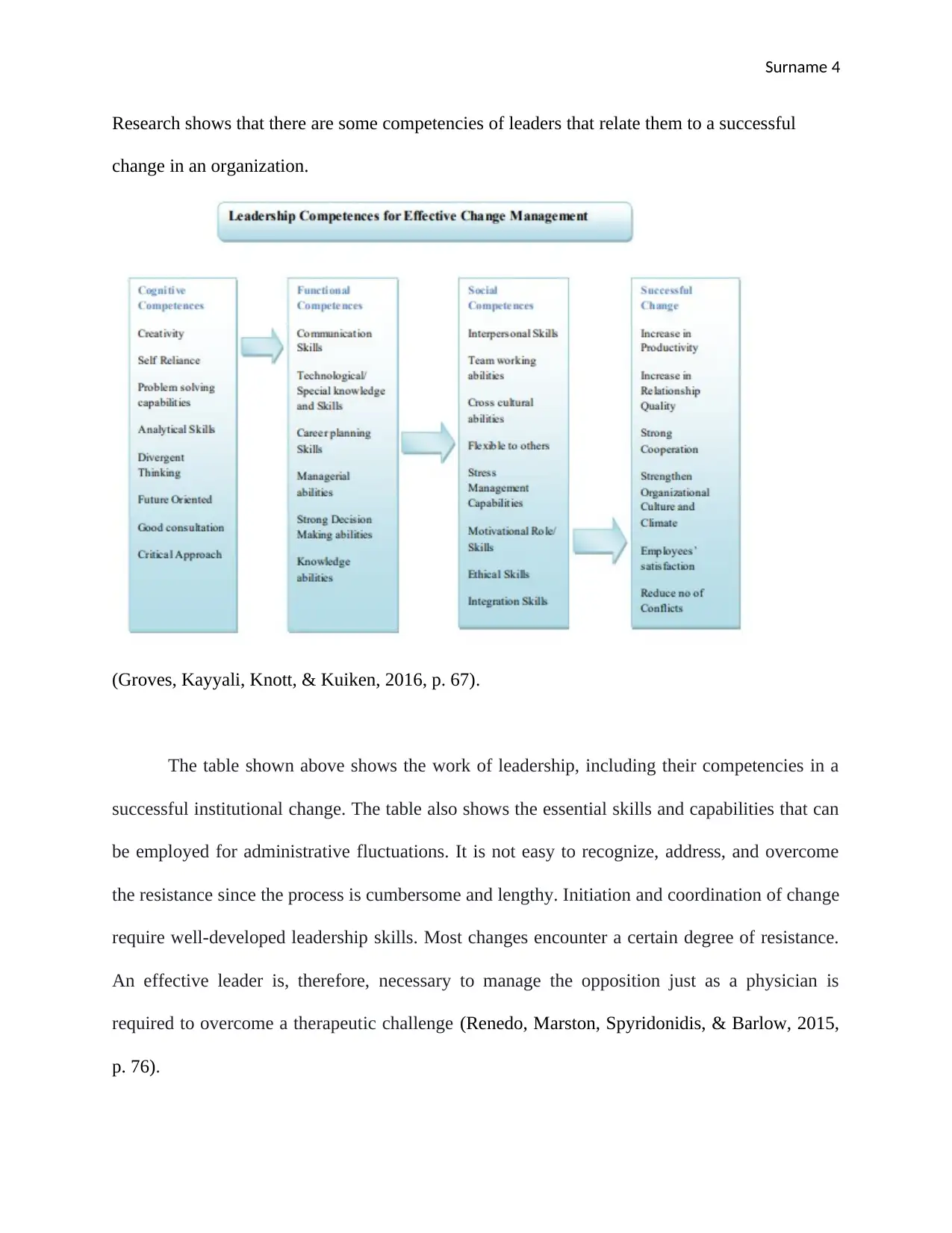
Research shows that there are some competencies of leaders that relate them to a successful
change in an organization.
(Groves, Kayyali, Knott, & Kuiken, 2016, p. 67).
The table shown above shows the work of leadership, including their competencies in a
successful institutional change. The table also shows the essential skills and capabilities that can
be employed for administrative fluctuations. It is not easy to recognize, address, and overcome
the resistance since the process is cumbersome and lengthy. Initiation and coordination of change
require well-developed leadership skills. Most changes encounter a certain degree of resistance.
An effective leader is, therefore, necessary to manage the opposition just as a physician is
required to overcome a therapeutic challenge (Renedo, Marston, Spyridonidis, & Barlow, 2015,
p. 76).
Research shows that there are some competencies of leaders that relate them to a successful
change in an organization.
(Groves, Kayyali, Knott, & Kuiken, 2016, p. 67).
The table shown above shows the work of leadership, including their competencies in a
successful institutional change. The table also shows the essential skills and capabilities that can
be employed for administrative fluctuations. It is not easy to recognize, address, and overcome
the resistance since the process is cumbersome and lengthy. Initiation and coordination of change
require well-developed leadership skills. Most changes encounter a certain degree of resistance.
An effective leader is, therefore, necessary to manage the opposition just as a physician is
required to overcome a therapeutic challenge (Renedo, Marston, Spyridonidis, & Barlow, 2015,
p. 76).
Paraphrase This Document
Need a fresh take? Get an instant paraphrase of this document with our AI Paraphraser
Surname 5
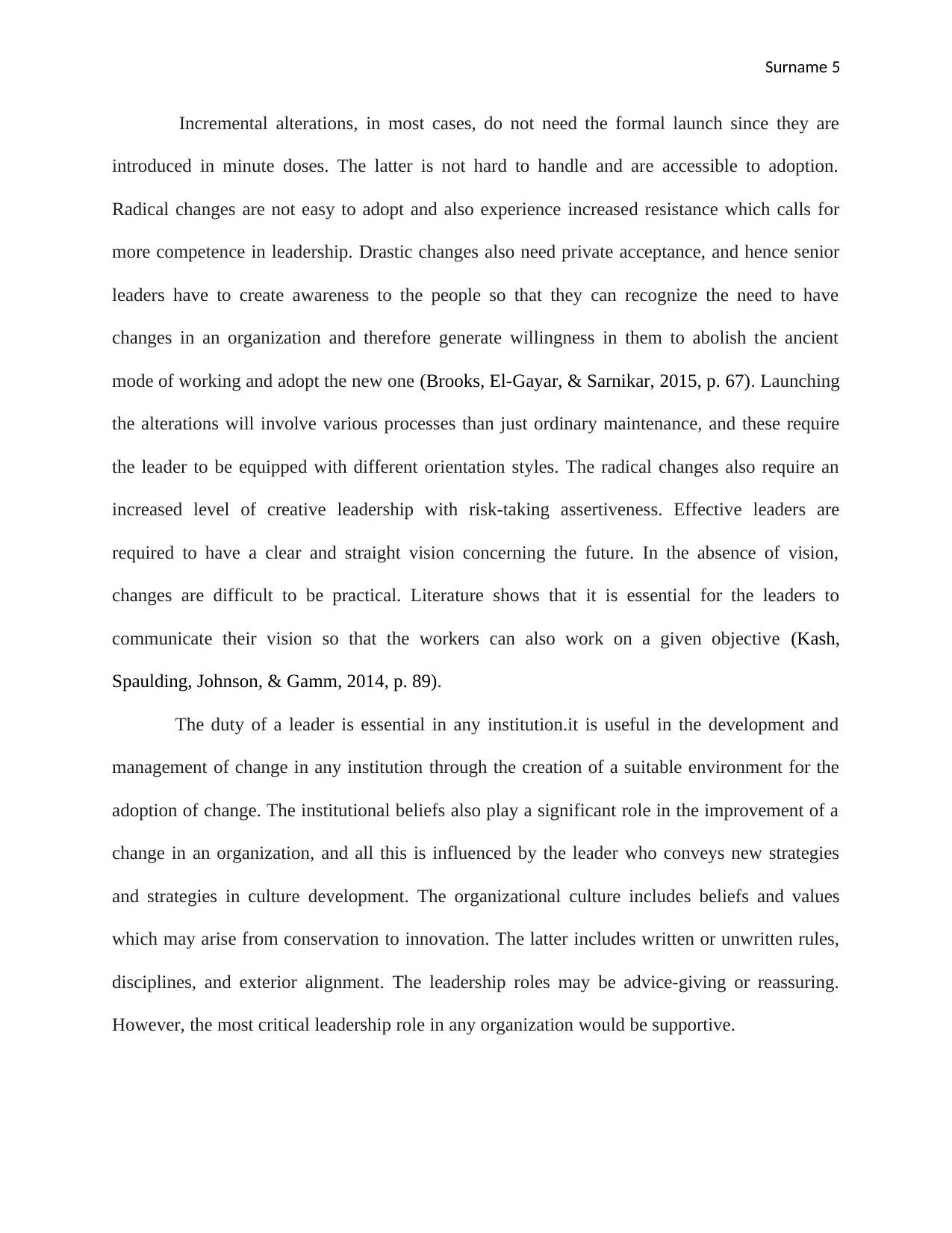
Incremental alterations, in most cases, do not need the formal launch since they are
introduced in minute doses. The latter is not hard to handle and are accessible to adoption.
Radical changes are not easy to adopt and also experience increased resistance which calls for
more competence in leadership. Drastic changes also need private acceptance, and hence senior
leaders have to create awareness to the people so that they can recognize the need to have
changes in an organization and therefore generate willingness in them to abolish the ancient
mode of working and adopt the new one (Brooks, El-Gayar, & Sarnikar, 2015, p. 67). Launching
the alterations will involve various processes than just ordinary maintenance, and these require
the leader to be equipped with different orientation styles. The radical changes also require an
increased level of creative leadership with risk-taking assertiveness. Effective leaders are
required to have a clear and straight vision concerning the future. In the absence of vision,
changes are difficult to be practical. Literature shows that it is essential for the leaders to
communicate their vision so that the workers can also work on a given objective (Kash,
Spaulding, Johnson, & Gamm, 2014, p. 89).
The duty of a leader is essential in any institution.it is useful in the development and
management of change in any institution through the creation of a suitable environment for the
adoption of change. The institutional beliefs also play a significant role in the improvement of a
change in an organization, and all this is influenced by the leader who conveys new strategies
and strategies in culture development. The organizational culture includes beliefs and values
which may arise from conservation to innovation. The latter includes written or unwritten rules,
disciplines, and exterior alignment. The leadership roles may be advice-giving or reassuring.
However, the most critical leadership role in any organization would be supportive.
Incremental alterations, in most cases, do not need the formal launch since they are
introduced in minute doses. The latter is not hard to handle and are accessible to adoption.
Radical changes are not easy to adopt and also experience increased resistance which calls for
more competence in leadership. Drastic changes also need private acceptance, and hence senior
leaders have to create awareness to the people so that they can recognize the need to have
changes in an organization and therefore generate willingness in them to abolish the ancient
mode of working and adopt the new one (Brooks, El-Gayar, & Sarnikar, 2015, p. 67). Launching
the alterations will involve various processes than just ordinary maintenance, and these require
the leader to be equipped with different orientation styles. The radical changes also require an
increased level of creative leadership with risk-taking assertiveness. Effective leaders are
required to have a clear and straight vision concerning the future. In the absence of vision,
changes are difficult to be practical. Literature shows that it is essential for the leaders to
communicate their vision so that the workers can also work on a given objective (Kash,
Spaulding, Johnson, & Gamm, 2014, p. 89).
The duty of a leader is essential in any institution.it is useful in the development and
management of change in any institution through the creation of a suitable environment for the
adoption of change. The institutional beliefs also play a significant role in the improvement of a
change in an organization, and all this is influenced by the leader who conveys new strategies
and strategies in culture development. The organizational culture includes beliefs and values
which may arise from conservation to innovation. The latter includes written or unwritten rules,
disciplines, and exterior alignment. The leadership roles may be advice-giving or reassuring.
However, the most critical leadership role in any organization would be supportive.
Surname 6
Justifications for Change
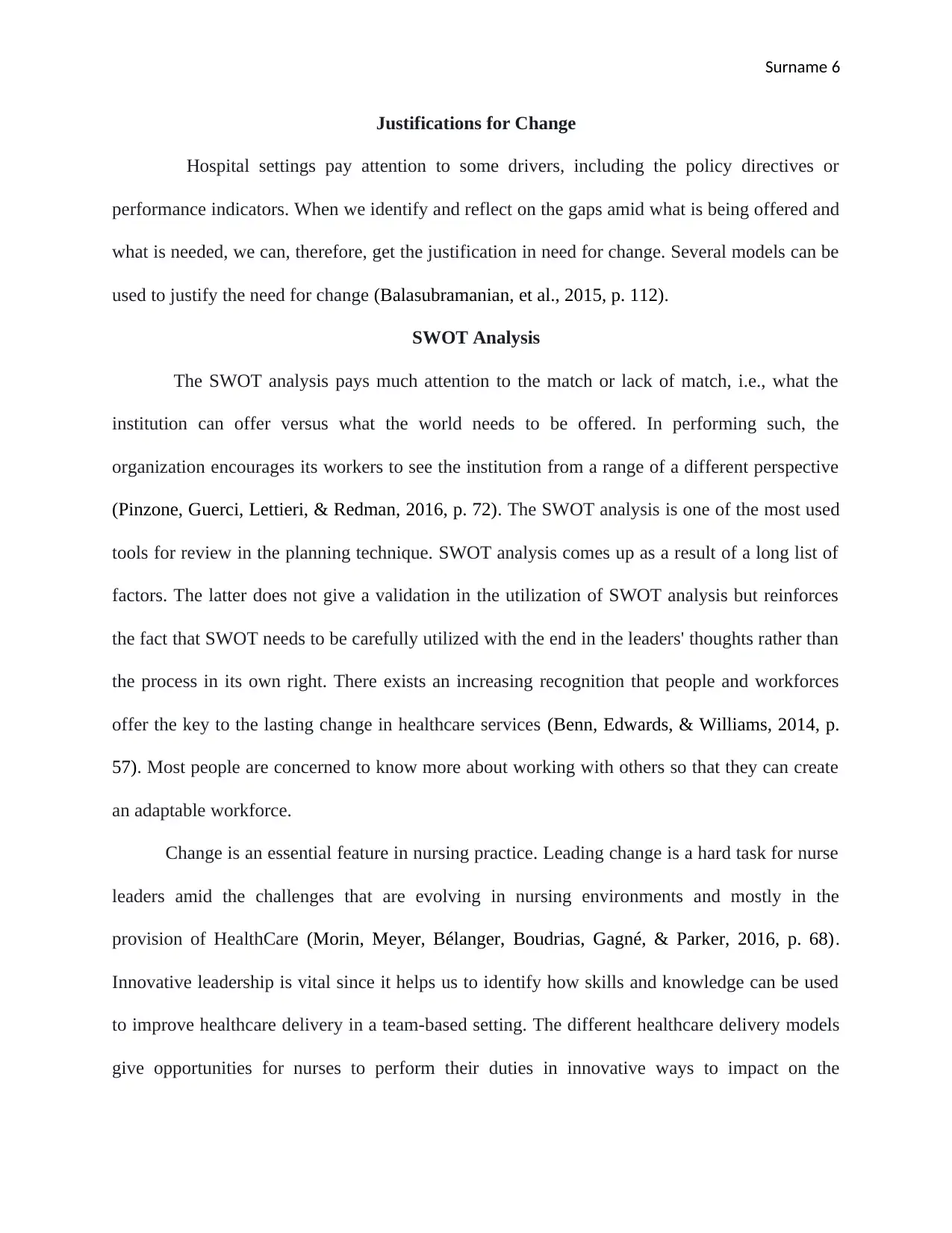
Hospital settings pay attention to some drivers, including the policy directives or
performance indicators. When we identify and reflect on the gaps amid what is being offered and
what is needed, we can, therefore, get the justification in need for change. Several models can be
used to justify the need for change (Balasubramanian, et al., 2015, p. 112).
SWOT Analysis
The SWOT analysis pays much attention to the match or lack of match, i.e., what the
institution can offer versus what the world needs to be offered. In performing such, the
organization encourages its workers to see the institution from a range of a different perspective
(Pinzone, Guerci, Lettieri, & Redman, 2016, p. 72). The SWOT analysis is one of the most used
tools for review in the planning technique. SWOT analysis comes up as a result of a long list of
factors. The latter does not give a validation in the utilization of SWOT analysis but reinforces
the fact that SWOT needs to be carefully utilized with the end in the leaders' thoughts rather than
the process in its own right. There exists an increasing recognition that people and workforces
offer the key to the lasting change in healthcare services (Benn, Edwards, & Williams, 2014, p.
57). Most people are concerned to know more about working with others so that they can create
an adaptable workforce.
Change is an essential feature in nursing practice. Leading change is a hard task for nurse
leaders amid the challenges that are evolving in nursing environments and mostly in the
provision of HealthCare (Morin, Meyer, Bélanger, Boudrias, Gagné, & Parker, 2016, p. 68).
Innovative leadership is vital since it helps us to identify how skills and knowledge can be used
to improve healthcare delivery in a team-based setting. The different healthcare delivery models
give opportunities for nurses to perform their duties in innovative ways to impact on the
Justifications for Change
Hospital settings pay attention to some drivers, including the policy directives or
performance indicators. When we identify and reflect on the gaps amid what is being offered and
what is needed, we can, therefore, get the justification in need for change. Several models can be
used to justify the need for change (Balasubramanian, et al., 2015, p. 112).
SWOT Analysis
The SWOT analysis pays much attention to the match or lack of match, i.e., what the
institution can offer versus what the world needs to be offered. In performing such, the
organization encourages its workers to see the institution from a range of a different perspective
(Pinzone, Guerci, Lettieri, & Redman, 2016, p. 72). The SWOT analysis is one of the most used
tools for review in the planning technique. SWOT analysis comes up as a result of a long list of
factors. The latter does not give a validation in the utilization of SWOT analysis but reinforces
the fact that SWOT needs to be carefully utilized with the end in the leaders' thoughts rather than
the process in its own right. There exists an increasing recognition that people and workforces
offer the key to the lasting change in healthcare services (Benn, Edwards, & Williams, 2014, p.
57). Most people are concerned to know more about working with others so that they can create
an adaptable workforce.
Change is an essential feature in nursing practice. Leading change is a hard task for nurse
leaders amid the challenges that are evolving in nursing environments and mostly in the
provision of HealthCare (Morin, Meyer, Bélanger, Boudrias, Gagné, & Parker, 2016, p. 68).
Innovative leadership is vital since it helps us to identify how skills and knowledge can be used
to improve healthcare delivery in a team-based setting. The different healthcare delivery models
give opportunities for nurses to perform their duties in innovative ways to impact on the
⊘ This is a preview!⊘
Do you want full access?
Subscribe today to unlock all pages.
Trusted by 1+ million students worldwide
Surname 7
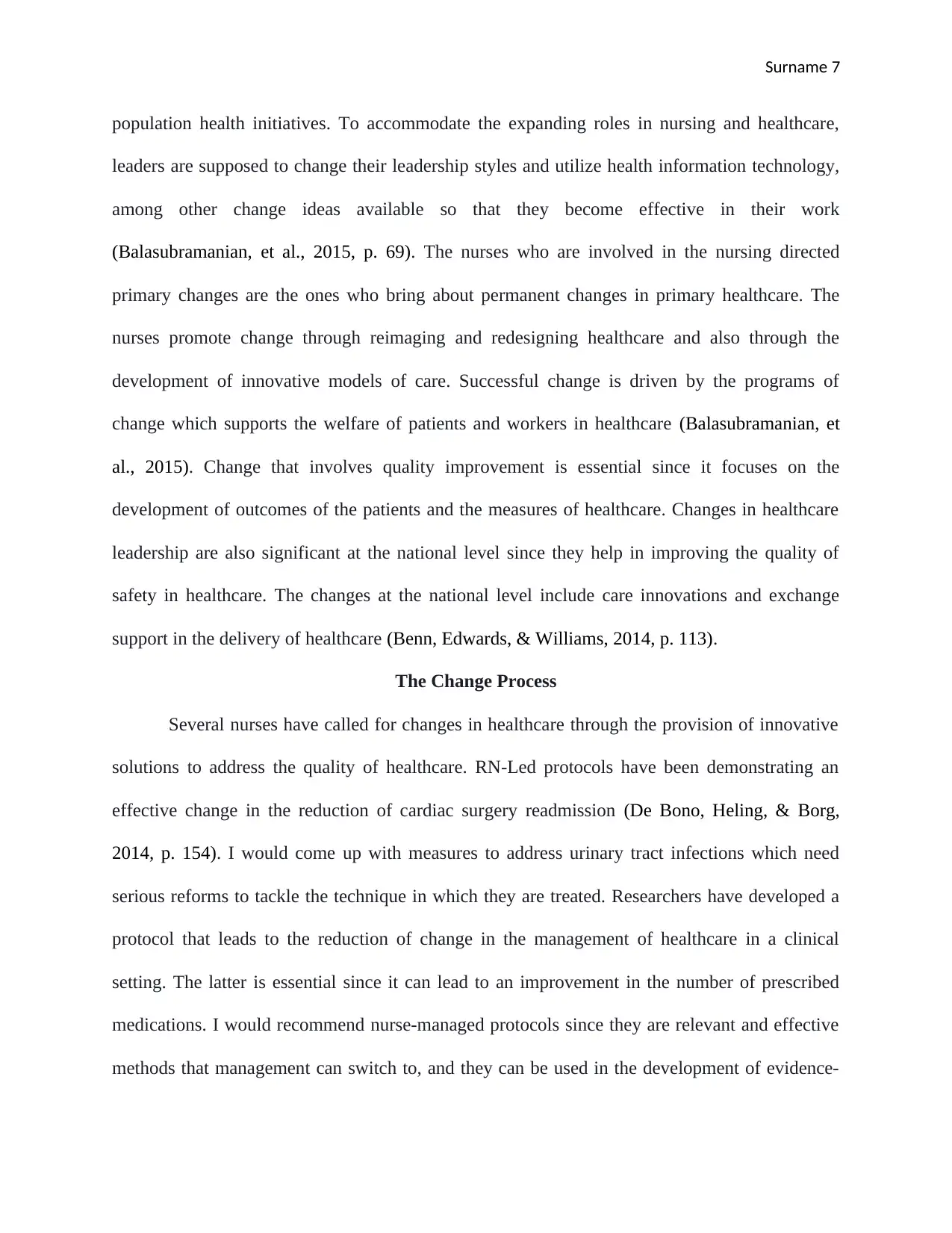
population health initiatives. To accommodate the expanding roles in nursing and healthcare,
leaders are supposed to change their leadership styles and utilize health information technology,
among other change ideas available so that they become effective in their work
(Balasubramanian, et al., 2015, p. 69). The nurses who are involved in the nursing directed
primary changes are the ones who bring about permanent changes in primary healthcare. The
nurses promote change through reimaging and redesigning healthcare and also through the
development of innovative models of care. Successful change is driven by the programs of
change which supports the welfare of patients and workers in healthcare (Balasubramanian, et
al., 2015). Change that involves quality improvement is essential since it focuses on the
development of outcomes of the patients and the measures of healthcare. Changes in healthcare
leadership are also significant at the national level since they help in improving the quality of
safety in healthcare. The changes at the national level include care innovations and exchange
support in the delivery of healthcare (Benn, Edwards, & Williams, 2014, p. 113).
The Change Process
Several nurses have called for changes in healthcare through the provision of innovative
solutions to address the quality of healthcare. RN-Led protocols have been demonstrating an
effective change in the reduction of cardiac surgery readmission (De Bono, Heling, & Borg,
2014, p. 154). I would come up with measures to address urinary tract infections which need
serious reforms to tackle the technique in which they are treated. Researchers have developed a
protocol that leads to the reduction of change in the management of healthcare in a clinical
setting. The latter is essential since it can lead to an improvement in the number of prescribed
medications. I would recommend nurse-managed protocols since they are relevant and effective
methods that management can switch to, and they can be used in the development of evidence-
population health initiatives. To accommodate the expanding roles in nursing and healthcare,
leaders are supposed to change their leadership styles and utilize health information technology,
among other change ideas available so that they become effective in their work
(Balasubramanian, et al., 2015, p. 69). The nurses who are involved in the nursing directed
primary changes are the ones who bring about permanent changes in primary healthcare. The
nurses promote change through reimaging and redesigning healthcare and also through the
development of innovative models of care. Successful change is driven by the programs of
change which supports the welfare of patients and workers in healthcare (Balasubramanian, et
al., 2015). Change that involves quality improvement is essential since it focuses on the
development of outcomes of the patients and the measures of healthcare. Changes in healthcare
leadership are also significant at the national level since they help in improving the quality of
safety in healthcare. The changes at the national level include care innovations and exchange
support in the delivery of healthcare (Benn, Edwards, & Williams, 2014, p. 113).
The Change Process
Several nurses have called for changes in healthcare through the provision of innovative
solutions to address the quality of healthcare. RN-Led protocols have been demonstrating an
effective change in the reduction of cardiac surgery readmission (De Bono, Heling, & Borg,
2014, p. 154). I would come up with measures to address urinary tract infections which need
serious reforms to tackle the technique in which they are treated. Researchers have developed a
protocol that leads to the reduction of change in the management of healthcare in a clinical
setting. The latter is essential since it can lead to an improvement in the number of prescribed
medications. I would recommend nurse-managed protocols since they are relevant and effective
methods that management can switch to, and they can be used in the development of evidence-
Paraphrase This Document
Need a fresh take? Get an instant paraphrase of this document with our AI Paraphraser
Surname 8
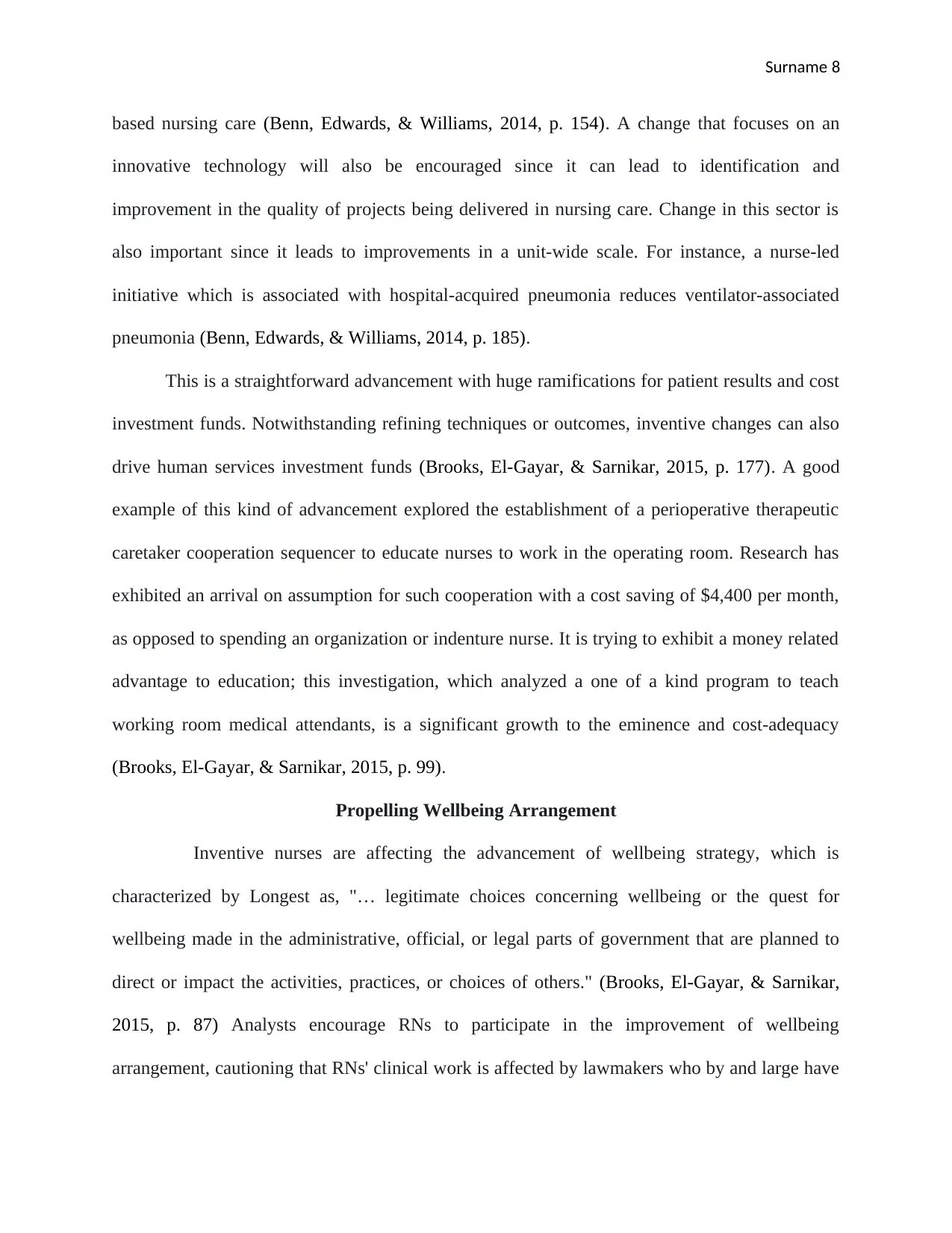
based nursing care (Benn, Edwards, & Williams, 2014, p. 154). A change that focuses on an
innovative technology will also be encouraged since it can lead to identification and
improvement in the quality of projects being delivered in nursing care. Change in this sector is
also important since it leads to improvements in a unit-wide scale. For instance, a nurse-led
initiative which is associated with hospital-acquired pneumonia reduces ventilator-associated
pneumonia (Benn, Edwards, & Williams, 2014, p. 185).
This is a straightforward advancement with huge ramifications for patient results and cost
investment funds. Notwithstanding refining techniques or outcomes, inventive changes can also
drive human services investment funds (Brooks, El-Gayar, & Sarnikar, 2015, p. 177). A good
example of this kind of advancement explored the establishment of a perioperative therapeutic
caretaker cooperation sequencer to educate nurses to work in the operating room. Research has
exhibited an arrival on assumption for such cooperation with a cost saving of $4,400 per month,
as opposed to spending an organization or indenture nurse. It is trying to exhibit a money related
advantage to education; this investigation, which analyzed a one of a kind program to teach
working room medical attendants, is a significant growth to the eminence and cost-adequacy
(Brooks, El-Gayar, & Sarnikar, 2015, p. 99).
Propelling Wellbeing Arrangement
Inventive nurses are affecting the advancement of wellbeing strategy, which is
characterized by Longest as, "… legitimate choices concerning wellbeing or the quest for
wellbeing made in the administrative, official, or legal parts of government that are planned to
direct or impact the activities, practices, or choices of others." (Brooks, El-Gayar, & Sarnikar,
2015, p. 87) Analysts encourage RNs to participate in the improvement of wellbeing
arrangement, cautioning that RNs' clinical work is affected by lawmakers who by and large have
based nursing care (Benn, Edwards, & Williams, 2014, p. 154). A change that focuses on an
innovative technology will also be encouraged since it can lead to identification and
improvement in the quality of projects being delivered in nursing care. Change in this sector is
also important since it leads to improvements in a unit-wide scale. For instance, a nurse-led
initiative which is associated with hospital-acquired pneumonia reduces ventilator-associated
pneumonia (Benn, Edwards, & Williams, 2014, p. 185).
This is a straightforward advancement with huge ramifications for patient results and cost
investment funds. Notwithstanding refining techniques or outcomes, inventive changes can also
drive human services investment funds (Brooks, El-Gayar, & Sarnikar, 2015, p. 177). A good
example of this kind of advancement explored the establishment of a perioperative therapeutic
caretaker cooperation sequencer to educate nurses to work in the operating room. Research has
exhibited an arrival on assumption for such cooperation with a cost saving of $4,400 per month,
as opposed to spending an organization or indenture nurse. It is trying to exhibit a money related
advantage to education; this investigation, which analyzed a one of a kind program to teach
working room medical attendants, is a significant growth to the eminence and cost-adequacy
(Brooks, El-Gayar, & Sarnikar, 2015, p. 99).
Propelling Wellbeing Arrangement
Inventive nurses are affecting the advancement of wellbeing strategy, which is
characterized by Longest as, "… legitimate choices concerning wellbeing or the quest for
wellbeing made in the administrative, official, or legal parts of government that are planned to
direct or impact the activities, practices, or choices of others." (Brooks, El-Gayar, & Sarnikar,
2015, p. 87) Analysts encourage RNs to participate in the improvement of wellbeing
arrangement, cautioning that RNs' clinical work is affected by lawmakers who by and large have
Surname 9
almost no information concerning how their choices influence the human services framework. A
few heads depict an inventive way to deal with impacting arrangement at the state level, where
RNs in Virginia taught general society and state administrators to deliver required changes to
propel nursing training and to expand pay rates to nursing staff in the state (Brooks, El-Gayar, &
Sarnikar, 2015, p. 57). I would suggest the actual utilization of Imaginative methodologies. The
latter has been utilized to propel nursing training on the significance of wellbeing approach. I
would also call for the exploration that addresses the importance of having RNs occupied with
policymaking, the need to incorporate the procedure of approach improvement in the nursing
educational program, and the significance of having attendant pioneers guide new RNs about
how to engage in arrangement advancement (Kash, Spaulding, Johnson, & Gamm, 2014, p. 88).
A case of progress in wellbeing strategy training is whereby scientists who write about an
inventive methodology attempted in Canada to assist the objective of drawing in RNs in
wellbeing arrangement work through an administration learning the background (Kash,
Spaulding, Johnson, & Gamm, 2014, p. 190).
As a leader, I can think of various advancements to show appointment abilities to nursing
learners. For instance, I can make contextual analyses set in nursing home practice conditions
features obstructions and hindrances to the utilization of best rehearses for delegating. Recent
research depicted a reproduction experience made to address various aptitudes, for example,
designation, expected of medical caretakers in the ebb, and flow human services condition. I can
utilize an innovative way to deal with creating rules for nursing designation (Kash, Spaulding,
Johnson, & Gamm, 2014, p. 132).
almost no information concerning how their choices influence the human services framework. A
few heads depict an inventive way to deal with impacting arrangement at the state level, where
RNs in Virginia taught general society and state administrators to deliver required changes to
propel nursing training and to expand pay rates to nursing staff in the state (Brooks, El-Gayar, &
Sarnikar, 2015, p. 57). I would suggest the actual utilization of Imaginative methodologies. The
latter has been utilized to propel nursing training on the significance of wellbeing approach. I
would also call for the exploration that addresses the importance of having RNs occupied with
policymaking, the need to incorporate the procedure of approach improvement in the nursing
educational program, and the significance of having attendant pioneers guide new RNs about
how to engage in arrangement advancement (Kash, Spaulding, Johnson, & Gamm, 2014, p. 88).
A case of progress in wellbeing strategy training is whereby scientists who write about an
inventive methodology attempted in Canada to assist the objective of drawing in RNs in
wellbeing arrangement work through an administration learning the background (Kash,
Spaulding, Johnson, & Gamm, 2014, p. 190).
As a leader, I can think of various advancements to show appointment abilities to nursing
learners. For instance, I can make contextual analyses set in nursing home practice conditions
features obstructions and hindrances to the utilization of best rehearses for delegating. Recent
research depicted a reproduction experience made to address various aptitudes, for example,
designation, expected of medical caretakers in the ebb, and flow human services condition. I can
utilize an innovative way to deal with creating rules for nursing designation (Kash, Spaulding,
Johnson, & Gamm, 2014, p. 132).
⊘ This is a preview!⊘
Do you want full access?
Subscribe today to unlock all pages.
Trusted by 1+ million students worldwide
Surname 10
As a leader, I can call for lengthy open opportunities for medical caretakers to lead and
employ collective enhancement activities and to enhance practical training. I can prescribe
funding to boost research on simulations of care and inventive solutions, comprising novelty, to
empower homeopathic caretakers to add to upgraded welfare and human services and urge social
insurance connotations to lead the progression of creative, tolerant focused healthcare models. I
can likewise call Healthcare associations to draw in medical caretakers to conformation, create,
purchase, execute, and evaluate wellbeing data novelty items and diverse implements.
Significant steps have been made in propelling the job of medical caretakers in advancement, yet
boundaries remain. This segment will consider abilities that may help homeopathic nurses
conquer hindrances to improvement (Benn, Edwards, & Williams, 2014, p. 172).
I will strive to Foster and spread medical attendant centered advancements and best
practices to affect patient and attendant results. I will also influence information and
investigation over the healthcare continuum to drive care-driven improvements. I can recognize
and realize personal qualities and recognitions of medicinal attendant leaders to resolve if
informative levels, confirmation, preparing, training, or some different factors sway inventive
conduct (Groves, Kayyali, Knott, & Kuiken, 2016, p. 188). There is restricted data on the
creative practices and attributes of RNs. I can do an exploration that would grow this information
by recognizing characteristics of RNs who scored higher on a development scale, including
strength affirmation, advanced educations, and involvement in the executives. Also, I would find
out whether RNs at medium-to-huge emergency clinics and clinics have an embraced mid-level
of electronic restorative records with higher advancement scores. I would call for activities to
energize inventive deduction in RNs, recommend further look into about attributes that
As a leader, I can call for lengthy open opportunities for medical caretakers to lead and
employ collective enhancement activities and to enhance practical training. I can prescribe
funding to boost research on simulations of care and inventive solutions, comprising novelty, to
empower homeopathic caretakers to add to upgraded welfare and human services and urge social
insurance connotations to lead the progression of creative, tolerant focused healthcare models. I
can likewise call Healthcare associations to draw in medical caretakers to conformation, create,
purchase, execute, and evaluate wellbeing data novelty items and diverse implements.
Significant steps have been made in propelling the job of medical caretakers in advancement, yet
boundaries remain. This segment will consider abilities that may help homeopathic nurses
conquer hindrances to improvement (Benn, Edwards, & Williams, 2014, p. 172).
I will strive to Foster and spread medical attendant centered advancements and best
practices to affect patient and attendant results. I will also influence information and
investigation over the healthcare continuum to drive care-driven improvements. I can recognize
and realize personal qualities and recognitions of medicinal attendant leaders to resolve if
informative levels, confirmation, preparing, training, or some different factors sway inventive
conduct (Groves, Kayyali, Knott, & Kuiken, 2016, p. 188). There is restricted data on the
creative practices and attributes of RNs. I can do an exploration that would grow this information
by recognizing characteristics of RNs who scored higher on a development scale, including
strength affirmation, advanced educations, and involvement in the executives. Also, I would find
out whether RNs at medium-to-huge emergency clinics and clinics have an embraced mid-level
of electronic restorative records with higher advancement scores. I would call for activities to
energize inventive deduction in RNs, recommend further look into about attributes that
Paraphrase This Document
Need a fresh take? Get an instant paraphrase of this document with our AI Paraphraser
Surname 11
encourage creative conduct, investigate whether patient results are affected by imaginative
manner (De Bono, Heling, & Borg, 2014, p. 111).
I can make Environments to Foster Innovation. The development can be cultivated by
making situations helpful for inventive reasoning and growing the thought of where and when
nursing advancement takes place (Kash, Spaulding, Johnson, & Gamm, 2014, p. 165). The
convergence between condition, innovativeness, and development are a fundamental component
to empower advancement. The creative procedure might be increasingly entangled in
associations with bureaucratic primary leadership forms, while steady initiative, a defensive or
protected zone away from operational pressures, advancement systems, and committed time for
critical thinking would all be able to help assist an innovative environment (Morin, Meyer,
Bélanger, Boudrias, Gagné, & Parker, 2016, p. 221).
Medical attendant supervisors and pioneers assume a significant job to make a situation
that cultivates and empowers advancement. Attendant pioneers must make conditions and open
doors for staff development; convey desires concerning time responsibilities and adequate
degrees of hazard; and take into consideration disappointments. Making open doors for
advancement includes acknowledgment of danger and the obscure and encouraging imagination
and scholarly incitement. I will also make a situation that will bolster new mentalities (Morin,
Meyer, Bélanger, Boudrias, Gagné, & Parker, 2016, p. 312). There is additionally potential
incentive in what numerous strategies and plans of action presently characterize as "inefficient"
time or time away when the RN is not giving direct patient consideration. The accessibility of
such a time might be a significant instrument to encourage development.
encourage creative conduct, investigate whether patient results are affected by imaginative
manner (De Bono, Heling, & Borg, 2014, p. 111).
I can make Environments to Foster Innovation. The development can be cultivated by
making situations helpful for inventive reasoning and growing the thought of where and when
nursing advancement takes place (Kash, Spaulding, Johnson, & Gamm, 2014, p. 165). The
convergence between condition, innovativeness, and development are a fundamental component
to empower advancement. The creative procedure might be increasingly entangled in
associations with bureaucratic primary leadership forms, while steady initiative, a defensive or
protected zone away from operational pressures, advancement systems, and committed time for
critical thinking would all be able to help assist an innovative environment (Morin, Meyer,
Bélanger, Boudrias, Gagné, & Parker, 2016, p. 221).
Medical attendant supervisors and pioneers assume a significant job to make a situation
that cultivates and empowers advancement. Attendant pioneers must make conditions and open
doors for staff development; convey desires concerning time responsibilities and adequate
degrees of hazard; and take into consideration disappointments. Making open doors for
advancement includes acknowledgment of danger and the obscure and encouraging imagination
and scholarly incitement. I will also make a situation that will bolster new mentalities (Morin,
Meyer, Bélanger, Boudrias, Gagné, & Parker, 2016, p. 312). There is additionally potential
incentive in what numerous strategies and plans of action presently characterize as "inefficient"
time or time away when the RN is not giving direct patient consideration. The accessibility of
such a time might be a significant instrument to encourage development.
Surname 12
Wellbeing Policy Innovation
Critical time spent with patients joined with useful care exercises carries basic
understandings to RNs and accordingly answers for a broad scope of social insurance issues. A
comprehension of wellbeing arrangement enables medical attendants to partake in the creation
and usage of inventive installment models and social insurance conveyance frameworks (Kash,
Spaulding, Johnson, & Gamm, 2014, p. 117).
I would develop flexibility. Flexibility is a vital segment for me as a transformational
pioneer to learn and help the managers and me to control others through the troublesome
procedure of tolerating and executing creative changes. Flexibility assumes a job in
advancement, can be improved and created and is a significant technique for attendants (Morin,
Meyer, Bélanger, Boudrias, Gagné, & Parker, 2016, p. 183).
I would ensure that I have critical budgetary duties and furthermore money related
administration abilities. To work successfully in a changing social insurance condition, I need
monetary and business sharpness. I should exclusively build up a comprehension of funds and
give such data to medical caretakers at all levels to drive change and accomplish fruitful results. I
can distinguish key segments for instructing funds to medical caretakers. I can also incorporate
explicit suggestions concerning back training in the report, Essentials of Baccalaureate Education
for Professional Nursing Practice (Sherwood & Barnsteiner, 2017, p. 172).
Wellbeing Policy Innovation
Critical time spent with patients joined with useful care exercises carries basic
understandings to RNs and accordingly answers for a broad scope of social insurance issues. A
comprehension of wellbeing arrangement enables medical attendants to partake in the creation
and usage of inventive installment models and social insurance conveyance frameworks (Kash,
Spaulding, Johnson, & Gamm, 2014, p. 117).
I would develop flexibility. Flexibility is a vital segment for me as a transformational
pioneer to learn and help the managers and me to control others through the troublesome
procedure of tolerating and executing creative changes. Flexibility assumes a job in
advancement, can be improved and created and is a significant technique for attendants (Morin,
Meyer, Bélanger, Boudrias, Gagné, & Parker, 2016, p. 183).
I would ensure that I have critical budgetary duties and furthermore money related
administration abilities. To work successfully in a changing social insurance condition, I need
monetary and business sharpness. I should exclusively build up a comprehension of funds and
give such data to medical caretakers at all levels to drive change and accomplish fruitful results. I
can distinguish key segments for instructing funds to medical caretakers. I can also incorporate
explicit suggestions concerning back training in the report, Essentials of Baccalaureate Education
for Professional Nursing Practice (Sherwood & Barnsteiner, 2017, p. 172).
⊘ This is a preview!⊘
Do you want full access?
Subscribe today to unlock all pages.
Trusted by 1+ million students worldwide

1 out of 16


Related Documents


![Healthcare Administration Report - [University Name]](/_next/image/?url=https%3A%2F%2Fdesklib.com%2Fmedia%2Fhealth-care-business_page_2.jpg&w=256&q=75)


Your All-in-One AI-Powered Toolkit for Academic Success.
+13062052269
info@desklib.com
Available 24*7 on WhatsApp / Email
![[object Object]](/_next/static/media/star-bottom.7253800d.svg)
Unlock your academic potential
Copyright © 2020–2026 A2Z Services. All Rights Reserved. Developed and managed by ZUCOL.