Analysis of Risk Management in Healthcare Settings: A Case Study

Verified

Added on  2022/08/21

|7
|1467
|19
Report
AI Summary
This report analyzes a case study focused on risk management in healthcare settings, specifically addressing the challenges and opportunities presented by risk-based contracts. The study examines the internal and external influences impacting healthcare organizations, including contract negotiation, geographic distribution models, and care management. It identifies strengths such as the shift towards value-based care and weaknesses like contract uncertainties and inflexibility. The analysis includes recommendations for improvement, such as developing financial guides, managing budgeting methods, and adjusting organizational culture. The report emphasizes the need for executive support in implementing payment models and operationalizing experience into actionable strategies to achieve risk-based objectives. The report provides solutions that can be used to reduce the risk of financial loss in the future.
Document Page
Managing Risk in Healthcare settings
Case Study
Student Name:
University:
tabler-icon-diamond-filled.svg

Paraphrase This Document

Need a fresh take? Get an instant paraphrase of this document with our AI Paraphraser
Document Page
1
Background
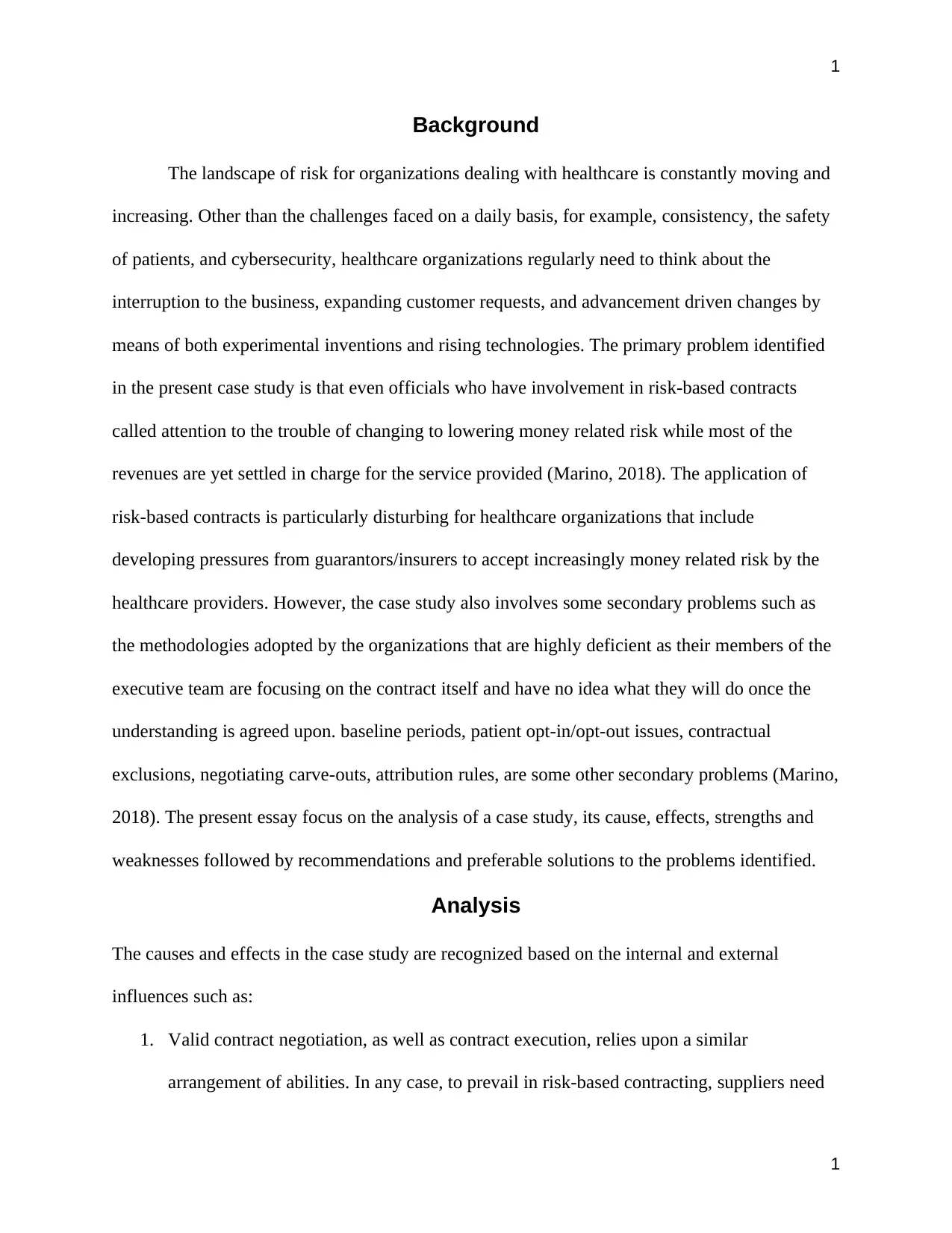
The landscape of risk for organizations dealing with healthcare is constantly moving and
increasing. Other than the challenges faced on a daily basis, for example, consistency, the safety
of patients, and cybersecurity, healthcare organizations regularly need to think about the
interruption to the business, expanding customer requests, and advancement driven changes by
means of both experimental inventions and rising technologies. The primary problem identified
in the present case study is that even officials who have involvement in risk-based contracts
called attention to the trouble of changing to lowering money related risk while most of the
revenues are yet settled in charge for the service provided (Marino, 2018). The application of
risk-based contracts is particularly disturbing for healthcare organizations that include
developing pressures from guarantors/insurers to accept increasingly money related risk by the
healthcare providers. However, the case study also involves some secondary problems such as
the methodologies adopted by the organizations that are highly deficient as their members of the
executive team are focusing on the contract itself and have no idea what they will do once the
understanding is agreed upon. baseline periods, patient opt-in/opt-out issues, contractual
exclusions, negotiating carve-outs, attribution rules, are some other secondary problems (Marino,
2018). The present essay focus on the analysis of a case study, its cause, effects, strengths and
weaknesses followed by recommendations and preferable solutions to the problems identified.
Analysis
The causes and effects in the case study are recognized based on the internal and external
influences such as:
1. Valid contract negotiation, as well as contract execution, relies upon a similar
arrangement of abilities. In any case, to prevail in risk-based contracting, suppliers need
1
Document Page
2
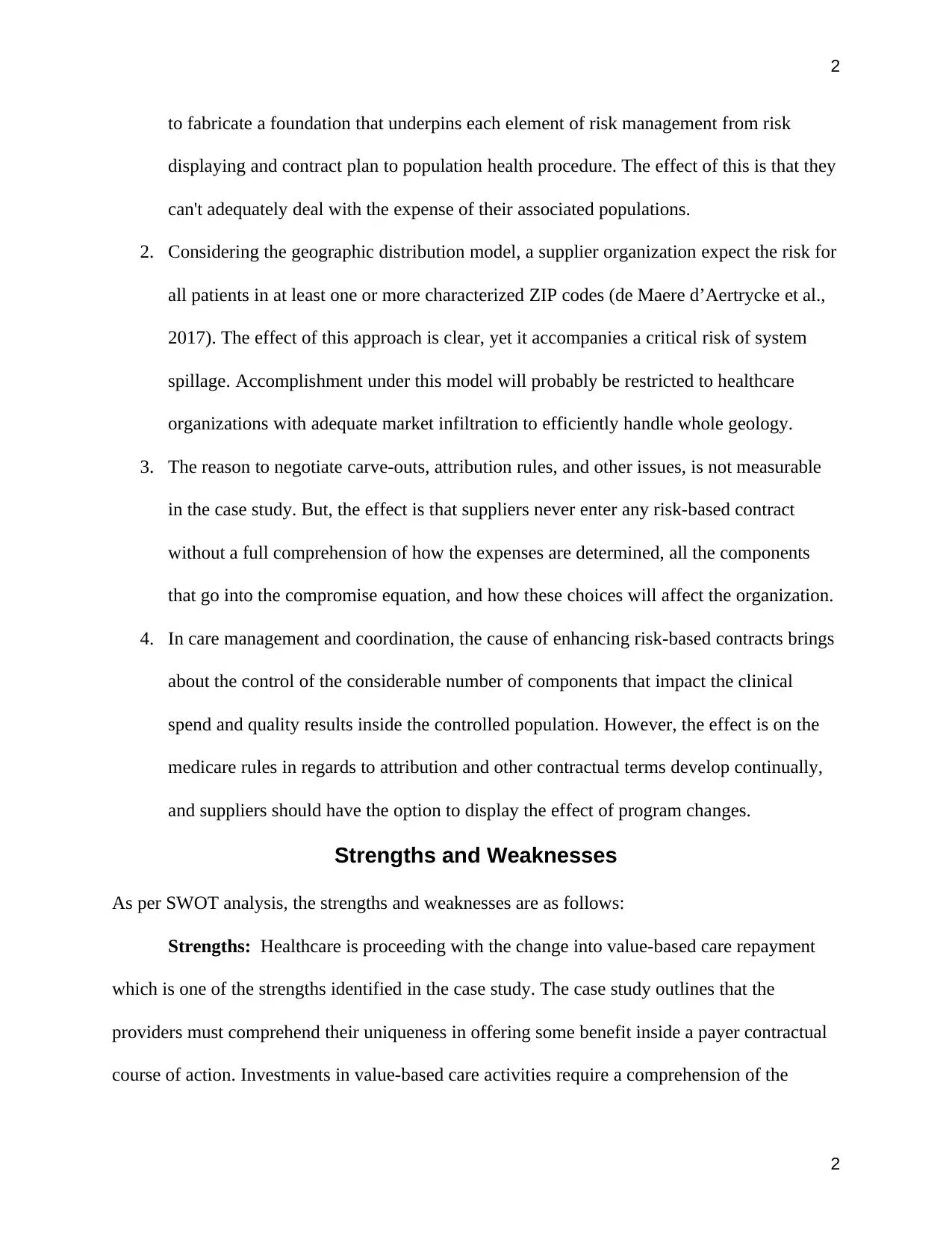
to fabricate a foundation that underpins each element of risk management from risk
displaying and contract plan to population health procedure. The effect of this is that they
can't adequately deal with the expense of their associated populations.
2. Considering the geographic distribution model, a supplier organization expect the risk for
all patients in at least one or more characterized ZIP codes (de Maere d’Aertrycke et al.,
2017). The effect of this approach is clear, yet it accompanies a critical risk of system
spillage. Accomplishment under this model will probably be restricted to healthcare
organizations with adequate market infiltration to efficiently handle whole geology.
3. The reason to negotiate carve-outs, attribution rules, and other issues, is not measurable
in the case study. But, the effect is that suppliers never enter any risk-based contract
without a full comprehension of how the expenses are determined, all the components
that go into the compromise equation, and how these choices will affect the organization.
4. In care management and coordination, the cause of enhancing risk-based contracts brings
about the control of the considerable number of components that impact the clinical
spend and quality results inside the controlled population. However, the effect is on the
medicare rules in regards to attribution and other contractual terms develop continually,
and suppliers should have the option to display the effect of program changes.
Strengths and Weaknesses
As per SWOT analysis, the strengths and weaknesses are as follows:
Strengths: Healthcare is proceeding with the change into value-based care repayment
which is one of the strengths identified in the case study. The case study outlines that the
providers must comprehend their uniqueness in offering some benefit inside a payer contractual
course of action. Investments in value-based care activities require a comprehension of the
2
Document Page
3
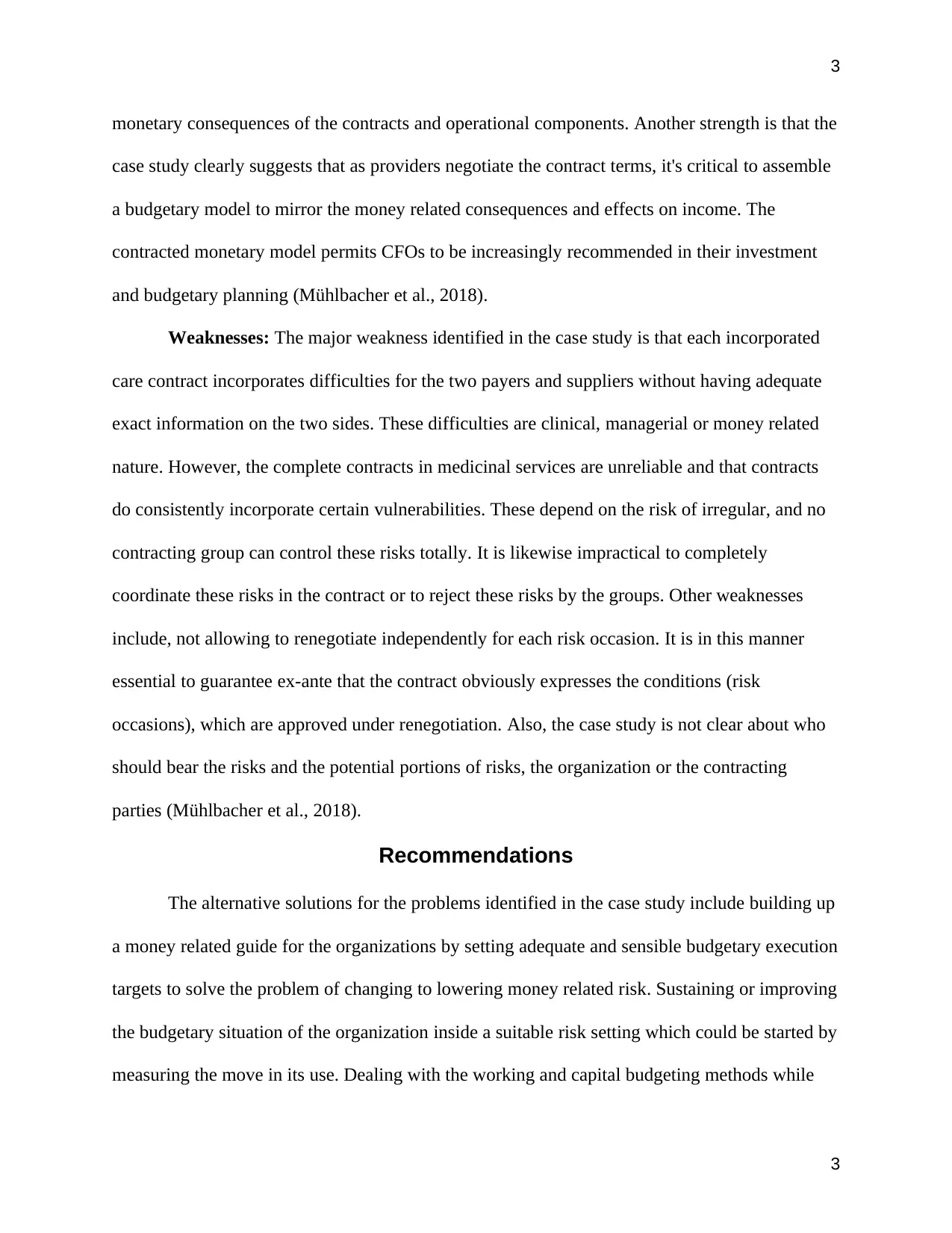
monetary consequences of the contracts and operational components. Another strength is that the
case study clearly suggests that as providers negotiate the contract terms, it's critical to assemble
a budgetary model to mirror the money related consequences and effects on income. The
contracted monetary model permits CFOs to be increasingly recommended in their investment
and budgetary planning (Mühlbacher et al., 2018).
Weaknesses: The major weakness identified in the case study is that each incorporated
care contract incorporates difficulties for the two payers and suppliers without having adequate
exact information on the two sides. These difficulties are clinical, managerial or money related
nature. However, the complete contracts in medicinal services are unreliable and that contracts
do consistently incorporate certain vulnerabilities. These depend on the risk of irregular, and no
contracting group can control these risks totally. It is likewise impractical to completely
coordinate these risks in the contract or to reject these risks by the groups. Other weaknesses
include, not allowing to renegotiate independently for each risk occasion. It is in this manner
essential to guarantee ex-ante that the contract obviously expresses the conditions (risk
occasions), which are approved under renegotiation. Also, the case study is not clear about who
should bear the risks and the potential portions of risks, the organization or the contracting
parties (Mühlbacher et al., 2018).
Recommendations
The alternative solutions for the problems identified in the case study include building up
a money related guide for the organizations by setting adequate and sensible budgetary execution
targets to solve the problem of changing to lowering money related risk. Sustaining or improving
the budgetary situation of the organization inside a suitable risk setting which could be started by
measuring the move in its use. Dealing with the working and capital budgeting methods while
3
tabler-icon-diamond-filled.svg

Paraphrase This Document

Need a fresh take? Get an instant paraphrase of this document with our AI Paraphraser
Document Page
4
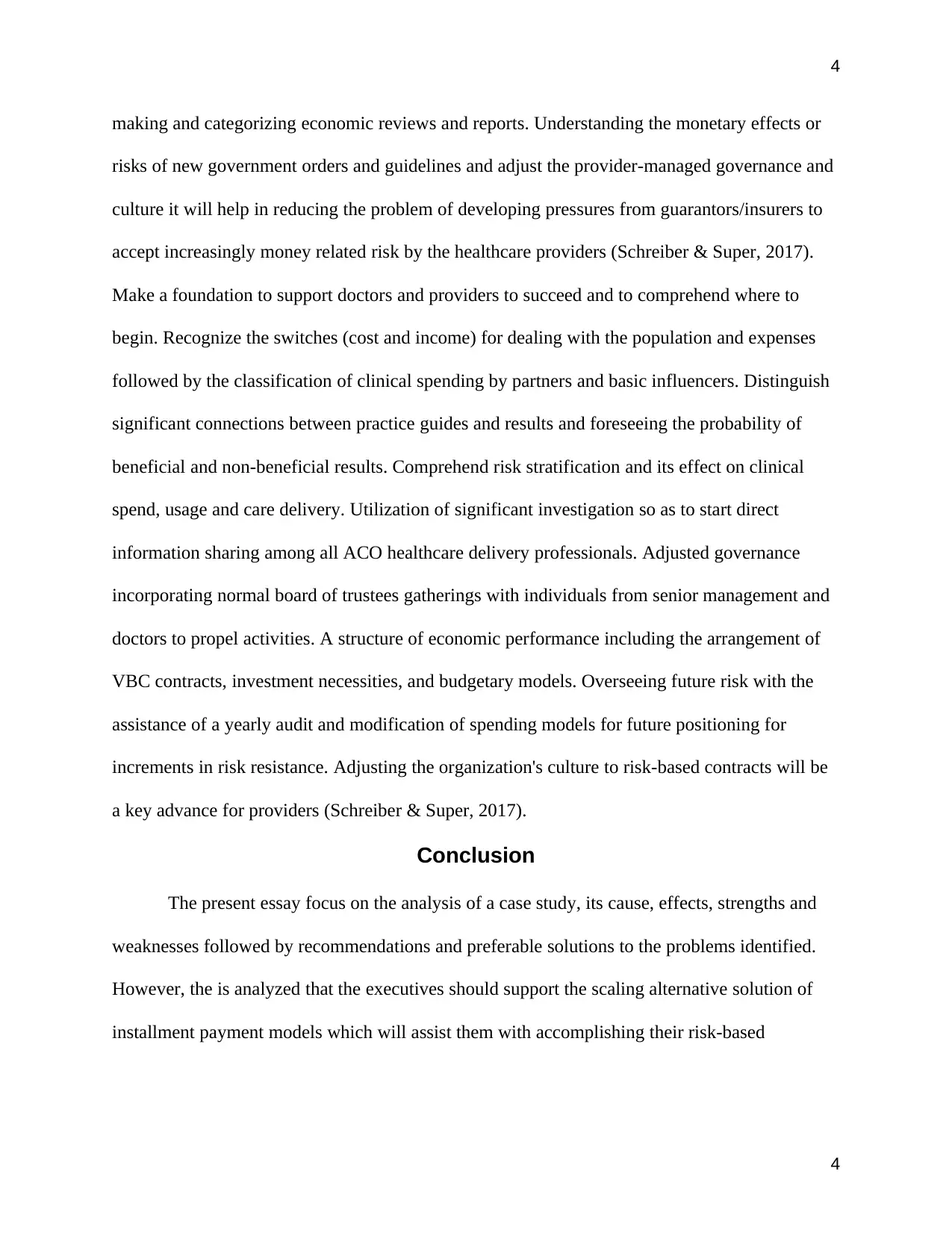
making and categorizing economic reviews and reports. Understanding the monetary effects or
risks of new government orders and guidelines and adjust the provider-managed governance and
culture it will help in reducing the problem of developing pressures from guarantors/insurers to
accept increasingly money related risk by the healthcare providers (Schreiber & Super, 2017).
Make a foundation to support doctors and providers to succeed and to comprehend where to
begin. Recognize the switches (cost and income) for dealing with the population and expenses
followed by the classification of clinical spending by partners and basic influencers. Distinguish
significant connections between practice guides and results and foreseeing the probability of
beneficial and non-beneficial results. Comprehend risk stratification and its effect on clinical
spend, usage and care delivery. Utilization of significant investigation so as to start direct
information sharing among all ACO healthcare delivery professionals. Adjusted governance
incorporating normal board of trustees gatherings with individuals from senior management and
doctors to propel activities. A structure of economic performance including the arrangement of
VBC contracts, investment necessities, and budgetary models. Overseeing future risk with the
assistance of a yearly audit and modification of spending models for future positioning for
increments in risk resistance. Adjusting the organization's culture to risk-based contracts will be
a key advance for providers (Schreiber & Super, 2017).
Conclusion
The present essay focus on the analysis of a case study, its cause, effects, strengths and
weaknesses followed by recommendations and preferable solutions to the problems identified.
However, the is analyzed that the executives should support the scaling alternative solution of
installment payment models which will assist them with accomplishing their risk-based
4
Document Page
5
objectives. The organization should begin making an interpretation of experience into the
direction that can be completely operationalized.
References
de Maere d’Aertrycke, G., Ehrenmann, A., & Smeers, Y. (2017). Investment with
incomplete markets for risk: The need for long-term contracts. Energy Policy, 105, 571-
583. https://doi.org/10.1016/j.enpol.2017.01.029
Marino, D. (2018). A Blueprint for Building a ‘Risk Ready’ Healthcare Organization
[Ebook]. HFMA. Retrieved 11 April 2020, from
https://www.hfma.org/topics/hfm/2018/october/61959.html.
5
Document Page
6
Mühlbacher, A., Amelung, V., & Juhnke, C. (2018). Contract Design: Risk Management
and Evaluation. International Journal Of Integrated Care, 18(1).
https://doi.org/10.5334/ijic.3616
Riascos, A., & Guerrero, R. (2017). Capital Requirements of Health Insurers Under
Different Risk-Adjusted Capitation Payments. SSRN Electronic Journal.
https://doi.org/10.2139/ssrn.2912942
Schreiber, R., & Super, N. (2017). COMMUNITY-BASED ORGANIZATION
INTEGRATION IN THE U.S. HEALTHCARE SYSTEM: BUILDING THE
BUSINESS CASE. Innovation In Aging, 1(suppl_1), 1087-1088.
https://doi.org/10.1093/geroni/igx004.3990
6
chevron_up_icon
1 out of 7
circle_padding
hide_on_mobile
zoom_out_icon
[object Object]