An Analysis of the Roles, Ethical Dilemmas, and Teamwork in Healthcare
VerifiedAdded on 2020/06/06
|10
|2703
|103
Essay
AI Summary
This essay provides a comprehensive overview of the roles and responsibilities of healthcare professionals, particularly focusing on social workers and their interactions with other professionals and non-professionals in the social care sector. It delves into the ethical dilemmas they face, such as balancing conflicting values, maintaining confidentiality, and making difficult decisions regarding patient care and child abuse cases. The essay highlights the importance of ethical principles, teamwork, and professional qualifications in delivering effective care. It also examines the context in which healthcare professionals work, emphasizing the significance of teamwork, supervision, and the impact of family background on service delivery. The essay underscores the need for adherence to ethical guidelines and the importance of professional bodies in regulating practices to ensure high-quality care for all individuals.
ROLE OF HEALTH
CARE PROFESSIONALS
CARE PROFESSIONALS

Paraphrase This Document
Need a fresh take? Get an instant paraphrase of this document with our AI Paraphraser
TABLE OF CONTENTS
INTRODUCTION ..........................................................................................................................3
ESSAY ............................................................................................................................................3
1.1.................................................................................................................................................3
1....................................................................................................................................................3
2....................................................................................................................................................3
3....................................................................................................................................................4
1.2.................................................................................................................................................4
1.3.................................................................................................................................................5
2.1 ................................................................................................................................................5
2.2.................................................................................................................................................6
3.1.................................................................................................................................................6
3.2.................................................................................................................................................7
CONCLUSION ...............................................................................................................................7
REFERENCES ...............................................................................................................................8
INTRODUCTION ..........................................................................................................................3
ESSAY ............................................................................................................................................3
1.1.................................................................................................................................................3
1....................................................................................................................................................3
2....................................................................................................................................................3
3....................................................................................................................................................4
1.2.................................................................................................................................................4
1.3.................................................................................................................................................5
2.1 ................................................................................................................................................5
2.2.................................................................................................................................................6
3.1.................................................................................................................................................6
3.2.................................................................................................................................................7
CONCLUSION ...............................................................................................................................7
REFERENCES ...............................................................................................................................8
INTRODUCTION
Role of health and the social care professionals is important in delivering better and
effective care to the patients (Du Pré, 2010). Present report describes about the role of front line
social worker and main difference between social worker and other professionals. In addition to
that main differences between the role of social worker and that of other professionals have been
mentioned.
ESSAY
1.1
1
Front line social worker play an important role within the social service teams.
It is also essential that they should play their part effectively so that they can complete
their assigned job roles and duties successfully (Kahn, Yang and Kahn, 2010).
Front line social workers have major role towards working for child protection and they
take part in teams and role playing sessions. It supports them in effectively
accomplishing their major objectives for child protection.
They are accountable for ensuring that children should be protected and cases of child
abuse could be minimized.
2
There are various practical issues that are faced by social care professionals and due to
that challenges are faced in providing care to the people. Code of ethics refers about guiding
principles that needs to be followed by social care professionals (Makai and et. al., 2014).
Sometimes tough decisions needs to be taken for betterment of individual and due to that
ethical dilemmas are faced by social care workers. It is their responsibility to take critical
decisions that are in best interest for the person. This type of situation generally occur when there
is need for prioritizing a specific principle over another principle and due to this ethical dilemma
is created for health care professionals.
3
1
Role of health and the social care professionals is important in delivering better and
effective care to the patients (Du Pré, 2010). Present report describes about the role of front line
social worker and main difference between social worker and other professionals. In addition to
that main differences between the role of social worker and that of other professionals have been
mentioned.
ESSAY
1.1
1
Front line social worker play an important role within the social service teams.
It is also essential that they should play their part effectively so that they can complete
their assigned job roles and duties successfully (Kahn, Yang and Kahn, 2010).
Front line social workers have major role towards working for child protection and they
take part in teams and role playing sessions. It supports them in effectively
accomplishing their major objectives for child protection.
They are accountable for ensuring that children should be protected and cases of child
abuse could be minimized.
2
There are various practical issues that are faced by social care professionals and due to
that challenges are faced in providing care to the people. Code of ethics refers about guiding
principles that needs to be followed by social care professionals (Makai and et. al., 2014).
Sometimes tough decisions needs to be taken for betterment of individual and due to that
ethical dilemmas are faced by social care workers. It is their responsibility to take critical
decisions that are in best interest for the person. This type of situation generally occur when there
is need for prioritizing a specific principle over another principle and due to this ethical dilemma
is created for health care professionals.
3
1
⊘ This is a preview!⊘
Do you want full access?
Subscribe today to unlock all pages.

Trusted by 1+ million students worldwide
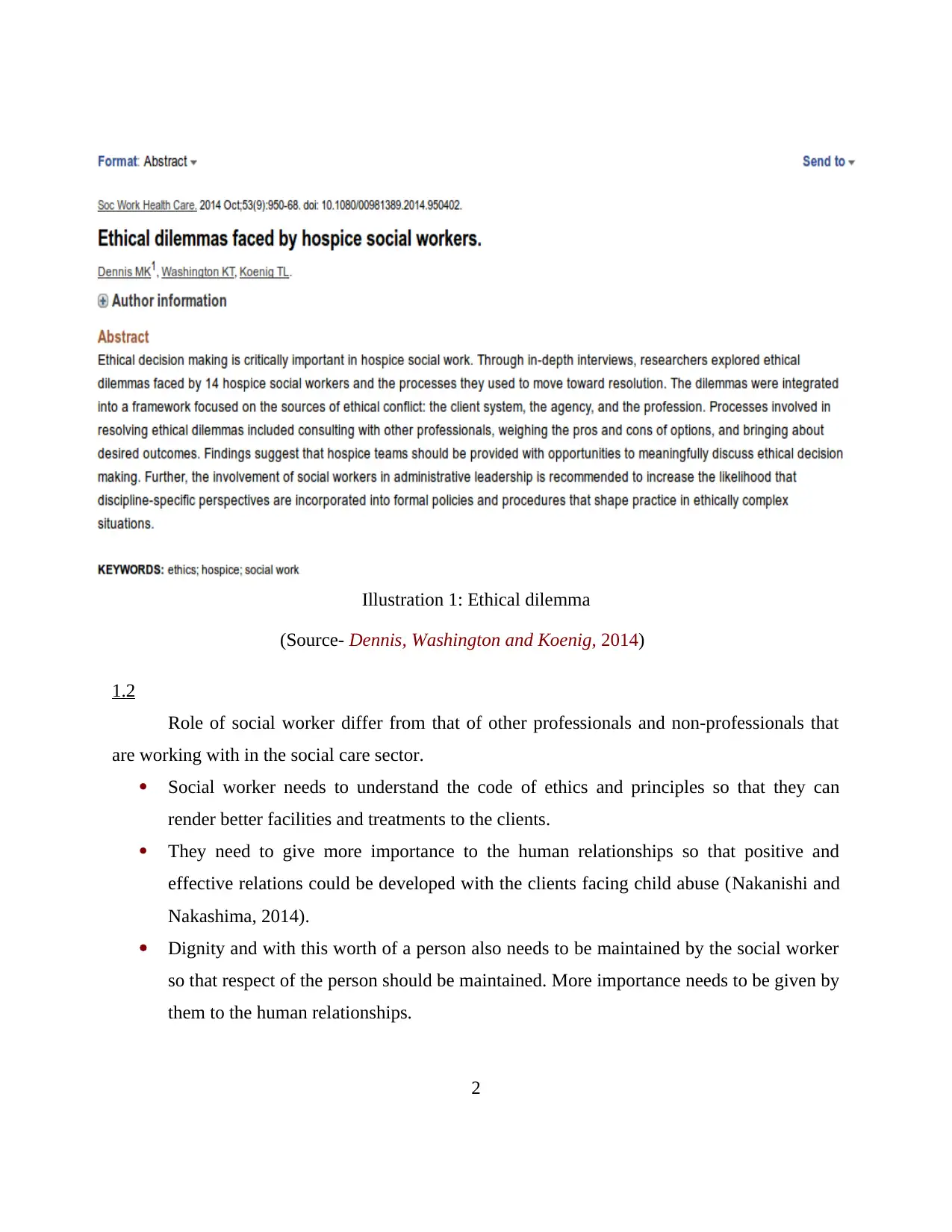
(Source- Dennis, Washington and Koenig, 2014)
1.2
Role of social worker differ from that of other professionals and non-professionals that
are working with in the social care sector.
Social worker needs to understand the code of ethics and principles so that they can
render better facilities and treatments to the clients.
They need to give more importance to the human relationships so that positive and
effective relations could be developed with the clients facing child abuse (Nakanishi and
Nakashima, 2014).
Dignity and with this worth of a person also needs to be maintained by the social worker
so that respect of the person should be maintained. More importance needs to be given by
them to the human relationships.
2
Illustration 1: Ethical dilemma
1.2
Role of social worker differ from that of other professionals and non-professionals that
are working with in the social care sector.
Social worker needs to understand the code of ethics and principles so that they can
render better facilities and treatments to the clients.
They need to give more importance to the human relationships so that positive and
effective relations could be developed with the clients facing child abuse (Nakanishi and
Nakashima, 2014).
Dignity and with this worth of a person also needs to be maintained by the social worker
so that respect of the person should be maintained. More importance needs to be given by
them to the human relationships.
2
Illustration 1: Ethical dilemma
Paraphrase This Document
Need a fresh take? Get an instant paraphrase of this document with our AI Paraphraser
Role of social worker: Social worker support families and guide them how to behave at the time
of crisis. Social worker also refers children and their families to take additional medical services
if required. Social care worker also identifies possible neglect and abuse. Social workers needs to
be aware of various types of neglect and abuse that might be faced by child. It includes
knowledge about physical, emotional and sexual abuse. Role of social worker also includes
working with the other community partners and address issues of child neglect and abuse. They
are accountable for reporting to the higher authorities for reporting about suspected child abuse
(Du Pré, 2010.
Ethical dilemmas faced by Social workers: They face ethical dilemmas when their moral
values gets in conflict with the moral values of clients.
Role of other professionals
Who are other professionals :- Other professional includes individuals who are responsible for
working with social worker to work for preventing child abuse.
Other professionals such as Doctors, nurses and Health visitors are responsible for providing
medical care to child who is facing abuse. Their role is as follows :-
Nurses :- They are responsible for referring the child to follow up medical and mental health
care. They are responsible for carrying out documentation of examinations findings and assisting
for identifying child abuse.
Police :- They have powers for taking the children into police protections if they identify any
kind of suspected abuse. In addition to the above mentioned other professionals, Social
administers are responsible for managing the functional activities of social care home (Glasby,
2017).
Ethical dilemmas faced by Other professionals :-
Doctors, nurse and health visitors: Ethical dilemmas is faced in maintaining
confidentiality of information which is related to child abuse.
3
of crisis. Social worker also refers children and their families to take additional medical services
if required. Social care worker also identifies possible neglect and abuse. Social workers needs to
be aware of various types of neglect and abuse that might be faced by child. It includes
knowledge about physical, emotional and sexual abuse. Role of social worker also includes
working with the other community partners and address issues of child neglect and abuse. They
are accountable for reporting to the higher authorities for reporting about suspected child abuse
(Du Pré, 2010.
Ethical dilemmas faced by Social workers: They face ethical dilemmas when their moral
values gets in conflict with the moral values of clients.
Role of other professionals
Who are other professionals :- Other professional includes individuals who are responsible for
working with social worker to work for preventing child abuse.
Other professionals such as Doctors, nurses and Health visitors are responsible for providing
medical care to child who is facing abuse. Their role is as follows :-
Nurses :- They are responsible for referring the child to follow up medical and mental health
care. They are responsible for carrying out documentation of examinations findings and assisting
for identifying child abuse.
Police :- They have powers for taking the children into police protections if they identify any
kind of suspected abuse. In addition to the above mentioned other professionals, Social
administers are responsible for managing the functional activities of social care home (Glasby,
2017).
Ethical dilemmas faced by Other professionals :-
Doctors, nurse and health visitors: Ethical dilemmas is faced in maintaining
confidentiality of information which is related to child abuse.
3
Police: Ethical dilemmas is faced in taking difficult decisions for the child.
Role of Non professionals
Who are non- professionals :- Non professionals are people who are not directly associated with
social workers but their work is related to Child abuse.
Advocacy workers- These are other professionals that work in social care sector for
ensuring that voice of vulnerable child should be heard. They empower children to
express their issues, views and wishes. In addition to that they also encourage children
for involving in the decisions which might going to affect them.
Rehabilitations workers- They are responsible for carrying out the assessment for
identifying the care and support needs of child. Their role is to work with other
professionals so that better help can be provided to children.
Personal assistant- List of non professionals also includes personal assistant and they
are responsible for assisting in providing personal care to victim of child abuse.
Ethical dilemmas faced by Non professionals :-
Social Administers: Ethical dilemma is faced in taking decisions in situations which
involves conflict between values, policies and laws.
Advocacy worker: Ethical dilemma is also faced when two standard are applies to a
situation but there exist conflict in each other. In addition to that dilemma is faced in
handing issues which requires to maintain confidentiality of information.
1.3
There are several ethical and moral dilemmas that are faced by professionals that are
working in health and social care. One major dilemma that is faced by an individual while
rendering care to the individuals is in situations when there is need for deciding about the best
course of action that could be taken for the individuals. It is required that best medical care
4
Role of Non professionals
Who are non- professionals :- Non professionals are people who are not directly associated with
social workers but their work is related to Child abuse.
Advocacy workers- These are other professionals that work in social care sector for
ensuring that voice of vulnerable child should be heard. They empower children to
express their issues, views and wishes. In addition to that they also encourage children
for involving in the decisions which might going to affect them.
Rehabilitations workers- They are responsible for carrying out the assessment for
identifying the care and support needs of child. Their role is to work with other
professionals so that better help can be provided to children.
Personal assistant- List of non professionals also includes personal assistant and they
are responsible for assisting in providing personal care to victim of child abuse.
Ethical dilemmas faced by Non professionals :-
Social Administers: Ethical dilemma is faced in taking decisions in situations which
involves conflict between values, policies and laws.
Advocacy worker: Ethical dilemma is also faced when two standard are applies to a
situation but there exist conflict in each other. In addition to that dilemma is faced in
handing issues which requires to maintain confidentiality of information.
1.3
There are several ethical and moral dilemmas that are faced by professionals that are
working in health and social care. One major dilemma that is faced by an individual while
rendering care to the individuals is in situations when there is need for deciding about the best
course of action that could be taken for the individuals. It is required that best medical care
4
⊘ This is a preview!⊘
Do you want full access?
Subscribe today to unlock all pages.
Trusted by 1+ million students worldwide
should be given to the patients so that they can avail best possible medical care (Munn-Giddings
and Winter, 2013).
Sometimes the care taker finds it difficult in making the patient comfortable in the
treatment that is being provided to them. One more ethical dilemma that is being faced includes
difficulties in choosing one course of action and it is essential that there should be different
courses to choose from. This is the major dilemma that is being faced while giving care to the
patients. It becomes ethical and moral responsibility of the health and social care professionals
for providing better and effective care to the people. It is the major dilemma that is being faced
by professionals To choose best course (Kitson and et. al., 2013).
Sometimes situation occurs when it is required that compromise should be made with the
ethical principles so that effective decisions could be taken for the service takers. Ethical
principles needs to be followed so that personal values of individuals should not get affected.
Along with this, for rendering good care to the patients it is required that sometimes compromise
should be made with the ethical principles (Mair, Quiñones and Pasha, 2015). Moreover, in some
situations breach of confidentiality of ethical situation occurs and due to that issues are being
faced by the health and social care workers so that appropriate and effective decisions could be
taken.
2.1
It is vital that values and different professional qualities that are required for practising in
area of health and social care should be possessed by the individual. In addition to that it is vital
that due qualification should be possessed by the leaders so that their required objectives could
be met successfully. It is required that ethical values should be followed while rendering better
care and services to the people that are living in the society (Du Pré, 2010.).
Educational qualification must be possessed by the health and social care professionals
so that they should deliver effective care to the care takers. Diploma and certificates that are
needed by the health and social care professionals must be completed by them so that they
should meet with the standards that have been required by them for giving care to the
individuals. Ethical and moral values should also be followed by the health care professionals so
that all people should get equal opportunity for taking better and effective care and treatment.
5
and Winter, 2013).
Sometimes the care taker finds it difficult in making the patient comfortable in the
treatment that is being provided to them. One more ethical dilemma that is being faced includes
difficulties in choosing one course of action and it is essential that there should be different
courses to choose from. This is the major dilemma that is being faced while giving care to the
patients. It becomes ethical and moral responsibility of the health and social care professionals
for providing better and effective care to the people. It is the major dilemma that is being faced
by professionals To choose best course (Kitson and et. al., 2013).
Sometimes situation occurs when it is required that compromise should be made with the
ethical principles so that effective decisions could be taken for the service takers. Ethical
principles needs to be followed so that personal values of individuals should not get affected.
Along with this, for rendering good care to the patients it is required that sometimes compromise
should be made with the ethical principles (Mair, Quiñones and Pasha, 2015). Moreover, in some
situations breach of confidentiality of ethical situation occurs and due to that issues are being
faced by the health and social care workers so that appropriate and effective decisions could be
taken.
2.1
It is vital that values and different professional qualities that are required for practising in
area of health and social care should be possessed by the individual. In addition to that it is vital
that due qualification should be possessed by the leaders so that their required objectives could
be met successfully. It is required that ethical values should be followed while rendering better
care and services to the people that are living in the society (Du Pré, 2010.).
Educational qualification must be possessed by the health and social care professionals
so that they should deliver effective care to the care takers. Diploma and certificates that are
needed by the health and social care professionals must be completed by them so that they
should meet with the standards that have been required by them for giving care to the
individuals. Ethical and moral values should also be followed by the health care professionals so
that all people should get equal opportunity for taking better and effective care and treatment.
5
Paraphrase This Document
Need a fresh take? Get an instant paraphrase of this document with our AI Paraphraser
They should make it ensure that no discrimination should be made with any individual on the
grounds of gender, Educational qualification, financial status and ethnicity and religious back
ground. Along with this they should make it ensure that prior permission should be taken from
the participants before providing them medical treatment (Glasby, 2017).
2.2
All the professional bodies that are working in health and social care sector should be
accountable for regulating the practices and conducts for a specific profession. It is critical that
there should be strict guidelines so that requirement of values should be fulfilled and on the basis
of that all the organizations working in health and social care should execute their functional
activities. For example in social care professional bodies are responsible for making the strict
norms so that smooth functioning of all the organizations in social care sector should be ensured
(Makai and et. al., 2014).
Further, norms and rules that are formed by state are mandatory to be followed for all the
organizations that are working in the health and social care sector. Professional bodies that are
working in health and social care sector makes rules and regulations on the basis of that practices
and procedures. Professional bodies conducts and regulate practices in social care so that all the
individuals should be provided with better care and their requirement should be met successfully
(Munn-Giddings and Winter, 2013).
3.1
There are different context in which a social and health care professional works. Context
and requirement of individual and situation plays a key role in determining the services that are
being provided to individuals in health and social care. Various social care workers finds context
for their family and on the basis of that medical care and facilities are provided to the care taker.
For example quality of practising environment and with this quality of education and
various training programs that are available for practitioners. One more important thing that
matter is quality of professional supervision that is available for professionals is also one of the
significant context that needs to be considered while giving care to the service users. One more
important criteria is support of family background of the care taker. Context in which care
6
grounds of gender, Educational qualification, financial status and ethnicity and religious back
ground. Along with this they should make it ensure that prior permission should be taken from
the participants before providing them medical treatment (Glasby, 2017).
2.2
All the professional bodies that are working in health and social care sector should be
accountable for regulating the practices and conducts for a specific profession. It is critical that
there should be strict guidelines so that requirement of values should be fulfilled and on the basis
of that all the organizations working in health and social care should execute their functional
activities. For example in social care professional bodies are responsible for making the strict
norms so that smooth functioning of all the organizations in social care sector should be ensured
(Makai and et. al., 2014).
Further, norms and rules that are formed by state are mandatory to be followed for all the
organizations that are working in the health and social care sector. Professional bodies that are
working in health and social care sector makes rules and regulations on the basis of that practices
and procedures. Professional bodies conducts and regulate practices in social care so that all the
individuals should be provided with better care and their requirement should be met successfully
(Munn-Giddings and Winter, 2013).
3.1
There are different context in which a social and health care professional works. Context
and requirement of individual and situation plays a key role in determining the services that are
being provided to individuals in health and social care. Various social care workers finds context
for their family and on the basis of that medical care and facilities are provided to the care taker.
For example quality of practising environment and with this quality of education and
various training programs that are available for practitioners. One more important thing that
matter is quality of professional supervision that is available for professionals is also one of the
significant context that needs to be considered while giving care to the service users. One more
important criteria is support of family background of the care taker. Context in which care
6
service providers renders care to professionals also plays an important role (HM Government,
2017).
3.2
Team work supports for involving mutual efforts of all the individuals that are working in
team and it also helps for performing all the necessary functions. Supervision is also one of the
main component that is included while giving care to the individuals. Health and social care
organizations works with objective to impart quality care to the individuals. Their main
objectives is for ensuring the physical and mental well-being of people. Health and social care
profession can be developed and in this regard it is critical that Teamwork should be there so that
all the health care professionals should support each other (Nakanishi and Nakashima, 2014).
It will help for making involvement of all the health care professionals so that required
activities could be performed successfully. Other than that, supervision is also important as it
helps for monitoring the work performances of staff members and due to that it becomes easier
for identifying their weak performing areas (Makai and et. al., 2014). It also helps for making the
positive improvements in the performance areas of the staff members. Along with this, team
working helps for reducing stress and job burden from an individual staff workers. Team work in
context of health and social care is mentioned as the manner in which two or more individuals
take initiatives for accomplishing their required task and work activities. It is practices that
comprise collaboration and better communication among the members so that they can achieve
the common purpose that have been defined by them.
CONCLUSION
Summing up the present report it can be concluded that there should be strict guidelines
so that requirement of values should be fulfilled in health and social care. Various individuals
working in social care sector including social worker, Other professionals and Non professionals
are accountable for fulfilling their responsibility. Team working activities helps the individuals
to render better care for the patients and on with this objectives of the care home are completed
successfully. One more benefit for the team working is that it helps for implementing the
principles and protocols so that all the practices should be performed successfully.
7
2017).
3.2
Team work supports for involving mutual efforts of all the individuals that are working in
team and it also helps for performing all the necessary functions. Supervision is also one of the
main component that is included while giving care to the individuals. Health and social care
organizations works with objective to impart quality care to the individuals. Their main
objectives is for ensuring the physical and mental well-being of people. Health and social care
profession can be developed and in this regard it is critical that Teamwork should be there so that
all the health care professionals should support each other (Nakanishi and Nakashima, 2014).
It will help for making involvement of all the health care professionals so that required
activities could be performed successfully. Other than that, supervision is also important as it
helps for monitoring the work performances of staff members and due to that it becomes easier
for identifying their weak performing areas (Makai and et. al., 2014). It also helps for making the
positive improvements in the performance areas of the staff members. Along with this, team
working helps for reducing stress and job burden from an individual staff workers. Team work in
context of health and social care is mentioned as the manner in which two or more individuals
take initiatives for accomplishing their required task and work activities. It is practices that
comprise collaboration and better communication among the members so that they can achieve
the common purpose that have been defined by them.
CONCLUSION
Summing up the present report it can be concluded that there should be strict guidelines
so that requirement of values should be fulfilled in health and social care. Various individuals
working in social care sector including social worker, Other professionals and Non professionals
are accountable for fulfilling their responsibility. Team working activities helps the individuals
to render better care for the patients and on with this objectives of the care home are completed
successfully. One more benefit for the team working is that it helps for implementing the
principles and protocols so that all the practices should be performed successfully.
7
⊘ This is a preview!⊘
Do you want full access?
Subscribe today to unlock all pages.
Trusted by 1+ million students worldwide
REFERENCES
Books and Journals
Du Pré, A., 2010. Communicating about health: current issues and perspectives.
Glasby, J., 2017.Understanding health and social care. Policy Press.
Kahn, J.G., Yang, J.S. and Kahn, J.S., 2010. ‘Mobile’health needs and opportunities in
developing countries. Health Affairs. 29(2). pp.252-258.
Kitson, A and et. al., 2013. What are the core elements of patient‐centred care? A narrative
review and synthesis of the literature from health policy, medicine and nursing. Journal
of advanced nursing. 69(1). pp.4-15.
Mair, C.A., Quiñones, A.R. and Pasha, M.A., 2015. Care preferences among middle-aged and
older adults with chronic disease in Europe: Individual health care needs and national
health care infrastructure. The Gerontologist, p.gnu119.
Makai, P. and et. al., 2014. Quality of life instruments for economic evaluations in health and
social care for older people: a systematic review. Social Science & Medicine. 102. pp.83-
93.
Munn-Giddings, C. and Winter, R., 2013. A handbook for action research in health and social
care. Routledge.
Nakanishi, M. and Nakashima, T., 2014. Features of the Japanese national dementia strategy in
comparison with international dementia policies: How should a national dementia policy
interact with the public health-and social-care systems?. Alzheimer's & Dementia. 10(4).
pp.468-476.
Online
Dennis, M. K., Washington, K.T. and Koenig T. L., 2014. Ethical dilemmas faced by hospice
social workers. Soc Work Health Care. [E-journal]. Available through:
<https://www.ncbi.nlm.nih.gov/pubmed/25397348>. [Accessed on 12th June, 2017].
HM Government. 2017. [Online]. Available through:
<http://www.appg-agscience.org.uk/linkedfiles/Defra%20food2030strategy.pdf>.
[Accessed on 12th May, 2017].
8
Books and Journals
Du Pré, A., 2010. Communicating about health: current issues and perspectives.
Glasby, J., 2017.Understanding health and social care. Policy Press.
Kahn, J.G., Yang, J.S. and Kahn, J.S., 2010. ‘Mobile’health needs and opportunities in
developing countries. Health Affairs. 29(2). pp.252-258.
Kitson, A and et. al., 2013. What are the core elements of patient‐centred care? A narrative
review and synthesis of the literature from health policy, medicine and nursing. Journal
of advanced nursing. 69(1). pp.4-15.
Mair, C.A., Quiñones, A.R. and Pasha, M.A., 2015. Care preferences among middle-aged and
older adults with chronic disease in Europe: Individual health care needs and national
health care infrastructure. The Gerontologist, p.gnu119.
Makai, P. and et. al., 2014. Quality of life instruments for economic evaluations in health and
social care for older people: a systematic review. Social Science & Medicine. 102. pp.83-
93.
Munn-Giddings, C. and Winter, R., 2013. A handbook for action research in health and social
care. Routledge.
Nakanishi, M. and Nakashima, T., 2014. Features of the Japanese national dementia strategy in
comparison with international dementia policies: How should a national dementia policy
interact with the public health-and social-care systems?. Alzheimer's & Dementia. 10(4).
pp.468-476.
Online
Dennis, M. K., Washington, K.T. and Koenig T. L., 2014. Ethical dilemmas faced by hospice
social workers. Soc Work Health Care. [E-journal]. Available through:
<https://www.ncbi.nlm.nih.gov/pubmed/25397348>. [Accessed on 12th June, 2017].
HM Government. 2017. [Online]. Available through:
<http://www.appg-agscience.org.uk/linkedfiles/Defra%20food2030strategy.pdf>.
[Accessed on 12th May, 2017].
8

1 out of 10


Related Documents


Your All-in-One AI-Powered Toolkit for Academic Success.
+13062052269
info@desklib.com
Available 24*7 on WhatsApp / Email
![[object Object]](/_next/static/media/star-bottom.7253800d.svg)
Unlock your academic potential
Copyright © 2020–2026 A2Z Services. All Rights Reserved. Developed and managed by ZUCOL.