Sustainability of Value-Based Healthcare: Health Economics Report
VerifiedAdded on 2023/06/03
|18
|4995
|236
Report
AI Summary
This report provides a detailed analysis of value-based healthcare systems, focusing on the transformation from traditional healthcare models, particularly in the context of Turkey's healthcare reforms. It examines guiding principles for successful healthcare transformation, challenges faced, and lessons learned from both successful and less successful reforms. The report also discusses the implications of value-based healthcare on health outcomes, experience of care, and cost-effectiveness, considering factors such as aging populations, increased chronic diseases, and technological advancements. Recommendations are provided to enhance the future performance of healthcare systems in addressing these challenges. Desklib offers a platform to explore similar healthcare reports and solved assignments for students.
Running Head: HEALTH ECONOMICS AND COMPARATIVE HEALTH SYSTEMS 1
HEALTH ECONOMICS AND COMPARATIVE HEALTH SYSTEMS
Name
Institution
HEALTH ECONOMICS AND COMPARATIVE HEALTH SYSTEMS
Name
Institution

Paraphrase This Document
Need a fresh take? Get an instant paraphrase of this document with our AI Paraphraser
HEALTH ECONOMICS AND COMPARATIVE HEALTH SYSTEMS 2
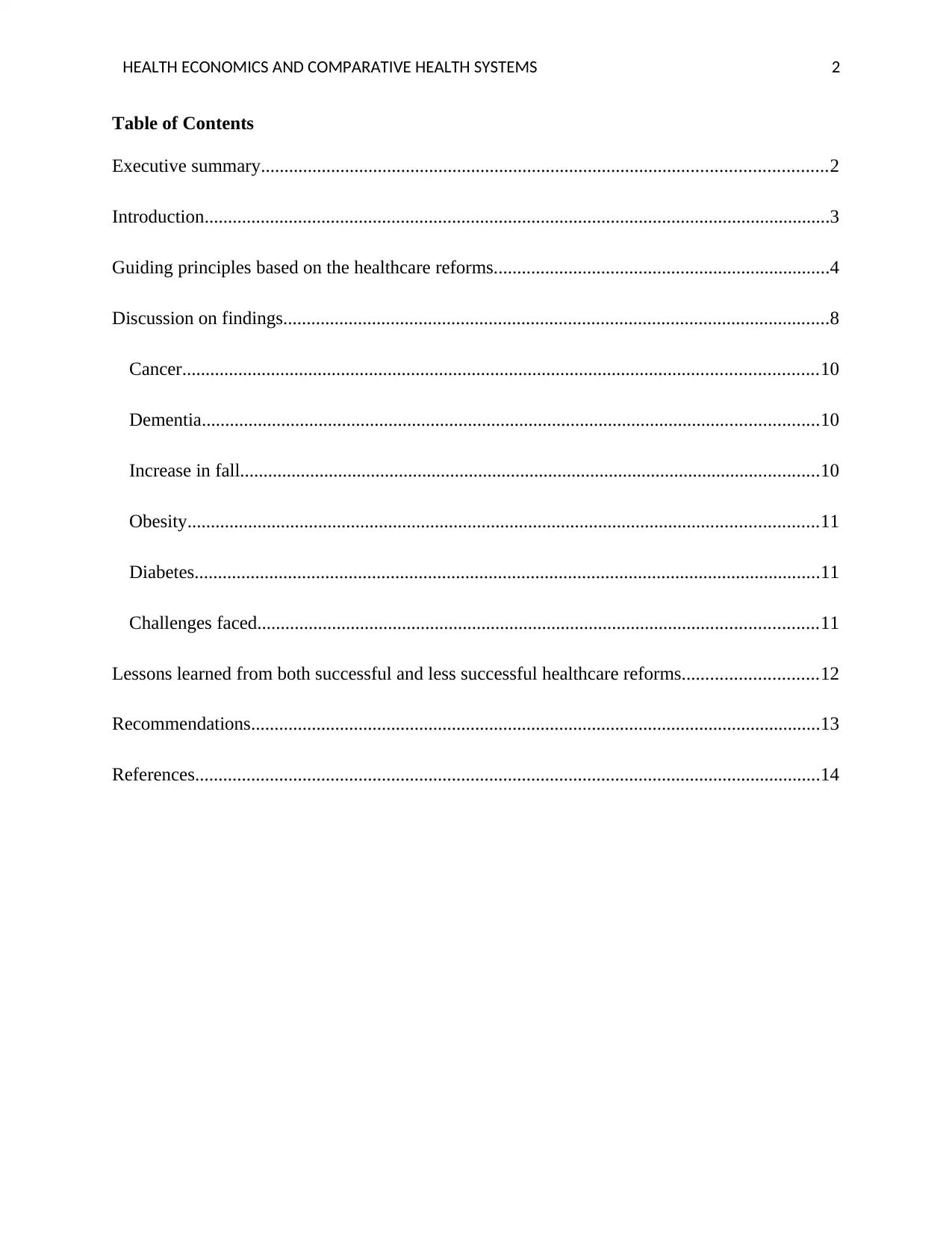
Table of Contents
Executive summary.........................................................................................................................2
Introduction......................................................................................................................................3
Guiding principles based on the healthcare reforms........................................................................4
Discussion on findings.....................................................................................................................8
Cancer........................................................................................................................................10
Dementia....................................................................................................................................10
Increase in fall............................................................................................................................10
Obesity.......................................................................................................................................11
Diabetes......................................................................................................................................11
Challenges faced........................................................................................................................11
Lessons learned from both successful and less successful healthcare reforms.............................12
Recommendations..........................................................................................................................13
References......................................................................................................................................14
Table of Contents
Executive summary.........................................................................................................................2
Introduction......................................................................................................................................3
Guiding principles based on the healthcare reforms........................................................................4
Discussion on findings.....................................................................................................................8
Cancer........................................................................................................................................10
Dementia....................................................................................................................................10
Increase in fall............................................................................................................................10
Obesity.......................................................................................................................................11
Diabetes......................................................................................................................................11
Challenges faced........................................................................................................................11
Lessons learned from both successful and less successful healthcare reforms.............................12
Recommendations..........................................................................................................................13
References......................................................................................................................................14
HEALTH ECONOMICS AND COMPARATIVE HEALTH SYSTEMS 3
Executive summary
The value-based health system is a system for measuring health based on the value of
health result the person receives after undergoing medication. The achievement of the value-
based health system is a possible goal but a difficult one. It needs a program of transformation
that is outcome-oriented plus a leadership of high-level politicians and a strong commitment
(Tan & Tan, 2017). The value-based health system also makes necessary attention for context
and change in reception which is crucial for delivering and development strategy. Any leader or
minister in charge of health care should acknowledge that success achievement without the
support from the public is very hard which also needs to be supported by the high leaders
beginning from the prime minister and the president of the country. The achievement of major
health system performance improvements like in our case health is possible within a short period
and under the relative and right conditions. The paper discusses how the nation of Turkey has
made a transformation in its health sector from a traditional healthcare system to a value-based
healthcare system. There are many achievements that Turkey made with its ten-year
transformation program. For instance, the progress that has been made by Turkey over that
period in satisfying the patient’s health status and also the provision of financial risks protection
is huge. Based on Turkey’s experience on transformation program, a collection of nine guiding
principles were used. Among them,are three principles that are extremely valuable in
overcoming challenges and also in leadership transformation. These includes; the assurance of
deep dedication with the intention of bringing change by commitment, the use of two-prolonged
action approach, depending on the support from the public as a shield, the balance achievement
between the private and the public sectors, development of a comprehensive program, acquiring
and protecting the citizens financially, the gaining of more knowledge from the mistakes we
Executive summary
The value-based health system is a system for measuring health based on the value of
health result the person receives after undergoing medication. The achievement of the value-
based health system is a possible goal but a difficult one. It needs a program of transformation
that is outcome-oriented plus a leadership of high-level politicians and a strong commitment
(Tan & Tan, 2017). The value-based health system also makes necessary attention for context
and change in reception which is crucial for delivering and development strategy. Any leader or
minister in charge of health care should acknowledge that success achievement without the
support from the public is very hard which also needs to be supported by the high leaders
beginning from the prime minister and the president of the country. The achievement of major
health system performance improvements like in our case health is possible within a short period
and under the relative and right conditions. The paper discusses how the nation of Turkey has
made a transformation in its health sector from a traditional healthcare system to a value-based
healthcare system. There are many achievements that Turkey made with its ten-year
transformation program. For instance, the progress that has been made by Turkey over that
period in satisfying the patient’s health status and also the provision of financial risks protection
is huge. Based on Turkey’s experience on transformation program, a collection of nine guiding
principles were used. Among them,are three principles that are extremely valuable in
overcoming challenges and also in leadership transformation. These includes; the assurance of
deep dedication with the intention of bringing change by commitment, the use of two-prolonged
action approach, depending on the support from the public as a shield, the balance achievement
between the private and the public sectors, development of a comprehensive program, acquiring
and protecting the citizens financially, the gaining of more knowledge from the mistakes we
⊘ This is a preview!⊘
Do you want full access?
Subscribe today to unlock all pages.

Trusted by 1+ million students worldwide
HEALTH ECONOMICS AND COMPARATIVE HEALTH SYSTEMS 4
make, avoiding being confused by the success that is short-lived and finallyconcentrating on the
results of your actions made to achieve our goal (Golberstein, Eisenberg & Downs, 2016).
Introduction
This essay is an expression of opinion that offers an explanation based on the health
transformation from traditional based health care to value-based healthcare specifically that took
place in the country of Turkey. The report also discusses the challenges in the leadership and all
that is related to this transformation. Currently, a great large number of countries have had the
desire to do the transformation on their health systems (Ferlie et al, 2016). The factor behind all
these motivations being the desire to satisfy their citizens needs related to health care and more
so through the provision of high-quality and equitable services without causing any hardship
financially. In another way, the main idea has been aiming to reach the Universal Health
Coverage (UHC) that is measured in terms of its value to the citizens. The main important
question is that why does a country or nation we aim to achieve this? The answer to this question
is just a simple and obvious one. Healthcare in a nation is a fundamental right to every citizen in
the country, and its sustainability depends on its operational condition. The purpose of writing
this report is to shed some light on how Turkey has been successful in their transformation from
traditional healthcare to the new advance value-added health care system. The report is also
made to learn from Turkey’s actions on how to aggressively move on so that one may achieve
value-based health care system that is measured in terms of the value it offers to the common
citizen (Baumhauer & Bozic, 2016). The structure of the essay has been divided into the
following various sections. The first section discusses guiding principles based on the healthcare
reforms, under this section; discussion about the guiding principles that were used by the nation
of Turkey in the realization of transformation from a traditional healthcare system to a value-
make, avoiding being confused by the success that is short-lived and finallyconcentrating on the
results of your actions made to achieve our goal (Golberstein, Eisenberg & Downs, 2016).
Introduction
This essay is an expression of opinion that offers an explanation based on the health
transformation from traditional based health care to value-based healthcare specifically that took
place in the country of Turkey. The report also discusses the challenges in the leadership and all
that is related to this transformation. Currently, a great large number of countries have had the
desire to do the transformation on their health systems (Ferlie et al, 2016). The factor behind all
these motivations being the desire to satisfy their citizens needs related to health care and more
so through the provision of high-quality and equitable services without causing any hardship
financially. In another way, the main idea has been aiming to reach the Universal Health
Coverage (UHC) that is measured in terms of its value to the citizens. The main important
question is that why does a country or nation we aim to achieve this? The answer to this question
is just a simple and obvious one. Healthcare in a nation is a fundamental right to every citizen in
the country, and its sustainability depends on its operational condition. The purpose of writing
this report is to shed some light on how Turkey has been successful in their transformation from
traditional healthcare to the new advance value-added health care system. The report is also
made to learn from Turkey’s actions on how to aggressively move on so that one may achieve
value-based health care system that is measured in terms of the value it offers to the common
citizen (Baumhauer & Bozic, 2016). The structure of the essay has been divided into the
following various sections. The first section discusses guiding principles based on the healthcare
reforms, under this section; discussion about the guiding principles that were used by the nation
of Turkey in the realization of transformation from a traditional healthcare system to a value-
Paraphrase This Document
Need a fresh take? Get an instant paraphrase of this document with our AI Paraphraser
HEALTH ECONOMICS AND COMPARATIVE HEALTH SYSTEMS 5
based healthcare system are discussed. The second section discusses on the findings based on the
sustainability of the value-based healthcare model putting into consideration the aging
population, the increased chronic diseases, demand on the entire healthcare and finally the ever
increasing cost of technological advancement. The final section discusses the recommendations
that should be made based on the future performance of the current healthcare system. Here the
emphasis is made addressing the aging population, increased chronic diseases, the rising demand
on the entire health care system and finally the increasing costs of technological advancement
(Nordin, Kork&Koskela, 2017).
Guiding principles based on achievement of healthcare reforms in Turkey.
The experience in Turkey teaches us a lot concerning the leadership of transformation
and the overcoming of challenges of change. Below are the nine guiding principles in the process
of Turkey struggle for transformation from traditional to value-based healthcare.
The leading principle is that transformation leadership needs internal motivation and
steady and resolute ability to decide on bringing revolution in the public favor. The importance
of this principle is that you find it difficult to address abuses of the system abuses without
making difficult decisions and also lobby groups wrath risking that are more powerful
(Aspry&Salmoirago-Blotcher, 2016). You can’t put a strong resistance that will lead to your
failure. Therefore, you ought to act fast enough to repel the attacks. In the absence, your
readiness for you to face opposition and real conflicts, you together with your teams can’t build
leadership that is transformational and finally ends up fighting with severe chaos and problems
of coordination. Now, this is the situation that is called the fibrillation state, and it looks like the
uncoordinated rapid twitching of the heart movements when circulation and pulse stops.
based healthcare system are discussed. The second section discusses on the findings based on the
sustainability of the value-based healthcare model putting into consideration the aging
population, the increased chronic diseases, demand on the entire healthcare and finally the ever
increasing cost of technological advancement. The final section discusses the recommendations
that should be made based on the future performance of the current healthcare system. Here the
emphasis is made addressing the aging population, increased chronic diseases, the rising demand
on the entire health care system and finally the increasing costs of technological advancement
(Nordin, Kork&Koskela, 2017).
Guiding principles based on achievement of healthcare reforms in Turkey.
The experience in Turkey teaches us a lot concerning the leadership of transformation
and the overcoming of challenges of change. Below are the nine guiding principles in the process
of Turkey struggle for transformation from traditional to value-based healthcare.
The leading principle is that transformation leadership needs internal motivation and
steady and resolute ability to decide on bringing revolution in the public favor. The importance
of this principle is that you find it difficult to address abuses of the system abuses without
making difficult decisions and also lobby groups wrath risking that are more powerful
(Aspry&Salmoirago-Blotcher, 2016). You can’t put a strong resistance that will lead to your
failure. Therefore, you ought to act fast enough to repel the attacks. In the absence, your
readiness for you to face opposition and real conflicts, you together with your teams can’t build
leadership that is transformational and finally ends up fighting with severe chaos and problems
of coordination. Now, this is the situation that is called the fibrillation state, and it looks like the
uncoordinated rapid twitching of the heart movements when circulation and pulse stops.
HEALTH ECONOMICS AND COMPARATIVE HEALTH SYSTEMS 6
The second principle has two-prolonged transformation approach. It is the first and the
decisive change that builds political support immediately along with gradual and deep change
aiming at revolutionizing the system. For example, one of the executed quickly changes that lead
to public support production that was strong is a decree that was issued against the patient
holding practices; whereas the implementation of the family medicine application was made for
more than five years gradually in the system (Howell, Conway & Rajkumar, 2015). Our effort in
solving the dual-practice problem also illustrates the two-prolonged approach. What we did is
that at first, we made the doctors to abandon their tasks by incentivizing them and when critical
doctors were on board, the practice was banned. By using these two-prolonged interventions, our
transformation power extended.
The third principle is the gaining of public support and trust. Sometimes the support
becomes the protector even against some friends, cabinet and also your very own party.
Therefore you should never act against the citizens and resist attempts of austerity (Vetter et al,
2014). The provision and the changes on a demand side have a close relation. When you set
public health insurance that is a single-payer, you have to make sure the facilities required are
available for providing emergency transport when they arise, hospital care, and primary care.
When these needs are not met, some incremental changes will limit the achievements that you
make.
The fourth principle is the making of a comprehensive transformation, and this is one of
Turkey's reasons for success. All the health insurance schemes that are fragmented of Turkey
were under one shed which leads to the formation of a public insurance system that was single.
Our certainty was that the UHC was not only about the universal insurance but also that our
focus was on both sides too. Therefore we harmonized and brought together all the services
The second principle has two-prolonged transformation approach. It is the first and the
decisive change that builds political support immediately along with gradual and deep change
aiming at revolutionizing the system. For example, one of the executed quickly changes that lead
to public support production that was strong is a decree that was issued against the patient
holding practices; whereas the implementation of the family medicine application was made for
more than five years gradually in the system (Howell, Conway & Rajkumar, 2015). Our effort in
solving the dual-practice problem also illustrates the two-prolonged approach. What we did is
that at first, we made the doctors to abandon their tasks by incentivizing them and when critical
doctors were on board, the practice was banned. By using these two-prolonged interventions, our
transformation power extended.
The third principle is the gaining of public support and trust. Sometimes the support
becomes the protector even against some friends, cabinet and also your very own party.
Therefore you should never act against the citizens and resist attempts of austerity (Vetter et al,
2014). The provision and the changes on a demand side have a close relation. When you set
public health insurance that is a single-payer, you have to make sure the facilities required are
available for providing emergency transport when they arise, hospital care, and primary care.
When these needs are not met, some incremental changes will limit the achievements that you
make.
The fourth principle is the making of a comprehensive transformation, and this is one of
Turkey's reasons for success. All the health insurance schemes that are fragmented of Turkey
were under one shed which leads to the formation of a public insurance system that was single.
Our certainty was that the UHC was not only about the universal insurance but also that our
focus was on both sides too. Therefore we harmonized and brought together all the services
⊘ This is a preview!⊘
Do you want full access?
Subscribe today to unlock all pages.
Trusted by 1+ million students worldwide
HEALTH ECONOMICS AND COMPARATIVE HEALTH SYSTEMS 7
through accountability and delegation an allowed their equal usage by all the citizens. A
generous and a package of equal benefit was made that applied to all the people with the
inclusion of even the poor. The benefits package contains all the primary care, hospital care, and
the entire emergency and the extensive care. That package also contains the cares that are most
expensive like the surgery of the heart, transplant organs and treatment for cancer.
The fifth principle is the creation of the engagement with the private sector and ensuring
that the public sector has the strength for the protection of both the low income and also the
middle-income groups. The balance established between the private and public sector is
challenging (Hunter, 2016). The challenge was because of excessive privatization, and under-
control private healthcare.
Maintenance of focus and carefulness in the protection of people from hardship is the
sixth principle. The reason behind this is that laissez –fair markets don’t consider health as one
of its parts. The Turkish citizens now are being protected well by the systems that are in place,
and are cheaper where the expenditure per capita was 5.6 percent of the Gross Domestic Product
back in the year 2012.
The seventh principle is the admitting and correcting the wrongdoing before you risk
blame. Different strategies have experience in the provision of health services that are equitable
across the regions that are economically unequal in Turkey makes a good illustration of this
point. Sometime back there was a service in Turkey that was compulsory, and this made doctors
sometimes spend in undeveloped regions. This policy was unpopular, and thus we tried changing
it. We desired that the same doctors start working in those regions instead of them serving there.
Luckily, our policy did not work because the rewards didn’t encourage a good number of doctors
through accountability and delegation an allowed their equal usage by all the citizens. A
generous and a package of equal benefit was made that applied to all the people with the
inclusion of even the poor. The benefits package contains all the primary care, hospital care, and
the entire emergency and the extensive care. That package also contains the cares that are most
expensive like the surgery of the heart, transplant organs and treatment for cancer.
The fifth principle is the creation of the engagement with the private sector and ensuring
that the public sector has the strength for the protection of both the low income and also the
middle-income groups. The balance established between the private and public sector is
challenging (Hunter, 2016). The challenge was because of excessive privatization, and under-
control private healthcare.
Maintenance of focus and carefulness in the protection of people from hardship is the
sixth principle. The reason behind this is that laissez –fair markets don’t consider health as one
of its parts. The Turkish citizens now are being protected well by the systems that are in place,
and are cheaper where the expenditure per capita was 5.6 percent of the Gross Domestic Product
back in the year 2012.
The seventh principle is the admitting and correcting the wrongdoing before you risk
blame. Different strategies have experience in the provision of health services that are equitable
across the regions that are economically unequal in Turkey makes a good illustration of this
point. Sometime back there was a service in Turkey that was compulsory, and this made doctors
sometimes spend in undeveloped regions. This policy was unpopular, and thus we tried changing
it. We desired that the same doctors start working in those regions instead of them serving there.
Luckily, our policy did not work because the rewards didn’t encourage a good number of doctors
Paraphrase This Document
Need a fresh take? Get an instant paraphrase of this document with our AI Paraphraser
HEALTH ECONOMICS AND COMPARATIVE HEALTH SYSTEMS 8
(Berwick, Bauchner & Fontanarosa, 2015).This became a crucial lesson for us .Therefore, the
previous policy of the doctors was restored that were compulsory.
Principle number eight is avoiding being blinded by the success. Always, there will
always be something that needs change or improvement. For instance, a period of ten years is
long enough to make preparations for a health transformation plan (Sen&DeLeire, 2018).They
believe that there is that the health transformation system that Turkey has consisted of
overlapping of small circles of changes and thus every policy that is great needs to be followed
by another one, because of varying in the needs, context, expectations, and the resources.
Principle number nine is outcome oriented rather than input oriented as a sign of
expressing the literature on health reform. Turkey made use of a wide array of tools for
assessment reforms and monitoring as well as channels for feedback to strengthen the outcome-
orientation reforms. We began by a helpline that was operating 24 hours for seven days a week
and it responded to 6,000 calls daily in approximation. We created the rights of the patients in
every hospital; an annual satisfaction and expenditure was conducted using the Turkish statistical
institute and used the international universities and organizations(Yip & Hsiao, 2015). The
learning and monitoring require the top level executives in the understanding events at all levels
of policy implementations.
Discussion on findings
With current health progress and the findings that we have, the aging population that
continues to grow. According to the report on aging that was presented by WHO and the Global
health,the people's population aged 65 and above is expected to rise from an estimate of 524
million to almost 1.5 billion by the year 2050, with the most increase in the developed
(Berwick, Bauchner & Fontanarosa, 2015).This became a crucial lesson for us .Therefore, the
previous policy of the doctors was restored that were compulsory.
Principle number eight is avoiding being blinded by the success. Always, there will
always be something that needs change or improvement. For instance, a period of ten years is
long enough to make preparations for a health transformation plan (Sen&DeLeire, 2018).They
believe that there is that the health transformation system that Turkey has consisted of
overlapping of small circles of changes and thus every policy that is great needs to be followed
by another one, because of varying in the needs, context, expectations, and the resources.
Principle number nine is outcome oriented rather than input oriented as a sign of
expressing the literature on health reform. Turkey made use of a wide array of tools for
assessment reforms and monitoring as well as channels for feedback to strengthen the outcome-
orientation reforms. We began by a helpline that was operating 24 hours for seven days a week
and it responded to 6,000 calls daily in approximation. We created the rights of the patients in
every hospital; an annual satisfaction and expenditure was conducted using the Turkish statistical
institute and used the international universities and organizations(Yip & Hsiao, 2015). The
learning and monitoring require the top level executives in the understanding events at all levels
of policy implementations.
Discussion on findings
With current health progress and the findings that we have, the aging population that
continues to grow. According to the report on aging that was presented by WHO and the Global
health,the people's population aged 65 and above is expected to rise from an estimate of 524
million to almost 1.5 billion by the year 2050, with the most increase in the developed
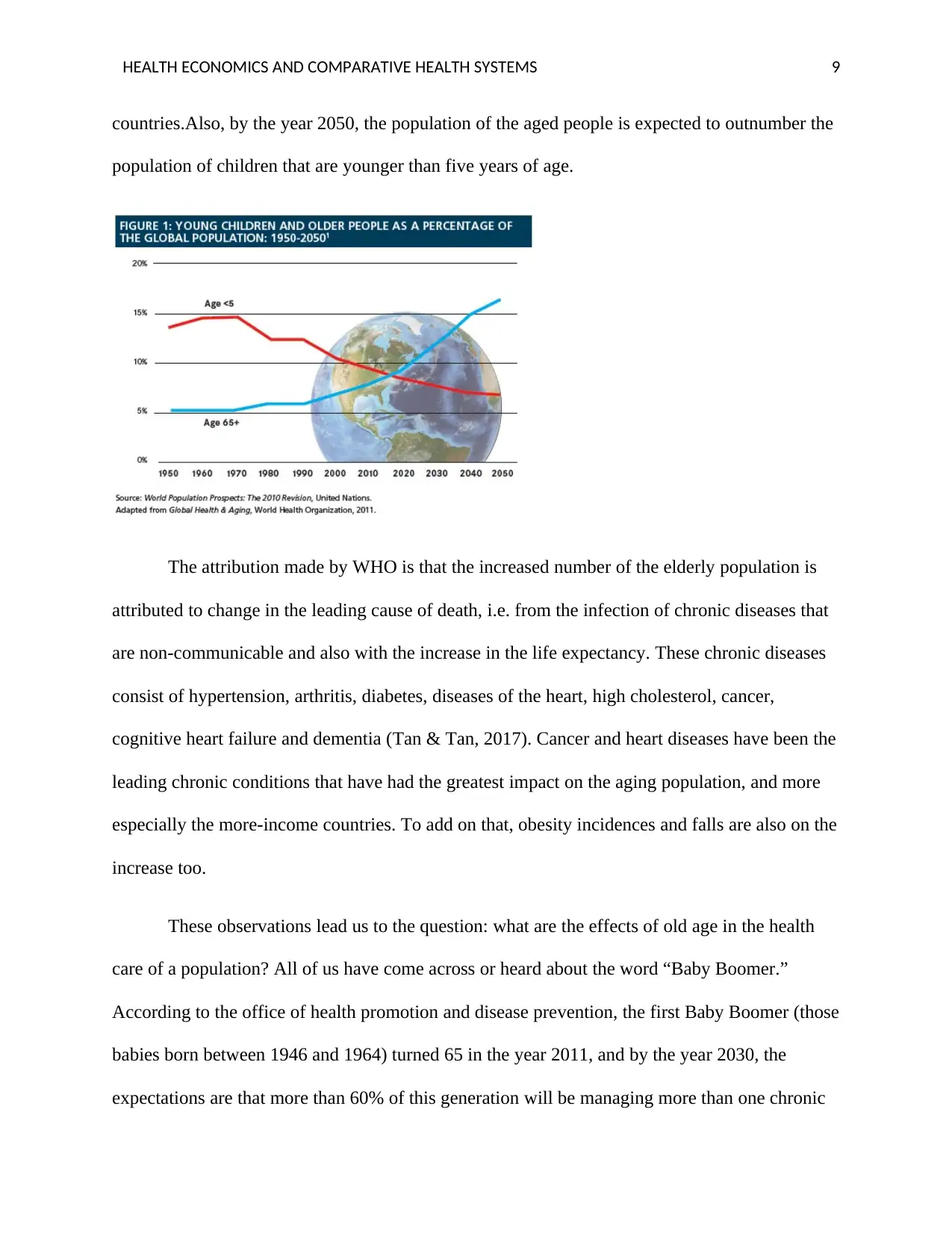
HEALTH ECONOMICS AND COMPARATIVE HEALTH SYSTEMS 9
countries.Also, by the year 2050, the population of the aged people is expected to outnumber the
population of children that are younger than five years of age.
The attribution made by WHO is that the increased number of the elderly population is
attributed to change in the leading cause of death, i.e. from the infection of chronic diseases that
are non-communicable and also with the increase in the life expectancy. These chronic diseases
consist of hypertension, arthritis, diabetes, diseases of the heart, high cholesterol, cancer,
cognitive heart failure and dementia (Tan & Tan, 2017). Cancer and heart diseases have been the
leading chronic conditions that have had the greatest impact on the aging population, and more
especially the more-income countries. To add on that, obesity incidences and falls are also on the
increase too.
These observations lead us to the question: what are the effects of old age in the health
care of a population? All of us have come across or heard about the word “Baby Boomer.”
According to the office of health promotion and disease prevention, the first Baby Boomer (those
babies born between 1946 and 1964) turned 65 in the year 2011, and by the year 2030, the
expectations are that more than 60% of this generation will be managing more than one chronic
countries.Also, by the year 2050, the population of the aged people is expected to outnumber the
population of children that are younger than five years of age.
The attribution made by WHO is that the increased number of the elderly population is
attributed to change in the leading cause of death, i.e. from the infection of chronic diseases that
are non-communicable and also with the increase in the life expectancy. These chronic diseases
consist of hypertension, arthritis, diabetes, diseases of the heart, high cholesterol, cancer,
cognitive heart failure and dementia (Tan & Tan, 2017). Cancer and heart diseases have been the
leading chronic conditions that have had the greatest impact on the aging population, and more
especially the more-income countries. To add on that, obesity incidences and falls are also on the
increase too.
These observations lead us to the question: what are the effects of old age in the health
care of a population? All of us have come across or heard about the word “Baby Boomer.”
According to the office of health promotion and disease prevention, the first Baby Boomer (those
babies born between 1946 and 1964) turned 65 in the year 2011, and by the year 2030, the
expectations are that more than 60% of this generation will be managing more than one chronic
⊘ This is a preview!⊘
Do you want full access?
Subscribe today to unlock all pages.
Trusted by 1+ million students worldwide
HEALTH ECONOMICS AND COMPARATIVE HEALTH SYSTEMS 10
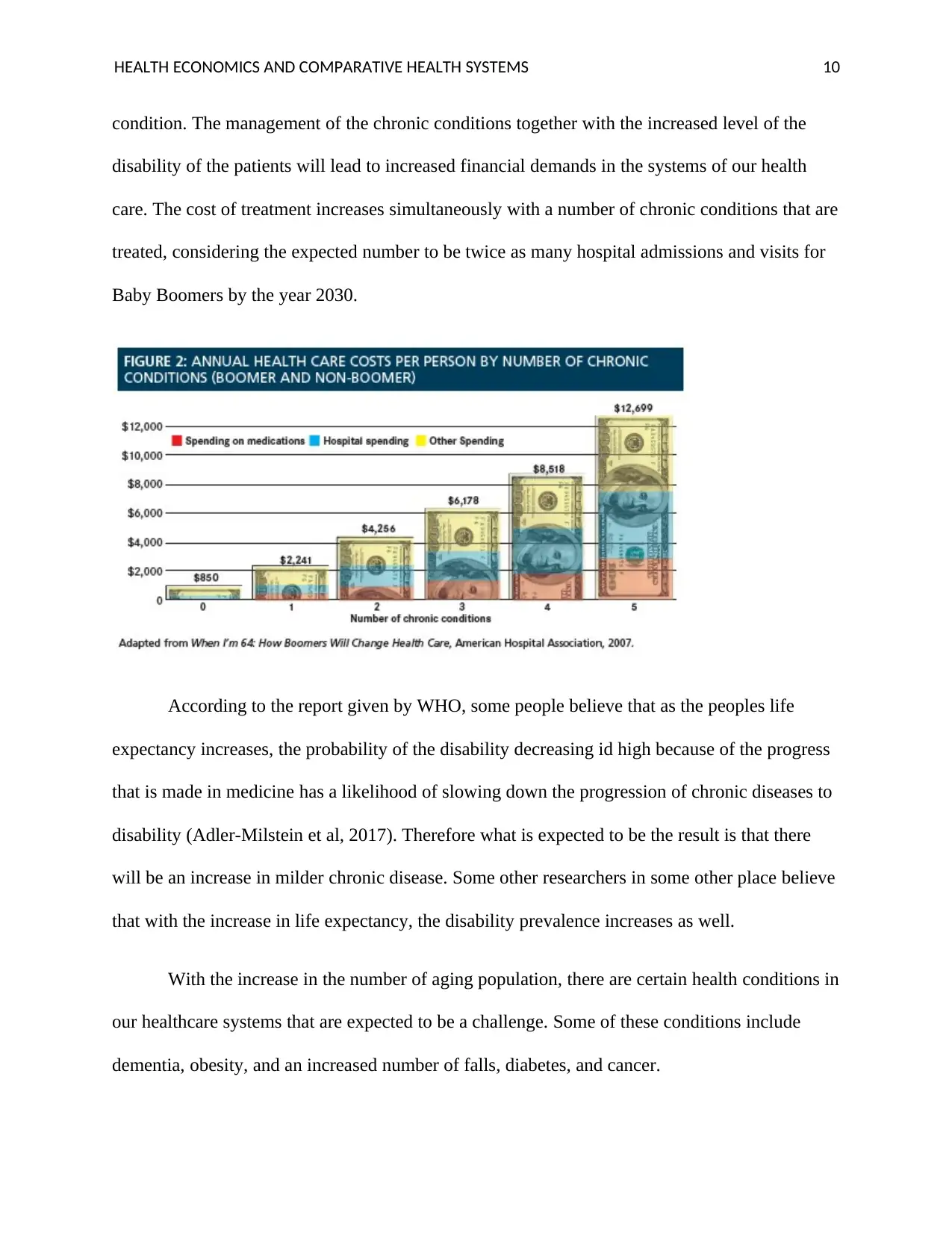
condition. The management of the chronic conditions together with the increased level of the
disability of the patients will lead to increased financial demands in the systems of our health
care. The cost of treatment increases simultaneously with a number of chronic conditions that are
treated, considering the expected number to be twice as many hospital admissions and visits for
Baby Boomers by the year 2030.
According to the report given by WHO, some people believe that as the peoples life
expectancy increases, the probability of the disability decreasing id high because of the progress
that is made in medicine has a likelihood of slowing down the progression of chronic diseases to
disability (Adler-Milstein et al, 2017). Therefore what is expected to be the result is that there
will be an increase in milder chronic disease. Some other researchers in some other place believe
that with the increase in life expectancy, the disability prevalence increases as well.
With the increase in the number of aging population, there are certain health conditions in
our healthcare systems that are expected to be a challenge. Some of these conditions include
dementia, obesity, and an increased number of falls, diabetes, and cancer.
condition. The management of the chronic conditions together with the increased level of the
disability of the patients will lead to increased financial demands in the systems of our health
care. The cost of treatment increases simultaneously with a number of chronic conditions that are
treated, considering the expected number to be twice as many hospital admissions and visits for
Baby Boomers by the year 2030.
According to the report given by WHO, some people believe that as the peoples life
expectancy increases, the probability of the disability decreasing id high because of the progress
that is made in medicine has a likelihood of slowing down the progression of chronic diseases to
disability (Adler-Milstein et al, 2017). Therefore what is expected to be the result is that there
will be an increase in milder chronic disease. Some other researchers in some other place believe
that with the increase in life expectancy, the disability prevalence increases as well.
With the increase in the number of aging population, there are certain health conditions in
our healthcare systems that are expected to be a challenge. Some of these conditions include
dementia, obesity, and an increased number of falls, diabetes, and cancer.
Paraphrase This Document
Need a fresh take? Get an instant paraphrase of this document with our AI Paraphraser
HEALTH ECONOMICS AND COMPARATIVE HEALTH SYSTEMS 11
Cancer
Because of the increase in the aging population, the expectations are that the numbers of
cancer infections are expected to rise to 18 million by the year 2020 and 27 million by the year
2030.
Dementia
Dementia expects that it will increase as well as the increase in the aging population.
Alzheimer’s Disease international makes projections that the number of individuals that will be
living with Alzheimer Disease will be 116 million all over the world by the year 2050 (Hooff et
al, 2015). The proportions of the organization are that among them 115m million people will be
from the developed countries.
Increase in fall
One of the common causes of injury to the aging population is caused by falling and the
expectations are that it might be one of the challenges in the healthcare systems that we have.
This is because Baby Boomers have a characteristic of living, being active and probably
remaining on medication that might lead them to falls. The American Hospital Association
released a report which stated that more than half of people greater than 65 years of age or older
fall every year. Among all those falls, 20% to 30 % have moderate or serious injuries such as the
hip fractures, which results in decreased mobility. Research shows that at least 350,000 bone
fractures of the hip occurred in the year 2000 and the expectations are that the same value will
double by 2050 (Ying, Feeley & Porter, 2016).
Cancer
Because of the increase in the aging population, the expectations are that the numbers of
cancer infections are expected to rise to 18 million by the year 2020 and 27 million by the year
2030.
Dementia
Dementia expects that it will increase as well as the increase in the aging population.
Alzheimer’s Disease international makes projections that the number of individuals that will be
living with Alzheimer Disease will be 116 million all over the world by the year 2050 (Hooff et
al, 2015). The proportions of the organization are that among them 115m million people will be
from the developed countries.
Increase in fall
One of the common causes of injury to the aging population is caused by falling and the
expectations are that it might be one of the challenges in the healthcare systems that we have.
This is because Baby Boomers have a characteristic of living, being active and probably
remaining on medication that might lead them to falls. The American Hospital Association
released a report which stated that more than half of people greater than 65 years of age or older
fall every year. Among all those falls, 20% to 30 % have moderate or serious injuries such as the
hip fractures, which results in decreased mobility. Research shows that at least 350,000 bone
fractures of the hip occurred in the year 2000 and the expectations are that the same value will
double by 2050 (Ying, Feeley & Porter, 2016).
HEALTH ECONOMICS AND COMPARATIVE HEALTH SYSTEMS 12
Obesity
Research shows that the number of people that are overweight is likely to continue
increasing in number and this will negatively impact the health care system. Obesity is not only
costly but also is a risk factor to a lot of health conditions: the cost of Medicare for people
suffering from obesity is 34 percent higher than for normal people (Apouey & Clark, 2015).
Diabetes
The number of diabetics in America is expected to rise from the current 36 million to 46
million by the year 2030. This is according to a research that was carried out by AHA (Dolan,
Gudex, Kind & Williams, 2016). Every 4 Boomer, 14 million people will be living with chronic
diseases
Challenges faced
Challenges that the health care system is expected to experience are as seen below. For
instance, the resource needs are expected to continue increasing across all the healthcare settings.
We also get to see that the incidences of obesity will go on increasing. Also, the shortages of
professionals in health care are expected to occur (Abrahams, Balch, Goldsmith, Kean, Miller,
Omenn &Westrich, 2017). There is also a challenge in that care has been focused on addressing
comorbidity and a single disease. It is also a challenge that the sustainability and the structure of
federal programs about the increasing relations are a concern (Phelps, 2016). Another challenge
is the change in the structure of the family, and this may lead to a reduction in the number of
caregivers. The adaptations of adjusting to the affordable care act pose challenges.
Obesity
Research shows that the number of people that are overweight is likely to continue
increasing in number and this will negatively impact the health care system. Obesity is not only
costly but also is a risk factor to a lot of health conditions: the cost of Medicare for people
suffering from obesity is 34 percent higher than for normal people (Apouey & Clark, 2015).
Diabetes
The number of diabetics in America is expected to rise from the current 36 million to 46
million by the year 2030. This is according to a research that was carried out by AHA (Dolan,
Gudex, Kind & Williams, 2016). Every 4 Boomer, 14 million people will be living with chronic
diseases
Challenges faced
Challenges that the health care system is expected to experience are as seen below. For
instance, the resource needs are expected to continue increasing across all the healthcare settings.
We also get to see that the incidences of obesity will go on increasing. Also, the shortages of
professionals in health care are expected to occur (Abrahams, Balch, Goldsmith, Kean, Miller,
Omenn &Westrich, 2017). There is also a challenge in that care has been focused on addressing
comorbidity and a single disease. It is also a challenge that the sustainability and the structure of
federal programs about the increasing relations are a concern (Phelps, 2016). Another challenge
is the change in the structure of the family, and this may lead to a reduction in the number of
caregivers. The adaptations of adjusting to the affordable care act pose challenges.
⊘ This is a preview!⊘
Do you want full access?
Subscribe today to unlock all pages.
Trusted by 1+ million students worldwide

1 out of 18


Related Documents


Your All-in-One AI-Powered Toolkit for Academic Success.
+13062052269
info@desklib.com
Available 24*7 on WhatsApp / Email
![[object Object]](/_next/static/media/star-bottom.7253800d.svg)
Unlock your academic potential
Copyright © 2020–2026 A2Z Services. All Rights Reserved. Developed and managed by ZUCOL.