Healthy Ageing Policy: Advocacy Coalition Framework Analysis
VerifiedAdded on 2023/06/03
|13
|3197
|451
Report
AI Summary
This report provides an in-depth analysis of healthy ageing policies, utilizing the Advocacy Coalition Framework to understand the complexities of healthcare for the elderly. It begins with an introduction to the framework, explaining its role in policy analysis and decision-making within intricate public policy systems. The report then delves into the context of healthy ageing, examining current policies in Australia, such as the 'Healthy life Better Ageing' initiative, and the involvement of various stakeholders like the government, healthcare organizations, and families. It discusses the application of the Advocacy Coalition Framework, identifying stakeholders, political contexts, and the impact of previous policies. The report also reviews the current policy on healthy ageing, highlighting its effectiveness in promoting active ageing and providing aged care services. Furthermore, it explores alternative strategies, such as addressing non-communicable diseases and implementing fall prevention measures, as suggested by the World Health Organization. The report concludes by assessing the usefulness and limitations of the Advocacy Coalition Framework in enhancing and promoting collective health efforts for improved aged care. This analysis aims to provide a comprehensive understanding of the challenges and opportunities in formulating and implementing effective healthy ageing policies.
Healthcare 1.
HEALTHCARE: ADVOCACY COALITION FRAMEWORK ON HEALTHY AGEING
POLICY
Name
Course
Tutor
University
City/State
Date
HEALTHCARE: ADVOCACY COALITION FRAMEWORK ON HEALTHY AGEING
POLICY
Name
Course
Tutor
University
City/State
Date

Paraphrase This Document
Need a fresh take? Get an instant paraphrase of this document with our AI Paraphraser
Healthcare 2.
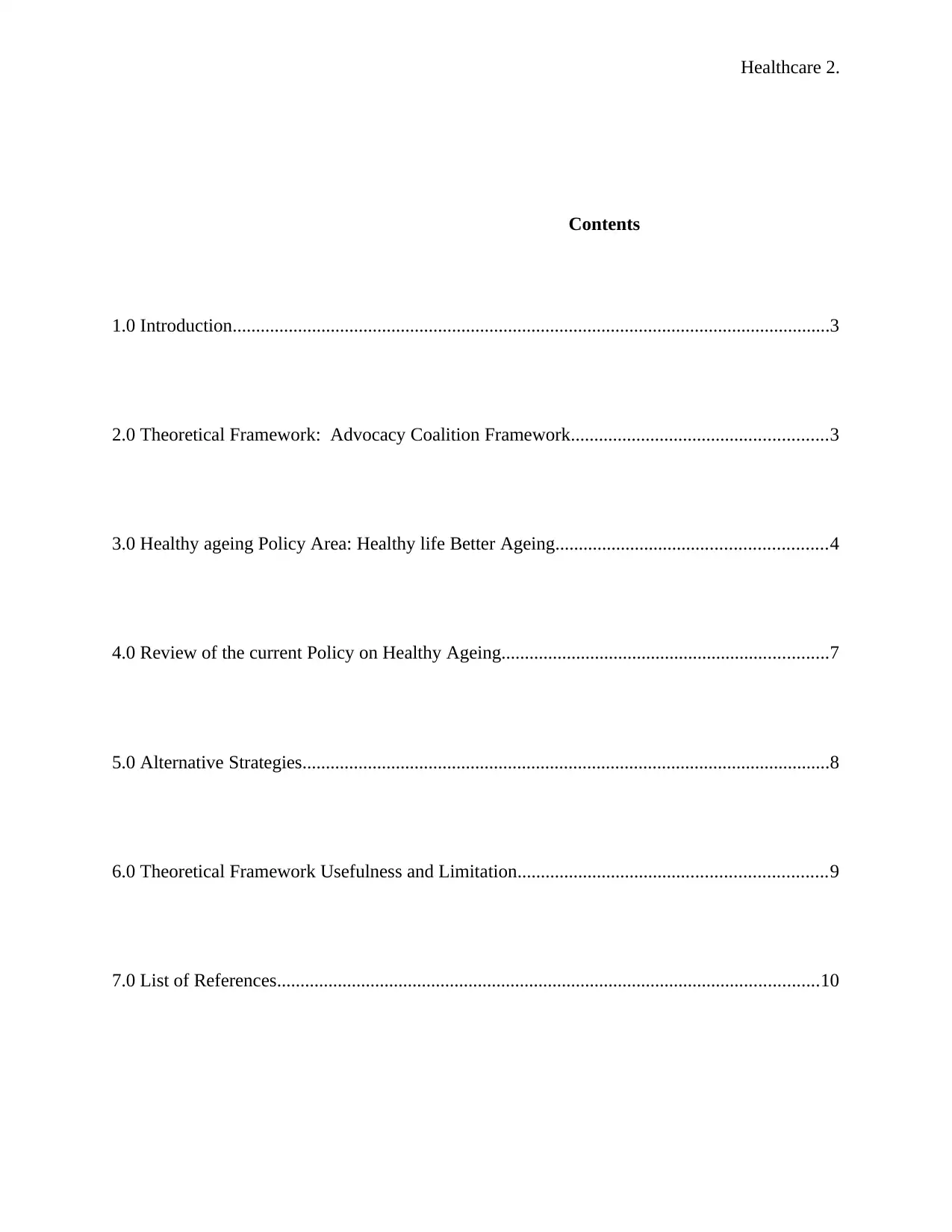
Contents
1.0 Introduction................................................................................................................................3
2.0 Theoretical Framework: Advocacy Coalition Framework.......................................................3
3.0 Healthy ageing Policy Area: Healthy life Better Ageing..........................................................4
4.0 Review of the current Policy on Healthy Ageing......................................................................7
5.0 Alternative Strategies.................................................................................................................8
6.0 Theoretical Framework Usefulness and Limitation..................................................................9
7.0 List of References....................................................................................................................10
Contents
1.0 Introduction................................................................................................................................3
2.0 Theoretical Framework: Advocacy Coalition Framework.......................................................3
3.0 Healthy ageing Policy Area: Healthy life Better Ageing..........................................................4
4.0 Review of the current Policy on Healthy Ageing......................................................................7
5.0 Alternative Strategies.................................................................................................................8
6.0 Theoretical Framework Usefulness and Limitation..................................................................9
7.0 List of References....................................................................................................................10
Healthcare 3.
1.0 Introduction
Advocacy Coalition Framework is a tool for policy making and analysis and has been
successfully used in dealing with intense or complicated public policy systems. Due to the
complex nature of public policies, the framework provides an understanding of the policy
priorities that are involved in dispute management from the interaction of the various
stakeholders interested in the policy (Coombes et al., 2018, p. 132). The Advocacy Coalition
Framework takes into account and explains the complicated policy-making environment to
enhance the efficiency of the policy-making process and decision making. Healthy aging has
been advocated by various stakeholders in the healthcare sector with the aim of improving the
quality of health care for the aging population. Development of healthy aging policies requires
the integration of various perspectives and views from different stakeholders. Healthy ageing
policies focus on improving the health conditions of the elderly against a wide range of
objectives which are related to an individual wellbeing (McNamara, Rosenwax, Lee & Same,
2016, p. 32). The policies also focus on reducing the overall costs of ageing to society. This
essay will, therefore, apply the use of the Advocacy Coalition Framework in analyzing the
different aspects of healthy ageing. Current policies in healthy ageing will also be discussed as
well as their impact on public health policies. Alternate policies will also be discussed to enhance
the development of the theoretical framework of the Healthy
2.0 Theoretical Framework: Advocacy Coalition Framework
Advocacy Coalition Framework (ACF) is an action based framework that is used to
analyze policy changes over a given period of time (Jenkins-Smith, Nohrstedt, Weible &
Sabatier, 2014, p. 190). It, therefore, provides a framework of policy processes and is very
1.0 Introduction
Advocacy Coalition Framework is a tool for policy making and analysis and has been
successfully used in dealing with intense or complicated public policy systems. Due to the
complex nature of public policies, the framework provides an understanding of the policy
priorities that are involved in dispute management from the interaction of the various
stakeholders interested in the policy (Coombes et al., 2018, p. 132). The Advocacy Coalition
Framework takes into account and explains the complicated policy-making environment to
enhance the efficiency of the policy-making process and decision making. Healthy aging has
been advocated by various stakeholders in the healthcare sector with the aim of improving the
quality of health care for the aging population. Development of healthy aging policies requires
the integration of various perspectives and views from different stakeholders. Healthy ageing
policies focus on improving the health conditions of the elderly against a wide range of
objectives which are related to an individual wellbeing (McNamara, Rosenwax, Lee & Same,
2016, p. 32). The policies also focus on reducing the overall costs of ageing to society. This
essay will, therefore, apply the use of the Advocacy Coalition Framework in analyzing the
different aspects of healthy ageing. Current policies in healthy ageing will also be discussed as
well as their impact on public health policies. Alternate policies will also be discussed to enhance
the development of the theoretical framework of the Healthy
2.0 Theoretical Framework: Advocacy Coalition Framework
Advocacy Coalition Framework (ACF) is an action based framework that is used to
analyze policy changes over a given period of time (Jenkins-Smith, Nohrstedt, Weible &
Sabatier, 2014, p. 190). It, therefore, provides a framework of policy processes and is very
⊘ This is a preview!⊘
Do you want full access?
Subscribe today to unlock all pages.

Trusted by 1+ million students worldwide
Healthcare 4.
essential in analyzing intense public policy systems. The framework was developed by Sabatier
and Jenkins in the 1980s but was first published in the year 1988. ACF argument is that policy
participants or stakeholders will seek to develop allies or coalitions with other stakeholders’
interest in the policy. It's development as a reaction to the three main limitations which existed in
the contemporary policy process and therefore encourages the development of advocacy
coalitions thinking rather than focusing at the power struggles to understand primary policy
changes (Weible & Jenkins-Smith, 2016, p. 24). The Advocacy Coalition Framework has three
main principal theoretical domains which include advocacy coalitions, policy subsystems as well
as policy changes. The framework provides that both policy subsystems and advocacy coalitions
are the most efficient ways of organizing all the actors or stakeholders interested in the policy
process. However, it also provides that policy subsystems is the main unit of policy analysis and
plays a critical role in the policy development and implementation process (Pierce & Weible,
2016, p. 22). The Advocacy Coalition Framework has established itself in the field of policy as a
powerful reference in understanding and explaining complex policy processes. It will be critical
in helping us understand the policy of Healthy living, better ageing in the development and
improvement of the healthcare status of the aged populations across different countries.
3.0 Healthy ageing Policy Area: Healthy life Better Ageing
The Advocacy coalition framework (ACF) can be applied to in the analyses of various
aspects of healthy ageing. According to the World health organization, there is a distinction
between active ageing and healthy ageing in policy making where active ageing health policies
focus on the longer activities such as working at old age to promote healthy ageing process
essential in analyzing intense public policy systems. The framework was developed by Sabatier
and Jenkins in the 1980s but was first published in the year 1988. ACF argument is that policy
participants or stakeholders will seek to develop allies or coalitions with other stakeholders’
interest in the policy. It's development as a reaction to the three main limitations which existed in
the contemporary policy process and therefore encourages the development of advocacy
coalitions thinking rather than focusing at the power struggles to understand primary policy
changes (Weible & Jenkins-Smith, 2016, p. 24). The Advocacy Coalition Framework has three
main principal theoretical domains which include advocacy coalitions, policy subsystems as well
as policy changes. The framework provides that both policy subsystems and advocacy coalitions
are the most efficient ways of organizing all the actors or stakeholders interested in the policy
process. However, it also provides that policy subsystems is the main unit of policy analysis and
plays a critical role in the policy development and implementation process (Pierce & Weible,
2016, p. 22). The Advocacy Coalition Framework has established itself in the field of policy as a
powerful reference in understanding and explaining complex policy processes. It will be critical
in helping us understand the policy of Healthy living, better ageing in the development and
improvement of the healthcare status of the aged populations across different countries.
3.0 Healthy ageing Policy Area: Healthy life Better Ageing
The Advocacy coalition framework (ACF) can be applied to in the analyses of various
aspects of healthy ageing. According to the World health organization, there is a distinction
between active ageing and healthy ageing in policy making where active ageing health policies
focus on the longer activities such as working at old age to promote healthy ageing process
Paraphrase This Document
Need a fresh take? Get an instant paraphrase of this document with our AI Paraphraser
Healthcare 5.
(Jenkins-Smith, Nohrstedt, Weible & Ingold, 2018, p. 162). Active ageing according to World
Health Organization is the optimization of health opportunities and participation enhance the
quality of life as people continued to age. On the other hand, WHO defines healthy ageing as the
through which individuals are able to maximize the available opportunities for social, mental and
physical health to enable the older people to participate in the society without necessarily been
discriminated against as well as to enable them to enjoy a quality and independent life. Healthy
ageing policies presume that older people are valuable to the society and therefore they should be
treated as such and not to be viewed as a burden. Therefore their autonomy of personal control is
critical for maintaining human dignity as well as their integrity.
The policy of Healthy life better ageing was developed through a coalition in Australia as
a policy guideline that sought to provide access to quality healthcare for the older people in
Australia. It is the responsibility of the government is the main stakeholder to strive and provide
a healthcare system that treats all the Australian at their old age with the dignity, respect, and
integrity they deserve. On the other hand, it is the responsibility of the family members also to
develop trust with the system in that it will be able to deliver quality healthcare to their members
(Beard et al., 2016, p. 2150). The application of the advocacy coalition framework requires the
identification of all the stakeholders in who are interested in the health policy and in this case we
have the government, the families of the aged people, healthcare global organizations such as the
World Health Organization, the community as well as the medical or the healthcare practitioners
(Howlett, McConnell &Perl, 2017, p. 72). Through advocacy coalition principle, the success of
the Healthy life Better living policy is depended on the integration of these stakeholders in
developing the best strategies to overcome the health condition and development of appropriate
(Jenkins-Smith, Nohrstedt, Weible & Ingold, 2018, p. 162). Active ageing according to World
Health Organization is the optimization of health opportunities and participation enhance the
quality of life as people continued to age. On the other hand, WHO defines healthy ageing as the
through which individuals are able to maximize the available opportunities for social, mental and
physical health to enable the older people to participate in the society without necessarily been
discriminated against as well as to enable them to enjoy a quality and independent life. Healthy
ageing policies presume that older people are valuable to the society and therefore they should be
treated as such and not to be viewed as a burden. Therefore their autonomy of personal control is
critical for maintaining human dignity as well as their integrity.
The policy of Healthy life better ageing was developed through a coalition in Australia as
a policy guideline that sought to provide access to quality healthcare for the older people in
Australia. It is the responsibility of the government is the main stakeholder to strive and provide
a healthcare system that treats all the Australian at their old age with the dignity, respect, and
integrity they deserve. On the other hand, it is the responsibility of the family members also to
develop trust with the system in that it will be able to deliver quality healthcare to their members
(Beard et al., 2016, p. 2150). The application of the advocacy coalition framework requires the
identification of all the stakeholders in who are interested in the health policy and in this case we
have the government, the families of the aged people, healthcare global organizations such as the
World Health Organization, the community as well as the medical or the healthcare practitioners
(Howlett, McConnell &Perl, 2017, p. 72). Through advocacy coalition principle, the success of
the Healthy life Better living policy is depended on the integration of these stakeholders in
developing the best strategies to overcome the health condition and development of appropriate
Healthcare 6.
activities to enhance active ageing. The older people have been discriminated against in society
as many view them as a burden and therefore do not receive adequate care attention. Most
governments are spending a lot of money on treatment for medical conditions which are
associated with old age as well as increased chronic diseases which could be prevented through
prevention strategies aimed at promoting healthy ageing.
Another level of application of the advocacy coalition framework is the understanding of
the political context concerning the Healthy life Better ageing policy. Politically the ageing
population is taken as a primarily economic and political challenge in which it is misunderstood
often under political realm. Before changing healthcare policies, structures as well as funding
streams it is critical for the policymakers, the government as well as the healthcare practitioners
to understand the complexity of the healthcare issues of the ageing population (Sotirov &
Winkel, 2016, p. 132). Despite the government promising to prioritize aged care in their second
term, the Rudd-Gillard government had a good intent but delivering the promise to the citizens
has lacked progress. The report for caring for the older Australians was not responded by the
government for over 250 days as well as the introduction of the report in the parliament for
legislation also tool over 327 days and hence affecting the implementation of the policy. The
changes in the policy were only legislated by the government few weeks at the end of the 43rd
parliament. According to the advocacy coalition framework, there must be a certainty on going
forward with the implementation process of the proposed policy changes.
The implementation of the Healthy life Better ageing policy was also affected by
previous health policies. According to the Advocacy Coalition framework principle of policy
subsystems, the effectiveness of implementation of a policy is dependent on the previous policies
activities to enhance active ageing. The older people have been discriminated against in society
as many view them as a burden and therefore do not receive adequate care attention. Most
governments are spending a lot of money on treatment for medical conditions which are
associated with old age as well as increased chronic diseases which could be prevented through
prevention strategies aimed at promoting healthy ageing.
Another level of application of the advocacy coalition framework is the understanding of
the political context concerning the Healthy life Better ageing policy. Politically the ageing
population is taken as a primarily economic and political challenge in which it is misunderstood
often under political realm. Before changing healthcare policies, structures as well as funding
streams it is critical for the policymakers, the government as well as the healthcare practitioners
to understand the complexity of the healthcare issues of the ageing population (Sotirov &
Winkel, 2016, p. 132). Despite the government promising to prioritize aged care in their second
term, the Rudd-Gillard government had a good intent but delivering the promise to the citizens
has lacked progress. The report for caring for the older Australians was not responded by the
government for over 250 days as well as the introduction of the report in the parliament for
legislation also tool over 327 days and hence affecting the implementation of the policy. The
changes in the policy were only legislated by the government few weeks at the end of the 43rd
parliament. According to the advocacy coalition framework, there must be a certainty on going
forward with the implementation process of the proposed policy changes.
The implementation of the Healthy life Better ageing policy was also affected by
previous health policies. According to the Advocacy Coalition framework principle of policy
subsystems, the effectiveness of implementation of a policy is dependent on the previous policies
⊘ This is a preview!⊘
Do you want full access?
Subscribe today to unlock all pages.
Trusted by 1+ million students worldwide
Healthcare 7.
(Henry, Ingold, Nohrstedt & Weible, 2014, p. 306). One the policy that has had an impact on the
implementation of the Healthy Life better Ageing is the Mental Health policy which has been
neglected the older population. Healthy ageing is a function of the mental health of older people.
The policy has not taken into consideration the mental healthcare issues of older people in
Australia and as a result, many older people have suffered from depression and other related
mental conditions. Lack of enforcement and implementation of the policies has led to increased
ignorance and normalization of healthcare for the aged population (Bandelow, 2015, p. 12). The
policy subsystems made of various stakeholders in Australia healthcare, the media, the
community as well as international healthcare organizations such as the World Health
Organization through the coalition has led to improved efforts in implementation of healthcare
practices and especially community-based preventive practices for healthy eating and physical
exercise have been critical in promoting healthy ageing in the country.
4.0 Review of the current Policy on Healthy Ageing
The current policy on ageing policy area in Australia is the Healthy ageing policy which
is focused on increasing the longevity of individuals working population to an eligibility of 70
years to access aged care services. The policy seeks to promote increased participation in
physical activities a way of active ageing and increased savings for healthcare at old age
(Bousquet et al., 2015, p. 956). The policy impacts the labor markets that are required to change
the existing retirement age to increase the time spent at work. This is because there was a
mismatch between life expectancy in the country where people are living longer and the
retirement policy in which people were retiring earlier. The policy has been found to be effective
(Henry, Ingold, Nohrstedt & Weible, 2014, p. 306). One the policy that has had an impact on the
implementation of the Healthy Life better Ageing is the Mental Health policy which has been
neglected the older population. Healthy ageing is a function of the mental health of older people.
The policy has not taken into consideration the mental healthcare issues of older people in
Australia and as a result, many older people have suffered from depression and other related
mental conditions. Lack of enforcement and implementation of the policies has led to increased
ignorance and normalization of healthcare for the aged population (Bandelow, 2015, p. 12). The
policy subsystems made of various stakeholders in Australia healthcare, the media, the
community as well as international healthcare organizations such as the World Health
Organization through the coalition has led to improved efforts in implementation of healthcare
practices and especially community-based preventive practices for healthy eating and physical
exercise have been critical in promoting healthy ageing in the country.
4.0 Review of the current Policy on Healthy Ageing
The current policy on ageing policy area in Australia is the Healthy ageing policy which
is focused on increasing the longevity of individuals working population to an eligibility of 70
years to access aged care services. The policy seeks to promote increased participation in
physical activities a way of active ageing and increased savings for healthcare at old age
(Bousquet et al., 2015, p. 956). The policy impacts the labor markets that are required to change
the existing retirement age to increase the time spent at work. This is because there was a
mismatch between life expectancy in the country where people are living longer and the
retirement policy in which people were retiring earlier. The policy has been found to be effective
Paraphrase This Document
Need a fresh take? Get an instant paraphrase of this document with our AI Paraphraser
Healthcare 8.
in promoting healthy ageing through the contribution of the increase in aged care services which
have reduced government expenditures on aged care by approximately 30 per cent annually on
health care services (Sadana, Blas, Budhwani, Koller & Paraje, 2016, p. 181). The healthy
ageing policy has contributed significantly to the promotion of public health principles of equity,
social justice as well as addressing social discrimination. Through the establishment of a
retirement policy for eligibility to aged care has provided an equal opportunity for the
development of market labor policies which do not discriminate some groups in the society.
Social justice has also been achieved through increased participation and active engagement at
work at old age without been discriminated against because of their social status of being old and
been seen as an economic burden and challenge to the society.
5.0 Alternative Strategies
According to the Advocacy Coalition Framework, it is critical to developing an
understanding of the policy alternatives as suggested by the interested stakeholder groups. These
strategies play a critical role in shaping the policy implementation process. One of the
alternatives raised by the World Health Organization is the fighting of non-communicable
diseases over life-course. This is because non-communicable diseases have been found to
contribute to increased mortality to people over the age of 60 years (Daskalopoulou et al., 2017,
p. 15). This strategy will, therefore, contribute to increased health gains in at old age and hence
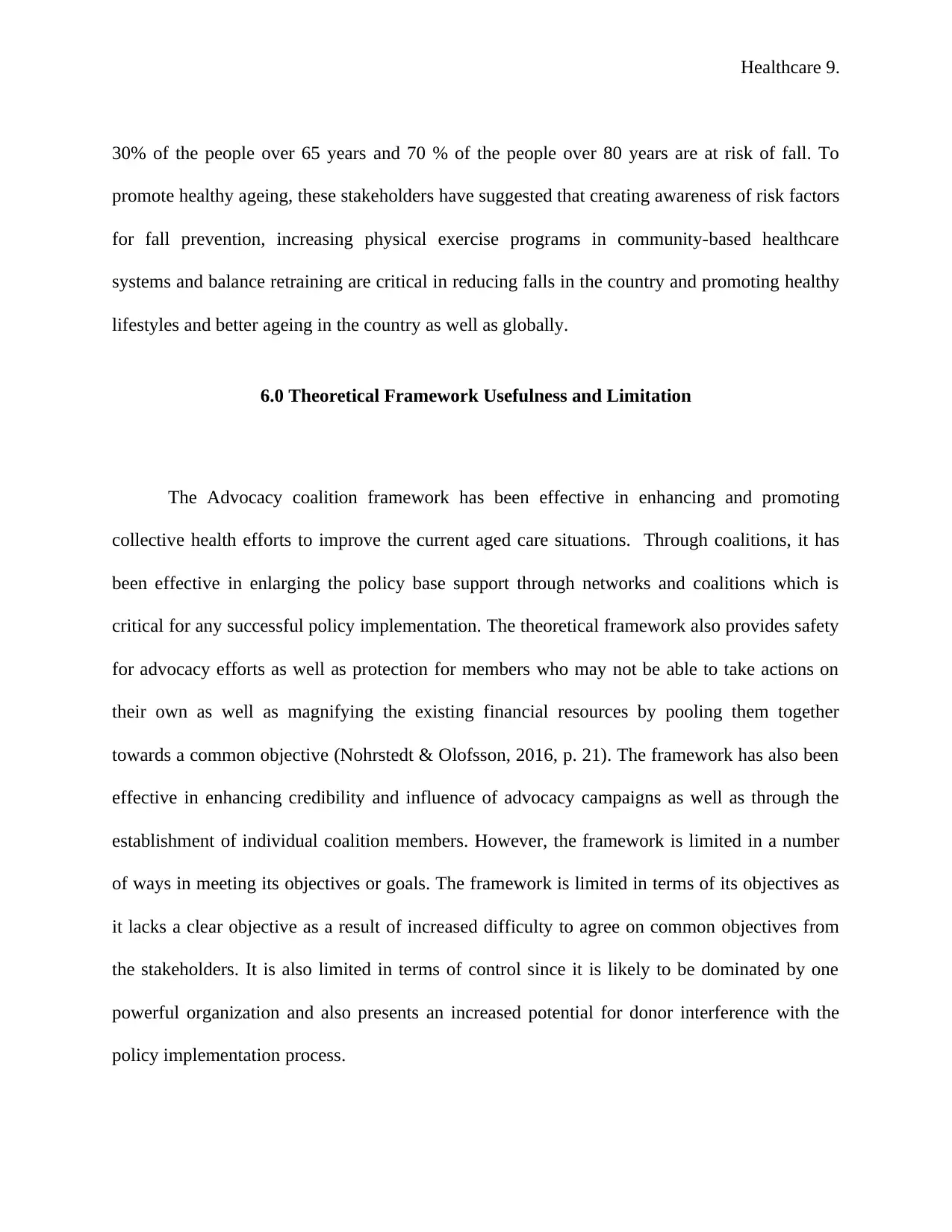
an effective prevention and healthy ageing promotion strategy. Fall prevention strategies have
also been suggested as effective strategies to enhance healthy ageing. According to the reports
by healthcare practitioners and the WHO as well as research, it has provided that raising over
in promoting healthy ageing through the contribution of the increase in aged care services which
have reduced government expenditures on aged care by approximately 30 per cent annually on
health care services (Sadana, Blas, Budhwani, Koller & Paraje, 2016, p. 181). The healthy
ageing policy has contributed significantly to the promotion of public health principles of equity,
social justice as well as addressing social discrimination. Through the establishment of a
retirement policy for eligibility to aged care has provided an equal opportunity for the
development of market labor policies which do not discriminate some groups in the society.
Social justice has also been achieved through increased participation and active engagement at
work at old age without been discriminated against because of their social status of being old and
been seen as an economic burden and challenge to the society.
5.0 Alternative Strategies
According to the Advocacy Coalition Framework, it is critical to developing an
understanding of the policy alternatives as suggested by the interested stakeholder groups. These
strategies play a critical role in shaping the policy implementation process. One of the
alternatives raised by the World Health Organization is the fighting of non-communicable
diseases over life-course. This is because non-communicable diseases have been found to
contribute to increased mortality to people over the age of 60 years (Daskalopoulou et al., 2017,
p. 15). This strategy will, therefore, contribute to increased health gains in at old age and hence
an effective prevention and healthy ageing promotion strategy. Fall prevention strategies have
also been suggested as effective strategies to enhance healthy ageing. According to the reports
by healthcare practitioners and the WHO as well as research, it has provided that raising over
Healthcare 9.
30% of the people over 65 years and 70 % of the people over 80 years are at risk of fall. To
promote healthy ageing, these stakeholders have suggested that creating awareness of risk factors
for fall prevention, increasing physical exercise programs in community-based healthcare
systems and balance retraining are critical in reducing falls in the country and promoting healthy
lifestyles and better ageing in the country as well as globally.
6.0 Theoretical Framework Usefulness and Limitation
The Advocacy coalition framework has been effective in enhancing and promoting
collective health efforts to improve the current aged care situations. Through coalitions, it has
been effective in enlarging the policy base support through networks and coalitions which is
critical for any successful policy implementation. The theoretical framework also provides safety
for advocacy efforts as well as protection for members who may not be able to take actions on
their own as well as magnifying the existing financial resources by pooling them together
towards a common objective (Nohrstedt & Olofsson, 2016, p. 21). The framework has also been
effective in enhancing credibility and influence of advocacy campaigns as well as through the
establishment of individual coalition members. However, the framework is limited in a number
of ways in meeting its objectives or goals. The framework is limited in terms of its objectives as
it lacks a clear objective as a result of increased difficulty to agree on common objectives from
the stakeholders. It is also limited in terms of control since it is likely to be dominated by one
powerful organization and also presents an increased potential for donor interference with the
policy implementation process.
30% of the people over 65 years and 70 % of the people over 80 years are at risk of fall. To
promote healthy ageing, these stakeholders have suggested that creating awareness of risk factors
for fall prevention, increasing physical exercise programs in community-based healthcare
systems and balance retraining are critical in reducing falls in the country and promoting healthy
lifestyles and better ageing in the country as well as globally.
6.0 Theoretical Framework Usefulness and Limitation
The Advocacy coalition framework has been effective in enhancing and promoting
collective health efforts to improve the current aged care situations. Through coalitions, it has
been effective in enlarging the policy base support through networks and coalitions which is
critical for any successful policy implementation. The theoretical framework also provides safety
for advocacy efforts as well as protection for members who may not be able to take actions on
their own as well as magnifying the existing financial resources by pooling them together
towards a common objective (Nohrstedt & Olofsson, 2016, p. 21). The framework has also been
effective in enhancing credibility and influence of advocacy campaigns as well as through the
establishment of individual coalition members. However, the framework is limited in a number
of ways in meeting its objectives or goals. The framework is limited in terms of its objectives as
it lacks a clear objective as a result of increased difficulty to agree on common objectives from
the stakeholders. It is also limited in terms of control since it is likely to be dominated by one
powerful organization and also presents an increased potential for donor interference with the
policy implementation process.
⊘ This is a preview!⊘
Do you want full access?
Subscribe today to unlock all pages.
Trusted by 1+ million students worldwide
Healthcare 10.
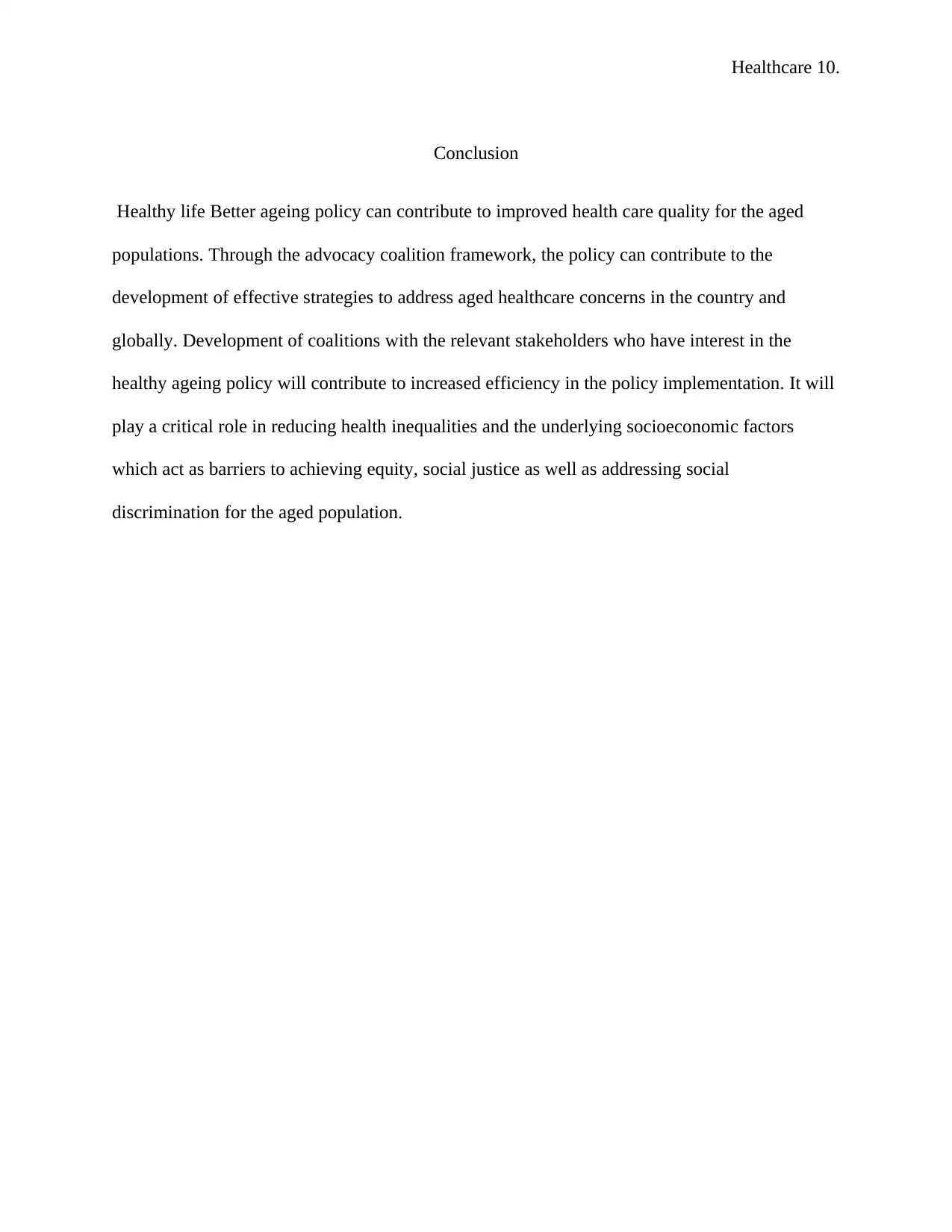
Conclusion
Healthy life Better ageing policy can contribute to improved health care quality for the aged
populations. Through the advocacy coalition framework, the policy can contribute to the
development of effective strategies to address aged healthcare concerns in the country and
globally. Development of coalitions with the relevant stakeholders who have interest in the
healthy ageing policy will contribute to increased efficiency in the policy implementation. It will
play a critical role in reducing health inequalities and the underlying socioeconomic factors
which act as barriers to achieving equity, social justice as well as addressing social
discrimination for the aged population.
Conclusion
Healthy life Better ageing policy can contribute to improved health care quality for the aged
populations. Through the advocacy coalition framework, the policy can contribute to the
development of effective strategies to address aged healthcare concerns in the country and
globally. Development of coalitions with the relevant stakeholders who have interest in the
healthy ageing policy will contribute to increased efficiency in the policy implementation. It will
play a critical role in reducing health inequalities and the underlying socioeconomic factors
which act as barriers to achieving equity, social justice as well as addressing social
discrimination for the aged population.
Paraphrase This Document
Need a fresh take? Get an instant paraphrase of this document with our AI Paraphraser
Healthcare 11.
7.0 List of References
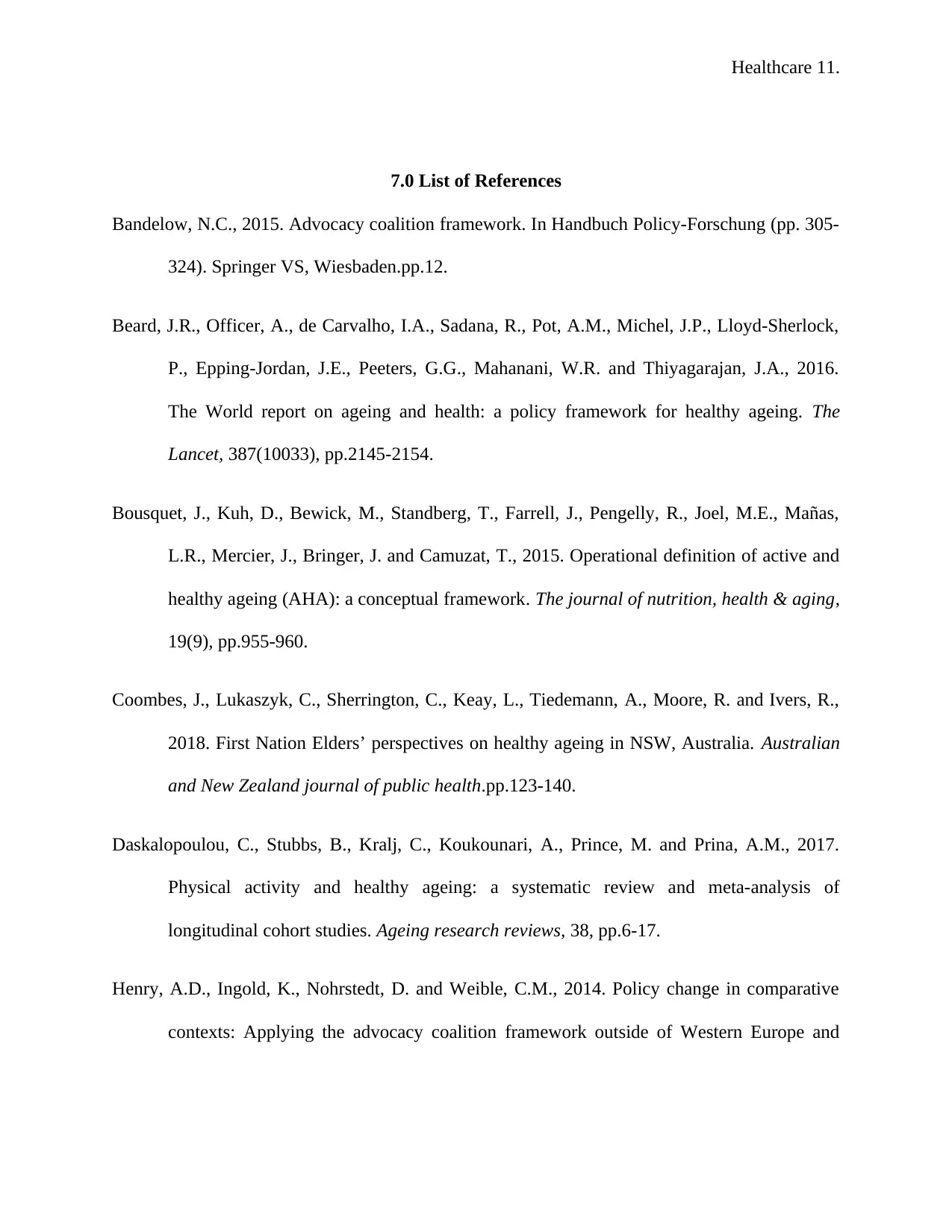
Bandelow, N.C., 2015. Advocacy coalition framework. In Handbuch Policy-Forschung (pp. 305-
324). Springer VS, Wiesbaden.pp.12.
Beard, J.R., Officer, A., de Carvalho, I.A., Sadana, R., Pot, A.M., Michel, J.P., Lloyd-Sherlock,
P., Epping-Jordan, J.E., Peeters, G.G., Mahanani, W.R. and Thiyagarajan, J.A., 2016.
The World report on ageing and health: a policy framework for healthy ageing. The
Lancet, 387(10033), pp.2145-2154.
Bousquet, J., Kuh, D., Bewick, M., Standberg, T., Farrell, J., Pengelly, R., Joel, M.E., Mañas,
L.R., Mercier, J., Bringer, J. and Camuzat, T., 2015. Operational definition of active and
healthy ageing (AHA): a conceptual framework. The journal of nutrition, health & aging,
19(9), pp.955-960.
Coombes, J., Lukaszyk, C., Sherrington, C., Keay, L., Tiedemann, A., Moore, R. and Ivers, R.,
2018. First Nation Elders’ perspectives on healthy ageing in NSW, Australia. Australian
and New Zealand journal of public health.pp.123-140.
Daskalopoulou, C., Stubbs, B., Kralj, C., Koukounari, A., Prince, M. and Prina, A.M., 2017.
Physical activity and healthy ageing: a systematic review and meta-analysis of
longitudinal cohort studies. Ageing research reviews, 38, pp.6-17.
Henry, A.D., Ingold, K., Nohrstedt, D. and Weible, C.M., 2014. Policy change in comparative
contexts: Applying the advocacy coalition framework outside of Western Europe and
7.0 List of References
Bandelow, N.C., 2015. Advocacy coalition framework. In Handbuch Policy-Forschung (pp. 305-
324). Springer VS, Wiesbaden.pp.12.
Beard, J.R., Officer, A., de Carvalho, I.A., Sadana, R., Pot, A.M., Michel, J.P., Lloyd-Sherlock,
P., Epping-Jordan, J.E., Peeters, G.G., Mahanani, W.R. and Thiyagarajan, J.A., 2016.
The World report on ageing and health: a policy framework for healthy ageing. The
Lancet, 387(10033), pp.2145-2154.
Bousquet, J., Kuh, D., Bewick, M., Standberg, T., Farrell, J., Pengelly, R., Joel, M.E., Mañas,
L.R., Mercier, J., Bringer, J. and Camuzat, T., 2015. Operational definition of active and
healthy ageing (AHA): a conceptual framework. The journal of nutrition, health & aging,
19(9), pp.955-960.
Coombes, J., Lukaszyk, C., Sherrington, C., Keay, L., Tiedemann, A., Moore, R. and Ivers, R.,
2018. First Nation Elders’ perspectives on healthy ageing in NSW, Australia. Australian
and New Zealand journal of public health.pp.123-140.
Daskalopoulou, C., Stubbs, B., Kralj, C., Koukounari, A., Prince, M. and Prina, A.M., 2017.
Physical activity and healthy ageing: a systematic review and meta-analysis of
longitudinal cohort studies. Ageing research reviews, 38, pp.6-17.
Henry, A.D., Ingold, K., Nohrstedt, D. and Weible, C.M., 2014. Policy change in comparative
contexts: Applying the advocacy coalition framework outside of Western Europe and
Healthcare 12.
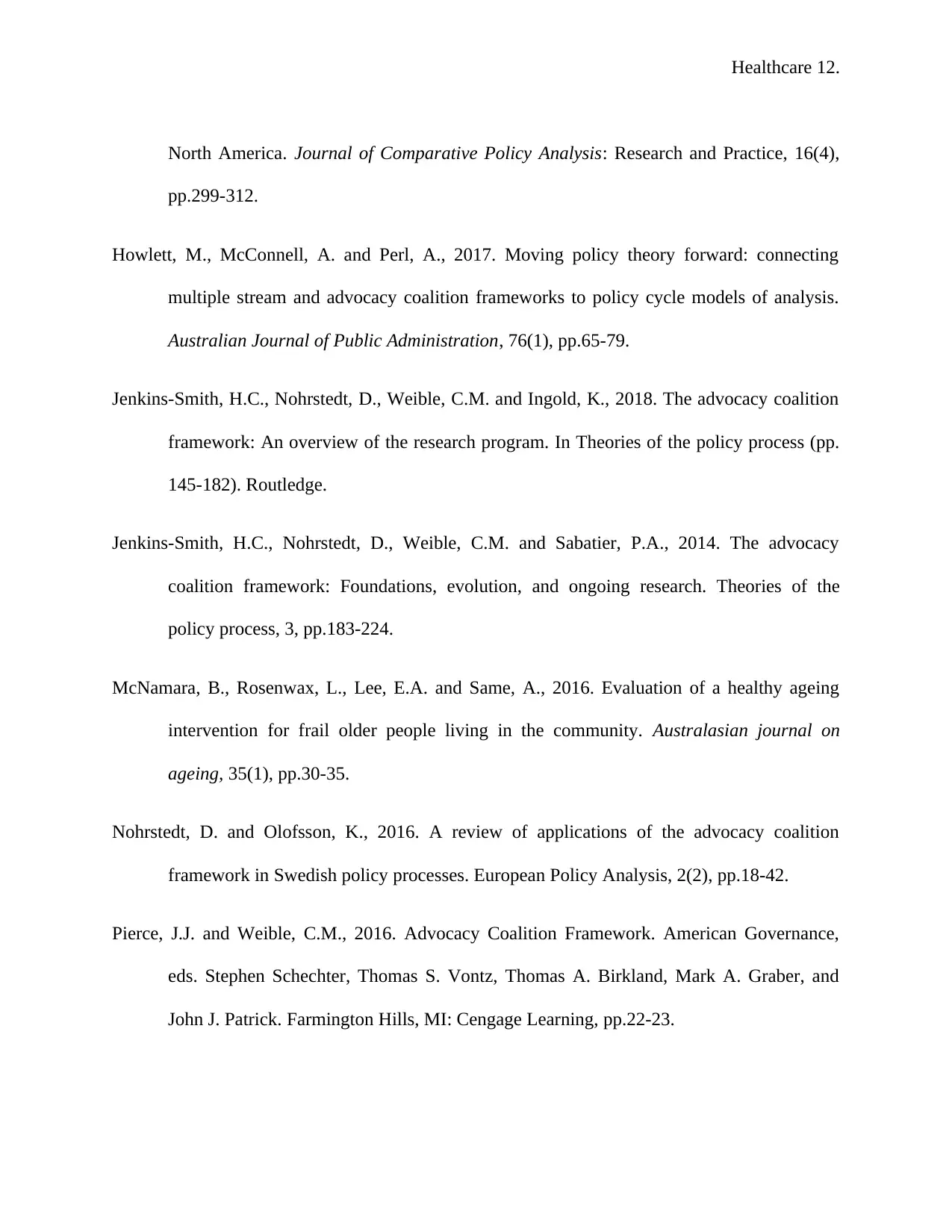
North America. Journal of Comparative Policy Analysis: Research and Practice, 16(4),
pp.299-312.
Howlett, M., McConnell, A. and Perl, A., 2017. Moving policy theory forward: connecting
multiple stream and advocacy coalition frameworks to policy cycle models of analysis.
Australian Journal of Public Administration, 76(1), pp.65-79.
Jenkins-Smith, H.C., Nohrstedt, D., Weible, C.M. and Ingold, K., 2018. The advocacy coalition
framework: An overview of the research program. In Theories of the policy process (pp.
145-182). Routledge.
Jenkins-Smith, H.C., Nohrstedt, D., Weible, C.M. and Sabatier, P.A., 2014. The advocacy
coalition framework: Foundations, evolution, and ongoing research. Theories of the
policy process, 3, pp.183-224.
McNamara, B., Rosenwax, L., Lee, E.A. and Same, A., 2016. Evaluation of a healthy ageing
intervention for frail older people living in the community. Australasian journal on
ageing, 35(1), pp.30-35.
Nohrstedt, D. and Olofsson, K., 2016. A review of applications of the advocacy coalition
framework in Swedish policy processes. European Policy Analysis, 2(2), pp.18-42.
Pierce, J.J. and Weible, C.M., 2016. Advocacy Coalition Framework. American Governance,
eds. Stephen Schechter, Thomas S. Vontz, Thomas A. Birkland, Mark A. Graber, and
John J. Patrick. Farmington Hills, MI: Cengage Learning, pp.22-23.
North America. Journal of Comparative Policy Analysis: Research and Practice, 16(4),
pp.299-312.
Howlett, M., McConnell, A. and Perl, A., 2017. Moving policy theory forward: connecting
multiple stream and advocacy coalition frameworks to policy cycle models of analysis.
Australian Journal of Public Administration, 76(1), pp.65-79.
Jenkins-Smith, H.C., Nohrstedt, D., Weible, C.M. and Ingold, K., 2018. The advocacy coalition
framework: An overview of the research program. In Theories of the policy process (pp.
145-182). Routledge.
Jenkins-Smith, H.C., Nohrstedt, D., Weible, C.M. and Sabatier, P.A., 2014. The advocacy
coalition framework: Foundations, evolution, and ongoing research. Theories of the
policy process, 3, pp.183-224.
McNamara, B., Rosenwax, L., Lee, E.A. and Same, A., 2016. Evaluation of a healthy ageing
intervention for frail older people living in the community. Australasian journal on
ageing, 35(1), pp.30-35.
Nohrstedt, D. and Olofsson, K., 2016. A review of applications of the advocacy coalition
framework in Swedish policy processes. European Policy Analysis, 2(2), pp.18-42.
Pierce, J.J. and Weible, C.M., 2016. Advocacy Coalition Framework. American Governance,
eds. Stephen Schechter, Thomas S. Vontz, Thomas A. Birkland, Mark A. Graber, and
John J. Patrick. Farmington Hills, MI: Cengage Learning, pp.22-23.
⊘ This is a preview!⊘
Do you want full access?
Subscribe today to unlock all pages.
Trusted by 1+ million students worldwide

1 out of 13


Your All-in-One AI-Powered Toolkit for Academic Success.
+13062052269
info@desklib.com
Available 24*7 on WhatsApp / Email
![[object Object]](/_next/static/media/star-bottom.7253800d.svg)
Unlock your academic potential
Copyright © 2020–2026 A2Z Services. All Rights Reserved. Developed and managed by ZUCOL.