Qualitative Research Report: Heart Disease and Immigrant Health
VerifiedAdded on 2023/04/21
|16
|3947
|366
Report
AI Summary
This report delves into qualitative research methodologies for evaluating the role of healthcare workers in managing chronic heart disease among immigrants. It employs a case study approach with narrative interviews to explore the psychological experiences of recently settled African male immigrants (sole breadwinners) diagnosed with chronic heart disease in Hamilton, Ontario. The research question was modified to address clinical perspectives, investigating the impact of chronic heart disease on job stability, utilizing an interpretive descriptive method. The report highlights the significance of understanding the interplay between familial responsibilities, psychological well-being, and health outcomes in this vulnerable population. The study emphasizes the importance of culturally sensitive healthcare approaches and the need for further research to improve patient outcomes and address the unique challenges faced by immigrant communities. The report also discusses the study's methodology, including sampling, recruitment, and the rationale behind the chosen qualitative research designs.

Running head: QUALITATIVE RESEARCH COURSE
QUALITATIVE RESEARCH COURSE
Name of the Student:
Name of the University:
Author note:
QUALITATIVE RESEARCH COURSE
Name of the Student:
Name of the University:
Author note:

Paraphrase This Document
Need a fresh take? Get an instant paraphrase of this document with our AI Paraphraser
1QUALITATIVE RESEARCH COURSE
Abstract
The following report focuses extensively on the various qualitative research methods which can
be utilized for the purpose of conducting research pertaining to the evaluation of the role of
health workers on the management of issues associated with chronic heart disease in immigrants.
A case study approach using narrative interviewing methods were utilized for evaluation of the
same. Likewise, to add varied research perspectives the research question was modified to
address clinical perspectives between immigrants’ chronic heart disease and effects on job
stability for which, a qualitative approach of interpretive descriptive method was adopted.
Abstract
The following report focuses extensively on the various qualitative research methods which can
be utilized for the purpose of conducting research pertaining to the evaluation of the role of
health workers on the management of issues associated with chronic heart disease in immigrants.
A case study approach using narrative interviewing methods were utilized for evaluation of the
same. Likewise, to add varied research perspectives the research question was modified to
address clinical perspectives between immigrants’ chronic heart disease and effects on job
stability for which, a qualitative approach of interpretive descriptive method was adopted.
2QUALITATIVE RESEARCH COURSE
Table of Contents
Introduction..........................................................................................................................3
Discussion............................................................................................................................3
Research Question...........................................................................................................3
Qualitative Research Design: Case Study.......................................................................5
Sampling and Recruitment..............................................................................................6
Second Qualitative Research Approach..........................................................................8
Changed Sampling and Recruitment...............................................................................9
Conclusion.........................................................................................................................10
References..........................................................................................................................12
Table of Contents
Introduction..........................................................................................................................3
Discussion............................................................................................................................3
Research Question...........................................................................................................3
Qualitative Research Design: Case Study.......................................................................5
Sampling and Recruitment..............................................................................................6
Second Qualitative Research Approach..........................................................................8
Changed Sampling and Recruitment...............................................................................9
Conclusion.........................................................................................................................10
References..........................................................................................................................12
⊘ This is a preview!⊘
Do you want full access?
Subscribe today to unlock all pages.

Trusted by 1+ million students worldwide

3QUALITATIVE RESEARCH COURSE
Introduction
According to Agree (2009), qualitative research derives its name due to its primary
research principles of exploration and evaluation of the opinions and experiences underlying
individuals. As observed by Fusch and Ness (2015), research methodologies which are prevalent
in qualitative studies are primarily subjective, unstructured and semi-structured in nature and
comprises of interviews, cases studies, focus groups or observational studies. The following
report discusses succinctly the qualitative research methodologies considered for evaluation of
the chosen research question, along with the possible sampling and research methodologies
which can be considered appropriate for the same.
Discussion
Research Question
The draft of the original research question emphasized primarily on the following: What
is the role of healthcare workers in the management of the issues associated with chronic
heart disease among Canadian adults? As reported by the Government of Canada, the second
highest contribution of high mortality rate has been attributed to chronic heart diseases in the
Canadian population resulting in deaths estimated to be amounting to 51, 500 every year
(Greiver et al., 2018). Further, in accordance to the Canadian Chronic Disease Surveillance
System in the years 2012-2013, a diagnosis of ischemic heart disease and heart failure was
acquired in 2.4 million of Canadians aged 20 years or more, and in 669, 600 Canadians aged 40
years or beyond (Allison, Lix Lisa & Kim, 2017). As examined by Valtorta et al., (2016), risk
factors associated with the acquisition of chronic heart disease comprise of adherence to an
Introduction
According to Agree (2009), qualitative research derives its name due to its primary
research principles of exploration and evaluation of the opinions and experiences underlying
individuals. As observed by Fusch and Ness (2015), research methodologies which are prevalent
in qualitative studies are primarily subjective, unstructured and semi-structured in nature and
comprises of interviews, cases studies, focus groups or observational studies. The following
report discusses succinctly the qualitative research methodologies considered for evaluation of
the chosen research question, along with the possible sampling and research methodologies
which can be considered appropriate for the same.
Discussion
Research Question
The draft of the original research question emphasized primarily on the following: What
is the role of healthcare workers in the management of the issues associated with chronic
heart disease among Canadian adults? As reported by the Government of Canada, the second
highest contribution of high mortality rate has been attributed to chronic heart diseases in the
Canadian population resulting in deaths estimated to be amounting to 51, 500 every year
(Greiver et al., 2018). Further, in accordance to the Canadian Chronic Disease Surveillance
System in the years 2012-2013, a diagnosis of ischemic heart disease and heart failure was
acquired in 2.4 million of Canadians aged 20 years or more, and in 669, 600 Canadians aged 40
years or beyond (Allison, Lix Lisa & Kim, 2017). As examined by Valtorta et al., (2016), risk
factors associated with the acquisition of chronic heart disease comprise of adherence to an
Paraphrase This Document
Need a fresh take? Get an instant paraphrase of this document with our AI Paraphraser
4QUALITATIVE RESEARCH COURSE
unhealthy diet rich in trans fats, sugars and processed foods, and lifestyle habits such as smoking
and a sedentary lifestyle. Health workers are the primary drivers of health behavior change in the
population due to their increased health literacy and competency. Thus, considering the
widespread chronic heart disease prevalence rates and beneficial role of health workers in the
management of the same, the original research question was formulated (Xavier et al., 2016).
However, literature searches revealed limited focus on the mitigation of disease issues
overcome by immigrants residing the Canada. Taking insights from the Cardiovascular Heart in
Ambulatory Care Research Team (CANHEART) Immigrant Study, authors Tu et al., 2015),
reported gradually emergence of higher susceptibility rates of chronic heart diseases among
immigrants in Canada, associated with increments in their period of stay. Further, as researched
by Roberts et al., (2015), immigrants residing in Ontario are in possession of high rates of
smoking (22.1%), inadequacy in intake of vegetables and fruits (65.2%) and lack of adequate
exercise (54.7%), which are causative factors for the contribution of chronic heart diseases. Such
high risk factor prevalence may be attributed to the difficulties overcome by immigrants during
adjustments to the mainstream societies, considering their non-English speaking and culturally
diverse backgrounds resulting in lack of communication, high unemployment rates, financial
constraints and lack of accessibility or awareness concerning prevention, management and
treatment of chronic diseases of the heart. Hence, considering the rising trends of immigration
and chronic heart disease rates in Canada, evaluation of the existing role of health workers is of
utmost importance for future improvements in evidence based clinical practice and achievements
of culturally diverse, positive patient health outcomes (Lane et al., 2018).
unhealthy diet rich in trans fats, sugars and processed foods, and lifestyle habits such as smoking
and a sedentary lifestyle. Health workers are the primary drivers of health behavior change in the
population due to their increased health literacy and competency. Thus, considering the
widespread chronic heart disease prevalence rates and beneficial role of health workers in the
management of the same, the original research question was formulated (Xavier et al., 2016).
However, literature searches revealed limited focus on the mitigation of disease issues
overcome by immigrants residing the Canada. Taking insights from the Cardiovascular Heart in
Ambulatory Care Research Team (CANHEART) Immigrant Study, authors Tu et al., 2015),
reported gradually emergence of higher susceptibility rates of chronic heart diseases among
immigrants in Canada, associated with increments in their period of stay. Further, as researched
by Roberts et al., (2015), immigrants residing in Ontario are in possession of high rates of
smoking (22.1%), inadequacy in intake of vegetables and fruits (65.2%) and lack of adequate
exercise (54.7%), which are causative factors for the contribution of chronic heart diseases. Such
high risk factor prevalence may be attributed to the difficulties overcome by immigrants during
adjustments to the mainstream societies, considering their non-English speaking and culturally
diverse backgrounds resulting in lack of communication, high unemployment rates, financial
constraints and lack of accessibility or awareness concerning prevention, management and
treatment of chronic diseases of the heart. Hence, considering the rising trends of immigration
and chronic heart disease rates in Canada, evaluation of the existing role of health workers is of
utmost importance for future improvements in evidence based clinical practice and achievements
of culturally diverse, positive patient health outcomes (Lane et al., 2018).
5QUALITATIVE RESEARCH COURSE
Hence, due to the literature gap in the management of chronic heart disease issues among
immigrants, the research question was modified to: How can healthcare providers in North
America better manage the issues that arise from chronic heart disease in immigrants?
However, upon evaluating the statistical data reported by the Canadian Cardiovascular
Society, it was observed that African immigrants in Canada were in possession of the high
susceptibility to hypertension, a key precursory symptom of chronic heart disease. Further, as
discussed above, immigrants are susceptible to increased financial constraints, unemployment
issues as well as racial and cultural disparities hence, increasing their acquisition of chronic
stress, depression and disruptive mental states (Sohail et al., 2015). Such mental health issues
coupled with societal and financial issues result in increased chronic disease such as heart
disorders and the associated psychological implications. The burden of such difficulties are
shared greater by primarily male bread winner due to their increased responsibility of sustaining
their family (Cooper Brathwaite & Lemonde, 2016). Considering the same, the final research
question was modified to form: How do recently settled (within 5 years) African male
immigrants (40-50 years of age,) who are the sole bread winner of the family describe their
psychological experience following the diagnosis of chronic heart disease (CHD)? A Case
study in Hamilton Ontario.
Qualitative Research Design: Case Study
Considering the above research question on evaluation of the psychological experiences
of African male immigrants upon chronic heart disease diagnosis, the specific qualitative
research design which was chosen initially, was a case study research methodology. As
examined by Cooper, Endacott and Chapman (2009), the research methodology of case study
relies in the principle of examining characteristics, preferences, opinions, experiences and
Hence, due to the literature gap in the management of chronic heart disease issues among
immigrants, the research question was modified to: How can healthcare providers in North
America better manage the issues that arise from chronic heart disease in immigrants?
However, upon evaluating the statistical data reported by the Canadian Cardiovascular
Society, it was observed that African immigrants in Canada were in possession of the high
susceptibility to hypertension, a key precursory symptom of chronic heart disease. Further, as
discussed above, immigrants are susceptible to increased financial constraints, unemployment
issues as well as racial and cultural disparities hence, increasing their acquisition of chronic
stress, depression and disruptive mental states (Sohail et al., 2015). Such mental health issues
coupled with societal and financial issues result in increased chronic disease such as heart
disorders and the associated psychological implications. The burden of such difficulties are
shared greater by primarily male bread winner due to their increased responsibility of sustaining
their family (Cooper Brathwaite & Lemonde, 2016). Considering the same, the final research
question was modified to form: How do recently settled (within 5 years) African male
immigrants (40-50 years of age,) who are the sole bread winner of the family describe their
psychological experience following the diagnosis of chronic heart disease (CHD)? A Case
study in Hamilton Ontario.
Qualitative Research Design: Case Study
Considering the above research question on evaluation of the psychological experiences
of African male immigrants upon chronic heart disease diagnosis, the specific qualitative
research design which was chosen initially, was a case study research methodology. As
examined by Cooper, Endacott and Chapman (2009), the research methodology of case study
relies in the principle of examining characteristics, preferences, opinions, experiences and
⊘ This is a preview!⊘
Do you want full access?
Subscribe today to unlock all pages.
Trusted by 1+ million students worldwide
6QUALITATIVE RESEARCH COURSE
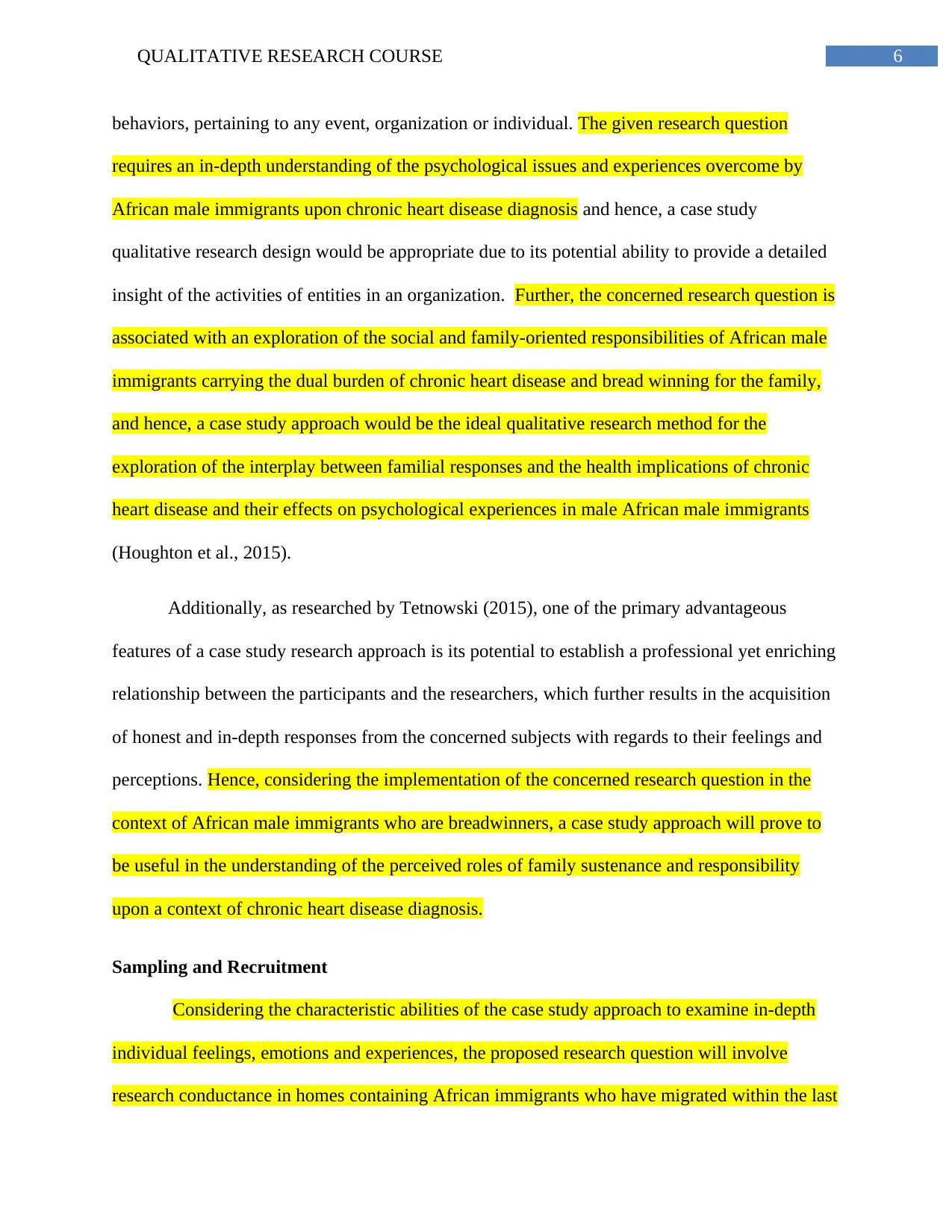
behaviors, pertaining to any event, organization or individual. The given research question
requires an in-depth understanding of the psychological issues and experiences overcome by
African male immigrants upon chronic heart disease diagnosis and hence, a case study
qualitative research design would be appropriate due to its potential ability to provide a detailed
insight of the activities of entities in an organization. Further, the concerned research question is
associated with an exploration of the social and family-oriented responsibilities of African male
immigrants carrying the dual burden of chronic heart disease and bread winning for the family,
and hence, a case study approach would be the ideal qualitative research method for the
exploration of the interplay between familial responses and the health implications of chronic
heart disease and their effects on psychological experiences in male African male immigrants
(Houghton et al., 2015).
Additionally, as researched by Tetnowski (2015), one of the primary advantageous
features of a case study research approach is its potential to establish a professional yet enriching
relationship between the participants and the researchers, which further results in the acquisition
of honest and in-depth responses from the concerned subjects with regards to their feelings and
perceptions. Hence, considering the implementation of the concerned research question in the
context of African male immigrants who are breadwinners, a case study approach will prove to
be useful in the understanding of the perceived roles of family sustenance and responsibility
upon a context of chronic heart disease diagnosis.
Sampling and Recruitment
Considering the characteristic abilities of the case study approach to examine in-depth
individual feelings, emotions and experiences, the proposed research question will involve
research conductance in homes containing African immigrants who have migrated within the last
behaviors, pertaining to any event, organization or individual. The given research question
requires an in-depth understanding of the psychological issues and experiences overcome by
African male immigrants upon chronic heart disease diagnosis and hence, a case study
qualitative research design would be appropriate due to its potential ability to provide a detailed
insight of the activities of entities in an organization. Further, the concerned research question is
associated with an exploration of the social and family-oriented responsibilities of African male
immigrants carrying the dual burden of chronic heart disease and bread winning for the family,
and hence, a case study approach would be the ideal qualitative research method for the
exploration of the interplay between familial responses and the health implications of chronic
heart disease and their effects on psychological experiences in male African male immigrants
(Houghton et al., 2015).
Additionally, as researched by Tetnowski (2015), one of the primary advantageous
features of a case study research approach is its potential to establish a professional yet enriching
relationship between the participants and the researchers, which further results in the acquisition
of honest and in-depth responses from the concerned subjects with regards to their feelings and
perceptions. Hence, considering the implementation of the concerned research question in the
context of African male immigrants who are breadwinners, a case study approach will prove to
be useful in the understanding of the perceived roles of family sustenance and responsibility
upon a context of chronic heart disease diagnosis.
Sampling and Recruitment
Considering the characteristic abilities of the case study approach to examine in-depth
individual feelings, emotions and experiences, the proposed research question will involve
research conductance in homes containing African immigrants who have migrated within the last
Paraphrase This Document
Need a fresh take? Get an instant paraphrase of this document with our AI Paraphraser
7QUALITATIVE RESEARCH COURSE
five years, situated in the Canadian locality of Hamilton. Ontario or in a hospital or a community
health centre or a residential care centre, where African male immigrants must comprise of a
significant number of the existing clientele (Boddy, 2016). Likewise, as researched by Cronin
(2016), the preferred sampling method used in a case study approach is a purposive sampling
method, where participants are not selected on a probability basis but due to their adherence to a
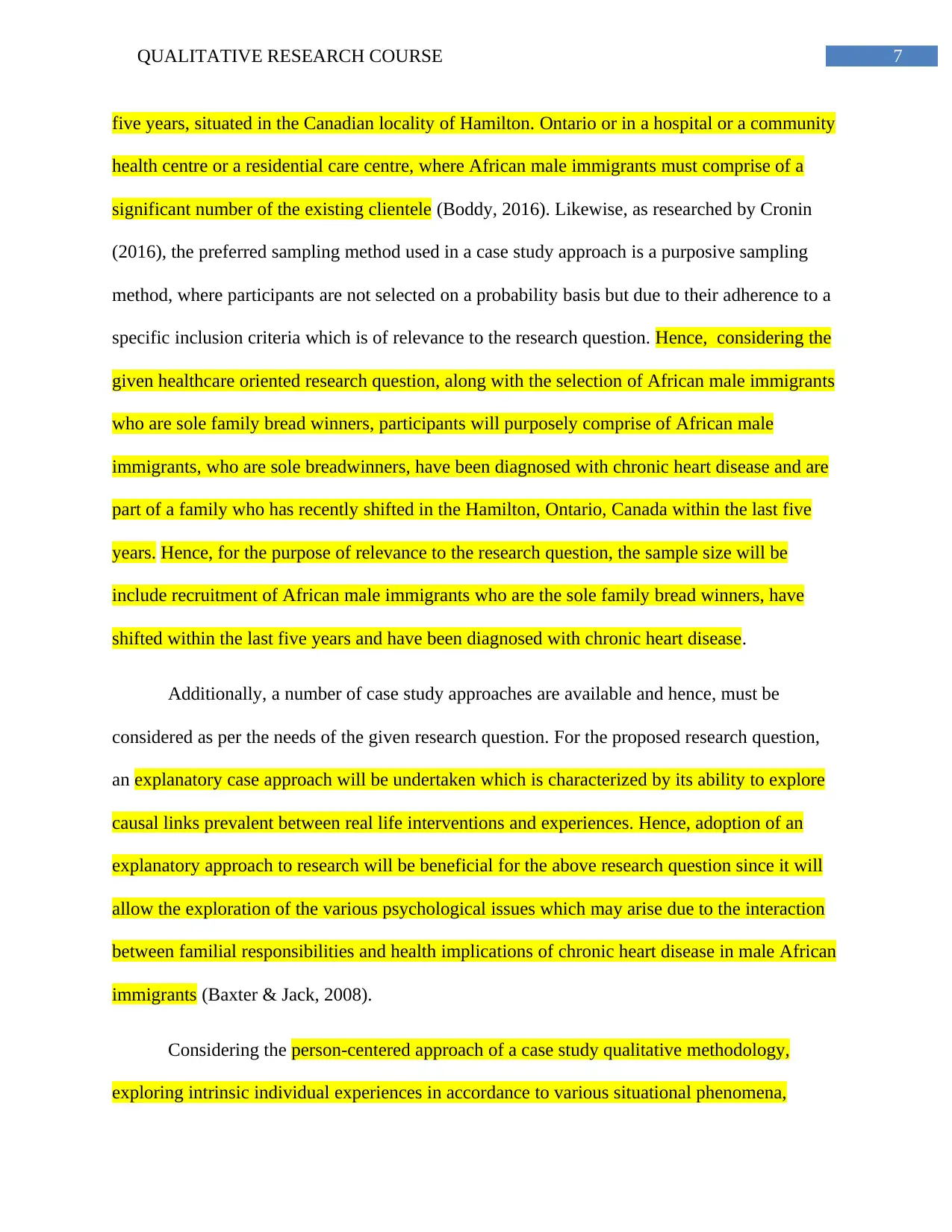
specific inclusion criteria which is of relevance to the research question. Hence, considering the
given healthcare oriented research question, along with the selection of African male immigrants
who are sole family bread winners, participants will purposely comprise of African male
immigrants, who are sole breadwinners, have been diagnosed with chronic heart disease and are
part of a family who has recently shifted in the Hamilton, Ontario, Canada within the last five
years. Hence, for the purpose of relevance to the research question, the sample size will be
include recruitment of African male immigrants who are the sole family bread winners, have
shifted within the last five years and have been diagnosed with chronic heart disease.
Additionally, a number of case study approaches are available and hence, must be
considered as per the needs of the given research question. For the proposed research question,
an explanatory case approach will be undertaken which is characterized by its ability to explore
causal links prevalent between real life interventions and experiences. Hence, adoption of an
explanatory approach to research will be beneficial for the above research question since it will
allow the exploration of the various psychological issues which may arise due to the interaction
between familial responsibilities and health implications of chronic heart disease in male African
immigrants (Baxter & Jack, 2008).
Considering the person-centered approach of a case study qualitative methodology,
exploring intrinsic individual experiences in accordance to various situational phenomena,
five years, situated in the Canadian locality of Hamilton. Ontario or in a hospital or a community
health centre or a residential care centre, where African male immigrants must comprise of a
significant number of the existing clientele (Boddy, 2016). Likewise, as researched by Cronin
(2016), the preferred sampling method used in a case study approach is a purposive sampling
method, where participants are not selected on a probability basis but due to their adherence to a
specific inclusion criteria which is of relevance to the research question. Hence, considering the
given healthcare oriented research question, along with the selection of African male immigrants
who are sole family bread winners, participants will purposely comprise of African male
immigrants, who are sole breadwinners, have been diagnosed with chronic heart disease and are
part of a family who has recently shifted in the Hamilton, Ontario, Canada within the last five
years. Hence, for the purpose of relevance to the research question, the sample size will be
include recruitment of African male immigrants who are the sole family bread winners, have
shifted within the last five years and have been diagnosed with chronic heart disease.
Additionally, a number of case study approaches are available and hence, must be
considered as per the needs of the given research question. For the proposed research question,
an explanatory case approach will be undertaken which is characterized by its ability to explore
causal links prevalent between real life interventions and experiences. Hence, adoption of an
explanatory approach to research will be beneficial for the above research question since it will
allow the exploration of the various psychological issues which may arise due to the interaction
between familial responsibilities and health implications of chronic heart disease in male African
immigrants (Baxter & Jack, 2008).
Considering the person-centered approach of a case study qualitative methodology,
exploring intrinsic individual experiences in accordance to various situational phenomena,
8QUALITATIVE RESEARCH COURSE
conductance of narrative interviews will prove to be beneficial since such a research
methodology, will provide an in-depth insight into perceptions and experiences of participants.
Hence, for collection of information concerning the nature of description of experiences
provided by African male immigrants who have been diagnosed with heart disease and are the
sole bread winners, narrative interviews will be useful since it will allow participating
immigrants to discuss their experiences associated with diagnosis and the burden of familial
responsibilities. Such a method is beneficial considering the need to evaluate the personal
perceptions of the participants in response to real life experiences and events (Patton, 2002).
Second Qualitative Research Approach
A second qualitative research approach which would prove to beneficial in obtaining
varied insights of the chosen research question, is the interpretive description, for which, a
modification of the research problem is required.
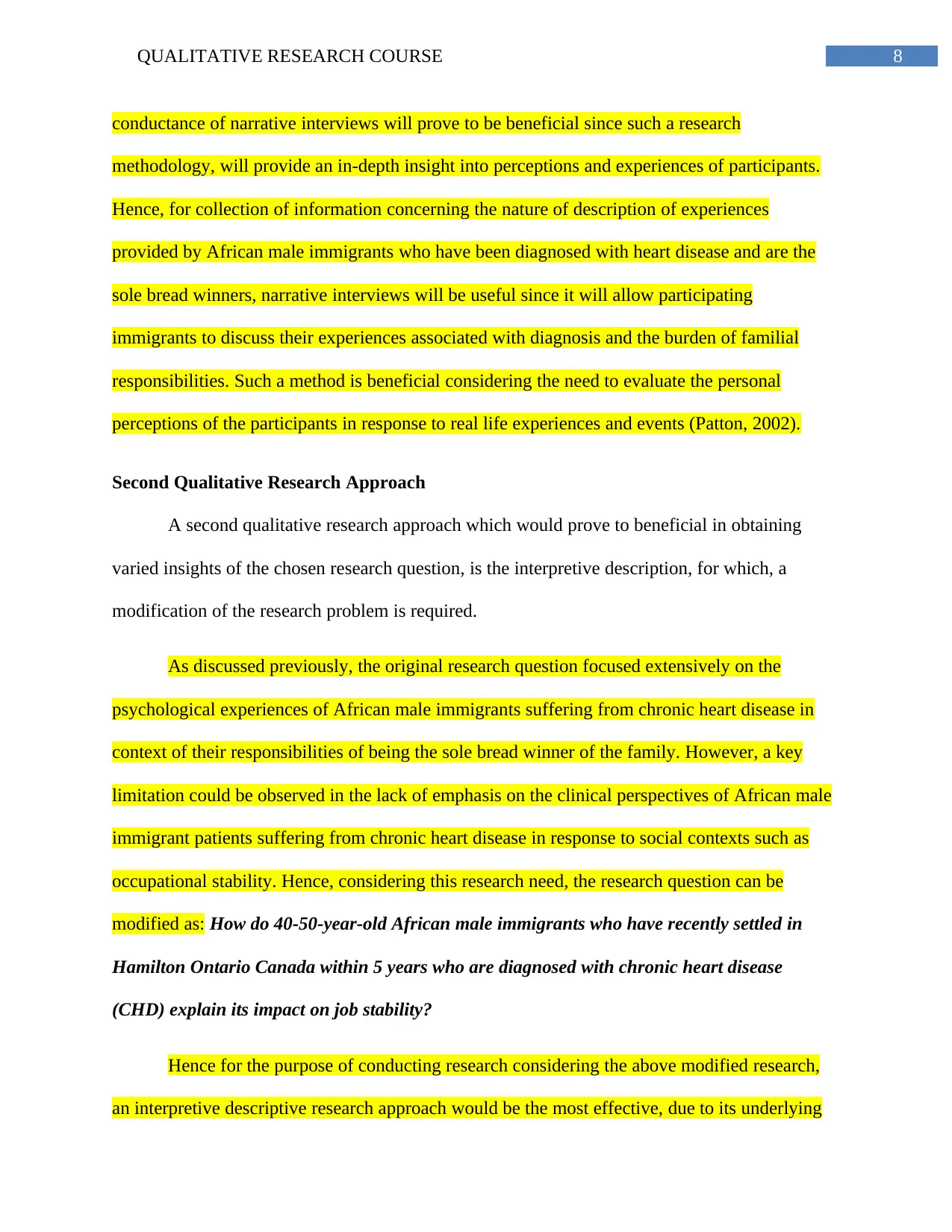
As discussed previously, the original research question focused extensively on the
psychological experiences of African male immigrants suffering from chronic heart disease in
context of their responsibilities of being the sole bread winner of the family. However, a key
limitation could be observed in the lack of emphasis on the clinical perspectives of African male
immigrant patients suffering from chronic heart disease in response to social contexts such as
occupational stability. Hence, considering this research need, the research question can be
modified as: How do 40-50-year-old African male immigrants who have recently settled in
Hamilton Ontario Canada within 5 years who are diagnosed with chronic heart disease
(CHD) explain its impact on job stability?
Hence for the purpose of conducting research considering the above modified research,
an interpretive descriptive research approach would be the most effective, due to its underlying
conductance of narrative interviews will prove to be beneficial since such a research
methodology, will provide an in-depth insight into perceptions and experiences of participants.
Hence, for collection of information concerning the nature of description of experiences
provided by African male immigrants who have been diagnosed with heart disease and are the
sole bread winners, narrative interviews will be useful since it will allow participating
immigrants to discuss their experiences associated with diagnosis and the burden of familial
responsibilities. Such a method is beneficial considering the need to evaluate the personal
perceptions of the participants in response to real life experiences and events (Patton, 2002).
Second Qualitative Research Approach
A second qualitative research approach which would prove to beneficial in obtaining
varied insights of the chosen research question, is the interpretive description, for which, a
modification of the research problem is required.
As discussed previously, the original research question focused extensively on the
psychological experiences of African male immigrants suffering from chronic heart disease in
context of their responsibilities of being the sole bread winner of the family. However, a key
limitation could be observed in the lack of emphasis on the clinical perspectives of African male
immigrant patients suffering from chronic heart disease in response to social contexts such as
occupational stability. Hence, considering this research need, the research question can be
modified as: How do 40-50-year-old African male immigrants who have recently settled in
Hamilton Ontario Canada within 5 years who are diagnosed with chronic heart disease
(CHD) explain its impact on job stability?
Hence for the purpose of conducting research considering the above modified research,
an interpretive descriptive research approach would be the most effective, due to its underlying
⊘ This is a preview!⊘
Do you want full access?
Subscribe today to unlock all pages.
Trusted by 1+ million students worldwide

9QUALITATIVE RESEARCH COURSE
research principles of extensively interpreting and generating information which is significant for
the application of clinical and health perspectives in a social scenario (Teodoro et al., 2018).
Hence, considering the aim of the modified research question to explore individual healthcare
perceptions of immigrants in response to their surrounding social environment such as job
stability, an interpretive descriptive qualitative approach would be beneficial since it would
provide deep rooted insights into clinical effects of chronic heart disease in African male
immigrants on job security and stability, while working in their respective occupational duties.
Upon close examination, it can be observed that the two research questions were different
in their approach and examination of the concerned participants. The first research question
focused extensively on a deductive and explanatory research approach for the purpose of
hypothesizing and postulating the causal links between real life psychological experiences, bread
winning responsibilities and chronic heart disease diagnosis (Yazan, 2015). However, the second
question adopts an interpretive approach to research where the researcher adhere to transactional
inquiry methods and interact personally with the unique case scenario of the participant, resulting
in a clinical and health oriented interpretation of the social context. Hence, due to such
differences, the first question benefit from a person-centered, deductive approach of case study,
while the second research will benefit extensively from adopting clinical interpretations of the
social context of participants (Hunt, 2009).
Changed Sampling and Recruitment
Considering a shift of participant focus on the modified research question evaluating
immigrant perspectives, the sample size will again employ the characteristic qualitative sampling
procedure of purposive sampling African male immigrants, who have recently migrated and
research principles of extensively interpreting and generating information which is significant for
the application of clinical and health perspectives in a social scenario (Teodoro et al., 2018).
Hence, considering the aim of the modified research question to explore individual healthcare
perceptions of immigrants in response to their surrounding social environment such as job
stability, an interpretive descriptive qualitative approach would be beneficial since it would
provide deep rooted insights into clinical effects of chronic heart disease in African male
immigrants on job security and stability, while working in their respective occupational duties.
Upon close examination, it can be observed that the two research questions were different
in their approach and examination of the concerned participants. The first research question
focused extensively on a deductive and explanatory research approach for the purpose of
hypothesizing and postulating the causal links between real life psychological experiences, bread
winning responsibilities and chronic heart disease diagnosis (Yazan, 2015). However, the second
question adopts an interpretive approach to research where the researcher adhere to transactional
inquiry methods and interact personally with the unique case scenario of the participant, resulting
in a clinical and health oriented interpretation of the social context. Hence, due to such
differences, the first question benefit from a person-centered, deductive approach of case study,
while the second research will benefit extensively from adopting clinical interpretations of the
social context of participants (Hunt, 2009).
Changed Sampling and Recruitment
Considering a shift of participant focus on the modified research question evaluating
immigrant perspectives, the sample size will again employ the characteristic qualitative sampling
procedure of purposive sampling African male immigrants, who have recently migrated and
Paraphrase This Document
Need a fresh take? Get an instant paraphrase of this document with our AI Paraphraser
10QUALITATIVE RESEARCH COURSE
suffering from heart disease and are sole breadwinners of the family, will be recruited as
samples (Sandelowski, 1995).
Likewise, an interpretive descriptive qualitative research approach will rely
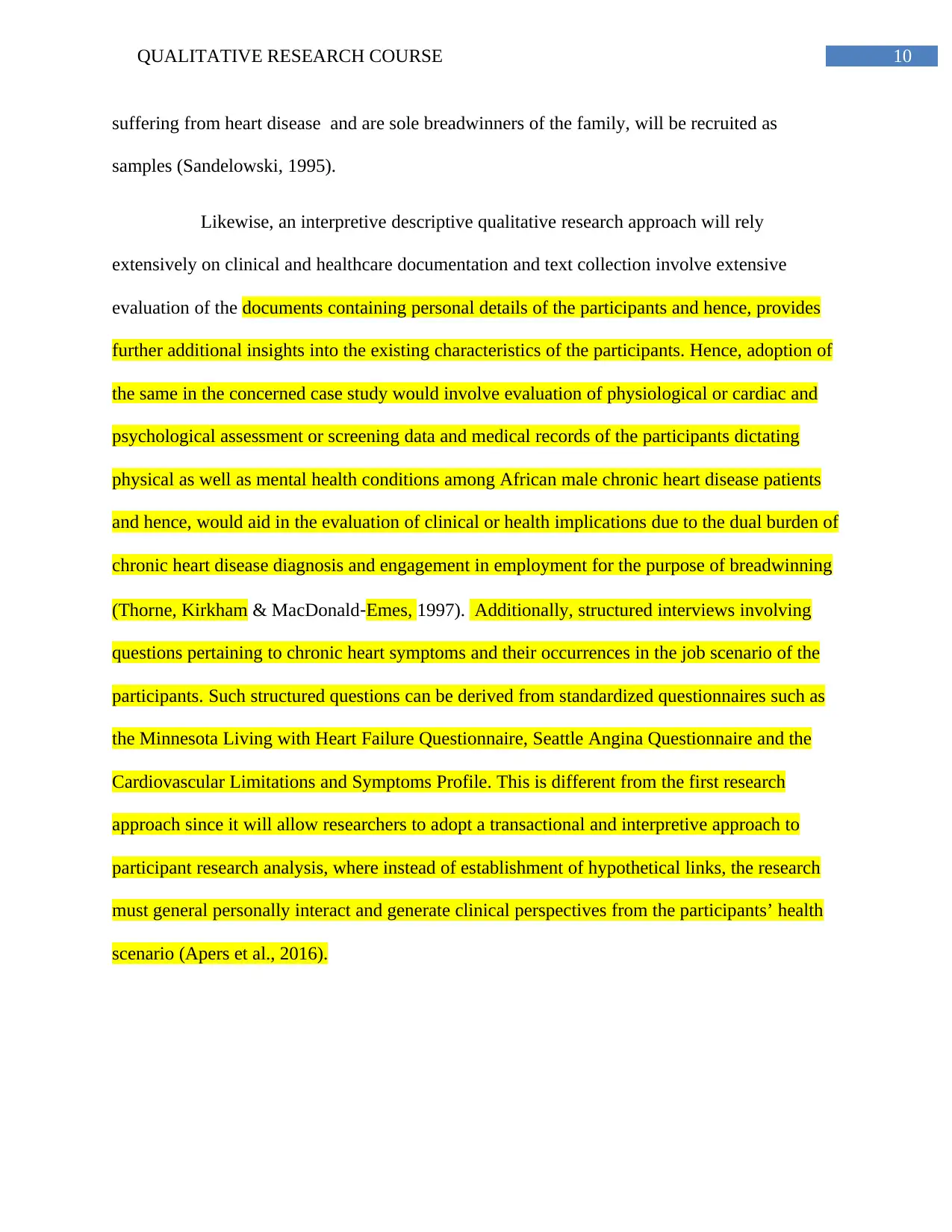
extensively on clinical and healthcare documentation and text collection involve extensive
evaluation of the documents containing personal details of the participants and hence, provides
further additional insights into the existing characteristics of the participants. Hence, adoption of
the same in the concerned case study would involve evaluation of physiological or cardiac and
psychological assessment or screening data and medical records of the participants dictating
physical as well as mental health conditions among African male chronic heart disease patients
and hence, would aid in the evaluation of clinical or health implications due to the dual burden of
chronic heart disease diagnosis and engagement in employment for the purpose of breadwinning
(Thorne, Kirkham & MacDonald‐Emes, 1997). Additionally, structured interviews involving
questions pertaining to chronic heart symptoms and their occurrences in the job scenario of the
participants. Such structured questions can be derived from standardized questionnaires such as
the Minnesota Living with Heart Failure Questionnaire, Seattle Angina Questionnaire and the
Cardiovascular Limitations and Symptoms Profile. This is different from the first research
approach since it will allow researchers to adopt a transactional and interpretive approach to
participant research analysis, where instead of establishment of hypothetical links, the research
must general personally interact and generate clinical perspectives from the participants’ health
scenario (Apers et al., 2016).
suffering from heart disease and are sole breadwinners of the family, will be recruited as
samples (Sandelowski, 1995).
Likewise, an interpretive descriptive qualitative research approach will rely
extensively on clinical and healthcare documentation and text collection involve extensive
evaluation of the documents containing personal details of the participants and hence, provides
further additional insights into the existing characteristics of the participants. Hence, adoption of
the same in the concerned case study would involve evaluation of physiological or cardiac and
psychological assessment or screening data and medical records of the participants dictating
physical as well as mental health conditions among African male chronic heart disease patients
and hence, would aid in the evaluation of clinical or health implications due to the dual burden of
chronic heart disease diagnosis and engagement in employment for the purpose of breadwinning
(Thorne, Kirkham & MacDonald‐Emes, 1997). Additionally, structured interviews involving
questions pertaining to chronic heart symptoms and their occurrences in the job scenario of the
participants. Such structured questions can be derived from standardized questionnaires such as
the Minnesota Living with Heart Failure Questionnaire, Seattle Angina Questionnaire and the
Cardiovascular Limitations and Symptoms Profile. This is different from the first research
approach since it will allow researchers to adopt a transactional and interpretive approach to
participant research analysis, where instead of establishment of hypothetical links, the research
must general personally interact and generate clinical perspectives from the participants’ health
scenario (Apers et al., 2016).

11QUALITATIVE RESEARCH COURSE
Conclusion
Hence, it can be concluded that the chosen research question, which aims to evaluate the
psychological experiences of African male immigrants who are sole bread winners and are
suffering from chronic heart diseases can be researched successfully using a case study
qualitative research approach. The second research question can focus on the interpreting the
clinical perspectives immigrants health conditions in response to employment stability. For
exploration of this alternative case study, a interpretive descriptive qualitative approach can be
undertaken, due to its modified focus on interpretive research and the researcher’s personal
general of clinical perspectives as compared to the deductive case study research approach
adopted in the first question.
Conclusion
Hence, it can be concluded that the chosen research question, which aims to evaluate the
psychological experiences of African male immigrants who are sole bread winners and are
suffering from chronic heart diseases can be researched successfully using a case study
qualitative research approach. The second research question can focus on the interpreting the
clinical perspectives immigrants health conditions in response to employment stability. For
exploration of this alternative case study, a interpretive descriptive qualitative approach can be
undertaken, due to its modified focus on interpretive research and the researcher’s personal
general of clinical perspectives as compared to the deductive case study research approach
adopted in the first question.
⊘ This is a preview!⊘
Do you want full access?
Subscribe today to unlock all pages.
Trusted by 1+ million students worldwide

1 out of 16


Related Documents


Your All-in-One AI-Powered Toolkit for Academic Success.
+13062052269
info@desklib.com
Available 24*7 on WhatsApp / Email
![[object Object]](/_next/static/media/star-bottom.7253800d.svg)
Unlock your academic potential
Copyright © 2020–2026 A2Z Services. All Rights Reserved. Developed and managed by ZUCOL.