Hewlett-Packard - Business Activity and Instalment Statement Tasks
VerifiedAdded on 2020/04/21
|27
|4722
|400
Homework Assignment
AI Summary
This assignment solution addresses business activity statement tasks, including GST implications, PAYG, and BAS reconciliation. The solution covers the three main categories of tax obligations: registration, lodgement, and reporting/payment. It explores the application of GST, reporting on payroll activities, other amounts withheld, PAYG installments, and taxes. The assignment also details the tasks for completing and lodging activity statements, including BAS reconciliation steps and calculations. Furthermore, it examines the advantages of using the activity statement functions in the portal, the use of accounting software for lodging, the purpose of the Tax Agent Services Act 2009, and what can be included in a BAS. The solution also clarifies the difference between cash and non-cash reporting options.

MOHSIN ALI SHAIKH
1321600
1321600

Paraphrase This Document
Need a fresh take? Get an instant paraphrase of this document with our AI Paraphraser
MOHSIN ALI SHAIKH
1321600
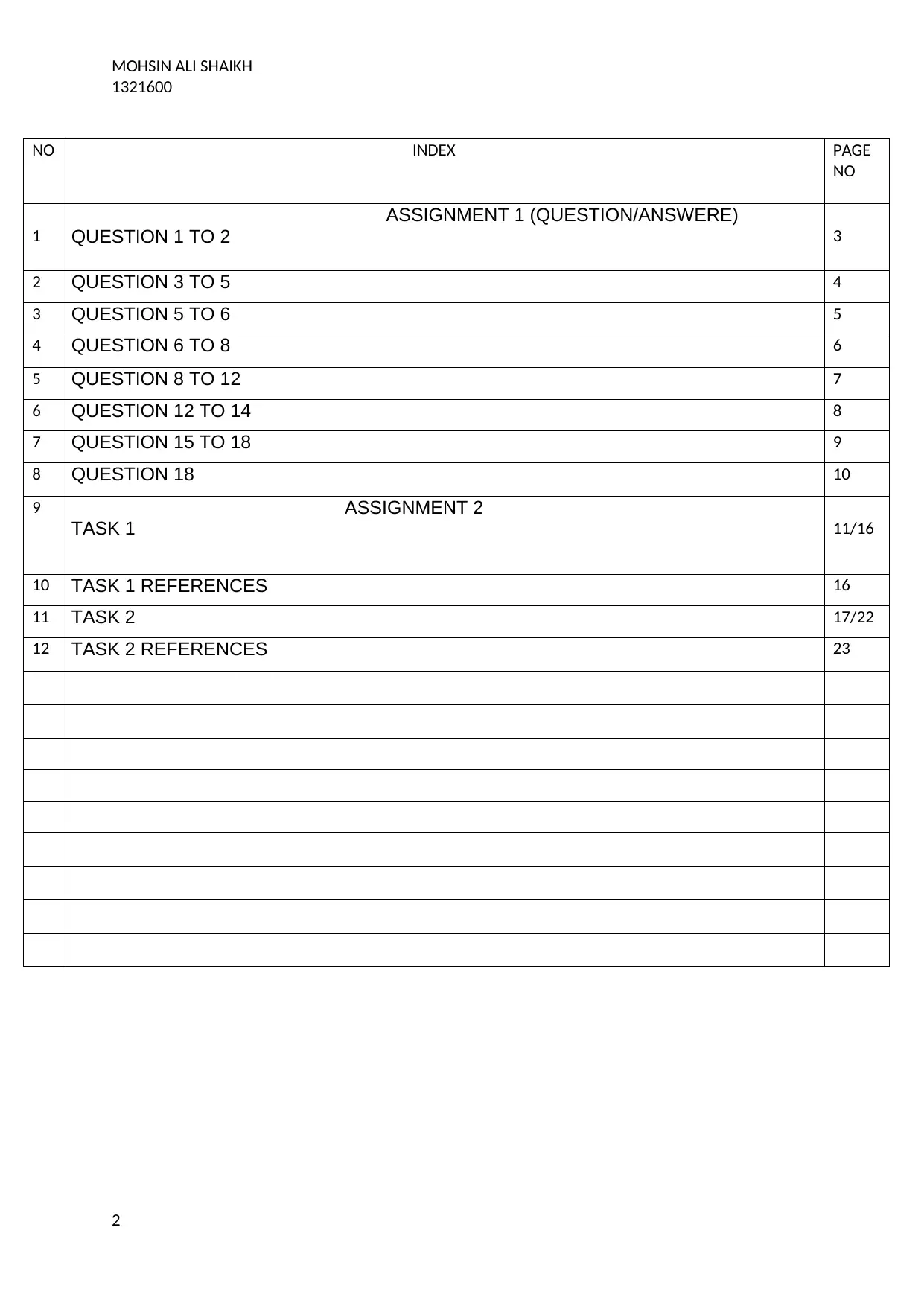
NO INDEX PAGE
NO
1
ASSIGNMENT 1 (QUESTION/ANSWERE)
QUESTION 1 TO 2 3
2 QUESTION 3 TO 5 4
3 QUESTION 5 TO 6 5
4 QUESTION 6 TO 8 6
5 QUESTION 8 TO 12 7
6 QUESTION 12 TO 14 8
7 QUESTION 15 TO 18 9
8 QUESTION 18 10
9 ASSIGNMENT 2
TASK 1 11/16
10 TASK 1 REFERENCES 16
11 TASK 2 17/22
12 TASK 2 REFERENCES 23
2
1321600
NO INDEX PAGE
NO
1
ASSIGNMENT 1 (QUESTION/ANSWERE)
QUESTION 1 TO 2 3
2 QUESTION 3 TO 5 4
3 QUESTION 5 TO 6 5
4 QUESTION 6 TO 8 6
5 QUESTION 8 TO 12 7
6 QUESTION 12 TO 14 8
7 QUESTION 15 TO 18 9
8 QUESTION 18 10
9 ASSIGNMENT 2
TASK 1 11/16
10 TASK 1 REFERENCES 16
11 TASK 2 17/22
12 TASK 2 REFERENCES 23
2
MOHSIN ALI SHAIKH
1321600
ASSESSMENT 1: WRITTEN QUESTIONS
QUESTIONS
1. What are the three main categories of tax obligations?
Answer: The three main tax obligations for the taxpayer are as follows;
a. Registration
b. Lodgement
c. Reporting and Payment
Irrespective of the type of entity an individual, big organization or SMSF all the tax
payers are required to make an application for the TFN and a large number of them
are required to lodge a yearly tax return.
2. What do you need to do in order to identify individual compliance and other
requirements?
Answer: Obeying to the lawful requirements and obligations or systematically and
preventively protecting the individual taxpayer in the field of taxes is known as the
tax compliance. Government with the help of the tax administrations, usually seek to
reduce their own system of taxation operating cost whereas at the same time
keeping the compliance cost for taxpayers as minimum as possible. In order to attain
this, an equilibrium should be created between the cost borne by the individual in
complying with the regulations of tax and the cost that is shouldered by the revenue
authority in running the system. Enforcing compliance through constant checks,
substantial audits and prosecution is considered as an expensive method of making
3
1321600
ASSESSMENT 1: WRITTEN QUESTIONS
QUESTIONS
1. What are the three main categories of tax obligations?
Answer: The three main tax obligations for the taxpayer are as follows;
a. Registration
b. Lodgement
c. Reporting and Payment
Irrespective of the type of entity an individual, big organization or SMSF all the tax
payers are required to make an application for the TFN and a large number of them
are required to lodge a yearly tax return.
2. What do you need to do in order to identify individual compliance and other
requirements?
Answer: Obeying to the lawful requirements and obligations or systematically and
preventively protecting the individual taxpayer in the field of taxes is known as the
tax compliance. Government with the help of the tax administrations, usually seek to
reduce their own system of taxation operating cost whereas at the same time
keeping the compliance cost for taxpayers as minimum as possible. In order to attain
this, an equilibrium should be created between the cost borne by the individual in
complying with the regulations of tax and the cost that is shouldered by the revenue
authority in running the system. Enforcing compliance through constant checks,
substantial audits and prosecution is considered as an expensive method of making
3
⊘ This is a preview!⊘
Do you want full access?
Subscribe today to unlock all pages.

Trusted by 1+ million students worldwide
MOHSIN ALI SHAIKH
1321600
sure that adequate compliance is attained where the taxpayer is stimulated to co-
operate and actively comply with the regulations of taxation.
3. How would you recognise and apply GST implications and code transactions?
Answer: Recognizing and applying GST implications and code transactions are as
follows;
a. The fundamentals of GST are recognized, applied and recorded.
b. Purchases and payments are recorded, coded in accordance with the GST
classifications and they are split in capital and non-capital as considered
appropriate.
c. Sales and other receipts are recognized and coded according to the GST
classifications
d. Accounting data is processed to adhere with the reporting requirements of
taxation1.
4. What do you need to do to report on payroll activities?
Answer: Reporting on payroll activities are as follows;
a. An employer under the payroll activities is required to report to the ATO
regarding all the payments on or prior to the payday, through the payroll
event.
b. When the payment is made through electronic means, the day of payment is
either considered as the date that is stipulated in the electronic transactions or
else no date is specified, the data on which the payment is proposed to be
made in the employees bank account.
c. The report should take into the account the employee, with the amount that is
subjected to withholding in the regular cycle of pay.
1 Coleman, C, & K Sadiq, Principles of taxation law 2013. in
4
1321600
sure that adequate compliance is attained where the taxpayer is stimulated to co-
operate and actively comply with the regulations of taxation.
3. How would you recognise and apply GST implications and code transactions?
Answer: Recognizing and applying GST implications and code transactions are as
follows;
a. The fundamentals of GST are recognized, applied and recorded.
b. Purchases and payments are recorded, coded in accordance with the GST
classifications and they are split in capital and non-capital as considered
appropriate.
c. Sales and other receipts are recognized and coded according to the GST
classifications
d. Accounting data is processed to adhere with the reporting requirements of
taxation1.
4. What do you need to do to report on payroll activities?
Answer: Reporting on payroll activities are as follows;
a. An employer under the payroll activities is required to report to the ATO
regarding all the payments on or prior to the payday, through the payroll
event.
b. When the payment is made through electronic means, the day of payment is
either considered as the date that is stipulated in the electronic transactions or
else no date is specified, the data on which the payment is proposed to be
made in the employees bank account.
c. The report should take into the account the employee, with the amount that is
subjected to withholding in the regular cycle of pay.
1 Coleman, C, & K Sadiq, Principles of taxation law 2013. in
4
Paraphrase This Document
Need a fresh take? Get an instant paraphrase of this document with our AI Paraphraser
MOHSIN ALI SHAIKH
1321600
d. Total amount of salaries and other types of payments during the period of
accounting are recognized and reconciled.
e. The sum that is to be withhold from the salaries, wages and other payments
during the period of accounting are recognized and reconciled in the
conjunctions with the department of payroll if it is applicable.
5. What do you need to do in order to report on other amounts withheld, PAYG
instalments and taxes?
Answer: The requirements of reporting on the other amount withheld, PAYG
instalments and taxes are as follows;
a. An employer having a branch for PAYG for withholding purpose, the employer
is required to report separately the payroll events for each of the PAYG
withholding branch that is established with the ATO.
b. Amounts that are withheld from other payments during the period of
accounting are recognized and identified and reconciled in accordance with
other subdivisions provided they are applicable.
c. The instalment amount of PAYG should be verified or wherever applicable
should be computed.
d. Instalments amounts must be verified wherever applicable and must be
computed for other taxes2.
6. What tasks must be performed when completing and reconciling the activity
statement?
2 Kenny, P, Australian tax 2013. in , Chatswood, N.S.W., LexisNexis
Butterworths, 2013.
5
1321600
d. Total amount of salaries and other types of payments during the period of
accounting are recognized and reconciled.
e. The sum that is to be withhold from the salaries, wages and other payments
during the period of accounting are recognized and reconciled in the
conjunctions with the department of payroll if it is applicable.
5. What do you need to do in order to report on other amounts withheld, PAYG
instalments and taxes?
Answer: The requirements of reporting on the other amount withheld, PAYG
instalments and taxes are as follows;
a. An employer having a branch for PAYG for withholding purpose, the employer
is required to report separately the payroll events for each of the PAYG
withholding branch that is established with the ATO.
b. Amounts that are withheld from other payments during the period of
accounting are recognized and identified and reconciled in accordance with
other subdivisions provided they are applicable.
c. The instalment amount of PAYG should be verified or wherever applicable
should be computed.
d. Instalments amounts must be verified wherever applicable and must be
computed for other taxes2.
6. What tasks must be performed when completing and reconciling the activity
statement?
2 Kenny, P, Australian tax 2013. in , Chatswood, N.S.W., LexisNexis
Butterworths, 2013.
5
MOHSIN ALI SHAIKH
1321600
Answer: Tasks that needs to be executed at the time of completing and reconciling
the activity statement are as follows;
a. Activity statement report should be generated whenever required and should
be checked and validated.
b. Errors should be identified and correct bookkeeping entries must be
generated.
c. Adjustment for previous quarter should be made, or months or end of the year
whenever it is necessary.
d. BAS and IAS return must be completed in compliance with the up to date
statutory, regulatory and legislative organisational schedule.
e. Figures must be completed on the BAS and IAS form and must be reconciled
with the journal entries profit and loss statement, GST and other forms of
control accounts.
7. What tasks are required when lodging an activity statement?
Answer: Task required at the time of lodging activity statements are as follows;
a. Activity statement must be checked and signed off by an appropriate
individual as identified by the statutory legislation and regulations
requirements
b. Activity statements must be dispatched in compliance with the statutory
requirements, legislative and regulatory requirements.
c. Payment or any form of refund that is processed must be recorded.
8. What steps are involved in completing a BAS reconciliation?
6
1321600
Answer: Tasks that needs to be executed at the time of completing and reconciling
the activity statement are as follows;
a. Activity statement report should be generated whenever required and should
be checked and validated.
b. Errors should be identified and correct bookkeeping entries must be
generated.
c. Adjustment for previous quarter should be made, or months or end of the year
whenever it is necessary.
d. BAS and IAS return must be completed in compliance with the up to date
statutory, regulatory and legislative organisational schedule.
e. Figures must be completed on the BAS and IAS form and must be reconciled
with the journal entries profit and loss statement, GST and other forms of
control accounts.
7. What tasks are required when lodging an activity statement?
Answer: Task required at the time of lodging activity statements are as follows;
a. Activity statement must be checked and signed off by an appropriate
individual as identified by the statutory legislation and regulations
requirements
b. Activity statements must be dispatched in compliance with the statutory
requirements, legislative and regulatory requirements.
c. Payment or any form of refund that is processed must be recorded.
8. What steps are involved in completing a BAS reconciliation?
6
⊘ This is a preview!⊘
Do you want full access?
Subscribe today to unlock all pages.
Trusted by 1+ million students worldwide
MOHSIN ALI SHAIKH
1321600
Answer: Steps involved in completed BAS reconciliation are as follows;
Step 1: Preparing the information: Under this step the taxpayer is required to
reconcile their books of accounts to make sure that all the information is correct and
up to date.
Step 2: Entering Missing Transactions: An individual is required to record any
missing transaction for which they have receipts and invoices. For each of the
missing transactions the taxpayer will be needing a date, total sum of the
transaction, amount of GST and description3.
Step 3: Totalling all records: Once the information is appropriately entered an
individual can either run the activity statement in their software or if an individual is
using a manual method then all the numbers must be added up to determine the
amount of GST that is owed during the period of tax.
Step 4: Updating the records and lodge: Once the taxpayer has completed the BAS,
they are required to update their records with new information and make the copies
of all the necessary documents. Then in the later stages either the taxpayer should
mail the hard copy of the BAS form to the ATO or they can file through electronic
means to the portal of ATO or have their agent to lodge the report on behalf of the
taxpayer.
9. How can you calculate the amount of GST that needs to be paid or will be
refunded?
Answer: GST is payable if an individual makes a taxable supply. A taxable supply is
the supply that an individual has paid for or receive considerations for in the course
of running their business. GST is computed as the 10 per cent of the amount of the
supply. The worth of the taxable supply represents the considerations that is payable
during the supply.
10. What is GST?
Answer: GST can be defined as the goods and service tax which represents a
broad based tax of 10 per cent on large number of goods, service and other items
that are sold and consumed in Australia. GST is applicable to most of the production
in Australia however it is refunded to all the parties that are involved in the chain of
production other than the final consumers. All the Australia business whose turnover
3 Krever, R, Australian taxation law cases 2013. in , Pyrmont, N.S.W., Thomson
Reuters, 2013.
7
1321600
Answer: Steps involved in completed BAS reconciliation are as follows;
Step 1: Preparing the information: Under this step the taxpayer is required to
reconcile their books of accounts to make sure that all the information is correct and
up to date.
Step 2: Entering Missing Transactions: An individual is required to record any
missing transaction for which they have receipts and invoices. For each of the
missing transactions the taxpayer will be needing a date, total sum of the
transaction, amount of GST and description3.
Step 3: Totalling all records: Once the information is appropriately entered an
individual can either run the activity statement in their software or if an individual is
using a manual method then all the numbers must be added up to determine the
amount of GST that is owed during the period of tax.
Step 4: Updating the records and lodge: Once the taxpayer has completed the BAS,
they are required to update their records with new information and make the copies
of all the necessary documents. Then in the later stages either the taxpayer should
mail the hard copy of the BAS form to the ATO or they can file through electronic
means to the portal of ATO or have their agent to lodge the report on behalf of the
taxpayer.
9. How can you calculate the amount of GST that needs to be paid or will be
refunded?
Answer: GST is payable if an individual makes a taxable supply. A taxable supply is
the supply that an individual has paid for or receive considerations for in the course
of running their business. GST is computed as the 10 per cent of the amount of the
supply. The worth of the taxable supply represents the considerations that is payable
during the supply.
10. What is GST?
Answer: GST can be defined as the goods and service tax which represents a
broad based tax of 10 per cent on large number of goods, service and other items
that are sold and consumed in Australia. GST is applicable to most of the production
in Australia however it is refunded to all the parties that are involved in the chain of
production other than the final consumers. All the Australia business whose turnover
3 Krever, R, Australian taxation law cases 2013. in , Pyrmont, N.S.W., Thomson
Reuters, 2013.
7
Paraphrase This Document
Need a fresh take? Get an instant paraphrase of this document with our AI Paraphraser
MOHSIN ALI SHAIKH
1321600
is beyond the minimum threshold limit of $75,000 per annum are required to get
registered for the purpose of GST.
11. When does PAYG apply?
Answer: When an individual makes payments to the employees and some
contractors they are required to withhold the amount and send it to the Australia
Taxation Office at the regular intervals. An individual has the withholding obligations
if any of the following is applicable;
a. If an individual has employees
b. An individual has other workers, such as contractors and they enter into
voluntary agreement to withholding amounts from their payment to them.
c. If an individual makes payment to the business that do not quote their
Australian business number.
12. What advantages are there in using the activity statement functions in the
portal?
Answer: The business portal is considered as the gateway to the Australian
government online service for business. It is regarded as the easy and convenient
method of accessing information and managing the business tax affairs. The benefits
of having activity statement portal on the portal are as follows;
a. An individual can view, prepare, lodge and revise their activity statements
b. An individual can update and view their details of the business registration
c. An individual can view their statement of account and options of payment
d. An individual can request for refunds and transfer credits
e. Send messages to the office of taxation on the selected matters4.
13. Can you use your accounting software package to lodge without having to
manually re-key the data on to the activity statement showing in the portal?
4 Morgan, A, C Mortimer, & D Pinto, A practical introduction to Australian taxation
law. in , North Ryde [N.S.W.], CCH Australia, 2013.
8
1321600
is beyond the minimum threshold limit of $75,000 per annum are required to get
registered for the purpose of GST.
11. When does PAYG apply?
Answer: When an individual makes payments to the employees and some
contractors they are required to withhold the amount and send it to the Australia
Taxation Office at the regular intervals. An individual has the withholding obligations
if any of the following is applicable;
a. If an individual has employees
b. An individual has other workers, such as contractors and they enter into
voluntary agreement to withholding amounts from their payment to them.
c. If an individual makes payment to the business that do not quote their
Australian business number.
12. What advantages are there in using the activity statement functions in the
portal?
Answer: The business portal is considered as the gateway to the Australian
government online service for business. It is regarded as the easy and convenient
method of accessing information and managing the business tax affairs. The benefits
of having activity statement portal on the portal are as follows;
a. An individual can view, prepare, lodge and revise their activity statements
b. An individual can update and view their details of the business registration
c. An individual can view their statement of account and options of payment
d. An individual can request for refunds and transfer credits
e. Send messages to the office of taxation on the selected matters4.
13. Can you use your accounting software package to lodge without having to
manually re-key the data on to the activity statement showing in the portal?
4 Morgan, A, C Mortimer, & D Pinto, A practical introduction to Australian taxation
law. in , North Ryde [N.S.W.], CCH Australia, 2013.
8
MOHSIN ALI SHAIKH
1321600
Answer: Yes, an individual can make the use of the accounting software package to
lodge the tax return without entering manually the re-key on the business activity
statements that is showing in the portal.
14. State the purpose of the Tax Agent Services Act 2009.
Answer: The purpose of the tax agent service act 2009 are as follows;
a. The main purpose of the tax agent services act 2009 is to make sure that the
agent services are offered to the public in compliance with the correct
standards of professional and ethical code of conduct.
b. The purpose of this act is to establish a national board in order to register tax
agents and BAS agents
c. The purpose of tax agent service act 2009 is to introduce a code of
professional conduct for agents that are tax registered and BAS agents
d. Providing for a permission to self-control registered tax agents and BAS
agents5.
15. Under the TASA 2009, what is a BAS service?
Answer: A BAS service can be defined as the tax agent service which is related to
the ascertainment of the liabilities, obligations or entitlements of an entity which arise
or might arise under the provision of the BAS. It provides an advise to the entities
regarding the liabilities, obligations or entitlements of the entity or any other entity
that originate or might arise under the provision of the BAS.
16. Can you complete a BAS return using Xero?
Answer: Yes, an individual tax payer can complete the BAS by using the Xero. This
is because the activity statement that is generated by the Xero for the Australian
5 Woellner, R, Australian taxation law select 2013. in , North Ryde, N.S.W., CCH
Australia, 2013.
9
1321600
Answer: Yes, an individual can make the use of the accounting software package to
lodge the tax return without entering manually the re-key on the business activity
statements that is showing in the portal.
14. State the purpose of the Tax Agent Services Act 2009.
Answer: The purpose of the tax agent service act 2009 are as follows;
a. The main purpose of the tax agent services act 2009 is to make sure that the
agent services are offered to the public in compliance with the correct
standards of professional and ethical code of conduct.
b. The purpose of this act is to establish a national board in order to register tax
agents and BAS agents
c. The purpose of tax agent service act 2009 is to introduce a code of
professional conduct for agents that are tax registered and BAS agents
d. Providing for a permission to self-control registered tax agents and BAS
agents5.
15. Under the TASA 2009, what is a BAS service?
Answer: A BAS service can be defined as the tax agent service which is related to
the ascertainment of the liabilities, obligations or entitlements of an entity which arise
or might arise under the provision of the BAS. It provides an advise to the entities
regarding the liabilities, obligations or entitlements of the entity or any other entity
that originate or might arise under the provision of the BAS.
16. Can you complete a BAS return using Xero?
Answer: Yes, an individual tax payer can complete the BAS by using the Xero. This
is because the activity statement that is generated by the Xero for the Australian
5 Woellner, R, Australian taxation law select 2013. in , North Ryde, N.S.W., CCH
Australia, 2013.
9
⊘ This is a preview!⊘
Do you want full access?
Subscribe today to unlock all pages.
Trusted by 1+ million students worldwide
MOHSIN ALI SHAIKH
1321600
taxation office is based on the PAYG withholding and the frequency of GST
reporting. Therefore, using the BAS serves as the advantage for multiple users that
are working in the organization.
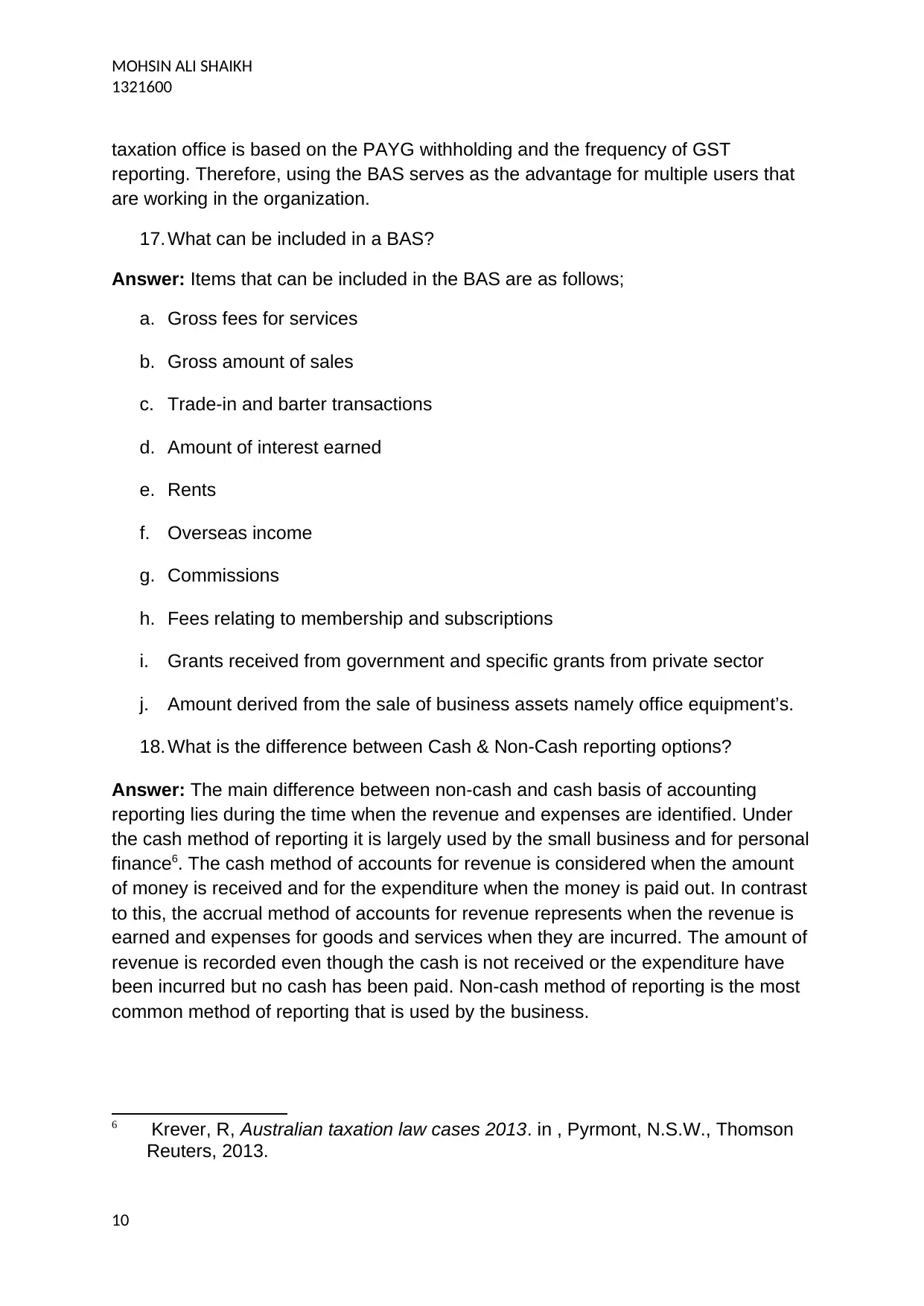
17. What can be included in a BAS?
Answer: Items that can be included in the BAS are as follows;
a. Gross fees for services
b. Gross amount of sales
c. Trade-in and barter transactions
d. Amount of interest earned
e. Rents
f. Overseas income
g. Commissions
h. Fees relating to membership and subscriptions
i. Grants received from government and specific grants from private sector
j. Amount derived from the sale of business assets namely office equipment’s.
18. What is the difference between Cash & Non-Cash reporting options?
Answer: The main difference between non-cash and cash basis of accounting
reporting lies during the time when the revenue and expenses are identified. Under
the cash method of reporting it is largely used by the small business and for personal
finance6. The cash method of accounts for revenue is considered when the amount
of money is received and for the expenditure when the money is paid out. In contrast
to this, the accrual method of accounts for revenue represents when the revenue is
earned and expenses for goods and services when they are incurred. The amount of
revenue is recorded even though the cash is not received or the expenditure have
been incurred but no cash has been paid. Non-cash method of reporting is the most
common method of reporting that is used by the business.
6 Krever, R, Australian taxation law cases 2013. in , Pyrmont, N.S.W., Thomson
Reuters, 2013.
10
1321600
taxation office is based on the PAYG withholding and the frequency of GST
reporting. Therefore, using the BAS serves as the advantage for multiple users that
are working in the organization.
17. What can be included in a BAS?
Answer: Items that can be included in the BAS are as follows;
a. Gross fees for services
b. Gross amount of sales
c. Trade-in and barter transactions
d. Amount of interest earned
e. Rents
f. Overseas income
g. Commissions
h. Fees relating to membership and subscriptions
i. Grants received from government and specific grants from private sector
j. Amount derived from the sale of business assets namely office equipment’s.
18. What is the difference between Cash & Non-Cash reporting options?
Answer: The main difference between non-cash and cash basis of accounting
reporting lies during the time when the revenue and expenses are identified. Under
the cash method of reporting it is largely used by the small business and for personal
finance6. The cash method of accounts for revenue is considered when the amount
of money is received and for the expenditure when the money is paid out. In contrast
to this, the accrual method of accounts for revenue represents when the revenue is
earned and expenses for goods and services when they are incurred. The amount of
revenue is recorded even though the cash is not received or the expenditure have
been incurred but no cash has been paid. Non-cash method of reporting is the most
common method of reporting that is used by the business.
6 Krever, R, Australian taxation law cases 2013. in , Pyrmont, N.S.W., Thomson
Reuters, 2013.
10
Paraphrase This Document
Need a fresh take? Get an instant paraphrase of this document with our AI Paraphraser
MOHSIN ALI SHAIKH
1321600
ASSESSMENT 2: SKILLS ASSESSMENT
Task 1 – Financial Activity Reporting #1
A. Using the accounts following, complete the GST Worksheet for BAS. Complete
the BAS Statement (copy may be downloaded from the Australian Taxation Office at
https://www.ato.gov.au/uploadedFiles/Content/CAS/downloads/BUS25199Nat4189s.
pdf).
Trial balance
Trial balance
11
1321600
ASSESSMENT 2: SKILLS ASSESSMENT
Task 1 – Financial Activity Reporting #1
A. Using the accounts following, complete the GST Worksheet for BAS. Complete
the BAS Statement (copy may be downloaded from the Australian Taxation Office at
https://www.ato.gov.au/uploadedFiles/Content/CAS/downloads/BUS25199Nat4189s.
pdf).
Trial balance
Trial balance
11
MOHSIN ALI SHAIKH
1321600
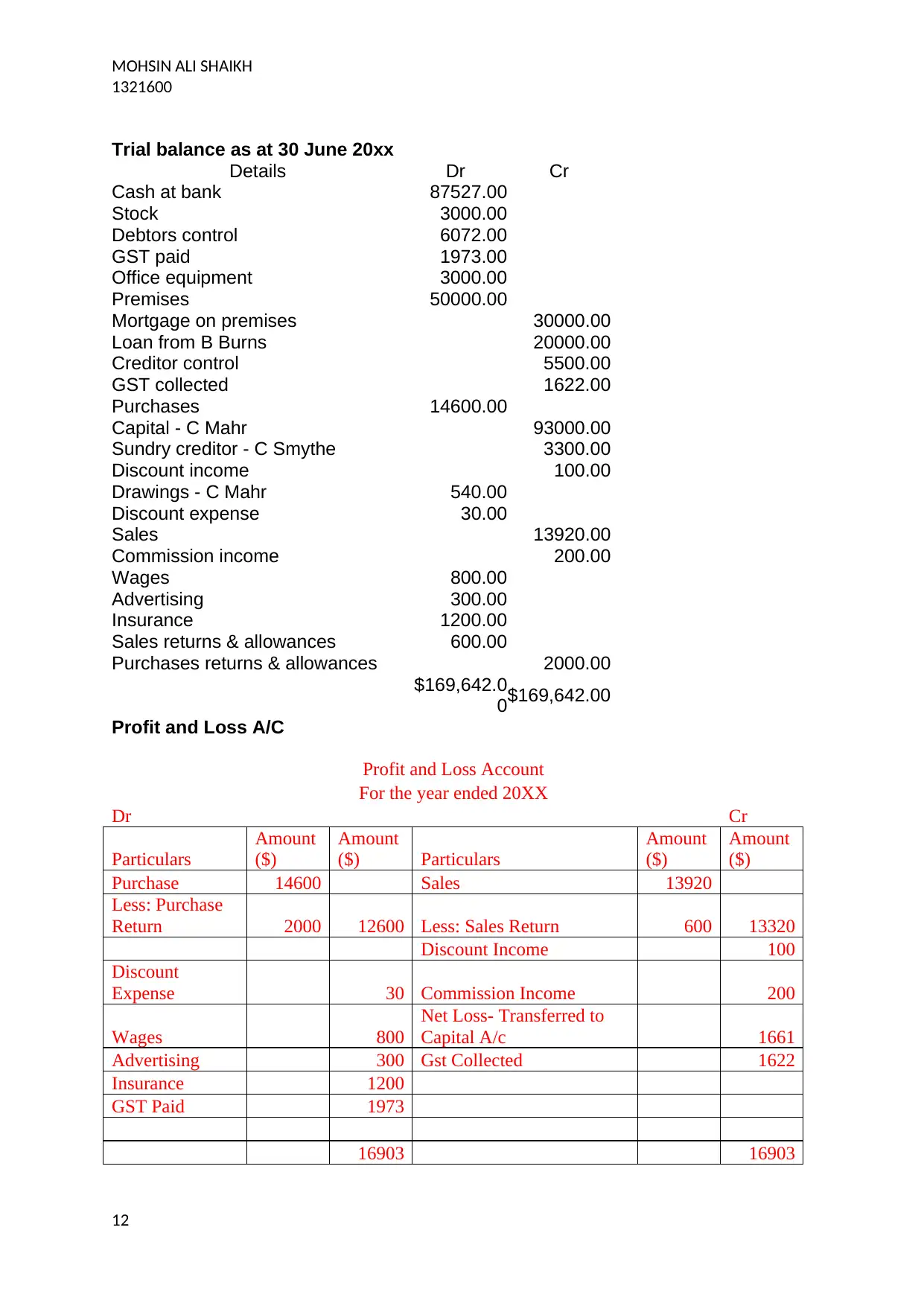
Trial balance as at 30 June 20xx
Details Dr Cr
Cash at bank 87527.00
Stock 3000.00
Debtors control 6072.00
GST paid 1973.00
Office equipment 3000.00
Premises 50000.00
Mortgage on premises 30000.00
Loan from B Burns 20000.00
Creditor control 5500.00
GST collected 1622.00
Purchases 14600.00
Capital - C Mahr 93000.00
Sundry creditor - C Smythe 3300.00
Discount income 100.00
Drawings - C Mahr 540.00
Discount expense 30.00
Sales 13920.00
Commission income 200.00
Wages 800.00
Advertising 300.00
Insurance 1200.00
Sales returns & allowances 600.00
Purchases returns & allowances 2000.00
$169,642.0
0$169,642.00
Profit and Loss A/C
Profit and Loss Account
For the year ended 20XX
Dr Cr
Particulars
Amount
($)
Amount
($) Particulars
Amount
($)
Amount
($)
Purchase 14600 Sales 13920
Less: Purchase
Return 2000 12600 Less: Sales Return 600 13320
Discount Income 100
Discount
Expense 30 Commission Income 200
Wages 800
Net Loss- Transferred to
Capital A/c 1661
Advertising 300 Gst Collected 1622
Insurance 1200
GST Paid 1973
16903 16903
12
1321600
Trial balance as at 30 June 20xx
Details Dr Cr
Cash at bank 87527.00
Stock 3000.00
Debtors control 6072.00
GST paid 1973.00
Office equipment 3000.00
Premises 50000.00
Mortgage on premises 30000.00
Loan from B Burns 20000.00
Creditor control 5500.00
GST collected 1622.00
Purchases 14600.00
Capital - C Mahr 93000.00
Sundry creditor - C Smythe 3300.00
Discount income 100.00
Drawings - C Mahr 540.00
Discount expense 30.00
Sales 13920.00
Commission income 200.00
Wages 800.00
Advertising 300.00
Insurance 1200.00
Sales returns & allowances 600.00
Purchases returns & allowances 2000.00
$169,642.0
0$169,642.00
Profit and Loss A/C
Profit and Loss Account
For the year ended 20XX
Dr Cr
Particulars
Amount
($)
Amount
($) Particulars
Amount
($)
Amount
($)
Purchase 14600 Sales 13920
Less: Purchase
Return 2000 12600 Less: Sales Return 600 13320
Discount Income 100
Discount
Expense 30 Commission Income 200
Wages 800
Net Loss- Transferred to
Capital A/c 1661
Advertising 300 Gst Collected 1622
Insurance 1200
GST Paid 1973
16903 16903
12
⊘ This is a preview!⊘
Do you want full access?
Subscribe today to unlock all pages.
Trusted by 1+ million students worldwide

1 out of 27


Related Documents


Your All-in-One AI-Powered Toolkit for Academic Success.
+13062052269
info@desklib.com
Available 24*7 on WhatsApp / Email
![[object Object]](/_next/static/media/star-bottom.7253800d.svg)
Unlock your academic potential
Copyright © 2020–2026 A2Z Services. All Rights Reserved. Developed and managed by ZUCOL.