Comparative Analysis of Boiling Points: 1-Hexanol and 2-Hexanone

Verified

Added on  2022/09/18

|3
|622
|39
Essay
AI Summary
This essay examines the boiling points of two organic molecules, 1-hexanol and 2-hexanone. The analysis begins by defining boiling point and its relationship to atmospheric pressure. A table compares the molecular formulas, weights, and boiling points of the two compounds, highlighting that 1-hexanol has a higher boiling point than 2-hexanone. The essay explains that the difference in boiling points is primarily due to intermolecular forces, specifically the presence of hydrogen bonds in 1-hexanol versus dispersion forces in 2-hexanone. Steric hindrance is also considered, though its impact is deemed less significant. The essay concludes that the stronger intermolecular forces in 1-hexanol result in its higher boiling point, requiring more energy to overcome the forces of attraction. The essay uses multiple references to support the analysis.
Document Page
In Chemistry, the term boiling point means that specific temperature at which the
pressure of the vapor and the external pressure atmosphere of a liquid is equivalent to each other.
It can also be said to be the specific temperature rate at which the external pressure surrounding
the solution or the liquid becomes similar to the liquid’s vapor (Britannica 1796). We can
therefore conclude that the atmospheric pressure in one way or another can determine the boiling
point. The two molecules in question are 2-hexanone and 1-hexanol. 1-hexanol is a six carbon
organic alcohol and 2-hexanole which is also known as methyl-butyl ketone and it is a volatile
compound with the molecular formula of C6H12O.
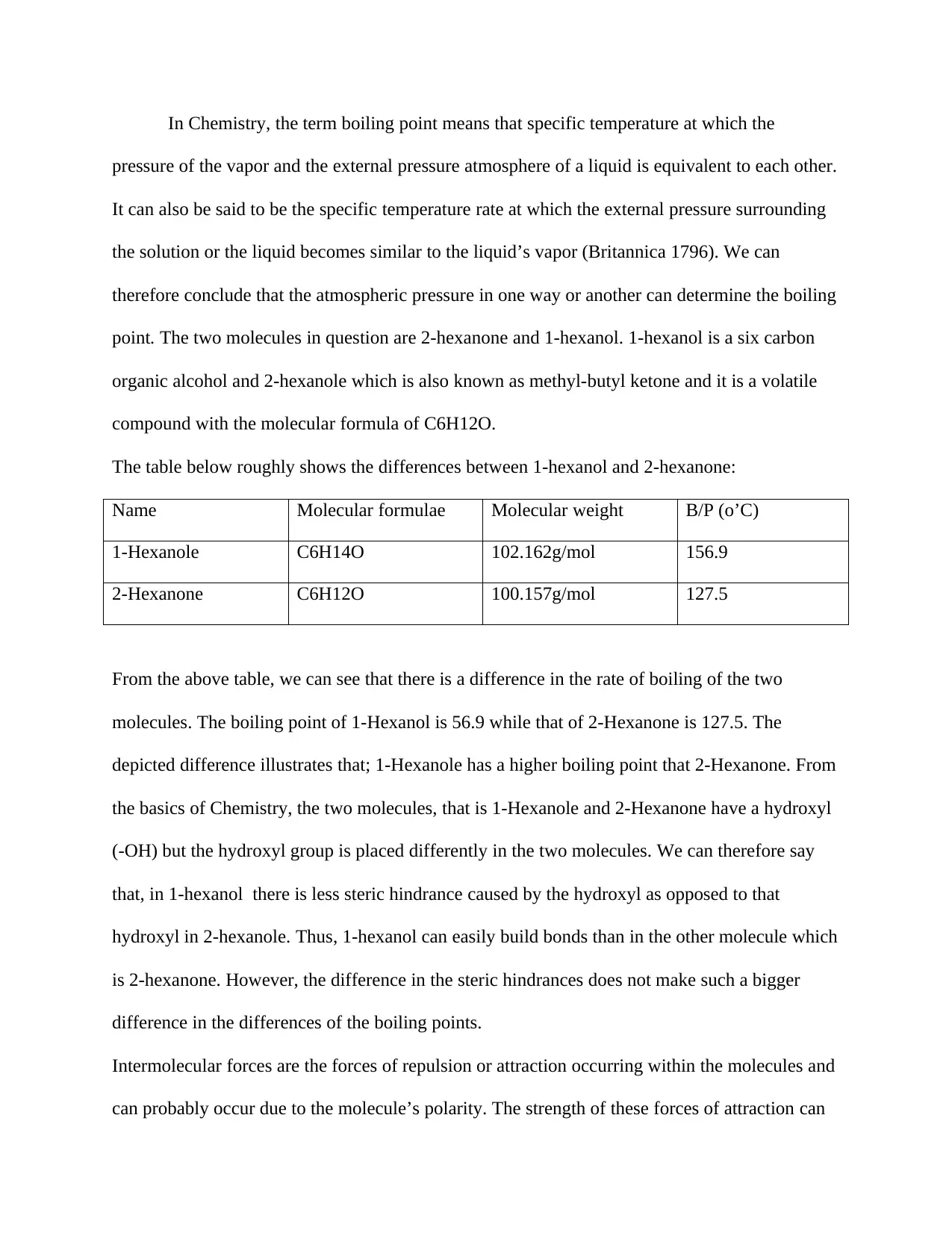
The table below roughly shows the differences between 1-hexanol and 2-hexanone:
Name Molecular formulae Molecular weight B/P (o’C)
1-Hexanole C6H14O 102.162g/mol 156.9
2-Hexanone C6H12O 100.157g/mol 127.5
From the above table, we can see that there is a difference in the rate of boiling of the two
molecules. The boiling point of 1-Hexanol is 56.9 while that of 2-Hexanone is 127.5. The
depicted difference illustrates that; 1-Hexanole has a higher boiling point that 2-Hexanone. From
the basics of Chemistry, the two molecules, that is 1-Hexanole and 2-Hexanone have a hydroxyl
(-OH) but the hydroxyl group is placed differently in the two molecules. We can therefore say
that, in 1-hexanol there is less steric hindrance caused by the hydroxyl as opposed to that
hydroxyl in 2-hexanole. Thus, 1-hexanol can easily build bonds than in the other molecule which
is 2-hexanone. However, the difference in the steric hindrances does not make such a bigger
difference in the differences of the boiling points.
Intermolecular forces are the forces of repulsion or attraction occurring within the molecules and
can probably occur due to the molecule’s polarity. The strength of these forces of attraction can
tabler-icon-diamond-filled.svg

Paraphrase This Document

Need a fresh take? Get an instant paraphrase of this document with our AI Paraphraser
Document Page
equally affect boiling point of the molecule. The relationship between the boiling point and these
forces of attraction is that incase these intermolecular forces tend to be stronger; more energy is
required to break the bonds of attraction thus the higher the boiling point. In our case study, 1-
Hexanol has the hydrogen bonds while 2-Hexanone has the forces of dispersion. Therefore, we
can conclude that the forces of attraction in 2-Hexanone are less strong compared to those in 1-
Hexanole thus the difference in the boiling points.
We can therefore conclude that, the difference in the rates boiling for the two molecules is
majorly caused by intermolecular forces of attraction as well as the bipolar factor.
References
Gooch, J. W. (2011). “Hexanol”. Encyclopedic Dictionary of Polymers, 366-368 doi:10.1007/978-1-4419-
8_5642
Document Page
Michael P. Garoutte. Ashley B. Mahoney (2012) Introductory Chemistry; “the term boiling point
means….similar to atmospheric pressure”. A Guided Inquiry PP. 102-107
Klein, N. R. Organic Chemistry. “Hydroxyl differences”2nd ed. (2013) pp.87-96
Gooch, J. W. (2014). Solution-Phase; “Organic Chemistry”. Computational Organic Chemistry, 445-530.
doi:10,1002/9781118671191.ch7
Gilbert, J. C. & Martin S. F. (Experimental Organic Chemistry. “(Comparison table of 1-
Hexanol and 2-Hexanone)” Boston, Mass.: Brooks/Cole Cengage Leraning, pp. 123-145
McMurray, J, 2014, Organic Chemistry; the intermolecular forces of attraction…, the more the
energy required”. 4st edition (, Brooks/Cole Thomson Learning Inc Belmont USA. Pp. 121-130
chevron_up_icon
1 out of 3
circle_padding
hide_on_mobile
zoom_out_icon
[object Object]