Contemporary Organization: Business Model of Heytesbury Holdings
VerifiedAdded on 2023/06/07
|13
|1894
|285
Essay
AI Summary
This essay provides an in-depth analysis of Heytesbury Holdings Limited, examining its business model and organizational structure through the lens of contemporary management theories. It begins by introducing Heytesbury Holdings and its operations, highlighting its focus on retail, franchising, and property management. The essay then delves into the company's business model, utilizing a business model canvas to outline key partners, activities, resources, value propositions, customer relationships, segments, channels, cost structure, and revenue streams. Furthermore, the essay explores relevant management theories, including scientific management theory and contingency theory, to interpret Heytesbury's organizational structure and operational techniques. It concludes that Heytesbury operates under a contemporary framework, integrating contingency and scientific management theories, and emphasizes the importance of communication and leadership in managing cultural differences within the organization. The essay also reflects on the strengths and deficiencies within the business model, suggesting areas for improvement. Desklib provides access to this assignment and many other resources for students.
UNDERSTANDING CONTEMPORARY ORGANIZATION
Paraphrase This Document
Need a fresh take? Get an instant paraphrase of this document with our AI Paraphraser

UNDERSTANDING CONTEMPORARY ORGANIZATION
Contents
Introduction:....................................................................................................................................3
Heytesbury Holdings Limited:........................................................................................................4
The business model of Heytesbury Holdings Limited:...................................................................5
Management models and theories:..................................................................................................7
Scientific Management Theory:..................................................................................................7
Contingency theory of Management:..........................................................................................8
The organisational structure of Heytesbury Holdings Limited:......................................................9
Conclusion:....................................................................................................................................10
Reference:......................................................................................................................................11
Page 2 of 13
Contents
Introduction:....................................................................................................................................3
Heytesbury Holdings Limited:........................................................................................................4
The business model of Heytesbury Holdings Limited:...................................................................5
Management models and theories:..................................................................................................7
Scientific Management Theory:..................................................................................................7
Contingency theory of Management:..........................................................................................8
The organisational structure of Heytesbury Holdings Limited:......................................................9
Conclusion:....................................................................................................................................10
Reference:......................................................................................................................................11
Page 2 of 13

UNDERSTANDING CONTEMPORARY ORGANIZATION
Introduction:
Creating Business models and personal interpretation of a certain organisational structure refers
to the use of different managerial interpretation and concepts. This has to be supported by an
explanation of proper reasoning and suggestion on the future of the organisational processing.
The motive of creating a business model canvas reflects the business position and environmental
analysis of a company. With reference to Heytesbury Holdings Limited, this paper has been
designed to address the prevailing business model of the company and the interpretation of the
structure by the learner. The culture of the company is going to settle on the significance of the
model and structure they are following with suggestive changes.
Page 3 of 13
Introduction:
Creating Business models and personal interpretation of a certain organisational structure refers
to the use of different managerial interpretation and concepts. This has to be supported by an
explanation of proper reasoning and suggestion on the future of the organisational processing.
The motive of creating a business model canvas reflects the business position and environmental
analysis of a company. With reference to Heytesbury Holdings Limited, this paper has been
designed to address the prevailing business model of the company and the interpretation of the
structure by the learner. The culture of the company is going to settle on the significance of the
model and structure they are following with suggestive changes.
Page 3 of 13
⊘ This is a preview!⊘
Do you want full access?
Subscribe today to unlock all pages.

Trusted by 1+ million students worldwide

UNDERSTANDING CONTEMPORARY ORGANIZATION
Heytesbury Holdings Limited:
Heytesbury Holdings limited has been a public sector holding in the list of Australian Stock
Exchange that mainly operates to integrate the activities with retail, franchising and management
portfolio of property. It mainly sells the houseware items and electrical goods. The most variable
part of their operations and business model is the structure of the organisation and differences of
each franchises operational techniques. Every store is found to be working differently that
predominantly prioritise style of management and culture.
Page 4 of 13
Heytesbury Holdings Limited:
Heytesbury Holdings limited has been a public sector holding in the list of Australian Stock
Exchange that mainly operates to integrate the activities with retail, franchising and management
portfolio of property. It mainly sells the houseware items and electrical goods. The most variable
part of their operations and business model is the structure of the organisation and differences of
each franchises operational techniques. Every store is found to be working differently that
predominantly prioritise style of management and culture.
Page 4 of 13
Paraphrase This Document
Need a fresh take? Get an instant paraphrase of this document with our AI Paraphraser

UNDERSTANDING CONTEMPORARY ORGANIZATION
The business model of Heytesbury Holdings Limited:
Key Partners: Key Activities: Value
Proposition:
Customer
Relations:
Customer
Segments:
Key Resources: Channels:
Costs: Revenue Streams:
Table 1: Business Model Canvas
(Source: Spiethet al. 2014)
Key Partners:
The key partners of the company are retail operations and franchises in Australia, New Zealand
and different countries of Europe.
Key activities:
The key activities of the company are integrated franchising, management portfolio of property
and retaining. The retail operations mainly focused on selling homewares, electrical goods and
computers (Joyce and Paquin, 2016).
Value proposition:
The value proposition offered by the company is multifaceted and integrated with the strength of
a retail portfolio of properties being combined with the franchising formula that seems unique.
Customer relationship& segment:
Customer relationship and segmentation focuses on the maximum turnover of the local
community as well as customers from Australia, New Zealand and different countries in Europe.
Page 5 of 13
The business model of Heytesbury Holdings Limited:
Key Partners: Key Activities: Value
Proposition:
Customer
Relations:
Customer
Segments:
Key Resources: Channels:
Costs: Revenue Streams:
Table 1: Business Model Canvas
(Source: Spiethet al. 2014)
Key Partners:
The key partners of the company are retail operations and franchises in Australia, New Zealand
and different countries of Europe.
Key activities:
The key activities of the company are integrated franchising, management portfolio of property
and retaining. The retail operations mainly focused on selling homewares, electrical goods and
computers (Joyce and Paquin, 2016).
Value proposition:
The value proposition offered by the company is multifaceted and integrated with the strength of
a retail portfolio of properties being combined with the franchising formula that seems unique.
Customer relationship& segment:
Customer relationship and segmentation focuses on the maximum turnover of the local
community as well as customers from Australia, New Zealand and different countries in Europe.
Page 5 of 13

UNDERSTANDING CONTEMPORARY ORGANIZATION
Key resource:
The key resources and mode of channels that are valuing the proposition is mainly television and
print media. The strength of the company is the number of franchised and owned outlets
consisting of 174 and 41 respectively. The head office consists of 470 employees, retail outlets
have 2,000 employees, and the franchise details have more than 12,000 people working (Hill,
2017).
Distribution channel:
Distribution channel refers to the unique franchising formula adopted by the company in order to
address customer requirements and considering extending the franchising model to overseas as
well as the online platform.
Cost structure:
The cost structure of the company refers to the financial transactions that the strength of the
company is the number of franchised and owned outlets consisting of 174 and 41 respectively.
The head office consists of 470 employees, retail outlets have 2,000 employees, and the
franchise details have more than 12,000 people working.
Revenue stream:
Comprises an annual sales revenue from the franchises as 3.96 billion dollars and from the
owned details with a sales revenue of 1.48 billion dollars. There has been an increase in the
annual sales revenue for 11% every year since 2000.
Page 6 of 13
Key resource:
The key resources and mode of channels that are valuing the proposition is mainly television and
print media. The strength of the company is the number of franchised and owned outlets
consisting of 174 and 41 respectively. The head office consists of 470 employees, retail outlets
have 2,000 employees, and the franchise details have more than 12,000 people working (Hill,
2017).
Distribution channel:
Distribution channel refers to the unique franchising formula adopted by the company in order to
address customer requirements and considering extending the franchising model to overseas as
well as the online platform.
Cost structure:
The cost structure of the company refers to the financial transactions that the strength of the
company is the number of franchised and owned outlets consisting of 174 and 41 respectively.
The head office consists of 470 employees, retail outlets have 2,000 employees, and the
franchise details have more than 12,000 people working.
Revenue stream:
Comprises an annual sales revenue from the franchises as 3.96 billion dollars and from the
owned details with a sales revenue of 1.48 billion dollars. There has been an increase in the
annual sales revenue for 11% every year since 2000.
Page 6 of 13
⊘ This is a preview!⊘
Do you want full access?
Subscribe today to unlock all pages.

Trusted by 1+ million students worldwide

UNDERSTANDING CONTEMPORARY ORGANIZATION
Management models and theories:
Scientific Management Theory:
The relevant Management Theory that can be perceived in the case of Heytesbury is the
scientific management theory by Frederick Taylor (Taylor, 2004). The motive of this theory is to
highlight the propositionstated by a tailor that optimises and simplifying the job to increase the
productivity of the organisation. The idea of management was improved with the implementation
of cooperation of the workers with one another. The most significant parameters that were
considered by Taylor was time and motion.
The four principles of scientific management as stated by Taylor or as follows:
Replacing the working formula of the rule of thumb and simplifying the practices
with common sense is to utilise the method scientifically proven to study
determination and efficiency of an individual that he puts in work to perform a
specified task.
It is better to match the perfect workers with their appropriate jobs rather than simply
assigning a worker with available tasks. According to Kumar (2015), this will
maintain the motivational level, and the Walker will be capable of producing
maximum efficiency.
It is important to monitor the performance of a worker and provide effective
instructions that will supervise the efficient ways of producing a piece of work.
Formation of the team and allocating the job amongst workers and managers can be
efficient to allow team is working and time management that requires a high level of
cooperation and efficiency (Bovée and Thill, 2011).
Page 7 of 13
Management models and theories:
Scientific Management Theory:
The relevant Management Theory that can be perceived in the case of Heytesbury is the
scientific management theory by Frederick Taylor (Taylor, 2004). The motive of this theory is to
highlight the propositionstated by a tailor that optimises and simplifying the job to increase the
productivity of the organisation. The idea of management was improved with the implementation
of cooperation of the workers with one another. The most significant parameters that were
considered by Taylor was time and motion.
The four principles of scientific management as stated by Taylor or as follows:
Replacing the working formula of the rule of thumb and simplifying the practices
with common sense is to utilise the method scientifically proven to study
determination and efficiency of an individual that he puts in work to perform a
specified task.
It is better to match the perfect workers with their appropriate jobs rather than simply
assigning a worker with available tasks. According to Kumar (2015), this will
maintain the motivational level, and the Walker will be capable of producing
maximum efficiency.
It is important to monitor the performance of a worker and provide effective
instructions that will supervise the efficient ways of producing a piece of work.
Formation of the team and allocating the job amongst workers and managers can be
efficient to allow team is working and time management that requires a high level of
cooperation and efficiency (Bovée and Thill, 2011).
Page 7 of 13
Paraphrase This Document
Need a fresh take? Get an instant paraphrase of this document with our AI Paraphraser

UNDERSTANDING CONTEMPORARY ORGANIZATION
Considering the case study of Heytesbury Holdings Limited, the unique franchising formula of
their business model considers the scientific management theory that differs from their
operational activities from stores to stores. Interpreting with the business model of the
organisation, analysis of the organisational structure seems to be variant rather than working
under the same unit.
Contingency theory of Management:
Contingency theory is one of the major parts of the behavioural theory which says that a single
theory can not be the key to success for all the organisation because every organisation has a
different model and different structure. As opined by Alvesson and Sandberg (2013), every
organisation has their own strategy to develop their business. Joan Woodward explained that the
technology is one of the major parts of the company which determines the development or the
progress of the company. The technology helps the company to develop a strategy and set new
rules which help to enhance the operational efficiency of the company. According to Kieseret al.
(2015), contingency theory helps the leader of the organisation to identify their own model to
build the business. This helps the leader to understand the technology of the company and thus
develop the strategy to develop the technology. There are few contingencies which the company
should follow:
1. Technology
2. Distributors and suppliers
3. An interest group of consumers
4. Competitors and customers
5. Government
6. Unions
Page 8 of 13
Considering the case study of Heytesbury Holdings Limited, the unique franchising formula of
their business model considers the scientific management theory that differs from their
operational activities from stores to stores. Interpreting with the business model of the
organisation, analysis of the organisational structure seems to be variant rather than working
under the same unit.
Contingency theory of Management:
Contingency theory is one of the major parts of the behavioural theory which says that a single
theory can not be the key to success for all the organisation because every organisation has a
different model and different structure. As opined by Alvesson and Sandberg (2013), every
organisation has their own strategy to develop their business. Joan Woodward explained that the
technology is one of the major parts of the company which determines the development or the
progress of the company. The technology helps the company to develop a strategy and set new
rules which help to enhance the operational efficiency of the company. According to Kieseret al.
(2015), contingency theory helps the leader of the organisation to identify their own model to
build the business. This helps the leader to understand the technology of the company and thus
develop the strategy to develop the technology. There are few contingencies which the company
should follow:
1. Technology
2. Distributors and suppliers
3. An interest group of consumers
4. Competitors and customers
5. Government
6. Unions
Page 8 of 13

UNDERSTANDING CONTEMPORARY ORGANIZATION
Gareth Morgan explains the main factors of the contingency theory that all the organisations are
important and it needs a sensitive touch ethic can develop the entire system. A proper
organisation values will balance the external and internal factors. Every organisation has their
own to do the work, and that organisation needs appropriate leadership and task. According to
Bovée and Thill (2012), the management of the organisation should have very much cared for
their tasks and goals.
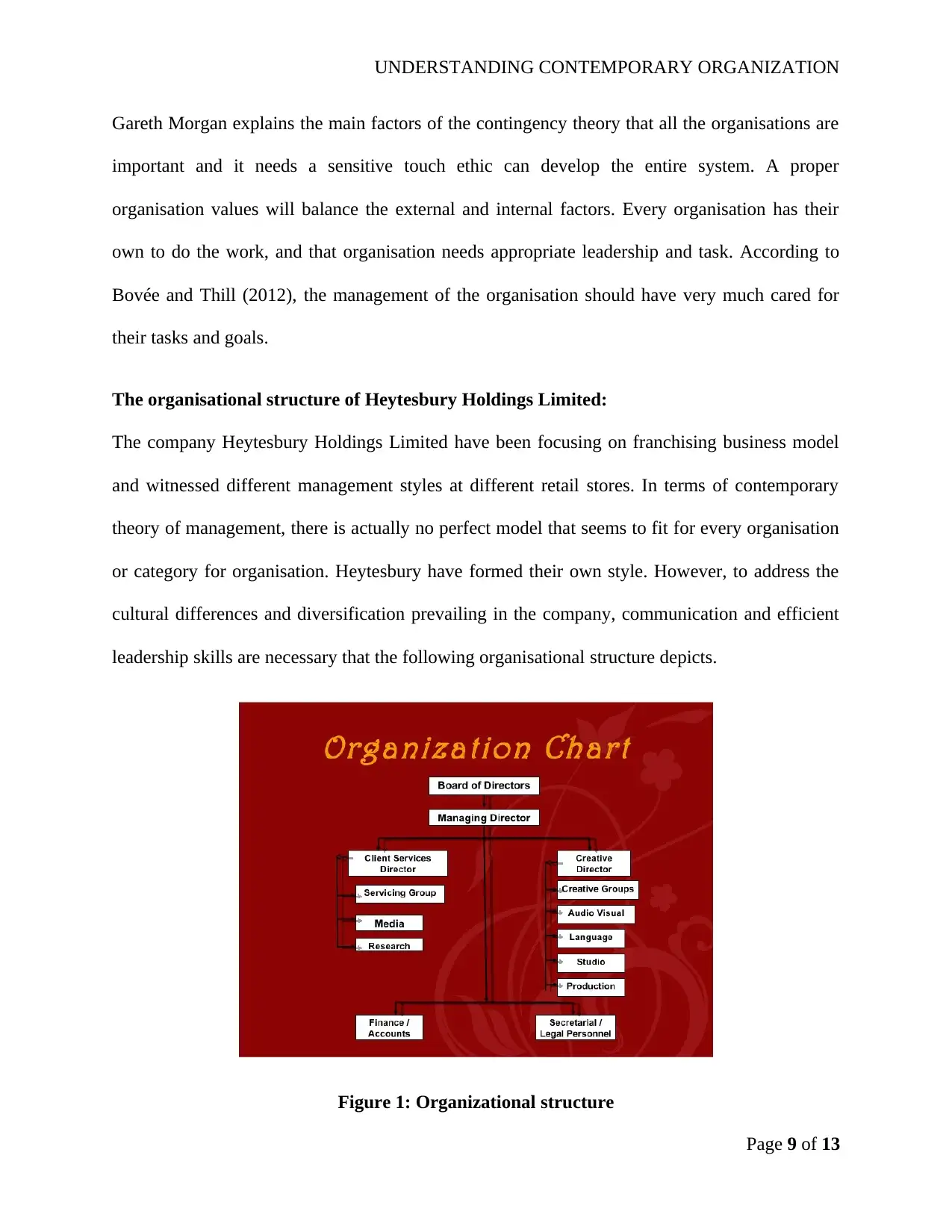
The organisational structure of Heytesbury Holdings Limited:
The company Heytesbury Holdings Limited have been focusing on franchising business model
and witnessed different management styles at different retail stores. In terms of contemporary
theory of management, there is actually no perfect model that seems to fit for every organisation
or category for organisation. Heytesbury have formed their own style. However, to address the
cultural differences and diversification prevailing in the company, communication and efficient
leadership skills are necessary that the following organisational structure depicts.
Figure 1: Organizational structure
Page 9 of 13
Gareth Morgan explains the main factors of the contingency theory that all the organisations are
important and it needs a sensitive touch ethic can develop the entire system. A proper
organisation values will balance the external and internal factors. Every organisation has their
own to do the work, and that organisation needs appropriate leadership and task. According to
Bovée and Thill (2012), the management of the organisation should have very much cared for
their tasks and goals.
The organisational structure of Heytesbury Holdings Limited:
The company Heytesbury Holdings Limited have been focusing on franchising business model
and witnessed different management styles at different retail stores. In terms of contemporary
theory of management, there is actually no perfect model that seems to fit for every organisation
or category for organisation. Heytesbury have formed their own style. However, to address the
cultural differences and diversification prevailing in the company, communication and efficient
leadership skills are necessary that the following organisational structure depicts.
Figure 1: Organizational structure
Page 9 of 13
⊘ This is a preview!⊘
Do you want full access?
Subscribe today to unlock all pages.

Trusted by 1+ million students worldwide

UNDERSTANDING CONTEMPORARY ORGANIZATION
(Source: Parkay et al. 2014)
Page 10 of 13
(Source: Parkay et al. 2014)
Page 10 of 13
Paraphrase This Document
Need a fresh take? Get an instant paraphrase of this document with our AI Paraphraser

UNDERSTANDING CONTEMPORARY ORGANIZATION
Conclusion:
Analysing the different theories and business model of contemporary organisations like
Heytesbury, it can be concluded that the organisation falls under the contemporary category that
follows contingency theory and scientific management theories to operate their business and
organisational structure. The business model canvas created for the organisation had been
reflecting the basic and company substances with which the company is made of and therefore,
the essentials of the model reflects the operational efficiency and deficiency that needs to be
looked upon. The purpose of the paper was to discuss the business model and interpret it with
management theories that have been done along with a representation of the organisational
structure.
Page 11 of 13
Conclusion:
Analysing the different theories and business model of contemporary organisations like
Heytesbury, it can be concluded that the organisation falls under the contemporary category that
follows contingency theory and scientific management theories to operate their business and
organisational structure. The business model canvas created for the organisation had been
reflecting the basic and company substances with which the company is made of and therefore,
the essentials of the model reflects the operational efficiency and deficiency that needs to be
looked upon. The purpose of the paper was to discuss the business model and interpret it with
management theories that have been done along with a representation of the organisational
structure.
Page 11 of 13

UNDERSTANDING CONTEMPORARY ORGANIZATION
Reference:
Alvesson, M. and Sandberg, J., 2013. Has management studies lost its way? Ideas for more
imaginative and innovative research. Journal of Management Studies, 50(1), pp.128-152.
Bovée, C.L. and Thill, J.V., 2011. Business in Action: With Real-time Updates. London: Prentice
Hall.
Bovee, C.L. and Thill, J.V., 2012. Excellence in business communication. London: Pearson
Higher Ed.
Hill, T., 2017. Manufacturing strategy: the strategic management of the manufacturing function.
London: Macmillan International Higher Education.
Joyce, A. and Paquin, R.L., 2016. The triple-layered business model canvas: A tool to design
more sustainable business models. Journal of Cleaner Production, 135, pp.1474-1486.
Kieser, A., Nicolai, A. and Seidl, D., 2015. The practical relevance of management research:
Turning the debate on relevance into a rigorous scientific research program. The Academy of
Management Annals, 9(1), pp.143-233.
Kumar, V., 2015. Evolution of marketing as a discipline: What has happened and what to look
out for. Journal of Marketing, 79(1), pp.1-9.
Spieth, P., Schneckenberg, D. and Ricart, J.E., 2014. Business model innovation–state of the art
and future challenges for the field. R&d Management, 44(3), pp.237-247.
Taylor, F.W., 2004. Scientific management. Abington: Routledge.
Page 12 of 13
Reference:
Alvesson, M. and Sandberg, J., 2013. Has management studies lost its way? Ideas for more
imaginative and innovative research. Journal of Management Studies, 50(1), pp.128-152.
Bovée, C.L. and Thill, J.V., 2011. Business in Action: With Real-time Updates. London: Prentice
Hall.
Bovee, C.L. and Thill, J.V., 2012. Excellence in business communication. London: Pearson
Higher Ed.
Hill, T., 2017. Manufacturing strategy: the strategic management of the manufacturing function.
London: Macmillan International Higher Education.
Joyce, A. and Paquin, R.L., 2016. The triple-layered business model canvas: A tool to design
more sustainable business models. Journal of Cleaner Production, 135, pp.1474-1486.
Kieser, A., Nicolai, A. and Seidl, D., 2015. The practical relevance of management research:
Turning the debate on relevance into a rigorous scientific research program. The Academy of
Management Annals, 9(1), pp.143-233.
Kumar, V., 2015. Evolution of marketing as a discipline: What has happened and what to look
out for. Journal of Marketing, 79(1), pp.1-9.
Spieth, P., Schneckenberg, D. and Ricart, J.E., 2014. Business model innovation–state of the art
and future challenges for the field. R&d Management, 44(3), pp.237-247.
Taylor, F.W., 2004. Scientific management. Abington: Routledge.
Page 12 of 13
⊘ This is a preview!⊘
Do you want full access?
Subscribe today to unlock all pages.

Trusted by 1+ million students worldwide
1 out of 13
Related Documents
Your All-in-One AI-Powered Toolkit for Academic Success.
+13062052269
info@desklib.com
Available 24*7 on WhatsApp / Email
Unlock your academic potential
Copyright © 2020–2025 A2Z Services. All Rights Reserved. Developed and managed by ZUCOL.