HI6005: Exploring the Paradigm Shift in Management Theories Today

Verified

Added on  2023/06/04

|12
|1259
|375
Report
AI Summary
This report explores the paradigm shift in management theories, tracing the evolution from the scientific management era to the modern humanistic approach. It highlights the limitations of early theories that focused solely on production and efficiency, neglecting the psychological and social needs of employees. The shift was driven by research questions raised by management leaders and researchers, leading to an increased emphasis on employee motivation, satisfaction, and overall well-being. The report references key figures like Maslow and Mary Parker Follet, whose work underscored the importance of human psychology in the workplace, ultimately shaping contemporary management practices. Modern management theories now prioritize employee engagement and happiness as vital factors in enhancing organizational efficiency and productivity. The analysis includes contributions and limitations of quantitative management, the transition to human relations, and the impact of behavioral science on management practices.
Document Page
Management theories –
Management Yesterday &
Today
Aim- To Study the Paradigm shift in management theories &
the key reasons that led to the shift
tabler-icon-diamond-filled.svg

Paraphrase This Document

Need a fresh take? Get an instant paraphrase of this document with our AI Paraphraser
Document Page
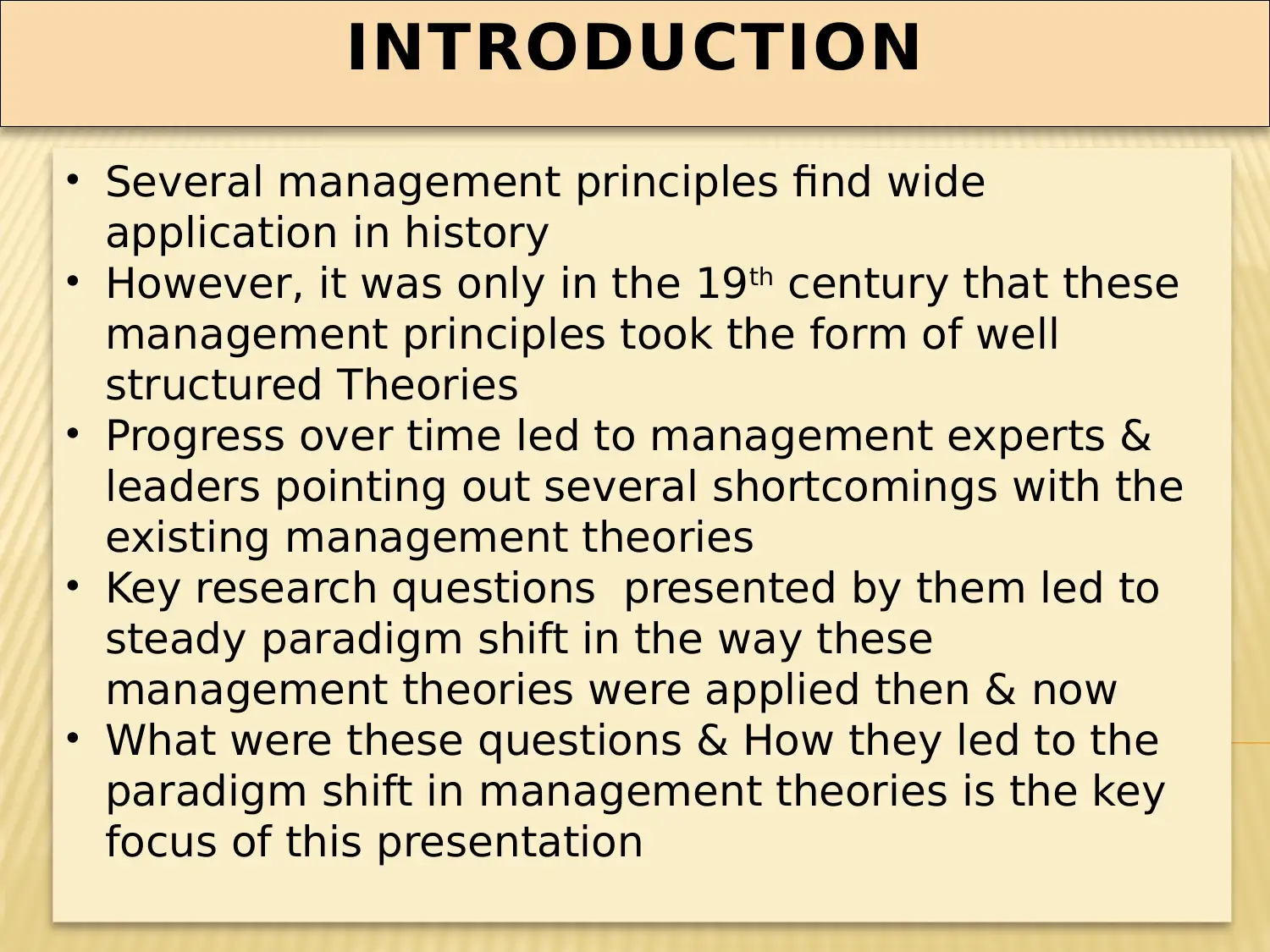
INTRODUCTION
Several management principles find wide
application in history
However, it was only in the 19th century that these
management principles took the form of well
structured Theories
Progress over time led to management experts &
leaders pointing out several shortcomings with the
existing management theories
Key research questions presented by them led to
steady paradigm shift in the way these
management theories were applied then & now
What were these questions & How they led to the
paradigm shift in management theories is the key
focus of this presentation
Document Page
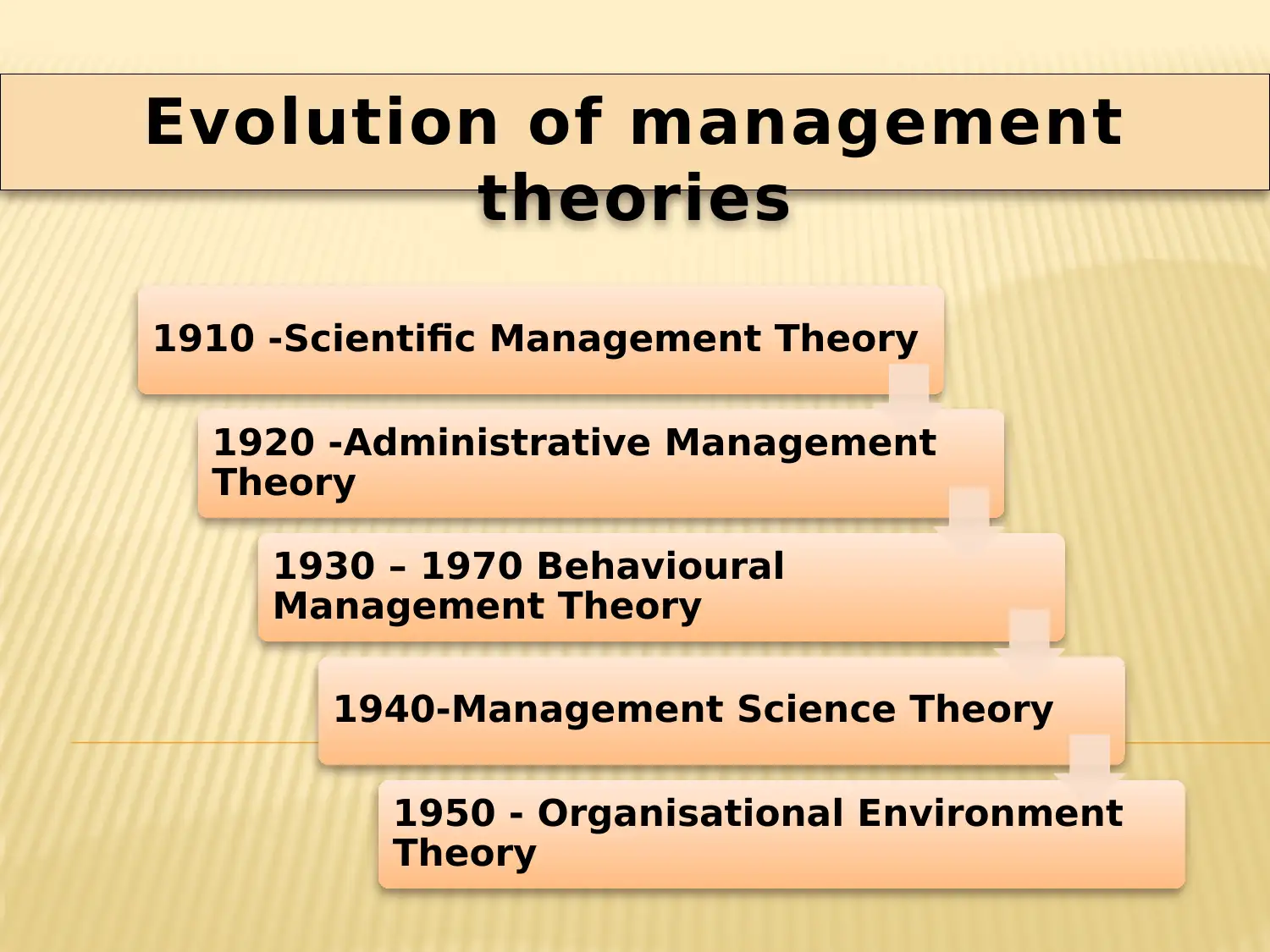
Evolution of management
theories
1910 -Scientific Management Theory
1920 -Administrative Management
Theory
1930 – 1970 Behavioural
Management Theory
1940-Management Science Theory
1950 - Organisational Environment
Theory
Document Page
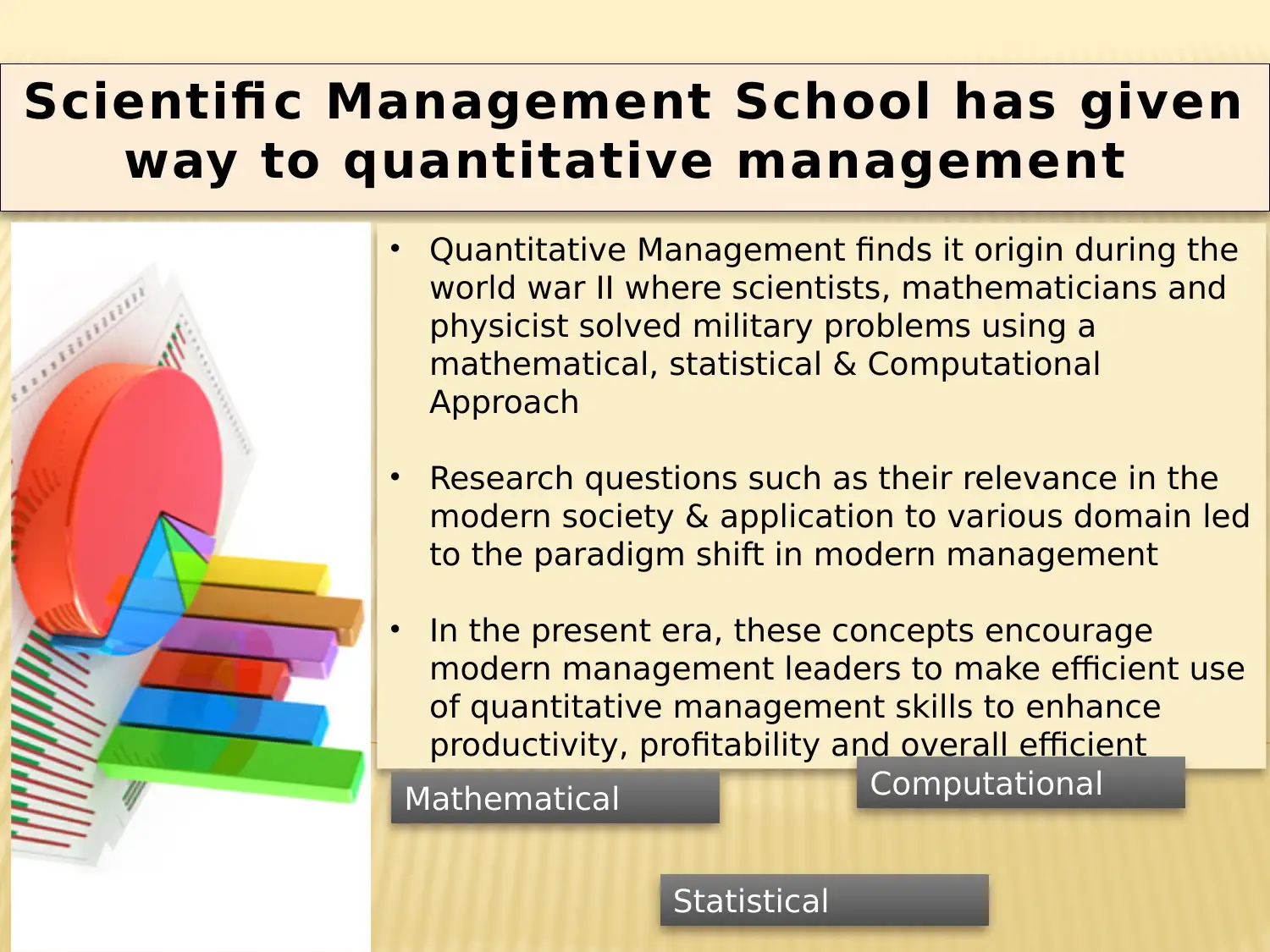
Scientifi c Management School has given
way to quantitative management
Quantitative Management finds it origin during the
world war II where scientists, mathematicians and
physicist solved military problems using a
mathematical, statistical & Computational
Approach
Research questions such as their relevance in the
modern society & application to various domain led
to the paradigm shift in modern management
In the present era, these concepts encourage
modern management leaders to make efficient use
of quantitative management skills to enhance
productivity, profitability and overall efficient
Mathematical Computational
Statistical
tabler-icon-diamond-filled.svg

Paraphrase This Document

Need a fresh take? Get an instant paraphrase of this document with our AI Paraphraser
Document Page
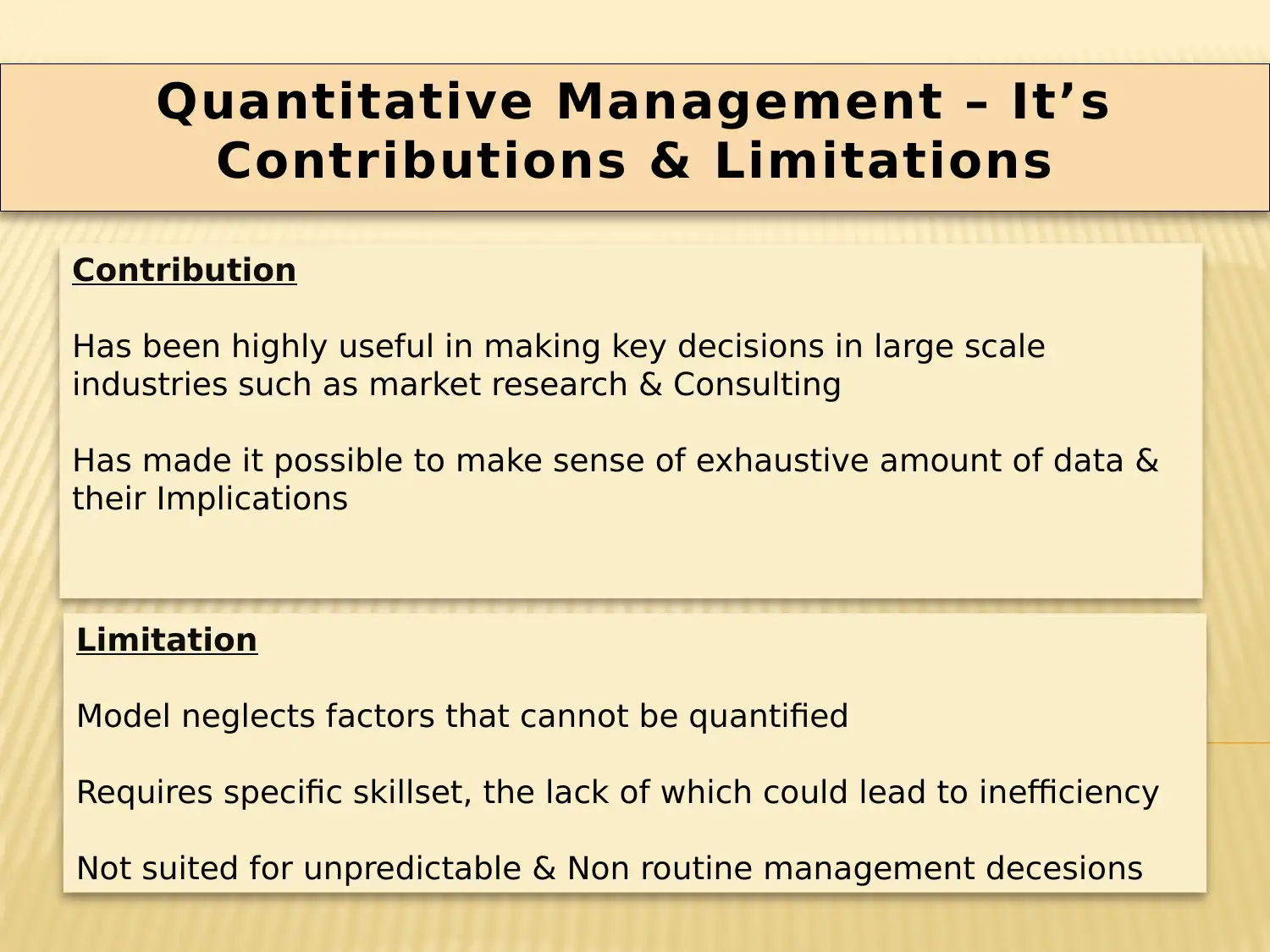
Quantitative Management – It’s
Contributions & Limitations
Contribution
Has been highly useful in making key decisions in large scale
industries such as market research & Consulting
Has made it possible to make sense of exhaustive amount of data &
their Implications
Limitation
Model neglects factors that cannot be quantified
Requires specific skillset, the lack of which could lead to inefficiency
Not suited for unpredictable & Non routine management decesions
Document Page
Scientifi c Management Schools has given way
to Human Relations School of Management
Conventional management school did not
usually consider the human aspect of workers
in an organizational setup
The scientific approach was found to be
highly ineffective in organizations which
heavily relied on humans for their daily
operations
This led to research questions regarding the
psychological & social needs of employees at
workplace
Ultimately leading to the paradigm shift in
meeting their psychological demands .
Document Page
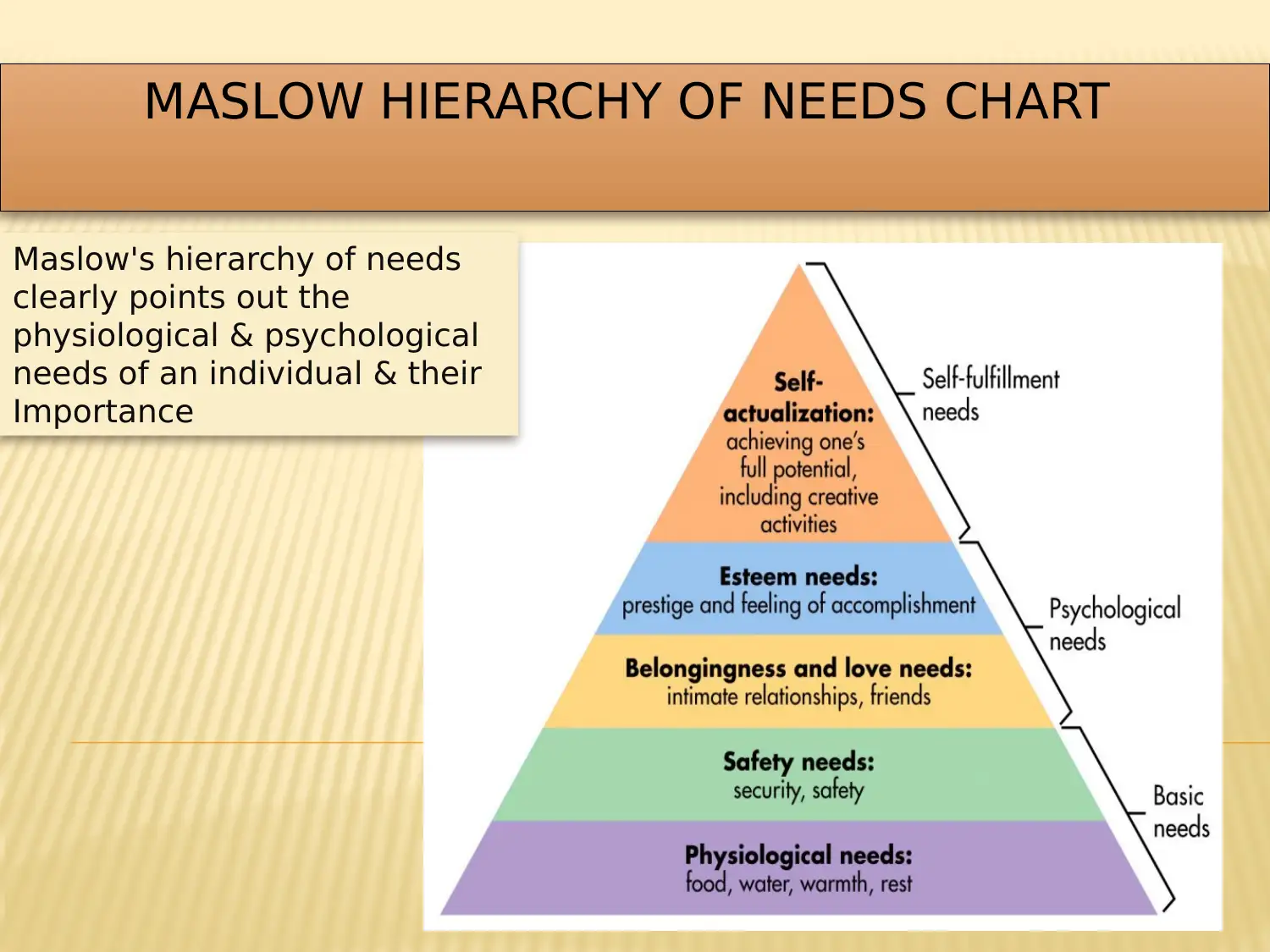
MASLOW HIERARCHY OF NEEDS CHART
Maslow's hierarchy of needs
clearly points out the
physiological & psychological
needs of an individual & their
Importance
tabler-icon-diamond-filled.svg

Paraphrase This Document

Need a fresh take? Get an instant paraphrase of this document with our AI Paraphraser
Document Page
Human Relation school of management
has given way to behavioral Science
School of Management
Conventional Scientific management was heavily
production oriented
Efforts of management leaders like Mary Parker
Follet questioned the lack of human psychology &
behavioural aspect in the conventional theories
This led to a paradigm shift in the late 19th
century with several management practises
focused on aspects like employee motivation &
Satisfaction at workplace .
Since then management theories give vital
importance to humanistic behaviour and actions
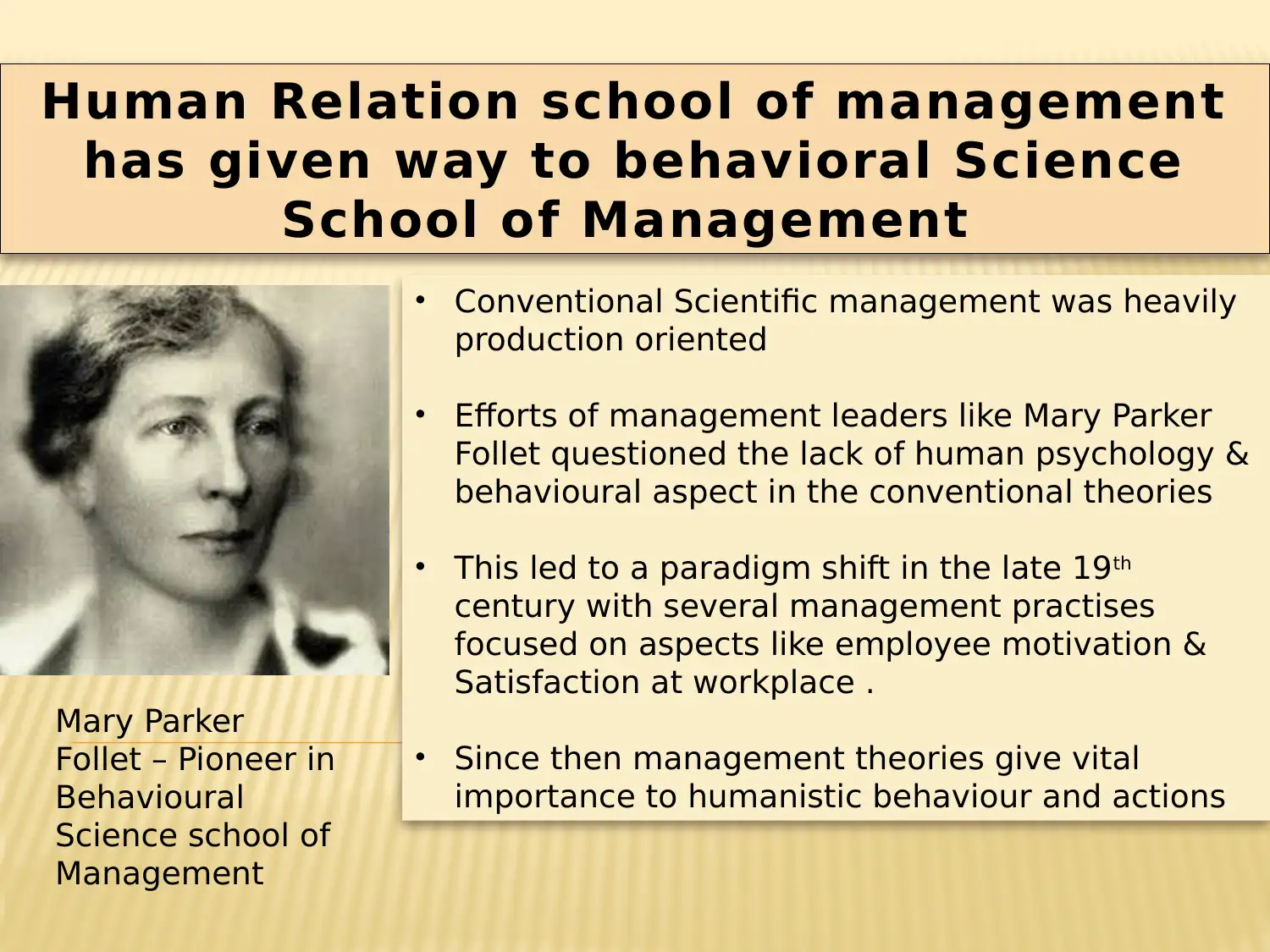
Mary Parker
Follet – Pioneer in
Behavioural
Science school of
Management
Document Page
CONCLUSION
Scientific Management Theories have
projected a paradigm shift in the last 100
years
Conventional management thoughts were
more production & Efficiency oriented, thus
lacking humanistic approach in their
application
Taylor’s work time theory, weber’s
hierarchy theory were widely prevalent in
classical management
Efforts made by leaders & researchers like
Maslow & Mary Follet questioned the
shortcomings and lack of humanistic
approach in traditional management
Document Page
CONCLUSION
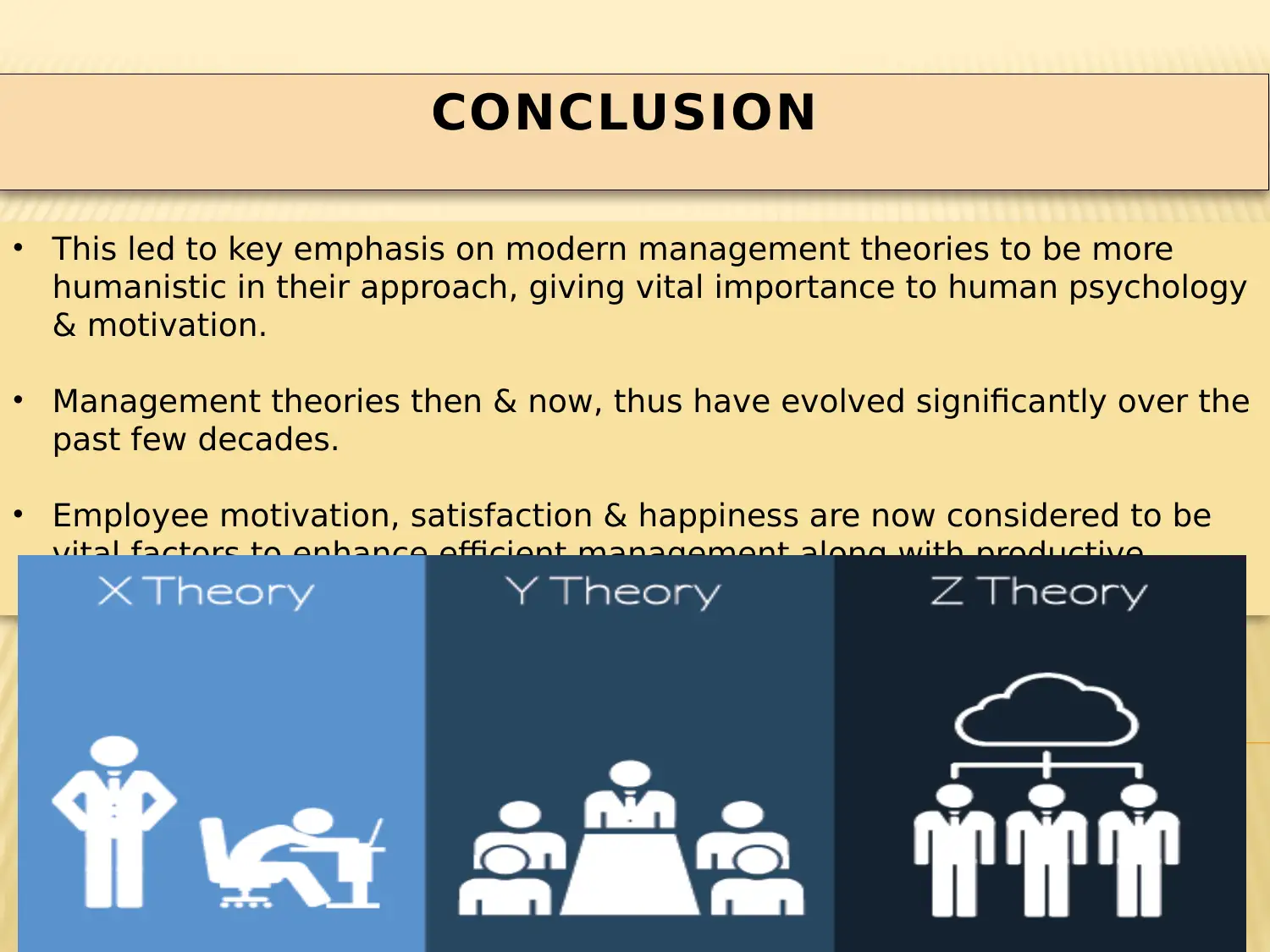
This led to key emphasis on modern management theories to be more
humanistic in their approach, giving vital importance to human psychology
& motivation.
Management theories then & now, thus have evolved significantly over the
past few decades.
Employee motivation, satisfaction & happiness are now considered to be
vital factors to enhance efficient management along with productive
output
tabler-icon-diamond-filled.svg

Paraphrase This Document

Need a fresh take? Get an instant paraphrase of this document with our AI Paraphraser
Document Page
Akpor-Robaro, M.O.M. and Erigbe, P.A., 2018. Evaluation Of The Application Of Traditional Western Management
Theories In Africa From A Survey Of Nigerian Organizations. Archives of Business Research, 6(7).
Barney, J.B., Dagnino, G.B., Della Corte, V. and Tsang, E.W., 2017. Management and Organization Review Special
Issue ‘Coopetition and Innovation in Transforming Economies’. Management and Organization Review, 13(1),
pp.201-204.
Bhagavatula, S., Mudambi, R. and Murmann, J.P., 2017. Management and organization review special issue ‘The
innovation and entrepreneurship ecosystem in India’. Management and Organization Review, 13(1), pp.209-212.
Daddi, T., Todaro, N.M., De Giacomo, M.R. and Frey, M., 2018. A Systematic Review of the Use of Organization
and Management Theories in Climate Change Studies. Business Strategy and the Environment, 27(4), pp.456-
474.
Dahlgaard-Park, S.M., Reyes, L. and Chen, C.K., 2018. The evolution and convergence of total quality
management and management theories. Total Quality Management & Business Excellence, pp.1-21.
Fleming, P. and Spicer, A., 2014. Power in management and organization science. The Academy of Management
Annals, 8(1), pp.237-298.
George, G., 2015. Expanding context to redefine theories: Africa in management research. Management and
Organization Review, 11(1), pp.5-10.
Huarng, K.H. and Ribeiro-Soriano, D.E., 2014. Developmental management: Theories, methods, and applications
in entrepreneurship, innovation, and sensemaking. Journal of Business Research, 67(5), pp.657-662.
Lindebaum, D., 2016. Critical essay: Building new management theories on sound data? The case of
neuroscience. human relations, 69(3), pp.537-550.
Plakoyiannaki, E., Wei, T., Hsu, C., Cassell, C. and Prashantham, S., 2017. Management and Organization Review
Special Issue ‘Doing Qualitative Research in Emerging Markets’. Management and Organization Review, 13(2),
pp.455-458.
REFERENCES
Document Page
REFERENCES
Schuler, R. and E. Jackson, S., 2014. Human resource management and
organizational effectiveness: yesterday and today. Journal of Organizational
Effectiveness: People and Performance, 1(1), pp.35-55.
Spina, G., Caniato, F., Luzzini, D. and Ronchi, S., 2016. Assessing the use of
external grand theories in purchasing and supply management
research. Journal of Purchasing and Supply Management, 22(1), pp.18-30.
Touboulic, A. and Walker, H., 2015. Theories in sustainable supply chain
management: a structured literature review. International Journal of
Physical Distribution & Logistics Management, 45(1/2), pp.16-42.
Tuczek, F., Castka, P. and Wakolbinger, T., 2018. A review of management
theories in the context of quality, environmental and social responsibility
voluntary standards. Journal of Cleaner Production, 176, pp.399-416.
Willingham, D.T., Hughes, E.M. and Dobolyi, D.G., 2015. The scientific
status of learning styles theories. Teaching of Psychology, 42(3), pp.266-
271.
chevron_up_icon
1 out of 12
circle_padding
hide_on_mobile
zoom_out_icon
[object Object]