HI6008 Business Research: Analyzing Technology's Role in Job Creation
VerifiedAdded on 2023/06/12
|15
|3168
|96
Report
AI Summary
This research proposal investigates the complex relationship between technology and job opportunities, addressing whether technology primarily creates new jobs or threatens existing ones. It outlines the project's objectives and scope, including a literature review that summarizes previous research, identifies gaps, and proposes hypotheses. The proposal details the research design and methodology, incorporating both qualitative and quantitative approaches, including data collection methods, sampling techniques, and data analysis processes. It also acknowledges research limitations and presents a time schedule for the project. The primary research question focuses on the overall relationship between technology and job opportunities, with secondary questions exploring the benefits and challenges of technology in job creation. The research aims to determine how companies can empower workers and how individuals can adapt to the changing needs of the industry.

Business Research
Proposal
0
2018
Relationship between Technology and Job Opportunities
Name of Student:
Proposal
0
2018
Relationship between Technology and Job Opportunities
Name of Student:

Paraphrase This Document
Need a fresh take? Get an instant paraphrase of this document with our AI Paraphraser
Relationship between Technology and Job opportunities 1
Table of Contents
Introduction...........................................................................................................................................2
Project Objective...................................................................................................................................2
Project Scope.........................................................................................................................................2
Literature Review..................................................................................................................................3
Research Question/ Hypothesis............................................................................................................5
Research design and Methodology.......................................................................................................5
Qualitative Research and Quantitative Research..............................................................................5
Quantitative research........................................................................................................................6
Research Limitation...............................................................................................................................8
Time schedule........................................................................................................................................8
Conclusion.............................................................................................................................................9
References...........................................................................................................................................10
Appendix.............................................................................................................................................12
Table of Contents
Introduction...........................................................................................................................................2
Project Objective...................................................................................................................................2
Project Scope.........................................................................................................................................2
Literature Review..................................................................................................................................3
Research Question/ Hypothesis............................................................................................................5
Research design and Methodology.......................................................................................................5
Qualitative Research and Quantitative Research..............................................................................5
Quantitative research........................................................................................................................6
Research Limitation...............................................................................................................................8
Time schedule........................................................................................................................................8
Conclusion.............................................................................................................................................9
References...........................................................................................................................................10
Appendix.............................................................................................................................................12
Relationship between Technology and Job opportunities 2
Introduction
Technology is reshaping the labour markets of the world. The 21st century is the witness of
the expansion of the technology and its increased usage which bought a change in the world
and its practices. According to Nubler (2016), technology is believed to create new jobs but
it also poses a threat to the future jobs for people. The new age of technology is changing
the fundamentals of future jobs. This research focuses on the relationship between
Technology and job opportunities. It will cover the effect of the increased usage of smart
devices and techniques on the creation of employment which is complex to determine.
Project Objective
The main purpose of the research paper is to identify the relationship between technology
and the future of job creation or the effect on the employment opportunities for people. It
is very important to determine this relationship as growing use of technology provides
employment to many people but on the other hand, also reduces the need of manual jobs
which makes people jobless. The paper will discuss about how a person can enhance his
own skills and knowledge to fit in the changing world of technology.
Project Scope
The scope of the research project is wide as more or less every organisation in different
industries uses technology and strives to improve their technologies just to fit in the
competitive environment. There is a considerable scope for the companies to shape their
employment policies and to align them with technologies so that the job creation can be
enhanced and do not make people unemployed. Nowadays, there is a growing scope of
technology implementation in the industries to address the competition at global level
(Vivarelli, 2015).
Introduction
Technology is reshaping the labour markets of the world. The 21st century is the witness of
the expansion of the technology and its increased usage which bought a change in the world
and its practices. According to Nubler (2016), technology is believed to create new jobs but
it also poses a threat to the future jobs for people. The new age of technology is changing
the fundamentals of future jobs. This research focuses on the relationship between
Technology and job opportunities. It will cover the effect of the increased usage of smart
devices and techniques on the creation of employment which is complex to determine.
Project Objective
The main purpose of the research paper is to identify the relationship between technology
and the future of job creation or the effect on the employment opportunities for people. It
is very important to determine this relationship as growing use of technology provides
employment to many people but on the other hand, also reduces the need of manual jobs
which makes people jobless. The paper will discuss about how a person can enhance his
own skills and knowledge to fit in the changing world of technology.
Project Scope
The scope of the research project is wide as more or less every organisation in different
industries uses technology and strives to improve their technologies just to fit in the
competitive environment. There is a considerable scope for the companies to shape their
employment policies and to align them with technologies so that the job creation can be
enhanced and do not make people unemployed. Nowadays, there is a growing scope of
technology implementation in the industries to address the competition at global level
(Vivarelli, 2015).
⊘ This is a preview!⊘
Do you want full access?
Subscribe today to unlock all pages.

Trusted by 1+ million students worldwide
Relationship between Technology and Job opportunities 3
Literature Review
According to the report prepared by World Bank Group (2015), technologies like advanced
robots, machine learning, computers and laptops, mobile networking, cloud computing and
big data and many more have seen a high growth in the past decade which has promised to
have social and economic impact in the coming years (Acemoglu and Restrepo, 2016). This
impact is mainly of employment of people as technology has created millions of jobs for
people in IT and digital sector. The emerging economies are benefitted from this shift as it
has employed millions of people and gave them a high standard of living. But there are also
the spill over effects of the same (Dubin, 2017). Technology has taken over the jobs of many
people who are not qualified and trained enough to deal with technology and were earning
their living through manual jobs (Matuzeviciute, Butkus and Karaliute, 2017).
In the opinion of West (2016), technologies like Robots, artificial intelligence, 3-D printing
and more is transforming the manual jobs into digital jobs. The industries and businesses
now need fewer workers to perform the basic tasks. The past decades have already seen the
transformation of blue collared jobs into white collared jobs. As per the report by World
Economic Forum (2016), overall if the impact is measured then it is assessed that the
outlook is positive towards technology. It increase job opportunities in many sectors and
also enhances the skills of the employees. It helps many companies in attracting talents
which are facing recruitment challenges. The government and industries should work
together to upscale the skills of the workers and to prepare them for the future technology
(Feldmann, 2013). It is also clear from the report that technology is not just the sole factor
for the change in employment but there are other factors too like demographic and socio
economic factors (changing work environment, geopolitical volatility, ethical issues, ageing
societies and more).
The rapid increase in the use of technology have a mixed impact on the workforce. In many
cases, it is observed that the adoption of technology have forced companies to downsize
their employees because they are no longer useful for the company and they creates extra
cost for the business (Aguilera and Barrera, 2016). For e.g. the driverless cars created by
Google has reduced the need of employing drivers. But it is not surprising that the
technological progress revamped the job creation and provided jobs to millions of people. It
Literature Review
According to the report prepared by World Bank Group (2015), technologies like advanced
robots, machine learning, computers and laptops, mobile networking, cloud computing and
big data and many more have seen a high growth in the past decade which has promised to
have social and economic impact in the coming years (Acemoglu and Restrepo, 2016). This
impact is mainly of employment of people as technology has created millions of jobs for
people in IT and digital sector. The emerging economies are benefitted from this shift as it
has employed millions of people and gave them a high standard of living. But there are also
the spill over effects of the same (Dubin, 2017). Technology has taken over the jobs of many
people who are not qualified and trained enough to deal with technology and were earning
their living through manual jobs (Matuzeviciute, Butkus and Karaliute, 2017).
In the opinion of West (2016), technologies like Robots, artificial intelligence, 3-D printing
and more is transforming the manual jobs into digital jobs. The industries and businesses
now need fewer workers to perform the basic tasks. The past decades have already seen the
transformation of blue collared jobs into white collared jobs. As per the report by World
Economic Forum (2016), overall if the impact is measured then it is assessed that the
outlook is positive towards technology. It increase job opportunities in many sectors and
also enhances the skills of the employees. It helps many companies in attracting talents
which are facing recruitment challenges. The government and industries should work
together to upscale the skills of the workers and to prepare them for the future technology
(Feldmann, 2013). It is also clear from the report that technology is not just the sole factor
for the change in employment but there are other factors too like demographic and socio
economic factors (changing work environment, geopolitical volatility, ethical issues, ageing
societies and more).
The rapid increase in the use of technology have a mixed impact on the workforce. In many
cases, it is observed that the adoption of technology have forced companies to downsize
their employees because they are no longer useful for the company and they creates extra
cost for the business (Aguilera and Barrera, 2016). For e.g. the driverless cars created by
Google has reduced the need of employing drivers. But it is not surprising that the
technological progress revamped the job creation and provided jobs to millions of people. It
Paraphrase This Document
Need a fresh take? Get an instant paraphrase of this document with our AI Paraphraser
Relationship between Technology and Job opportunities 4
provides lifetime learning to the employees and helps them in retaining their jobs. The
success of driverless cars impressed the manufacturers like general Motors and Audi to
create cars which gives better mileage and lesser accidents. The workforce which is
employed for creating the driverless cars got the job and provided them better pay and
lifestyle (West, 2016). One more example of negative impact of technology on employment
can be determine from the example of Google. The company is worth $3700 billion but
employs only 55000 employees because it runs with technology but on the other hand,
AT&T employs 10 times more the employees than Google do (Johnston and Marshall,
2016).
People have to upscale themselves in order to face the challenges of the digital industry and
to learn how to work hand in hand with technology for which government can run training
programs in collaboration with the industrialists (Aydalot and Keeble, 2018). It will also
assist people in choosing the right job opportunity for themselves. The workforce need to
be empowered. Human capital development will bridge the gap and will help in protecting
the employees during the transition period and in the future (Marchant, Stevens and
Hennessy, 2014).
Justification for Research problem
The growing usage of technology in industries have increased the job opportunities for
people in the digital field and IT sector. The use of digital tools and the shift of global
business on digital platform benefits the employees to take advantage of the available
opportunities. It enhances the skills of employees and reduces the risks of unemployment
and job loss. Technology is therefore changing its relationship with employment (David,
2015).
Literature Gap
By going through the literature review of the topic ‘Relationship between Technology and
Job opportunities’, it can be observed that technology is both the advantageous and
harmful for employment generation. It is not discussed that how companies can empower
their workers and individuals can transform themselves as per the changing needs of the
working industry. It will be determined by the help of the research. The literature helped in
provides lifetime learning to the employees and helps them in retaining their jobs. The
success of driverless cars impressed the manufacturers like general Motors and Audi to
create cars which gives better mileage and lesser accidents. The workforce which is
employed for creating the driverless cars got the job and provided them better pay and
lifestyle (West, 2016). One more example of negative impact of technology on employment
can be determine from the example of Google. The company is worth $3700 billion but
employs only 55000 employees because it runs with technology but on the other hand,
AT&T employs 10 times more the employees than Google do (Johnston and Marshall,
2016).
People have to upscale themselves in order to face the challenges of the digital industry and
to learn how to work hand in hand with technology for which government can run training
programs in collaboration with the industrialists (Aydalot and Keeble, 2018). It will also
assist people in choosing the right job opportunity for themselves. The workforce need to
be empowered. Human capital development will bridge the gap and will help in protecting
the employees during the transition period and in the future (Marchant, Stevens and
Hennessy, 2014).
Justification for Research problem
The growing usage of technology in industries have increased the job opportunities for
people in the digital field and IT sector. The use of digital tools and the shift of global
business on digital platform benefits the employees to take advantage of the available
opportunities. It enhances the skills of employees and reduces the risks of unemployment
and job loss. Technology is therefore changing its relationship with employment (David,
2015).
Literature Gap
By going through the literature review of the topic ‘Relationship between Technology and
Job opportunities’, it can be observed that technology is both the advantageous and
harmful for employment generation. It is not discussed that how companies can empower
their workers and individuals can transform themselves as per the changing needs of the
working industry. It will be determined by the help of the research. The literature helped in
Relationship between Technology and Job opportunities 5
giving the scenario of the relationship between both the variables and now the research
methods used will help in collecting more information to ascertain the final conclusion of
the research.
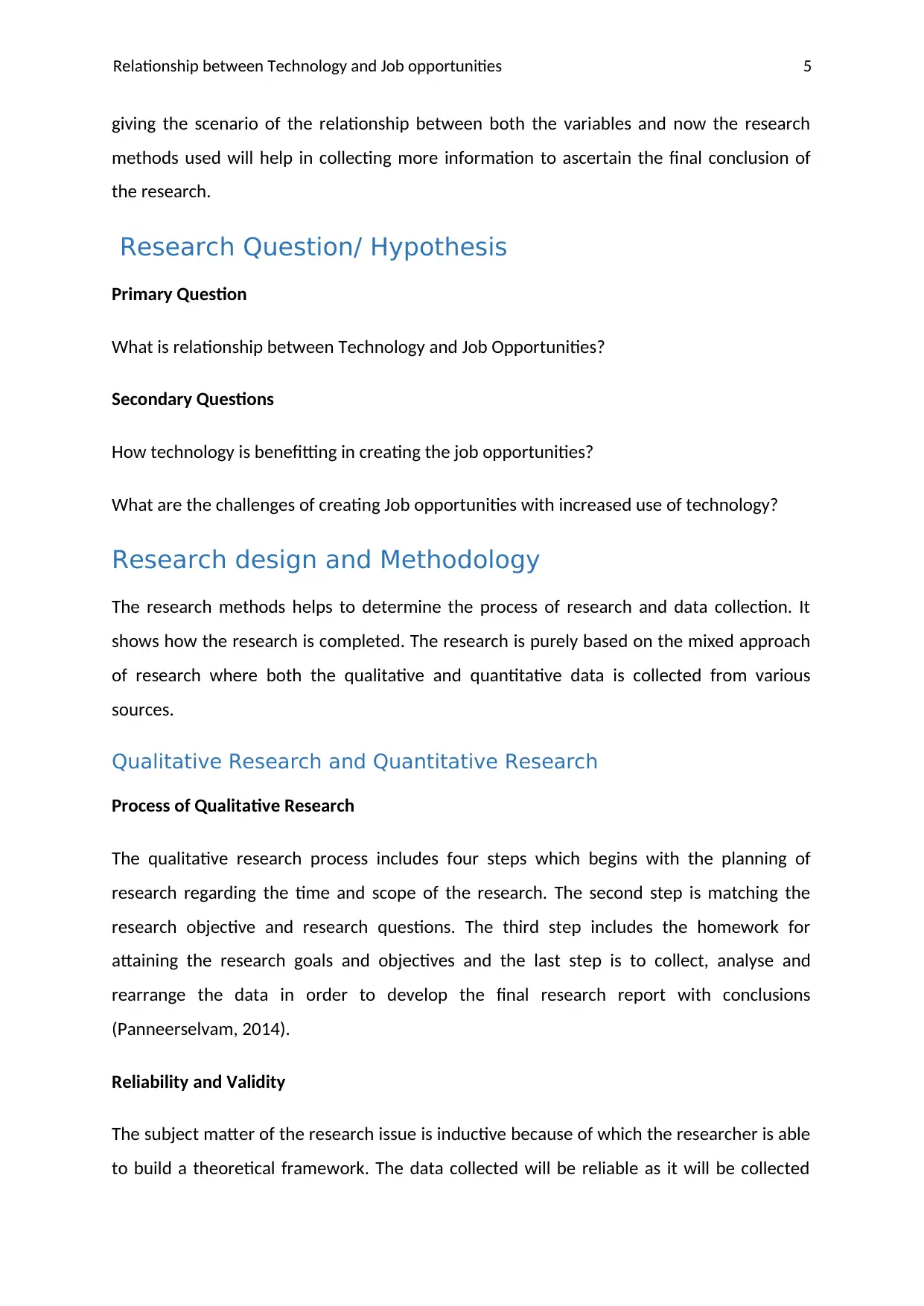
Research Question/ Hypothesis
Primary Question
What is relationship between Technology and Job Opportunities?
Secondary Questions
How technology is benefitting in creating the job opportunities?
What are the challenges of creating Job opportunities with increased use of technology?
Research design and Methodology
The research methods helps to determine the process of research and data collection. It
shows how the research is completed. The research is purely based on the mixed approach
of research where both the qualitative and quantitative data is collected from various
sources.
Qualitative Research and Quantitative Research
Process of Qualitative Research
The qualitative research process includes four steps which begins with the planning of
research regarding the time and scope of the research. The second step is matching the
research objective and research questions. The third step includes the homework for
attaining the research goals and objectives and the last step is to collect, analyse and
rearrange the data in order to develop the final research report with conclusions
(Panneerselvam, 2014).
Reliability and Validity
The subject matter of the research issue is inductive because of which the researcher is able
to build a theoretical framework. The data collected will be reliable as it will be collected
giving the scenario of the relationship between both the variables and now the research
methods used will help in collecting more information to ascertain the final conclusion of
the research.
Research Question/ Hypothesis
Primary Question
What is relationship between Technology and Job Opportunities?
Secondary Questions
How technology is benefitting in creating the job opportunities?
What are the challenges of creating Job opportunities with increased use of technology?
Research design and Methodology
The research methods helps to determine the process of research and data collection. It
shows how the research is completed. The research is purely based on the mixed approach
of research where both the qualitative and quantitative data is collected from various
sources.
Qualitative Research and Quantitative Research
Process of Qualitative Research
The qualitative research process includes four steps which begins with the planning of
research regarding the time and scope of the research. The second step is matching the
research objective and research questions. The third step includes the homework for
attaining the research goals and objectives and the last step is to collect, analyse and
rearrange the data in order to develop the final research report with conclusions
(Panneerselvam, 2014).
Reliability and Validity
The subject matter of the research issue is inductive because of which the researcher is able
to build a theoretical framework. The data collected will be reliable as it will be collected
⊘ This is a preview!⊘
Do you want full access?
Subscribe today to unlock all pages.
Trusted by 1+ million students worldwide

Relationship between Technology and Job opportunities 6
from the genuine sources and from the ones which are recently published so that no
outdated data forms the base of the research.
from the genuine sources and from the ones which are recently published so that no
outdated data forms the base of the research.
Paraphrase This Document
Need a fresh take? Get an instant paraphrase of this document with our AI Paraphraser
Relationship between Technology and Job opportunities 7
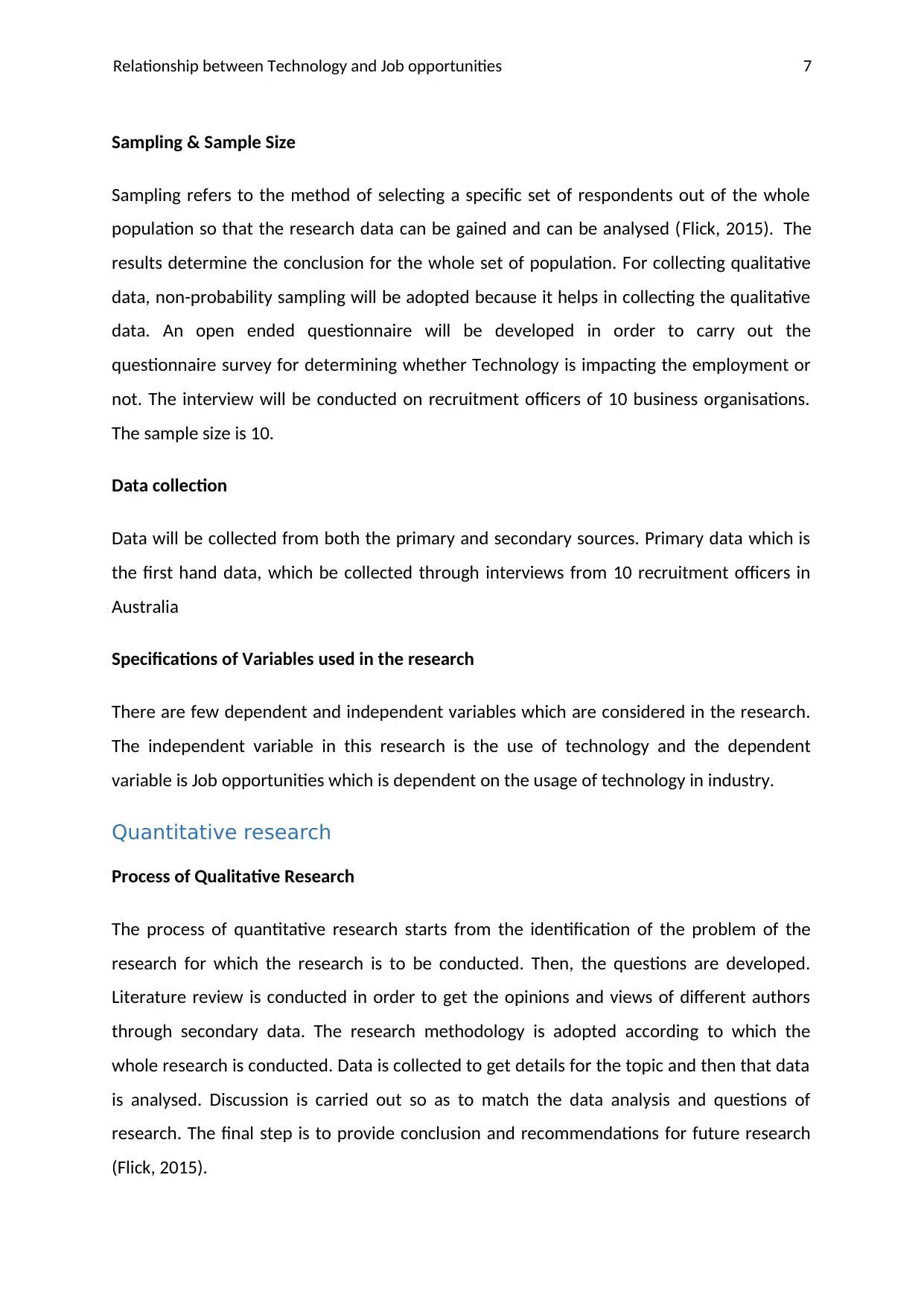
Sampling & Sample Size
Sampling refers to the method of selecting a specific set of respondents out of the whole
population so that the research data can be gained and can be analysed (Flick, 2015). The
results determine the conclusion for the whole set of population. For collecting qualitative
data, non-probability sampling will be adopted because it helps in collecting the qualitative
data. An open ended questionnaire will be developed in order to carry out the
questionnaire survey for determining whether Technology is impacting the employment or
not. The interview will be conducted on recruitment officers of 10 business organisations.
The sample size is 10.
Data collection
Data will be collected from both the primary and secondary sources. Primary data which is
the first hand data, which be collected through interviews from 10 recruitment officers in
Australia
Specifications of Variables used in the research
There are few dependent and independent variables which are considered in the research.
The independent variable in this research is the use of technology and the dependent
variable is Job opportunities which is dependent on the usage of technology in industry.
Quantitative research
Process of Qualitative Research
The process of quantitative research starts from the identification of the problem of the
research for which the research is to be conducted. Then, the questions are developed.
Literature review is conducted in order to get the opinions and views of different authors
through secondary data. The research methodology is adopted according to which the
whole research is conducted. Data is collected to get details for the topic and then that data
is analysed. Discussion is carried out so as to match the data analysis and questions of
research. The final step is to provide conclusion and recommendations for future research
(Flick, 2015).
Sampling & Sample Size
Sampling refers to the method of selecting a specific set of respondents out of the whole
population so that the research data can be gained and can be analysed (Flick, 2015). The
results determine the conclusion for the whole set of population. For collecting qualitative
data, non-probability sampling will be adopted because it helps in collecting the qualitative
data. An open ended questionnaire will be developed in order to carry out the
questionnaire survey for determining whether Technology is impacting the employment or
not. The interview will be conducted on recruitment officers of 10 business organisations.
The sample size is 10.
Data collection
Data will be collected from both the primary and secondary sources. Primary data which is
the first hand data, which be collected through interviews from 10 recruitment officers in
Australia
Specifications of Variables used in the research
There are few dependent and independent variables which are considered in the research.
The independent variable in this research is the use of technology and the dependent
variable is Job opportunities which is dependent on the usage of technology in industry.
Quantitative research
Process of Qualitative Research
The process of quantitative research starts from the identification of the problem of the
research for which the research is to be conducted. Then, the questions are developed.
Literature review is conducted in order to get the opinions and views of different authors
through secondary data. The research methodology is adopted according to which the
whole research is conducted. Data is collected to get details for the topic and then that data
is analysed. Discussion is carried out so as to match the data analysis and questions of
research. The final step is to provide conclusion and recommendations for future research
(Flick, 2015).

Relationship between Technology and Job opportunities 8
⊘ This is a preview!⊘
Do you want full access?
Subscribe today to unlock all pages.
Trusted by 1+ million students worldwide
Relationship between Technology and Job opportunities 9
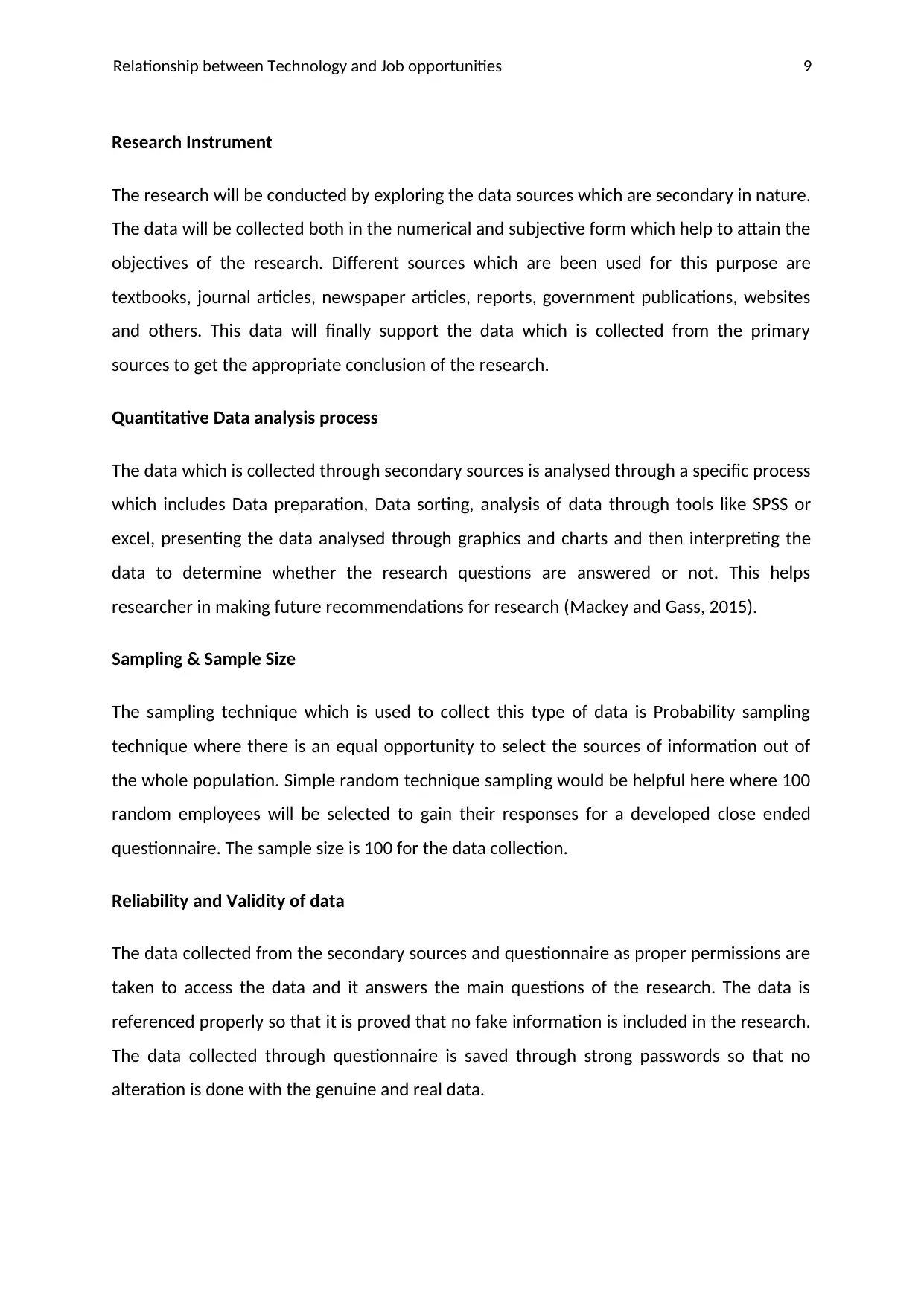
Research Instrument
The research will be conducted by exploring the data sources which are secondary in nature.
The data will be collected both in the numerical and subjective form which help to attain the
objectives of the research. Different sources which are been used for this purpose are
textbooks, journal articles, newspaper articles, reports, government publications, websites
and others. This data will finally support the data which is collected from the primary
sources to get the appropriate conclusion of the research.
Quantitative Data analysis process
The data which is collected through secondary sources is analysed through a specific process
which includes Data preparation, Data sorting, analysis of data through tools like SPSS or
excel, presenting the data analysed through graphics and charts and then interpreting the
data to determine whether the research questions are answered or not. This helps
researcher in making future recommendations for research (Mackey and Gass, 2015).
Sampling & Sample Size
The sampling technique which is used to collect this type of data is Probability sampling
technique where there is an equal opportunity to select the sources of information out of
the whole population. Simple random technique sampling would be helpful here where 100
random employees will be selected to gain their responses for a developed close ended
questionnaire. The sample size is 100 for the data collection.
Reliability and Validity of data
The data collected from the secondary sources and questionnaire as proper permissions are
taken to access the data and it answers the main questions of the research. The data is
referenced properly so that it is proved that no fake information is included in the research.
The data collected through questionnaire is saved through strong passwords so that no
alteration is done with the genuine and real data.
Research Instrument
The research will be conducted by exploring the data sources which are secondary in nature.
The data will be collected both in the numerical and subjective form which help to attain the
objectives of the research. Different sources which are been used for this purpose are
textbooks, journal articles, newspaper articles, reports, government publications, websites
and others. This data will finally support the data which is collected from the primary
sources to get the appropriate conclusion of the research.
Quantitative Data analysis process
The data which is collected through secondary sources is analysed through a specific process
which includes Data preparation, Data sorting, analysis of data through tools like SPSS or
excel, presenting the data analysed through graphics and charts and then interpreting the
data to determine whether the research questions are answered or not. This helps
researcher in making future recommendations for research (Mackey and Gass, 2015).
Sampling & Sample Size
The sampling technique which is used to collect this type of data is Probability sampling
technique where there is an equal opportunity to select the sources of information out of
the whole population. Simple random technique sampling would be helpful here where 100
random employees will be selected to gain their responses for a developed close ended
questionnaire. The sample size is 100 for the data collection.
Reliability and Validity of data
The data collected from the secondary sources and questionnaire as proper permissions are
taken to access the data and it answers the main questions of the research. The data is
referenced properly so that it is proved that no fake information is included in the research.
The data collected through questionnaire is saved through strong passwords so that no
alteration is done with the genuine and real data.
Paraphrase This Document
Need a fresh take? Get an instant paraphrase of this document with our AI Paraphraser
Relationship between Technology and Job opportunities
10
Data collection
Data collection is done through Primary and secondary sources. It is done in order to get
sufficient information to meet the research objectives. Primary sources of data used in the
research are interview and survey questionnaire and secondary data sources used for the
research are published journals, articles, books, reports and websites.
Research Limitation
There are certain limitations of the research. It is complex for the researcher to collect data
from so many sources and then to integrate them. There was a limitation of funds and of
resources. The sample size was taken minimum as time was limited and for the simpler
interpretation of data collected. It was also a challenge to maintain the confidentiality and
privacy of data collected from the respondents of questionnaire and interview.
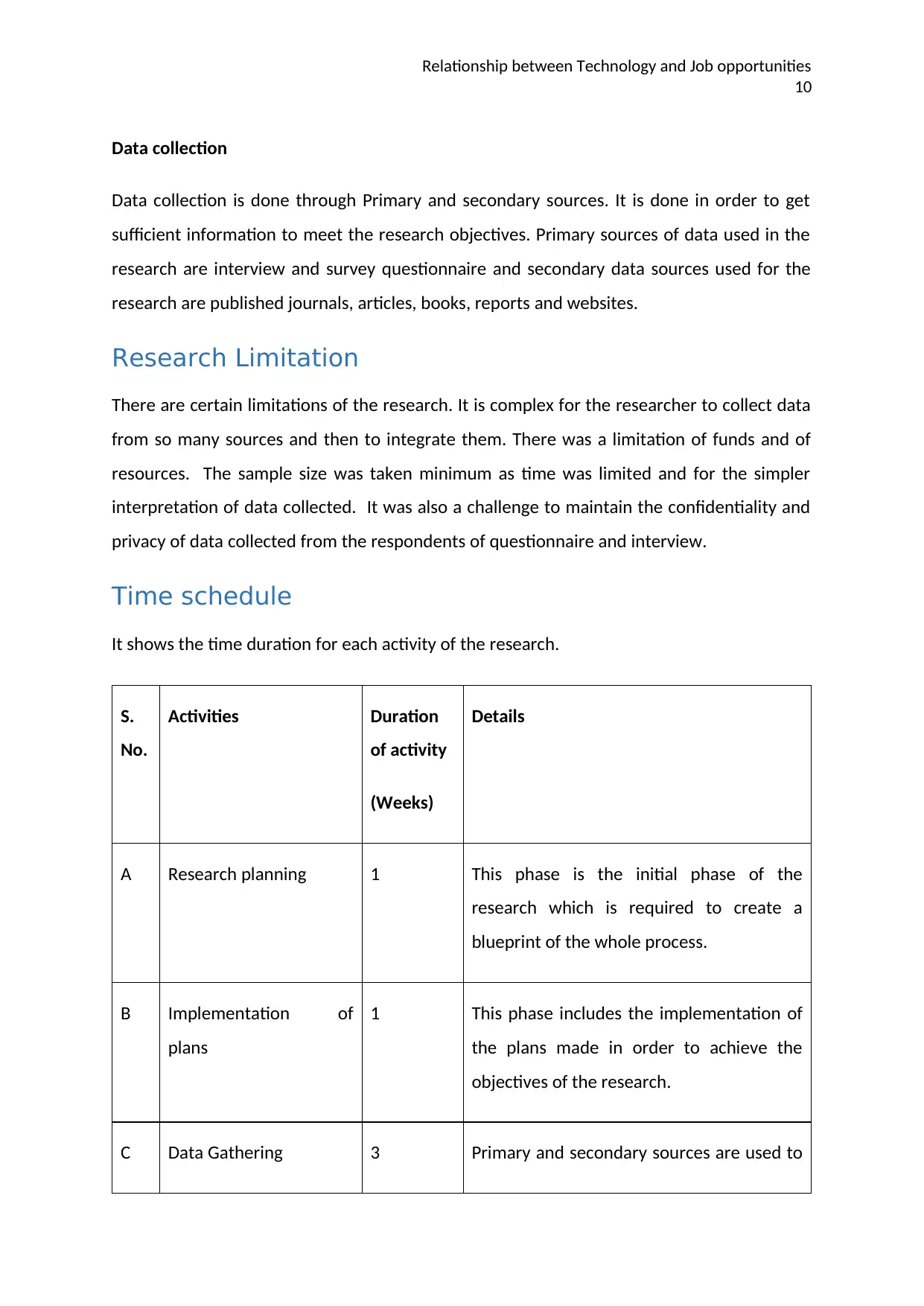
Time schedule
It shows the time duration for each activity of the research.
S.
No.
Activities Duration
of activity
(Weeks)
Details
A Research planning 1 This phase is the initial phase of the
research which is required to create a
blueprint of the whole process.
B Implementation of
plans
1 This phase includes the implementation of
the plans made in order to achieve the
objectives of the research.
C Data Gathering 3 Primary and secondary sources are used to
10
Data collection
Data collection is done through Primary and secondary sources. It is done in order to get
sufficient information to meet the research objectives. Primary sources of data used in the
research are interview and survey questionnaire and secondary data sources used for the
research are published journals, articles, books, reports and websites.
Research Limitation
There are certain limitations of the research. It is complex for the researcher to collect data
from so many sources and then to integrate them. There was a limitation of funds and of
resources. The sample size was taken minimum as time was limited and for the simpler
interpretation of data collected. It was also a challenge to maintain the confidentiality and
privacy of data collected from the respondents of questionnaire and interview.
Time schedule
It shows the time duration for each activity of the research.
S.
No.
Activities Duration
of activity
(Weeks)
Details
A Research planning 1 This phase is the initial phase of the
research which is required to create a
blueprint of the whole process.
B Implementation of
plans
1 This phase includes the implementation of
the plans made in order to achieve the
objectives of the research.
C Data Gathering 3 Primary and secondary sources are used to
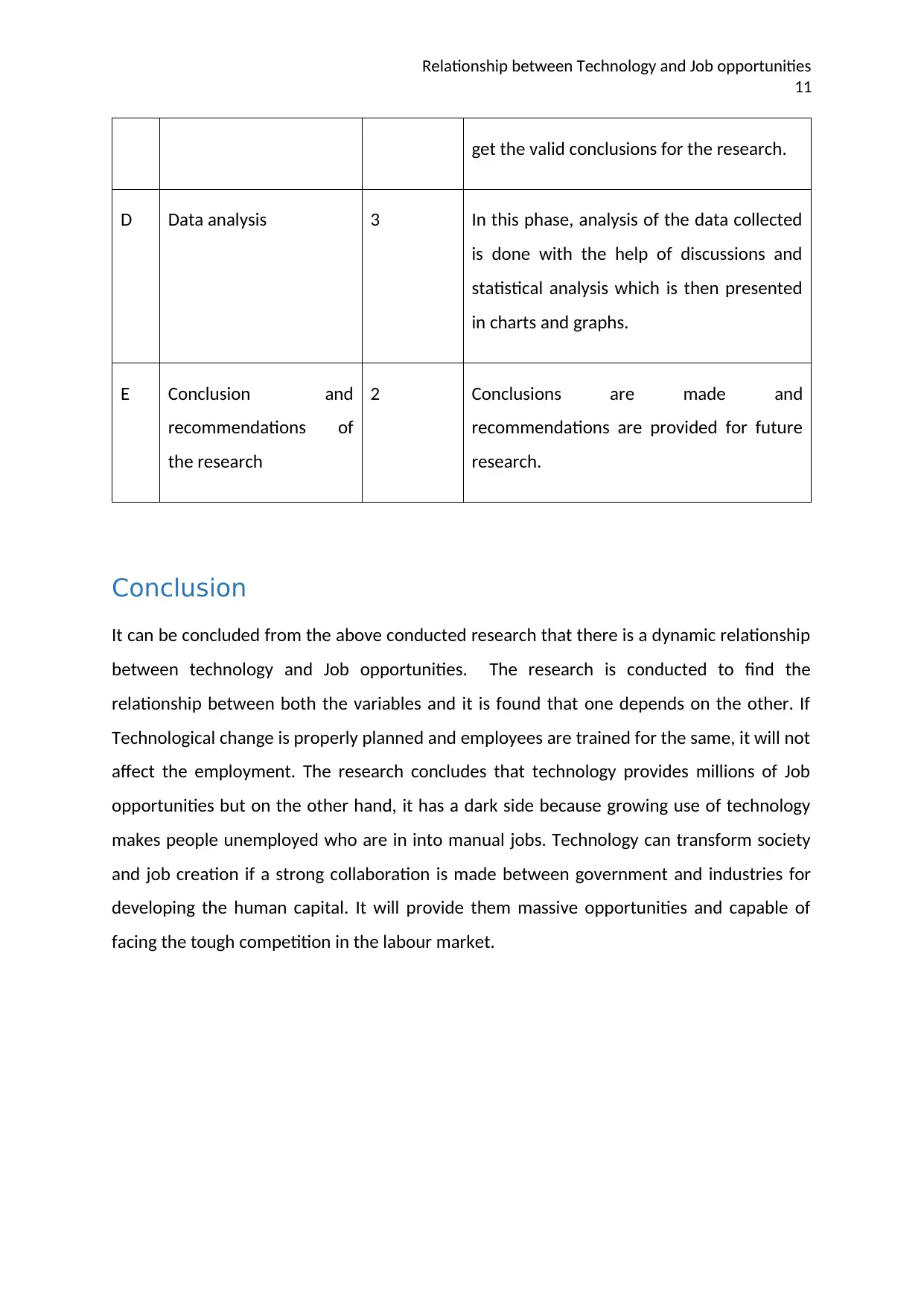
Relationship between Technology and Job opportunities
11
get the valid conclusions for the research.
D Data analysis 3 In this phase, analysis of the data collected
is done with the help of discussions and
statistical analysis which is then presented
in charts and graphs.
E Conclusion and
recommendations of
the research
2 Conclusions are made and
recommendations are provided for future
research.
Conclusion
It can be concluded from the above conducted research that there is a dynamic relationship
between technology and Job opportunities. The research is conducted to find the
relationship between both the variables and it is found that one depends on the other. If
Technological change is properly planned and employees are trained for the same, it will not
affect the employment. The research concludes that technology provides millions of Job
opportunities but on the other hand, it has a dark side because growing use of technology
makes people unemployed who are in into manual jobs. Technology can transform society
and job creation if a strong collaboration is made between government and industries for
developing the human capital. It will provide them massive opportunities and capable of
facing the tough competition in the labour market.
11
get the valid conclusions for the research.
D Data analysis 3 In this phase, analysis of the data collected
is done with the help of discussions and
statistical analysis which is then presented
in charts and graphs.
E Conclusion and
recommendations of
the research
2 Conclusions are made and
recommendations are provided for future
research.
Conclusion
It can be concluded from the above conducted research that there is a dynamic relationship
between technology and Job opportunities. The research is conducted to find the
relationship between both the variables and it is found that one depends on the other. If
Technological change is properly planned and employees are trained for the same, it will not
affect the employment. The research concludes that technology provides millions of Job
opportunities but on the other hand, it has a dark side because growing use of technology
makes people unemployed who are in into manual jobs. Technology can transform society
and job creation if a strong collaboration is made between government and industries for
developing the human capital. It will provide them massive opportunities and capable of
facing the tough competition in the labour market.
⊘ This is a preview!⊘
Do you want full access?
Subscribe today to unlock all pages.
Trusted by 1+ million students worldwide

1 out of 15


Related Documents


Your All-in-One AI-Powered Toolkit for Academic Success.
+13062052269
info@desklib.com
Available 24*7 on WhatsApp / Email
![[object Object]](/_next/static/media/star-bottom.7253800d.svg)
Unlock your academic potential
Copyright © 2020–2026 A2Z Services. All Rights Reserved. Developed and managed by ZUCOL.